

Low Akkermansia is not a clinical diagnosis and doesn't produce a unique symptom pattern. It may appear alongside nonspecific gut discomfort, metabolic or inflammatory patterns, or a stool test showing reduced relative abundance.
You might be reading this after another uncomfortable meal, an unpredictable bowel movement, or a microbiome report with Akkermansia flagged low. When bloating and fatigue keep interrupting your day, finding a named organism can feel like finally finding an explanation.
The useful next step isn't to assume you've identified the culprit. It's to understand what that finding can tell you, what it can't, and how to choose digestive support without treating a supplement as a diagnosis.
Table of Contents
- What Low Akkermansia Actually Means
- The Role of Akkermansia in the Mucus Layer and Gut Barrier
- Digestive and Gut Symptoms Linked with Reduced Akkermansia
- Metabolic and Inflammatory Patterns That Travel with Low Akkermansia
- Why Low Akkermansia Is Not the Same Story in Every IBS Subtype
- How to Test and Interpret Akkermansia Levels
- What Depletes Akkermansia and How to Support It
- Probiotic, Synbiotic, and Next-Generation Akkermansia Supplements
What Low Akkermansia Actually Means
You're bloated after lunch, tired in the afternoon, and never quite sure what your bowel habits will do next. A stool report identifies low Akkermansia muciniphila, and suddenly those complaints seem connected. That connection is worth exploring, but it isn't proof that this organism caused them.
A. muciniphila is a mucus-associated gut bacterium, not a disease label. Researchers study it because of its relationship with the intestinal lining and metabolic health. A low result describes a microbiome finding, whereas a diagnosis requires an appropriate clinical evaluation.
Low Akkermansia at a Glance
| Question | Short Answer |
|---|---|
| Is low Akkermansia a diagnosed illness? | No. It's a microbiome-associated finding. |
| Can symptoms identify it? | No symptom or combination of symptoms is distinctive enough. |
| Does a low result explain bloating? | It may be relevant, but it doesn't establish the cause. |
| Is more always better? | A result needs context rather than a simple higher-is-better interpretation. |
| What should accompany the report? | Symptom history, diet and medication review, and appropriate medical assessment. |
Think of the report as a clue that changes your questions, not an answer that ends the investigation. When did the discomfort start? Does it happen after particular meals? Did it begin around a medication change? Are there persistent bowel changes or concerns about glucose regulation?
Those details help distinguish a potentially meaningful pattern from a result that has little bearing on your current symptoms.
Practical rule: Don't choose treatment solely because a microbiome report highlights one organism.
Searching for symptoms of low Akkermansia is understandable, but a symptom checklist can create false certainty. The more useful approach is to connect the report with what's happening in your body, then decide whether the immediate priority is digestive evaluation, metabolic testing, or a carefully chosen support routine.
The Role of Akkermansia in the Mucus Layer and Gut Barrier
Akkermansia lives in the intestinal mucus layer and uses mucin, a component of mucus, as a nutrient source. That can sound contradictory: why would a bacterium that consumes mucus be considered relevant to barrier support?
A mucus gardener is a helpful analogy. The gardener works within a living environment rather than stripping it away. Likewise, researchers investigate Akkermansia's interaction with intestinal cells and mucus-layer maintenance, not just its ability to feed on mucin.
The illustration makes that relationship easier to visualize.

How the barrier connection works
The mucus layer and the cells beneath it help separate gut contents from underlying tissue. Tight-junction proteins, including zonula occludens-1 and occludin, are part of the connections between neighboring intestinal cells. Akkermansia is associated with these barrier-related systems.
Reduced abundance may coincide with weaker mucus-layer support, increased permeability, and immune activation. Its mucin fermentation also contributes to short-chain-fatty-acid activity, including pathways involving butyrate, which nourishes colon cells and helps regulate inflammation. These mechanisms and the limits of symptom-based interpretation are discussed in the review of Akkermansia and intestinal barrier function.
That's a plausible biological explanation, not a direct measurement of your intestinal lining. A low stool result doesn't tell you whether your tight junctions are impaired or whether barrier changes explain your discomfort.
For plain-language context, the guide to intestinal permeability can help distinguish the underlying concept from broad “leaky gut” claims.
- Mechanism: Researchers have reasons to investigate Akkermansia's role in barrier maintenance.
- Clinical interpretation: Those mechanisms don't establish an individual diagnosis.
- Buying implication: “Gut barrier support” on a supplement label shouldn't be read as proof that it repairs a demonstrated defect.
Digestive and Gut Symptoms Linked with Reduced Akkermansia
Bloating, abdominal discomfort, altered stool consistency, perceived food sensitivity, and diarrhea can fit a broader pattern in which Akkermansia is reduced. None identifies low Akkermansia by itself. The barrier mechanisms described earlier explain why researchers consider a connection plausible, but they don't turn ordinary digestive complaints into a specific bacterial deficiency.
The most useful distinction is between what you feel and what caused it. Abdominal pressure is an experience you can describe reliably. Whether it reflects a food trigger, a bowel-pattern problem, or another issue requires a different kind of assessment.
Read the symptom without jumping to the cause
| What you notice | What to record | What not to conclude |
|---|---|---|
| Bloating or gas after meals | Foods, timing, portion changes, and accompanying discomfort | That low Akkermansia is responsible |
| Loose or inconsistent stools | Persistence, urgency, and changes from your usual pattern | That a microbiome supplement is the only relevant option |
| Discomfort with particular foods | Whether the reaction repeats under similar circumstances | That you have a newly diagnosed food intolerance |
| Constipation or alternating habits | Your overall bowel pattern and medication history | That increasing Akkermansia will normalize it |
For example, someone who mainly feels uncomfortable after dairy needs a different conversation from someone whose bowel habits have changed regardless of what they eat. These are illustrative situations, not evidence that a particular food or diagnosis explains either person's symptoms.
Bring those distinctions to a clinician rather than trying to infer the cause from a report. Ask whether diet, stress, medication effects, motility concerns, or conditions such as SIBO need consideration. Don't self-diagnose an alternative condition either.
A symptom can be real and disruptive even when a microbiome result doesn't explain it.
For purchase decisions, start with the actual use case. A probiotic for bloating, a probiotic for constipation, and digestive enzymes for bloating after eating aren't interchangeable promises. A low Akkermansia finding may influence the discussion, but it shouldn't replace a clear understanding of the problem you're trying to address.
Metabolic and Inflammatory Patterns That Travel with Low Akkermansia
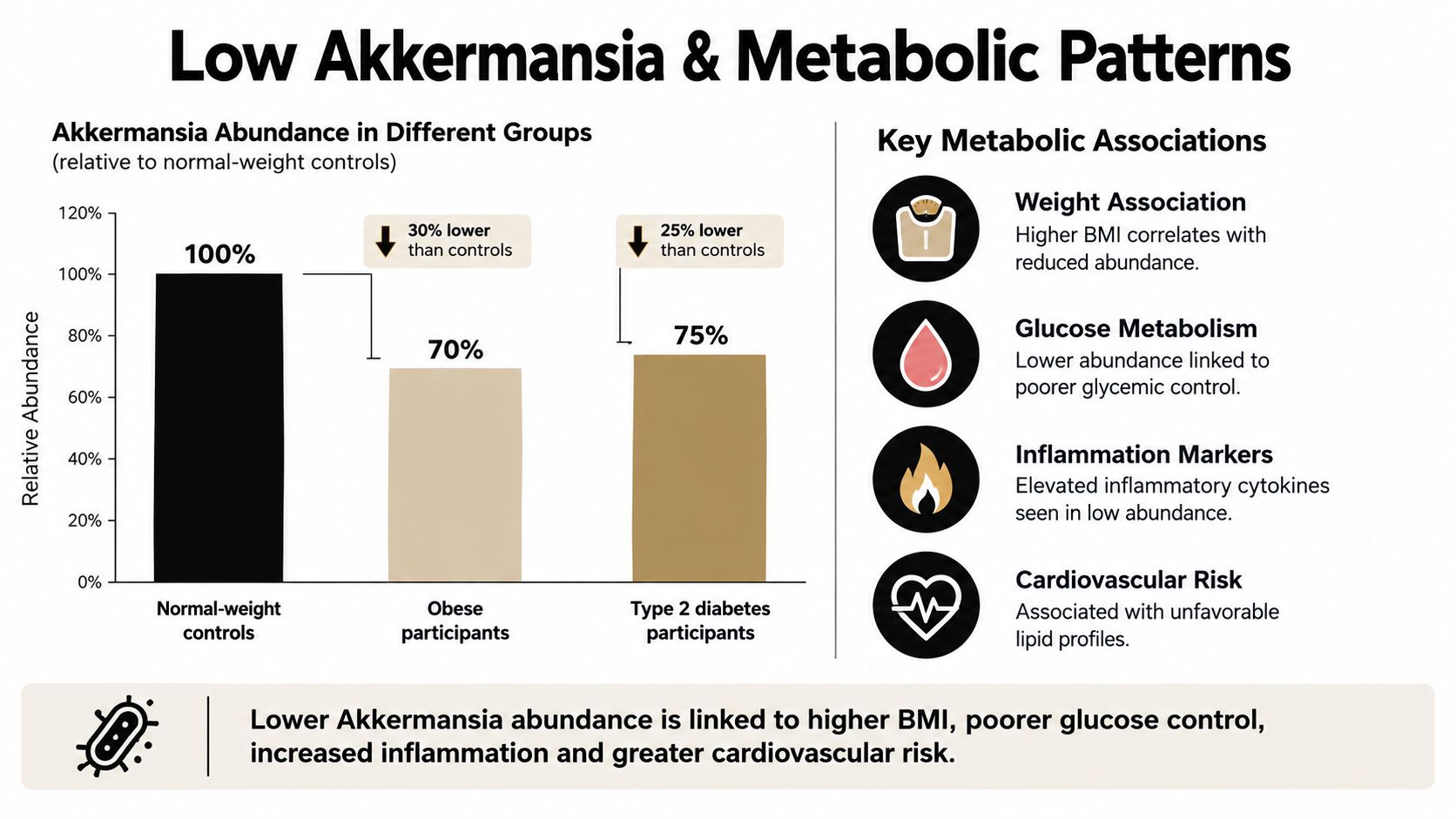
Some people encounter Akkermansia research because of weight or glucose concerns, not digestive discomfort. Lower abundance has been associated with obesity, insulin resistance, type 2 diabetes, metabolic inflammation, and inflammatory bowel disease. These are associations across human and preclinical literature, not evidence that low Akkermansia caused a person's condition.
The visual below introduces these categories. Its percentage comparisons should not be treated as established clinical benchmarks; the specific population results discussed underneath are the relevant numerical evidence.
What the population findings actually show
In a population-based study, median stool Akkermansia relative abundance was 0.08%, with an interquartile range of 0.006% to 0.93%, and it was undetectable in 17.6% of participants. Participants with obesity had a median abundance of 0.043%, compared with 0.088% in normal-weight participants, with P < 0.001; the population study of Akkermansia and obesity also reported an inverse association after accounting for factors including diet and country.
Those findings describe groups. They don't provide a target percentage for your stool report or prove that raising your abundance will produce weight loss.
Fatigue, post-meal discomfort, or difficulty managing weight and glucose may coexist with a metabolic-inflammatory pattern. A review of Akkermansia's metabolic and inflammatory associations emphasizes that strain variation, limited human intervention evidence, and uncertain causality constrain interpretation.
- Weight concerns: Discuss the overall pattern rather than blaming a bacterium.
- Glucose concerns: Prioritize standard testing such as glucose or HbA1c.
- Inflammatory concerns: Ask whether markers or further investigation are clinically indicated.
The guide to blood sugar support offers related educational context, but a stool percentage can't substitute for medical testing.
A video resource is also available for readers who prefer an audiovisual explanation.
Why Low Akkermansia Is Not the Same Story in Every IBS Subtype
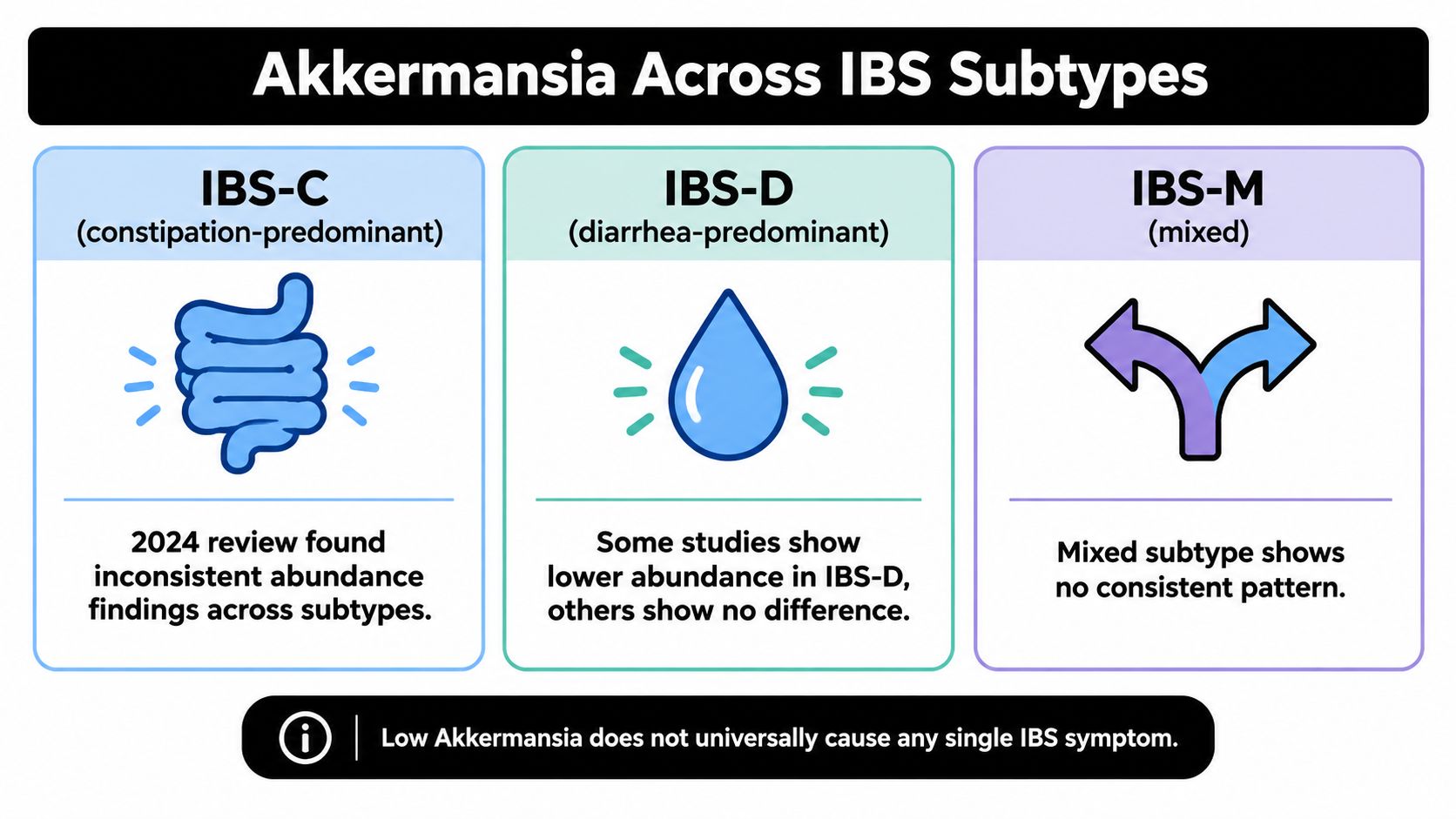
Constipation and diarrhea shouldn't be grouped together as interchangeable evidence of low Akkermansia. Findings across irritable bowel syndrome subtypes are inconsistent, and the population being studied matters.
A 2024 review describes a 2012 study that found significantly reduced fecal Akkermansia in children with diarrhea-predominant IBS. The same review of Akkermansia across IBS research reports that several studies found increased abundance in constipation-predominant IBS, while others found lower abundance than in healthy controls.
The comparison visual highlights the need to distinguish subtypes, but its summaries shouldn't be interpreted as a definitive finding for every group.
Compare the evidence with your situation
| Research context | Supported interpretation | Important limit |
|---|---|---|
| Children with diarrhea-predominant IBS | Reduced abundance was reported in a particular study | It doesn't establish the same pattern in adults |
| Constipation-predominant IBS | Both increased and decreased abundance have been reported | Low abundance isn't a universal constipation explanation |
| Alternating bowel complaints | Symptoms require their own clinical context | The findings above don't establish a rule for mixed symptoms |
Age, diet, medication use, testing method, and the surrounding microbiome can affect how a result should be understood. A study in children with diarrhea-predominant IBS can't automatically guide a supplement choice for an adult with constipation.
This matters when comparing a probiotic for diarrhea with a daily probiotic for regularity. The same ingredient name on both labels doesn't prove that the formulas address the same need, and neither should be selected solely because a stool report says Akkermansia is low.
Before buying, identify the dominant bowel pattern and whether it has been medically assessed. Then look for evidence relevant to that use case rather than evidence that merely mentions IBS or Akkermansia somewhere in the discussion.
How to Test and Interpret Akkermansia Levels
A stool microbiome report may present Akkermansia as a percentage, a flag, or a detectable-versus-undetectable finding. Relative abundance describes its share of the measured microbial community. It isn't a direct reading of the organism's activity, the condition of your mucus layer, or the cause of your symptoms.
An undetectable result means the assay didn't detect it in that sample under its testing conditions. Don't automatically translate that into complete absence throughout your gut.
Questions to ask the laboratory or provider
- Assay validation: Has the method been validated for measuring the organism reported?
- Testing approach: Does the laboratory use 16S sequencing, shotgun sequencing, or another approach, and what can that method resolve?
- Reference interpretation: What comparison population supports the laboratory's flag?
- Detection limits: What does “undetectable” mean for this particular test?
- Clinical usefulness: Would the result change your care or supplement decision?
These questions are more useful than assuming every microbiome panel measures the same thing. Don't infer that one testing method is automatically superior without understanding the assay's validation and intended use.
Put ordinary medical evaluation first when needed
Persistent bowel changes deserve a diagnostic discussion. Blood in the stool, rapid unexplained weight change, or new metabolic concerns are reasons to involve a clinician rather than begin with an online supplement purchase.
Depending on your history, the more actionable next step may be glucose or HbA1c testing, inflammatory markers when indicated, or evaluation of ongoing bowel symptoms. Bring your medication list and a description of your usual diet alongside the microbiome report.
Before paying for a test: Ask what you'll do differently if the result is low, normal, or undetectable.
Testing has the greatest practical value when it helps answer a specific question. If your plan would be identical regardless of the result, reconsider whether a microbiome panel is the best first use of your time and money.
What Depletes Akkermansia and How to Support It
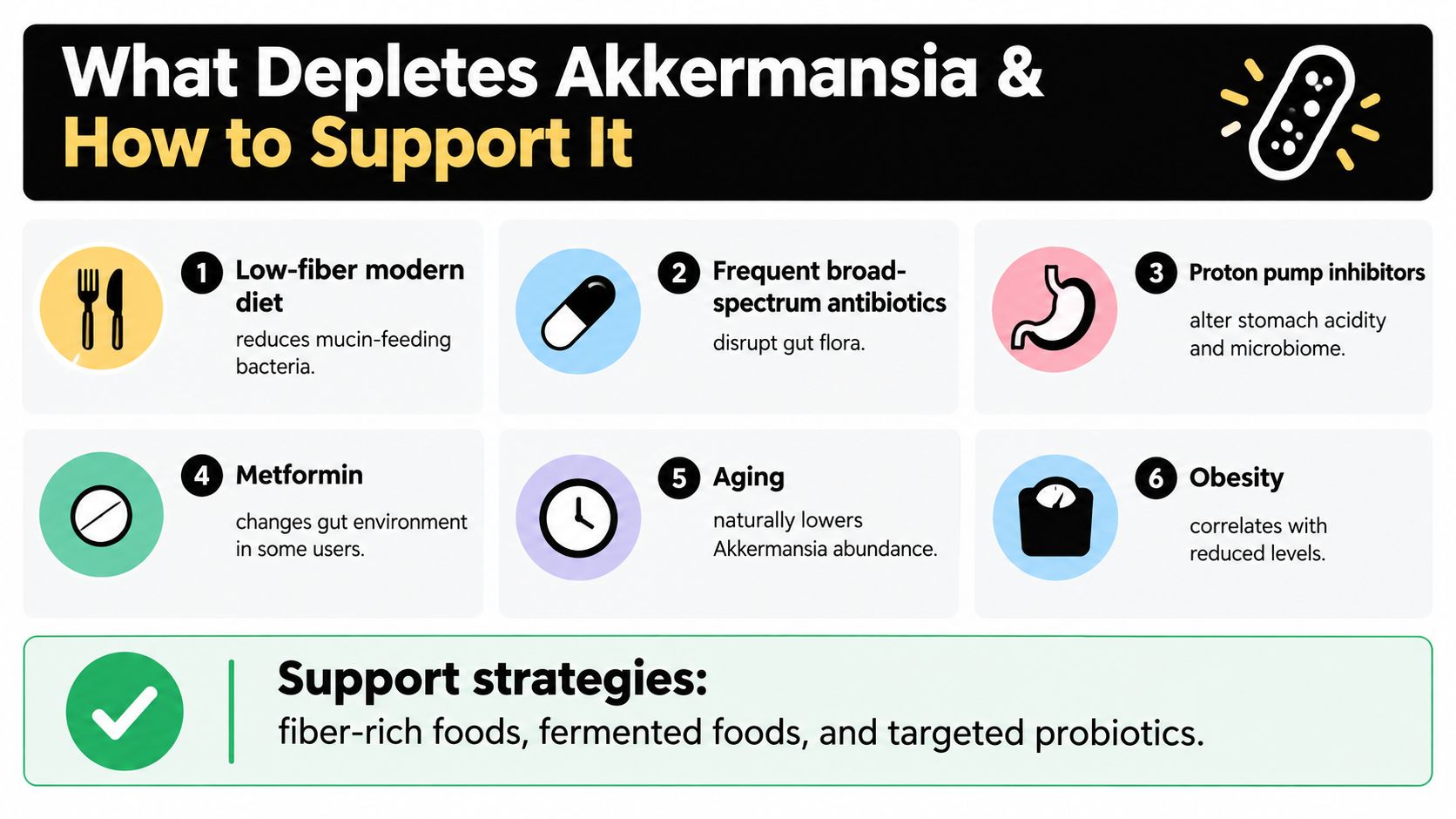
Finding low Akkermansia doesn't identify what reduced it. Diet, medication history, age, and illness are useful topics to review, but a stool result can't establish the direction of cause and effect.
The checklist below names commonly discussed factors. Treat it as a conversation starter, not proof that every listed factor lowers Akkermansia in every person, particularly the categorical medication and aging statements.
Review before you change anything
Discuss antibiotics, proton pump inhibitors, metformin, and other medications with the prescribing clinician. Don't stop necessary medication to change a microbiome result. Obesity and inflammatory or metabolic conditions belong in that review too, but the associations already described don't establish a depletion pathway for an individual.
For food choices, distinguish an overall nutrition plan from an organism-specific promise. Berries, pomegranate, green tea, fermented foods, and fiber-rich foods are options to discuss according to your preferences and tolerance. The evidence summarized here doesn't establish that a particular serving or routine will reliably raise your Akkermansia.
- Food variety: Consider practical additions rather than a restrictive “repair” diet.
- Prebiotic ingredients: Ask about inulin, FOS, or resistant starch before stacking several supplements.
- Lifestyle: Discuss manageable activity and routines alongside diet, without treating them as proven Akkermansia treatments.
- Symptom tracking: Record whether a change helps your actual discomfort, not just whether it sounds microbiome-friendly.
For related reading, how to increase Akkermansia muciniphila can help you organize questions about support strategies. Tecton Ketones™ also offers a broader resource on how to heal your gut naturally; use it for ideas to discuss, not as a promise of healing or a replacement for diagnosis.
Choose a manageable change and reassess. Starting a complicated supplement stack makes it harder to tell what helps, what doesn't, and what might be worsening your symptoms.
Probiotic, Synbiotic, and Next-Generation Akkermansia Supplements
Shopping for a probiotic with Akkermansia requires more than finding the organism's name on an Amazon listing. You'll encounter conventional multi-strain probiotics, probiotic-and-prebiotic combinations, and pasteurized Akkermansia preparations. These formats shouldn't be treated as interchangeable.
A high CFU count describes a formulation characteristic, not proof that it will relieve your bloating or correct a stool result. Look for evidence that matches the preparation, intended use, and people studied.
Compare formulation before potency
| Option | What to examine | What not to assume |
|---|---|---|
| Standard multi-strain probiotic | Named strains and evidence relevant to your goal | That it contains Akkermansia |
| Akkermansia-containing probiotic | Organism identification, preparation, and quality documentation | That it will establish lasting colonization |
| Synbiotic-style blend | Probiotic ingredients, prebiotic components, and rationale | That combining ingredients proves better outcomes |
| Pasteurized Akkermansia | Evidence for the specific preparation | That it works identically to a live product |
| Digestive enzyme supplement | Ingredients matched to meal-related concerns | That it addresses low bacterial abundance |
Human supplementation research provides a cautious benchmark. A 2019 randomized, double-blind, placebo-controlled pilot study enrolled 40 overweight or obese insulin-resistant adults, with 32 completing the trial; participants received 10^10 bacteria daily in live or pasteurized form for three months, as summarized in Akkermansia supplementation research resources.
Both preparations were reported as safe and well tolerated, and investigators assessed barrier-related plasma lipopolysaccharides alongside metabolic outcomes. That small trial doesn't prove that every retail Akkermansia supplement repairs the gut barrier or treats digestive complaints.
For a broader buying conversation, REVETIX's guide to choosing probiotics and enzymes is a related resource. Keep the central distinction clear: meal-specific support and microbiome-focused support are different purchasing goals.
What to request before ordering
Compare strain verification, third-party testing, and downloadable Certificates of Analysis. Ask whether documentation covers the finished product and the relevant batch, rather than relying on an unsupported quality badge.
For an enteric-coated, delayed-release, or shelf-stable probiotic, request evidence supporting that delivery or storage claim. Also verify capsule count, serving directions, prebiotic and postbiotic ingredients, and vegan, non-GMO, or manufacturing claims when those factors matter to you.
One catalog option is GutRx COMPLETE, described as a high-potency probiotic and prebiotic blend with 62B CFUs and Akkermansia muciniphila. Its stated SIBO, digestion, and immune-support positioning isn't evidence that it diagnoses or treats the cause of your symptoms.
The product image can help you identify the formula while comparing its label and documentation.

Choose a next step you can evaluate
- Match symptoms to evaluation. Persistent bowel changes or alarm features come before supplement experimentation.
- Decide which test answers your question. Metabolic concerns may call for standard labs before microbiome testing.
- Keep the intervention manageable. Choose a limited change with a clear goal, such as better meal comfort or more predictable bowel habits.
There isn't an established personal restoration timeline in the evidence discussed here. Judge progress with your clinician using symptoms and appropriate clinical measures, not an assumed deadline for rebuilding Akkermansia.
GutRx offers probiotic and prebiotic digestive-support options, including an Akkermansia-containing formula for readers comparing microbiome-focused supplements. Visit GutRx to review ingredients and product information, and bring your symptoms and any stool results to your clinician before choosing a formula.


