

The most popular advice about a women's probiotic is too broad. A bottle can promise gut support, vaginal balance, urinary support, and “overall wellness,” but the evidence doesn't work that way, because probiotic benefits are strain-specific, route-specific, and condition-specific. If you want a useful probiotic for women benefits article, the right question isn't whether probiotics “work.” It's which benefit has real trial support, and which one is marketing expansion.
Table of Contents
- What Women's Probiotics Actually Promise
- The Female Microbiome and How Probiotics Work
- The Five Benefit Categories and the Evidence Behind Each
- Strains That Matter for Women's Health Goals
- How to Read a Women's Probiotic Label
- Matching a Symptom Profile to a Product Type
- Probiotics, Prebiotics, Postbiotics, and Enzymes Explained
- A Practical Summary for Choosing a Women's Probiotic
What Women's Probiotics Actually Promise
Most women's probiotic labels bundle several goals into one product, but the clinical evidence doesn't move in a bundle. A formula studied for bacterial vaginosis recurrence isn't automatically the same thing as a formula studied for digestive upset, and a product sold for urinary support doesn't earn that claim just because it contains Lactobacillus. That gap matters for buyers, because the label can sound thorough while the actual evidence is narrow.
A more honest way to read the category is to separate biological plausibility from demonstrated outcomes. Some probiotic strains can help restore a Lactobacillus-dominant environment, which makes sense in vaginal microbiome support. Other strains are better known for digestion-related applications, and some claims, especially around urinary protection, haven't held up well in pooled evidence.
Practical rule: if the product name says “women's probiotic,” the next question should be, “Which condition was this strain actually studied for?”
That's the framework used by readers who don't want a generic wellness supplement. It also keeps expectations realistic when a product is positioned for multiple outcomes at once. For a broader discussion of how women's health products are being framed in practical terms, health solutions for athletes and parents is a useful outside resource because it shows how health categories can be translated into real-world use cases without turning them into empty claims.
The key takeaway is simple. Women's probiotics are not interchangeable, and a smart buyer looks for the goal first, then the strain, then the delivery format. That order matters far more than front-label language like “complete,” “advanced,” or “all-in-one.”
The Female Microbiome and How Probiotics Work
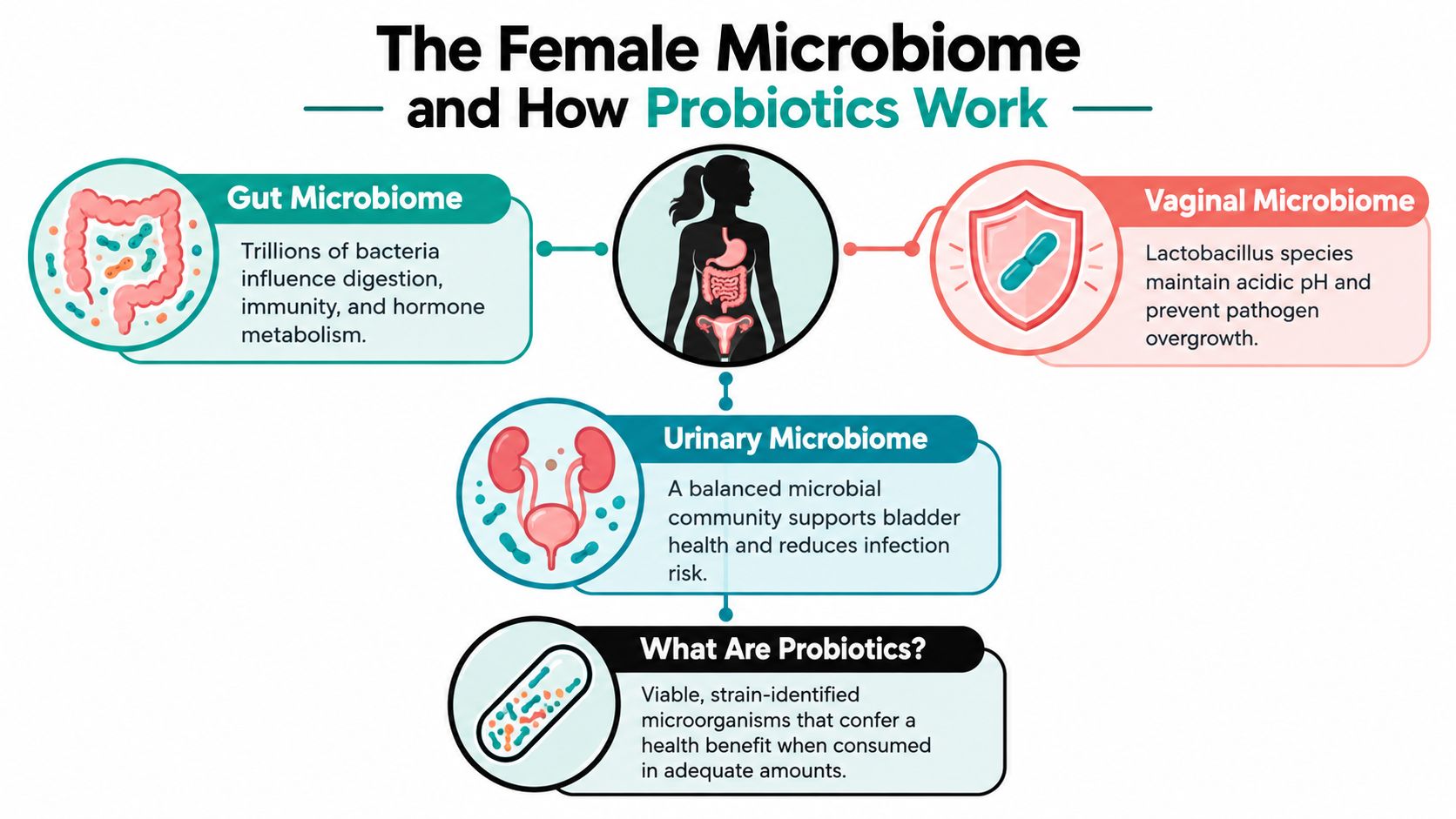
The female microbiome isn't one system, it's several. The gut, vaginal, and urinary environments each have their own ecology, and probiotics only help when the strain, route, and dose fit that environment. A women's product that ignores those differences is treating microbiology like a slogan instead of a system.
What a probiotic actually is
A probiotic is a viable, strain-identified microorganism that confers a health benefit when taken in adequate amounts. That definition matters because a genus name alone is too vague to guide a purchase. Lactobacillus rhamnosus GR-1 is not the same organism as Lactobacillus rhamnosus GG, even though the labels look similar at first glance.
CFU, or colony-forming units, is the count of viable organisms. For buyers, that number only means something when the product tells you the count is held through shelf life, not just at manufacturing. The NIH Office of Dietary Supplements notes that product weight can include both live and dead cells, so front-label mass isn't a reliable proxy for viable dose.
The garden analogy is useful here. The goal isn't sterility, it's balance. Probiotics work by helping shape that balance over time through competition, pH effects, and interaction with local microbes and host signaling. That's why daily use tends to matter more than one-off use, especially when the goal is restoring a stable environment rather than masking symptoms.
For readers who want a broader clinical overview of probiotic use and gut health, browse gut health expertise offers a practical lens on how microbiome support gets translated into everyday decisions. The right takeaway is not “take any probiotic.” It's “match the organism to the job.”
The Five Benefit Categories and the Evidence Behind Each
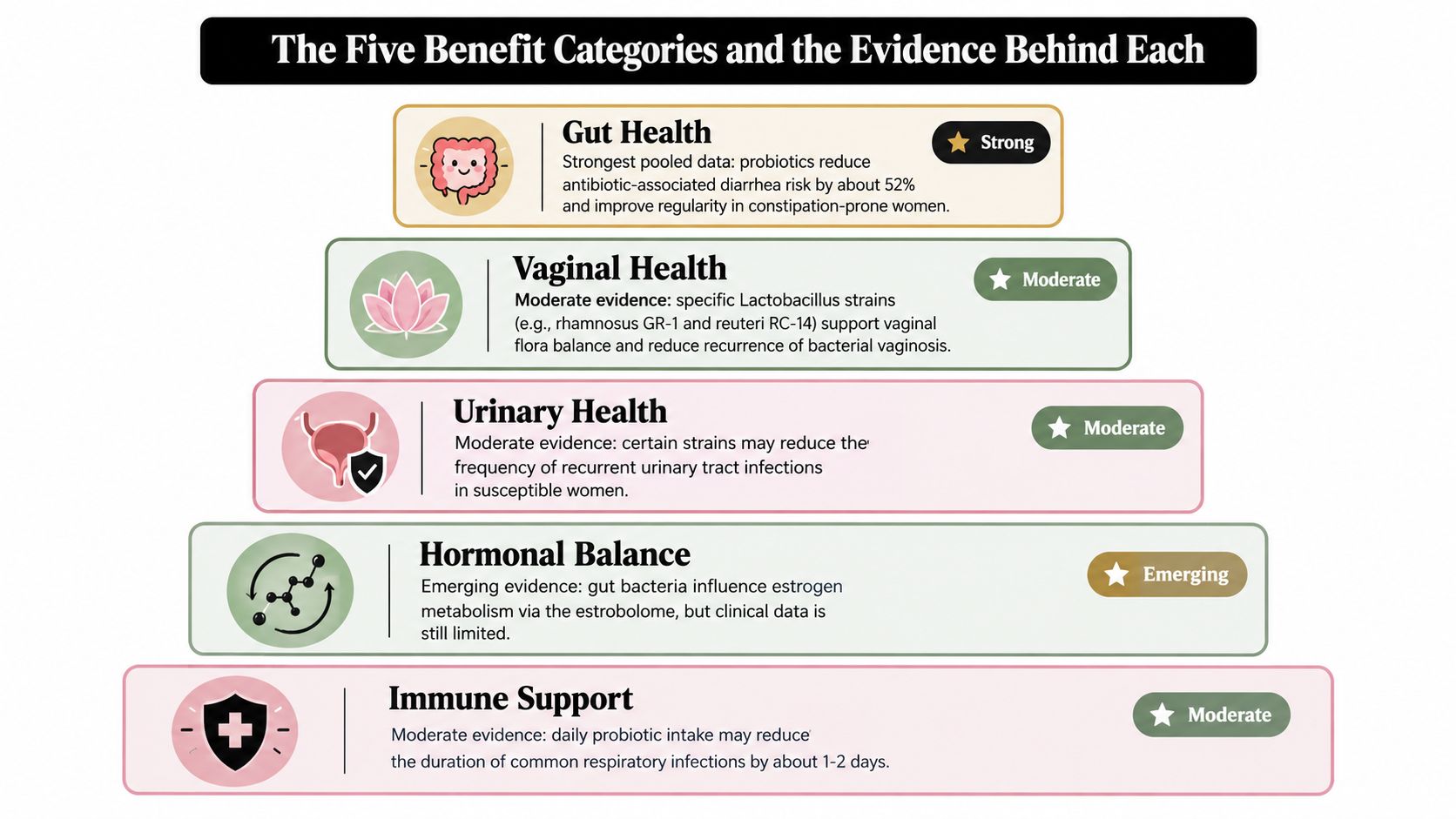
Women's probiotic marketing often groups very different outcomes under one promise. The evidence does not. Across five common benefit categories, the support ranges from clinically useful to preliminary, and that difference should shape how you read a label and what claims you treat cautiously.
Gut support
Gut support has the broadest practical use, but even here the strongest case is narrower than many labels suggest. The clearest benefit is antibiotic-associated diarrhea. A review of 42 randomized controlled trials involving 11,305 adults found diarrhea in 13.7% of probiotic users versus 18.8% of controls, with a 5.1 percentage-point absolute reduction and an NNT of 20 (AAFP review). That makes probiotics easier to justify for a defined scenario, antibiotic exposure, than for a vague promise of “better digestion.”
Vaginal support
Women-specific evidence is most credible here, especially for bacterial vaginosis recurrence after standard treatment. A 2022 systematic review of 10 studies involving 1,234 women found a 45% relative reduction in recurrence with probiotics used after standard therapy. Recurrence occurred in 14.8% of probiotic-treated participants versus 25.5% of controls, with an estimated number needed to treat of about 8.
That does not mean any oral or vaginal probiotic can treat BV on its own. It means adjunctive use has supportive evidence in a specific condition, after diagnosis and standard care. Route, strain, and timing matter here more than category branding. For a closer look at recurrence-focused use, see our guide to probiotics for BV prevention.
Urinary support
Urinary claims are much weaker than vaginal claims, even though they are often marketed side by side. A Cochrane UTI review found no significant reduction in recurrent UTI risk with probiotics compared with placebo or antibiotic prophylaxis in women or children. Buyers should treat this as a separate evidence category, not an automatic extension of vaginal microbiome support.
Mood and metabolic positioning
These claims are still early. Microbiome research in mood, metabolism, and next-generation organisms such as Akkermansia muciniphila and Christensenella is scientifically interesting, but product positioning usually runs ahead of outcome-specific proof. For now, these ingredients fit an emerging category, not a settled women's-health use case.
Immune support and pregnancy claims
Pregnancy is another area where broad wellness marketing can overreach. A Cochrane pregnancy review covering 12 trials, 1,450 mothers, and 1,204 known infants found insufficient evidence for broad benefits on major obstetric outcomes. Use that as a boundary. In the next stage of comparison, match each strain to the outcome it was studied for, not to the promise on the front of the bottle.
Strains That Matter for Women's Health Goals
A women's probiotic is only as specific as its strain label. If a product lists only “Lactobacillus” or “Bifidobacterium,” you still cannot tell whether it fits bloating, regularity, vaginal balance, or antibiotic-related digestive support, because those outcomes are studied at the strain level, not the genus level. Our breakdown of Lactobacillus benefits explains why species names alone often leave too much unresolved.
| Strain | Women's-health goal studied | What the evidence suggests |
|---|---|---|
| Lactobacillus rhamnosus GR-1 | Vaginal balance | Frequently discussed in vaginal microbiome formulas, but the delivery route and companion strains still affect relevance. |
| Lactobacillus reuteri RC-14 | Vaginal balance | Often paired with GR-1, with the same caution that strain identity alone does not settle product fit. |
| Lactobacillus acidophilus | Digestive and vaginal support | Too broad by itself, because the species name does not identify the exact clinical use. |
| Bifidobacterium lactis | Regularity and digestive support | Better aligned with gut-focused formulas than with stand-alone intimacy positioning. |
| Saccharomyces boulardii | Antibiotic-associated diarrhea | More relevant for digestive resilience during antibiotic use than for general women's-health branding. |
| Akkermansia muciniphila | Gut barrier and metabolic signaling | Scientifically interesting, but not a shortcut to broad vaginal or urinary claims. |
| Christensenella minuta | Metabolic signaling | Early-stage positioning only, so conservative interpretation is warranted. |
This is the part many labels blur. Marketers often group digestive, vaginal, urinary, and immune goals into one front-panel message, even though the evidence does not travel that neatly from one condition to another.
Route matters alongside strain. A probiotic studied through vaginal delivery may produce local effects that do not automatically carry over to an oral capsule. Oral products also depend on survivability, dose design, and whether the formula is built for a gut outcome or a local vaginal one. A long strain list can still be poorly matched to the result a buyer wants.
The strongest takeaway from the recent literature is not that “women's probiotics” work as one category. It is that some interventions look more promising for some endpoints than others. A 2024 review found that higher-quality randomized trials using oral, vaginal, or combined probiotic interventions were associated with improved outcomes in BV and vulvovaginal candidiasis, along with greater Lactobacillus abundance. That supports strain-directed, condition-specific selection. It does not justify treating every probiotic with a feminine label as interchangeable.
GutRx BALANCE is a useful example of this distinction. It is positioned as a gut-focused formula with 30 billion CFUs per capsule, next-generation probiotics, and digestive and immune support framing. That is a clearer use case than implying that any probiotic aimed at gut health should also be expected to deliver vaginal benefits.
How to Read a Women's Probiotic Label
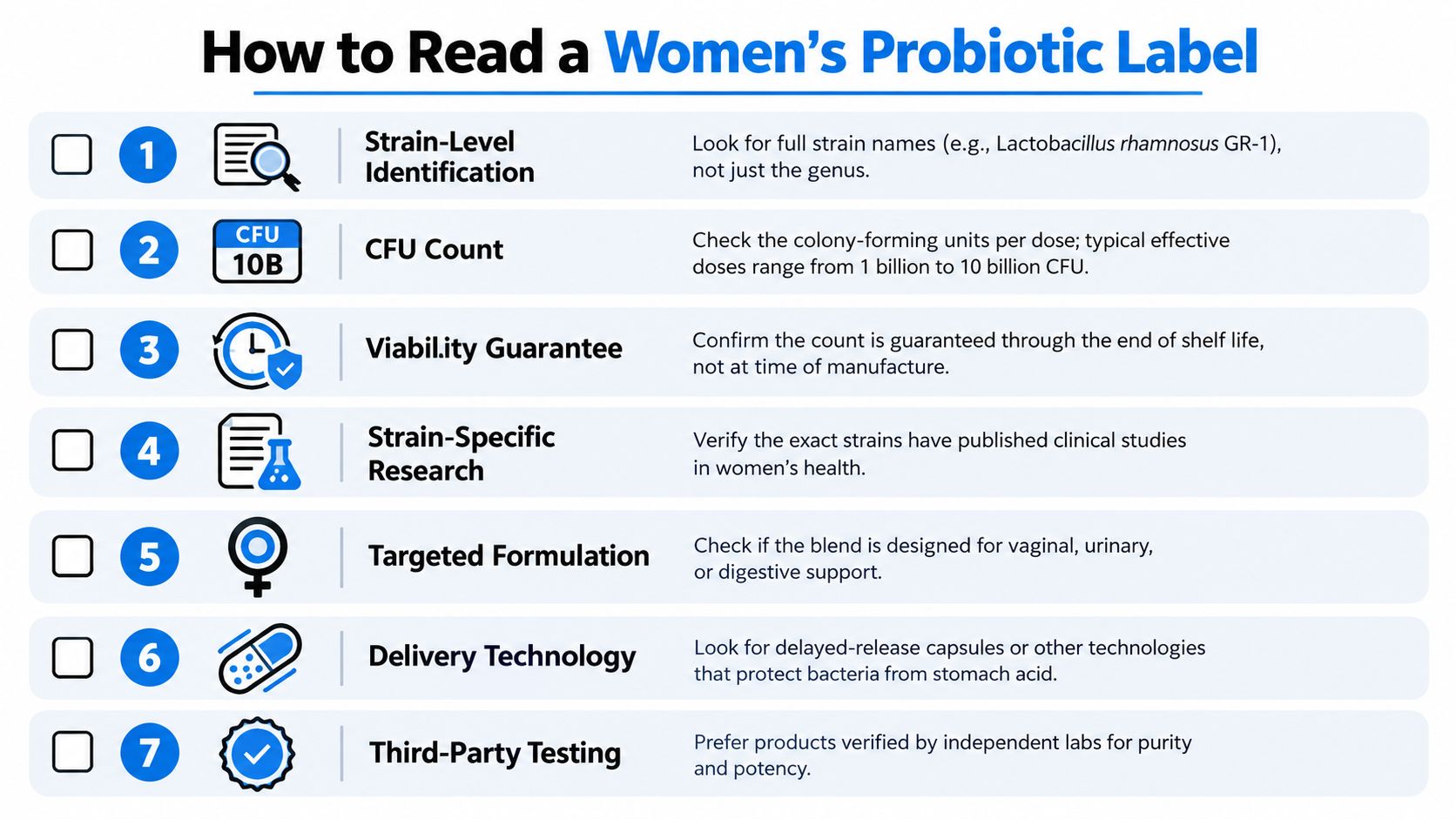
A women's probiotic label should answer seven questions before it earns your money. If it doesn't, the product is asking you to trust the front panel more than the formulation.
The seven checkpoints
- Strain-level identification, because genus-only labels are too vague for decision-making.
- CFU guaranteed through expiration, not just at manufacture, because viability changes over time.
- Delivery technology, especially enteric-coated or delayed-release formats when stomach survival matters.
- Third-party testing, ideally with a downloadable Certificate of Analysis.
- Dietary fit, including vegan, gluten-free, and non-GMO when those matter to you.
- Storage instructions, because heat and moisture can reduce viability.
- Clinical framing, which tells you whether the product is built for digestion, vaginal support, or a broader maintenance role.
Practical rule: a bigger CFU number isn't automatically better if the strain isn't studied for your goal or the product can't keep those organisms viable.
The NIH Office of Dietary Supplements also notes the distinction between viable CFU and product weight, which is why a “large” capsule can still be a poor comparison point if the label doesn't clarify survivability (ODS fact sheet). That's especially relevant for women comparing daily products, because a formulation built for shelf stability may be more useful than a refrigerated product that's hard to keep consistent.
Labels that combine prebiotics and postbiotics can be more complete, but only if the formulation is coherent. Extra ingredients don't fix weak strains, and a proprietary blend can hide underdosed organisms. The right question is never “How many things are in here?” It's “Does this product match my goal well enough to justify taking it every day?”
Matching a Symptom Profile to a Product Type
A woman in her 30s or 40s with monthly bloating, occasional irregularity, and a history of feeling off after antibiotics doesn't need a vague wellness blend. She needs a product choice that maps to the symptom pattern. That usually means separating maintenance support, recovery support, and women-specific microbiome support instead of trying to solve everything with one capsule.
If the main issue is day-to-day irregularity and general digestive drift, a daily maintenance formula makes sense first. If the pattern is post-antibiotic upset, the better fit is a product designed for digestive resilience rather than a product marketed mainly around vaginal balance. If the concern includes recurrent vaginal imbalance alongside gut symptoms, a combined women's formula becomes more relevant.
A simple decision split looks like this:
- Daily gut maintenance: choose a product built around regularity and digestive balance.
- After antibiotics: look for strains with digestive-use evidence, especially when diarrhea is the concern.
- Vaginal recurrence pattern: use a women's formula that identifies strains and frames support as adjunctive.
- Urinary symptom history: don't assume a probiotic prevents UTI, because the evidence doesn't support that leap.
GutRx's lineup reflects that kind of segmentation, with Daily, Balance, and Women's each aiming at a different use case. That structure is more useful than one oversized formula trying to do everything at once.
Active urinary tract infection, symptomatic bacterial vaginosis, and candidiasis still need clinician-directed care. Probiotics can support recovery or recurrence prevention in some settings, but they don't replace diagnosis, culture when indicated, or antimicrobial treatment.
Probiotics, Prebiotics, Postbiotics, and Enzymes Explained
These ingredient classes perform different jobs, so a product's ingredient count says little about whether its formula makes biological sense. A true synbiotic pairs a probiotic with the specific prebiotic substrate that strain can metabolize. Digestive enzymes follow a separate mechanism: they break down food rather than seed or feed the microbiome.

What each ingredient class does
- Probiotics are live microorganisms that may provide a health benefit when taken in adequate amounts.
- Prebiotics, including inulin and FOS, serve as food for beneficial microbes.
- Postbiotics are non-viable microbial byproducts or heat-treated cells that may support gut function.
- Digestive enzymes help break down lactose, fats, proteins, and other food components.
For a fuller comparison, see our guide to prebiotics and postbiotics.
The practical distinction depends on the symptom. A probiotic may influence the microbiome over time, while lactase addresses lactose digestion during a dairy-containing meal. A formula combining inulin with a strain suited to metabolize that substrate is a coherent synbiotic design. Inulin paired with an unidentified or unrelated strain is a mixed-ingredient formula, not evidence of a useful pairing.
Enzymes can signal a meal-focused purpose, whereas probiotics and prebiotics target microbial support. Reading the ingredient roles this way helps shoppers judge whether the formula matches the discomfort they want to address, rather than treating every digestive ingredient as interchangeable.
A Practical Summary for Choosing a Women's Probiotic
The safest way to buy a women's probiotic is to work backward from the problem. Identify the primary goal, look for strains studied for that goal, verify the CFU count through expiration, confirm third-party testing, and check whether the delivery system protects viability. If the label can't answer those questions, it's probably selling breadth instead of evidence.
The most important conclusion is also the most inconvenient for marketers. Probiotic benefits for women are real, but they're not universal. Vaginal recurrence support has stronger evidence than urinary prevention, digestive support is useful in targeted settings like antibiotic-associated diarrhea, and pregnancy claims still need caution. Route, strain, and condition all matter.
Consistency matters too. Probiotics aren't instant fixes, and the studies that show benefit generally involve repeated use rather than casual, intermittent dosing. That's why a practical formula is usually better than a flashy one, especially if you're trying to match a product to a specific symptom pattern instead of a broad promise.
GutRx Women's fits into that decision-making model as one option for women who want integrated gut, vaginal, and urinary support with the same evidence filters applied. If you want a more structured look at how those formulas are organized, visit GutRx and compare the product purpose to your own symptom pattern before you buy.


