

“Just eat more fiber and take a probiotic” isn't a useful answer to how to reduce foul smelling flatulence. Start by separating odor from gas volume, record your food and bowel patterns, and test suspected triggers individually. Match any diet change or supplement to the pattern you find, and get persistent symptoms or warning signs assessed rather than piling on more products.
Table of Contents
- Why Foul Smelling Gas Is a Different Problem Than Bloating
- Build a Three-Day Trigger Log Before Changing Anything
- Rank the High-Sulfur and High-Fermentation Foods by Mechanism
- Run a Time-Limited Low-FODMAP Trial With a Real Reintroduction Plan
- Match Enzymes, Probiotics, and Bismuth to the Actual Problem
- Fix Stool Transit, Meal Timing, and Swallowed Air
- Red Flags That Mean You Should Stop Tweaking and Get Tested
Why Foul Smelling Gas Is a Different Problem Than Bloating
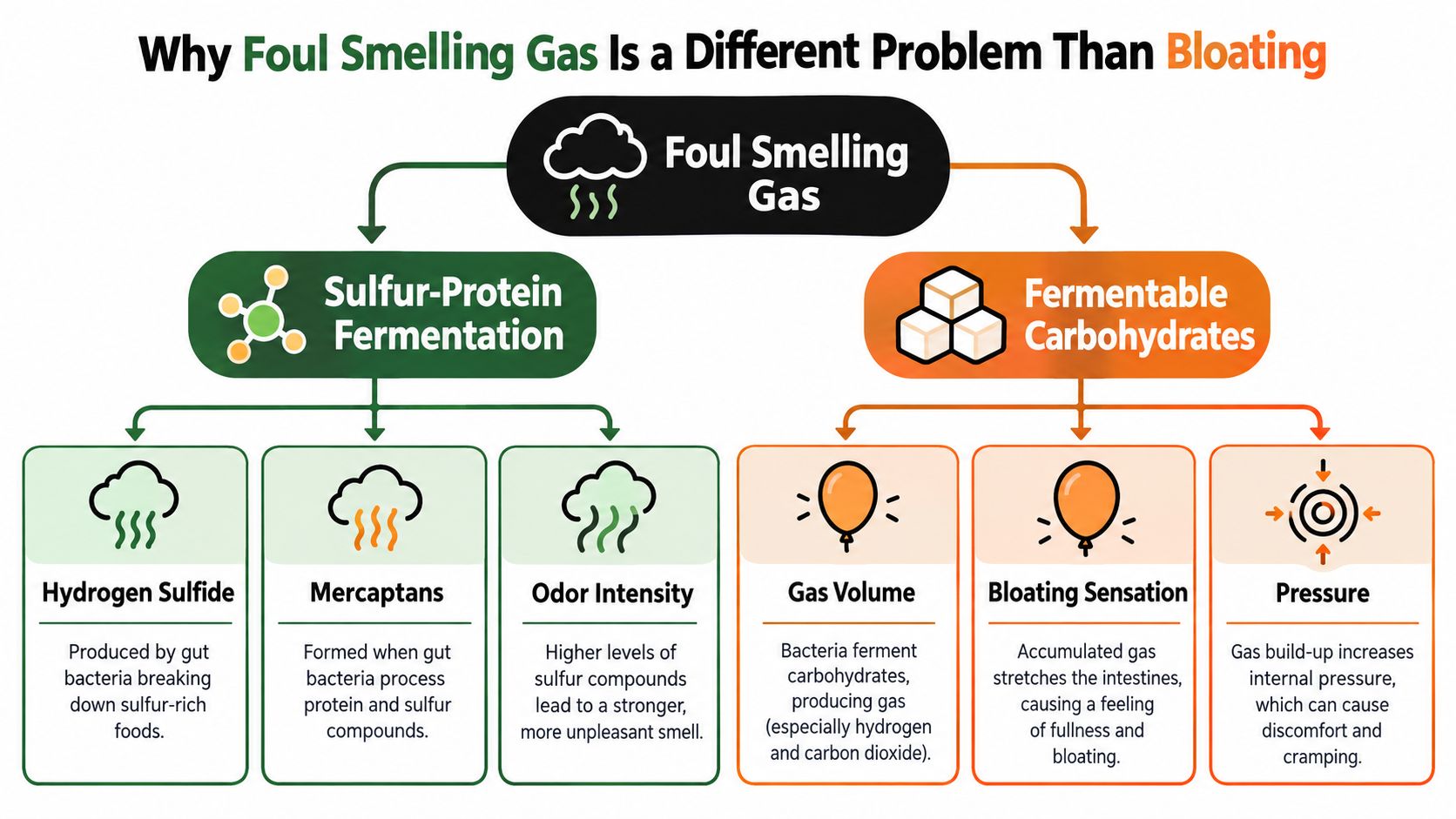
Smell, frequency, and pressure are different outcomes. You can improve bloating without improving odor, or notice stronger-smelling gas without passing more of it. Treating those experiences as interchangeable makes it harder to tell whether a remedy helped.
The unpleasant smell is linked particularly to sulfur-containing gases, including hydrogen sulfide. Gas volume also reflects swallowed air and bacterial fermentation of carbohydrates that weren't fully digested earlier in the digestive tract. Those carbohydrates include certain sugars, starches, and fibers, as explained in the NIDDK overview of gas symptoms and causes.
The useful distinction is what you're trying to change.
Choose the outcome before choosing the remedy
If your main complaint is odor, record odor separately from discomfort. If your abdomen feels tight but the smell hasn't changed, a different part of the problem may deserve attention.
- Odor intensity: Does the smell become noticeably stronger after a reproducible food pattern?
- Gas frequency: Are you passing gas more often, regardless of smell?
- Bloating and pressure: Do you feel uncomfortable even when gas frequency seems unchanged?
- Bowel changes: Does the problem coincide with hard stools, loose stools, or incomplete emptying?
Broad advice to increase fiber skips those distinctions. Fermentable fiber can increase gas when introduced abruptly, so adding a large prebiotic dose isn't a sensible opening move for someone already struggling with fermentation-related symptoms.
Practical rule: Judge a remedy against the symptom you wanted to improve, not against a vague feeling that your gut must be healthier.
Persistent symptoms also aren't automatically evidence that you need a probiotic. Functional constipation, irritable bowel syndrome, and functional abdominal bloating can contribute to gas symptoms. The GutRx guide to IBS gas and bloating provides related reading when odor occurs alongside recurring discomfort or bowel changes.
Build a Three-Day Trigger Log Before Changing Anything
Your latest meal is a suspect, not a verdict. Colonic fermentation can reflect food eaten earlier, so blaming whatever you ate immediately before an episode is an unreliable way to identify triggers.
Start with a three-day baseline while keeping your usual meals and other variables reasonably steady. Then remove a suspected food, track the same outcomes, and reintroduce a normal portion to check whether the pattern returns. This structured approach is consistent with the practical self-testing measures accompanying NHS guidance on excessive or smelly flatulence.
Record enough detail to make a decision
A useful log doesn't need elaborate scoring. It needs consistent observations.
- Meals and ingredients: Include sauces, drinks, sweeteners, protein supplements, and snacks.
- Odor and episodes: Describe smell as mild, noticeable, or strong, and record when gas occurs.
- Stool pattern: Note hard, formed, or loose stools, plus urgency or incomplete emptying.
- Timing: Record when you ate and when symptoms appeared without assuming the closest meal caused them.
- Other changes: Note medicines, supplements, constipation, or an unusually different routine.
If you'd rather keep those observations in a structured format, you can use Guiding Growth to log symptoms. Use the record to compare patterns, not to diagnose an intolerance from an isolated bad evening.
What a useful entry looks like
Consider this illustrative entry, not a patient case: “Milk-based lunch, usual dinner, strong evening odor, loose stool, no new supplements.” That entry suggests dairy deserves investigation, but it doesn't prove lactose is responsible.
Keep the rest of the routine stable while testing the suspected food. If symptoms improve during removal and return after reintroduction, you have a more useful lead than you'd get from cutting dairy, wheat, beans, eggs, and onions together.
A restriction that changes everything tells you very little about which change mattered.
Don't re-challenge a food that has caused a suspected allergic reaction or a severe response. That situation needs clinical advice, not a home experiment.
Rank the High-Sulfur and High-Fermentation Foods by Mechanism
Rank foods by your symptom pattern, not by an internet blacklist. An odor-dominant problem after protein-heavy meals calls for a different initial test than bloating and loose stools after dairy or sugar-free sweets.
A human dietary intervention found that animal-based, higher-protein eating generally produced more colonic hydrogen sulfide than plant-based eating. Responses varied, however, and some participants didn't improve on the plant-based diet. That variability, discussed in this review of dietary influences on intestinal gas, is why “eat more plants” isn't a guaranteed odor solution.
High-Odor Foods Ranked by Mechanism
There's no universal trigger portion established by the evidence discussed here. Use your usual portion as the starting reference rather than inventing a threshold that supposedly applies to everyone.
| Food Class | Dominant Odor Driver | Typical Trigger Portion | Test Priority |
|---|---|---|---|
| Animal-protein-heavy meals and eggs | Sulfur-related microbial metabolism is a plausible odor lead | Individual, no established universal threshold | Earlier when odor dominates after these meals |
| Cruciferous vegetables | Sulfur-containing foods plus fermentable material | Depends on food, amount, and tolerance | Earlier when your log repeatedly implicates them |
| Onions and garlic | Fermentable carbohydrates, with potential overlap in odor triggers | Individual tolerance varies | Earlier when mixed dishes repeatedly precede symptoms |
| Beans, peas, and lentils | Carbohydrate fermentation, often prominent for gas volume | No universal flare threshold | Earlier for meal-related gas and pressure |
| Lactose-containing dairy | Poorly absorbed lactose in susceptible people | Depends on lactose tolerance and the food | Earlier when dairy accompanies loose stools or bloating |
| Sugar-free products with polyols | Poorly absorbed sweeteners and fermentation | Depends on ingredient and intake | Earlier when these products appear regularly in the log |
Test the meal component, not the whole diet
A dinner containing meat, onions, beans, and beer doesn't identify which ingredient mattered. Separate the likely contributors instead of declaring the entire meal category off-limits.
Portion size, preparation, and the overall meal deserve a place in your notes. If you change from a large raw serving to a smaller cooked serving, you've changed more than preparation alone, so don't credit cooking without checking.
Avoid treating soaking, sprouting, or cooking as dependable odor remedies. They may be worth recording as variables, but your own repeatable response should determine whether they're useful. The objective is to preserve tolerated foods, not build the longest possible exclusion list.
Run a Time-Limited Low-FODMAP Trial With a Real Reintroduction Plan
A low-FODMAP trial makes sense when foul-smelling gas accompanies IBS-type bloating, pain, or irregular stools and your log points toward fermentable carbohydrates. It's not a universal sulfur-odor treatment.
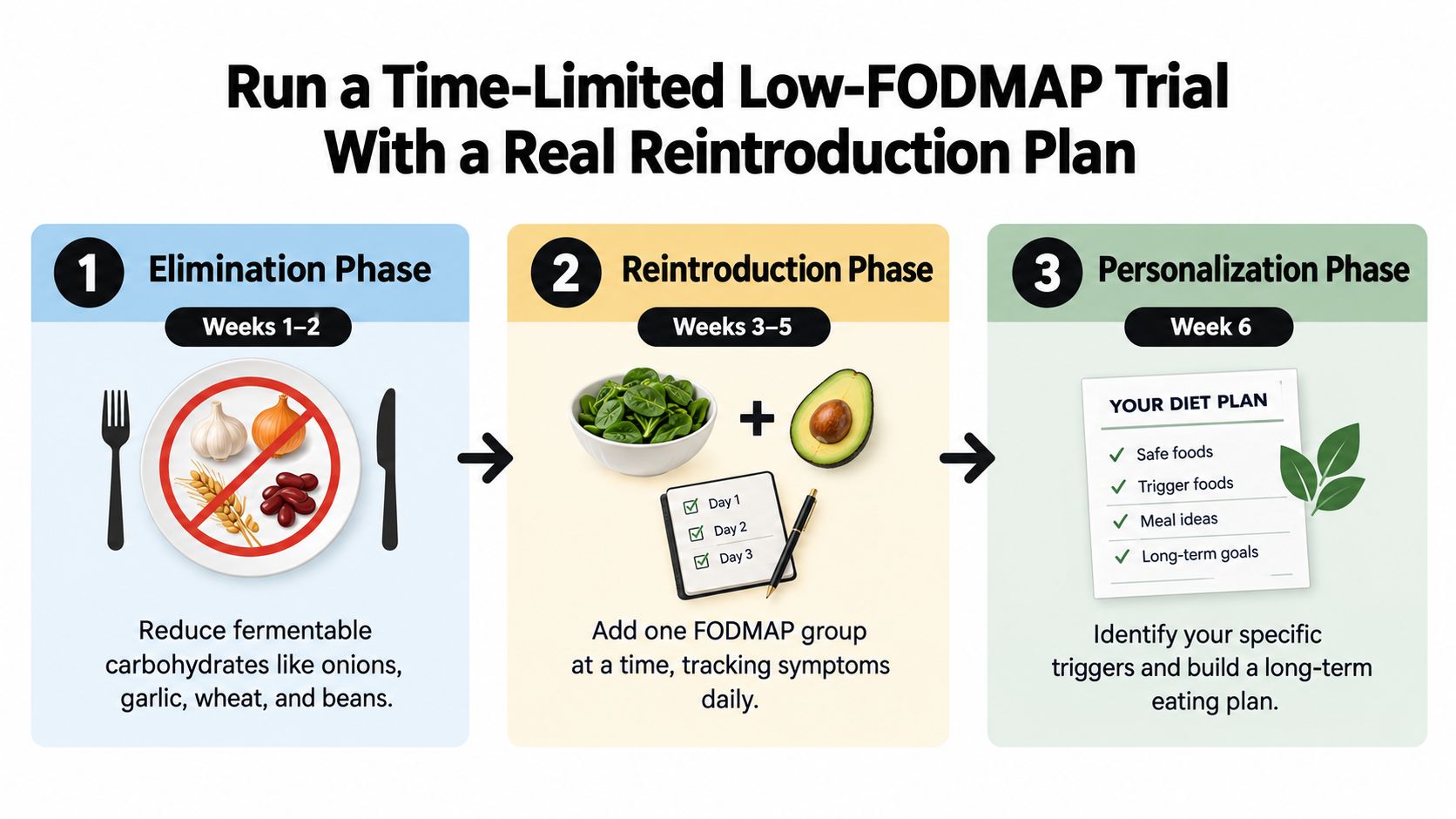
The structured protocol is a 3–7-day baseline, followed by approximately 2–6 weeks of reduced major fermentable carbohydrate sources with a trained dietitian, then systematic reintroduction of a FODMAP subgroup at a time. Reported response rates commonly range from 50–86%, but inadequate response can affect up to 50% of patients across the evidence discussed in this review of the low-FODMAP diet for IBS. Those figures describe different study findings, not a personalized prediction or an odor-reduction percentage.
The phases matter more than a rigid calendar.
Restrict with a defined purpose
During the reduction phase, a dietitian can help you adjust sources such as onions, garlic, wheat-based products, beans, certain dairy foods, stone fruits, and polyols while maintaining workable nutrition. Carbonated drinks also deserve attention in the overall symptom plan.
Don't interpret less bloating as proof that every excluded food was harmful. You've changed multiple exposures, and symptom improvement doesn't establish which subgroup mattered or whether sulfur-related odor changed.
Reintroduce before restriction becomes the routine
- Challenge a subgroup at a time: Keep the surrounding diet sufficiently consistent to interpret the response.
- Track separate outcomes: Record odor, discomfort, and stool changes independently.
- Restore tolerated foods: Build the long-term diet around demonstrated tolerance.
- Set an exit decision: If the trial doesn't help, reassess the explanation instead of making the diet progressively narrower.
The endpoint is personalization, not permanent elimination.
Prolonged unsupervised restriction can reduce dietary variety and potentially alter the gut microbiota. If you remain symptomatic despite following the plan, ask about other explanations, including lactose intolerance, celiac disease, or inflammatory disease, rather than assuming you haven't restricted enough.
Match Enzymes, Probiotics, and Bismuth to the Actual Problem
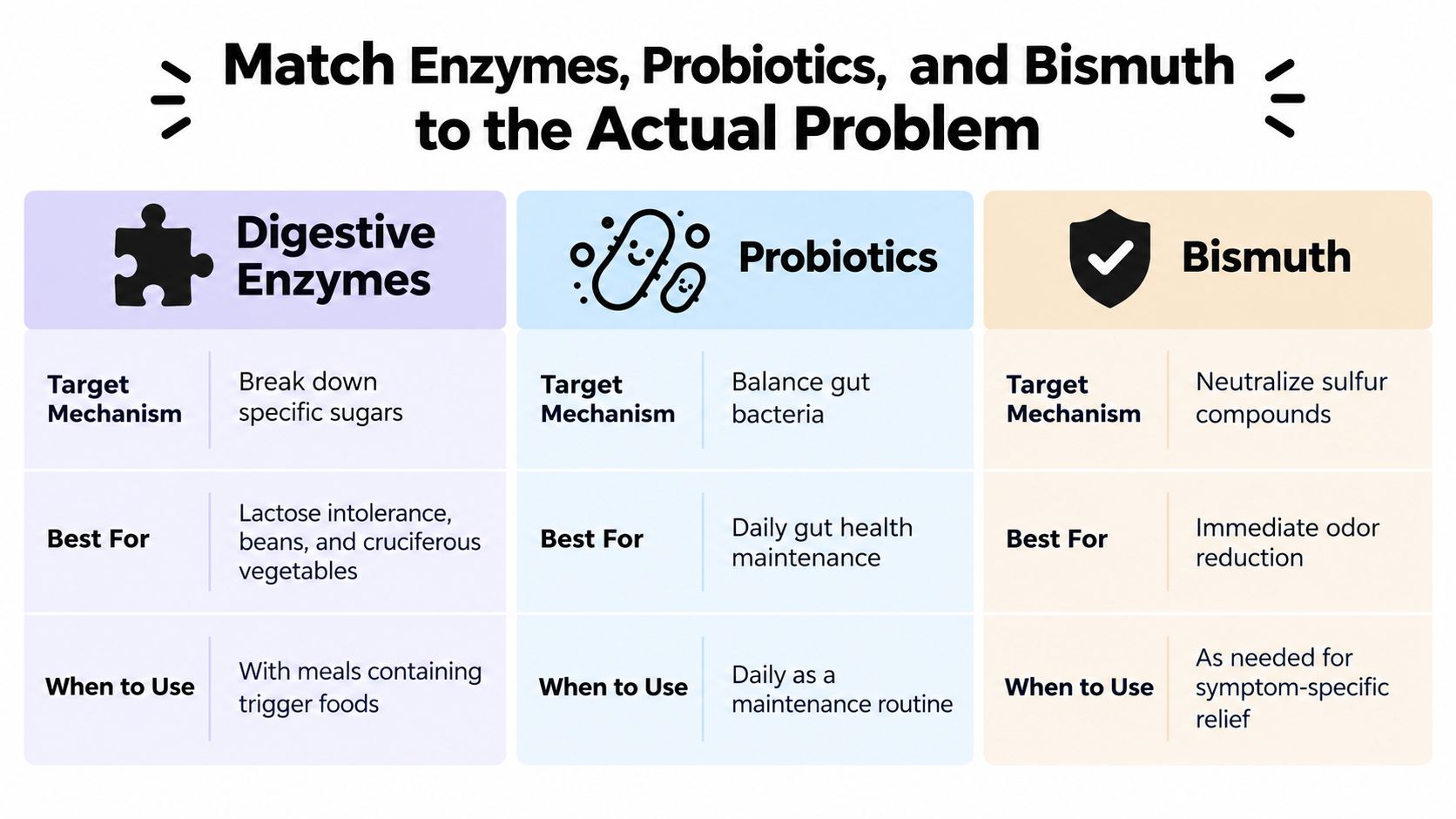
Don't buy a supplement until you can state what you expect it to change. “Better gut health” is too vague to evaluate; less dairy-associated discomfort or fewer troublesome gas episodes is a usable target.
The comparison below separates the intended roles. It shouldn't be read as proof that every product in a category treats odor.
Match the evidence to the outcome
Probiotics have mixed evidence for flatulence symptoms, not a guaranteed deodorizing effect. A systematic review reported improvement in a categorical analysis with an odds ratio of 2.31, while a separate continuous-data analysis found no statistically significant benefit, as detailed in the systematic review of probiotics for IBS. Different outcomes can produce different conclusions, so don't translate symptom improvement into proven sulfur-odor control.
The NCCIH summary of complementary approaches for IBS also describes benefits for global IBS symptoms, including flatulence. That supports a selective trial for an appropriate symptom pattern, not a promise that any daily probiotic will work.
| Option | Evidence Label for This Decision | Practical Buying Rule |
|---|---|---|
| Digestive enzymes | Substrate-specific rationale, not established here as an odor cure | Match the enzyme to the suspected food component |
| Probiotics | Mixed evidence for flatulence symptoms | Look for strain-specific evidence and a relevant outcome |
| Bismuth subsalicylate | Limited evidence for short-term sulfur-odor reduction | Review suitability with a clinician or pharmacist |
| Charcoal products or pads | Insufficient support here for a dependable recommendation | Don't make them your primary strategy |
Lactase and alpha-galactosidase are food-specific enzyme options to discuss for dairy- or legume-related symptoms. They aren't interchangeable with a protein-digestion product. NZ Supps' discussion of enzymes for protein digestion is useful background when comparing enzyme purposes, but it isn't proof of reduced sulfur odor.
GutRx MEALTIME is a digestive enzyme supplement positioned to support digestion, reduce bloating, and enhance nutrient absorption. Those intended benefits shouldn't be mistaken for demonstrated treatment of foul-smelling flatus.
Compare labels without confusing features with results
When choosing a probiotic for bloating or digestive balance, ask for strain identification, relevant clinical evidence, third-party testing, and accessible Certificates of Analysis. Enteric coating, shelf stability, high potency, and a prebiotic-probiotic-postbiotic combination don't, by themselves, establish odor benefit. The guide to probiotics for gas offers another comparison starting point.
Interest in Akkermansia, Christensenella, and synbiotics doesn't establish that they reduce foul odor specifically. Avoid adding multiple formulas together, because you won't know which change helped or worsened symptoms.
For an additional visual explanation, consider the accompanying video alongside these evidence limits.
Fix Stool Transit, Meal Timing, and Swallowed Air
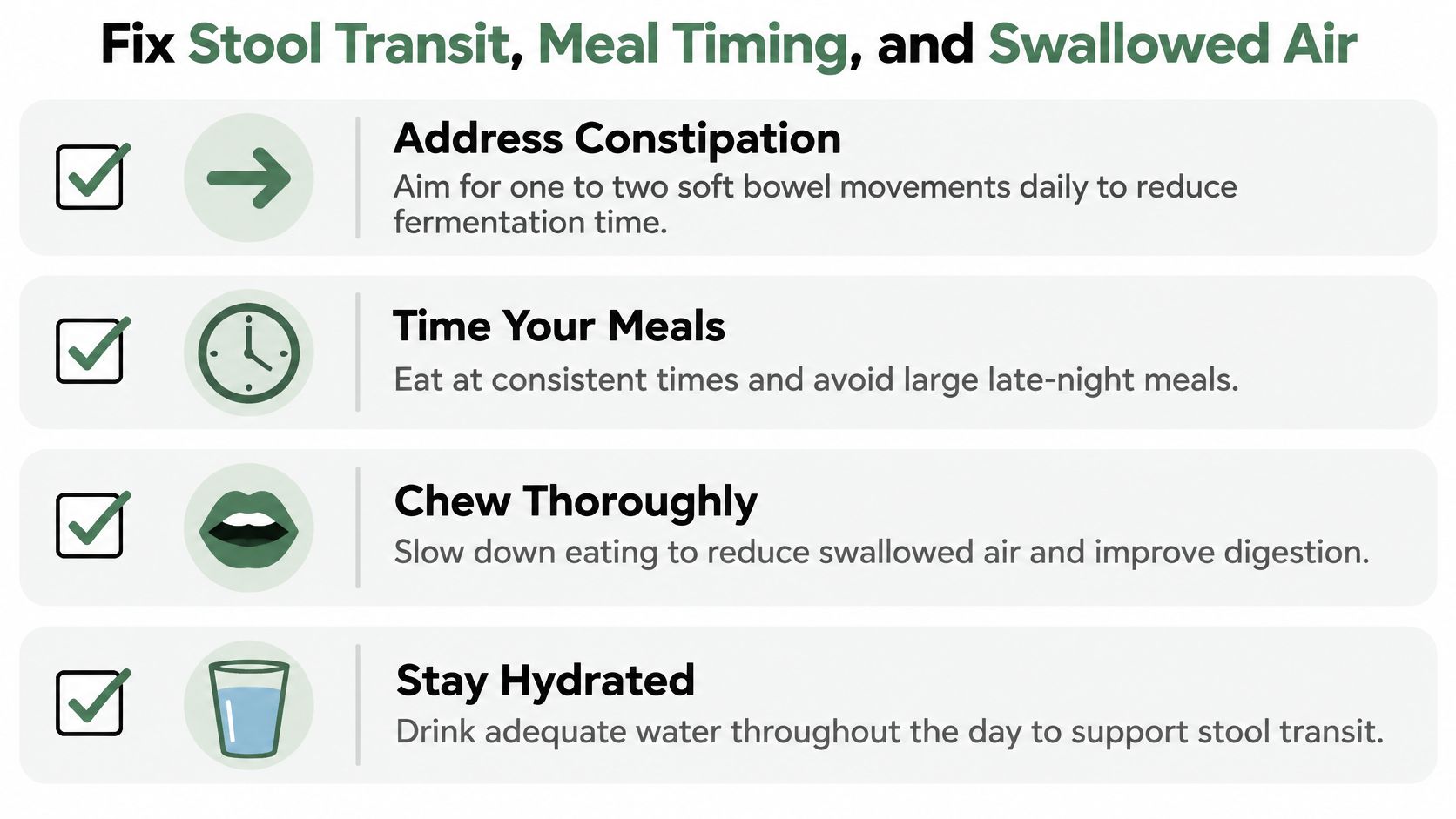
A food trigger isn't the only variable worth changing. Constipation can extend fermentation time, while swallowed air adds to the amount of gas you need to move through your digestive tract.
Work on these contributors alongside targeted food testing rather than waiting for a supplement to solve everything. Smaller, more frequent meals and individualized dietary adjustments are practical options described in NIDDK guidance on treating gas symptoms.
Use the checklist as a habit prompt, not a prescription for a fixed bowel-movement count.
Daily Habits That Cut Swallowed Air and Speed Transit
These habits target different contributors. Don't expect every habit to change sulfur odor directly.
| Habit | What It Changes | Effort Level | When to Start |
|---|---|---|---|
| Address hard stools and incomplete emptying | Constipation-related retention | Variable, may need clinical help | Alongside food testing |
| Increase fiber gradually when needed | Avoids an abrupt rise in fermentable intake | Moderate | During a planned adjustment |
| Eat smaller meals | Reduces the size of an individual meal | Low | At your next usual meal |
| Chew slowly with your mouth closed | Reduces swallowed air | Low | At meals and snacks |
| Avoid gum and fizzy drinks | Removes common air-related contributors | Low | During your baseline review |
| Exercise regularly | Supports the overall bowel-management routine | Moderate | As your health allows |
Make the evening routine useful
Review your log before dinner. If a particular ingredient is under investigation, don't include it in a complicated meal with several other suspected triggers and expect a clear answer.
Eat without rushing, skip the carbonated drink, and note whether you've been constipated that day. If you're adjusting fiber, resist adding a large serving of beans and a fermentable prebiotic supplement simultaneously.
- Don't invent a liquid cutoff: There's no established rule here requiring you to stop drinking a fixed interval before meals.
- Don't chase a prescribed stool count: Comfortable passage and your broader bowel pattern matter more than an arbitrary daily target.
- Don't ignore persistent constipation: Seek help when routine adjustments aren't enough.
For a closer look at bowel movement patterns, see the guide to improving gut motility. Use it to prepare better questions about transit, not to diagnose the cause of odor yourself.
Red Flags That Mean You Should Stop Tweaking and Get Tested
Persistent foul-smelling gas needs triage, not endless deodorizing experiments. Odor alone doesn't diagnose small-intestinal bacterial overgrowth, a damaged microbiome, or any specific disease.
Bismuth subsalicylate can inhibit hydrogen-sulfide release and may reduce odor in the short term, but it has salicylate-related contraindications and isn't appropriate for everyone. The broader clinical priority remains assessing the symptom pattern and selecting tests appropriately, as discussed in this clinical review of belching, bloating, and distention management.
Get assessed when odor comes with other changes
Arrange clinical evaluation for new, persistent, or progressive symptoms, especially with any of the following:
- Blood or systemic symptoms: Blood in stool, fever, unexplained weight loss, or anemia.
- Significant pain: Severe, worsening, or persistent abdominal pain.
- Ongoing diarrhea: Chronic diarrhea, greasy stools, or stools that are difficult to flush.
- Nighttime symptoms: Digestive symptoms that wake you from sleep.
- Relevant history: Recent antibiotics, travel, or a family history of gastrointestinal disease.
- Unexplained progression: A lasting change that doesn't fit your usual diet or bowel pattern.
Severe pain, bleeding, or feeling acutely unwell warrants prompt medical attention. Don't delay care while completing a food challenge.
Ask for an explanation, not a generic microbiome label
A clinician may consider lactose intolerance, celiac disease, pancreatic insufficiency, infection, constipation with retained stool, or medicines that alter motility or carbohydrate absorption. Testing for small-intestinal bacterial overgrowth is generally reserved for selected at-risk patients, not everyone who reports smelly gas.
Bring your food-and-symptom record, current medicines, and supplement labels. Describe whether the problem is mainly odor, frequent gas, pain, diarrhea, or difficult bowel movements, and explain what changed during your controlled tests.
Persistent restriction isn't a substitute for finding out why symptoms continue.
If there are no warning signs, the trigger-testing approach offers a sensible starting point. If symptoms persist despite a coherent trial, stop expanding the blacklist and arrange an assessment.
GutRx offers probiotic and digestive enzyme options for people comparing support for digestive balance and meal-related discomfort. Visit GutRx with your symptom log in hand, compare the intended use and testing information, and choose an option only when it matches the problem you're trying to address.


