

The advice to “just take a probiotic” skips the most important buying decision. How do you choose digestive health products? Start with your symptom pattern, then compare the formula, quality documentation, and a realistic trial plan, rather than choosing the bottle with the biggest colony count.
A product for ongoing irregularity isn't automatically the right choice for discomfort after dairy. The useful question at the shelf is narrower: what is this formula designed to do, and what evidence supports that particular use?
Table of Contents
- Why Probiotic Labels Need Closer Reading
- Matching Your Symptoms to the Right Product Type
- Strain Names, CFUs, and Delivery Format That Matter
- Verifying Third-Party Testing and Certificates of Analysis
- Comparing Digestive Product Types and Where GutRx Fits
- How Long to Trial a Product and When to Stop
- Safety Checks and Your Next Step
Why Probiotic Labels Need Closer Reading
Two products can promise similar digestive support and still contain different formulas. A front label saying “probiotic for gut health” leaves key questions open: which organisms are included, whether the finished product matches a studied formulation, and how its potency holds up during storage.
The National Health Interview Survey found that about 4 million U.S. adults used probiotics or prebiotics in the previous month. Adult use quadrupled between 2007 and 2012, according to the National Center for Complementary and Integrative Health's probiotic overview.
Similar listings can represent different purchases
Amazon listings may highlight the same benefits, such as less bloating, regularity, digestive balance, or daily support. Open the Supplement Facts panels of two listings and compare their strain lines side by side. Then check the rest of the formula and the product directions.
- Organism identification: Species names alone don't identify the specific strains in a product.
- Formula composition: Added fibers, postbiotics, and enzymes change what the product contains and what you are evaluating.
- Potency wording: Check whether the colony count is guaranteed through expiration. A count without that information leaves potency over time unclear.
- Delivery and storage: Compare capsule design and storage directions. These details affect how the product is handled and used.
Match the product type to the job you expect it to do. A daily probiotic may be a poor fit for discomfort tied to a particular food. An enzyme product taken with meals, in turn, does not address every cause of ongoing bowel symptoms.
Practical rule: Compare the actual Supplement Facts panels before weighing front-label promises.
Buy for a defined job
Set a clear measure of improvement before buying. Easier bowel movements, less disruptive bloating, and better tolerance of a problem meal are separate goals.
This makes it easier to judge whether the product deserves a continued trial. Broad promises such as “gut microbiome repair” give you little to measure on their own. Use this buying sequence: symptom pattern, formula fit, quality proof, then trial plan. Brand recognition comes after those checks.
Matching Your Symptoms to the Right Product Type
Start with when symptoms occur and what accompanies them. Bloating with infrequent bowel movements calls for a different evaluation than bloating after a particular meal, while persistent loose stools shouldn't be treated as a routine shopping problem.
A symptom pattern helps organize your choices. It doesn't establish a diagnosis or prove that a supplement is appropriate.
Symptom Pattern and Starting Product Type
| Primary Symptom Pattern | Product Type to Evaluate First | Label Feature to Check | GutRx Lineup Match |
|---|---|---|---|
| Infrequent stools or bloating with constipation | Soluble fiber or a regularity-focused probiotic routine | Fiber type, dose directions, and identified strains | Daily |
| Bloating and gas without an obvious food trigger | A targeted probiotic, after considering other causes | Evidence relevant to bloating and the specific formulation | Balance positioning |
| Loose stools or diarrhea-type discomfort | Clinical assessment when persistent; otherwise a carefully selected targeted product | Intended use, strain identification, and safety information | Balance positioning, not treatment for unexplained diarrhea |
| Discomfort after heavy or fatty meals | A meal-focused enzyme formula for evaluation | Named enzymes, activity information, and meal directions | Mealtime positioning |
| Discomfort associated with dairy or FODMAP-rich foods | Food-specific enzyme support | The named food component the formula is designed to address | Mealtime positioning |
| Combined digestive, vaginal, and urinary wellness goals | A women's-focused formula | Separate support for each claimed outcome | Women's positioning |
These lineup matches describe shopping categories, not evidence that a product will resolve a particular symptom. Confirm the current label rather than assuming that a product name establishes suitability.
Regularity and meal tolerance are different goals
For a regularity-focused option, GutRx DAILY combines strains chosen to help shape and move bowel movements with prebiotics selected to feed those probiotics, with benefits intended to build over time. That positioning fits a daily bowel-support routine, rather than a product taken only around a problem meal.
For searches such as “digestive enzymes for dairy and FODMAP foods,” inspect the exact food-related claim. Don't assume that an enzyme blend covers every food you find uncomfortable, or that “heavy-meal support” explains persistent pain after eating.
Women shopping for a probiotic with cranberry and D-mannose should use the same discipline. Check whether the current formula contains both ingredients, then evaluate the evidence for each intended outcome separately. A gut-support claim doesn't, by itself, substantiate vaginal or urinary benefits.
Choose your dominant goal first. If bloating, stool changes, and food-related discomfort overlap, a clinician or dietitian can help you avoid buying several products to address an unidentified cause.
Strain Names, CFUs, and Delivery Format That Matter
The most useful organism name is the most specific one. Genus, species, and strain are different levels of identification, and the strain code is the detail to match against evidence for the intended use.
For example, the label hierarchy below uses Lactobacillus rhamnosus GG to illustrate how the name becomes more specific. The example isn't a recommendation for that organism or an endorsement of the illustrated potency.
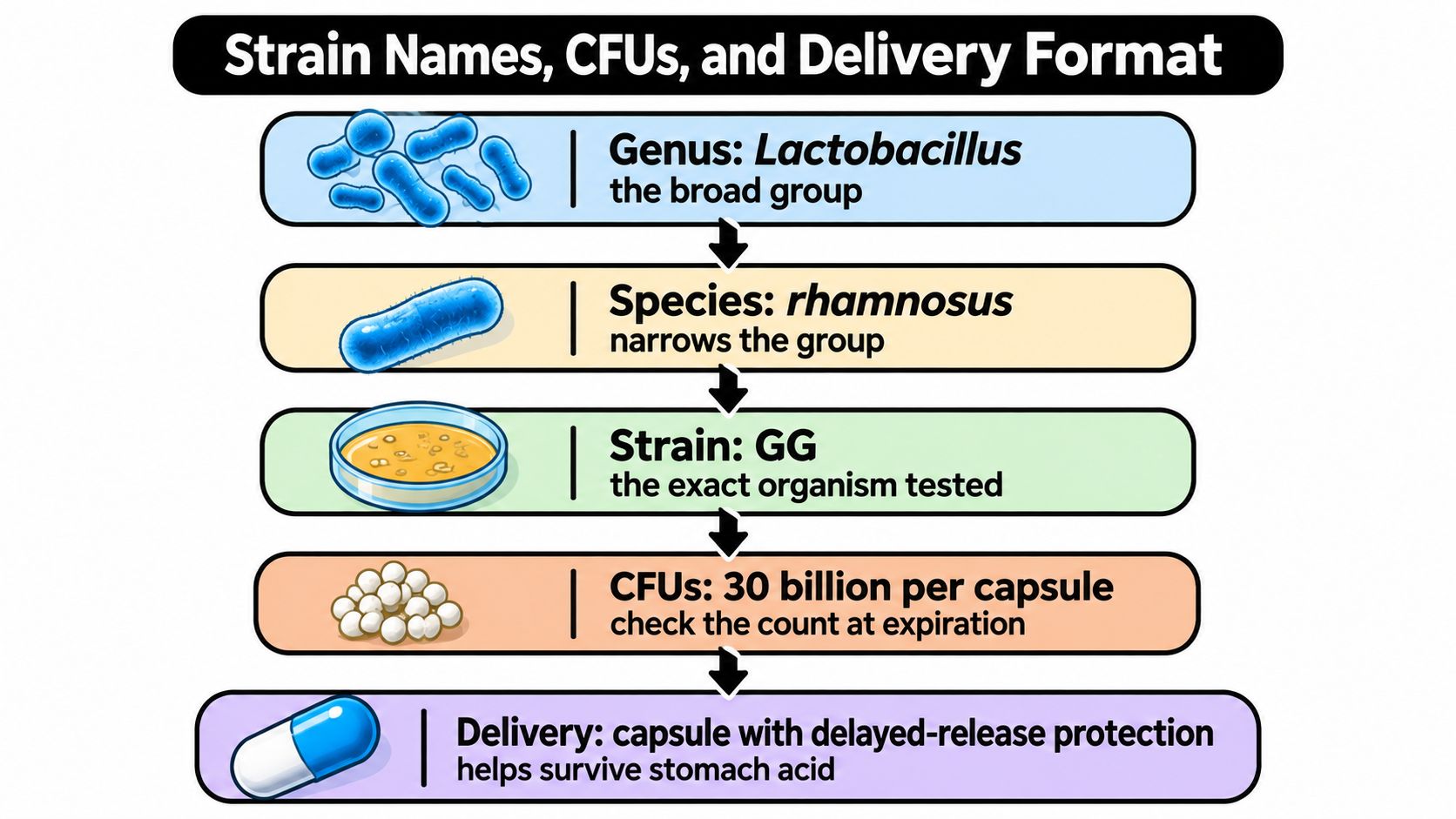
Read potency as a specification, not a ranking
Colony-forming units, or CFUs, describe viable microorganisms. A larger number doesn't establish better symptom relief, and a blend total doesn't necessarily tell you how much of each strain you're getting.
Compare the count at the labeled serving, then look for a statement that potency is maintained through expiration under the stated storage conditions. If a manufacturer discusses overage, ask whether it means extra organisms added at manufacture to account for losses, rather than additional proven benefit.
Delivery claims deserve their own questions:
- Enteric-coated or delayed-release: Ask what testing supports the protection claim for the finished capsule.
- Shelf-stable: Check the temperature and moisture conditions under which the claim applies.
- Refrigerated: Confirm how the seller handles shipping and how you'll store the product after arrival.
These details help assess the delivery system. They don't replace evidence for the intended outcome.
Added fiber changes the tolerance question
Don't treat every prebiotic as equivalent to a poorly fermentable soluble fiber used for IBS support. Read the ingredient name and amount, particularly if fermentable fibers have previously increased your bloating.
A meta-analysis of 14 randomized trials involving 906 patients found a benefit for soluble fiber in IBS, with a risk ratio for persistent symptoms of 0.83, and the American College of Gastroenterology monograph supports gradual increases with adequate fluid because fiber can initially cause gas and bloating.
For an IBS-oriented soluble-fiber product, avoid jumping straight to a full serving. Follow an appropriate titration plan, track tolerance, and ask about medication separation when relevant. If a fixed-dose capsule combines probiotics and fiber, recognize the trade-off: you may not be able to adjust those components independently.
Verifying Third-Party Testing and Certificates of Analysis
A “third-party tested probiotic” claim should lead to documents, not end the conversation. Ask what was tested, who performed the testing, and whether the report applies to the lot you're buying.
The regulatory context matters. DSHEA, enacted in 1994, classified supplements as food rather than drugs, and manufacturers generally don't have to demonstrate safety and effectiveness to the FDA before marketing, as explained in Pew's dietary supplement regulation fact sheet.
Use this checklist to organize the documentation review.
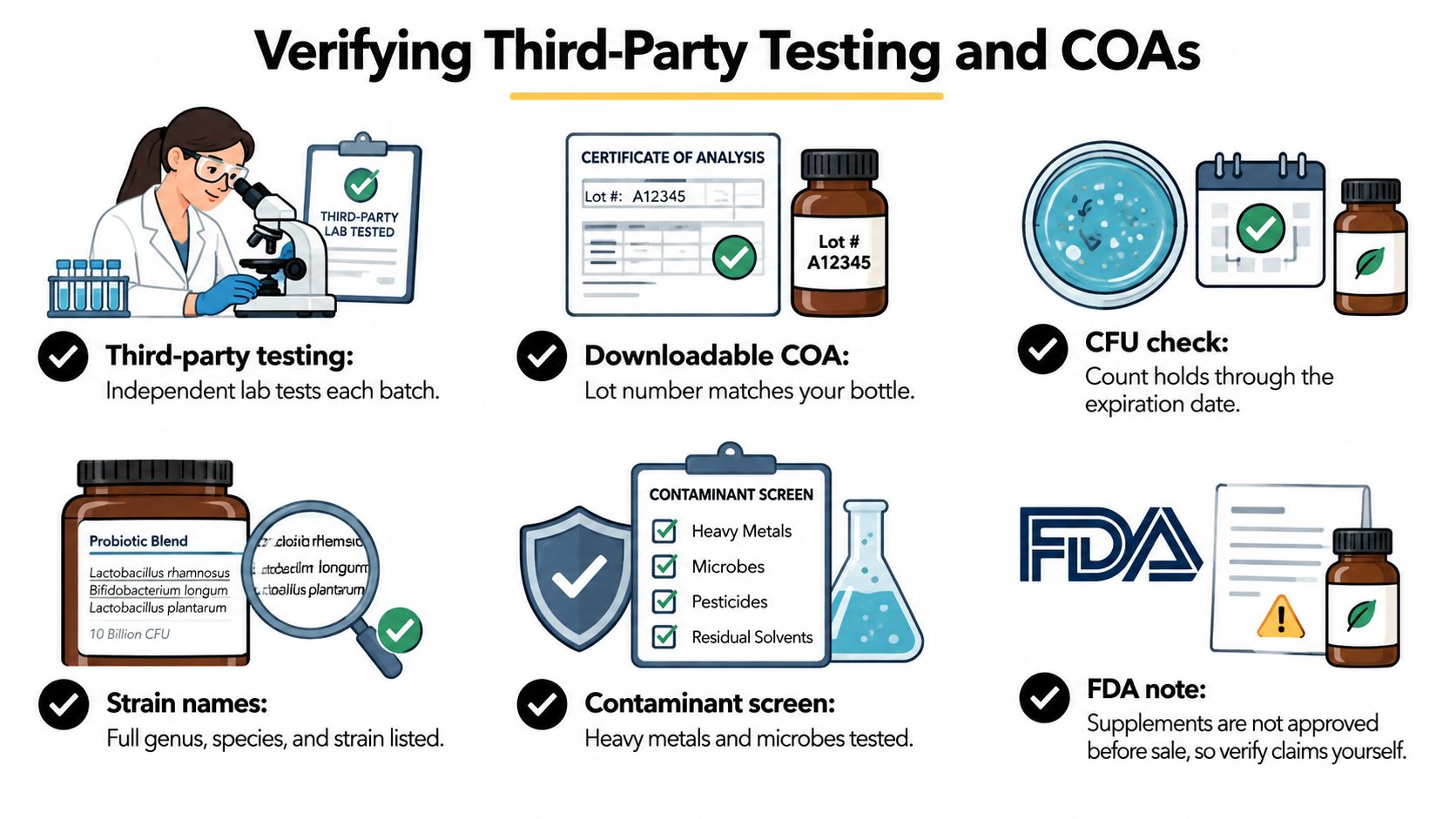
Read beyond the word “pass”
A Certificate of Analysis, or COA, is useful only when you can tell what its results establish. GutRx's explanation of what a certificate of analysis means provides a starting point for interpreting the document.
- Match the lot: The report should identify the batch, not merely show a generic sample.
- Inspect identity testing: Determine whether the method supports strain-level identification or something less specific.
- Read potency results: Look for units, specifications, and testing dates. A release test alone doesn't establish end-of-shelf-life potency.
- Check contamination screening: Ask which microbial contaminants and heavy metals were assessed, and against which limits.
- Identify the laboratory: Confirm who performed the work and what was independently verified.
A missing downloadable report doesn't prove that a product is unsafe. It does leave you with less information to evaluate before purchase.
The following video offers an additional reference alongside the document checklist.
Separate bottle contents from clinical outcomes
Identity and potency testing, manufacturing controls, and clinical evidence answer different questions. A clean contamination screen doesn't show that a formula improves bloating, while a published strain study doesn't verify the contents of your bottle.
A COA can support confidence in what you're taking. It can't, by itself, tell you whether that product will help your symptoms.
Made in the USA, vegan, gluten-free, non-GMO, and medical-expert collaboration claims may matter to your preferences. Verify them where relevant, but don't substitute them for batch documentation or outcome-specific evidence.
Comparing Digestive Product Types and Where GutRx Fits
Digestive products are not interchangeable. A meal-related enzyme, a probiotic, and a formula combining microbial ingredients address different needs, and each makes different trade-offs. Choose the product type around the symptom pattern first, then compare labels.
| Product Type | Main Buying Purpose | What to Compare | Main Trade-off |
|---|---|---|---|
| Daily probiotic | Ongoing digestive support | Relevant strains and whether the routine is practical to maintain | Broad positioning may not address a specific complaint |
| Targeted probiotic | A defined symptom or support goal | Whether evidence matches the formulation and intended use | Findings for one formula may not apply to another |
| Synbiotic | Combined probiotic and prebiotic support | Organisms, prebiotic identity, and listed amounts | Extra ingredients can make tolerance harder to assess |
| Postbiotic-containing formula | A specified non-live microbial preparation | The exact preparation and relevant supporting evidence | The category name alone does not establish benefit |
| Digestive enzyme | Support around particular meals or food components | Enzyme identity, activity, and directions | Meal-focused support does not replace a probiotic |
A combined formula can reduce the number of bottles in a routine, but it can also make it harder to tell which component suits you. That distinction matters if you are comparing a prebiotic, probiotic, and postbiotic product with a simpler formula. Choose convenience only if the ingredient combination fits your needs and tolerance.
GutRx's digestive enzyme and probiotic comparison explains the difference between meal-focused enzyme use and probiotic use. Use that distinction to assess the product category, then check the current label rather than relying on a product name.
The product-page screenshot below shows where to start when reviewing a probiotic listing.
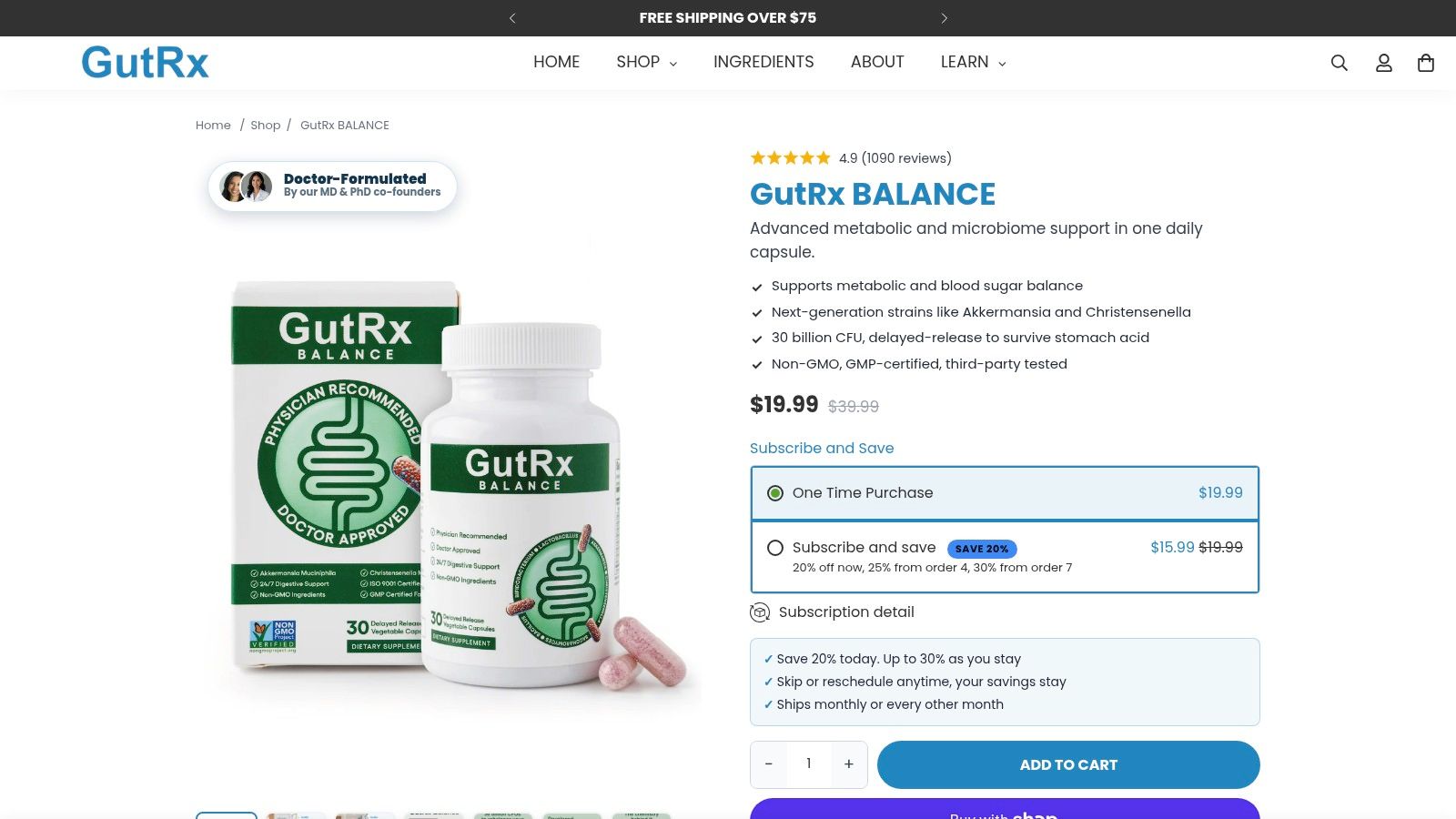
GutRx BALANCE is positioned for gut health, digestive balance, and immune support. Treat those as product-page positioning, not proof that it will address a particular symptom. Before buying, review the current ingredient list, directions, and available product information against your reason for considering it.
Assess named organisms by the evidence
If a label features Akkermansia or Christensenella, check the organism preparation and whether the supporting evidence relates to your goal. A named organism alone does not show that every formula containing it will offer the same benefit, including for gut barrier support or recovery.
Compare products by criteria that affect fit: strain focus, standout ingredients, prebiotics or postbiotics, delivery protection, downloadable COAs, capsule count, and whether the product is positioned for daily maintenance or a specific use. Ingredient count and brand reputation cannot establish which product suits your needs. Check the current label and supporting documentation, and weigh any added ingredients against your tolerance and the reason you are buying.
How Long to Trial a Product and When to Stop
Set a review schedule before the first dose. Without a baseline, day-to-day symptom changes are difficult to judge, and a refill can become a habit rather than a considered choice.
A meta-analysis of 35 randomized trials involving 3,452 people found lower symptom persistence versus placebo, with a risk ratio of 0.79; the review of probiotics and prebiotics in IBS also describes strain-dependent benefits and low-to-very-low certainty. It notes that guidelines do not formally recommend routine probiotic use for global IBS symptoms. That evidence supports a measured trial, not a promise that any probiotic will help.
Choose an endpoint before choosing a refill
Choose one outcome to track: bloating severity, ease of bowel movements, stool pattern, or discomfort after a particular meal. Record it daily, along with relevant changes to food, medication, and other supplements. Keep the measure consistent so you can compare weeks rather than relying on memory.
Use a defined schedule: log your baseline for 7 days, then start the product and reassess at week 4 and week 8. Follow label directions, and discuss an 8-week probiotic trial with your clinician if your health circumstances or the product's evidence call for guidance. The guide to how long to take probiotics offers further help with setting a trial period. Treat each check-in as a decision point, not a reason to tolerate worsening symptoms.
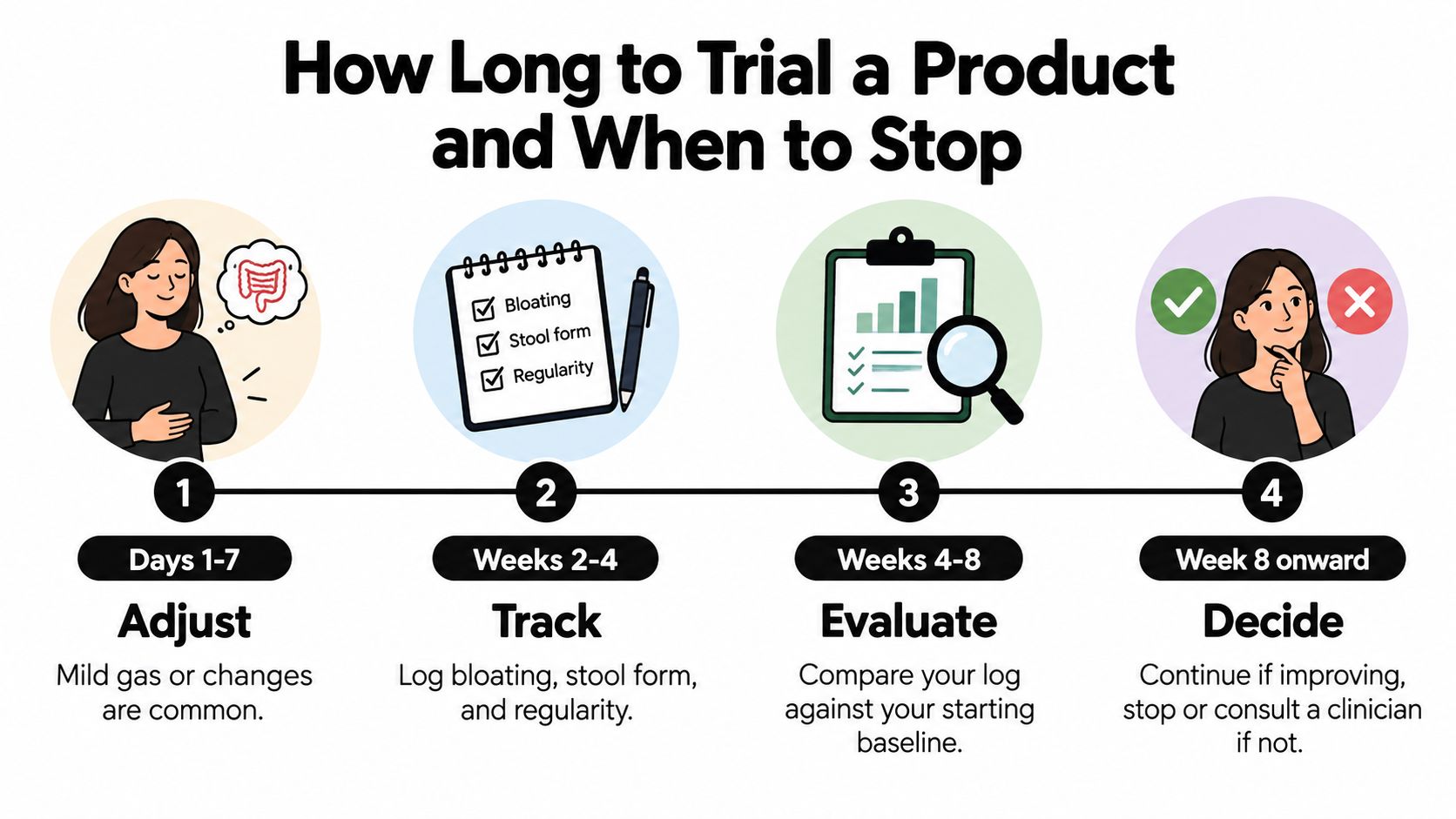
Don't mistake discomfort for proof it's working
Transient gas can occur, particularly with added fiber. New loose stools or increased discomfort do not show that “detox” or microbiome repair is working. Track these changes too, and take worsening symptoms seriously.
- Continue thoughtfully: Look for meaningful improvement in the outcome you chose.
- Reassess nonresponse: If there is no worthwhile benefit by the planned review, avoid automatically raising the dose or adding another formula.
- Stop for worsening: Discontinue and seek appropriate advice if symptoms worsen or unfamiliar symptoms appear.
Use the product's purpose to set the endpoint. For meal-focused enzymes, assess the intended meal-related outcome while following directions; a probiotic timeline may not fit.
A trial should leave you with a clear choice: continue when the target symptom improves, or stop and reassess when it does not.
Safety Checks and Your Next Step
A supplement label cannot screen out every risk. If you're severely ill or immunocompromised, consult the clinician managing your care before starting a probiotic.
A 2025 review covering more than 7,000 participants in 55 randomized trials found no higher adverse-event risk than placebo. Inconsistent reporting limited the conclusions. The NIH Office of Dietary Supplements' probiotic guidance also warns of possible harm for severely ill or immunocompromised people.
Know when shopping should stop
Persistent diarrhea, rectal bleeding, unexplained weight loss, fever, or nighttime symptoms call for medical assessment. A digestive supplement is not a way to investigate those symptoms.
Discuss pregnancy, hospitalization, immune-suppressing treatment, and medication timing with your clinician or pharmacist. Ask about the specific formula, including any added fiber, botanicals, enzymes, or other ingredients. Those details can change the precautions.
- Review your medication list: Ask whether spacing doses or taking another precaution is appropriate.
- Avoid overlapping experiments: Starting several formulas together makes it harder to identify benefits or adverse effects.
- Keep the packaging: Save the lot number and product details in case a reaction needs review.
Make the shortlist earn its place
Choose products that match your dominant symptom pattern, then check their labels and supporting documentation. If a brand cannot clarify a specification that matters to your decision, consider whether you are willing to accept that uncertainty.
For a GutRx option, compare the relevant probiotic or Mealtime information with your goal, review available batch documentation, and confirm current directions before purchase. The brand's 90-day money-back guarantee sets a commercial return window. Before buying, set a stop rule: discontinue the product if your symptoms worsen or unfamiliar symptoms appear, and seek appropriate advice.
Choose a formula with a clear purpose, enough supporting information to assess it, and an endpoint for judging the trial. A more elaborate bottle does not make the choice stronger. Look for a defensible reason to try it and a clear condition for stopping.
GutRx offers probiotic routines and meal-focused digestive enzyme options for different support goals. Visit GutRx to compare current formulas, review available Certificates of Analysis, and choose an option suited to your symptom pattern and trial plan.


