

Lipase is a family of fat-cleaving enzymes whose main digestive role is breaking triglycerides into fatty acids and monoglycerides so the body can absorb fat and fat-soluble vitamins. Gastric lipase starts the process, while pancreatic lipase completes most of the work in the small intestine, where bile salts and colipase help the reaction succeed.
You may notice lipase enzyme function most clearly after a rich meal. Your stomach feels heavy, bloating appears, or your bowel movement changes later in the day. That experience can reflect many things, including meal size, food intolerance, fermentation, or altered fat digestion. Lipase itself is only one part of the process, and an over-the-counter enzyme isn't automatically the right response.
Table of Contents
- What Lipase Does in Your Body After a Heavy Meal
- How Lipase Breaks Down Fat Step by Step
- The Main Types of Lipase and Where Each One Works
- The Catalytic Mechanism Behind Lipase Function
- Real-World Examples of Lipase at Work and Under Strain
- When Low Lipase Activity Becomes a Real Problem
- Digestive Enzyme Supplements and When They Make Sense
- Putting It All Together for Better Digestion
What Lipase Does in Your Body After a Heavy Meal
After a rich meal, digestion becomes a coordinated process rather than a single enzyme reaction. Lipase specifically addresses fat digestion. Bloating has many causes, including fermentation, food intolerance, and meal size, so a lipase supplement targets only one possible source of discomfort.
Lipase acts mainly on triglycerides, the dominant fats in food. It helps produce free fatty acids and monoglycerides that can enter the intestinal absorption process. When fat digestion is inadequate, absorption of fat-soluble vitamins A, D, E, and K may also suffer. The NCBI overview of pancreatic insufficiency describes how these digestion products combine with bile salts to form micelles, which transport them toward intestinal cells.
The process begins in the stomach. Gastric lipase starts breaking down dietary fat, while pancreatic lipase carries out most of the work after pancreatic juice enters the upper small intestine. Bile disperses large fat droplets into smaller ones, increasing the working surface available to the enzyme. Colipase helps pancreatic lipase stay attached to those droplets even when bile salts are present.
That distinction matters when someone considers an over-the-counter digestive enzyme. A product may contain lipase, but its label number does not show whether it will improve digestion for that person. The result depends on the cause of symptoms, the product's formulation, and whether the digestive system can complete the rest of the process.
Occasional discomfort after a fatty or heavy meal may lead someone to adjust food choices or consider an enzyme blend. Persistent oily stools, unexplained weight loss, or nutrient deficiencies raise a different concern, such as exocrine pancreatic insufficiency, and warrant clinical evaluation.
People exploring integrative weight loss can place digestion within a broader health plan. A practical rule is simple: match the response to the symptom pattern, rather than treating every episode of bloating as low lipase activity.
How Lipase Breaks Down Fat Step by Step
After a meal containing fat, digestion works like a coordinated delivery system. A triglyceride has one glycerol backbone attached to three fatty acids by ester bonds. Lipase uses water to hydrolyze those bonds, producing smaller molecules that the intestine can handle.
Fat and water naturally separate, so bile salts first disperse dietary fat into smaller droplets. This increases the boundary where the enzyme can work. Lipase attaches at that boundary and cuts accessible ester bonds, much like scissors trimming sections from a ribbon rather than cutting an entire bundle at once.
From a fat droplet to an absorbed nutrient
The sequence is easier to follow as one continuous process:
- In the stomach, gastric lipase begins hydrolyzing dietary fat. This early activity starts before the meal reaches the small intestine.
- In the upper small intestine, bile salts divide larger fat masses into smaller droplets. The increased lipid-water interface gives pancreatic lipase more access.
- Pancreatic lipase removes fatty acids from triglycerides. The main products are free fatty acids and monoglycerides.
- Bile salts then surround these lipid products in mixed micelles. Micelles keep the products moving through the watery intestinal contents toward the brush border of enterocytes.
- Enterocytes take up the digestion products. The body can then use dietary fat and absorb fat-soluble vitamins A, D, E, and K.
The physiology review of lipid digestion explains why cleavage alone does not complete fat digestion. The products must also remain solubilized and reach the intestinal surface.
For product comparisons, GutRx MEALTIME includes pancreatin-derived lipase alongside protease, amylase, and lactase, addressing fat, protein, starch, and dairy in one formula. That enzyme profile describes what the product contains. It does not establish that an over-the-counter formula can replace prescription pancreatic enzyme replacement therapy or improve digestion for a particular person. A label's lipase number alone cannot show whether the full digestive process has improved.
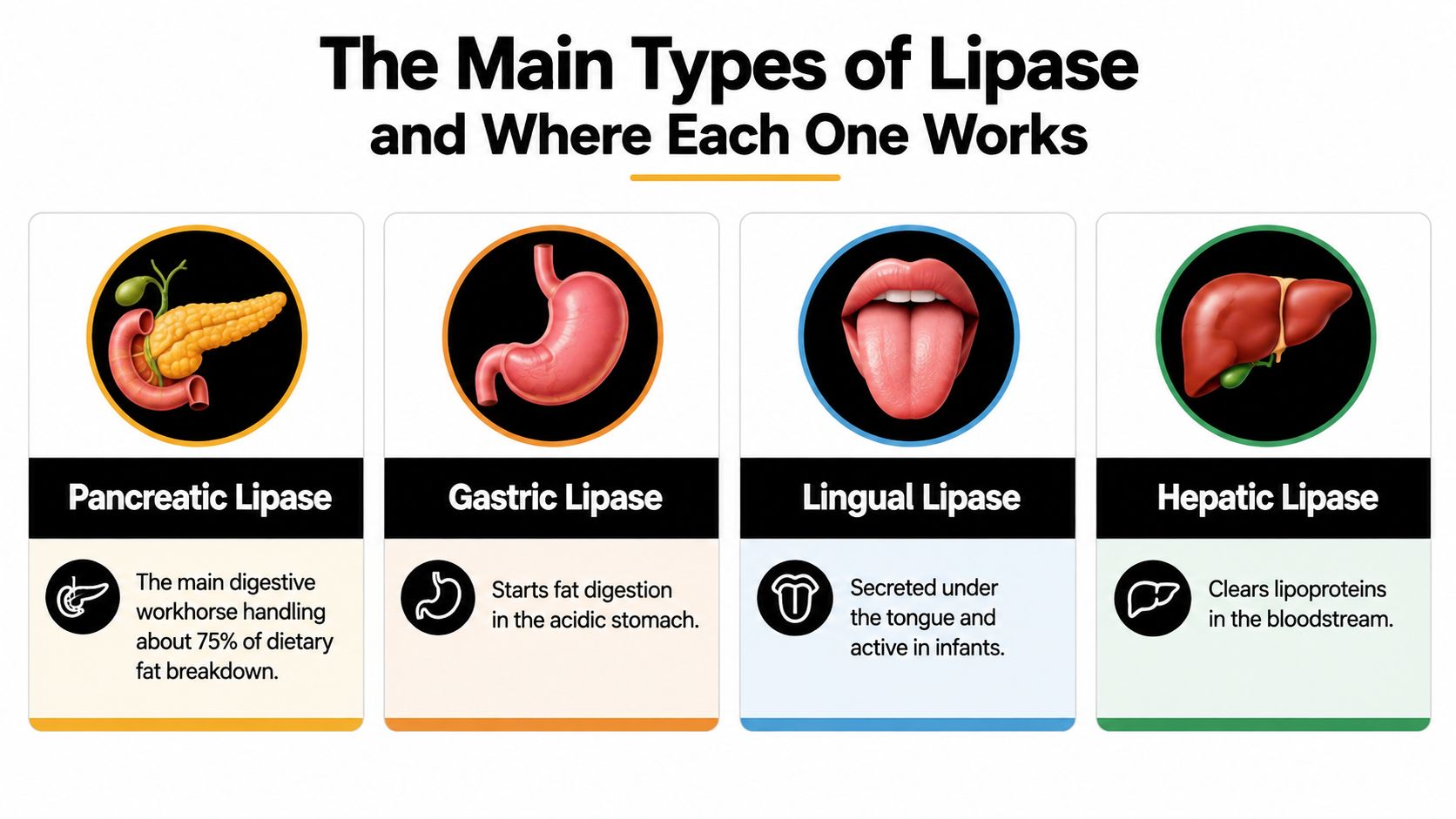
The Main Types of Lipase and Where Each One Works
Not all lipases do the same job. Their names may look interchangeable on a supplement label or in a health article, but location determines function.
Pancreatic lipase
Pancreatic lipase is the principal digestive form. It enters the small intestine in pancreatic juice and hydrolyzes about 75% of dietary triglycerides, according to research published in the American Journal of Veterinary Research. It depends on emulsified fat, bile salts, colipase, and a suitable intestinal environment.
Gastric lipase
Gastric lipase works in the stomach and starts the breakdown of dietary fat. It cleaves approximately 15 to 20% of dietary fatty acids, as described in the review of gastrointestinal fat digestion. Its contribution continues to matter because it begins processing fat before pancreatic secretions arrive.
Lingual lipase
Lingual lipase is secreted in the mouth and contributes to early fat digestion. Its role is particularly relevant during infancy, when digestive conditions and feeding patterns differ from those of adults. It belongs to the digestive family, but it shouldn't be confused with pancreatic lipase.
Lipoprotein lipase
Lipoprotein lipase, or LPL, operates outside the intestinal lumen. It hydrolyzes triglycerides carried in circulating chylomicrons and very-low-density lipoproteins, releasing fatty acids for uptake by tissues. LPL therefore participates in systemic lipid transport, not the direct digestion of a meal in the small intestine.
This distinction has a clinical history. A review of lipase biology and milestones describes Claude Bernard's identification of pancreatic lipase in 1848, the recognition of LPL in 1943, and later work connecting defective LPL activity with severe hyperchylomicronemia. Those discoveries show why “lipase function” covers both nutrient digestion and blood lipid handling.
The four types are best understood by asking one question: where is the enzyme acting? Stomach and intestinal lipases help digest food. LPL acts on circulating particles after fats have entered the bloodstream.
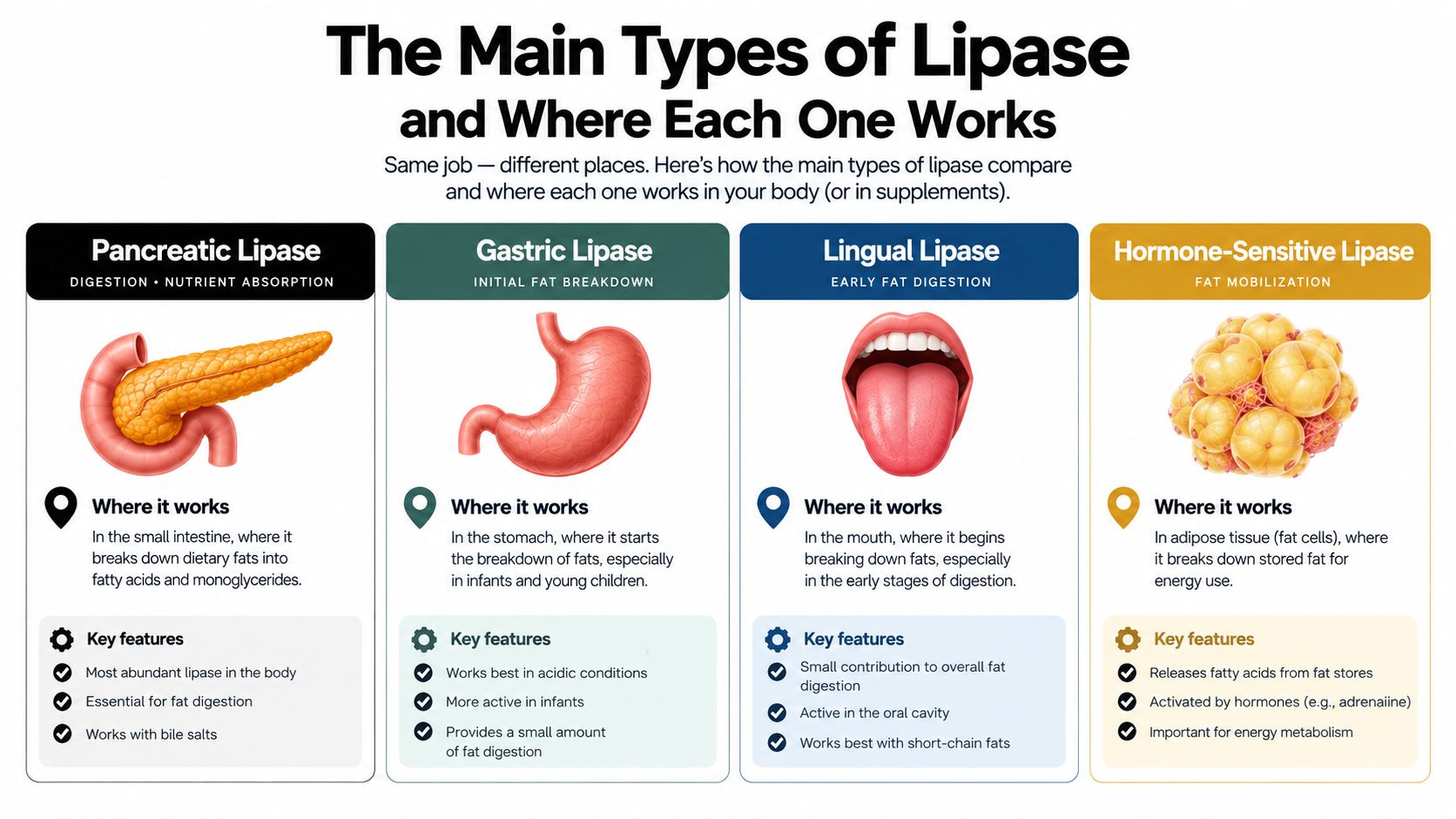
The digestive sequence is easier to remember when you follow the food, while LPL makes sense only after you follow the lipids beyond the gut.
The Catalytic Mechanism Behind Lipase Function
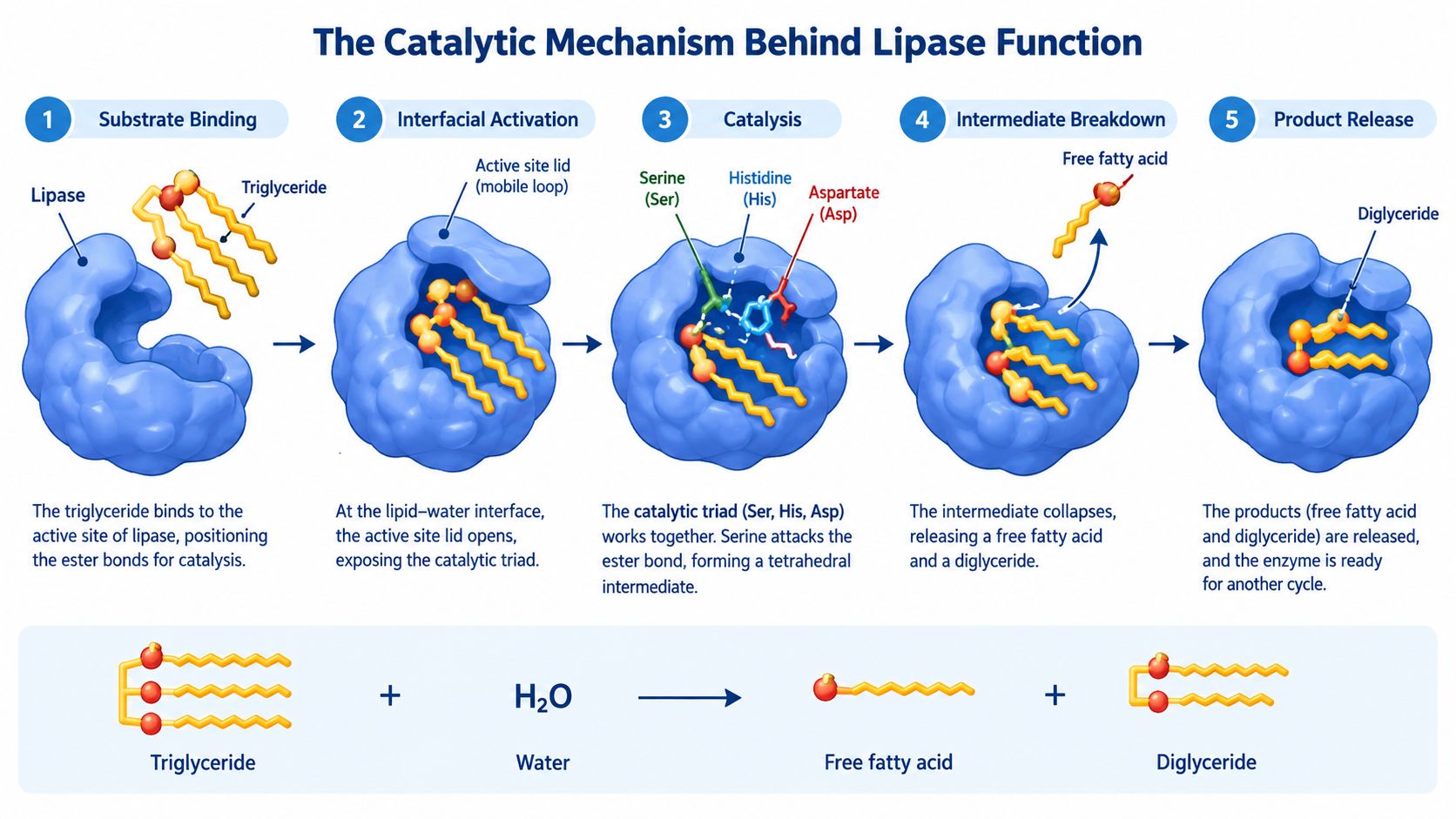
Lipase doesn't dissolve a fat droplet from the inside. It works at the lipid-water interface, the boundary where an insoluble fat particle meets the watery digestive environment. Emulsification by bile expands that boundary and makes more triglyceride available.
Pancreatic lipase faces a complication. Bile salts help organize fat into micelles, but they can also interfere with the enzyme's ability to bind directly to the lipid surface. Colipase, a pancreatic cofactor of approximately 10 kilodaltons, acts like a small molecular anchor. It helps pancreatic lipase stay attached to the lipid droplet so catalysis can continue.
Why pH changes the reaction
Pancreatic lipase is secreted in pancreatic juice at approximately pH 8. Experimental work summarized in this review of physiological parameters governing pancreatic lipase indicates that the enzyme loses catalytic activity below pH 5.
The enzyme's effective operating range also changes in the presence of bile salts. Without them, activity favors an alkaline optimum around pH 8 to 9. With bile salts, colipase helps the enzyme function in the near-neutral, slightly acidic conditions found in the upper small intestine. At about pH 7, bile salts can prevent efficient substrate binding unless colipase is available.
This is why a lipase unit number doesn't tell the whole story. Enzyme source, formulation, pH stability, meal composition, and whether the enzyme survives until the relevant intestinal site can all affect performance. A plain-language overview of the broader topic is available in how enzymes help digestion, but biochemical activity still shouldn't be treated as proof of a clinical outcome.
Real-World Examples of Lipase at Work and Under Strain
When pancreatic output drops below a critical threshold, undigested fat can move through the bowel largely unchanged. Orlistat intentionally mimics part of this situation by inhibiting gastrointestinal lipases. Oily stools, gas, and urgency can therefore appear as predictable effects of reduced fat digestion.
After a rich meal containing fried food, cream sauce, or another concentrated fat source, digestion follows a coordinated sequence. The stomach starts processing the meal, while pancreatic lipase, bile salts, and colipase act in the small intestine. Fullness may follow a large meal, but normal digestion does not usually cause ongoing oily stools or progressive nutrient loss.
Pancreatic strain creates a different pattern. In chronic pancreatitis or cystic fibrosis, damage or dysfunction can reduce the delivery of digestive enzymes. Dietary fat may then remain incompletely processed, contributing to excess stool fat, weight loss, and lower levels of fat-soluble vitamins.
These examples form a practical spectrum:
- Normal digestion: Lipase, bile, colipase, and intestinal absorption coordinate after eating.
- Intentional inhibition: A medication lowers lipase activity, leaving more dietary fat undigested.
- Pancreatic insufficiency: The pancreas supplies too little digestive capacity, producing a wider malabsorption problem.
Symptoms reflect the full digestion and absorption process, so they cannot identify lipase activity by themselves. Bloating after dairy, for example, may relate to lactose digestion, meal volume, fermentation, or another trigger. Adding an over-the-counter lipase product may not address the cause when the meal is not mainly a fat-digestion problem.
The distinction also matters when reading supplement labels. A high enzyme-unit number describes measured activity under test conditions, not proof that the product survives digestion or improves absorption. Over-the-counter lipase enzymes and prescription pancreatic enzyme replacement therapy are therefore not interchangeable.
When Low Lipase Activity Becomes a Real Problem
A person may have reduced pancreatic enzyme output without noticing it at first. The digestive system has reserve capacity, so mild changes can remain quiet. Symptoms usually become more persuasive when fat digestion and absorption are repeatedly affected, especially through steatorrhea, unintended weight loss, or signs of fat-soluble vitamin deficiency.
Exocrine pancreatic insufficiency, or EPI, means the pancreas does not release enough digestive enzymes to break down and absorb nutrients effectively. Chronic pancreatitis, pancreatic surgery, cystic fibrosis, and other pancreatic disorders can increase the likelihood. Oily, floating, or unusually foul-smelling stools are useful clues, but no single symptom proves that lipase is the cause.
How clinicians investigate the pattern
Fecal elastase-1 is a commonly used noninvasive test when EPI is suspected. A clinician interprets the result with the person's symptoms, nutritional status, medical history, and other findings. A supplement label cannot diagnose pancreatic insufficiency, just as a large lipase-unit number cannot show that digestion has improved.
Bloating after a particular food may reflect fermentation, meal size, lactose digestion, altered bowel habits, or another trigger. That pattern differs from repeated greasy stools accompanied by weight loss or nutrient deficiency, although symptoms can overlap. An occasional meal-related complaint calls for observation rather than assuming a pancreatic disorder.
A practical decision tree keeps the response proportionate: if steatorrhea or unexplained weight loss is present, request a fecal elastase-1 test; if symptoms are occasional and meal-linked, a food and symptom diary is the appropriate first step. Persistent or worsening findings deserve clinical assessment, particularly with a history of pancreatic disease.
For a plain-language explanation of the broader symptom pattern, see what fat malabsorption can mean. The key distinction is between a product's stated activity and its clinical effect. More lipase units are not automatically better, because effective treatment depends on the underlying problem, enzyme delivery, timing, and whether maldigestion has been established. Over-the-counter lipase products and prescription pancreatic enzyme replacement therapy serve different roles, so one should not be treated as a substitute for the other.
Digestive Enzyme Supplements and When They Make Sense
Over-the-counter digestive enzyme blends and prescription pancreatic enzyme replacement therapy, or PERT, serve different purposes. PERT commonly begins around 25,000 to 50,000 lipase units per meal and may be titrated substantially higher under medical supervision, as described in clinical guidance on digestive enzyme replacement. That treatment is designed for confirmed or strongly suspected pancreatic insufficiency, not casual experimentation.
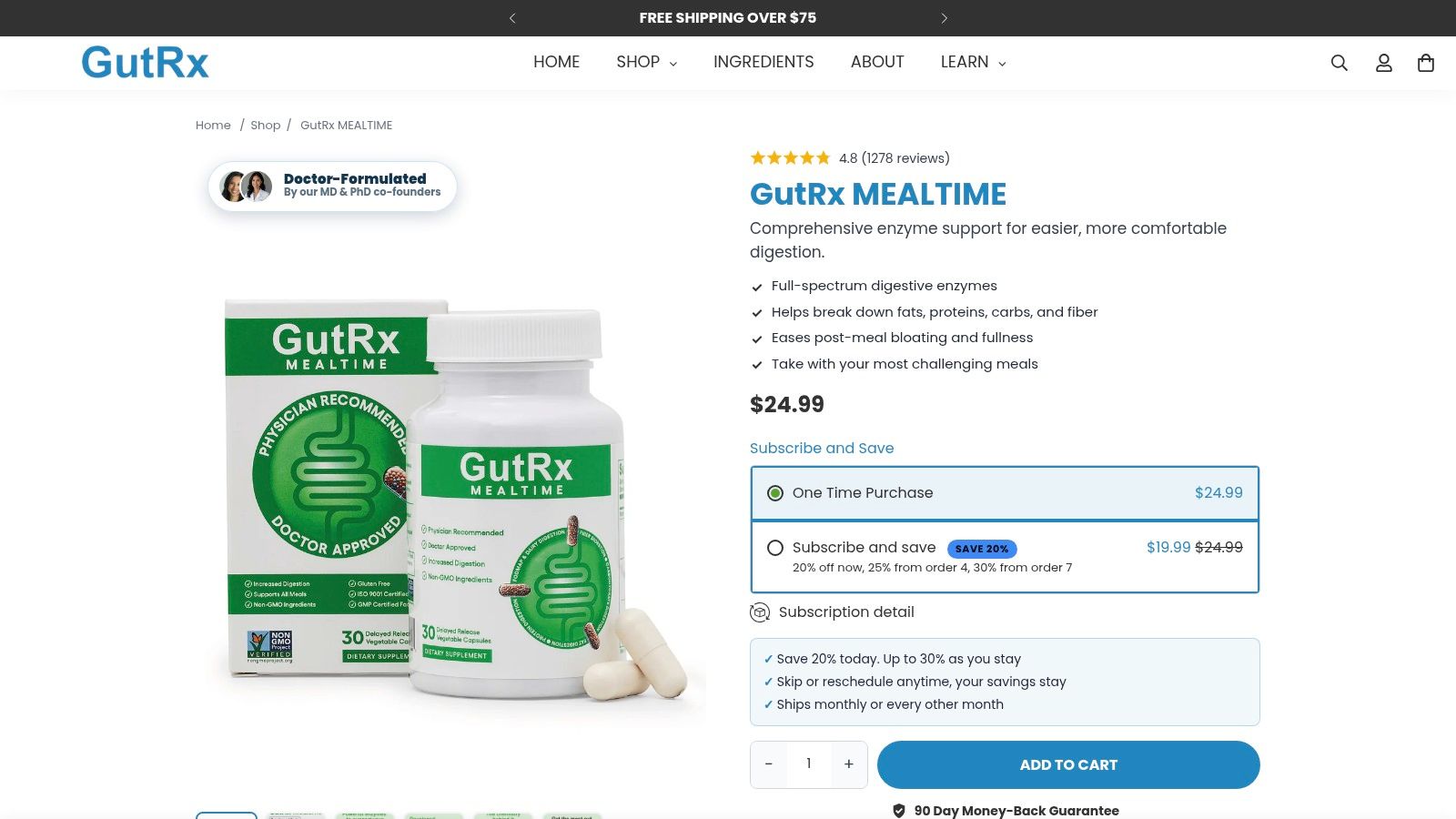
OTC products are generally positioned around meal-related comfort. A formula may combine enzymes for fat, protein, fiber, dairy, and FODMAP digestion, which is broader than lipase alone. GutRx Mealtime is described as a multi-enzyme formula covering those digestive targets, making it relevant to a heavy, dairy-rich, or fiber-heavy meal context, but it shouldn't be presented as a replacement for PERT.
What a label can and can't tell you
An enzyme unit measures activity under defined assay conditions. It doesn't automatically tell you how much activity remains after storage, whether the enzyme survives the stomach, how it behaves with a particular meal, or whether the user experiences better absorption.
Look for quality signals that make the label easier to interpret:
- Activity assays: Prefer clearly stated enzyme activity over an ingredient name alone.
- Testing transparency: Third-party testing and accessible quality documentation provide more useful context than a large-sounding unit count.
- Delivery information: Formulation and stability matter because enzymes must reach the site where they act.
- Scope of claims: A meal-support product shouldn't claim to treat EPI unless it has an appropriate medical basis.
A practical guide to blend design is available in this explanation of digestive enzyme blends. Consider an OTC product when symptoms are occasional, clearly meal-related, and not accompanied by malabsorption red flags. Involve a clinician when symptoms persist, stools become oily, weight changes without intent, nutrient deficiencies appear, or you have a relevant pancreatic history.
Putting It All Together for Better Digestion
After a rich meal, fat digestion depends on coordination rather than one enzyme acting alone. Lingual and gastric lipases begin hydrolysis, pancreatic lipase performs most of the work in the small intestine, and bile helps move the resulting fatty acids and monoglycerides into micelles for absorption. LPL has a different assignment: it releases fatty acids from triglycerides carried in circulating lipoproteins outside the gut.
That distinction matters when choosing support. An occasional heavy feeling after a fatty, dairy-heavy, or unusually large meal may fit a meal-support approach, such as GutRx Mealtime. An enzyme label, however, cannot show whether a product survives the stomach, matches the meal, or improves nutrient absorption. OTC digestive enzymes and prescription pancreatic enzyme replacement therapy are therefore different tools, with different purposes and clinical oversight.
Use three questions to guide the decision:
- Identify the pattern. Occasional, meal-specific discomfort calls for a different response than persistent symptoms, oily stools, or unexplained weight loss.
- Match the support. Adjust the meal and consider any supplement according to the symptoms and digestive need you are addressing.
- Recognize warning signs. Seek clinical guidance for steatorrhea, nutrient deficiencies, unintentional weight loss, or a history of pancreatitis.
Food decisions also include your relationship with eating and your body. The perspective in 4 ways to honor your body can support a practical plan without treating every post-meal sensation as disease.
GutRx offers Mealtime digestive enzyme support alongside synbiotic products for broader digestive goals. Visit GutRx to review the available options. This approach belongs in the meal-support category. Clinical evaluation is appropriate when steatorrhea, weight loss, or pancreatic history is present.


