

The most popular advice treats low FODMAP vs high FODMAP as a permanent verdict. Cut the "bad" foods, keep the "safe" ones, and stay there. That advice is too blunt.
A low-FODMAP pattern limits fermentable carbohydrates for a short, structured trial. A high-FODMAP pattern includes larger combined amounts of those same carbohydrates. Neither pattern is a moral ranking of food. Symptoms in susceptible people track dose, meal stacking, and gut sensitivity. Many high-FODMAP foods still supply fiber and prebiotic carbohydrates.
The useful comparison isn't which list to obey forever. It's which pattern fits a specific gut problem, for how long, and what you put back afterward.
Table of Contents
- Defining Low FODMAP and High FODMAP Eating
- Typical Foods in Each Category
- What Clinical Trials Show for IBS Symptoms
- Who Each Approach Suits Beyond IBS
- Weighing Benefits, Risks, and Reintroduction
- Running a Trial with Practical Meal Examples
- Choosing Your Next Step for Digestive Support
Defining Low FODMAP and High FODMAP Eating
High-FODMAP foods aren't simply harmful. Wheat, onion, garlic, legumes, milk, and certain fruits are ordinary foods. They become a problem for some people when the combined load of poorly absorbed, rapidly fermentable carbohydrates gets high.
FODMAP is the group name for those carbohydrates: fructans, galacto-oligosaccharides (GOS), lactose, excess fructose, and polyols. Low-FODMAP eating limits the total amount in a sitting. It doesn't ban a food family. A high-FODMAP meal is usually a stack of those sources, not one villain ingredient.
Two physical effects, not a food label
Poorly absorbed short-chain carbohydrates stay in the small-intestinal lumen and pull or hold extra water. Once they reach the colon, bacteria ferment them quickly and gas rises. Extra water plus extra gas can stretch the bowel. People with visceral hypersensitivity may then feel bloating, pain, discomfort, or a change in stool. MRI and breath-testing research supports both the fluid shift and the fermentation effect, so the comparison is about physiology, not a grocery label.
Practical rule: Judge the meal, not a single ingredient. Several moderate servings can cross a symptom line even when no one food looks extreme.
That split matters if you have IBS, and it also matters if you're only chasing everyday comfort. For IBS, the low pattern is a time-limited test of carbohydrate load. For general eating, a higher-FODMAP pattern can still be the more varied, fiber-rich choice. Someone without symptoms can eat onion, beans, and apple in one lunch and feel fine. Someone with IBS may not. The difference is dose and sensitivity, not a damaged food.
Typical Foods in Each Category
"High FODMAP" isn't one ingredient or one aisle. The National Institute of Diabetes and Digestive and Kidney Diseases spreads examples across fruits, vegetables, legumes, dairy, grains, honey, and polyol sweeteners. That's why two people can flare on different plates for different biochemical reasons.
Common High-FODMAP and Lower-FODMAP Food Examples
| Food category | Commonly high-FODMAP examples | Typical lower-FODMAP choices |
|---|---|---|
| Fruit | Apples, apricots, blackberries, cherries, mangoes, pears, plums, watermelon | Firm banana, blueberries, orange, kiwi, pineapple |
| Vegetables and legumes | Artichokes, asparagus, beans, cauliflower, garlic, lentils, mushrooms, onions, snow peas | Carrot, cucumber, spinach, potato, zucchini, green beans |
| Dairy | Milk, soft cheese, yogurt, custard, ice cream | Lactose-free milk or yogurt, hard cheeses such as cheddar or parmesan |
| Grains | Wheat and rye breads, cereals, and pastas | Rice, oats, quinoa, corn tortillas, rice noodles |
| Sweeteners | Honey, high-fructose corn syrup, sorbitol, mannitol, xylitol, maltitol | Maple syrup, table sugar, in modest amounts |
A food lands on the high side because of what it carries. Onion and garlic are classic fructan sources. Beans and lentils carry GOS. Milk and soft dairy carry lactose. Apples, mangoes, and honey often bring excess fructose. Cauliflower, mushrooms, and sweeteners ending in "-ol" bring polyols. You can react to one of those groups and tolerate another.
Why the same food can switch sides
Classifications are serving-size and dose dependent. The Monash cutoff framework uses lab assays for excess fructose, lactose, fructans, GOS, sorbitol, and mannitol. Practical low cutoffs per serving include less than 0.30 g of oligosaccharides in core grains, legumes, nuts, and seeds; less than 0.20 g in vegetables, fruits, and other products; less than 0.20 g of either sorbitol or mannitol; less than 0.40 g of total polyols; less than 0.15 g of excess fructose in most foods; and less than 1.00 g of lactose. In dietary studies, the low arm generally kept total FODMAPs, excluding lactose, to no more than 0.5 g per sitting.
A smaller serving of a "high" food can fall under those lines. A plate of several moderate foods can pass them even when nothing looks concentrated. For portion-aware swaps while you shop, the digestive-friendly food swaps from Mise are a practical cross-check beside a dietitian's list.
What Clinical Trials Show for IBS Symptoms
The performance gap is symptom load in people with IBS, not a universal benefit for every digestive complaint.
A 2014 randomized crossover trial compared 21 days of low-FODMAP eating with 21 days of a typical Australian diet in 30 adults with IBS and 8 healthy controls. Among the IBS participants, overall gastrointestinal symptom scores averaged 22.8 (95% CI 16.7-28.8) on the low-FODMAP phase versus 44.9 (95% CI 36.6-53.1) on the typical diet. That's about a 49% lower mean symptom score. The trial helped separate "low" from "high" eating. Symptoms aren't caused by one universally harmful food. They may rise when someone eats larger combined amounts of poorly absorbed, rapidly fermentable carbohydrates.
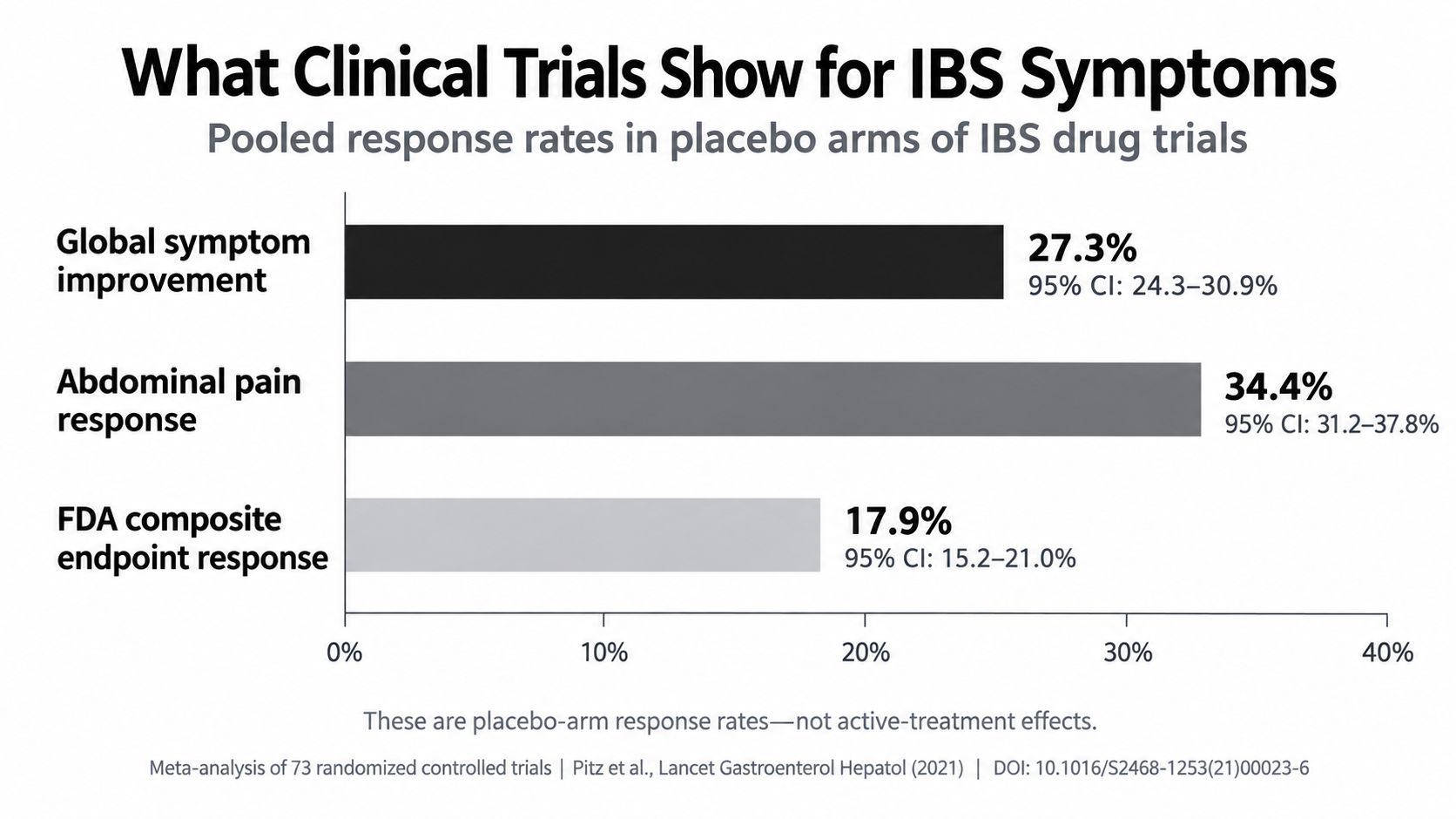
Control groups improve too. The chart above shows pooled placebo-arm response rates for global symptom improvement, abdominal pain, and FDA composite endpoints. Read a personal trial against your own baseline, not against a promise that every high-FODMAP food is the problem.
Relief rates are real, and they aren't uniform
A randomized 2×2 factorial trial enrolled 104 adults aged 18-65 with IBS. In the intention-to-treat analysis, 57% on a low-FODMAP diet reported adequate symptom relief versus 38% on a sham diet. That gap narrowly missed conventional significance (P=.051). Per protocol, relief was 61% versus 39% (P=.042). Mean IBS Severity Scoring System scores were 173 ± 95 versus 224 ± 89 (P=.001). A later synthesis of 13 randomized trials and 944 patients found that, compared with habitual diets, low-FODMAP treatment reduced the relative risk of failing to improve global IBS symptoms to 0.67 (95% CI 0.48-0.91).
A near-halving of mean symptom score in a short crossover can sit beside a large minority who still don't get adequate relief.
These numbers don't make high-FODMAP foods unhealthy. Many are nutritious. They show that lowering total exposure can help a substantial share of people with IBS, while reintroduction is still required. How this diet trial sits next to other care is covered in IBS treatment guidelines.
This video walks through how FODMAP load relates to IBS symptoms, which is the mechanism behind the score changes above.
Who Each Approach Suits Beyond IBS
Adults whose symptoms track meals
If bloating, gas, or stool changes follow what you eat, a time-limited low-FODMAP trial is the pattern built for that job. Run it with a clinician or dietitian, then liberalize. It isn't a lifestyle brand.
An umbrella review of low- versus high-FODMAP comparisons reported no significant overall effect on abdominal pain, stool consistency, stool frequency, or microbiota. At the same time, randomized research has found altered microbial richness and lower abundance of carbohydrate-fermenting organisms after low-FODMAP eating. Symptom relief and microbial change don't always travel together, and long-term clinical meaning is still uncertain. "It works" isn't one outcome for every patient or every endpoint.
People with discomfort and no diagnosis
Discomfort alone isn't a reason to strip the diet for months. Meal size, caffeine, fat, stress, and low fiber can drive the same complaints. A clinician should check red-flag symptoms before you restrict. A short supervised trial can still be reasonable when symptoms are clearly meal-linked and persistent. It isn't a self-assigned identity, and it isn't the first move if eating already feels rigid.
People eating for general diet quality
Legumes, wheat, and fruit earn their place when you don't have IBS-type symptoms. They contribute fiber and prebiotic carbohydrates. A higher-FODMAP pattern, with ordinary portion awareness, usually fits better than a ban. Restriction here solves a problem you don't have, and it can shrink variety for no symptom gain.
If meals don't provoke symptoms, the higher-FODMAP pattern is often the more nutritious default.
Bring in a dietitian before any strict phase if you have diagnosed IBS, unintentional weight loss, a history of restrictive eating, pregnancy, or a diet that's already narrow. Children and people with an eating-disorder history are poor candidates for a strict phase. The choice is situational. It isn't a winner between two food lists.
Weighing Benefits, Risks, and Reintroduction
Symptom improvement during restriction doesn't make that phase free of trade-offs.
Across nine studies, restriction consistently reduced Bifidobacteria. Overall microbial diversity and fecal short-chain fatty acids didn't show consistent declines. A clinical review of the three-phase approach notes that the restriction phase commonly lasts about 4-8 weeks, and that microbiota measures and nutrient adequacy can improve once the diet is personalized. FODMAPs include fermentable carbohydrates that can support beneficial gut microbes. Cutting them to run a test is different from cutting them for life. An unnecessarily broad plate also risks lower calcium, iron, and overall variety if nobody is watching the swaps.
A prospective study summarized for the American College of Gastroenterology shows why stopping at restriction backfires. Six weeks of restrictive eating dropped mean IBS Symptom Severity Score from 301 ± 97 at baseline to 150 ± 116, and 80% of participants had a responder-defined drop of more than 50 points. Symptoms returned in 85% when foods were reintroduced or the restrictive phase ended.
Watch the trade-off: Feeling better on the strict phase doesn't prove the foods you removed are damaging. It shows your dose was too high for your gut right then.
What reintroduction is actually for
Monash guidance on the three phases says to move into structured reintroduction after the opening period if symptoms improve, while adding FODMAP-containing foods back slowly. That stage commonly takes about 6-8 weeks. Each subgroup is tested on its own so a tolerance threshold isn't confused with total intolerance. A small serving of onion that you handle is not the same finding as a flare at any amount.
Judge the whole plan on three outcomes, not one. Symptom relief tells you the trial did something. Nutritional adequacy tells you the remaining diet still feeds you. Microbial ecology is the outcome we understand least, which is exactly why permanent avoidance is the wrong default. If you're also weighing a supplement during this phase, low-FODMAP eating and digestive enzymes separates a food test from a capsule decision.
Running a Trial with Practical Meal Examples
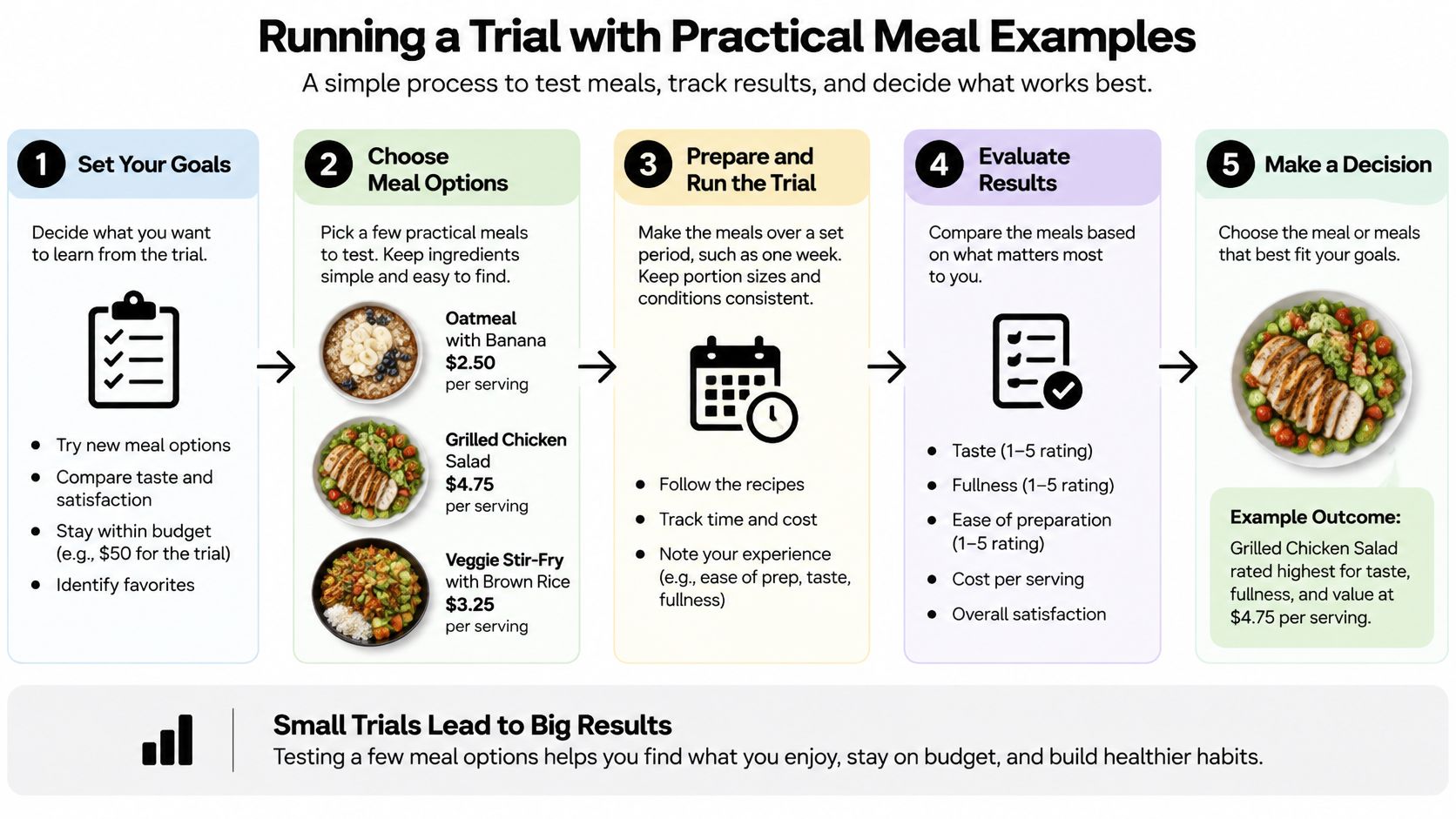
The figure is a simple test loop: set a baseline, change one meal pattern, hold portions steady, log symptoms, then decide before the next change. The clinical version of that loop has three named steps, not a forever menu.
The sequence
Monash's three-step sheet sets Step 1 at about 2-6 weeks, which overlaps the longer clinical window already noted. You substitute high-FODMAP foods with lower-FODMAP alternatives. If symptoms improve, Step 2 challenges one subgroup at a time: fructose, lactose, sorbitol, mannitol, fructans, and GOS, while the rest of the diet stays low. A typical challenge uses one reintroduction food daily for three days, so you can see both the group and the serving you tolerate. Step 3 keeps those tolerated amounts. Indefinite restriction isn't the objective.
Stacking still decides the day. As the cutoff work showed earlier, several individually moderate ingredients can pass a practical threshold together. Change one variable, or you won't know what flared.
One day, two versions
Breakfast. High pattern: wheat toast, honey, and a large ripe banana. Lower swap: oats or rice cakes, maple syrup, one firm banana, and lactose-free yogurt. Keep the fruit to a single piece so breakfast doesn't preload the day.
Lunch. High pattern: a wheat wrap piled with onion, beans, and cauliflower. Lower swap: a corn tortilla or rice bowl with chicken or firm tofu, carrot, spinach, and no garlic. Use garlic-infused oil if you want the flavor. Fructans don't leach into oil the way they do into a water-based sauce.
Dinner. High pattern: wheat pasta in a garlic-onion sauce with mushrooms. Lower swap: rice or a gluten-free pasta, tomato sauce without onion, zucchini, and a clear protein portion. Protein and fiber meals can stay filling without three fermentable sides on the same plate.
Snack. High pattern: an apple plus cashews. Lower swap: an orange or kiwi plus a small handful of peanuts or walnuts.
Write the portion, not just the food name. If lunch and the snack both carry moderate fructans, the day can fail even when each item looked acceptable alone.
Choosing Your Next Step for Digestive Support
Match the pattern to the job, using the three outcomes together.
Choose a structured low-FODMAP trial, with a clinician or dietitian, when IBS-type bloating, gas, or stool changes clearly follow meals and you can commit to reintroduction. Choose a varied, higher-FODMAP diet with portion awareness when you don't have those symptoms and you want the fiber and prebiotic carbohydrates those foods carry. Choose enzyme support as a complement, not a substitute, when discomfort shows up after specific meals, such as dairy, a heavy mix of protein and fat, or a known FODMAP stack, and broad restriction isn't the right first move.
GutRx MEALTIME is a digestive enzyme product aimed at digestion, bloating, and nutrient absorption, with a focus that includes protein, fat, fiber, dairy, and FODMAP-containing meals. It's one option to raise with a clinician. It doesn't replace a food trial, a diagnosis, or medical care.
What to do this week
Keep a seven-day log. Write the meal, rough portions, and symptoms within a few hours: bloating, pain, gas, and stool. Don't change five variables at once. At the end of the week, take the log to a dietitian and decide whether Step 1 is worth starting. If the pattern is obvious, such as ice cream or a large onion-and-bean bowl, test the portion first. If symptoms are constant no matter what you eat, restriction is the wrong opening move.
Relief without nutritional adequacy is a bad trade. A microbiome story without symptom data is incomplete too. A personal threshold beats either permanent list.
GutRx builds digestive support around how people eat, including enzyme support for meals that include dairy or FODMAP-containing foods, plus daily options aimed at regularity and balance. If you're sorting a short food trial from a supplement decision, use this week's symptom log and then look at the formulas at GutRx. A clinician should still guide any restriction phase.


