

A true vegan prebiotic supplement must contain specific fermentable fibers, such as inulin, fructooligosaccharides (FOS), galactooligosaccharides (GOS), or resistant starch, rather than just any plant-derived fiber. It should also be third-party tested for purity, identity, and contaminants.
Is a plant-based fiber automatically a prebiotic? No. Vegan describes the ingredient's origin, while prebiotic describes what the ingredient does in the gut. That distinction matters if you're comparing supplements for bloating, irregularity, microbiome support, or a daily synbiotic routine.
A useful label should tell you the exact fiber source and amount. It shouldn't hide behind phrases such as “natural fiber blend” or “feeds your good bacteria” without identifying the fermentable substrate. The right product can be a practical addition to a balanced diet, but more fermentability isn't automatically better, particularly if you're prone to gas, bloating, IBS symptoms, or FODMAP sensitivity.
Table of Contents
- Understanding Vegan Prebiotics Versus General Fiber
- Top Ingredients Found in Effective Supplements
- How Prebiotics Support Gut Balance and Digestion
- Evaluating Quality Standards and Testing
- Integrating Prebiotics into Your Daily Routine
- Making the Right Choice for Your Gut Health
Understanding Vegan Prebiotics Versus General Fiber
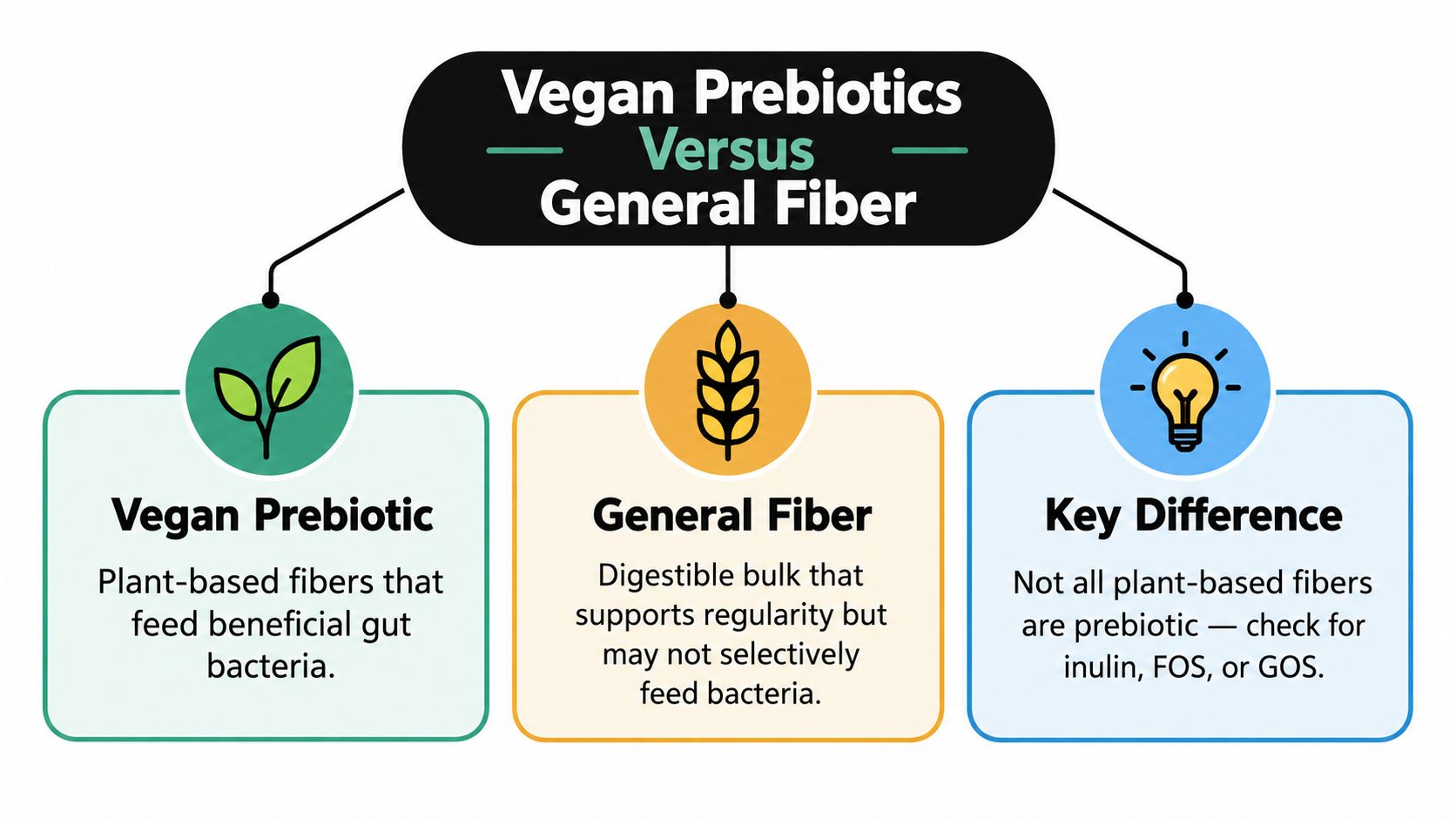
Could a vegan fiber supplement support digestion without functioning as a true prebiotic? Yes. Dietary fiber is a broad category, while a prebiotic has a narrower definition: a substrate selectively used by host microorganisms in a way associated with a health benefit. Earlier definitions emphasized nondigestible ingredients that selectively stimulated beneficial bacteria in the colon. Plant-based describes an ingredient's origin. Prebiotic describes its activity in the gut, which requires evidence of microbial use and a resulting physiological effect (scientific review of the prebiotic definition).
General fiber may still support bowel regularity and digestive function without selectively feeding a particular bacterial group. The FDA defines fiber as carbohydrate that is not readily digested in the small intestine and notes that it can help move food and waste through the body and increase bowel-movement frequency (FDA dietary fiber guidance). That makes fiber useful, but a fiber claim alone does not establish prebiotic activity.
What happens after you swallow it
Many prebiotic carbohydrates pass through the small intestine largely undigested. Microorganisms in the colon ferment them, producing short-chain fatty acids such as acetate, propionate, and butyrate. These compounds may influence intestinal energy metabolism, barrier signaling, immune regulation, and microbial activity (review of prebiotic fibers and fermentation).
That biology gives a vegan prebiotic supplement a different evaluation standard from a generic fiber powder. A product may increase daily fiber intake while offering little evidence that its substrate is selectively fermented. A clearly named inulin or FOS product has a more specific rationale, although rapid increases can cause gas and discomfort.
Practical rule: Plant-based identifies the source. Prebiotic identifies how microorganisms use the ingredient and whether that use is linked to a benefit.
How to read the distinction on a label
The FDA lists a Daily Value of 28 grams of fiber per day on a 2,000-calorie diet. Common adult recommendations include approximately 38 grams daily for adult men and 25 grams daily for adult women, depending on sex and energy needs. These figures describe total fiber intake, not a universal serving target for supplemental prebiotic fiber.
Check the label for five details:
- Named substrate: Look for inulin, FOS, GOS, resistant starch, or another specifically identified fermentable fiber.
- Amount per serving: A proprietary blend prevents you from judging how much of each ingredient you receive.
- Evidence behind the claim: Total fiber does not prove selective fermentation.
- Digestive tolerance: Highly fermentable products may aggravate symptoms for people with IBS or FODMAP sensitivity.
- Testing information: Vegan status does not confirm purity, potency, allergen controls, or contaminant testing.
A guide to fiber supplements and whole foods can help compare concentrated products with food-based sources. The practical takeaway is straightforward: choose a named, quantified substrate rather than assuming every plant-derived fiber performs the same job.
Top Ingredients Found in Effective Supplements
Which ingredients justify a supplement's “prebiotic” claim? Start with the substrate, not the marketing name. Inulin, FOS, GOS, and resistant starch are established examples of fibers that resist digestion in the small intestine and can provide fermentable material for microorganisms in the colon. A label that lists only “plant fiber” or “prebiotic complex” does not give enough information to judge whether the product contains a selectively fermented substrate.
Inulin and FOS
Inulin and fructooligosaccharides are closely related inulin-type fructans. Studies have examined their capacity to stimulate Bifidobacterium, a commonly studied bacterial genus, while fermentation can produce short-chain fatty acids such as acetate, propionate, and butyrate.
The amount supplied still matters. Human research suggests that approximately 3 grams per day of inulin-type fructan may reach a threshold for increasing bifidobacteria in some adults. In one controlled study, a positive microbiome response occurred in 25 of 30 participants at 8 grams per day, compared with 20 of 30 at 5 grams per day (evidence on established prebiotic fibers). These findings do not establish a guaranteed dose for every person. Results can vary with the substrate, existing microbiota, digestive tolerance, and clinical context.
Inulin may suit someone looking for a clearly identified fermentable fiber. It can be a poor fit for someone already dealing with pronounced gas, because rapid fermentation may increase discomfort in susceptible individuals.
GOS
Galactooligosaccharides are another recognized prebiotic fiber. GOS resists digestion and reaches the colon, where microorganisms ferment it. Research has examined its ability to support beneficial bacterial activity, but a trustworthy label should state the quantity rather than hide GOS inside an undisclosed blend.
GOS can appeal to consumers who want a targeted fermentable ingredient and do not want to assume that all plant-derived fibers behave alike. Tolerance remains individual. Consider current symptoms, the rest of the diet, and how much fermentable carbohydrate meals already provide before choosing a product.
Resistant starch
Resistant starch escapes digestion in the small intestine and reaches the colon, where microorganisms can ferment it. It may therefore meet the functional definition of a prebiotic when selective microbial use and a health benefit have been demonstrated. Because sources behave differently, a useful label should identify the specific resistant-starch ingredient rather than stopping at the category name.
Compare products by intended use, serving size, existing dietary fiber, and likely tolerance. The fiber name identifies the category, while the dose and supporting evidence show how to interpret the formula. A generic “fiber” claim alone cannot establish that a supplement delivers the same selective fermentation associated with a named prebiotic.
What the label should not imply
A formula may pair a probiotic with a prebiotic, creating a synbiotic approach. Evidence for the probiotic does not automatically show that the prebiotic works independently. A 2020 systematic review of 33 randomized controlled trials involving 4,321 patients with IBS reported improved global IBS symptoms with probiotics compared with placebo, while finding substantial variation between studies and comparatively limited evidence for prebiotics alone (systematic review of probiotics and synbiotics in IBS).

For shoppers assessing a combined formula, GutRx COMPLETE is described as a probiotic and prebiotic blend containing 62B CFUs, Akkermansia muciniphila, and SIBO support. Evaluate that description as a formulation summary, then check the specific prebiotic fiber identity and quantity before judging its likely effect.
Use this guide to prebiotic fiber supplements to compare isolated ingredients, blends, and food sources without treating every microbiome claim as equivalent.
How Prebiotics Support Gut Balance and Digestion
Could a vegan prebiotic supplement support digestion while making bloating worse? The answer depends on the fiber's fermentation pattern, dose, and your current symptoms. Selective fermentation can change microbial activity and produce short-chain fatty acids, but those effects do not guarantee immediate relief from irregularity or discomfort. A product may support the gut ecosystem while remaining a poor short-term choice for a sensitive digestive system.
Constipation research shows why “fiber” should not be treated as a single outcome. An updated meta-analysis of adults with chronic constipation found that fiber supplementation produced a higher treatment-response rate than control, 66% versus 41%, with a relative risk of 1.48 and a 95% confidence interval of 1.17 to 1.88 (meta-analysis of fiber for chronic constipation). The results were more specific than a general “supports gut health” claim. Inulin-type fructans and GOS did not consistently increase stool frequency, although inulin improved stool consistency in some studies.
Match the product to the symptom
For harder stool, a fermentable fiber may help soften consistency without increasing the number of bowel movements. Fluids and gradual introduction still matter. For bloating, the calculation changes. A rapidly fermented ingredient can increase gas before the digestive system adapts, particularly when the diet already contains onions, garlic, legumes, or other fermentable foods.
People with IBS should question generic “feed your good bacteria” messaging. NCCIH summarizes evidence from 11 randomized controlled trials involving 729 people and reports no overall improvement in IBS or functional-bowel symptoms or quality of life compared with placebo. One evidence summary found that moderate doses of some non-inulin-type fructans, specifically below 6 grams per day, improved flatulence, while inulin-type fructans increased flatulence in people with IBS. Doses above 20 grams per day can cause gas, bloating, abdominal pain, cramps, or diarrhea (NCCIH review of IBS and complementary approaches).
Fermentation makes a prebiotic biologically active, not universally suitable.
A 2024 meta-analysis found that prebiotics did not significantly improve bloating in IBS, with a standardized mean difference of -0.34 and a 95% confidence interval from -2.70 to 2.02. It also found no significant improvement in overall IBS symptoms for prebiotics and synbiotics in its pooled analysis (2024 systematic review of prebiotics and IBS).
The practical conclusion is narrower than many product labels suggest. A named, selectively fermented fiber may support microbial activity and bowel function, but it should not be presented as a universal solution for gas, bloating, constipation, or diarrhea. A combined formula also requires separate scrutiny of its probiotic and prebiotic components. For an example of a different delivery format, Mouthology on probiotic mints provides context on how supplements can differ in administration and intended use.
Evaluating Quality Standards and Testing
A vegan label answers one question: whether the product avoids animal-derived ingredients. It doesn't answer whether the fiber is correctly identified, whether the product is free from contaminants, or whether the stated ingredient is present at the expected potency. Those questions require quality documentation beyond front-label language.

What independent testing should establish
Look for testing that addresses identity, purity, potency, and contaminants. For a vegan prebiotic supplement, the certificate should make it possible to connect the finished product to the claimed fiber or blend. A product may also carry non-GMO or gluten-free certifications, but those labels should be treated as separate quality attributes rather than proof of prebiotic efficacy.
A Certificate of Analysis, or COA, is most useful when it identifies the tested product, batch or lot, test methods, results, and acceptance criteria. A vague statement such as “lab tested” is less informative than a downloadable document tied to a specific lot.
For a practical explanation of what this document should contain, use this guide to Certificates of Analysis. You can also review this guide to natural supplement science for broader context on how to assess supplement evidence and manufacturing claims.
Compare the label with the evidence
| Label feature | What it tells you | What it doesn't prove |
|---|---|---|
| Named fiber, such as inulin or GOS | Which substrate the formula uses | That the dose will suit your symptoms |
| Grams per serving | How much total or listed fiber you receive | That the fiber is selectively prebiotic |
| Third-party testing | That an independent process assessed specified criteria | That the product will relieve IBS symptoms |
| Vegan certification | That the product meets a defined animal-free standard | That it is tolerable or clinically effective |
| Downloadable COA | That batch-level documentation may be available | That every health claim is substantiated |
A product with delayed-release protection may be relevant for probiotic delivery, but it doesn't transform a generic fiber into a prebiotic. Similarly, shelf stability can improve convenience without telling you anything about fermentability. Delivery system, certification, and ingredient efficacy are separate decisions.
The following video can help consumers think more critically about supplement formulation and product documentation:
Before purchasing, verify the actual Supplement Facts panel, the fiber identity, the serving size, allergen information, and whether the manufacturer provides lot-level testing. If those details are missing, the product may still contain a useful ingredient, but you have less information with which to judge purity, potency, and suitability.
Integrating Prebiotics into Your Daily Routine
Start with the label's suggested serving, but don't assume you need to reach the full amount immediately. A gradual introduction gives you a way to assess gas, stool changes, cramping, and bloating before the supplement becomes a fixed part of your routine.
A practical introduction plan
- Choose one product first. Don't start a prebiotic, probiotic, digestive enzyme, and new diet at the same time. If symptoms change, you won't know which variable caused the response.
- Use the smallest reasonable amount. Follow the product instructions and begin conservatively, especially if you have IBS, FODMAP sensitivity, or a history of supplement-related bloating.
- Keep fluid intake consistent. Fiber changes stool behavior, so inconsistent hydration can make it harder to interpret the result.
- Track the outcome you want. Record stool consistency, frequency, gas, abdominal pain, and meal-related symptoms rather than relying on a general feeling of “gut health.”
- Adjust or stop if symptoms escalate. Persistent pain, diarrhea, bleeding, unexplained weight loss, or severe symptoms warrant medical assessment rather than more experimentation with fiber.
A useful routine: Change one variable, use a measured serving, and judge tolerance by symptoms rather than by the size of the marketing claim.
Pairing a prebiotic with a probiotic
A prebiotic and a probiotic serve different roles. The probiotic provides selected microorganisms, while the prebiotic provides a substrate that microorganisms may use. A combined synbiotic formula can be reasonable, but the evidence for the probiotic component shouldn't be presented as proof that the prebiotic alone will produce the same outcome.
Consistency generally matters more than a perfect time of day. Take the product according to its label, and consider whether the serving fits around medications or other supplements. If you follow a low-FODMAP diet, don't assume every “vegan” fiber fits the plan. Inulin and some other fermentable carbohydrates may be poorly tolerated, so ingredient-specific guidance is more useful than a general plant-based claim.
Your label checklist
Before adding a product to your shopping cart, confirm:
- Fiber identity: The label names the specific prebiotic substrate.
- Fiber quantity: The amount per serving is clear.
- Testing: The manufacturer explains third-party testing and provides meaningful documentation.
- Vegan status: The claim applies to the capsule, excipients, and manufacturing process where relevant.
- Tolerance guidance: The instructions acknowledge gradual titration and possible gastrointestinal effects.
- Scope of claims: The product supports digestive or microbiome goals without promising a guaranteed IBS outcome.
A supplement should fit your diet and symptom pattern, not force your symptoms to fit its advertising.
Making the Right Choice for Your Gut Health
The strongest buying decision is based on specificity, tolerability, and verification. A vegan prebiotic supplement should identify its fermentable fiber, provide a meaningful serving amount, and explain how the product has been tested. “Plant-based,” “natural,” and “microbiome support” are useful positioning terms, but they don't replace ingredient-level information.
Use this final filter:
- For general fiber support: Confirm the total fiber amount and decide whether you need additional fiber at all.
- For a targeted prebiotic: Look for a named ingredient such as inulin, FOS, GOS, or resistant starch.
- For IBS or significant bloating: Favor gradual dosing and symptom-specific caution over aggressive fermentation.
- For constipation support: Remember that softer stool and more frequent stool are different outcomes.
- For a synbiotic routine: Separate the evidence for the probiotic, prebiotic, and combined formula.
- For product quality: Look for third-party testing, a complete Supplement Facts panel, and accessible COA documentation.
A 2020 review of probiotics found benefits for global IBS symptoms, but also substantial study variation, while evidence for prebiotics alone was comparatively scarce (systematic review of probiotic and synbiotic evidence). That is why a careful practitioner will not recommend a product just because it contains a large blend or carries a vegan badge. The question is whether the formula gives you enough information to judge what you're taking and whether it matches your goal.
Choose transparency over novelty. If a label hides the fiber subtype, combines several ingredients without quantities, or makes broad promises about bloating and microbiome repair, keep looking. A well-defined formula with realistic dosing and independent testing gives you a stronger basis for a safe, informed trial.
GutRx offers digestive support formulas that include probiotic and prebiotic approaches, with GutRx Complete described as a blend featuring 62B CFUs and Akkermansia muciniphila. If you're comparing options for a vegan, transparently labeled gut routine, visit GutRx to review the available formulas and product information.


