

You're at dinner, you stand up later, and the odor is so strong it makes you wonder if something is wrong. Most of the time, the answer is simpler than people think. Smelly gas is usually a chemistry issue, not a hygiene issue, and the smell comes from a tiny sulfur fraction in an otherwise odorless mix of gases.
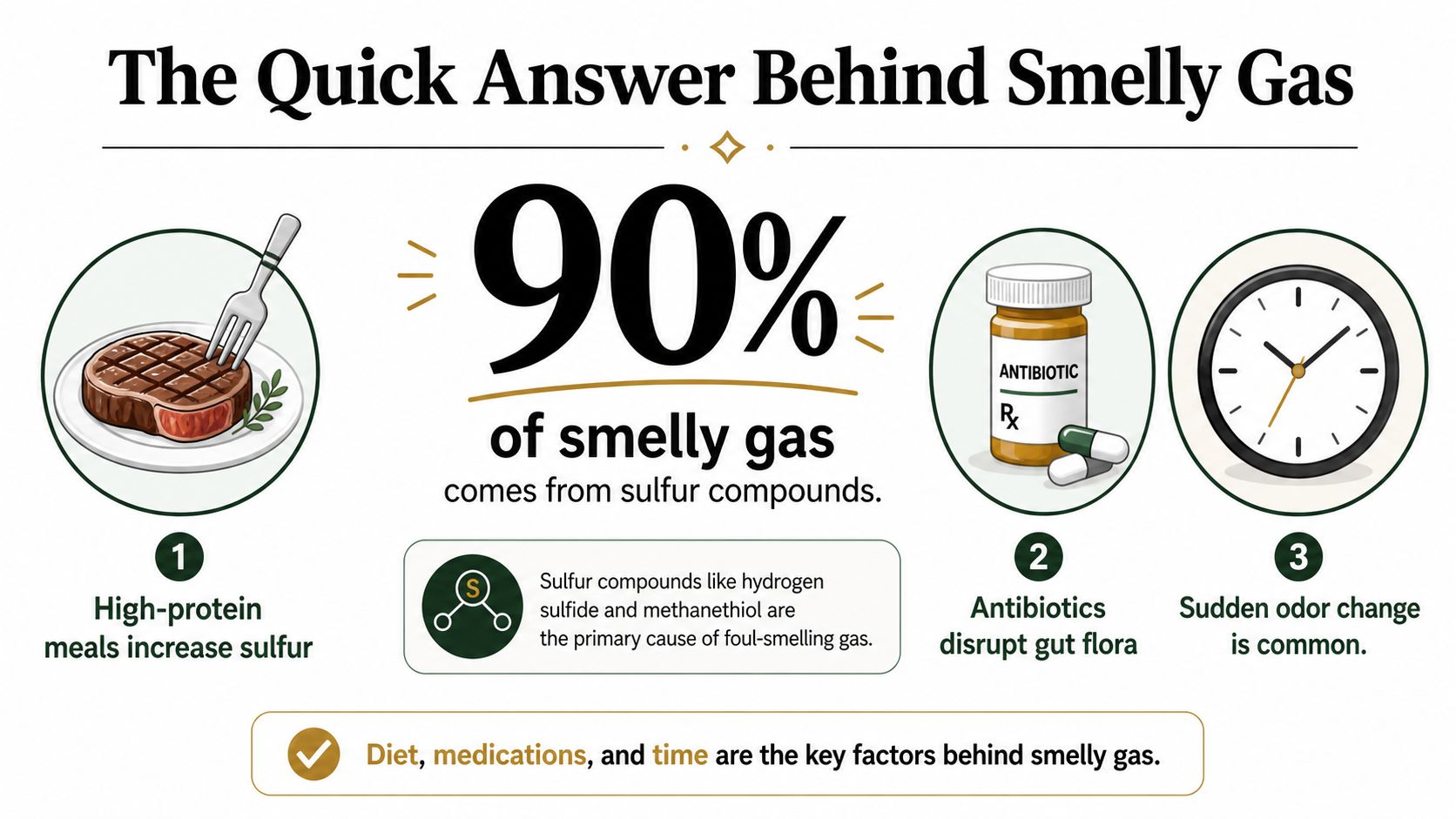
The short version is this. About 99% of flatulence is odorless gases like nitrogen, oxygen, carbon dioxide, hydrogen, and methane, while the smell comes from the remaining ~1% of sulfur-containing compounds, especially hydrogen sulfide biology science overview. That matters because the human nose can detect methanethiol at concentrations as low as 1 to 2 parts per billion biology science overview. In other words, a very small chemical shift can make gas seem dramatically worse than the volume of gas would suggest.
One more thing can ease the embarrassment right away. Passing gas is normal physiology, not a rare or shameful event. A clinical source notes that the average person passes gas 13 to 21 times per day Cleveland Clinic, so the goal isn't to stop gas completely, it's to understand why the odor changed.
Table of Contents
- The Quick Answer Behind Smelly Gas
- How Sulfur Chemistry Creates the Smell
- Common Dietary Causes of Smelly Farts
- Medical and Less Obvious Causes Worth Recognizing
- How to Identify Your Personal Triggers
- Evidence-Based Remedies That Actually Help
- Putting It All Together and Knowing When to See a Doctor
- Your Action Plan and Common Questions
The Quick Answer Behind Smelly Gas
A lot of people notice the problem after a week of high-protein meals, a course of antibiotics, or a sudden switch in supplements. That timing matters, because odor often changes when more sulfur-bearing material reaches the colon or when gut bacteria shift the way they break it down. The smell usually comes from a very small sulfur fraction, not from “dirty” digestion.
Why the smell feels so outsized
The bowel contains a mix of gases, but most of them do not smell. The sharp odor comes from sulfur compounds, especially hydrogen sulfide, the gas behind the classic rotten-egg smell Houston Methodist. A person can eat the same amount of food as usual and still notice a much worse odor after a few meals with eggs, meat, onions, or garlic.
Practical rule: If the smell changed more than the amount of gas changed, start by looking at food and digestion patterns.
That shift is often easier to understand than it feels in the moment. Smelly gas does not mean the gut is “unclean.” It usually means the ingredients reaching the colon, and the microbes breaking them down, have shifted in a way that produces more sulfur compounds Cleveland Clinic Healthline.
What that means in plain language
The colon is a place where leftovers get processed. When those leftovers include sulfur-rich foods or incompletely digested protein, the odor can become much stronger even if the total volume of gas stays the same. That is why two people can pass the same amount of gas and have very different experiences, one quiet and mild, the other unmistakable.
There is another useful clue to watch for. If the smell is strongest after rich, protein-heavy meals, the sulfur pathway is more likely. If the pattern seems tied to fatty meals, loose stools, or oilier bowel movements, the next step is different, because fat handling issues can create a separate kind of odor problem that deserves its own look.
How Sulfur Chemistry Creates the Smell
The colon works a bit like a fermentation tank. Food that was not fully digested earlier gets handed off to bacteria, and those bacteria break it apart into gases and byproducts. When the leftover material includes sulfur, the odor can turn sharp very quickly.
The main chemical path
Gut bacteria break down sulfur-containing food components and proteins, and sulfate-reducing microbes such as Desulfovibrio piger can convert dietary sulfur into hydrogen sulfide. Protein breakdown can also generate indole, skatole, and ammonia. Those compounds do not all smell the same, but together they create the kind of odor people describe as rotten, stale, or unusually foul.
The odor tracks with what reaches the colon, not just with how much food was eaten. A meal that is digested efficiently may produce less odor than the same meal during constipation or slowed transit, because the bacteria have more time to work on the leftovers.
Why timing and transit matter
Slow transit gives bacteria a longer window to ferment residue. More time in the colon means more opportunity for sulfur chemistry to build up. That also explains why gas odor can feel worse on days when digestion is sluggish, even if the meal itself was not unusual.
The smell is often a signal of what got fermented, not just how much gas escaped.
This is why diet advice sometimes helps and sometimes misses the mark. If the main issue is sulfur fermentation, the odor usually tracks with specific foods. If the issue is slowed transit or incomplete digestion, the smell can persist even when the meal seems ordinary. That difference matters because it points to the next step in evaluation.
Common Dietary Causes of Smelly Farts
If the smell seems tied to meals, food is usually the first place to look. The trick is sorting two different patterns. One comes from sulfur-rich foods that create sharper odors during fermentation. The other comes from foods that are not fully digested, so bacteria have more leftover material to work on.
The usual food triggers
Sulfur-heavy foods come up often. Eggs, garlic, onions, broccoli, cabbage, Brussels sprouts, meat, and beans UnityPoint can all increase sulfur-containing gases during digestion. They do not all act the same way, but they can leave a strong smell later, which is why a breakfast with eggs or a dinner with broccoli and meat may be especially noticeable afterward.
Lactose is another common trigger. If milk, cheese, or ice cream leave more sugar behind than your body can absorb, that sugar reaches the colon and gets fermented by bacteria, which can increase gas and odor BuzzRx. Fructose can do something similar in people who do not absorb it well. The result is more fermentation, more gas, and often more odor than people expect from what seemed like an ordinary meal.
The overlooked fat link
High-fat meals matter for a different reason. They can point to fat digestion problems, especially if the odor comes with greasy, floating, or hard-to-flush stools. That pattern is different from the sulfur-food pattern and deserves a separate look because the issue may be incomplete fat breakdown rather than a simple food trigger.
| Pattern you notice | More likely pattern |
|---|---|
| Egg, garlic, onion, broccoli, meat, beans | Sulfur fermentation |
| Milk, ice cream, creamy drinks | Lactose-related fermentation |
| Heavy, fatty meals with odd stools | Fat digestion or absorption problem |
If you are testing the food angle, change one thing at a time and keep the rest steady. For example, if you suspect dairy, cut milk and cheese for five days while keeping your bean and garlic intake the same, then bring dairy back on its own and see whether the odor returns. That kind of small, controlled test makes the pattern much clearer than removing everything at once. For a practical food-focused tool, see the guide on alpha-galactosidase support for beans and cruciferous vegetables at GutRx's digestive enzyme article.
Medical and Less Obvious Causes Worth Recognizing
Some odor patterns don't fit a simple food explanation. That's where the more overlooked causes matter, especially when the smell is persistent or comes with bloating, pain, or a major change in bowel habits.
When bacteria are in the wrong place
Small intestinal bacterial overgrowth, or SIBO, can create smellier gas because bacteria are fermenting food before it's where it's supposed to be fermented. That often goes with bloating and distension, not just odor. Constipation can create a similar effect, because longer transit gives bacteria more time to break material down and intensify the smell.
Antibiotics can also shift the microbiome enough to change odor. Sometimes that change is temporary. Sometimes it exposes a pattern that had already been building in the background. The important part is that the odor may reflect a changed microbial environment, not just a single meal.
The fat malabsorption pattern many articles miss
One of the most clinically useful clues is unusually foul gas with greasy, floating, hard-to-flush stools. That pattern is different from sulfur gas after eggs or broccoli. It can point to undigested fat, which raises the possibility of pancreatic or bile-related problems rather than a simple food trigger.
Clinical clue: Odor plus greasy stool deserves a different level of attention than odor alone.
That distinction matters because it changes what comes next. A person with sulfur-heavy odor after a large meal may benefit from diet changes or enzymes. A person with odor plus greasy stools may need testing for malabsorption rather than just another probiotic or a different dinner plan. If that sounds familiar, the enzyme discussion at GutRx's SIBO and enzyme article is a useful next read.
How to Identify Your Personal Triggers
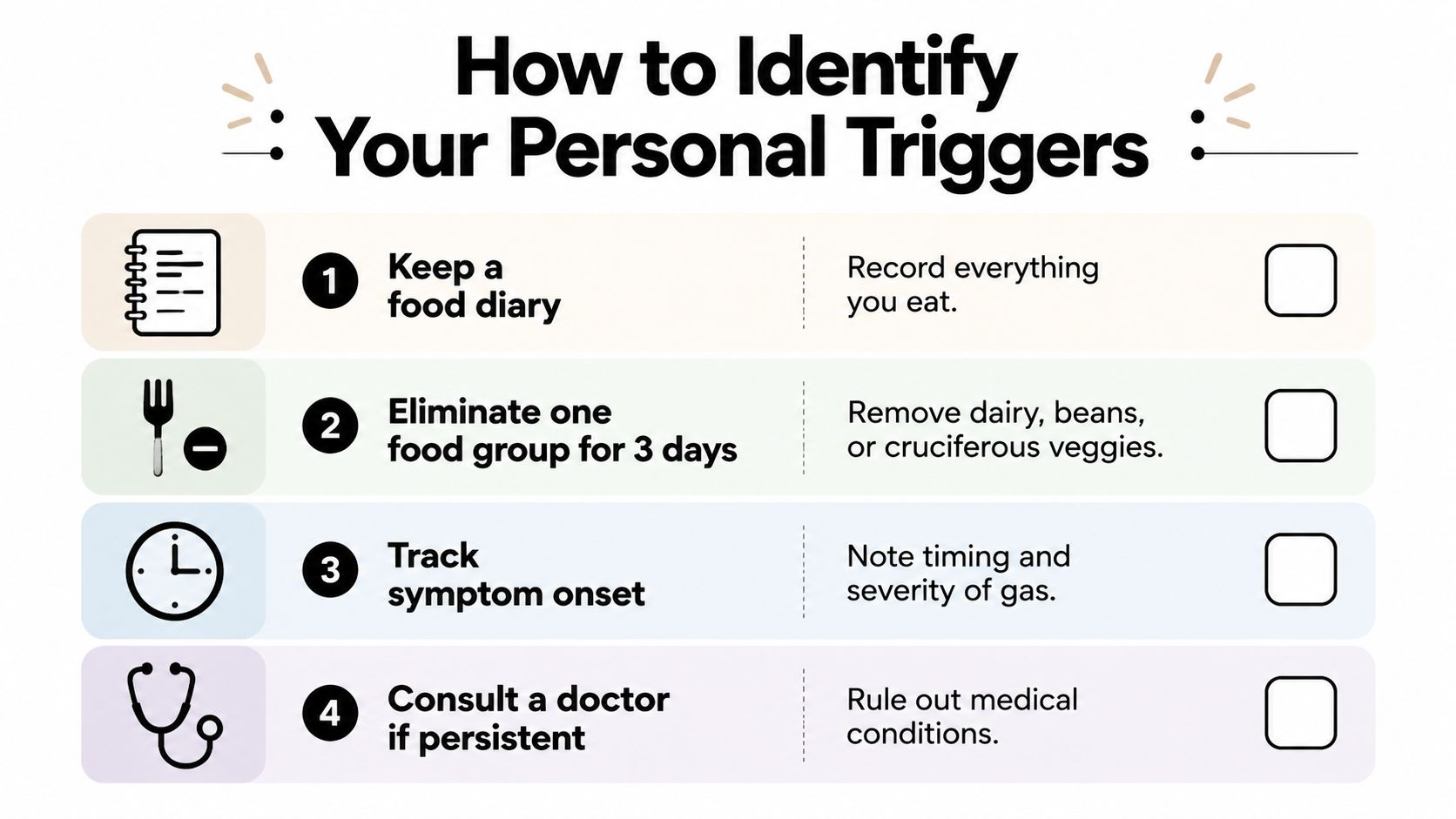
A good symptom diary turns confusion into a pattern. You don't need a perfect log, you need enough detail to see whether the smell tracks with a food group, a bowel pattern, or a recent change in supplements.
Start with one week of real tracking
Write down what you eat, when the gas shows up, how strong the odor seems, and what your stool looks like. Keep it simple. A seven-day record is often enough to show whether the problem follows a specific meal, a dairy-heavy day, a constipated day, or a sudden supplement change.
Then test one suspect at a time. If dairy seems likely, remove it first and keep everything else as steady as you can. If beans seem more likely, test that instead. The goal is to learn something from the change, not to create a giant restriction plan that's impossible to interpret.
When testing is worth doing
Objective testing helps when symptoms don't make sense or don't improve. Breath tests can help evaluate hydrogen and methane patterns for SIBO and lactose intolerance. Stool testing can look at fat content, inflammation, and other markers when the pattern points beyond ordinary food fermentation.
Sudden changes in fiber, probiotics, or other supplements can also temporarily worsen odor while the gut adjusts. That doesn't automatically mean the product is wrong for you, but it does mean timing matters. If the change started right after a new supplement, keep that on the list.
Evidence-Based Remedies That Actually Help
The right fix depends on the pattern you found. A sulfur-heavy odor after specific foods needs a different strategy than gas tied to constipation or malabsorption.
Food changes and timing fixes
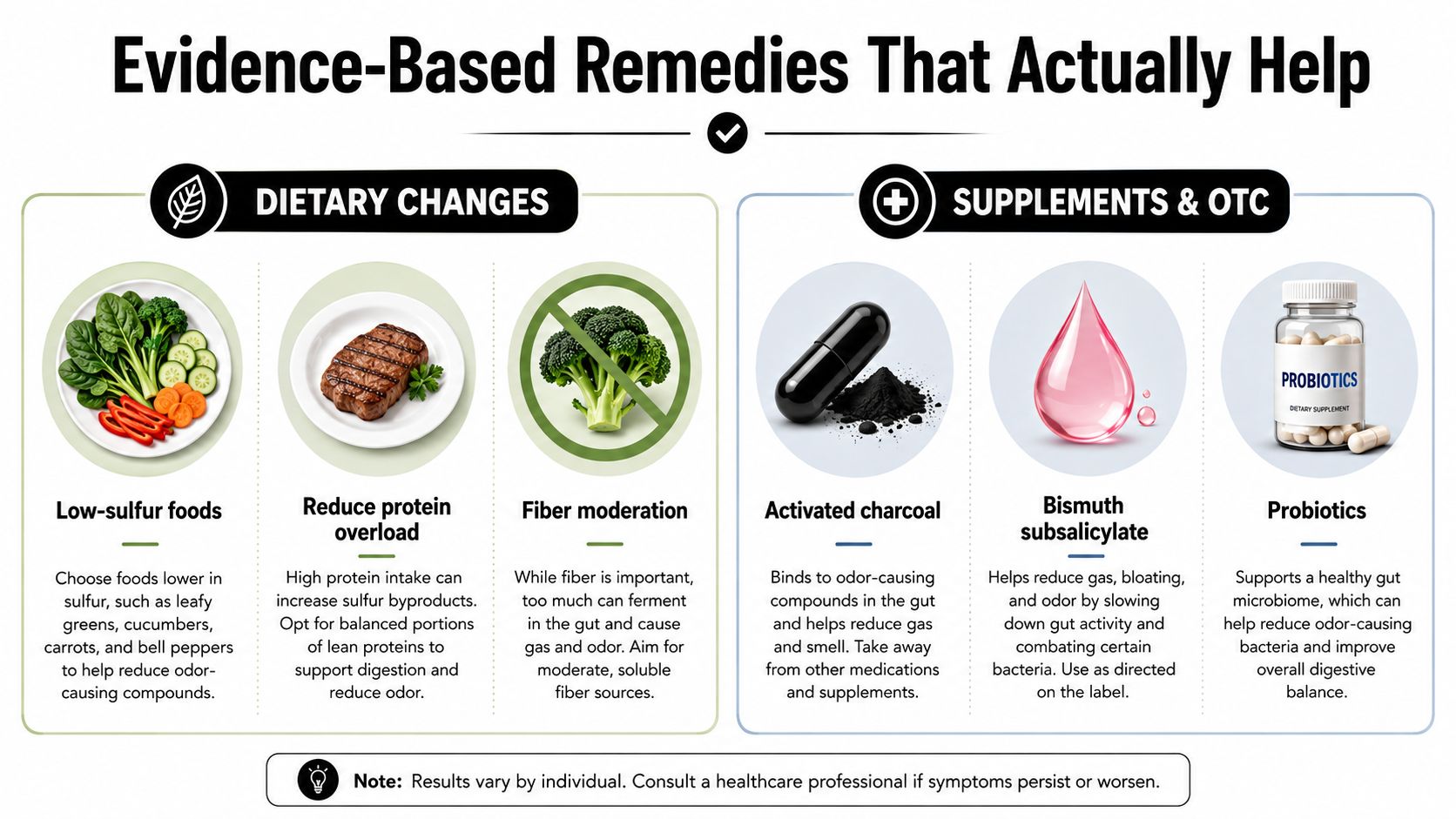
Short-term low-sulfur eating can help if the odor clearly tracks with eggs, garlic, onions, meat, or cruciferous vegetables. For people whose symptoms are broader and more food-sensitive, a FODMAP-aware approach makes more sense, especially when lactose or fructose seems to be involved. The practical advantage is that you can match the tool to the trigger instead of cutting everything at once.
Digestive enzymes can be useful when the problem is tied to a specific meal. Lactase helps with lactose, and alpha-galactosidase helps with beans and some cruciferous vegetables. Timing usually matters more than brand, because the enzyme has to be present when the food is being digested, not after the fact.
Probiotics, synbiotics, and constipation support
Probiotics are most useful when the issue looks like a disrupted microbial pattern, not just one food choice. Saccharomyces boulardii is often discussed in the context of antibiotic-related disruption, while broader synbiotic formulas may combine probiotics with prebiotics to support a more balanced fermentation pattern. Advanced formulas increasingly feature next-generation strains such as Akkermansia muciniphila and Christensenella, but the right fit still depends on the symptom pattern, not the trend.
If constipation is part of the picture, treating constipation can reduce odor on its own. Shorter transit means less time for bacteria to turn leftovers into foul-smelling gases. That's why some people notice improvement from walking after meals, improving meal timing, or addressing stool regularity before they see any benefit from a new supplement.
For readers comparing probiotic options, this overview of best probiotics for gas can help frame the choice: GutRx's probiotic comparison guide.
Putting It All Together and Knowing When to See a Doctor
The pattern usually points to the next step. Sulfur-heavy odor after specific foods suggests a dietary fix. Foul odor with greasy, floating stools points toward fat malabsorption testing. Persistent odor with bloating and distension raises the question of SIBO. A sudden change after antibiotics can justify a temporary microbiome-focused strategy.
When self-care isn't enough
A clinician visit is the right move if you have unexplained weight loss, blood in stool, persistent diarrhea, severe abdominal pain, or gas that doesn't improve after consistent dietary changes. Those symptoms need a real evaluation, not guesswork. Smelly gas is usually normal, but a major change in odor, smell, or frequency deserves attention.
The reassuring part is that the goal isn't to eliminate gas. That wouldn't be healthy or realistic. The goal is to make gas a less disruptive part of daily life by matching the fix to the mechanism.
Your Action Plan and Common Questions
Start with three steps. First, identify the trigger pattern. Second, keep a 7-day food and symptom diary. Third, move to testing or targeted supplementation if the pattern suggests SIBO, lactose intolerance, constipation, or malabsorption.
Can probiotics alone fix smelly gas? Sometimes they help, especially when the issue is microbiome disruption, but they're not a universal fix.
How long do dietary changes take to show results? Usually long enough to notice a pattern if you keep the rest of the routine steady.
Is daily smelly gas always a problem? No, but a persistent change that doesn't match your diet deserves attention.
When is it urgent? Blood in stool, severe pain, or unexplained weight loss should be evaluated promptly.
If you want a cleaner way to support the dietary changes, enzyme timing, and microbiome strategy you're already thinking about, GutRx offers targeted digestive support built around those exact use cases. Visit GutRx to explore options for gas, bloating, regularity, and meal-related discomfort, and choose the formula that best fits the pattern your symptoms are showing.


