

Most advice treats fiber gummies with psyllium like a simple upgrade over regular fiber gummies. That's too vague. The question is whether the product on the shelf contains psyllium, because the gummy format is just the delivery system, not the active fiber itself.
That distinction matters. Psyllium is the best-known bulk-forming, gel-forming fiber in this category, but many “fiber gummies” rely on inulin, soluble corn fiber, or other fibers instead, so the label tells you far more than the marketing on the front. If you're buying for regularity, constipation, or alternating bowel habits, the ingredient list is the part that decides whether you're getting psyllium or just a gummy with fiber-friendly branding.
Table of Contents
- What Fiber Gummies With Psyllium Actually Are
- How Psyllium Works and Why It Is Different
- The Evidence Base for Psyllium
- Fiber Gummies With Psyllium vs Other Fiber Formats
- How to Read the Label on a Fiber Gummy
- Who Fiber Gummies With Psyllium Are Really For
- Where Fiber Gummies Fit in a Broader Digestive Routine
- Frequently Asked Questions About Fiber Gummies With Psyllium
What Fiber Gummies With Psyllium Actually Are
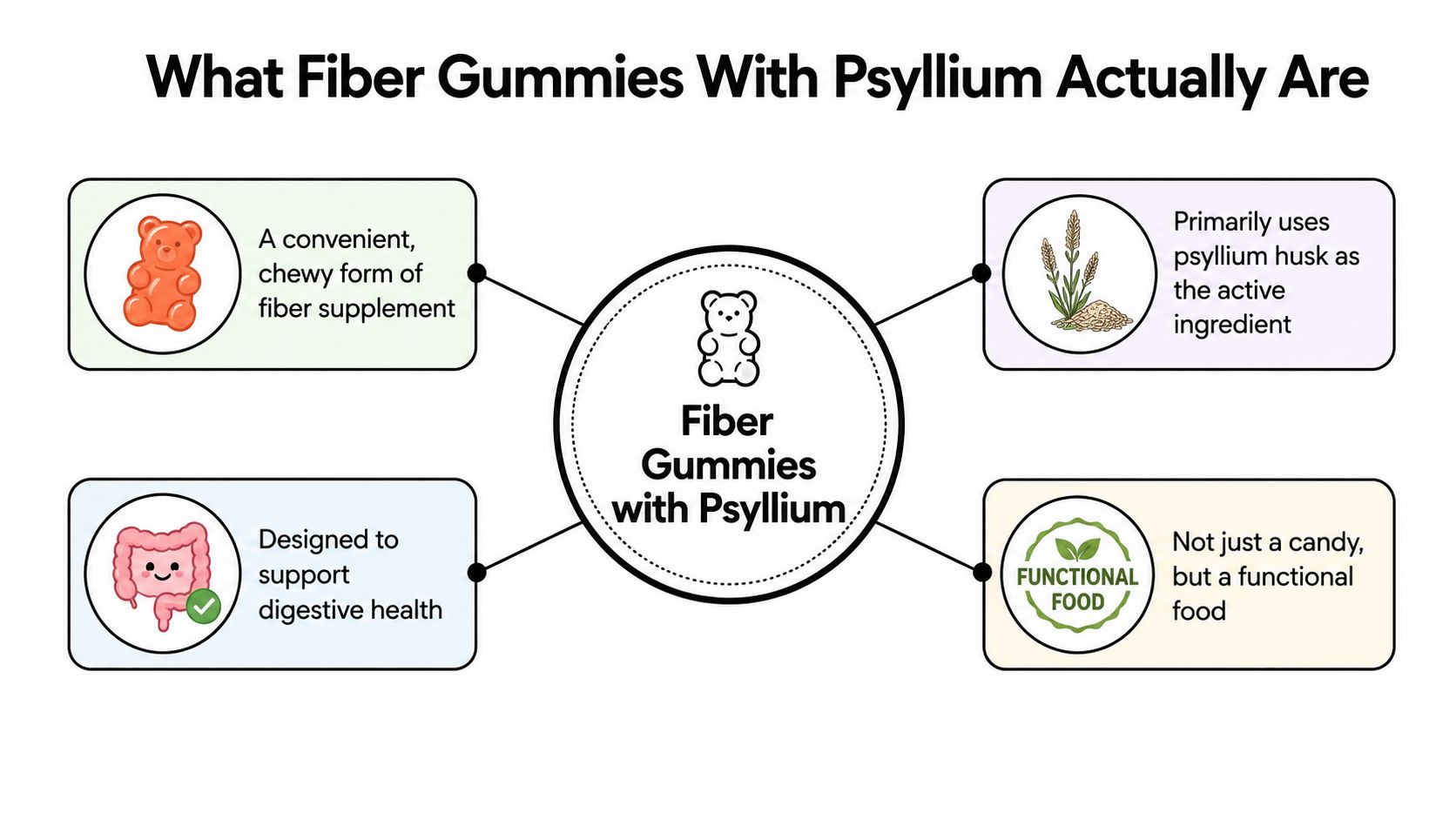
The phrase fiber gummies with psyllium sounds like a single product type, but it usually describes a shopper's search more than a shelf category. Some gummies really do contain psyllium husk. Others use different fibers and still sit under the broad “fiber gummy” label, which is why the front of the bottle can be misleading.
The label is the product
A gummy is just the delivery format. It can hold a fiber ingredient, but it doesn't guarantee which fiber is inside. That's where shoppers get tripped up by terms like “soluble fiber” or “prebiotic fiber”, because those phrases can be true without psyllium being present at all.
A real psyllium gummy will name psyllium husk on the ingredient list. A different gummy may say inulin or soluble corn fiber, which means it belongs to the same supplement aisle but not the same fiber category. One is built around psyllium's gel-forming behavior, the other usually isn't.
Practical rule: if psyllium matters to you, read the ingredient list first and the front label second.
Why this format is unusual
Psyllium is not a casual filler ingredient in gummies. It brings strong water-binding behavior, which is useful in the gut but demanding in a candy-like matrix. That's why psyllium-based gummies are a narrower technical subset than the larger “fiber gummy” market.
This is also why the same product language can create false confidence. A bottle can say “fiber gummies” and still be built on a completely different fiber profile. The only reliable signal is whether the label explicitly says psyllium husk.
How Psyllium Works and Why It Is Different
Psyllium works differently from the lighter prebiotic fibers that dominate many gummies. It's a hydrophilic mucilloid, which means it absorbs water, swells, and forms a gel. That gel is the point. It's what helps soften hard stool and bind loose stool.
Think sponge, not sugar
A simple way to picture psyllium is as a sponge that expands after it gets wet. Another useful analogy is pudding thickening in the fridge. It doesn't disappear into the liquid, it changes the texture of what it touches.
That's why psyllium is often used for both constipation and diarrhea support. It doesn't behave like a stimulant laxative, and it doesn't act like a simple sweetener or flavoring fiber. It changes stool form by changing how water is held in the bowel.
Why gummy formulators keep the dose low
Those same water-binding properties make psyllium hard to cram into a gummy. Too much psyllium can push the texture toward stiff or brittle, so formulators usually treat it as a structure-building ingredient rather than a high-load ingredient. In one fiber-gummy development study, the best balance of stability and texture came at 1.5 g psyllium fiber per 100 g product, along with 0.5 g/100 g pectin and 1.5 g/100 g other fiber development study.
That technical limit matters for the shopper. If a gummy contains true psyllium, it often can't carry the kind of dose you'd get from a powder scoop or a concentrated capsule. The format changes the ingredient's practical role, from main-event fiber to convenience-driven bridge.
The Evidence Base for Psyllium
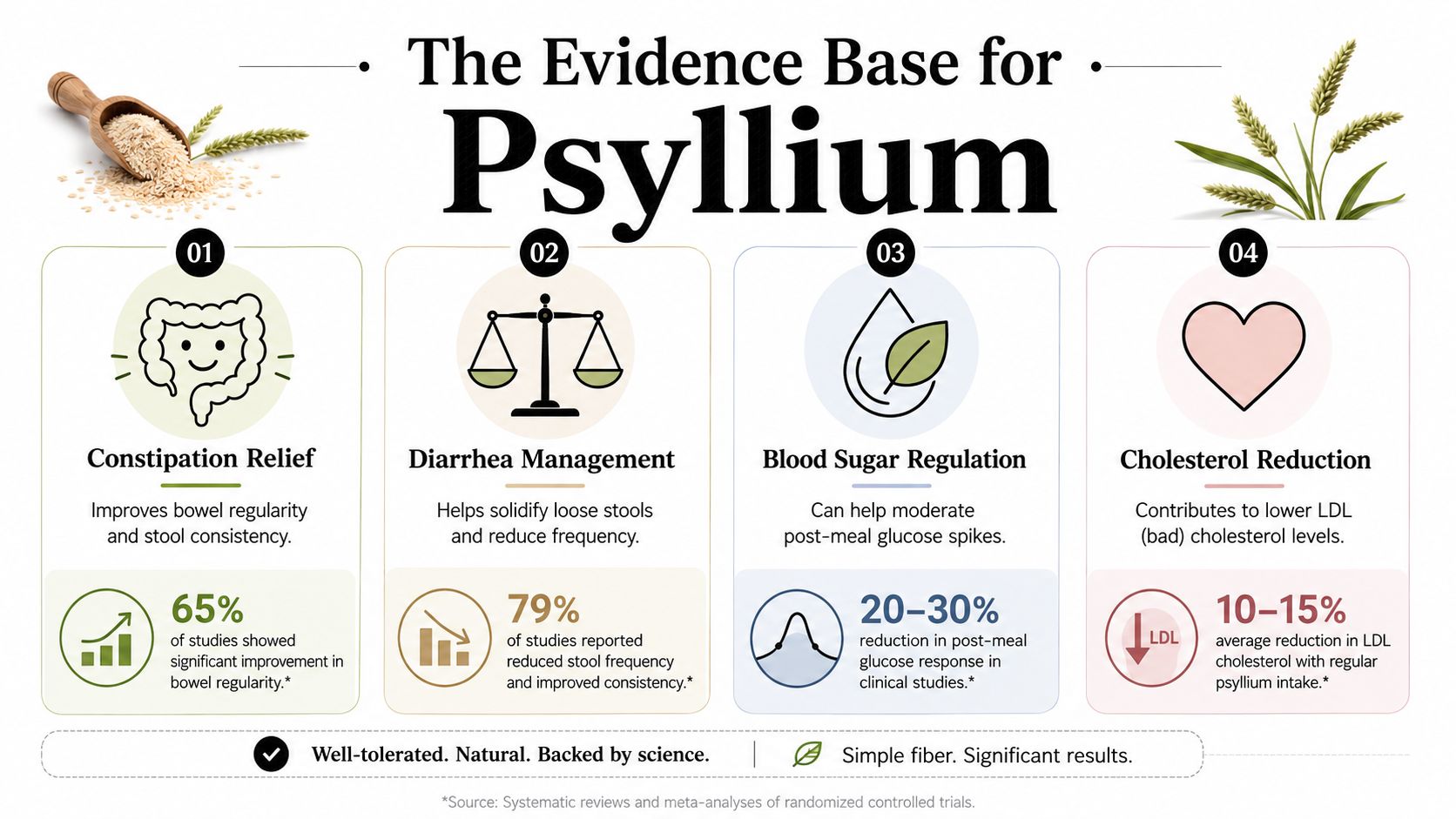
Psyllium has clinical support, and that support matters more than the label on a gummy bottle. In a meta-analysis of adult constipation trials, researchers pooled 473 people in fiber-treatment groups and 329 in control groups. 66% of people receiving fiber responded versus 41% in control, and the authors concluded that psyllium was the most efficacious investigated fiber for constipation relief meta-analysis.
What the evidence actually assumes
The same analysis found that doses above 10 g/day and treatment lasting at least 4 weeks appeared optimal for several symptoms meta-analysis. That detail matters because many gummy products do not come close to that level. A pleasant chew does not change the amount of psyllium you get, and the science is built around intake, not flavor.
Cleveland Clinic notes that psyllium can help with constipation relief by bulking and binding stool, and with diarrhea relief by binding loose stools Cleveland Clinic. That same source also says psyllium husk may help reduce gut inflammation in IBS, which is why it appears in symptom-targeted digestion products rather than in generic wellness formulas. The mechanism stays the same, but the product format can change how much of that mechanism you reach.
Why dose and time matter
Psyllium is not usually a “take one gummy and feel different by dinner” product. The evidence points to regular use, enough fiber, and enough time. Mayo Clinic says taking fiber supplements every day “seems to be safe” Mayo Clinic, but safe daily use is not the same as a daily dose that matches the studies.
The bottom line is simple. Psyllium has real evidence, but that evidence assumes a dose and a duration that many gummies cannot match.
Fiber Gummies With Psyllium vs Other Fiber Formats
The best format depends on what you're trying to fix, not on which texture you prefer. If your goal is stool normalization, psyllium powder and capsules usually deliver a more concentrated psyllium dose than gummies. If your goal is convenience, gummies win on taste and portability, but that doesn't make them equivalent.
Fiber Format Comparison
| Fiber Format | Psyllium Gummies | Psyllium Powder | Psyllium Capsules | Inulin Gummies |
|---|---|---|---|---|
| Main fiber | Psyllium, if the label truly says so | Psyllium husk | Psyllium husk | Inulin or similar prebiotic fiber |
| Typical role | Convenience format | Concentrated regularity support | Portable regularity support | Chewable prebiotic-style fiber |
| Evidence fit | Depends on actual psyllium dose | Strongest match to psyllium research | Strongest match to psyllium research | Different fiber, different physiology |
| Dose practicality | Often limited by gummy texture | Easier to reach meaningful psyllium amounts | Compact, but may require several capsules | Often marketed as fiber, not psyllium |
| Best fit | People who won't take powder | People prioritizing effect over convenience | People who want portability | People who want a gummy but not necessarily psyllium |
The practical tradeoff
U.S. News says fiber gummies usually require at least two gummies to provide 4 to 6 grams of fiber, while psyllium capsules may take five capsules or more to reach roughly 3 to 6 grams U.S. News. That's a useful reminder that the most convenient format isn't always the most concentrated one.
Powder is the easiest way to move closer to the dose used in psyllium research. Capsules offer portability, but they can turn into a handful fast. Gummies are easiest to stick with, yet many aren't psyllium-based at all, which changes the comparison completely.
Choosing rule: pick powder for dose, capsules for portability, gummies for compliance, and only choose gummies for psyllium if the label proves psyllium is actually there.
If you want a broader consumer comparison that frames fiber products against whole foods, this overview of fiber supplement choices and whole foods is a useful companion read.
How to Read the Label on a Fiber Gummy
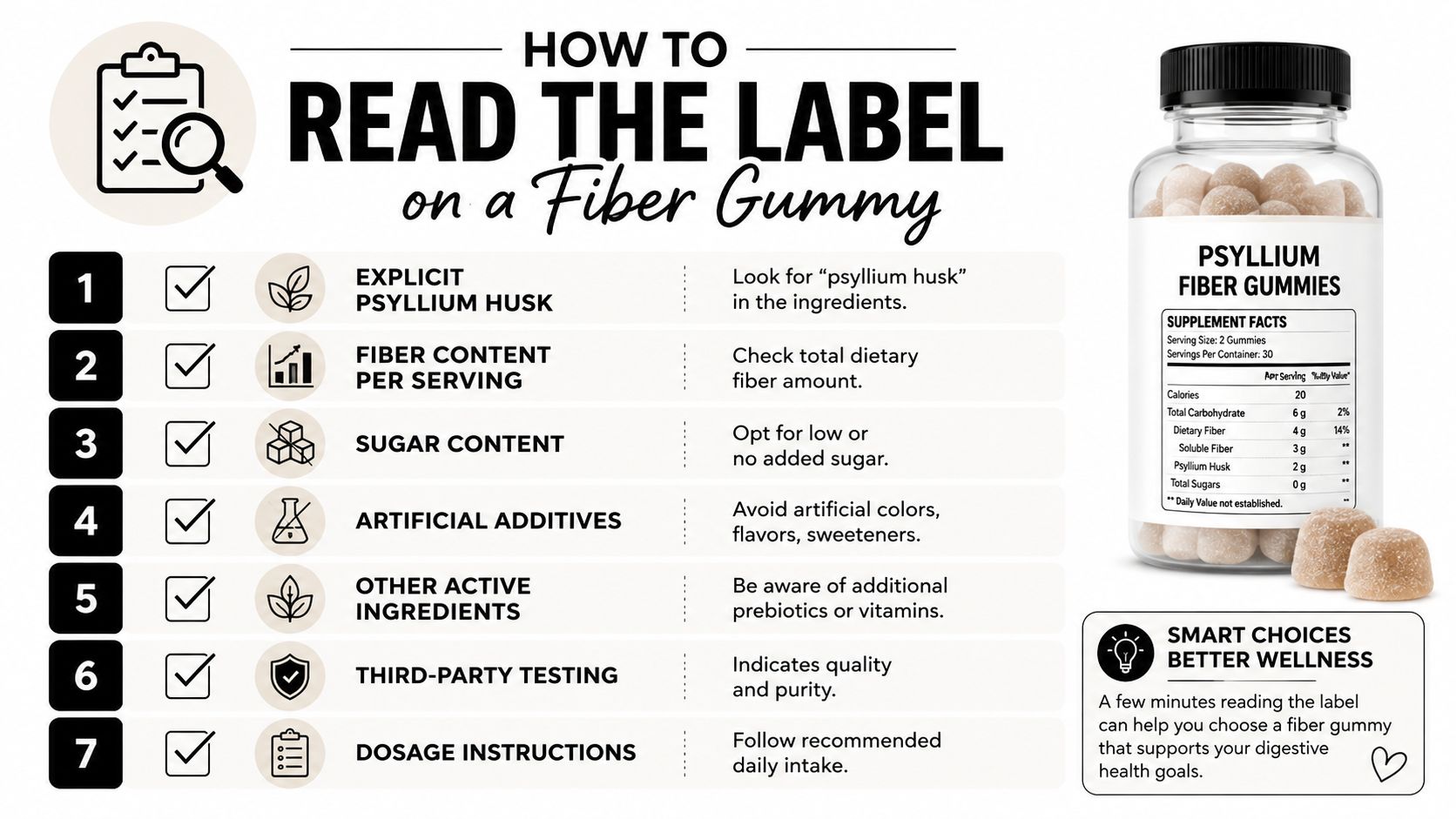
A good fiber gummy label should answer one question fast: what fiber is inside? If it can't answer that clearly, the product probably isn't built around psyllium in a meaningful way. The front of the bottle can be polished, but the ingredient list is where the truth sits.
The seven things to check
- Explicit Psyllium Husk: Look for the exact words psyllium husk in the ingredient list, not just “fiber blend” or “soluble fiber.”
- Fiber Content Per Serving: Check the grams per serving, not a marketing claim on the front panel.
- Sugar Content: Gummies can hide sweetness under the promise of convenience, so read the added sugar line carefully.
- Artificial Additives: Colors, flavors, and sweeteners may be fine for some shoppers, but they still matter if you want a cleaner label.
- Other Active Ingredients: Extra prebiotics or vitamins can change the product's gut behavior.
- Third-Party Testing: Independent testing matters more in a supplement than a glossy bottle ever will.
- Dosage Instructions: Follow the serving directions, because the right dose is tied to how much actual psyllium is inside.
Red flags that deserve a second look
A proprietary fiber blend is the classic gray area. It can hide whether psyllium is a meaningful component or just a minor ingredient mixed into something else. A fiber gummy can also sound “digestive” while being mostly a prebiotic-style formula rather than a psyllium product.
If you care about quality verification, this guide to what a Certificate of Analysis means is worth reading before you buy another supplement online.
The fastest habit is simple. Read the ingredient list, look for psyllium by name, then check whether the serving size makes the product plausible as a daily fiber tool rather than a candy with health language attached.
Who Fiber Gummies With Psyllium Are Really For
Fiber gummies with psyllium are ideal for individuals seeking a sustainable fiber routine. A stool pattern that fluctuates between constipation during stressful weeks and looser stools during travel is a common scenario. In such a situation, a powder tin on the counter or a handful of capsules every morning might be enough to disrupt the routine. A gummy may seem less potent on paper, but it often wins in terms of consistency.
The convenience question
The question is not whether a gummy is pleasant. It is whether the label gives enough psyllium to matter. If the serving only delivers a small amount of fiber, the product may work more like a light daily nudge than a true regularity tool.
Psyllium is a gel-forming fiber, so it changes stool by adding bulk and helping bind loose stool. That mechanism is why it can fit a mixed pattern better than a fiber that mainly acts through fermentation. The tradeoff is simple. Once psyllium is put into a gummy, the dose is usually lower and the evidence base is less direct than it is for the classic powder format.
Practical fit: if your symptoms move between hard stool and loose stool, psyllium is a more logical fiber than a gummy built mostly around fermentable fiber.
Where the gummy makes sense
For some shoppers, the gummy is the format that finally makes daily fiber realistic. That matters if the choice is between a modest supplement and no supplement at all. A habit taken consistently usually beats a stronger product that never gets used.
The label still sets the limit. A gummy that contains psyllium can be a bridge for people who want something easy to take every day, but it may still be underdosed compared with a powder or capsule routine. If constipation is the main issue, a closer look at constipation relief supplements can help you compare formats and decide whether the gummy is doing enough work for your symptoms.
That is the blunt distinction. Psyllium gummies are best for people who value convenience and consistency, and who are comfortable with a lower-dose product. They are a weaker fit for someone who wants the most evidence-aligned way to use psyllium for regularity.
Where Fiber Gummies Fit in a Broader Digestive Routine
Psyllium helps normalize stool, but it doesn't replace every kind of digestive support. It doesn't reseed the gut with bacteria, and it doesn't break down food for you. That means it fits best as one layer in a larger routine, not the whole plan.
Fiber is one lane, enzymes and probiotics are other lanes
A psyllium product is about regularity and stool form. A probiotic is about microbial support. A digestive enzyme is about meal breakdown. Those are related, but they're not interchangeable.
That distinction matters for shoppers who feel bloated after meals even when they're already getting enough fiber. In that case, a digestive enzyme may be a more relevant tool than another fiber supplement. If the main issue is irregularity, fiber is the place to start. If the main issue is post-meal heaviness, the cause may sit somewhere else.
How to think about layering
A good routine usually starts with the symptom pattern, then adds the right category. Fiber supports regular bowel habits. Probiotics are a separate category for people who want daily gut balance support. Enzymes belong in the meal-time bucket for people who know certain foods sit heavily.
That's why psyllium gummies often work best as a convenience piece inside a larger plan rather than a stand-alone solution. They can help if you need a gentler, easier way to stay consistent. They're less useful if you expect them to do the job of a higher-dose psyllium powder or a targeted digestive formula.
Frequently Asked Questions About Fiber Gummies With Psyllium
Do all fiber gummies contain psyllium
No. Many fiber gummies use inulin, soluble corn fiber, or other fibers instead of psyllium. If psyllium matters to you, the ingredient list has to say psyllium husk.
How long does a psyllium gummy take to work
Psyllium usually works with regular use, not as an instant fix. A gummy does not change that basic timeline. It still depends on daily use and on whether the product contains enough psyllium to matter, since the gummy format often keeps the dose lower than powder or capsules.
Are psyllium gummies good for IBS
They can be, especially when the goal is stool normalization and symptom balance rather than more fermentation. Psyllium is the better-known fiber for people who alternate between constipation and diarrhea, while some other fibers may be less predictable for sensitive guts.
Should I choose a gummy, powder, or capsule
Choose powder if you want the easiest path to a meaningful psyllium dose. Choose capsules if portability matters and you don't mind taking several. Choose gummies if consistency is your biggest barrier, but only if the label proves the product contains psyllium.
A gummy is usually the convenience version of psyllium, not the strongest one. That tradeoff is the whole point, and it is also the limit.
If you want digestive support that is built around transparent testing, targeted formulas, and clear use cases, explore GutRx and compare the options that fit your routine. For shoppers trying to match the right supplement to regularity, bloating, or meal-related discomfort, that is the fastest way to move from label confusion to a product choice that makes sense.


