

Popular advice says flax seed and chia seed are basically interchangeable. They're not. If your main problem is bloating, IBS, constipation, or slow transit, the better choice depends on fiber chemistry, preparation, and what your gut is doing after you eat it.
That's why the question isn't “which seed is healthier,” it's which seed matches the symptom. Flax brings more omega-3 ALA density and a more fermentable fiber profile, while chia brings more gel-forming fiber and a stronger stool-bulking effect per spoonful. Used well, they can do different jobs. Used blindly, they can make a sensitive gut feel worse.
| Per Ounce (28 g) | Flaxseed | Chia Seed |
|---|---|---|
| Calories | 150 | 138 |
| Carbs | 8 g | 12 g |
| Fiber | 8 g | 10 g |
| Protein | 5 g | 5 g |
| Fat | 12 g | Not specified in the verified data |
| Notable strengths | Thiamine 38% DV, copper 38% DV | Selenium 28% DV, calcium 14% DV, iron 12% DV |
| Omega-3 pattern | Higher omega-3 density | Lower than flax in the comparison data |
Table of Contents
- Why the Flax vs Chia Question Is More Complicated Than It Looks
- Nutrient and Fiber Profile Side by Side
- How Each Seed Behaves Inside the Gut
- Matching the Right Seed to Bloating, IBS, and Constipation
- Dosing, Preparation, and Easy Daily Recipes
- Pairing Seeds with Synbiotics and Digestive Enzymes
- Safety, Interactions, and Who Should Be Cautious
- Which Seed to Choose and When to Combine Them
Why the Flax vs Chia Question Is More Complicated Than It Looks
Both seeds are nutritious. What most comparisons miss is how they behave differently once they reach your gut, and that difference matters more than the nutrient label. If you are choosing between flax seed chia seed for digestive symptoms, the better lens is not a general superfood ranking. It is how each seed moves through the gut, how it ferments, and how your system tolerates it.
The history tells you these aren't niche trends
Flax is one of the oldest cultivated crops in human history, with wild flax fibers used by prehistoric people in what is now Georgia as far back as 30,000 years ago and domesticated oilseed flax estimated at roughly 11,800–11,300 BP in the Fertile Crescent (AHPA flax history). Chia also has a long food history. It originated in Mexico and Guatemala and has been used as food for about 5,500 years, with its commercial revival coming much more recently (PMC chia review).
That history matters because neither seed is a passing trend. Both have stayed in use long enough to earn a place in food systems, but they did not arrive in modern diets with the same role or texture. Flax became established as a major crop in food and fiber markets. Chia returned to modern commerce as a seed with a different structure and a different practical use case.
The decision is really about symptom mapping
A person with hard stools and sluggish motility often needs a different seed than someone whose main issue is post-meal bloating. Someone trying to increase plant omega-3 intake is making a different choice from someone who wants to soften stool without adding more gas. That is why the rest of this comparison needs to focus on four things, fiber type, fermentation behavior, omega-3 load, and tolerance.
The most useful takeaway is practical. Flax tends to fit a fermentation-forward pattern and gives more omega-3 payoff, while chia tends to fit a more gel-forming pattern with higher fiber per spoonful. Some people can use both without trouble, especially if their gut handles fiber well and they want a broader daily routine. In that case, a food-based fiber routine is often paired with a targeted synbiotic or enzyme formula rather than treated as a complete fix on its own.
Nutrient and Fiber Profile Side by Side
The first comparison worth making is not calories. It is how much useful material you get in a standard serving, and what kind of gut effect that material is likely to produce. Per 1-ounce (28 g) serving, flax seeds provide 150 calories, 8 g carbs, 8 g fiber, 5 g protein, and 12 g fat, with notably higher thiamine at 38% DV and copper at 38% DV (Healthline comparison). Chia seeds come in at 138 calories, 12 g carbs, 10 g fiber, and 5 g protein, and they're higher in selenium at 28% DV, calcium at 14% DV, and iron at 12% DV. For a fuller food-based fiber comparison, see this whole-foods fiber supplement guide.
That table points to a practical split. Flax gives more fat per serving, more omega-3 density, and more of the micronutrients tied to seed metabolism. Chia gives more fiber per spoonful and a stronger mineral payload, which matters if you are trying to raise fiber intake without relying only on powders or supplements.
Why the fiber difference matters in practice
Fiber is not just a larger or smaller number on a label. A seed with more total fiber, and a higher share of soluble, water-binding material, changes stool consistency differently than one with slightly less fiber but a more fermentable profile. That is why the two-gram gap between chia and flax is not trivial for someone tracking bloating or constipation. In practical terms, 10 g of chia fiber is more likely to increase stool bulk and moisture in a visible way, while 8 g of flax fiber may produce a gentler stool effect with more downstream fermentation in the colon.
The result is not “more is better.” If stool is dry and hard, the extra bulking effect from chia can be useful. If the issue is sluggish motility with a gut that tolerates fermentation poorly, flax may be the more workable starting point because the fiber load is lower and the fermentation pattern is different.
Best shorthand: chia bulks, flax ferments. That is a practical summary, not a complete verdict, but it helps separate stool-forming effects from microbiome-oriented effects.
The omega-3 trade-off is real
The American Heart Association reports that a 1-ounce serving of whole flaxseed contains about 6.4 grams of omega-3 fats, while a similar serving of chia seeds contains about 4.9 grams (AHA flax and chia article). That is the clearest reason to keep the seeds in different categories. Flax is the better omega-3 benchmark, while chia is the better fiber benchmark.
For someone with IBS-like symptoms, that distinction matters more than the idea that both seeds are healthy. A person trying to raise fiber per spoonful and get more stool bulk is usually better served by chia. A person who wants more omega-3 and a different fermentation pattern is usually better served by flax.
How Each Seed Behaves Inside the Gut
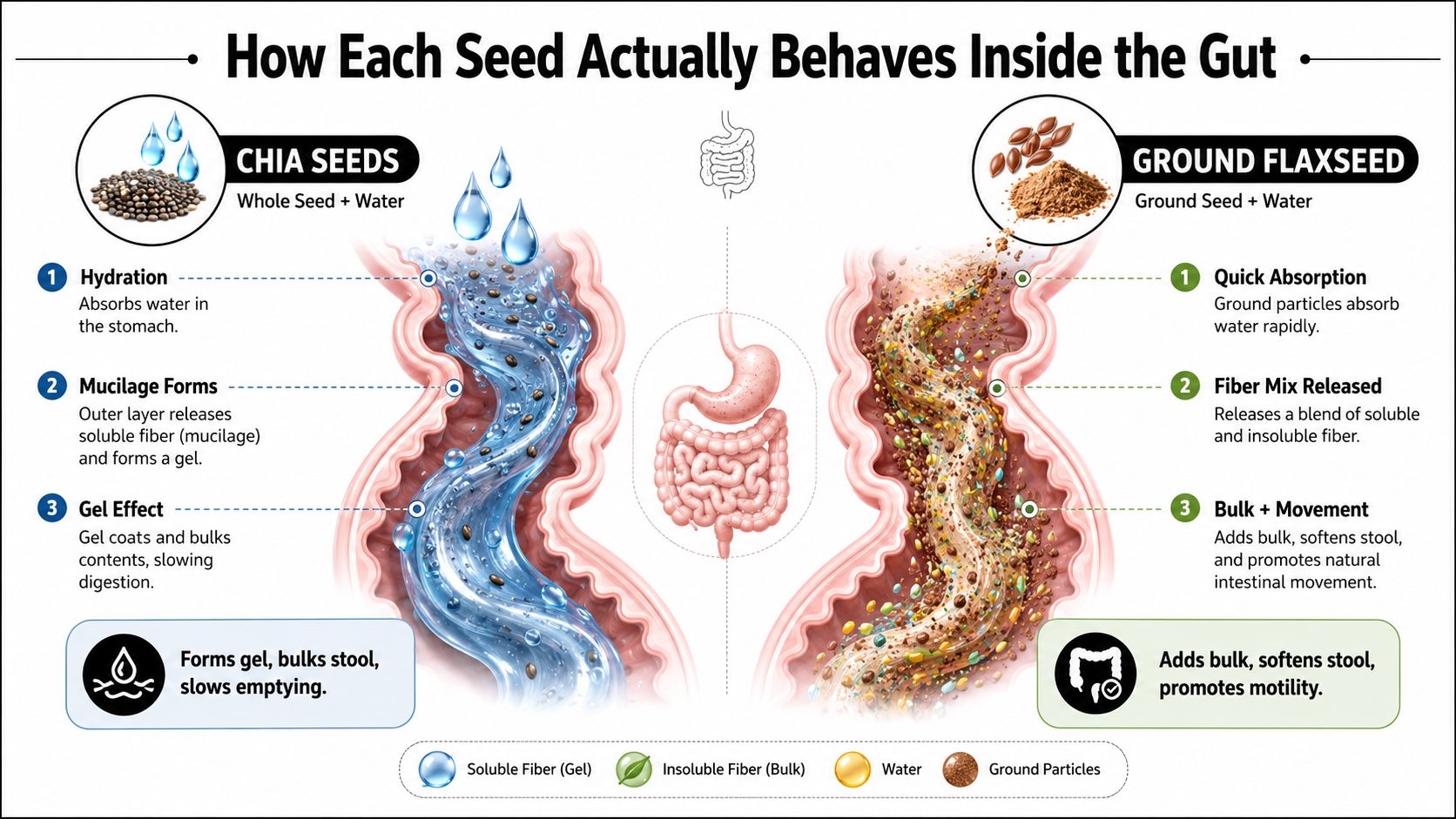
Chia and flax do not behave the same way after you swallow them. Chia is often eaten whole and absorbs water to form a gel, which helps it add bulk and can slow gastric emptying. Ground flax behaves differently. It supplies a mix of soluble and insoluble fiber that is typically more fermentable in the colon, which makes it more relevant for people who need a different type of motility support.
Gel formation versus fermentation
Gel-forming seeds excel at providing moisture and structure. Fermentable seeds excel at feeding the microbiome. The difference matters more than the label.
A gel-forming seed is more useful when stool needs moisture and structure. A more fermentable seed is more useful when you are trying to support the microbiome and encourage downstream metabolites.
A comparative review found that flaxseed fiber appeared more readily fermentable by fecal microbiota and generated almost two-fold more acetate, propionate, and butyrate than chia fiber (comparative review). That does not make flax universally better. It makes it different, and that difference is why some people tolerate one seed better than the other. For a deeper look at how fermentation shapes gut health, see our guide on butyrate-producing bacteria.
Why this matters for IBS and constipation
If your main issue is constipation, the first thing you often want is stool form. Chia's gel action helps there. If your problem is hard, dry stools plus slow transit, flax can be a better fit because fermentable fiber can support more downstream gut activity. If your issue is bloating, either seed can help or hurt depending on dose, water intake, and whether your gut is in a flare.
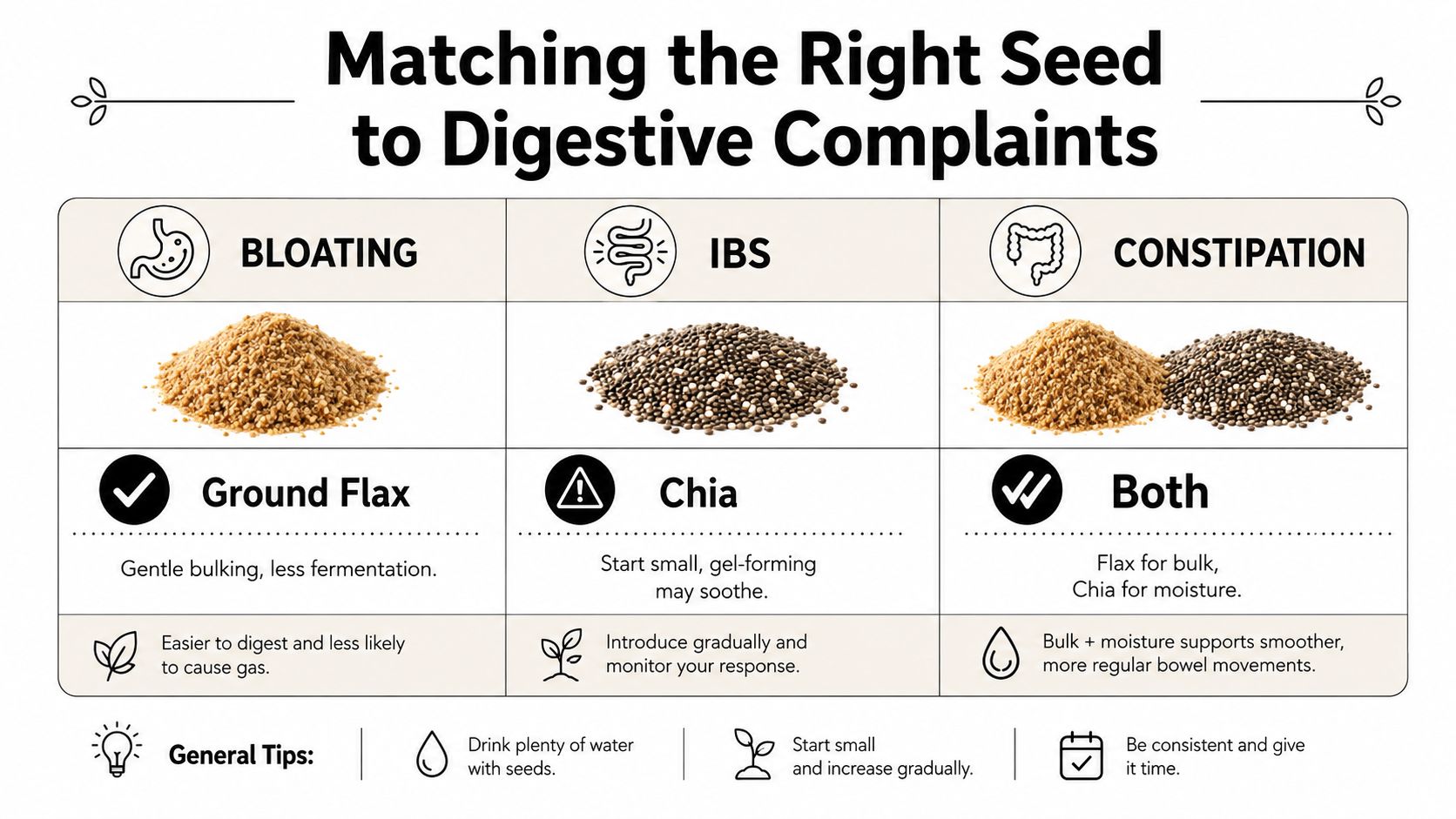
The most important point is that whole seeds and ground seeds are not the same experience. If you are using flax, ground flaxseed is typically needed for nutrient absorption. Chia is more forgiving in whole form, but it still needs enough water to do its job well.
Matching the Right Seed to Bloating, IBS, and Constipation
For bloating, start with the seed that is less likely to overdo fermentation
Bloating is where people get frustrated, because “healthy fiber” can still feel awful if the dose is too aggressive. For many people, ground flax is the more cautious first step because it can provide bulking support without the same level of gel expansion that chia creates once hydrated.
That said, the bigger issue is not just the seed, it's dose and timing. Someone who dumps a lot of either seed into a meal on day one is more likely to notice gas, pressure, or a heavy feeling. Starting small matters more than declaring a winner.
For IBS, tolerance beats theory
People with IBS are not all the same, and broad advice often fails. If you're IBS-D prone, either seed can be too much during an active flare because added fiber can aggravate urgency or cramping. If you're IBS-C prone, chia is often the more logical first option because its water-binding action can help soften stool when it's paired with enough fluid.
Use the seed that solves the symptom you actually have. If stool is loose, don't chase more fiber. If stool is hard, don't rely on low-hydration fiber alone.
For constipation, chia and flax can both help, but for different reasons
If constipation is the main issue, chia is often the better “first spoon” because it brings more fiber per ounce and a stronger moisture effect. Flax is useful when constipation looks more like slow motility and incomplete evacuation, especially when you want its fermentation pattern and omega-3 density.
A simple starting protocol looks like this:
- For bloating-prone users: start with a small amount of ground flax and watch the response over several days.
- For hard stools: try soaked chia with plenty of water.
- For IBS-D flares: pause both seeds until symptoms calm down.
- For mixed IBS patterns: test one seed at a time, not both at once.
That careful approach is more useful than any blanket “best seed” label. For some people, a food-first routine is enough. For others, the seed routine works best when the broader gut stack is also addressed, especially if regularity and microbiome balance are both concerns.
Dosing, Preparation, and Easy Daily Recipes
The useful dose is usually unglamorous, and that is a good sign. 1 to 2 tablespoons is the practical starting range for either seed, but the way you prepare them matters more than the headline amount. Go too fast and the gut usually makes that clear.
Preparation changes the outcome
Flax should be ground if you want better nutrient access. Whole flax often passes through without giving you the full benefit. Chia can be eaten whole, but it works better after a soak of about 10 minutes because that gives the seed time to hydrate and form its gel. If you are sensitive to texture, a 15 to 20 minute soak gives a thicker result and usually a more even mouthfeel.
Timing also changes what you get from the seeds. If your goal is satiety or blood sugar control, using seeds before or with meals makes more sense than taking them randomly. If your goal is regularity, using them with a meal and pairing them with enough fluid is usually the better setup. For people who feel full quickly, the meal context matters because a dry seed dose on an empty stomach is more likely to feel heavy than useful.
Three simple ways to use them
- Ground flax morning oats bowl: stir ground flax into oats, yogurt, or a smoothie bowl for a denser breakfast with a more even texture. If the oats already contain fruit, keep the flax modest so the bowl does not become overly thick.
- Chia pudding at night: soak chia in milk or a milk alternative and let it sit until it thickens, which gives you a higher-fiber, stool-bulking option. For a softer pudding, use a looser mix; for a firmer texture, let it rest longer.
- Two-seed yogurt parfait: combine a smaller amount of each seed so you get both the gel texture of chia and the fermentable profile of flax without pushing one pattern too far.
A simple substitution guide helps when recipes call for one seed and you want the other. Use ground flax where a recipe needs thickening plus a nutty taste, such as oatmeal, yogurt, or baked batter. Use chia where the recipe needs a gel, such as pudding, overnight oats, or jam-like toppings. If you want to swap them in a cold recipe, start by replacing part of the flax with chia rather than all of it, since chia thickens more aggressively once hydrated. If you are adjusting a baked recipe, flax usually behaves more like a binder, while chia contributes more bulk and a firmer set.
Storage matters too. Ground flax goes rancid faster than whole seeds, so keep it sealed and cool. Chia is more stable, but it still deserves dry storage and a lid that closes properly.
Pairing Seeds with Synbiotics and Digestive Enzymes
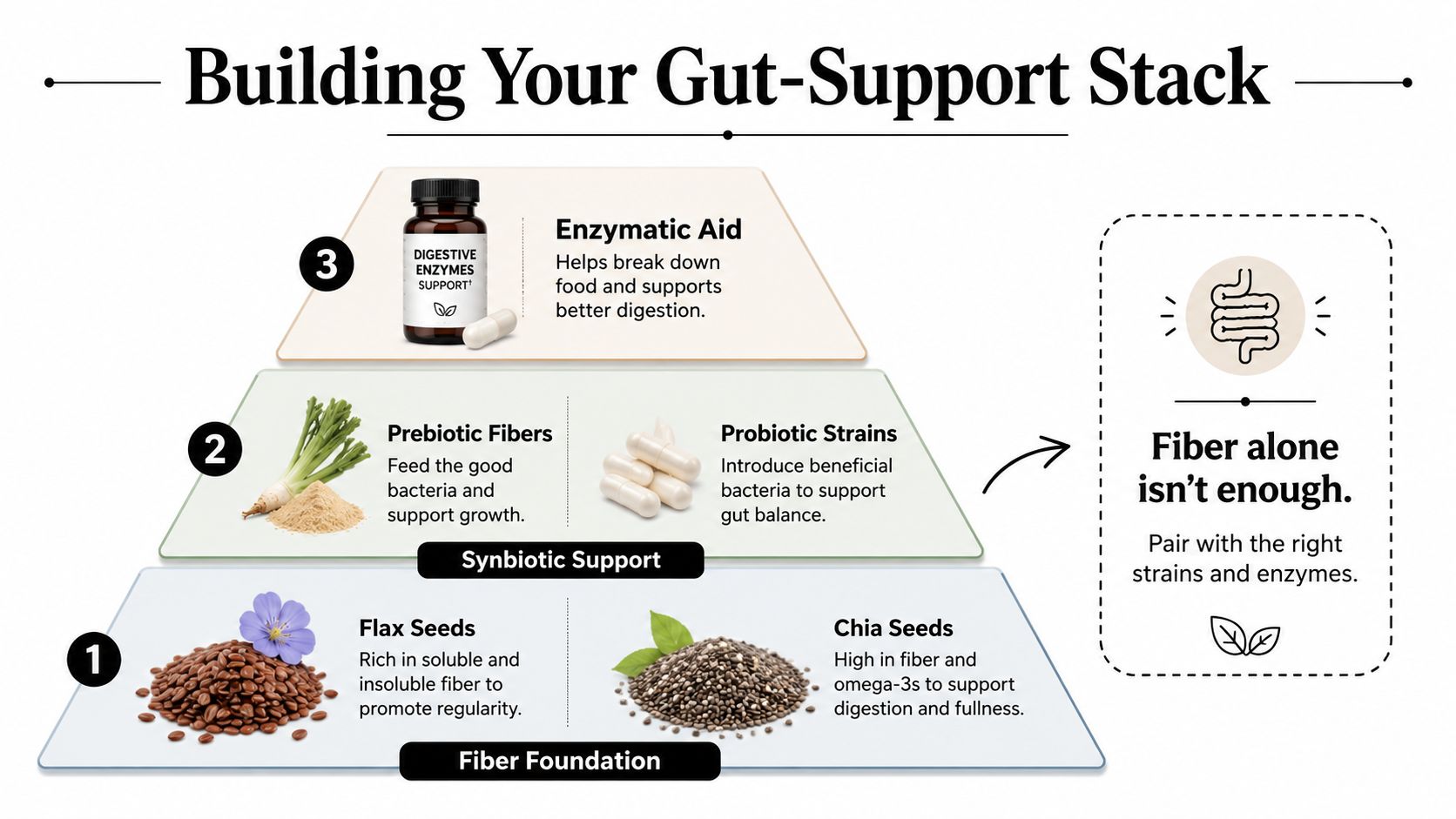
Fiber helps, but fiber alone doesn't solve every digestive complaint. If bloating shows up after meals, or if adding seeds makes a high-FODMAP meal feel heavier, the issue may be digestive capacity, not just fiber intake. That's where a broader stack can make sense.
Why seeds often need support from the rest of the meal
A seed routine works best when the rest of the meal is not sabotaging digestion. If you add fiber to a meal that is already dense, fatty, or full of trigger foods, the total load can be too much for some guts. Digestive enzymes are useful in that setting because they're designed to help break down dairy, fats, protein, and FODMAP-heavy foods.
The same logic applies to synbiotics. A formula built around prebiotics plus probiotic strains can complement a fiber routine when the goal is microbiome support rather than just stool bulk. That's especially relevant for people who want a more complete daily gut stack, not just a seed they sprinkle on breakfast.
The most practical pairing patterns
- Flax plus a microbiome-support formula for people who want fermentable fiber and barrier-focused support during stressful periods.
- Chia plus a daily regularity formula for people who need stool bulk and more predictable bowel movements.
- A seed smoothie plus enzymes when the meal itself is the problem, especially after dairy or heavier mixed meals.
For readers comparing broader supplement architectures, a prebiotic, probiotic, and postbiotic capsule strategy is the right conceptual lens, because seed fiber and targeted microbes serve different jobs. The seed feeds the gut environment, the capsule stack is there to shape what happens next.
Safety, Interactions, and Who Should Be Cautious
The biggest mistake with fiber seeds is assuming “natural” means automatically gentle. It doesn't. Both seeds can help, and both can backfire if hydration is poor or if the person using them has a condition that makes fiber harder to manage.
The main cautions are different for each seed
The National Kidney Foundation lists 2 tablespoons of ground flax seed as containing 90 mg of phosphorus, 114 mg of potassium, and classifies its oxalate level as low, while 2 tablespoons of chia seeds contain 224 mg of phosphorus, 106 mg of potassium, and are classified as high in oxalate (National Kidney Foundation). For people prone to kidney stones, that oxalate detail matters. For people watching mineral intake, the phosphorus difference matters too.
Hydration matters for both. If you don't drink enough fluid with these seeds, stool can get drier or harder to move, which is the opposite of what anyone wants. If you're already constipated, or if you take other supplements that affect bowel movements, check with your clinician before adding concentrated fiber seeds.
Blood sugar and satiety aren't identical effects
A University of Toronto report on a glucose-challenge study found that chia lowered the peak blood sugar rise by about 35% more than flax during the absorptive phase and produced about twice the satiety versus the glucose drink (University of Toronto report). That can be useful for meal planning if you want a stronger short-term fullness effect. It can also be too much of a good thing if you're someone who already struggles to eat enough.
Who should be more careful
- People on blood thinners: talk to a clinician before using flax regularly in concentrated amounts.
- Kidney-stone formers: pay close attention to chia's higher oxalate classification.
- People in active IBD flares or severe IBS flares: both seeds may be too irritating until symptoms settle.
- Anyone with swallowing problems: dry seeds need extra caution because they expand with liquid.
The safest rule is simple. Start low, add fluid, and match the seed to the symptom instead of the trend.
Which Seed to Choose and When to Combine Them
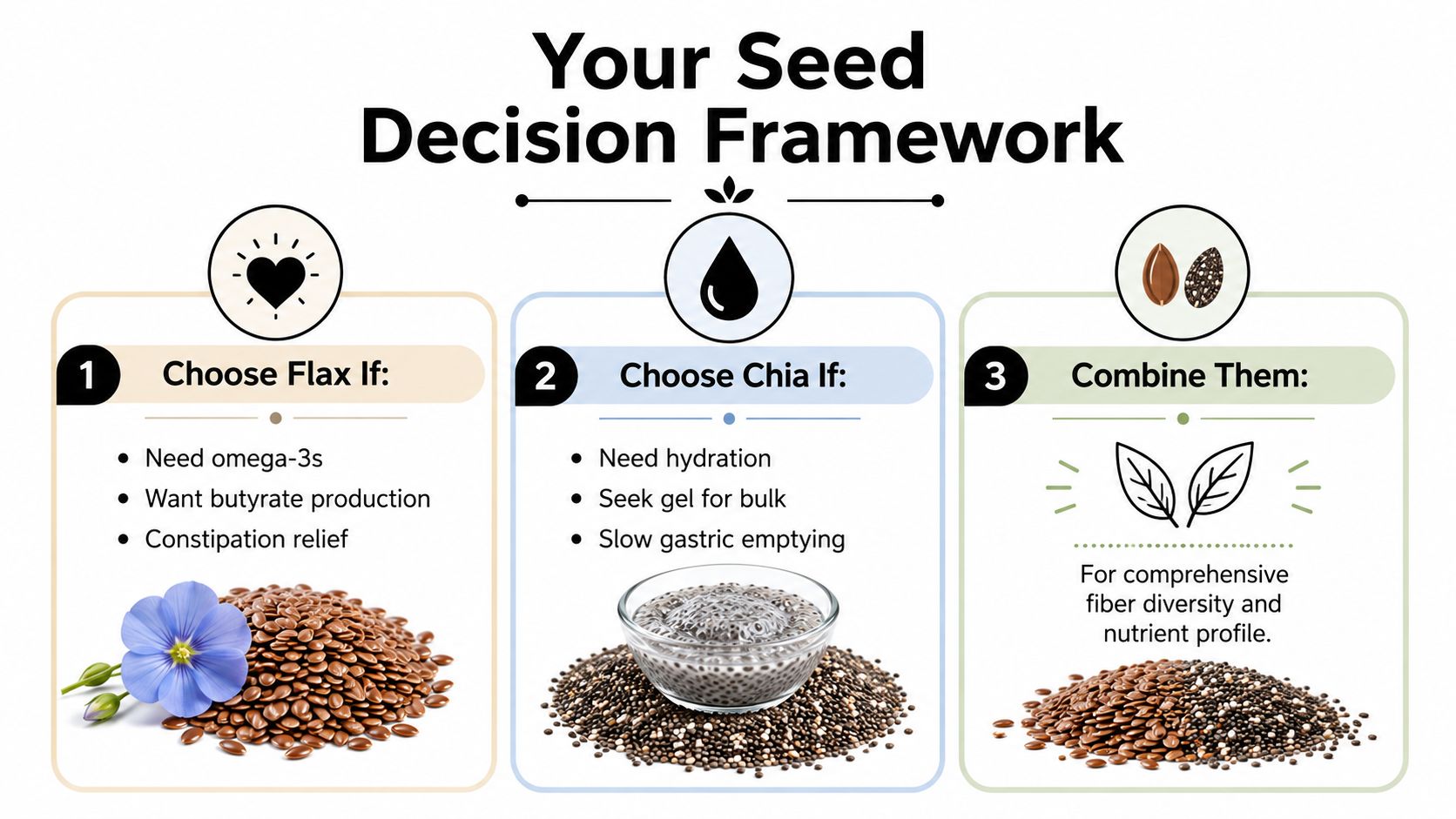
Start with the symptom, not the superfood label. If constipation is the main issue and you want help with stool passage plus a better omega-3 profile, choose flax. If your problem is small-volume stools, low satiety, or you want a seed that forms more of a gel in liquid, choose chia.
If the decision is still unclear, use a short trial instead of guessing. Pick one seed, keep the dose modest, and use it for a few days while watching for stool changes, bloating, and hunger between meals. That gives you a cleaner read than switching back and forth every day.
The combined option makes sense for a lot of people
Both seeds are reasonable when your gut tolerates fiber well and your goal is not just symptom relief, but a more flexible daily pattern. The combination gives you more fiber diversity, a wider nutrient spread, and two different textures, one that tends to ferment more readily and one that forms a stronger gel.
A practical way to decide is to match the seed to the complaint you are trying to solve first. If one seed clearly helps stool form but not regularity, add the other only after you know how the first one feels on its own. That avoids turning a useful food into a vague experiment.
Use this as a simple flowchart in prose:
- Flax first if your main target is constipation support and a better omega-3 intake.
- Chia first if you want more bulk, stronger hydration behavior, and a fuller feeling after meals.
- Both together if you already tolerate fiber well and want variety without relying on one texture alone.
The choice is not about which seed is universally better. Flax and chia solve different digestive problems, so the better fit depends on whether you need fermentation support, stool bulking, or a stronger satiety effect. If symptoms go beyond what fiber can fix, pair the food choice with the right support for regularity, microbiome balance, or meal-time digestion.
If you're sorting out bloating, irregularity, or the difference between a food that helps and one that backfires, GutRx builds gut-support formulas around those exact decision points. Visit GutRx to compare Daily, Balance, Women's, and Mealtime options against your actual symptoms, not just a generic “healthy gut” label.


