

For most bacterial probiotics, take the capsule with a meal or about 30 minutes before it, ideally with some dietary fat. There isn't strong evidence that morning or bedtime is superior, and consistent daily use matters more than choosing a precise hour.
The popular “take it first thing in the morning” rule is too simple. What matters more is which organism you're taking, whether the capsule is protected, and what food reaches your stomach with it. A meal can buffer gastric acidity and help more organisms survive transit, while an empty stomach can expose unprotected bacteria to harsher conditions.
The practical answer for most Lactobacillus and Bifidobacterium formulas is straightforward: attach the dose to a meal you reliably eat, choose food that isn't highly acidic, and follow the label if it gives different directions. The right routine beats a theoretically perfect schedule you keep forgetting.
Table of Contents
- Why the Clock Matters Less Than You Think
- With Food, Before Food, or Empty Stomach
- Matching Timing to Your Routine and Your Schedule
- Probiotics and Antibiotics
- Strain-Specific Timing Rules
- Practical Tips and Quick Answers
Why the Clock Matters Less Than You Think
“Take it in the morning” sounds precise, but it answers the wrong question. Morning may be convenient because people remember supplements alongside breakfast, yet the evidence doesn't establish a universal biological advantage for that hour. Bedtime isn't automatically better either, despite the common idea that slower overnight activity gives probiotics more time to work.
Survival studies focus on gastric acidity, food buffering, fat content, strain identity, and capsule design. They don't show that a probiotic taken at 7 a.m. works better than the same probiotic taken with dinner. A clinical-practice review reports that human evidence is insufficient to recommend a specific morning-versus-evening schedule, while research involving IBS, infectious diarrhea, and inflammatory bowel disease generally supports consistent daily use over exact clock timing (clinical-practice review).

The meal anchor is the useful rule
A 2011 dynamic gastrointestinal study found the strongest survival when a commercial multi-strain probiotic was taken with a meal or about 30 minutes before it, particularly with oatmeal and milk. Taking it 30 minutes after the meal produced substantially lower survival, and milk containing 1% fat plus oatmeal mixed with milk protected the organisms better than apple juice or spring water (the 2011 gastrointestinal survival study).
That doesn't mean every probiotic needs oatmeal, milk, or breakfast. It means food composition matters more than a magic hour. If you want a simple starting routine, use one regular meal with some carbohydrate, protein, and fat, then take the capsule during or directly after that meal unless the label says otherwise.
Practical rule: Choose the meal you can repeat every day, not the time that sounds most scientifically impressive.
If you're also researching supplement timing, separate the question from sleep routines. Guidance on melatonin timing for sleep deals with a different biological purpose and shouldn't be used to set probiotic timing.
Use this checklist tomorrow:
- Check the label: Look for fasting, refrigeration, delayed-release, or strain-specific directions.
- Pick one reliable meal: Breakfast, lunch, or dinner can work.
- Choose tolerable food: Favor a relatively non-acidic meal with some fat.
- Protect the organisms: Take the capsule with water, not a very hot drink.
- Stay consistent: Don't keep changing the schedule before you can judge how the routine feels.
With Food, Before Food, or Empty Stomach
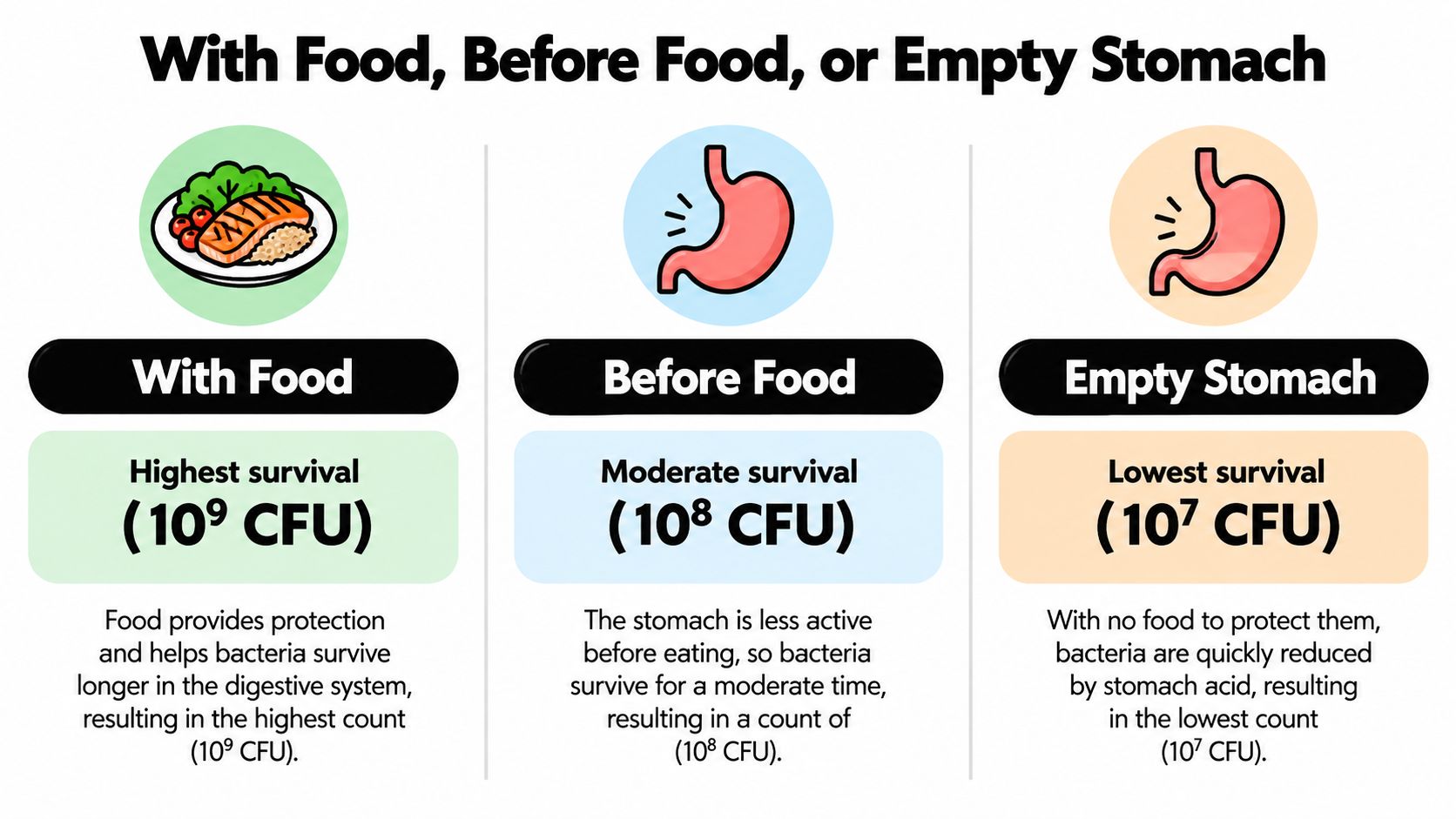
The three common windows are fasting, with food, and after food, but they aren't interchangeable for an unprotected bacterial capsule. In a controlled food-matrix study of Lactobacillus rhamnosus GG, recovered viability was approximately 4.93–6.04 log CFU/g on an empty stomach, 5.39–5.92 log CFU/g with food, and 5.19–6.38 log CFU/g after food (the food-matrix study).
Those figures measure gastrointestinal survival, not symptom improvement. Still, they support a clear practical preference: with food or immediately after food generally makes more sense than fasting for many bacterial formulas. The same experiment found pre-meal dosing produced the lowest survival across the tested food matrices, although another laboratory model found good survival when dosing occurred about 30 minutes before a meal. The safest general instruction is therefore to follow the formulation label, with meal-linked dosing as the default when no special direction exists.
Why food changes the decision
Food can provide a protective matrix and reduce the intensity of acid exposure. Dietary fat appears particularly useful in the laboratory evidence, which is why a meal containing some fat is a better default than plain water on an empty stomach. Water helps swallow the capsule, but it doesn't neutralize gastric acid.
Avoid making an acidic drink the main companion to an unprotected probiotic. Coffee, citrus juice, pineapple, and tomato-based foods may be less suitable close to dosing because of their acidity. You don't need a special meal. Rice with eggs, oats with a tolerated milk alternative, or a balanced lunch can be more practical than forcing a breakfast routine that causes nausea or reflux.
For people comparing top-rated digestive health aids, the timing instruction should be considered alongside strain identity, capsule design, storage requirements, and the intended use case. A product with clear directions is easier to use correctly than one chosen only for a large CFU number.
If your main concern is meal-related discomfort rather than microbiome support, see when to take digestive enzymes. Enzymes and probiotics serve different purposes, so don't substitute one timing rule for the other.
A product such as GutRx BALANCE offers 30 billion CFUs per capsule with next-gen probiotics for gut health, digestive balance, and immune support. Its timing should still follow the product label, with a regular meal serving as the sensible default if no more specific direction is provided.
Delayed-release and enteric-coated products are the main exception. Their design may change how the capsule handles stomach acid, so generic food advice shouldn't override manufacturer instructions.
Matching Timing to Your Routine and Your Schedule
Your best probiotic time is the meal that survives your actual calendar. A breakfast skipper shouldn't force a morning dose, and a shift worker shouldn't abandon a useful routine because the clock says it isn't conventional.

Four schedules that work
The breakfast-and-dinner routine: If you eat breakfast consistently, take the probiotic during that meal or shortly afterward. Choose a non-acidic option with some fat, and avoid using hot coffee as the capsule's immediate companion. Dinner is equally reasonable if it's the meal you never miss.
The intermittent faster: Don't take an unprotected bacterial probiotic on an empty stomach just to preserve a breakfast ritual. Anchor it to your first substantial meal, or use the evening meal if that fits better. A fasting window doesn't make morning biologically mandatory.
The shift worker: Define “breakfast” as your first dependable meal after waking, even if it happens later in the day. Keep the supplement with that meal or a second regular meal rather than tying it to a fixed civil clock time.
The traveler: Keep the dose attached to a meal in the new time zone instead of chasing the old hour. If the product requires refrigeration, follow its storage instructions carefully, and if the label permits room-temperature storage, protect it from heat and moisture.
A meal doesn't have to contain dairy. Oatmeal with a suitable non-dairy accompaniment, a balanced grain-and-protein meal, or another tolerable option can provide a practical food matrix. People with IBS, reflux, nausea, or dairy avoidance should choose foods they can comfortably repeat rather than copying someone else's breakfast.
After the main decision is made, use a reminder that fits the routine. These tips for consistent medication timing can also help with supplement adherence, especially for people managing rotating work hours or multiple daily medicines.
Very hot liquids aren't a good pairing with live organisms, so swallow the capsule with room-temperature or cool water.
The most useful test is simple: can you repeat the same meal-linked dose without discomfort or constant rearranging? If yes, you've found a better schedule than a theoretically ideal hour that fails in practice.
Probiotics and Antibiotics
Antibiotic timing deserves a separate rule because the medicine can directly affect bacterial probiotic organisms. For selected preparations used to support prevention of antibiotic-associated diarrhea, starting within 2 days of the first antibiotic dose was associated with greater benefit in adults and children aged 18–64 than delaying initiation, according to evidence summarized by the U.S. National Institutes of Health (NIH probiotics fact sheet for health professionals).
The same evidence summary describes a meta-regression of 19 studies estimating an 18% reduction in prophylactic effectiveness for each day administration was delayed from antibiotic initiation. That estimate applies to specific clinical outcomes and preparations. It isn't a universal success rate for every probiotic, symptom, or digestive concern.
Probiotic and antibiotic spacing quick reference
| Product type | When to start | Spacing from antibiotic dose | When to stop |
|---|---|---|---|
| Selected bacterial probiotic, including studied Lactobacillus rhamnosus GG | As soon as clinically appropriate after the antibiotic starts, ideally within 2 days | Separate by approximately 2 hours unless the label or clinician says otherwise | Follow the product or clinician plan after the course |
| Saccharomyces boulardii | As soon as clinically appropriate after the antibiotic starts | Antibiotics generally don't directly kill this yeast, so the same bacterial spacing rule doesn't apply | Follow the product or clinician plan after the course |
| Other probiotic formulas | Check the strain and product directions | Use approximately 2 hours as a practical bacterial-probiotic separation rule | Don't assume antibiotic-associated-diarrhea evidence applies to another use |
For a bacterial product, attach the probiotic to a meal and place that meal roughly 2 hours away from the antibiotic dose. The separation reduces immediate drug exposure, but it doesn't guarantee a clinical result. Don't start several days late and assume a higher CFU count will compensate.
The evidence doesn't justify transferring this schedule to IBS, constipation, bloating, or vaginal-health claims. If you're using antibiotics for one of those situations, ask the prescribing clinician or pharmacist how the chosen product fits your treatment.
Read the guide to probiotics for antibiotic use before combining products. People who are immunocompromised, critically ill, or medically complex should obtain clinician guidance before using probiotics, because the risk-benefit decision depends on the individual.
Strain-Specific Timing Rules
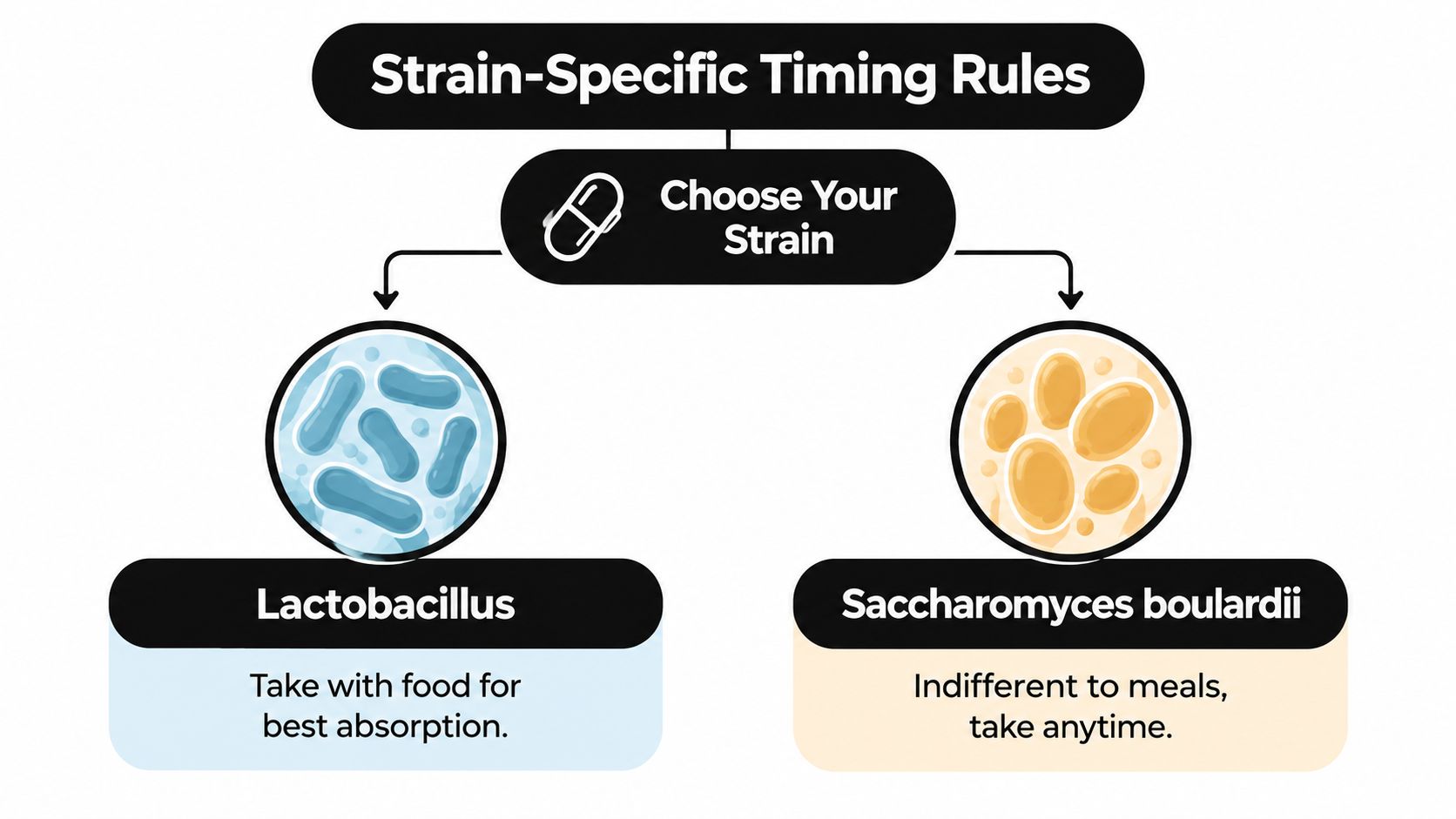
A probiotic label isn't a generic instruction sheet. Lactobacillus, Bifidobacterium, and Saccharomyces boulardii don't respond to meal timing in exactly the same way, so the organism matters before you choose breakfast, lunch, or bedtime.
A 2011 study found that Saccharomyces boulardii survival wasn't significantly affected by meal timing or food buffering, while Lactobacillus and Bifidobacterium showed stronger survival when taken with food or about 30 minutes before a meal (organism-specific timing summary). That makes S. boulardii more flexible, while bacterial blends deserve a meal-linked routine unless the label says otherwise.
Match the organism to the meal
Lactobacillus and Bifidobacterium blends: Take them during a meal or shortly before it when the product doesn't provide a different instruction. A meal with some fat and a relatively non-acidic profile is the strongest practical default.
Saccharomyces boulardii: Meal timing is less consequential because this is a yeast-based probiotic. Consistency still matters for routine adherence, but you don't need to force it into breakfast or separate it from antibiotics in the same way as a bacterial formula.
Akkermansia muciniphila and Christensenella minuta: These next-generation organisms are associated with the gut's mucin layer, but that doesn't create a universal exemption from stomach-transit concerns. A meal-anchored routine remains the sensible approach unless the formulation's directions specify otherwise.
The small human study involving Bifidobacterium longum BB536 and Lactobacillus rhamnosus HN001 compared 30-minutes-before-breakfast with 30-minutes-after-breakfast dosing in 20 participants, divided into two groups of 10. It found no significant difference in the organisms' ability to reach the intestine, colonize, or produce beneficial effects between those schedules (the breakfast timing study). That supports flexibility when the label doesn't demand a particular window.
For readers evaluating Lactobacillus rhamnosus GG specifically, this overview of Lactobacillus rhamnosus GG benefits can help separate strain-specific evidence from broad probiotic marketing.
When the capsule overrides the rule
Enteric-coated and delayed-release capsules are designed to alter where the contents are released. If the manufacturer says to take the product fasting, away from food, refrigerated, or at a specific interval, follow that instruction. Capsule engineering and strain identity can outweigh general advice based on uncoated bacterial products.
Practical Tips and Quick Answers
Set your probiotic routine by the meal, not by the clock. The best schedule is the one you can repeat with the same food pattern most days, because food matrix, capsule design, and label directions matter more than chasing a perfect hour.
Use this as your working protocol:
- Starting tomorrow: Tie the dose to one meal you regularly eat. A meal with some fat and water is a practical default.
- If you skip breakfast: Take it with lunch or dinner. Breakfast skippers and intermittent fasters do better with a real meal than with a forced empty-stomach habit.
- If you avoid dairy: That is fine. You do not need yogurt or milk for a probiotic to fit well into your routine. A mixed meal still works better than taking an unprotected product alone with coffee or juice.
- If you eat at night: Dinner is a good option if that is your most consistent meal. Consistency beats an idealized morning schedule you never follow.
- If you use antibiotics: Keep the probiotic on the same daily meal schedule, but separate it from the antibiotic as directed for that product or by your clinician.
- If you miss a dose: Take the next practical dose with your usual meal. Do not double up unless the label or a clinician tells you to.
- If week one feels uncomfortable: Mild digestive changes can happen. Persistent, worsening, or significant symptoms mean you should stop guessing, review the product, and speak with a clinician.
- If the bottle says shelf-stable: Follow the storage directions after opening. Shelf-stable does not mean heat, humidity, or a hot car are harmless.
- If the bottle requires refrigeration: Refrigerate it as directed and build that into the routine. If travel is coming up, decide in advance whether you can keep it cold or whether a shelf-stable option fits better.
- If the label mentions viability through expiration: Prefer products that state survival through the end of shelf life, not just at manufacture. That tells you more than a large front-label number by itself.
How long should you test the routine?
Keep the schedule stable for several weeks before judging it, unless you develop a concerning reaction or your clinician tells you to stop.
Do not change the meal, product, dose, and timing every few days. If you keep switching from breakfast to fasting to bedtime, you learn nothing about whether the product works for you. A stable routine gives you a fair read on tolerance and fit.
The practical rule is simple. Pick the meal pattern you can maintain, then stick to it long enough to evaluate the result. If the label gives specific timing, follow the label.
When to ask for help
Speak with a clinician before using a probiotic if you're immunocompromised, critically ill, medically complex, pregnant, nursing, or taking prescription medicines that require careful timing. Ask for help when diarrhea, constipation, bloating, pain, reflux, or other symptoms are persistent, severe, or changing.
The best answer to when is the best time to take probiotics is meal-linked and strain-aware. For many bacterial products, take the capsule with a tolerable meal you reliably eat, separate it from antibiotics when appropriate, and let the product label override generic internet advice.
GutRx offers probiotic formulas and digestive-support products designed around targeted gut needs, including bacterial blends and next-generation strain approaches. Visit GutRx to review the available options and match your timing routine to the product's specific directions.


