

Many people taking probiotics do not get constipated; in fact, research shows probiotics typically improve bowel regularity, though temporary digestive adjustments can occur. A 2020 meta-analysis found an average increase of 1.29 bowel movements per week and a reduction in whole-gut transit time of 12.36 hours, compared with placebo.
That may sound surprising if constipation started soon after you opened a new supplement. Timing can make the probiotic seem responsible, but it doesn't prove causation. Your response may reflect the specific strain, dose, added prebiotic fibers, hydration, diet, medication, or an unrelated change in your routine.
Table of Contents
- The Surprising Truth About Probiotics and Constipation
- What Clinical Research Actually Shows
- Distinguishing Normal Adjustment From Problematic Symptoms
- Why Strains and Formulations Matter So Much
- Practical Steps If You Experience Changes
- Making Confident Decisions About Probiotic Products
The Surprising Truth About Probiotics and Constipation
The popular warning is simple: probiotics add bacteria to the gut, so perhaps they slow digestion and make stools harder to pass. The clinical picture is more nuanced, and generally more reassuring. In healthy adults, evidence doesn't show that probiotics commonly cause constipation. Studies involving people with constipation more often report improved stool frequency or consistency than worsening bowel function. Research on probiotic use and safety also highlights that results depend on the specific organisms and formulation.
That doesn't mean your experience is imaginary. If your bowel movements changed after starting a probiotic, the symptom deserves attention. It means you shouldn't assume that every product labeled “probiotic” has the same effect, or that a symptom beginning after the first dose must have been caused by the live microorganisms.
The practical distinction: A short-lived change in stool pattern may be an adjustment. Persistent, worsening, or severe constipation needs a different response.
Gas, mild cramping, nausea, or altered stool habits can occur when someone introduces a new supplement, particularly if the product contains fermentable prebiotics or a large dose. Those sensations can be mistaken for constipation, especially when bloating creates a feeling of fullness or incomplete evacuation. Constipation itself can mean hard stools, reduced frequency, difficult passage, or a sense that the bowel hasn't emptied fully. These aren't interchangeable outcomes, and clinical trials don't always measure them in the same way.
If your symptoms are persistent, it can help to understand conditions involving chronic constipation motility disorders rather than treating every bowel change as a supplement side effect. A simple symptom log can also clarify whether stool frequency and consistency are improving, unchanged, or deteriorating. Guidance on interpreting those changes is available in how to know if probiotics are working.
The contrarian conclusion is straightforward: probiotics aren't a predictable cause of constipation for the average person. A product may still be a poor match for you, but that points toward evaluating the formulation and your individual context, not rejecting the entire category.
What Clinical Research Actually Shows
Clinical studies point in a direction many people do not expect. Across randomized trials, probiotics are more often linked with improvement in constipation-related outcomes than with causing constipation, even though some individuals still report feeling worse at first. The difference matters because population averages and personal experience are not the same thing.
A 2020 meta-analysis pooled 17 randomized controlled trials and 1,469 patients. Rather than repeating the headline numbers, the more useful takeaway here is what the study design adds. By combining multiple randomized trials, the review gives a steadier picture than any single story, clinic anecdote, or isolated product review. It also reported no serious adverse events in the included studies. (The meta-analysis in PubMed)
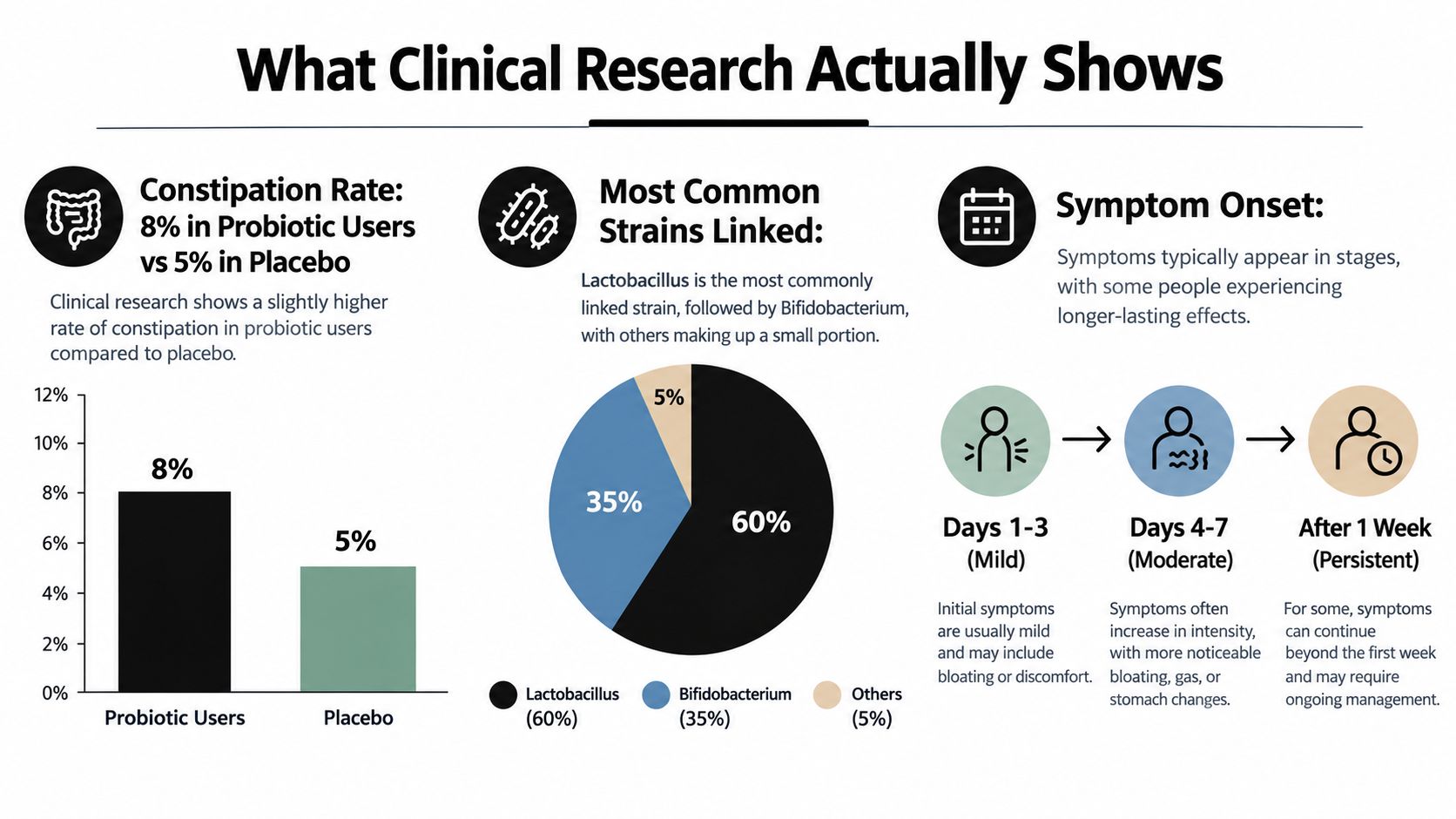
That does not mean every probiotic helps every form of constipation. A probiotic category is a bit like the term “antibiotic.” It sounds singular, but it contains many different products with different effects. In a 2022 systematic review of 10 randomized trials involving 757 people with IBS-C, probiotics improved stool consistency, but not abdominal pain, bloating, or quality of life overall. (The IBS-C systematic review) Softer stools can be a real benefit, yet a person may still say, truthfully, “I don't feel much better.”
Reports of constipation do appear in some trials, and that often fuels concern online. In the IBS-C review, four randomized trials described adverse events among 54 participants, including abdominal pain, anal irritation, reflux, cramping, and constipation. But when researchers compared probiotic and placebo groups together, they did not find a statistically significant difference in adverse events, and no serious adverse events were reported. That is a very different message from “probiotics commonly cause constipation.”
An earlier 2010 systematic review also found probiotics were well tolerated in the placebo-controlled trials it examined, including adult and pediatric studies. The practical lesson is reassuring but not simplistic. For the average person, constipation is not the expected clinical pattern. Individual responses can still differ because age, baseline gut function, medications, and immune status shape how the microbiome reacts, a point explored in these evidence-based aging insights.
For someone comparing products, GutRx BALANCE is described as providing 30 billion CFUs per capsule with next-generation probiotics for gut health, digestive balance, and immune support. That label gives useful context, but it still cannot predict your response on its own.
Distinguishing Normal Adjustment From Problematic Symptoms
A new bowel sensation deserves observation, not panic. Start by describing exactly what's happening. Are stools hard, or are you going less often? Is bloating creating pressure? Do you feel incomplete evacuation? These distinctions help separate constipation from a general change in digestion.
Mild gas, cramping, nausea, or temporary stool changes can occur after introducing a new probiotic. Cleveland Clinic notes that a new product may briefly trigger symptoms resembling the digestive concern it was intended to support, particularly when the dose is large or the gut is sensitive. The key question is direction. A mild symptom that settles is different from constipation that steadily worsens.

A simple symptom check
For several days, record:
- Stool consistency: Note whether stools are unusually hard, normal, or loose.
- Ease of passage: Record straining, urgency, and whether you feel fully emptied.
- Associated symptoms: Track bloating, cramping, nausea, pain, or changes in appetite.
- Product details: Write down the strain names, dose, timing, and any added fibers or sweeteners.
- Daily context: Include fluid intake, diet changes, travel, stress, and new medications.
A log can reveal that the probiotic was started at the same time as a diet change or medication. It can also show that symptoms are improving even if they haven't disappeared yet. Avoid making several changes at once, because changing the product, diet, fiber, and laxative routine together makes the cause impossible to identify.
Seek medical evaluation promptly for severe abdominal pain, vomiting, marked abdominal distension, blood in the stool, fever, dehydration, or inability to pass gas.
Persistent constipation shouldn't be dismissed as a harmless “die-off” or adjustment reaction. People with serious illness or weakened immunity need individualized advice because the safety evidence doesn't fully address every vulnerable group. If you're also reviewing medication-related concerns, distinguishing digestive symptoms from serious Celexa warning signs requires a clinician who knows your history.
Why Strains and Formulations Matter So Much
“Probiotic” is an umbrella term. In practice, that means two bottles on the same shelf can behave very differently in the same gut because the species, strain, delivery system, and inactive ingredients are not the same.
That difference matters for constipation. Some Bifidobacterium lactis strains have been studied for bowel regularity, but strain names are the part that carries the useful clinical meaning. For example, research on Bifidobacterium lactis HN019 has linked that specific strain with improved stool frequency and transit-related outcomes in some adults, while that does not automatically apply to every product labeled “B. lactis.” A broad front-label promise such as “supports digestive health” tells you far less than a label that identifies the exact strain used.
Compare the whole formulation
| Label feature | Why it may matter |
|---|---|
| Named strains | Different strains can produce different bowel effects. |
| CFU amount | A larger dose isn't automatically better tolerated or more effective. |
| Prebiotic fibers | Added ingredients can change how a product feels and functions for you. |
| Capsule design | Delayed-release or enteric protection can change where organisms are released. |
| Other ingredients | Sweeteners, fillers, or allergens may contribute to symptoms. |
| Storage instructions | Stability affects whether the product delivers the organisms listed. |
Capsule design also matters more than many people realize. A delayed-release product may deliver organisms farther down the digestive tract than a standard capsule, and a powder, chewable, or dairy-based format may suit one person better than another. The label is a map. The more specific it is, the easier it is to match the product to the symptom pattern.
This is also where product transparency helps. GutRx BALANCE, for example, is presented as a blend of next-generation strains plus Lactobacillus and Bifidobacterium species, and the company points readers to strain identity and potency documentation rather than asking them to rely on a vague wellness claim alone.
People with constipation-predominant IBS should be especially careful about generalizing from a general wellness probiotic. IBS-C studies are mixed, and stool frequency, abdominal pain, and bloating do not always improve together. A more symptom-focused discussion of probiotics for IBS-C can help you compare products by what they are designed to address, not by category alone.
Practical Steps If You Experience Changes
If constipation begins after a probiotic, first assess severity and timing. A mild change without alarm symptoms may justify careful observation, while severe or progressive symptoms require medical guidance. Don't increase the dose to force a faster result, and don't add multiple digestive supplements before you understand what's happening.

A calmer troubleshooting process
- Check the timing. Note when the symptom began relative to the first dose and whether it changes after each serving.
- Review hydration and routine. Low fluid intake, travel, reduced movement, and dietary changes can affect stool consistency independently of probiotics.
- Read the full label. Look for prebiotic fibers, sugar alcohols, dairy, soy, or other ingredients that might not suit you.
- Change one variable. With professional guidance when appropriate, consider a lower dose, a single-strain product, or a different formulation. Don't change all three at once.
- Track the response. Record stool consistency, frequency, ease of passage, and bloating so you can compare the old and new routine.
- Escalate when needed. Persistent constipation, worsening symptoms, or any alarm sign warrants a healthcare assessment rather than repeated product switching.
The right adjustment depends on the product and your health history. A person taking a high-dose multi-strain formula with added prebiotic fibers may respond differently from someone using a single strain without those additions. If a clinician agrees that a trial is reasonable, changing one feature at a time creates a cleaner test.
Before contacting a healthcare professional, gather the product label, start date, dose, other supplements, medications, bowel pattern before starting, and current warning symptoms. That information is more useful than merely saying, “The probiotic caused constipation.” For additional context on choosing constipation support, see constipation relief supplements.
People who are immunocompromised, severely ill, or managing a serious underlying gastrointestinal condition shouldn't self-manage a persistent reaction. The NIH Office of Dietary Supplements notes that safety studies don't always answer every adverse-event question, and rare severe infections have occurred, particularly in severely ill or immunocompromised people. In those situations, ask your clinician whether a live microorganism supplement is appropriate at all.
Making Confident Decisions About Probiotic Products
Buying a probiotic is less like choosing a generic vitamin and more like checking the ingredients on a recipe. The details determine how the product is likely to behave. Start with the label. You want the genus, species, and strain designation, the full list of added fibers and excipients, storage instructions, and a clear way to confirm potency. Third-party testing and downloadable Certificates of Analysis add another layer of quality control, even though they cannot predict exactly how your gut will respond.
Match the product to the symptom you want to change. For constipation or irregularity, focus on formulas built around bowel function rather than broad promises about “gut health.” For bloating, the probiotic strains matter, but so do fermentable add-ons that can increase gas in some people. For IBS-C, a long ingredient list or a high strain count does not automatically mean better symptom control. More components can make the picture murkier, not clearer.
Monitor before you decide
Keep the trial simple enough that you can learn from it:
- Record your baseline bowel pattern before starting.
- Introduce one product at a time.
- Follow the label rather than escalating the dose.
- Track stool frequency, consistency, ease, and accompanying symptoms.
- Reassess whether the pattern is improving, unchanged, or worsening.
- Stop self-experimentation and seek medical advice when symptoms persist or alarm signs appear.
This step matters because population studies describe averages, while your intestine is a real-world system with its own sensitivities. Clinical evidence often points toward neutral or helpful effects on regularity, yet an individual product can still be the wrong fit because of its strain blend, dose, delivery matrix, added prebiotics, or your underlying condition. That difference is not a contradiction. It is the difference between what tends to happen and what is happening to you.
If you're comparing options for constipation concerns, GutRx Daily is formulated for regularity, and GutRx Balance combines next-generation probiotic strains with barrier support. Review the formulation details and Certificates of Analysis at GutRx, then bring persistent, severe, or confusing symptoms to a qualified healthcare professional.


