

Pancreatic lipase is the primary enzyme that breaks down dietary fats, but it needs gastric lipase, bile, and colipase to work effectively. Gastric lipase starts the process in the stomach, while pancreatic lipase performs most fat digestion in the small intestine.
You may notice the problem after a rich meal: heaviness, bloating, loose stools, or an oily appearance in the toilet. The explanation isn't always that your body lacks one enzyme. Fat digestion depends on a coordinated system that moves from the stomach to the duodenum, changes the physical shape of fat, and then makes its breakdown products available for absorption.
Table of Contents
- The Core Enzymes That Digest Dietary Fats
- How Fat Digestion Works From Stomach to Intestine
- Why Lipase Needs Bile and Colipase to Succeed
- Recognizing the Symptoms of Fat Malabsorption
- Choosing the Right Digestive Enzyme Supplement
- When to Seek Medical Evaluation for Digestive Issues
- Building a Routine for Long-Term Digestive Comfort
The Core Enzymes That Digest Dietary Fats
The answer to what enzymes break down fats starts with lipases. Gastric lipase begins digesting triglycerides in the stomach. Pancreatic lipase then takes over in the small intestine and serves as the main enzyme for intestinal dietary fat digestion. Carboxyl ester lipase also contributes, so the process involves more than one enzyme, as explained in this overview of digestive enzymes.
A triglyceride is a fat molecule built from glycerol and fatty acids. Pancreatic lipase hydrolyzes triglycerides into absorbable products, including free fatty acids, diacylglycerols, monoacylglycerols, and glycerol. More specifically, it targets the sn-1 and sn-3 ester bonds, producing two free fatty acids and a 2-monoglyceride. You don't need to memorize those terms, but the practical point matters: the enzyme changes a large, water-insoluble fat molecule into smaller components that the intestine can transport and absorb. Modern physiology research describes pancreatic lipase as the central enzyme in this conversion.
The two main lipases
Gastric lipase works before pancreatic enzymes arrive. It starts breaking down triglycerides in the stomach and helps prepare the meal for the next stage. Its contribution is useful, but it usually isn't the quantitatively dominant part of adult fat digestion.
Pancreatic lipase performs the bulk of the work in the duodenum. Human pancreatic lipase accounts for roughly 40% to 70% of triglyceride hydrolysis, according to this clinical review of pancreatic lipase. That range helps explain why reduced pancreatic lipase activity can have a noticeable effect on the digestion and absorption of dietary fat.
The sequence is therefore simple to state but important to understand: gastric lipase starts the process, pancreatic lipase drives most of the intestinal breakdown, and bile acids plus colipase make the reaction possible under normal intestinal conditions. A lipase-only explanation misses the environment that allows the enzyme to reach its target.
How Fat Digestion Works From Stomach to Intestine
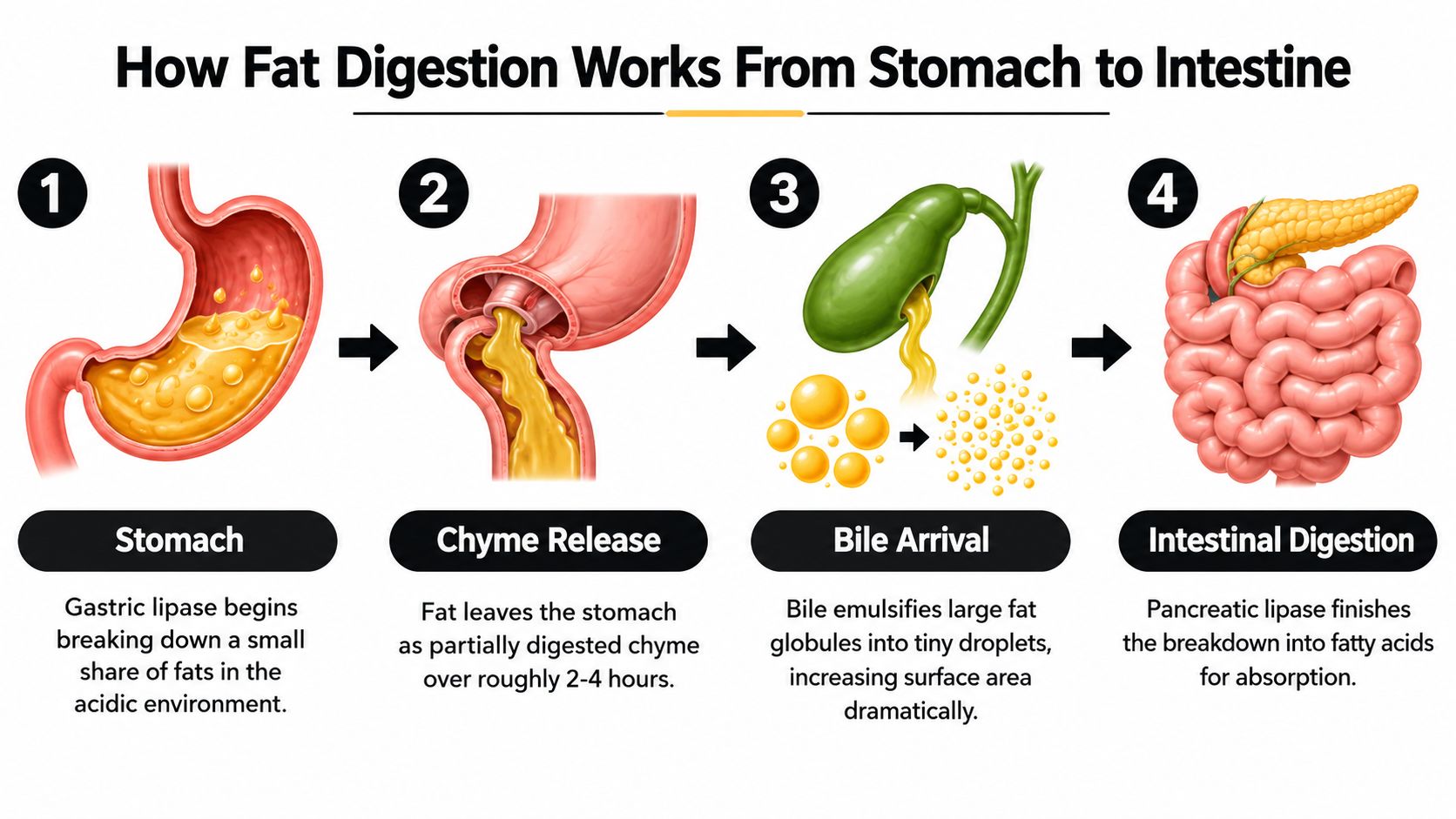
Fat digestion begins before food reaches the small intestine. As you chew and swallow a meal, the stomach mixes it with gastric fluid and turns it into a semi-liquid mixture. Gastric lipase starts breaking down triglycerides during this stage. One nutrition reference estimates that within 2 to 4 hours after eating, about 30% of triglycerides have been converted to diglycerides and fatty acids, as described in this nutrition reference on lipid digestion.
From large droplets to a workable surface
Fat creates a physical challenge for digestion. Oil and water don't mix easily, and digestive enzymes operate in a watery environment. A large fat globule offers relatively little exposed surface for an enzyme to contact. The digestive system therefore needs to divide that globule into much smaller droplets.
When the partially digested meal enters the duodenum, bile arrives from the biliary system. Bile salts emulsify fat, meaning they help disperse large globules into smaller droplets. This doesn't chemically digest the triglycerides by itself. Instead, it increases the available oil-water interface where pancreatic lipase can act.
Pancreatic lipase then works at that interface. It converts triglycerides into free fatty acids and 2-monoglycerides, among other products. Those products can associate with bile salts to form micellar solutions, which help move hydrophobic lipids through the watery intestinal contents toward the absorptive surface.
Practical rule: Fat digestion is both a chemical process and a surface-area problem. An enzyme can't efficiently break down fat it can't reach.
The timeline also explains why symptoms may appear after a meal rather than immediately after the first bite. The stomach begins the work, but most remaining lipid digestion occurs in the duodenum. A supplement designed for meal-related discomfort should therefore be judged by its enzyme activities and delivery system, not merely by the word “lipase” on the front label. For example, GutRx BALANCE is described as offering 30 billion CFUs per capsule with next-generation probiotics for gut health, digestive balance, and immune support, which is a different category of support from a targeted digestive enzyme product.
For a visual explanation of the sequence, this short video on fat digestion follows the movement from the stomach into the intestine.
Why Lipase Needs Bile and Colipase to Succeed
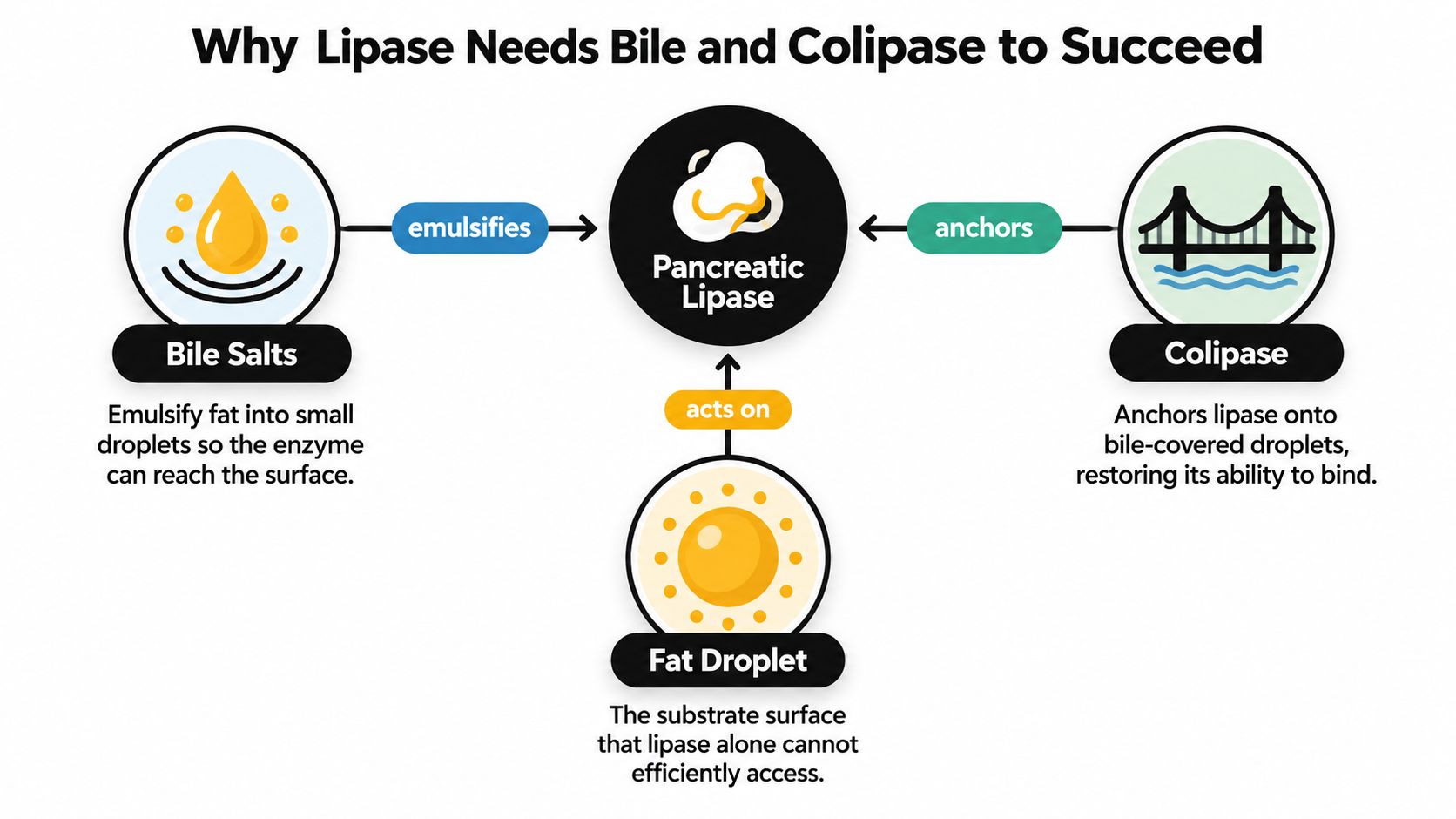
Pancreatic lipase doesn't work efficiently in isolation. Bile acids help make fat accessible, while colipase helps pancreatic lipase stay attached to the fat surface under intestinal conditions. This is why a supplement label that highlights lipase alone can't tell you whether the entire digestive environment is functioning well.
Bile creates access
Bile salts act like a dispersing system for fat. They reduce large droplets into smaller ones, exposing more surface area to the watery contents of the duodenum. This step doesn't replace pancreatic lipase. It gives the enzyme a usable working surface.
Bile also participates in micelle formation. Micelles help carry fatty acids and monoglycerides through the intestinal fluid so they can approach the absorptive lining. The review of bile acids and fat digestion explains why bile acids are necessary for optimal digestion of hydrophobic lipids.
Colipase protects the connection
Bile salts improve emulsification, but they can also interfere with the way lipase binds to the lipid surface. Colipase acts as an anchor or bridge. It helps pancreatic lipase remain positioned at the fat-water interface, allowing catalysis to continue in the presence of physiological bile salt concentrations.
That relationship changes how you should interpret persistent symptoms. If someone has some lipase activity but inadequate bile-mediated emulsification or insufficient colipase support, the overall reaction may still be inefficient. The issue isn't necessarily a total absence of enzyme. It may be poor access to the substrate or failure to keep the enzyme attached where the reaction occurs.
Fat digestion succeeds when the enzyme, the substrate surface, bile acids, and colipase arrive together.
This whole-system view also explains why digestive discomfort after fatty meals can have different causes. A broad enzyme product may be relevant when several food components cause symptoms, while a clinical problem involving pancreatic output or bile flow needs professional assessment. Taking more of a single enzyme isn't a reliable way to correct every failure in the digestive pathway.
Recognizing the Symptoms of Fat Malabsorption
Consider two different experiences. One person feels temporary fullness after eating a greasy meal, then returns to normal. Another repeatedly has bloating, urgent diarrhea, and stools that look oily, pale, unusually foul-smelling, or difficult to flush. The second pattern deserves more attention because it can reflect inadequate fat digestion or absorption rather than ordinary post-meal discomfort.
When triglycerides aren't converted into absorbable products, more undigested fat remains in the intestinal contents. That can produce steatorrhea, the clinical term for fatty stools. Excess unabsorbed material can also contribute to gas and bloating as it moves through the digestive tract. The symptom pattern matters most when it persists, appears repeatedly after meals, or occurs alongside unintended weight loss or signs of nutrient deficiency.
What nutrient absorption has to do with the symptoms
Fat doesn't only provide energy. It also helps the intestine absorb the fat-soluble vitamins A, D, E, and K. If lipase activity or the supporting bile system is insufficient, the body may absorb less dietary fat and may also absorb less of these vitamins. Updated clinical information from Johns Hopkins Medicine connects insufficient pancreatic lipase with impaired absorption of these vitamins, diarrhea, and fatty stools.
Track the pattern rather than blaming one food immediately:
- Timing: Note whether symptoms follow a high-fat meal, occur with many different meals, or happen independently of eating.
- Stool changes: Record persistent oiliness, floating stools, unusual paleness, or oily leakage.
- Associated signs: Pay attention to ongoing diarrhea, weight change, fatigue, or other symptoms that suggest poor nutrient intake or absorption.
A food diary can't diagnose pancreatic or biliary disease, but it gives a clinician useful context. For a focused explanation of the causes and signs, read this guide to what fat malabsorption can look like. Occasional heaviness after a large meal is different from a recurring pattern of fatty stools and nutrient-related symptoms.
Choosing the Right Digestive Enzyme Supplement
A digestive enzyme supplement should match the problem you're trying to solve. A broad-spectrum blend may combine enzymes intended to support the digestion of proteins, fats, carbohydrates, dairy components, fiber, or fermentable foods. A targeted lipase formula focuses more specifically on fat digestion. Neither category automatically suits everyone.
Read the Supplement Facts panel closely. Enzyme strength is more informative when the label lists activity units, such as USP units, rather than only the weight of an enzyme powder. The product should also explain when to take it. Because fat digestion occurs primarily in the small intestine, a delayed-release or enteric-coated delivery system may be relevant if it is designed to help the enzymes reach that location.
A practical label comparison
| Feature | Why It Matters for Fat Digestion |
|---|---|
| Lipase activity | Indicates the product's stated capacity to act on triglycerides. |
| Activity units | Help you compare functional enzyme activity instead of relying only on ingredient weight. |
| Broad-spectrum coverage | May suit people who notice discomfort after meals containing several macronutrients. |
| Delayed-release protection | May help protect enzymes from early breakdown and deliver them farther along the digestive tract. |
| Third-party testing | Adds independent quality verification for identity, purity, and potency when documentation is available. |
| Directions with meals | Places the enzymes alongside the food they are intended to help digest. |
The guide to digestive enzyme blends can help you compare formulas by intended use rather than by marketing language alone. Look for clear activity information, transparent directions, and a delivery format that makes biological sense.
GutRx Mealtime is one example of a product positioned for meal-related digestive support, but a label still needs to be evaluated on its actual formula and directions. Don't assume that a higher ingredient weight means stronger performance, and don't use an over-the-counter blend as a substitute for prescribed pancreatic enzyme replacement when a clinician has identified a medical deficiency.
Label-reading advice: Choose the product based on the food pattern and digestive concern, then verify enzyme activity, timing instructions, and quality documentation.
Probiotics and enzymes also serve different roles. A probiotic formula is not automatically a replacement for lipase, and a lipase supplement doesn't provide the same type of microbiome support as a probiotic. Buyers comparing options on Amazon or elsewhere should start with the main use case, then examine the differentiators.
When to Seek Medical Evaluation for Digestive Issues
Persistent fat-digestion symptoms deserve medical attention, especially when they include repeated steatorrhea, unexplained weight loss, ongoing diarrhea, or signs that fat-soluble vitamin absorption may be impaired. A single uncomfortable meal doesn't prove a disease. A continuing pattern can point to pancreatic exocrine insufficiency, gallbladder or bile-related problems, or another gastrointestinal condition.
Start with your primary clinician or a gastroenterologist. Bring a concise record of meals, timing, stool changes, medications, supplements, weight changes, and any known digestive history. This helps distinguish a food-triggered pattern from symptoms that occur regardless of meal composition.
What evaluation may involve
A clinician may review your history and perform laboratory testing. A stool elastase test can help assess pancreatic enzyme output, while other stool testing may examine fat content. Depending on the symptoms, a clinician may also consider breath testing or investigations for other digestive disorders. The appropriate test depends on the suspected cause, so self-ordering supplements shouldn't replace an evaluation.
Seek prompt advice if symptoms are severe, persistent, or accompanied by substantial weight change, dehydration, bleeding, or marked weakness. Fat-soluble vitamin problems can affect multiple body systems, and treating the underlying cause matters more than masking individual meals.
A general symptom list can help you prepare for an appointment, but it can't establish whether pancreatic output, bile delivery, or intestinal absorption is impaired. Use this guide to enzyme deficiency symptoms as a starting point for questions, not as a diagnosis.
Over-the-counter digestive support may have a place for occasional meal-related discomfort, but it isn't a treatment for exocrine pancreatic insufficiency or gallbladder disease. If a clinician identifies pancreatic enzyme insufficiency, follow the prescribed treatment plan and ask how to coordinate it with meals, snacks, and vitamin monitoring.
Building a Routine for Long-Term Digestive Comfort
Long-term comfort starts with reducing uncertainty. Notice which meals trigger symptoms, slow down enough to identify portion and ingredient patterns, and avoid making several supplement changes at once. A simple record can show whether discomfort follows a very fatty meal, dairy, fermentable carbohydrates, or a broader range of foods.
Meal composition also matters. Fat is an important nutrient, so eliminating it without professional guidance isn't a complete solution. If fatty foods repeatedly cause diarrhea or oily stools, a registered dietitian or clinician can help you maintain adequate nutrition while investigating the reason for poor digestion.
Make the routine practical
- Pace meals: Eating more slowly gives you time to recognize fullness and notice how your body responds.
- Use targeted support: If you choose an enzyme supplement for occasional discomfort, take it according to the product's meal-related directions.
- Separate goals: Use enzyme products for enzyme-related meal support and probiotic or synbiotic products for microbiome-focused goals.
- Review persistent symptoms: A supplement should not delay evaluation when fatty stools, weight loss, or recurring diarrhea continue.
The microbiome is part of the broader digestive environment, but it doesn't replace the mechanical and chemical steps required to digest triglycerides. Pancreatic lipase still needs access to the fat surface, bile still needs to emulsify the droplets, and colipase still helps stabilize the enzyme at the interface. Supporting digestive comfort therefore means matching the intervention to the failed step instead of treating every symptom as a generic “gut health” problem.
For everyday purchasing decisions, look for transparent labels, relevant enzyme activities, clear directions, and independent quality documentation. If you also want microbiome support, compare a probiotic, prebiotic, or synbiotic based on its stated purpose rather than assuming it will provide pancreatic enzyme activity.
You now have the key answer: pancreatic lipase does most dietary fat hydrolysis, gastric lipase starts the process, and bile plus colipase make efficient digestion possible. Use that framework to track symptoms, choose supplements carefully, and involve a clinician when the pattern suggests malabsorption rather than an occasional heavy meal.
GutRx offers digestive enzyme and microbiome-focused supplements designed for different digestive-support needs, with product choices that should be matched to your symptoms and goals. Visit GutRx to review the available options and choose a more informed next step for meal-related digestive comfort.


