

A vegan label doesn't prove that a probiotic will work. It only tells you something about the product's sourcing and formulation, and even that requires closer inspection. For vegan probiotic capsules, the more important question is whether the bacteria were grown without animal-derived materials, enclosed in a plant-based shell, protected from moisture and stomach acid, and still viable through the stated expiration date.
Capsules and tablets represented nearly 49.95% of the global vegan probiotics market in 2025, with estimated revenue of USD 624.41 million, according to market segment data on vegan probiotic delivery formats. Capsules are therefore a mainstream retail format, not a niche alternative. But a familiar delivery format can still contain weak manufacturing decisions. The right buying decision starts with the biology inside the capsule and the technology used to deliver it.
Table of Contents
- The Reality of Vegan Probiotic Manufacturing
- Surviving Stomach Acid with Delayed-Release Technology
- Evaluating Shelf-Stability and Third-Party Testing
- Targeting Symptoms with Next-Generation Strains and Enzymes
- The GutRx Approach to Lab-Grade Synbiotic Formulation
- Best Practices for Dosing and Daily Integration
The Reality of Vegan Probiotic Manufacturing
A vegan probiotic capsule can meet ethical preferences and still perform poorly. Vegan is a manufacturing claim, not a performance claim. The label does not establish strain survival, digestive comfort, or delivery to the intestine.
Verify vegan status across the full formula, not just the capsule:
The three checks that matter
- Growth medium: Bacteria need nutrients during cultivation. Confirm that the medium contains no dairy or other animal-derived inputs. “Vegan capsule” may describe only the shell, not the fermentation process.
- Capsule shell: Hypromellose, or HPMC, is a common plant-based capsule material. Gelatin is animal-derived. The Supplement Facts panel or technical documentation should identify the shell clearly.
- Fillers and excipients: Lactose, milk derivatives, gelatin, and processing aids may sit outside the active strains. Read the “other ingredients” line rather than relying on front-label wording.
A plant-based shell therefore does not guarantee end-to-end vegan production. This review also matters for people avoiding dairy because of intolerance or ingredient sensitivity, although vegan status does not show that a product will relieve bloating, constipation, diarrhea, or another digestive complaint.
Practical rule: Use “vegan” as one screening criterion. Evaluate strain identity, viability, acid protection, storage, and testing separately.
The category is expanding beyond specialty health-food channels. Forecasts report global vegan probiotic sales growing at a 7.6% CAGR from 2020 to 2024, with a projected 9.2% CAGR through 2035 and the sector expected to exceed USD 15.5469 billion by 2035, according to vegan probiotics market forecasts. More products create more choice, but they also make label comparison harder.
Start with the manufacturer's records. Look for a complete ingredient list, named strains, potency tied to expiration, storage instructions, and accessible quality documentation. Information about supplements manufactured in the USA explains why production controls deserve attention, but the country of manufacture alone cannot show that bacteria reach the intestine alive. A credible formula must connect its vegan inputs with evidence of viable delivery.
Surviving Stomach Acid with Delayed-Release Technology
A vegan capsule can still fail before its bacteria reach the intestine. The shell determines where the contents are released, so plant-based material alone says little about delivery. Standard non-enteric-coated HPMC capsules can disintegrate within 5 minutes in simulated gastric fluid. In one study, only 3% and 8% of viable cells remained after 60 minutes for two capsule types, while a protected formulation retained 97% viability, as documented in the probiotic capsule viability study.
Read the CFU claim in that context. The number printed on a bottle describes the labeled dose, not necessarily the number that survives gastric exposure. Without acid protection, the contents may be released before the bacteria have a practical opportunity to pass into the small intestine.
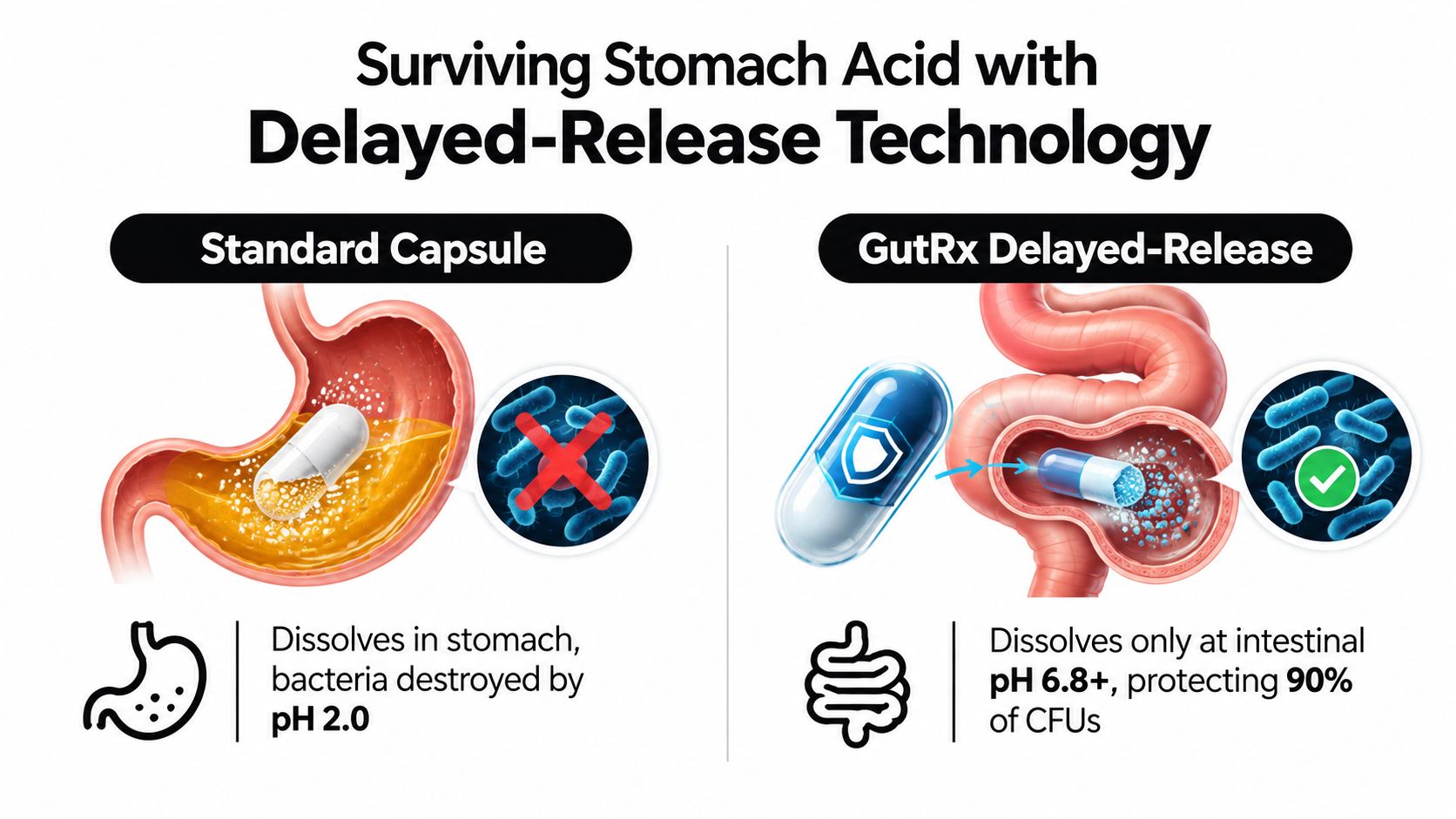
How the delivery systems differ
| Delivery approach | Main advantage | Main limitation |
|---|---|---|
| Standard HPMC capsule | Plant-based shell and straightforward manufacturing | May dissolve rapidly in gastric fluid |
| Microencapsulated bacteria | Adds a protective barrier around cells | Requires careful formulation and manufacturing control |
| Acid-resistant HPMC shell | Can delay dissolution until a less acidic environment | Must be validated for both gastric protection and intestinal release |
| Delayed-release system | Targets release beyond the stomach | A label should explain the technology rather than relying on vague “advanced” language |
Acid-resistant vegetable HPMC capsules can show a different dissolution profile. One platform showed less than 10% dissolution after 120 minutes at pH 1.2 and 89.18% dissolution after 45 minutes at pH 6.8, indicating gastric protection followed by intestinal release.
Performance still varies by formula. The shell, coating, moisture exposure, fill composition, and strain stability all affect whether delayed release works as intended. Look for a specific description of the system and its testing, rather than treating “vegan” as evidence of acid protection.
A product such as GutRx BALANCE is described as offering 30 billion CFUs per capsule with next-generation probiotics for gut health, digestive balance, and immune support. Evaluation should focus on whether the delivery design and testing documentation support the labeled dose through use and storage.
For a broader explanation of combining these ingredients, see prebiotic and probiotic capsules. The practical distinction is straightforward: vegan status identifies the capsule material, while delayed-release testing addresses where the contents are released.
This short video offers a visual explanation of why delivery design matters:
Evaluating Shelf-Stability and Third-Party Testing
The word “vegan” says little about whether probiotic cells survive storage. Moisture, heat, oxygen, and time can reduce viability after manufacturing, so a shelf-stable product needs evidence beyond a “no refrigeration required” statement. Packaging, storage directions, and the formula's stability data should agree.
Review the label and supporting documents through four practical questions:
- Is potency guaranteed through expiration? A CFU count measured at manufacture matters less than an amount guaranteed through the stated shelf life.
- Does the package control moisture? Low-moisture vegetarian capsule systems may support stability, but the bottle still needs an appropriate barrier and clear handling instructions.
- Are the strains identified precisely? Genus and species names provide more information than a generic “probiotic blend.” Strain-level identification matters because effects are strain-specific.
- Can the manufacturer provide independent testing? A downloadable Certificate of Analysis may document batch identity, purity, and viable count.
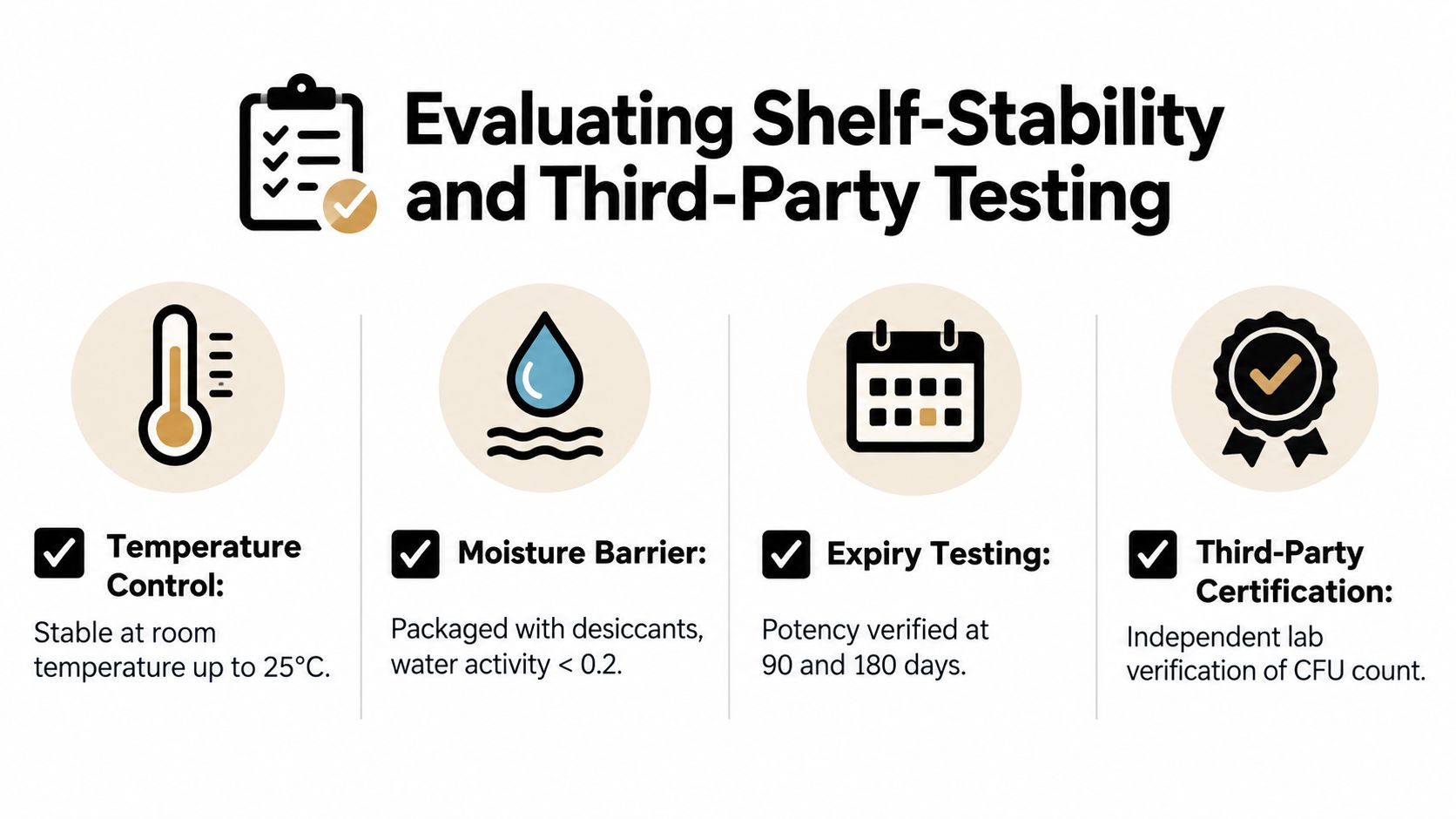
Read the storage instructions literally
“Store in a cool, dry place” is a quality instruction, not decorative wording. Keep the container closed, avoid a hot vehicle or humid bathroom, and follow refrigeration guidance when the manufacturer requires it. Travel exposure can affect viability even when the product is marketed as shelf-stable.
The relevant question is whether the manufacturer tested the finished formula under defined storage conditions. Results from one HPMC-encapsulated system cannot be generalized to every capsule, strain combination, or climate. The capsule material may contribute to stability, but moisture control, fill composition, packaging, and handling remain part of the outcome.
The U.S. FDA has issued draft guidance addressing quantitative labeling of dietary supplements containing live microbes, as shown in the FDA draft guidance for live-microbe supplement labeling. This distinction helps shoppers determine whether the stated CFU amount applies at manufacture or is guaranteed through the end of shelf life.
A useful standard: If a company cannot explain when its CFU count is measured, how the formula protects the bacteria, and whether an independent laboratory verifies the batch, compare another product.
Third-party testing does not establish that a probiotic will resolve a symptom. It gives you a stronger basis for checking whether the contents match the label, including identity, purity, and viable count. This guide to third-party-tested probiotics outlines documentation to request before buying.
Targeting Symptoms with Next-Generation Strains and Enzymes
The vegan label says little about symptom fit. What matters more is whether the finished capsule contains the right strain or enzyme, in the right form, with enough viability or activity to support its intended use.
Akkermansia muciniphila shows why product descriptions need precision. An independent review notes that pasteurized Akkermansia muciniphila was approved by the European Food Safety Authority as a safe novel food. Positive human trial results used pasteurized biomass at roughly 30 billion cells per day, as discussed in the review of Akkermansia muciniphila. Because the studied material was pasteurized rather than live, an “Akkermansia” capsule should not be assumed to reproduce those findings unless its form and formulation match the research.
Christensenella minuta has a different evidence profile. A peer-reviewed review describes it as a candidate next-generation probiotic with promising properties observed in animal models and humans, while also describing an emerging research base, according to the review of Christensenella minuta. It may be an interesting formulation choice, but the ingredient name alone does not establish clinical equivalence across products.
Match enzymes to the food trigger
Enzymes address particular food components rather than providing broad “digestive support.”
- Lactase is intended for lactose in dairy foods.
- Alpha-galactosidase targets carbohydrates in beans and cruciferous vegetables.
- FODMAP-focused enzyme approaches may be used with garlic, onion, and wheat fructans.
In a placebo-controlled crossover trial, three 4,500-unit lactase tablets taken before a lactose load reduced breath hydrogen by 55%, according to the digestive enzymes and probiotics guide. The result was food-specific, so timing matters. Lactase taken long after a dairy meal is not the same intervention as taking it before the trigger food.
For bloating paired with irregularity, a probiotic may suit a daily microbiome-support routine. Predictable discomfort after dairy or a bean-heavy meal may call for a targeted enzyme instead. Persistent diarrhea, severe abdominal pain, blood in stool, unexplained weight loss, or significant bowel-habit changes require medical evaluation rather than self-directed supplement stacking.
The GutRx Approach to Lab-Grade Synbiotic Formulation
The word “vegan” describes the ingredient boundary, not whether a probiotic reaches the intestine alive. A useful benchmark for vegan probiotic capsules combines ingredient transparency, delivery protection, stability controls, and evidence-aware positioning. A synbiotic pairs a probiotic with a prebiotic. A postbiotic contains nonliving microbial components or metabolites. These categories serve different purposes, so an all-in-one label should state each component and its intended role.
GutRx describes a product system using vegan, non-GMO, gluten-free ingredients, delayed-release delivery, next-generation strains, prebiotics, postbiotics, and third-party testing with downloadable Certificates of Analysis. Those features identify the areas worth checking. They do not prove that every strain remains viable through shelf life or produces a particular outcome. Review the product-specific label, strain names, expiration potency, storage instructions, and testing documents before judging the formulation.

Compare the formula to the job
| Buyer need | Formulation feature to examine | Product direction |
|---|---|---|
| Regularity and daily maintenance | Named probiotic strains, prebiotic support, expiration-date potency | A daily-focused formula |
| Bloating and digestive balance | Strain selection, delayed release, clear symptom positioning | A balance-focused formula |
| Gut and women's wellness | Women-specific strains or complementary ingredients, with transparent labeling | A women's formula |
| Heavy meals and food triggers | Enzymes matched to protein, fat, dairy, fiber, or FODMAP foods | A mealtime enzyme formula |
| Broad microbiome support | Probiotic, prebiotic, and postbiotic components with clear amounts and testing | A complete synbiotic formula |
This comparison prevents a common purchasing error. A large CFU number cannot compensate for poorly matched strains, weak acid protection, or potency that declines before expiration. A digestive enzyme may address a food trigger, but it does not replace a daily microbiome routine.
Market growth increases the number of formulations available for comparison. It also makes verification more important. Check the strain designations, dosage, delayed-release method, storage requirements, and evidence supporting the product's intended use.
For next-generation ingredients, identify the specific form used in research rather than relying on the ingredient category alone. For capsules, ask how acid resistance was assessed. For shelf stability, look for potency support through expiration, not only the count at manufacture. For vegan status, review the capsule shell, growth medium information, and excipients together.
Best Practices for Dosing and Daily Integration
The most effective vegan probiotic capsules still need sensible use. Start with the product's own directions, especially if the label specifies food timing, refrigeration, or a particular serving schedule. Don't transfer timing instructions from one strain or enzyme formula to another.
Use these practical rules:
- Take daily probiotics consistently: A routine is easier to evaluate than sporadic use. Choose a time you can repeat and avoid changing several supplements at once.
- Use mealtime enzymes with the meal: Lactase and other food-specific enzymes are intended to meet the relevant food substrate, so follow the label's timing rather than taking them hours afterward.
- Protect the bottle: Keep capsules sealed and away from heat and humidity. A shelf-stable product still needs proper storage.
- Increase complexity slowly: If a formula includes prebiotics, a sudden increase may feel uncomfortable for some people. Follow the serving instructions and reduce variables if bloating changes.
- Track the symptom you're targeting: Record bowel regularity, meal-related bloating, stool changes, or digestive comfort. Don't judge a formula only by how you feel on one day.
The term “die-off” or “Herxheimer reaction” is often used to explain temporary symptoms after starting probiotics, but it shouldn't become a reason to ignore worsening or alarming symptoms. Significant pain, dehydration, persistent diarrhea, blood in stool, or a new symptom that concerns you deserves clinical guidance.
Food still matters. Prebiotic-rich plant foods can support the broader dietary environment for beneficial microbes, but add fiber according to your tolerance, particularly if you're already dealing with gas or irregularity. A probiotic capsule can provide defined strains, yet it can't compensate for an eating pattern that consistently aggravates your symptoms.
Your final checklist is straightforward: confirm that the product is vegan end-to-end, identify the strains, look for delayed-release or other protection, check potency language through expiration, follow storage directions, and seek independent batch documentation. Choose a formula for your actual goal, whether that's daily gut support, bloating with irregularity, women's wellness, or food-specific digestive discomfort.
GutRx offers vegan, non-GMO digestive supplements built around lab-grade synbiotic and enzyme formulations, including delayed-release probiotic options and targeted support for regularity, digestive balance, women's wellness, and meal-related discomfort. Review the available formulas and quality documentation at GutRx to choose a delivery system that matches your specific digestive goal.


