

A prebiotic is a substrate that host microorganisms selectively use to produce a health benefit, while a postbiotic is a preparation of inanimate microorganisms or their components that produces a health benefit. They aren't interchangeable categories, and the label alone doesn't prove that either one will improve your symptoms.
Could a fiber that feeds gut microbes be useful without being a clinically supported prebiotic? Could a heat-treated microbe qualify as a postbiotic if nobody has tested the finished preparation in humans? Those questions matter when you're comparing a prebiotic probiotic postbiotic supplement, especially if bloating, irregularity, diarrhea, or IBS-pattern symptoms are already part of your routine.
The clearest way to evaluate these products is to separate three ideas: what an ingredient is, how it might work, and what the specific product has demonstrated. A supplement can have a plausible mechanism without having evidence for your symptom pattern. It can also contain a scientifically recognized category while using a dose, preparation, or combination that hasn't been tested.
Table of Contents
- What Prebiotics and Postbiotics Actually Mean
- How Prebiotics Work in the Gut
- How Postbiotics Work and Why They Are Different
- Probiotics, Prebiotics, and Postbiotics Side by Side
- How the Gut-Brain-Immune Axis Connects These Ingredients
- Why Stacking Does Not Always Mean Synergy
- Safe Use and Dosing for Sensitive Digestion
- Practical Takeaways for Choosing a Synbiotic Product
What Prebiotics and Postbiotics Actually Mean
The 2017 ISAPP consensus definition describes a prebiotic as “a substrate that is selectively utilized by host microorganisms conferring a health benefit.” In plain English, it isn't enough for a carbohydrate to ferment. Specific microorganisms or microbial functions must use it selectively, and that change must connect to a demonstrated benefit in the same body of evidence. The consensus was published in Nature Reviews Gastroenterology & Hepatology, volume 14, issue 8, pages 491–502 (ISAPP consensus on prebiotics).
The 2021 ISAPP consensus definition describes a postbiotic as “a preparation of inanimate microorganisms and/or their components that confers a health benefit on the host” (2021 postbiotic consensus). That definition requires an inactivated microbial preparation or microbial components, plus evidence of a health benefit. A purified metabolite by itself doesn't automatically qualify, and neither does an unverified microbial fragment.
The difference in one glance
| Category | What it contains | What must be demonstrated |
|---|---|---|
| Prebiotic | A substrate used by host microorganisms | Selective utilization plus a health benefit |
| Probiotic | A live microorganism | A health benefit at an adequate amount |
| Postbiotic | Inanimate microorganisms or their components | A health benefit from the specific preparation |
This distinction protects buyers from treating fiber, fermentability, or nonliving microbes as proof of efficacy. It also gives clinicians and formulators a more precise vocabulary for discussing regularity, digestive balance, gut barrier support, and microbiome-directed nutrition.
If you're already investigating digestive symptoms or broader health patterns, laboratory context can be useful alongside supplement research. For example, you can check Lola's blood tests as a separate resource, but test results and supplement labels answer different questions. A blood test may provide health information, while a prebiotic or postbiotic claim still needs product-specific evidence.
How Prebiotics Work in the Gut
A prebiotic begins as a substrate, meaning material that reaches host microorganisms and can be used by them. Examples discussed in prebiotic research include inulin, fructo-oligosaccharides, galacto-oligosaccharides, partially hydrolyzed guar gum, and some beta-glucans. Their presence on a label doesn't settle the question by itself. The relevant questions are which organisms use the substrate, what functions change, and whether researchers measured a meaningful human outcome.
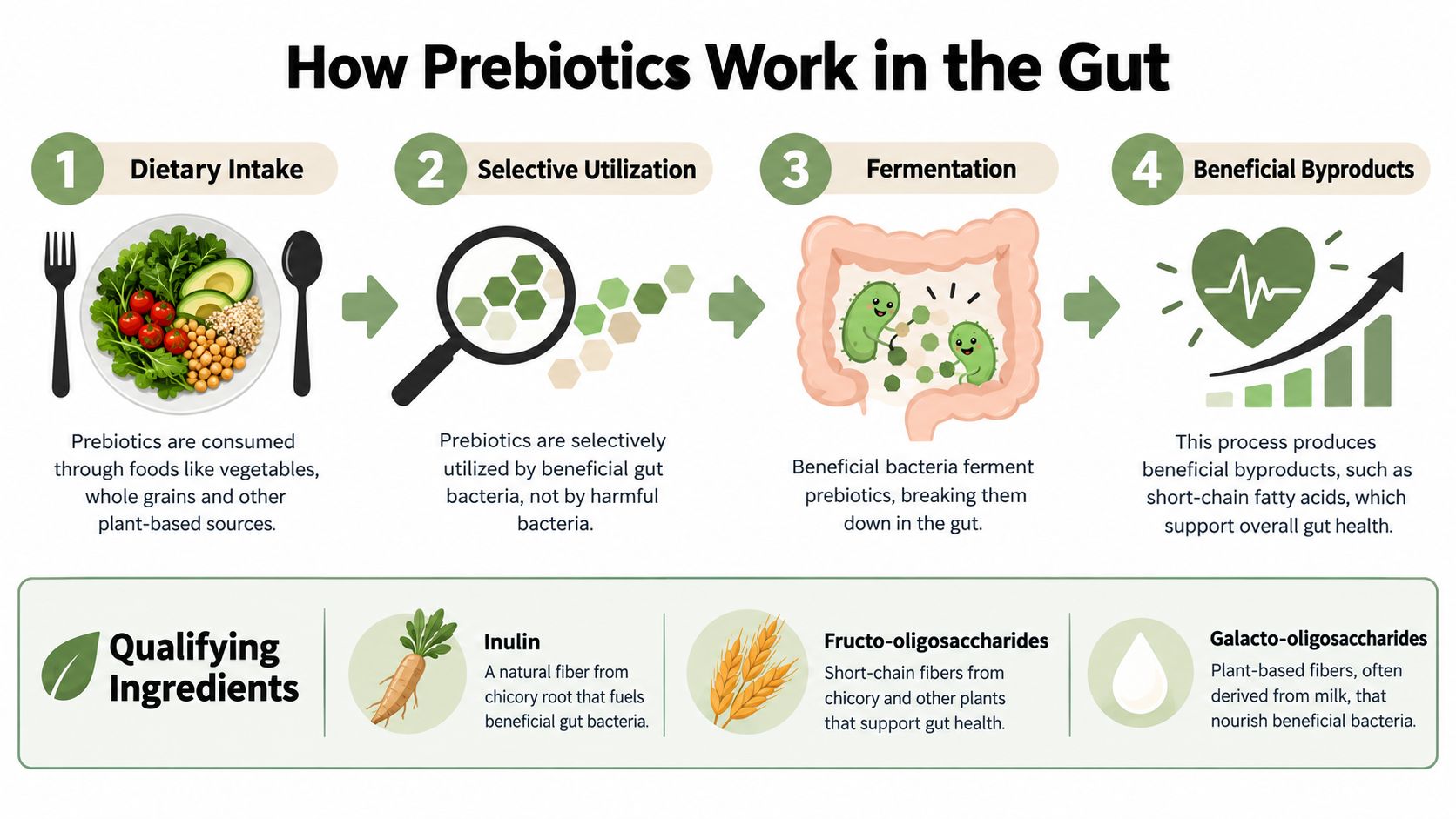
From substrate to physiological effect
The pathway is easier to understand as a sequence:
- Arrival: The substrate passes through digestion in a form that host microbes can access.
- Selective utilization: Some microorganisms use it more effectively than others.
- Fermentation: Microbial activity produces compounds such as short-chain fatty acids.
- Host response: Those compounds can interact with the gut lining, immune system, mineral handling, or other physiological pathways.
Butyrate is one short-chain fatty acid often discussed in this context. Fermentation products can influence epithelial and immune function, pathogen resistance, mineral availability, cardiometabolic markers, and gut-brain signaling. Those possibilities explain why prebiotic research is biologically interesting, but they don't eliminate the need to test a specific substrate in a specific population.
The practical distinction is selectivity plus benefit, not fermentation alone. A fiber may ferment broadly, produce gas, or alter stool consistency without meeting the technical standard for a prebiotic. This matters for people with IBS because the same biological activity that supports microbial metabolism can be poorly tolerated at a particular dose or in a sensitive microbiome. The ISAPP prebiotic consensus emphasizes that the definition links microbial utilization to a health benefit rather than treating every fermentable carbohydrate as a prebiotic.
Choosing a product around the mechanism
When comparing a prebiotic fiber supplement guide, look for the substrate identity, intended dose, target population, and measured endpoint. “Supports the microbiome” is broader than demonstrating relief of bloating, constipation, or diarrhea.
Some products combine multiple categories. GutRx COMPLETE is described as a high-potency probiotic and prebiotic blend with 62B CFUs, Akkermansia muciniphila, and SIBO support. That description identifies the formulation, but it shouldn't be read as proof that every person will respond in the same way.
Dietary context also matters. Foods and botanicals may be discussed alongside microbiome support, but they aren't interchangeable with a defined prebiotic intervention. A plain-language overview such as is ginger good for gut health can help separate food-based questions from supplement claims.
How Postbiotics Work and Why They Are Different
Postbiotics start with a microbial preparation, not with a substrate that you expect living microbes to consume. Under the 2021 ISAPP definition, the preparation contains inactivated microbial cells, microbial components, or both, with or without metabolites, and it must demonstrate a health benefit. The preparation's identity matters because changing the organism, processing method, or retained components can change what the body encounters.
Why “nonliving” isn't a complete explanation
A common label shortcut treats postbiotics as “dead probiotics.” That description is incomplete. A postbiotic isn't defined only by the fact that a microorganism no longer remains viable. It also needs a characterized preparation and evidence that the preparation confers a benefit.
This distinction excludes several assumptions:
- A purified metabolite alone isn't automatically a postbiotic.
- A microbial extract needs characterization and supporting evidence.
- A heat-killed organism may fit the broad material description, but the finished preparation still needs a demonstrated benefit.
- A result from one preparation can't automatically be transferred to another preparation made from a different organism or process.
Postbiotic preparations may interact directly with epithelial or immune cells, influence barrier-related signaling, or affect the local microbial environment without needing to remain alive and grow in the gut. Those mechanisms help explain interest in the category, including possible anti-inflammatory and barrier effects. They don't establish that a postbiotic category name alone resolves IBS, diarrhea, recurrent infections, or another specific concern.
What to compare on the label
A useful postbiotic benefits explainer should lead you to ask more precise buying questions:
- Which organism was used?
- Was the whole cell retained, or only a component?
- How was the preparation inactivated?
- Does the tested preparation match the marketed ingredient?
- What dose and human outcome were studied?
Stability can be an advantage for nonliving preparations because viability through manufacturing, storage, and gastrointestinal transit isn't the same challenge. But stability doesn't equal efficacy, and “shelf-stable” doesn't replace identity, dose, quality control, or human evidence.
Probiotics, Prebiotics, and Postbiotics Side by Side
How do these three categories differ when they appear in the same synbiotic formula? A probiotic adds a live microorganism. A prebiotic adds a substrate, or usable fuel, for selected host microorganisms. A postbiotic adds an inanimate microbial preparation or component with a demonstrated benefit. The shared formula does not make their roles interchangeable.
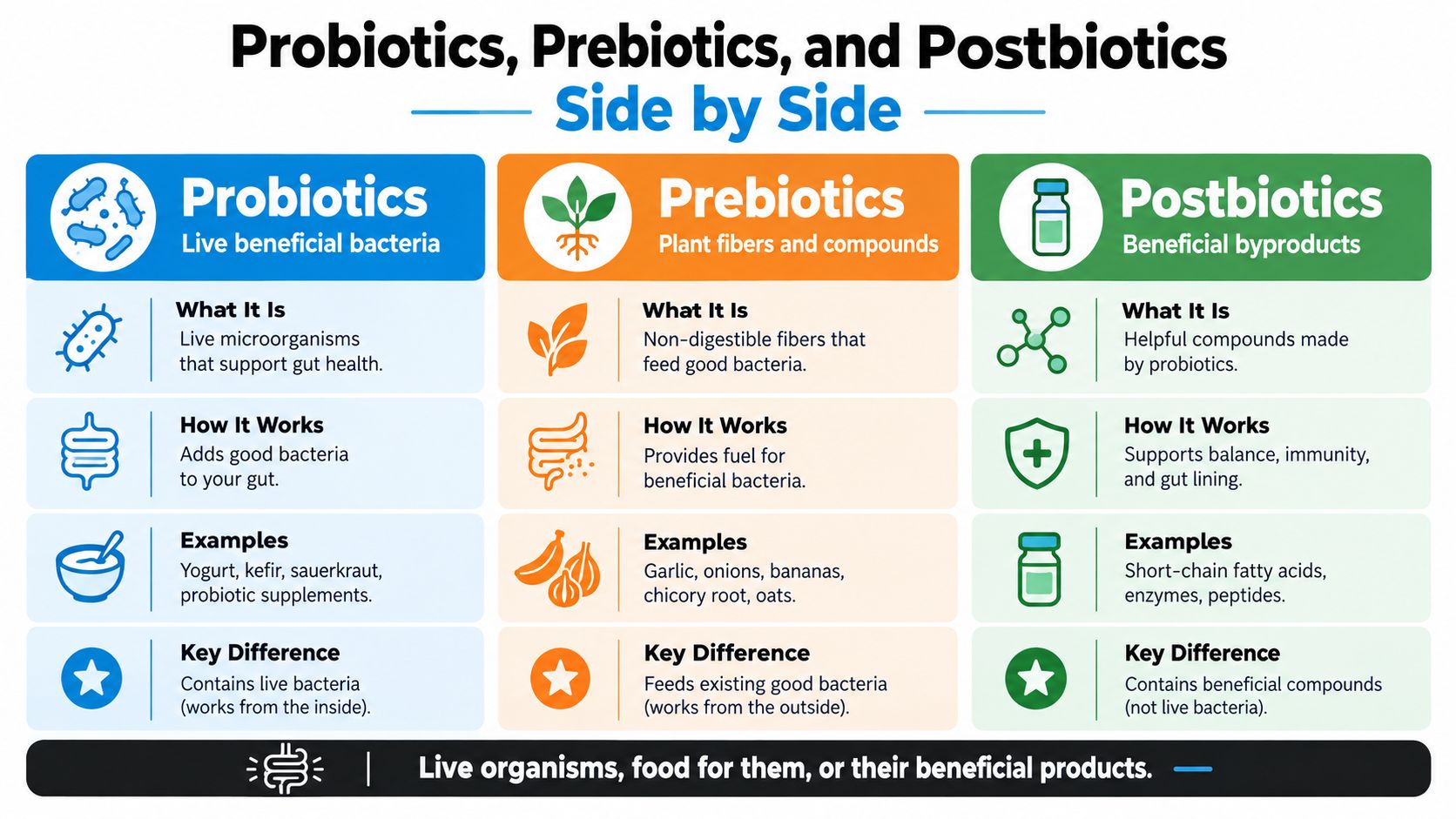
| Category | What It Is | Evidence Required | Typical Role |
|---|---|---|---|
| Probiotic | A live microorganism | Benefit tied to the particular strain, dose, and use | Adds a living microbial input |
| Prebiotic | A selectively used substrate | Selective utilization linked to a health benefit | Provides a targeted microbial fuel source |
| Postbiotic | Inanimate microorganisms or components | Benefit tied to the particular preparation | Delivers nonliving microbial material or signals |
The practical trade-offs
A probiotic is a living input, so its label and evidence need strain identity, amount, viability, storage conditions, and suitable delivery through the gastrointestinal tract. Results from one species or strain cannot automatically represent another. The NIH notes that IBS research has not established one specific strain, dose, and treatment duration for every IBS pattern (NIH probiotic fact sheet).
A prebiotic works more like fuel than a replacement microbe. It does not need to stay alive, but fermentation still has to fit the person taking it. The same substrate that supports microbial activity may contribute to gas or bloating in someone with sensitive digestion.
A postbiotic removes the viability requirement, yet it does not remove the need to identify the preparation and connect it with human evidence. A synbiotic stack therefore adds different inputs, not automatically greater benefit.
For regularity, substrate choice and tolerance usually come first. For a postbiotic, preparation identity and human outcomes deserve scrutiny. A probiotic requires the same discipline around strain, dose, and use.
How the Gut-Brain-Immune Axis Connects These Ingredients
The digestive tract doesn't operate as an isolated tube. Microbial substrates, fermentation products, and microbial cell components interact with the gut lining, immune system, and signaling pathways connected with the brain. That network is often called the gut-brain-immune axis.
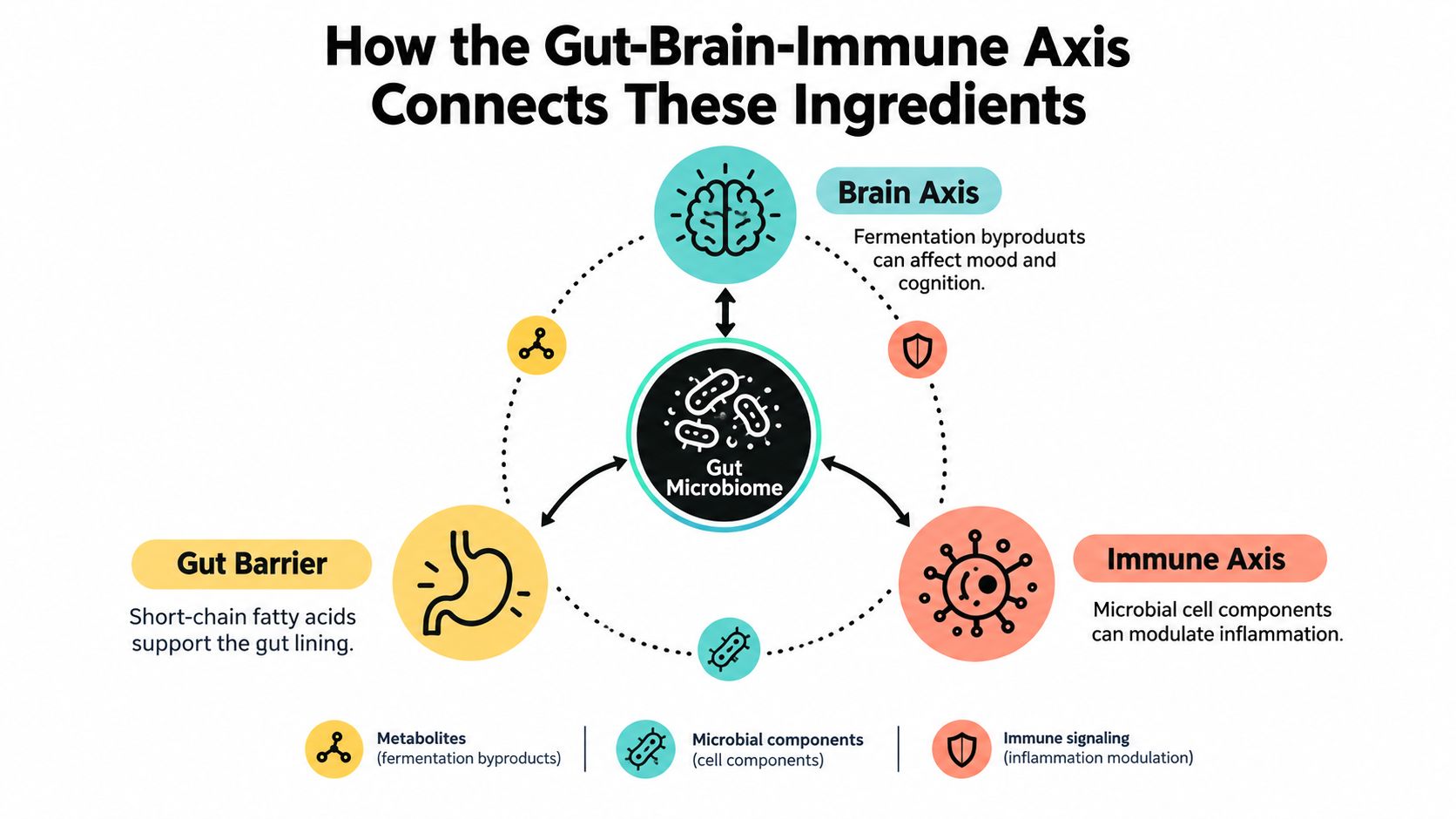
Three connected routes
The gut barrier is one route. Fermentation products such as short-chain fatty acids can interact with epithelial function and barrier signaling. That doesn't mean every fiber supplement strengthens the barrier in every person, but it explains why researchers measure more than stool frequency.
The immune interface is another. Microbial components can interact with immune cells and influence signaling related to inflammation. Postbiotic preparations are especially relevant to this route because they deliver inanimate microbial material rather than relying on a live organism to establish activity.
The brain connection involves multiple signals, including microbial metabolites, immune mediators, and neural communication. These pathways provide a reason to study stress-related digestive symptoms, energy, mood, or brain fog alongside bowel symptoms. They don't justify promising that a prebiotic or postbiotic will treat a mental health condition.
Clinical perspective: A gut-brain-immune explanation can clarify why symptoms travel together, but it can't replace evidence for the specific product or a medical evaluation when symptoms are persistent or severe.
A useful supplement decision therefore starts with the primary problem. If bloating follows fermentable foods, tolerance may dominate the decision. If the goal is broader digestive balance, the label should still identify the strains or preparations, the dose, and the quality controls rather than relying on broad “axis support” language.
Why Stacking Does Not Always Mean Synergy
Could a prebiotic, probiotic, and postbiotic work better together? The idea is biologically plausible. A prebiotic supplies a fermentable substrate, a probiotic adds living microorganisms, and a postbiotic provides inanimate microbial components or signals. That combination is a mechanistic rationale, not proof of superior clinical results.
A recent evidence synthesis found promising postbiotic findings across gut, immune, and metabolic outcomes. It also identified small samples, short follow-up, and wide variation in composition, dose, formulation, and metabolite profiles. No published clinical trial directly tested whether adding prebiotics and/or probiotics to a postbiotic produces greater benefit for gut dysfunction than postbiotic monotherapy (evidence synthesis on postbiotics).
Why IBS makes the question harder
A fermentable substrate can feed microbial activity while also increasing gas or discomfort. A person with IBS-pattern sensitivity may tolerate a small amount but react to a larger total load. Combining several new ingredients at once obscures the answer: which component helped, which caused symptoms, or whether the stack exceeded that person's tolerance?
The same principle applies to probiotics. An NIH-reviewed analysis of 23 randomized controlled trials involving 2,575 patients found that probiotics reduced the risk of IBS symptoms persisting or failing to improve by 21% overall (NIH probiotic evidence). This supports potential benefit, while showing why probiotic products should not be treated as interchangeable.
Other reviews produced less uniform results. A 15-trial analysis involving 1,793 people reported greater improvement in overall symptoms and abdominal pain than placebo after 8 to 10 weeks. A later review of 35 randomized trials and 3,406 adults found global-symptom improvement in 14 of 29 trials, while clinically meaningful abdominal-pain improvement appeared in 8 of 34 trials. The practical conclusion is clear: stacking may be plausible, but response depends on the exact product, dose, symptom pattern, and tolerance.
Safe Use and Dosing for Sensitive Digestion
People with bloating, irregularity, or IBS-pattern symptoms usually need a conservative testing process rather than an aggressive stack. Start with the ingredient most closely matched to the goal, introduce one meaningful change at a time, and record stool pattern, pain, bloating, urgency, and tolerance.
A cautious sequence
- Identify the substrate or preparation. Don't settle for “fiber blend” or “postbiotic complex.” Look for named ingredients, microbial identity, preparation details, and dose.
- Start below the full serving when appropriate. A gradual introduction can make fermentable ingredients easier to evaluate, especially if gas and bloating are already concerns.
- Hold other variables steady. Testing a prebiotic, probiotic, and digestive enzyme simultaneously makes the result difficult to interpret.
- Evaluate over a meaningful period. Day-to-day symptoms fluctuate, so judge the pattern rather than reacting to one bowel movement or one uncomfortable evening.
- Stop and seek medical care for warning signs. Persistent diarrhea, blood in stool, unexplained weight loss, or severe pain warrants medical assessment rather than continued supplement experimentation.
Evidence supports this cautious approach. The U.S. National Center for Complementary and Integrative Health reports that a 2019 review and analysis of 11 randomized controlled trials involving 729 people with IBS or other functional bowel disorders found no improvement in gastrointestinal symptoms or quality of life compared with placebo (NCCIH IBS and complementary approaches). Fermentability alone isn't the same as symptom relief.
A quality checklist
- Label clarity: Can you identify the substrate, strain, microbial preparation, dose, and intended use?
- Evidence matching: Was the same ingredient or preparation studied for the symptom you're trying to support?
- Testing: Does the company provide third-party testing or a downloadable Certificate of Analysis?
- Tolerance: Does the formula make sense for your response to fermentable carbohydrates?
- Clinical context: Are you using a supplement as support, not as a substitute for evaluation of red-flag symptoms?
Practical Takeaways for Choosing a Synbiotic Product
Choose a synbiotic by matching the ingredient to the symptom, the evidence to the claim, and the quality data to the label. A prebiotic may suit a person seeking a targeted substrate, but fermentation and tolerance still matter. A postbiotic may offer a nonliving preparation, but the organism, inactivation process, retained components, dose, and tested outcome should be clear.
For regularity-focused routines, a product such as GutRx Daily may be evaluated for its prebiotic and probiotic design. A high-potency option such as GutRx Complete can be compared by its listed 62B CFUs, Akkermansia muciniphila, and prebiotic blend. Other formulations may be positioned around digestive balance or combined gut and feminine wellness, but each decision should remain tied to the actual label and evidence rather than the category name.
When comparing top synbiotic capsules, use the same checklist: named ingredients, transparent doses, preparation identity, human evidence, and quality documentation. The guide to prebiotics and probiotics together can also help you think through combination logic without assuming that more ingredients automatically produce more benefit.
GutRx offers digestive supplements organized around different needs, including daily gut support, digestive balance, women's wellness, and mealtime enzyme support. Review the formulas and available quality information at GutRx, then choose a routine that matches your symptoms, tolerance, and preference for clearly identified prebiotic, probiotic, or postbiotic support.


