

You know the feeling. You finish a coffee, your bladder starts sending urgent messages, and you're suddenly planning your day around the nearest bathroom. If you've ever had a UTI before, that background worry can linger long after the symptoms fade. Urinary tract health isn't just about treating an infection when it shows up, it's about keeping the whole system steady enough that those flare-ups are less likely in the first place.
The urinary tract includes the kidneys, ureters, bladder, and urethra, and its job is to remove wastes and extra water by producing and controlling urine NICHD urinary tract factsheet. That sounds simple, but in real life it's a high-use system that responds to hydration, hormones, bowel regularity, sexual activity, and microbial balance. When one part gets pushed off track, symptoms can show up as urgency, burning, pressure, or that unfinished feeling people often dismiss until it becomes a pattern.
Table of Contents
- Why Urinary Tract Health Matters Every Day
- How the Urinary Tract Works
- Common Conditions and What Drives Them
- The Gut, Vaginal, and Urinary Microbiome Connection
- Daily Habits That Protect Urinary Tract Health
- Comparing the Main Supplement Options
- How Targeted Synbiotics Like GutRx Women Fit In
- When to Seek Medical Care and Your Prevention Checklist
Why Urinary Tract Health Matters Every Day
The everyday version of urinary tract trouble usually starts small. You notice urgency after coffee, a bit of pressure after exercise, or a vague fear that a past UTI is about to come back. That is why this area deserves daily attention, not just panic care after burning starts.
The burden is larger than many people realize. UTIs are one of the most common infections worldwide, and U.S. care costs are estimated at about $2.8 billion a year PMC review. Another review says recurrent UTIs in the United States carry an annual burden of more than $5 billion PMC review. That is not routine inconvenience, it is a public-health and health-economics issue.
The system works on small daily inputs
Urinary tract health depends on steady daily inputs, much like a home plumbing system with a filtration plant attached. If water flow is too low, waste sits longer. If the lining is irritated or the microbial balance shifts, the system becomes more vulnerable to symptoms and infection.
Practical rule: the goal is steady background support, not emergency triage every time urgency or discomfort shows up.
That mindset matters because prevention is cumulative. The habits that help today, hydration, scheduled emptying, bowel regularity, and targeted support, also make the system more resilient tomorrow. When people focus only on “treat the UTI,” they often miss the pattern underneath it.
Women carry a disproportionate share of this burden, with lifetime UTI incidence estimated at 50% to 60% in adult women and CDC estimates that 50% to 80% of women will experience at least one UTI in their lifetime PMC review. That does not mean symptoms are inevitable. It does mean the daily routine matters more than many assume.
How the Urinary Tract Works
The urinary tract works like a filtration plant with one-way pipes and a storage tank. The kidneys filter blood and make urine. The ureters carry urine down to the bladder. The bladder stores it until emptying time. The urethra is the exit route, and its length and structure shape risk differently in different people.
The bladder is not a passive bag. Its inner lining, often called the urothelium, helps maintain a barrier and also takes part in local defense. That matters because symptoms do not always follow a simple infection-versus-no-infection pattern. Irritation, incomplete emptying, and microbial shifts can all lead to discomfort, urgency, or frequency.
Why anatomy changes the risk
In women, the urethra is shorter, and the opening sits closer to the vaginal and anal areas. That makes bacterial transfer easier after sex, after wiping mistakes, or when moisture and friction build up. In men, the longer urethra creates more distance, which partly explains why UTIs are less common, though they still can occur.
Hormonal shifts matter too. After menopause, lower estrogen can change the local environment and make symptoms more likely. Pelvic-floor tone also plays a role. A bladder that does not empty well, or a pelvic floor that is too tight, can make urgency feel constant even when infection is not the main issue.
The most useful symptom question is simple, where does it hurt, and what happens when you try to empty?
That question helps separate a bladder problem from a kidney problem or a urethral irritation pattern. Pressure low in the pelvis, burning while voiding, flank pain, blood in urine, or a sense of incomplete emptying each points in a slightly different direction. Understanding the structure helps you decide whether self-care is reasonable or whether a clinical workup makes more sense.
Common Conditions and What Drives Them
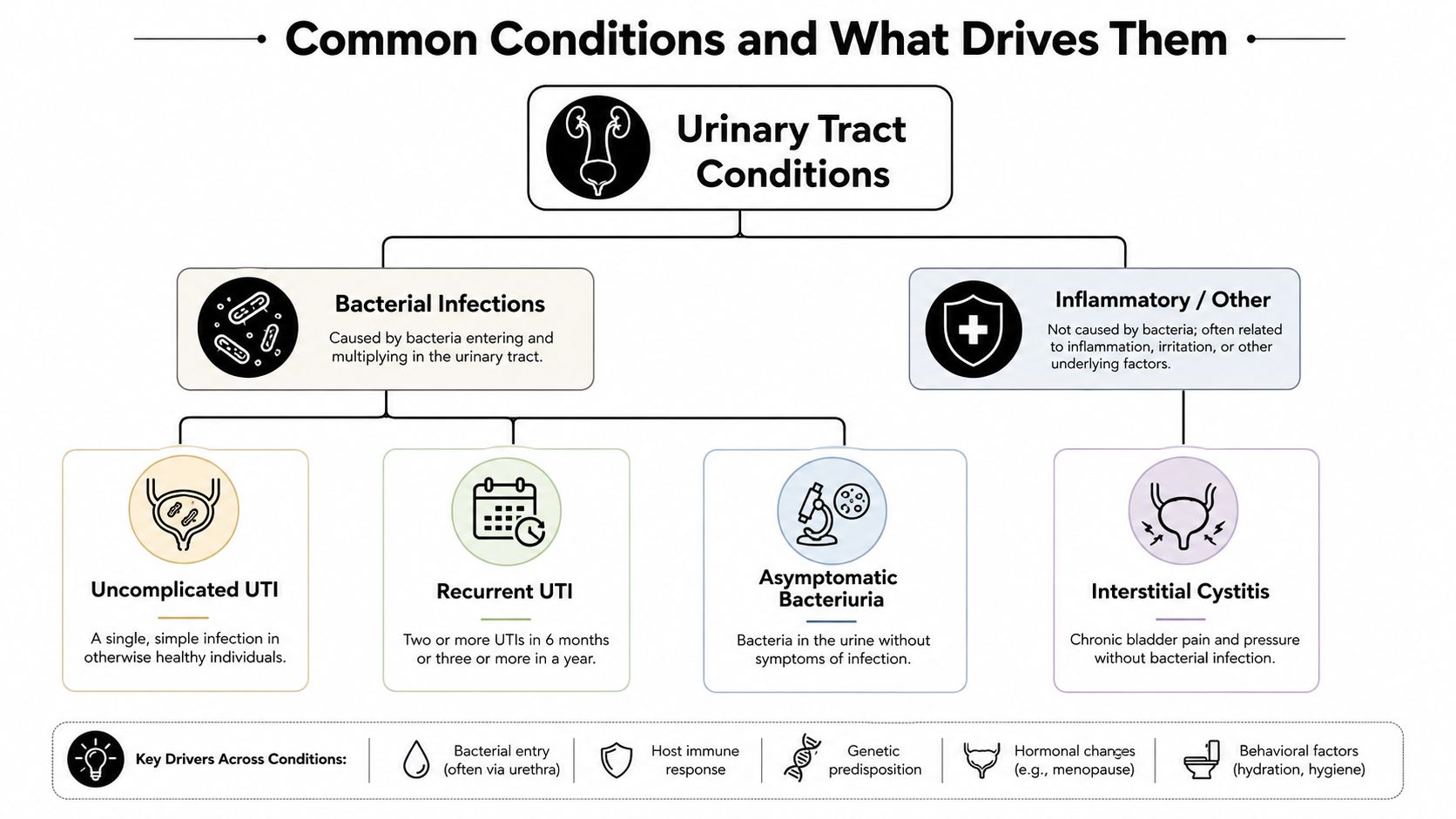
Urinary symptoms often get grouped together online, but the context changes what they likely mean. Burning, urgency, pressure, and frequency can appear in more than one condition, so the first job is to match the pattern to the likely driver instead of treating every symptom as the same problem.
A bladder symptom can start with a local infection, a shift in hormones, incomplete emptying, or a broader microbiome imbalance. That is why urinary tract health works best as a systems issue, not a UTI-only issue.
The main patterns readers run into
An uncomplicated UTI usually brings sudden burning, urgency, frequency, or pelvic discomfort. A recurrent UTI means the infections keep coming back, and that pattern often points to anatomy, estrogen status, sexual triggers, or incomplete emptying rather than bad luck alone. Asymptomatic bacteriuria means bacteria are present without symptoms, and many healthy adults do not need antibiotics for that alone.
A different category is interstitial cystitis or bladder pain syndrome, which tends to look more like chronic bladder pain, pressure, or urinary frequency without a straightforward infection pattern. Catheter-associated UTI is different again, because catheter exposure changes the bacterial threshold and the way clinicians interpret testing. People with neurologic conditions can also develop neurogenic bladder, where the main problem is emptying and control, not infection.
These patterns matter because they guide different decisions. A short course of antibiotics may fit one situation, while another calls for better emptying, estrogen support, catheter management, or a closer look at bladder pain triggers. As noted earlier, symptoms alone do not always tell the whole story.
What changes the risk profile
- Anatomy and sex: women are more likely to develop UTIs, in part because the urethra is shorter and closer to the vagina and rectum Harvard Health.
- Hormonal status: postmenopausal changes can make the local environment less protective.
- Incomplete emptying: urine that lingers gives bacteria more time to grow.
- Catheters and neurologic conditions: these change the testing threshold and the source-control questions clinicians ask EAU guideline.
Older adults can present less clearly, with symptoms that are easy to miss or misread. Men can also have recurrent or under-recognized urinary problems, especially when emptying is impaired. If symptoms keep returning, the pattern matters as much as the symptom itself.
Supportive habits are not only about the bladder itself. Hydration, regular voiding, pelvic-floor function, and the balance of the gut and vaginal microbiomes all influence whether the urinary tract stays calm or keeps getting irritated. For background on why Lactobacillus matters in that broader ecosystem, see this overview of Lactobacillus benefits.

The Gut, Vaginal, and Urinary Microbiome Connection
A bladder symptom can begin far from the bladder itself. The gut, vaginal, and urinary microbiomes influence one another, so a change in one system can ripple into the others. That becomes easier to see after antibiotics, when one infection is treated but the surrounding microbial balance shifts at the same time.
Estrogen helps maintain a vaginal environment where Lactobacillus species are more dominant. Those bacteria support a lower pH and create conditions that are less friendly to uropathogens. When that balance changes, bacteria that were previously kept in check can gain a foothold. For a closer look at why these organisms matter, see this overview of Lactobacillus benefits.
Why recurrences often follow disruption
Antibiotics can clear a current infection, but they can also alter the microbial terrain. If the vaginal and gut ecosystems are disrupted together, the urinary tract may face more repeated seeding and rebound symptoms. That is why recurrent cases often need more than a short-term fix aimed at a single flare.
The 2019 NIDDK workshop identified recurrent UTIs in men, asymptomatic bacteriuria, and urogenic bladder as underreported conditions and pointed to stigma, lack of screening, and financial barriers as reasons these issues stay under-addressed NICHD urinary health topic. That matters because urinary symptoms are often treated as one problem, even though the picture usually includes anatomy, hormones, and microbiome shifts.
A useful way to think about it: if a habit or supplement helps the gut ecosystem, it often helps the vaginal and urinary environment too.
That logic helps explain ingredients like cranberry proanthocyanidins, D-mannose, and targeted Lactobacillus strains. Cranberry PACs can help limit bacterial sticking, D-mannose can bind certain E. coli strains, and probiotic support can help maintain a more favorable microbial balance. The body does not treat these as separate silos, so prevention should not either.
Daily Habits That Protect Urinary Tract Health
The best daily routine is boring on purpose. It works because it lowers bacterial contact time, supports regular emptying, and keeps the nearby systems from working against you. That means hydration, timing, hygiene, bowel regularity, and pelvic-floor awareness all belong in the same plan.
The habits that actually move the needle
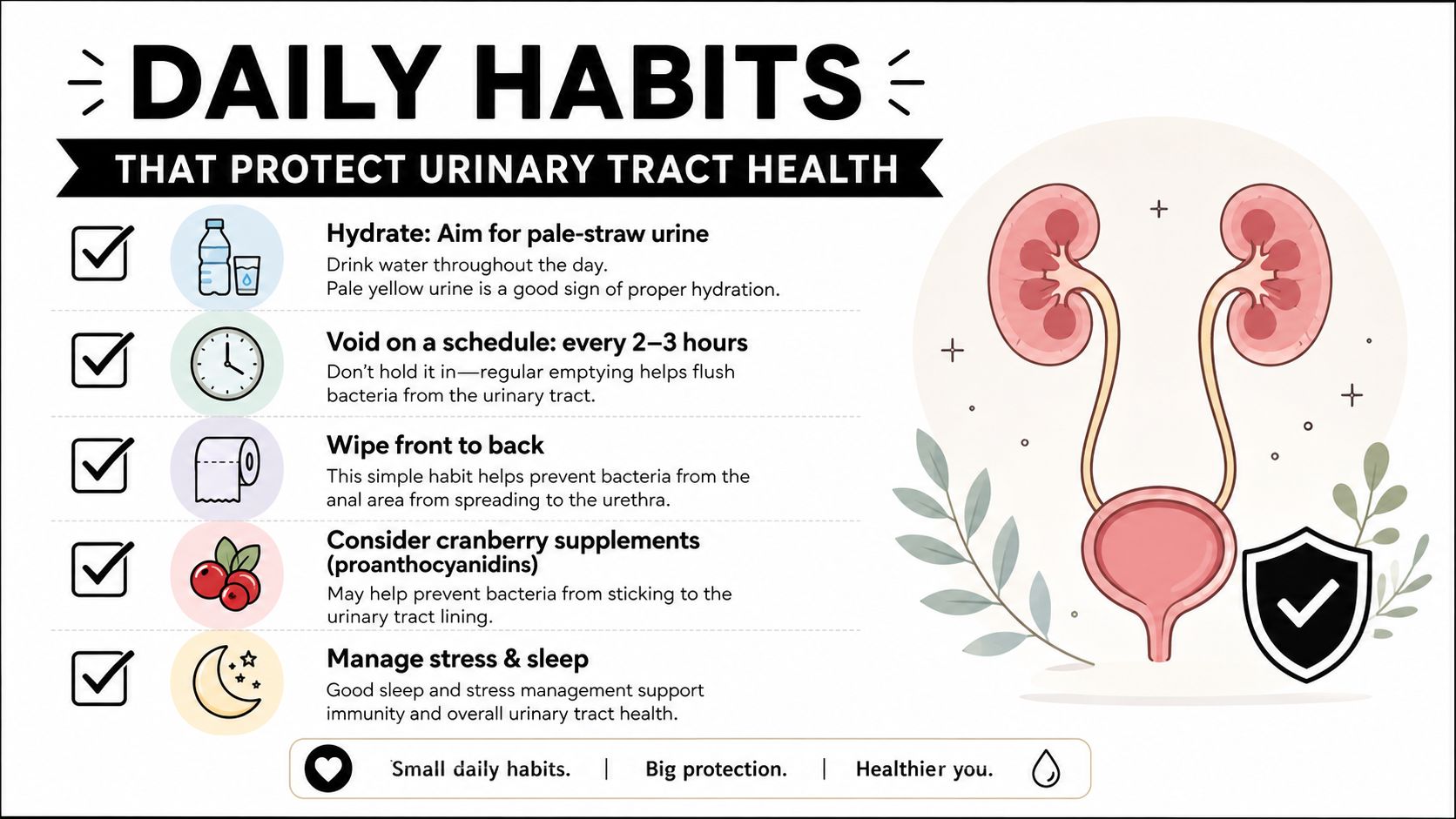
Start with fluid intake. The point isn't a perfect number, it's enough water to keep urine from becoming dark and concentrated. If your urine is consistently pale straw, that's a rough sign you're in a reasonable range. More fluid helps flush bacteria through the system instead of letting them linger.
Timed voiding matters too. Holding urine for long stretches can create a better environment for irritation and bacterial growth. A steady rhythm, including after sex when possible, is usually more protective than waiting for strong urgency.
Fiber belongs in this conversation because constipation and urinary issues often travel together. Backed-up stool can press on the bladder, and bowel dysbiosis can make nearby microbial conditions less favorable. Regular bowel movements are part of urinary tract care, not a separate issue.
Pelvic-floor basics that people miss
A lot of readers hear “pelvic floor” and assume they need stronger contractions. Sometimes they do. Sometimes they need the opposite, a better ability to relax and empty fully. A too-tight pelvic floor can contribute to urgency and a lingering sense of incomplete emptying.
- Hydrate steadily: choose water often enough that urine stays pale straw.
- Void on a schedule: don't wait for the bladder to become overly full.
- Use front-to-back hygiene: keep bacterial spread to a minimum.
- Urinate after sex: this is a simple habit with a clear mechanical rationale.
- Support regularity: fiber and movement help the bowel and bladder work together.
Breathable underwear helps, especially if you stay active or sweat a lot. For pelvic-floor work, think gentle release first, then controlled squeeze if needed. The goal is coordination, not constant clenching. That routine gives any supplement a better chance to do its job.
Comparing the Main Supplement Options
People often buy “bladder support” products without checking whether the mechanism matches the problem. That's how generic pills end up disappointing. The smarter approach is to compare the option to the pattern, occasional prevention, recurrent support, or a gut-vaginal-urinary overlap picture.
What each category is good for
| Option | Mechanism | Best Fit | Typical Daily Dose |
|---|---|---|---|
| Cranberry PACs | Helps reduce bacterial sticking to the urinary tract lining | Prevention between infections, especially when recurrences are a concern | 36 mg PACs or more per day |
| D-mannose | Binds certain E. coli strains and may help flush them out | Prevention support and early-use routines for people prone to E. coli-driven episodes | Use varies by product, often taken daily or around triggers |
| Probiotic and synbiotic blends | Supports the gut, vaginal, and urinary microbiomes with targeted strains and prebiotic fuel | People with recurrent patterns, antibiotic-related disruption, or women's urinary support needs | Follow the label, as formulas differ |
| Postbiotics | Uses heat-killed cells or metabolites rather than live organisms | Readers who want microbial support without relying only on live cultures | Product-specific |
| Prebiotic fibers | Feeds beneficial microbes and supports ecosystem balance | Daily maintenance when bowel regularity and microbial support both matter | Product-specific |
The evidence strength varies by use case, but the decision point is practical. Cranberry and D-mannose are more directly aligned with bacterial adhesion, while probiotic and synbiotic blends are better for people who want broader ecosystem support. Postbiotics can be useful when stability or survivability is a priority, and prebiotic fibers make more sense when bowel regularity is part of the problem.
Safety matters too. D-mannose should be used with awareness of blood sugar issues, and cranberry deserves caution for people on anticoagulants. If symptoms are severe, recurring, or unclear, a supplement shouldn't replace culture-based care.
For a deeper women's-support read, see this cranberry-focused women's probiotic guide. If your issue is more “what fits my pattern,” that's the better question to answer before you buy.
How Targeted Synbiotics Like GutRx Women Fit In
A targeted women's synbiotic makes sense when the pattern includes both prevention and recovery support. The logic is simple, pair clinically studied Lactobacillus strains with prebiotic fibers, cranberry, D-mannose, and postbiotic support so one daily routine can support the gut, vaginal, and urinary environments at the same time.
That approach is different from a single-ingredient product. Cranberry and D-mannose focus more on bacterial interaction, while a multi-strain synbiotic also aims to support the terrain bacteria live in. For someone who keeps cycling between antibiotic treatment and another flare-up, that broader design can be more relevant than a one-note formula.
What to ask before choosing any women's formula
- Are the strains named clearly? Look for clinically studied Lactobacillus and Bifidobacterium strains, not just vague “probiotic blend” language.
- Is there third-party testing? Downloadable Certificates of Analysis matter if you want strain verification and potency transparency.
- Does the delivery system protect the ingredients? Shelf-stable or delayed-release formats can be useful depending on how the product is built.
- Does it match your real use case? Daily maintenance is a different job from recovery support after repeated episodes.
- Are the standards clear? Non-GMO, vegan, and Made-in-USA claims are only useful if they're documented.
One product in this category is GutRx Women's Health Vaginal Health UTIs Hormonal Balance, which is positioned for vaginal and urinary support. That kind of formula belongs in the same decision set as cranberry and D-mannose products, not apart from them.
Bottom line: a women's synbiotic should support the ecosystem, not pretend to replace medical care when infection is active.
If infections are present, antibiotics and clinical review still matter. If the issue is repeated disruption, prevention support, and a daily routine that covers more than one body site, a targeted synbiotic becomes a more logical choice than a generic bladder capsule.
When to Seek Medical Care and Your Prevention Checklist
Some urinary symptoms belong in a clinic, not in a supplement cart. Fever, flank pain, blood in the urine, inability to urinate, pregnancy, symptoms that don't improve within 48 hours, and recurrent episodes all deserve medical attention. Those signs can point to infection that's moving beyond the bladder or to a condition that needs testing and treatment.
Clinical workup usually starts with history and symptom review, then urinalysis and, when the situation is more complex, urine culture with susceptibility testing. That matters because urine culture remains the technical benchmark, but the threshold depends on collection context, and the European Association of Urology notes that catheter-associated UTI can be defined microbiologically by ≥10^3 CFU/mL in an appropriately collected catheter specimen, while broader voided-urine criteria often use ≥10^5 CFU/mL EAU guideline. In other words, the test has to match the situation.
A simple prevention checklist
- Hydration: keep urine pale straw most days.
- Voiding rhythm: don't hold urine for long stretches.
- Post-sex routine: empty the bladder afterward when possible.
- Hygiene: wipe front to back and keep the area dry.
- Bowel regularity: use fiber and movement to avoid constipation.
- Pelvic-floor control: practice both relaxation and gentle coordination.
- Supplement match: choose cranberry, D-mannose, a synbiotic, or a postbiotic based on your pattern.
Women who get recurrent infections often need more than one strategy at once. That's not failure, it's how a complicated system responds. Daily habits form the base, supplements add targeted support, and clinical care steps in when symptoms or test results show it's needed.
If you want a supplement routine that's built around the gut, vaginal, and urinary connection, GutRx offers targeted options designed for that overlap. Visit GutRx to review the formulas, compare them with your symptom pattern, and choose the daily support that fits your prevention plan.


