

Constipation digestive enzymes are not a direct cure for most constipation. Digestive enzymes break down food in the upper digestive tract, while constipation usually involves how stool moves through the colon and how much water remains in it. The popular advice that “more enzymes means more regularity” misses that distinction.
That doesn't make enzymes useless. They may support people whose constipation-like discomfort is tied to lactose, beans, cruciferous vegetables, or other fermentable carbohydrates. The useful question isn't just whether enzymes help constipation, but whether a specific food-related digestive problem is adding bloating, gas, or abdominal pressure to an underlying bowel issue.
Table of Contents
- Do Digestive Enzymes Help Constipation At All
- Which Digestive Enzymes Are Relevant For Constipation Support
- Evidence For Enzyme Blends In IBS Constipation
- When Digestive Enzymes May Not Help Constipation
- How To Choose Enzymes For Constipation-Related Symptoms
- Beyond Enzymes What Actually Supports Constipation Relief
Do Digestive Enzymes Help Constipation At All
Consider two people who both say, “I'm constipated.” One has infrequent, hard stools and spends several days feeling that stool isn't moving. The other has daily bowel movements but feels swollen, gassy, and incompletely emptied after meals containing dairy, beans, or wheat-based foods. A digestive enzyme might be relevant to the second person's meal-related symptoms, but it isn't a substitute for treating slow or difficult bowel movements in the first.
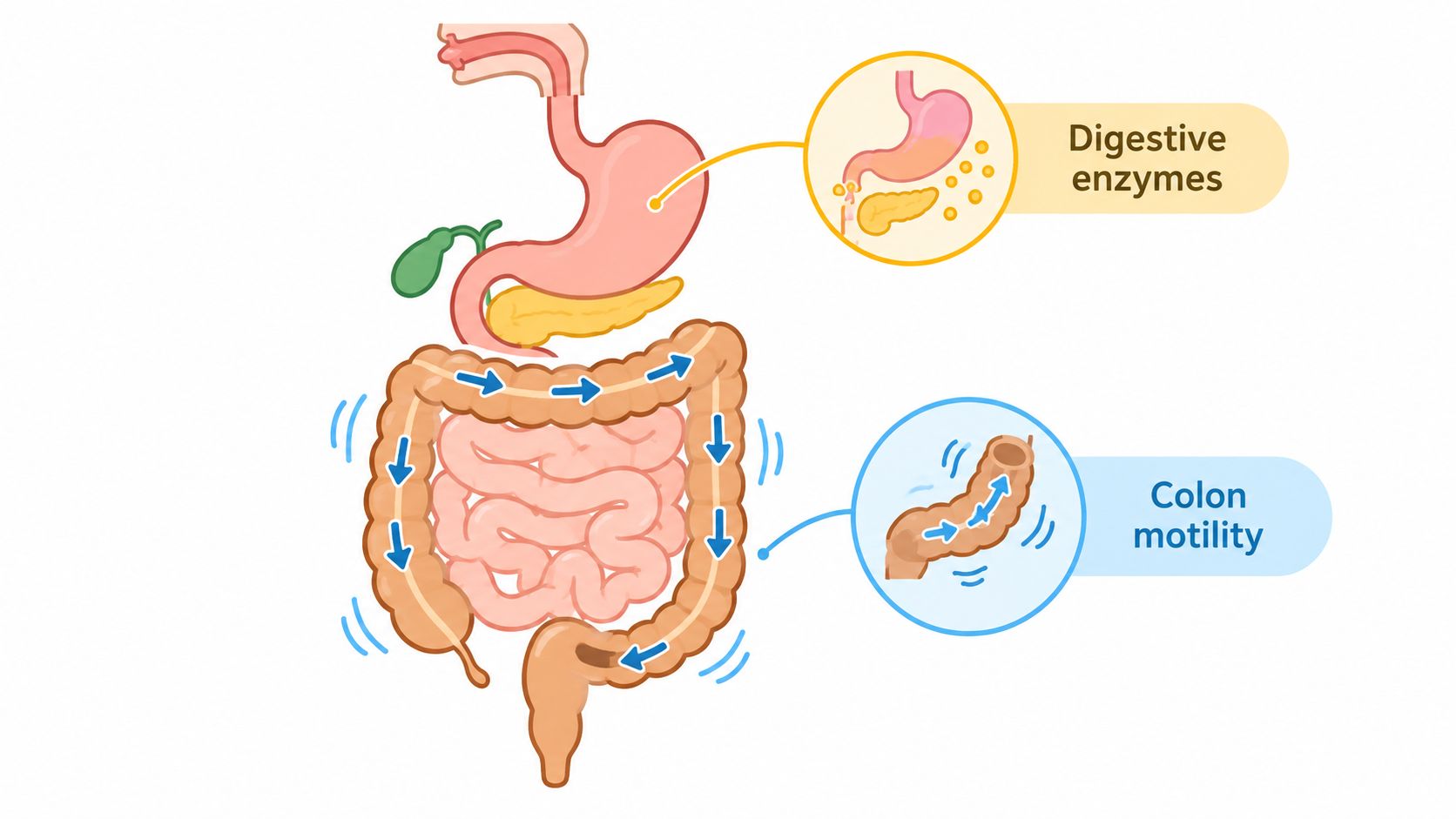
Constipation is primarily connected to colonic motility and stool-water balance. The colon stores and moves stool while absorbing water. Digestive enzymes work earlier, mainly in the mouth, stomach, and small intestine, where they help break down proteins, fats, and carbohydrates. They aren't laxatives, and clinical commentary on enzyme use advises against treating constipation, bloating, gas, or diarrhea with enzyme self-treatment instead of evaluating possible causes. Clinical guidance on digestive enzyme deficiency and appropriate treatment explains this distinction in practical terms.
The scale of the problem also explains why a single supplement can't fit every person. The World Gastroenterology Organisation estimates that chronic constipation affects about 9% to 20% of the global population, while a Rome IV-based estimate places prevalence at 11.7%, with a 95% confidence interval of 11.4% to 12.0%. In practical terms, depending on the definition used, roughly one in 9 to one in 11 people may experience chronic constipation. The World Gastroenterology Organisation's constipation guideline also notes that prevalence varies between populations.
Where enzymes can fit
Enzymes may have a supporting role when undigested food components create excess fermentation in the small intestine and colon. That can produce gas and abdominal distension, sensations that many people describe as pressure, blockage, or constipation even when the main problem isn't slow transit.
A targeted enzyme may help digest a trigger food before it reaches the colon. That could make a meal more comfortable, but less bloating doesn't automatically mean more frequent stools. People with persistent constipation should investigate diet, medications, pelvic-floor function, motility, and other possible causes with a qualified clinician. For a deeper explanation of potential upstream problems, see this resource on digestive enzyme deficiency root causes and fixes.
Clinical takeaway: Enzymes can improve the breakdown of a problem food. They don't directly push stool through the colon.
Which Digestive Enzymes Are Relevant For Constipation Support
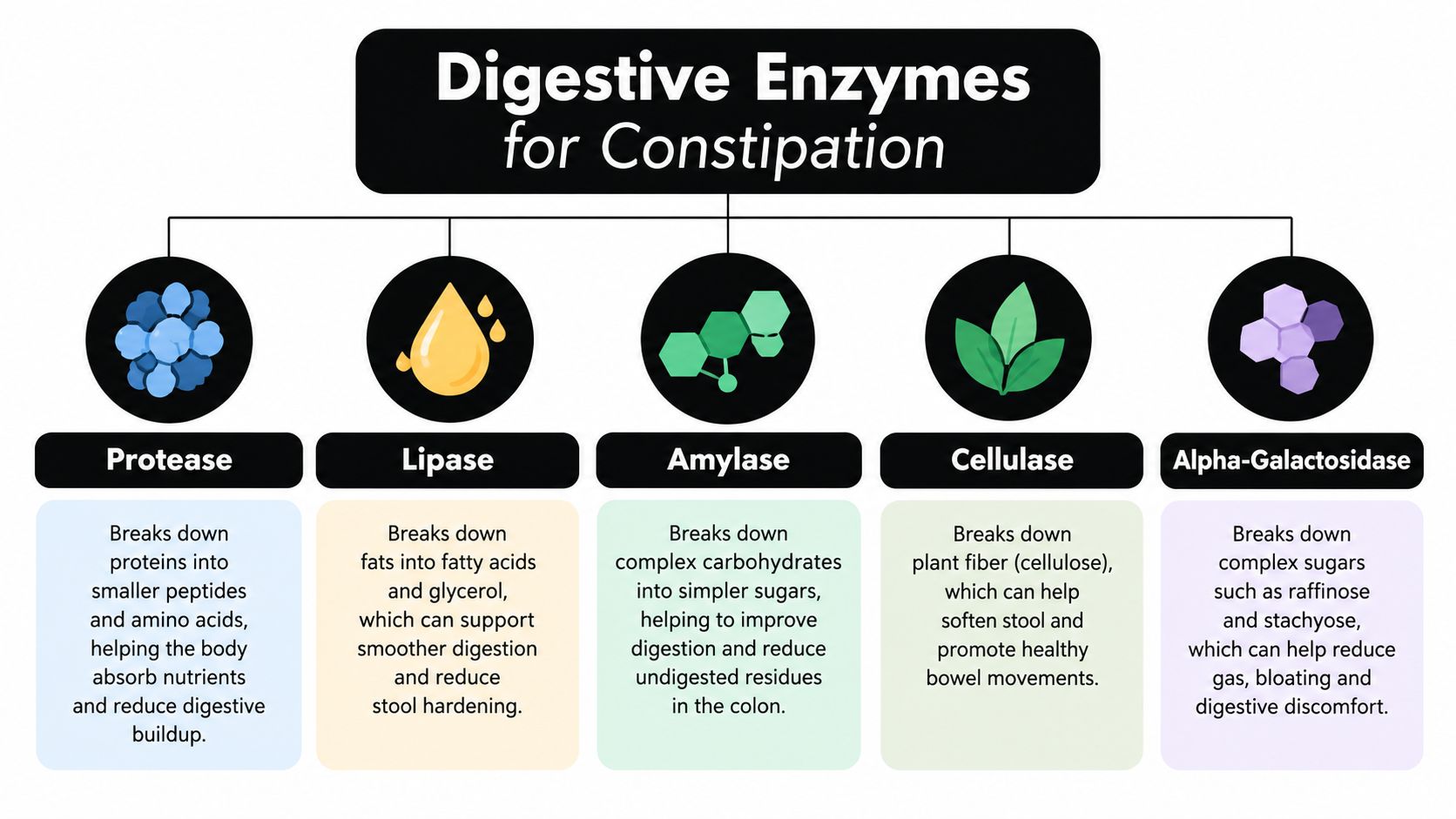
The word “enzyme” on a supplement label doesn't tell you whether the product matches your symptoms. Each enzyme acts on a particular substrate. The practical task is to connect the enzyme with the meal component that seems to trigger discomfort, rather than choosing a broad formula and expecting it to correct every type of irregularity.
The main enzyme map
| Enzyme | Main target | Where it may be relevant | What it usually won't address |
|---|---|---|---|
| Protease | Protein | Heavy meals that contain substantial meat, eggs, or other protein sources, particularly when fullness follows eating | Slow colonic transit or hard stool caused by inadequate stool water |
| Lipase | Fat | Fat-rich meals that leave a person feeling overly full or uncomfortable | Constipation caused by medication, pelvic-floor dysfunction, or reduced bowel movement |
| Amylase | Starches and other carbohydrates | Meals where starch digestion appears to contribute to meal-related discomfort | A general need for more frequent bowel movements |
| Lactase | Lactose in dairy | Milk, ice cream, soft cheese, and other lactose-containing foods for people who don't digest lactose well | Constipation unrelated to dairy exposure |
| Alpha-galactosidase | Galacto-oligosaccharides, or GOS | Beans and certain vegetables that cause gas and distension | Constipation that continues independently of those foods |
| Cellulase | Cellulose and some plant-cell structures | Fiber-rich meals when a product is specifically formulated for plant-food digestion | The need for adequate fluid, suitable fiber, and healthy colonic movement |
These enzymes don't all have the same level of evidence for every symptom. A 2024 review of diet therapies in gut disorders describes lactase and alpha-galactosidase as targeted options for specific food substrates, while emphasizing that evidence remains limited in broader gut disorders. It also discusses benefit in people sensitive to GOS when alpha-galactosidase was taken with high-GOS foods. The review of diet therapies and gut disorders provides useful context for reading labels without treating every enzyme as interchangeable.
Why FODMAP specificity matters
FODMAPs are fermentable carbohydrates. If a relevant enzyme breaks down part of a FODMAP load before it reaches the colon, there may be less material available for bacterial fermentation. That may reduce gas and distension, which can make the abdomen feel less obstructed. It still doesn't establish that the colon is moving stool more effectively.
In an in vitro study, an optimized enzyme mixture produced highly specific digestion results, including 100% digestion of fructans by invertase, 94% digestion of lactose by beta-galactosidase, 76% digestion of stachyose, and 52% digestion of raffinose. The study also reported lower gas pressure than with undigested FODMAP material. These findings describe a laboratory mechanism, not proof that the same response will occur in every person. The in vitro study of enzyme digestion of FODMAP ingredients is therefore most useful for understanding targeted formulation design.
For readers comparing a multi-enzyme product for meal-related symptoms, GutRx MEALTIME is described as a digestive enzyme supplement intended to support digestion, reduce bloating, and enhance nutrient absorption. The relevant question is still whether its enzyme coverage matches your problem foods, not whether the word “enzyme” promises relief from constipation itself.
Evidence For Enzyme Blends In IBS Constipation
The strongest constipation-related signal for digestive enzymes comes from a specific IBS-C and FODMAP-related context, not from ordinary constipation across the general population. A real-world report summarized in the literature followed people with IBS and found that, after four weeks, 72.7% of IBS-C participants reported improvement in constipation, while 65.3% reported improvement in abdominal pain. The report on enzyme blends in IBS contains the relevant results.
| Outcome Measure | Result | Population |
|---|---|---|
| Improvement in constipation | 72.7% after four weeks | IBS-C participants |
| Improvement in abdominal pain | 65.3% after four weeks | IBS-C participants |
Those findings make biological sense when symptoms are driven partly by fermentable carbohydrates. A targeted blend may reduce the amount of certain food components available for fermentation before they reach the colon. Less fermentation can mean less gas, pressure, and pain. For someone with IBS-C, reducing that symptom load may feel like meaningful improvement even if the enzyme isn't acting as a laxative.
Targeted blend versus general formula
| Question | FODMAP-targeted blend | Broad multi-enzyme formula |
|---|---|---|
| Best fit | A person who notices symptoms after specific fermentable foods | A person seeking coverage for mixed meals or uncertain food triggers |
| Mechanism | Acts on selected carbohydrate substrates | May include enzymes for protein, fat, starch, dairy, or plant foods |
| Evidence discussed here | Condition-specific IBS findings and food-substrate research | Limited evidence for general constipation relief |
| Main expectation | Less meal-related gas, distension, or pain | Support for digestion of a known difficult meal |
| What it cannot establish | That chronic constipation will resolve | That broad coverage is better than targeted treatment |
The distinction matters because a statistically notable response in an IBS-C group isn't proof that every person with functional constipation will respond. Recent commentary continues to identify a need for larger trials, factorial designs, and better subgroup analysis to determine which enzyme combinations, doses, and meal patterns help particular symptoms. A person with slow transit and no food-triggered bloating may have little reason to expect an enzyme to change bowel frequency.
For readers evaluating the topic alongside product options, this educational overview of digestive enzymes for IBS can help clarify why symptom pattern and food trigger matter more than a generic “gut support” label.
When Digestive Enzymes May Not Help Constipation
A supplement may fail because the problem is in the wrong part of the digestive tract. If your main symptoms are hard stools, straining, infrequent bowel movements, or a persistent sense that stool is not advancing, an enzyme that improves meal breakdown may not change the underlying bowel mechanics.
Harvard Health states that digestive enzyme supplements have little evidence for bloating, gas, or bowel irregularity in the general population. Harvard Health's review of enzyme supplements is a useful counterweight to product marketing because it separates targeted enzyme use from broad claims about digestive comfort.
Use the symptom pattern as your filter
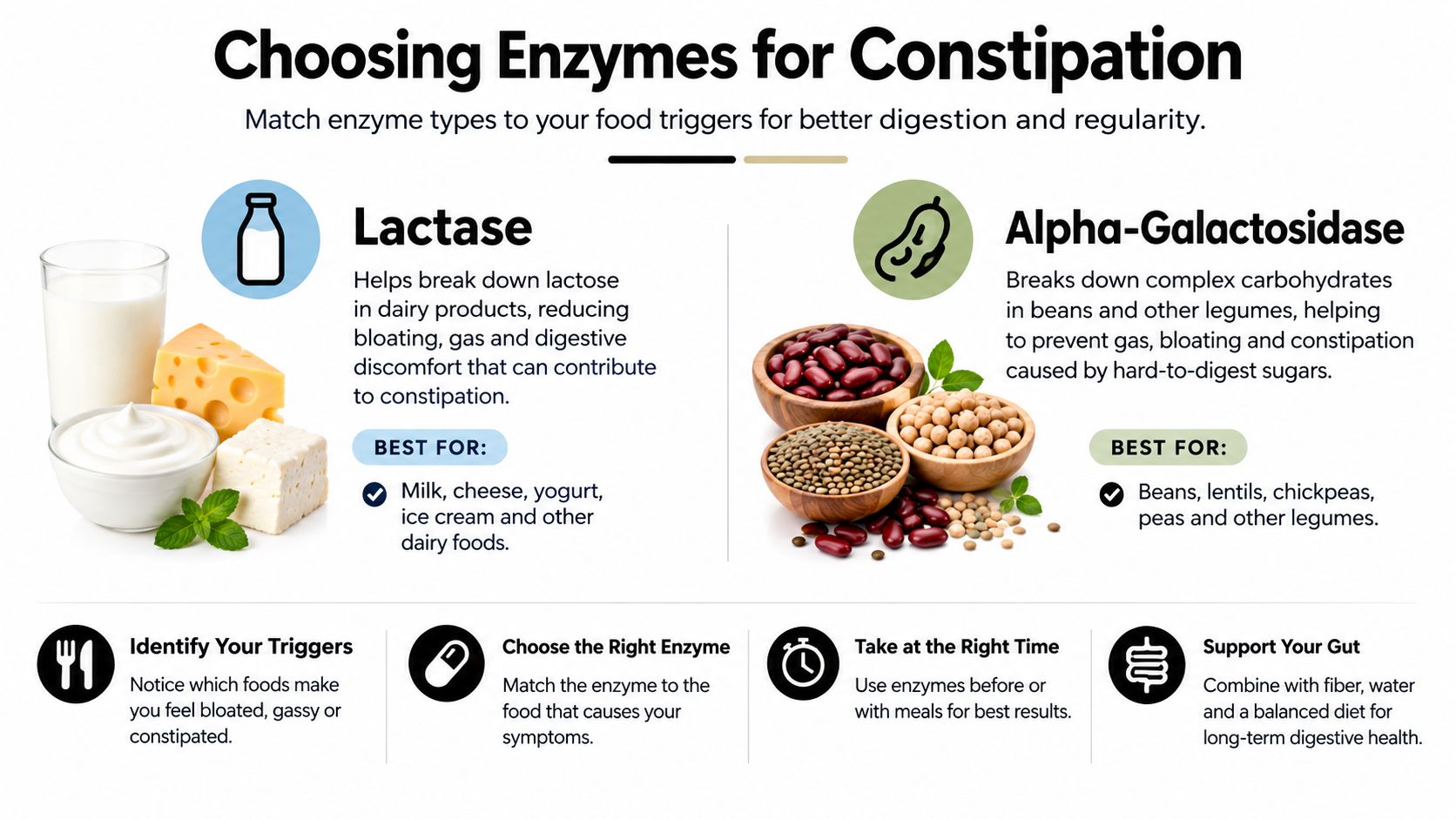
Start with the meal, not the label. If dairy reliably produces symptoms, lactase is more logically matched than a broad formula. If beans or certain vegetables trigger gas, alpha-galactosidase may be more relevant. If symptoms occur regardless of what you eat and constipation remains the dominant complaint, an enzyme trial is less likely to answer the underlying question.
A practical screening process looks like this:
- Identify the dominant symptom. Separate hard or infrequent stool from bloating, gas, and abdominal pressure.
- Track food timing. Note whether symptoms follow dairy, legumes, cruciferous vegetables, high-fat meals, or mixed foods.
- Match the substrate. Choose an enzyme that acts on the suspected food component rather than assuming every blend has the same coverage.
- Stop guessing if the pattern is persistent. Ongoing symptoms deserve an assessment for causes that enzymes cannot correct.
Enzymes are generally taken with the meal they are intended to support, because the product needs to encounter the food substrate. Taking a formula at random times or using it as a daily constipation treatment doesn't create a clear mechanism for improving colonic movement.
Safety boundary: A digestive enzyme shouldn't delay evaluation of persistent constipation, worsening symptoms, blood in the stool, significant pain, vomiting, or an unexplained change in bowel habits.
People also worry that enzymes themselves may cause constipation. The answer depends on the product, ingredients, dose, and the person's underlying condition, so a new or worsening symptom shouldn't be dismissed as normal adjustment. This discussion of whether digestive enzymes can cause constipation offers a focused way to review that concern, but medical advice is more appropriate when symptoms are severe, persistent, or changing.
How To Choose Enzymes For Constipation-Related Symptoms
Better digestion doesn't necessarily equal better regularity. That assumption is the main reason people buy a broad digestive enzyme for constipation and then feel disappointed. Enzymes can reduce the amount of a specific food component that reaches the colon, while regularity still depends on stool consistency, colonic movement, habits, and the cause of the constipation.
Match the product to the meal
Use the label as a compatibility check:
- Dairy trigger: Look for lactase when milk or other lactose-containing foods are the suspected problem.
- Beans and certain vegetables: Consider alpha-galactosidase when GOS-rich foods produce gas and pressure.
- High-fiber plant foods: A formula containing cellulase may be relevant to plant-food digestion, although it shouldn't be treated as a replacement for appropriate fiber and fluid intake.
- Mixed meals: Protease, lipase, and amylase may be relevant when symptoms consistently follow meals containing substantial protein, fat, or starch.
- Unclear pattern: A multi-enzyme blend can offer broader substrate coverage, but broader coverage doesn't automatically mean stronger evidence or better constipation relief.
Take a targeted enzyme with the problem meal, usually according to the product label and commonly with the first bites. This approach makes the trial more interpretable than taking it every day without recording what you ate or how you felt.
Check quality without confusing it with efficacy
A well-documented supplement should make it possible to understand the ingredients, enzyme activities, serving directions, allergen information, and storage requirements. Third-party testing and downloadable Certificates of Analysis can provide useful information about identity, purity, and batch verification. They don't prove that a product will resolve constipation, but they can make the quality-control claims easier to assess.
A practical best digestive enzyme supplements guide can help you compare formulation details, but keep the decision anchored to your own trigger pattern. Look for specific enzyme names and clearly stated activities rather than relying only on phrases such as “complete digestion” or “total gut support.”
Give a targeted approach a limited trial, generally two to four weeks, while recording meals, bloating, gas, stool consistency, and bowel frequency. If the food-related discomfort doesn't improve, or if constipation remains unchanged, the enzyme is probably not addressing the main problem. Continuing indefinitely without a clear benefit only makes it harder to identify what helps.
Beyond Enzymes What Actually Supports Constipation Relief
Constipation relief depends on stool water, fiber tolerance, movement, bowel habits, medications, and possible medical causes. Enzymes can support food-related discomfort, but they do not correct every mechanism that slows bowel movements.
Build fiber gradually, increasing intake only as your body tolerates it, and pair it with adequate fluids. Record stool consistency and bowel frequency while making one change at a time. This guide to fiber and hydration for constipation explains those foundations. A probiotic or synbiotic may support broader digestive symptoms, but persistent constipation still merits evaluation.
If constipation remains unchanged after a targeted trial, continuing the enzyme indefinitely can obscure what is helping. Seek clinical guidance when symptoms persist, worsen, or become painful, or when concerning symptoms appear. For additional natural constipation relief strategies, review the available options and match the next step to your symptom pattern.
Visit GutRx to compare meal-focused enzyme products with broader digestive-support formulas. Choose based on the problem you want to address.


