

Could a probiotic and fiber make bloating worse instead of better? Yes. The result depends on which probiotic strain is paired with which fiber, how much you take, and how your digestive system responds. “Probiotics plus fiber” isn't automatically a proven synbiotic, and a combination that suits one person may not suit someone prone to gas or bloating.
Probiotics are live beneficial microorganisms, while dietary fiber is a broad category of plant carbohydrates. A fiber only qualifies as a prebiotic under the scientific definition when host microorganisms selectively use it in a way that provides a health benefit. The practical question isn't whether to combine the two, but whether the specific strain, fiber, dose, and symptom goal make sense together.
Table of Contents
- What Probiotics Plus Fiber Really Means
- Probiotic, Prebiotic, Postbiotic, and Synbiotic Explained
- How Probiotics and Fiber Work Together in the Gut
- What the Clinical Evidence Actually Shows
- Why Adding Fiber Can Sometimes Make Bloating Worse
- Matching the Right Synbiotic Approach to Your Goal
- Putting It Together Into a Practical Routine
What Probiotics Plus Fiber Really Means
Think of probiotics and fiber as potential partners, not automatically as a matched set. Probiotics are live microorganisms that can provide a health benefit when taken in adequate amounts. Dietary fiber is a broad group of plant carbohydrates, and different fibers behave differently in the gut.
The distinction matters because ordinary fiber isn't automatically prebiotic. To meet the scientific definition, a substrate must be selectively used by host microorganisms and provide a health benefit. That means a product containing a probiotic and some fiber doesn't prove that the fiber feeds that probiotic, or that the pairing produces a useful outcome.
The term synbiotic has a more precise history. It was first proposed in 1995 for a combination of a probiotic microorganism and a prebiotic substrate. In 2017, an international expert panel defined a prebiotic as a substrate selectively used by host microorganisms in a way that provides a health benefit. In 2020, the International Scientific Association for Probiotics and Prebiotics (ISAPP) refined the definition of a synbiotic as a mixture of live microorganisms and substrate or substrates selectively used by host microorganisms that confers a health benefit. The ISAPP consensus on synbiotics also stresses that a product's ingredients don't qualify as a tested synbiotic just because they appear together. The combination itself needs evidence of efficacy.
Practical rule: Evaluate the strain, fiber substrate, dose, and target symptom as a set. Don't assume a generic probiotic-plus-fiber stack will work uniformly.
That framework can help you assess products marketed for regularity, bloating, digestive balance, or daily gut support. The following sections unpack the terminology, explain how microbes and fibers interact, and translate the evidence into choices that account for tolerance as well as potential benefit.
Probiotic, Prebiotic, Postbiotic, and Synbiotic Explained
A simple way to remember the terms is to think of a digestive ecosystem as a worksite. Probiotics are workers, prebiotics are selected foods those workers can use, postbiotics are useful products or components associated with microbes, and a synbiotic is a coordinated combination.
The analogy has limits, but it clarifies why the labels aren't interchangeable. Probiotics are live microorganisms. Prebiotics are substrates selectively used by host microorganisms in a way that confers a health benefit. Postbiotics are not the same as live probiotic organisms or fiber. A synbiotic brings live microorganisms and selectively used substrate or substrates together, with a health benefit from the combination.
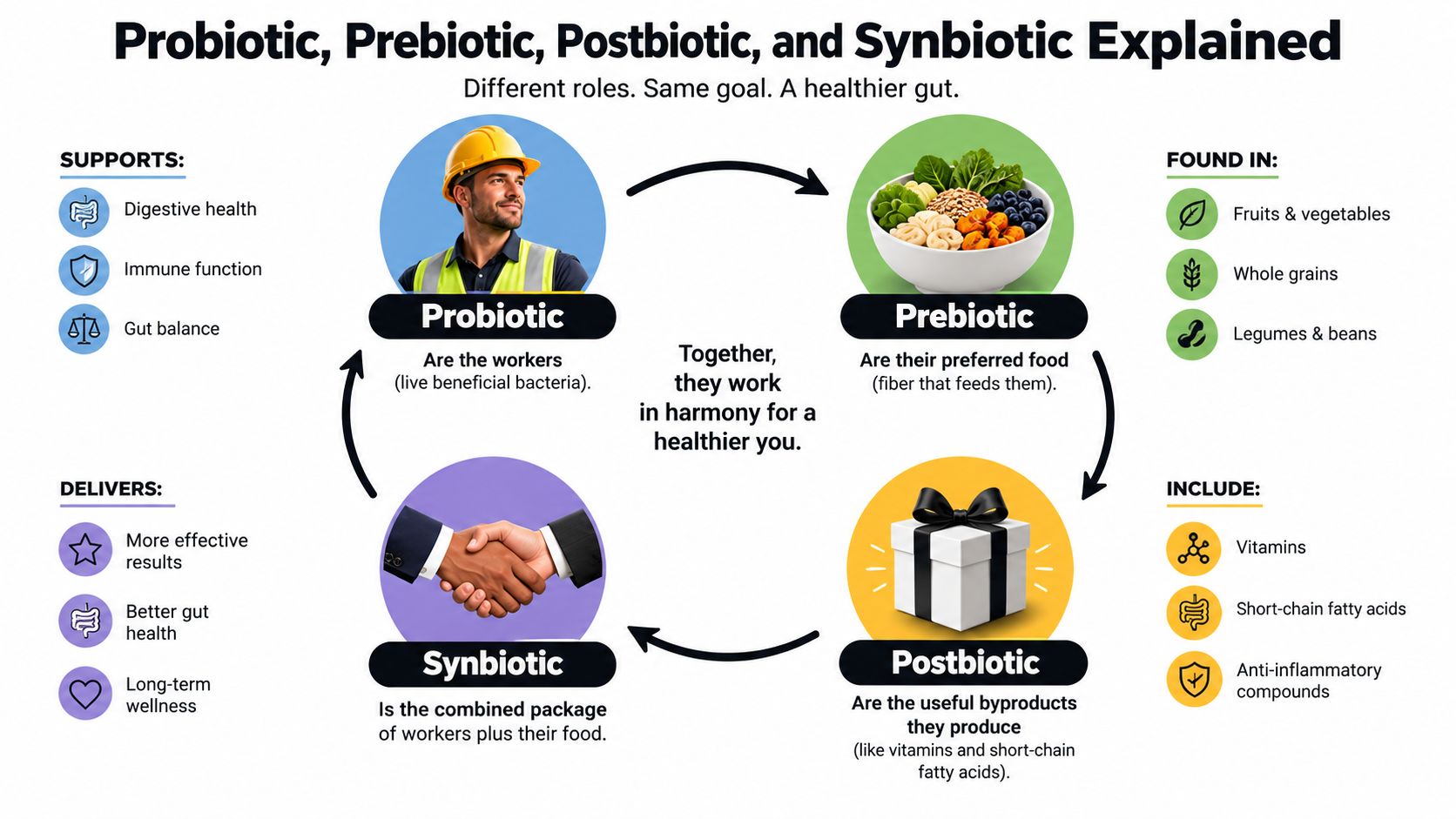
Examples of prebiotic substrates include inulin, fructooligosaccharides, galactooligosaccharides, lactulose, resistant starch, and human-milk oligosaccharides. But don't infer that every fiber works as a prebiotic, or that a substrate benefits every microbe. The 2020 ISAPP consensus describes two types of synbiotics:
- Complementary synbiotics combine a probiotic and a prebiotic that have each been established independently.
- Synergistic synbiotics pair a live microorganism with a substrate specifically used by that co-administered microorganism.
This makes “contains probiotics and fiber” a weaker statement than “this exact combination has been tested for a health benefit.” For a clear introduction to probiotic terminology in a different context, see understanding probiotics for child health. The same basic distinction applies to adults: the ingredient names are only the start of evaluating a formula.
How Probiotics and Fiber Work Together in the Gut
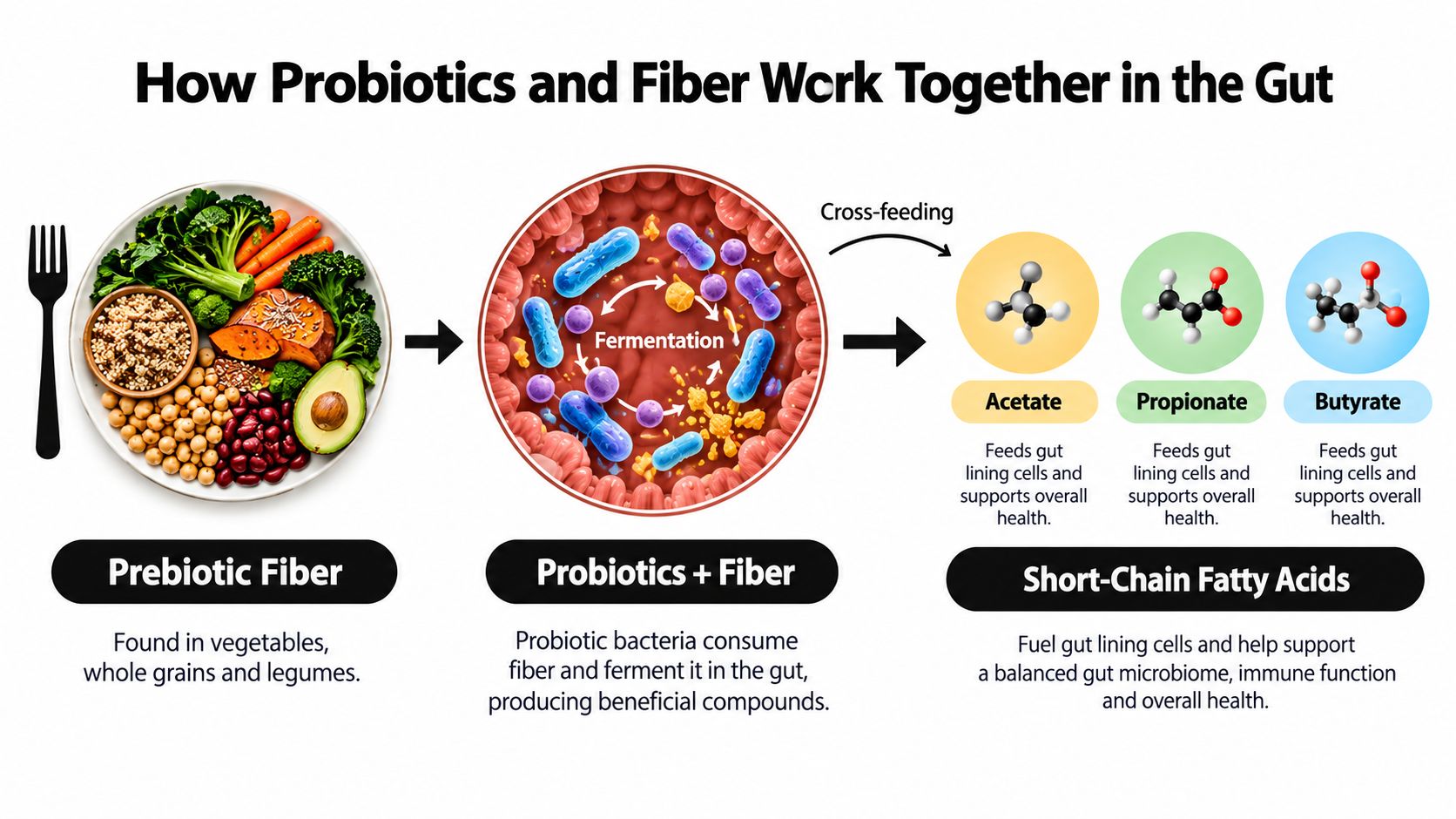
The basic mechanism starts when gut microorganisms use fermentable substrates. Some microbes break down fibers and produce short-chain fatty acids, including acetate, propionate, and butyrate. These compounds can serve as fuel for colon cells, influence gut conditions such as pH, and interact with the wider microbial community. The effect depends on which organisms encounter which substrate.
A sourdough starter offers a useful comparison: the culture matters, but so does the flour. A different culture or flour can change how the starter behaves. In the gut, a fiber that one strain uses may not be useful to another, so a probiotic's identity and its accompanying fiber matter.
A simulated gastrointestinal model illustrates why this pairing deserves attention. Potato fiber improved survival during gastric passage for four Lactobacillus strains: L. fermentum PCC, L. rhamnosus LGG, L. reuteri RC-14, and L. paracasei F-19. The effect varied by strain. Fermentation of potato fiber also produced a more diverse microbial community than starch and selectively changed taxa, including increases in Lachnospira, Butyrivibrio, Parabacteroides, Prevotella, and Bacteroides ovatus. The potato-fiber model research shows why one fiber shouldn't be assumed to have the same effect with every organism.
In simplified terms, the process may look like this:
- A substrate arrives: A microbe encounters a fiber it can use.
- Fermentation occurs: Microbial activity breaks down that substrate.
- Metabolites are produced: Short-chain fatty acids are among the resulting compounds.
- Effects depend on the pairing: Strain, fiber, dose, and host response shape what happens next.
For a plain-language overview of prebiotic fiber supplements, consider both the source of the fiber and the specific organisms in the formula. The useful unit of analysis is the strain–fiber pair, not a generic stack of “probiotics plus fiber.”
What the Clinical Evidence Actually Shows
Clinical evidence supports studying probiotics and prebiotic fibers together, but it doesn't establish that every combination works for every digestive complaint. Results vary with the population, formulation, dose, and measured outcome.
A systematic review and meta-analysis of critically ill patients included 33 randomized controlled trials and 5,073 participants. In that medically distinct group, synbiotic treatment was associated with a gastrointestinal-symptom risk ratio of 0.52 (95% confidence interval 0.35 to 0.77), an estimated 48% relative reduction compared with controls. Prebiotic interventions alone were associated with a risk ratio of 0.66 (95% confidence interval 0.49 to 0.87), an estimated 34% relative reduction. These results shouldn't be assumed to apply to generally healthy adults or people with IBS. The review of gastrointestinal outcomes in critically ill patients addresses a population with different medical needs.
IBS findings are more symptom-specific. A 2022 review of 10 randomized controlled trials involving 757 people with constipation-predominant IBS found that probiotics improved stool consistency and increased fecal Bifidobacteria and Lactobacillus, but didn't significantly improve abdominal pain, bloating, or quality of life. A separate review of 11 trials involving 729 people with IBS or related functional bowel disorders found no significant gastrointestinal-symptom or quality-of-life benefit from prebiotic supplements versus placebo. By contrast, 15 IBS randomized trials involving 1,048 patients found a significant global-symptom benefit for ispaghula, also called psyllium. The NCCIH evidence summary for IBS and complementary approaches describes these differences.
| Intervention | Population | Key outcomes | Evidence note |
|---|---|---|---|
| Synbiotics and prebiotics | Critically ill patients | Lower gastrointestinal-symptom risk versus controls | Results are population-specific and shouldn't be generalized directly |
| Probiotics | Constipation-predominant IBS | Stool consistency and fecal Bifidobacteria and Lactobacillus improved; several other symptoms didn't significantly improve | Benefit depended on the outcome measured |
| Prebiotic supplements | IBS and related functional bowel disorders | No significant overall symptom or quality-of-life benefit versus placebo | Fiber type and dose still matter |
| Psyllium | IBS | Significant global-symptom benefit | A more defensible fiber choice for regularity |
| Probiotic strains and combinations | IBS trials | Evidence certainty varied by strain and product | Combination-probiotic evidence was often very uncertain |
The practical lesson is that “probiotics plus fiber works” is too broad to guide a purchase. Look for evidence tied to the specific strain, fiber, dose, duration, and target condition, then weigh it against your own symptom pattern.
Why Adding Fiber Can Sometimes Make Bloating Worse
Fiber isn't one uniform ingredient, and adding more isn't always the right move for someone who already has gas or bloating. Highly fermentable fibers can produce gas as microbes break them down. For a person who tolerates that fermentation poorly, a probiotic-plus-fiber formula may aggravate discomfort rather than ease it.
Inulin-type fructans are a useful example. British Dietetic Association guidance warns that they can increase flatulence and recommends gradually increasing fiber when people with constipation have difficulty tolerating it. A review of 11 randomized controlled trials involving 729 participants with IBS found that prebiotic supplements overall didn't improve gastrointestinal symptoms or quality of life versus placebo. Within that review, moderate amounts of non-inulin-type fructans, specifically doses below 6 grams per day, improved flatulence, while inulin-type fructans increased gassiness. The NCCIH IBS guide on prebiotics and symptoms describes this difference.
The evidence also doesn't support assuming probiotics reliably reduce bloating. A review of five randomized trials involving 821 people with chronic constipation found no statistically clear overall reduction in bloating with probiotics versus placebo (standardized mean difference −0.38, 95% confidence interval −0.82 to 0.06). The British Dietetic Association discussion of fiber tolerance and probiotic-related bloating is available in its dietetic guidance review.
For a gas-prone person, that points to a more cautious approach:
- Start low with fermentable fibers. Increase gradually rather than adding a large serving at once.
- Consider soluble fiber for regularity. Psyllium may be a more defensible option than a high dose of rapidly fermented fiber.
- Track symptoms separately. Record stool form, pain, and gas instead of treating them as a single outcome.
- Match the fiber to your tolerance. A substrate that suits one person may not suit someone with IBS symptoms or gas sensitivity.
For related context on probiotics for gas, keep the central point in view: adding a prebiotic doesn't guarantee less bloating.
Matching the Right Synbiotic Approach to Your Goal
Start with the symptom you want to address, then ask whether the proposed strain and fiber make sense for that goal and for your tolerance. Avoid choosing by a “high CFU” number alone. In an evidence review of 82 randomized IBS trials covering 10,332 patients, only 24 trials had low risk of bias across all assessed domains. Certainty was moderate for Escherichia strains, low for Lactobacillus strains and Lactobacillus plantarum 299V, and very low for combination probiotics, Bacillus strains, and several named multi-strain products. The IBS probiotic evidence review supports checking the specific strain, outcome, and dose rather than relying on broad claims.
If regularity is the priority, gradually titrated soluble fiber, especially psyllium, has a stronger rationale than suddenly adding a large dose of fermentable prebiotic. A probiotic can be layered in when its strain and intended outcome are clear. Guidance on prebiotics and constipation can help frame the fiber question.
For bloating and gas, favor a slower ramp and pay attention to how fermentable the substrate is. More inulin isn't automatically better. If your goal is microbiome balance, look for named strains and a varied diet rather than assuming that one high-CFU blend or a microbiome marker predicts symptom relief. A diverse microbial response doesn't guarantee that pain or bloating will improve.
For women seeking combined gut, vaginal, and urinary support, assess whether a product's strains and ingredients fit the specific support goal. Cranberry and D-mannose are ingredient terms to evaluate in that context, but don't assume that a product's general probiotic or prebiotic content proves a benefit for every concern. For everyday food choices that can sit alongside supplement decisions, browse the diet guide collection.
Choose by evidence and fit: A formula is more relevant when its strain, substrate, and intended outcome align with your own needs.
For daily maintenance, prioritize a moderate approach you can tolerate and use consistently. GutRx DAILY pairs strains selected to help shape and move bowel movements with prebiotics intended to feed those probiotics. That product description doesn't replace evidence for the exact combination or guarantee the same response for everyone.
Putting It Together Into a Practical Routine
A useful routine starts with observation, not a chase for microbiome numbers. Track stool form, pain frequency, gas, energy, and any specific concern you're addressing, such as vaginal or urinary comfort. Changes may take weeks rather than days, and different symptoms may shift at different speeds.
When comparing products, look for transparent ingredient lists and clearly identified strains. Third-party testing, downloadable Certificates of Analysis, strain verification, and delayed-release protection are quality signals to investigate, but they don't prove that a particular pairing will resolve your symptoms. Confirm that the product's evidence and intended use align with your goal.
Use this short checklist:
- Name the main goal: Regularity, bloating, or another specific symptom.
- Check the fiber: Identify its type and consider how you've tolerated similar fibers.
- Review the strain: Look for strain-level details and relevant outcomes.
- Start cautiously: Follow product directions and increase fiber gradually if tolerance is a concern.
- Track your response: Record stool form, pain, and gas separately.
Probiotics plus fiber can be a useful combination when the strain, substrate, dose, and person are well matched. The best choice is the one with a clear rationale for your goal and a plan for judging whether you tolerate it.
GutRx offers digestive supplements for different goals, including regularity-focused probiotics, digestive-balance formulas, and digestive enzymes. Visit GutRx to review the product information and compare it with your needs.


