

If you've tried a fiber supplement for constipation and ended up more bloated, the popular advice to “just add more prebiotic fiber” probably isn't the answer you need. Prebiotics can support bowel regularity, but they don't all work the same way, and more isn't automatically better. The type of prebiotic, the dose, your starting symptoms, and your baseline gut microbiota can all influence whether you improve, stay unchanged, or feel worse.
The clinical picture is encouraging but not definitive. A 2024 systematic review and meta-analysis of fructooligosaccharides, or FOS, pooled 17 randomized controlled trials involving 713 participants and found higher bowel movement frequency, improved stool consistency, and less effort and pain during defecation, while mild bloating remained a possible adverse effect (the FOS meta-analysis). That's useful evidence, but it isn't permission to treat every constipation pattern with the same powder.
Table of Contents
- Why Prebiotics Are Not a Universal Constipation Fix
- How Prebiotics Influence Bowel Motility
- What Clinical Studies Show
- Comparing Inulin, FOS, GOS, and PHGG for Constipation
- Dosing and Titration to Minimize Bloating
- Combining Prebiotics with Probiotics and Synbiotics
- Deciding Whether Prebiotics Are Right for Your Constipation
Why Prebiotics Are Not a Universal Constipation Fix
Prebiotics are often grouped together as if inulin, FOS, galacto-oligosaccharides, or partially hydrolyzed guar gum were interchangeable. They aren't. Each is fermented differently, and fermentation speed affects both the potential benefit and the likelihood of gas or abdominal distension.
Some people respond because their colonic bacteria can use a particular prebiotic efficiently. Others may have a microbiome that responds weakly, or they may already have enough fermentable carbohydrate in the diet. A person with infrequent stools and low fiber intake may benefit from a carefully chosen addition, while someone whose constipation comes with marked bloating may need a slower approach or a different type of fiber altogether.
Practical rule: A prebiotic trial should be treated as a personalized experiment, not a universal constipation cure.
Functional constipation is biologically heterogeneous. Symptoms can reflect slow transit, difficult evacuation, low stool volume, changes in pelvic floor coordination, medication effects, or overlapping irritable bowel symptoms. A fermentable fiber may help one part of that picture without addressing the main cause.
The research reflects that uncertainty. Earlier pediatric evidence found only 6 randomized controlled trials of prebiotics for functional constipation, with most studies at high risk of bias and insufficient evidence to recommend prebiotics, probiotics, or synbiotics for children at that time (the pediatric systematic review). Later reviews continued to describe the clinical evidence as limited and inconsistent, even as newer analyses became more supportive.
Recent evidence also raises a personalization question that most consumer guidance misses. Baseline microbiota characteristics may help predict who responds to inulin, and a more recent line of evidence found that a prebiotic formulation in adults with functional constipation was associated with a decline in species richness and Shannon diversity (the microbiome evidence table). That doesn't mean prebiotics are harmful in general. It means the right question isn't, “Do prebiotics work?” It's, “Which prebiotic, at what dose, for which constipation pattern?”
For broader lifestyle guidance, you can also review natural constipation relief options, especially if you haven't assessed fluid intake, meal regularity, movement, or the type of fiber you're already using.
How Prebiotics Influence Bowel Motility
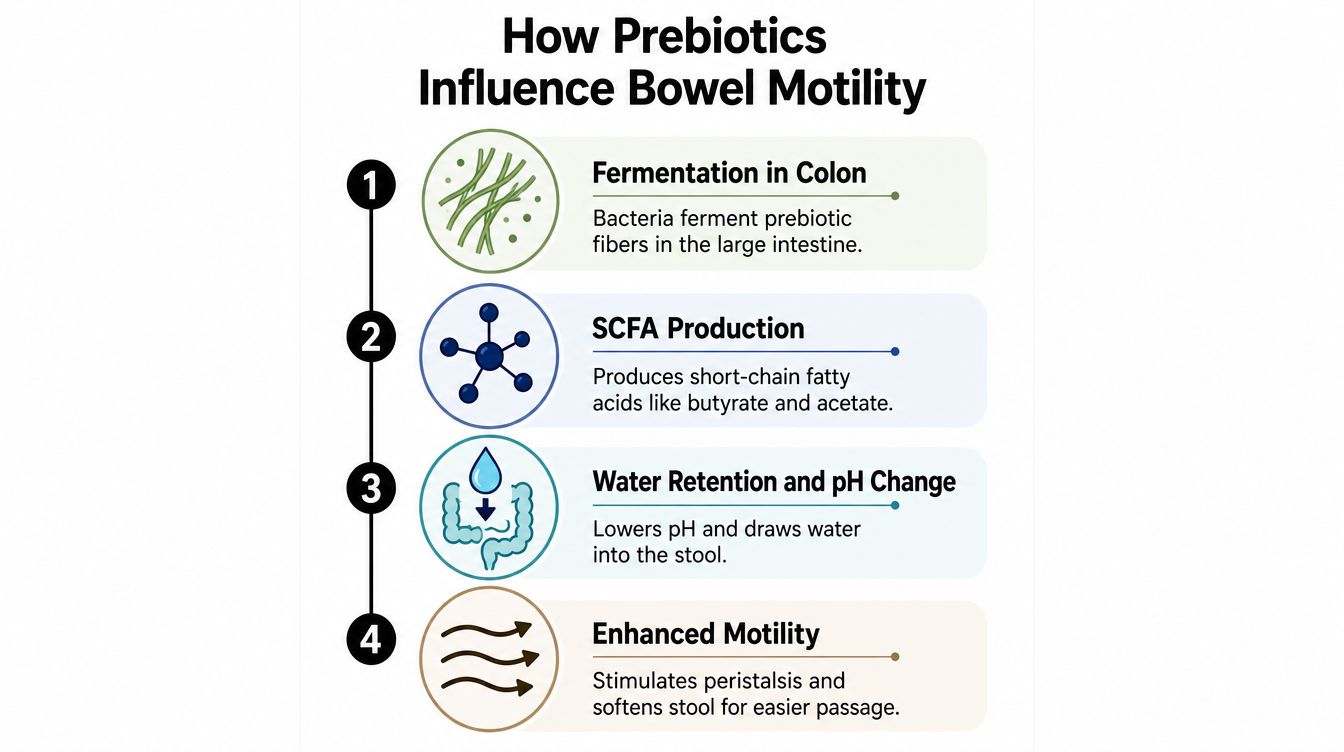
Prebiotics affect bowel function through a microbial pathway rather than only by adding physical bulk. The process usually unfolds in several linked stages.
First, the prebiotic reaches the colon without being fully digested in the upper gastrointestinal tract. There, resident bacteria ferment it and use it as a food source. Fermentation can produce short-chain fatty acids, including butyrate, acetate, and propionate, along with gases that may explain the bloating some people experience.
Second, those short-chain fatty acids alter the local colonic environment. They can lower colonic pH and contribute to an osmotic effect, meaning more water remains available in the intestinal contents. Softer, better-hydrated stool is generally easier to pass, although the size of this effect depends on the substrate, dose, and individual response.
Third, microbial metabolites interact with the intestinal lining and local signaling systems. They may influence motility and gut hormone activity, helping coordinate muscular contractions that move stool forward. This is different from psyllium, which primarily supports regularity through water retention, gel formation, and increased stool bulk.
Fermentation is useful, but it has a cost
The same process that may support stool passage can create gas. Rapidly fermented carbohydrates can produce a noticeable increase in abdominal pressure before the gut adapts. That's why a full serving may feel intolerable even when a smaller amount is manageable.
A prebiotic also isn't the same as a probiotic. A probiotic supplies selected living microorganisms, while a prebiotic supplies fermentable material that existing microbes can use. A synbiotic combines both, but the combination only makes practical sense when the prebiotic and probiotic components are compatible and the overall dose is tolerable.
For readers comparing microbiome formulas, GutRx COMPLETE is described as a high-potency probiotic and prebiotic blend with 62B CFUs, Akkermansia muciniphila, and SIBO support. Its presence of both probiotic and prebiotic components doesn't guarantee constipation relief, so the same tolerance and symptom-monitoring principles still apply.
A deeper explanation of one relevant microbial metabolite is available in this discussion of butyrate and gastric emptying. The important clinical point is simple: prebiotics work by changing the environment in which microbes operate, not by acting like an immediate stimulant laxative.
What Clinical Studies Show
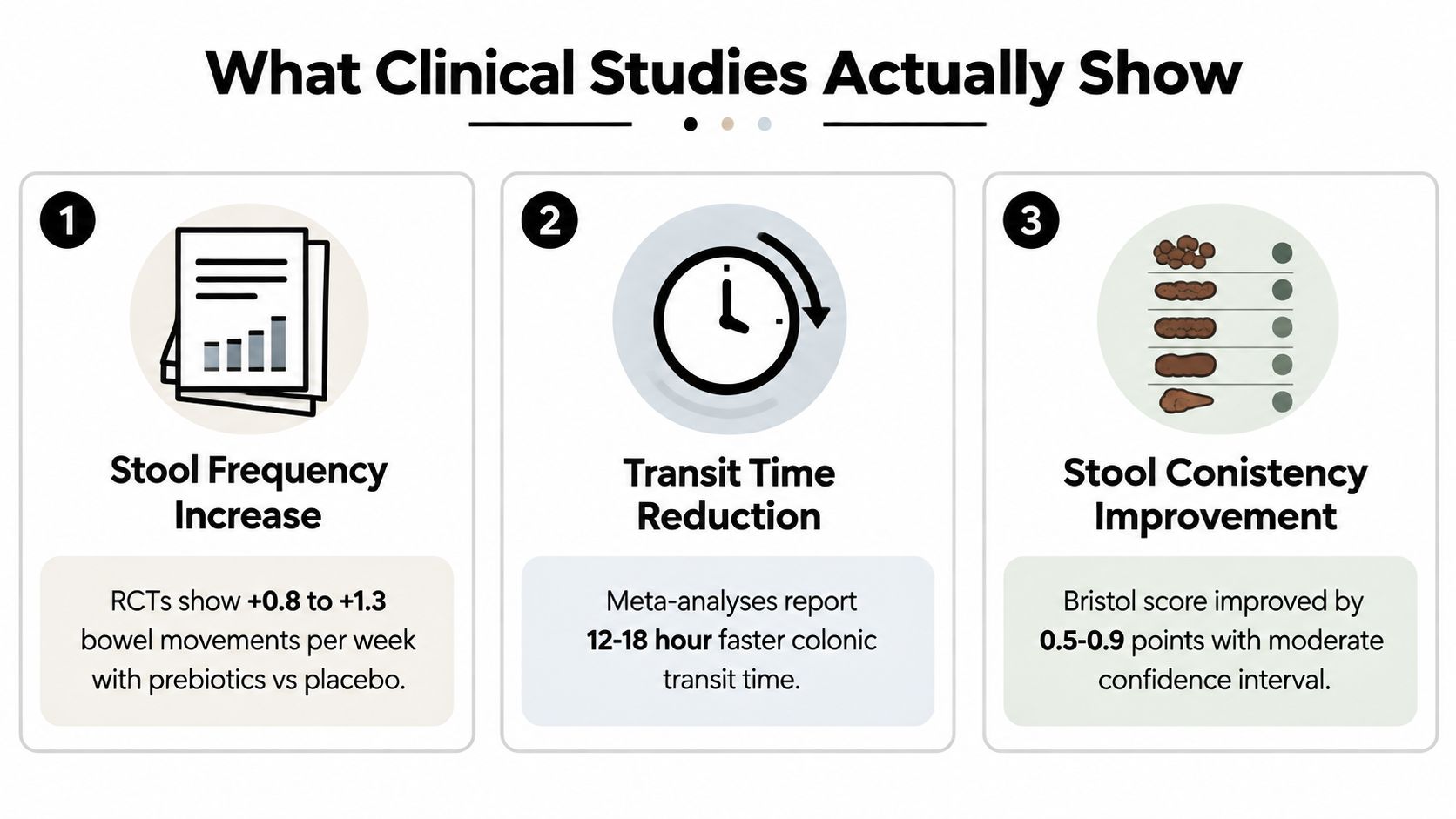
The clearest recent finding is that FOS can improve bowel movement frequency, stool consistency, and the effort or pain associated with defecation. A 2024 systematic review and meta-analysis pooled 17 randomized controlled trials with 713 participants and reported a 95% confidence interval of 0.80 to 1.50 and p < 0.00001 (the FOS clinical review). The confidence interval supports a meaningful average effect, but it does not predict how an individual will respond.
The practical trade-off was mild bloating. People may stop a prebiotic after early gas and assume it is harming digestion, when the more likely problem is a starting dose that was too high or increased too quickly. In the FOS trials, no serious adverse events were reported, although tolerance still varied between participants.
The older evidence is smaller and more variable
A 2017 meta-analysis of randomized controlled trials in adults with functional constipation found that prebiotics increased weekly stool frequency by 1.01 bowel movements per week, with a 95% confidence interval of 0.04 to 1.99. It also found improved stool consistency, measured as an SMD of -0.59, with a 95% confidence interval of -1.16 to -0.02 (the adult meta-analysis).
The strongest signals in that analysis involved galacto-oligosaccharides and fructooligosaccharide-probiotic combinations. The studies were small and heterogeneous, however, so these findings support a possible effect rather than a predictable result from every product.
A randomized, double-blind, placebo-controlled GOS study shows why baseline symptoms matter. Daily 11 g GOS increased stool frequency after three weeks in adults with self-reported constipation, with significant improvement among adults starting at 3 or fewer bowel movements per week and among adults aged 35 years and older (the GOS trial). Someone with infrequent stools may therefore respond differently from someone who has daily bowel movements but struggles with hard stools or incomplete evacuation. Baseline microbiome characteristics may also help explain this variation, because the available microbes determine how a fermentable substrate is used.
Product selection should follow the same logic. Compare ingredients, dose, and likely fermentation speed in our guide to choosing a prebiotic fiber supplement, then introduce one change at a time rather than combining several new fibers.
A British Journal of Nutrition review found that inulin-based constipation studies used doses ranging from 1 g/day to 20 g/day, contributing to the conclusion that the evidence remains inconclusive because the studies were small and heterogeneous (the prebiotic formulation review).
The evidence supports a trial, not a guarantee. Type, dose, baseline symptoms, microbiome characteristics, and tolerance determine whether the research translates to you.
Comparing Inulin, FOS, GOS, and PHGG for Constipation
Choosing a prebiotic starts with tolerability, not marketing. A product labeled “high fiber” may contain a rapidly fermented ingredient that worsens gas, while a gentler option may be easier to use consistently.
The table below summarizes the practical differences. Dose ranges reflect the broad clinical literature, not a universal prescription.
Prebiotic types compared for constipation support
| Prebiotic Type | Evidence Strength | Typical Dose Range | Bloating Risk | Best For |
|---|---|---|---|---|
| Inulin | Studied extensively, but results remain inconsistent across formulations | 1 to 20 g/day in inulin-based studies (review) | Higher, especially when increased quickly | People who tolerate fermentable fiber and want a microbiome-directed option |
| FOS | Stronger recent randomized support for stool frequency and consistency | Product-specific | Moderate to high | Adults seeking a studied option for infrequent or difficult stools |
| GOS | Useful signal in adults with low baseline stool frequency | 11 g/day in a randomized study (GOS trial) | Moderate | People whose main problem is infrequent bowel movements |
| PHGG | Often selected for gentler, better-tolerated fiber support | Product-specific | Generally lower than rapidly fermented options, but individual response varies | People who develop gas easily or don't tolerate aggressive fiber increases |
Why chain length matters
The structure of a prebiotic influences how quickly bacteria ferment it. Shorter-chain carbohydrates can ferment earlier and more rapidly, which may create gas sooner. Longer or more gradually fermented fibers may spread the effect through the colon and feel easier for some users.
That distinction doesn't make one ingredient universally superior. Someone with low stool frequency may prioritize the evidence around GOS or FOS, while someone with constipation plus prominent bloating may prefer a slower, lower-risk starting point such as PHGG. Inulin can be useful, but it's also a common reason people conclude that all prebiotics make symptoms worse.
Use the evidence as a filter, then use your symptoms as feedback. A named ingredient, transparent serving size, and clear testing information are more useful than a vague “proprietary fiber blend.”
Dosing and Titration to Minimize Bloating
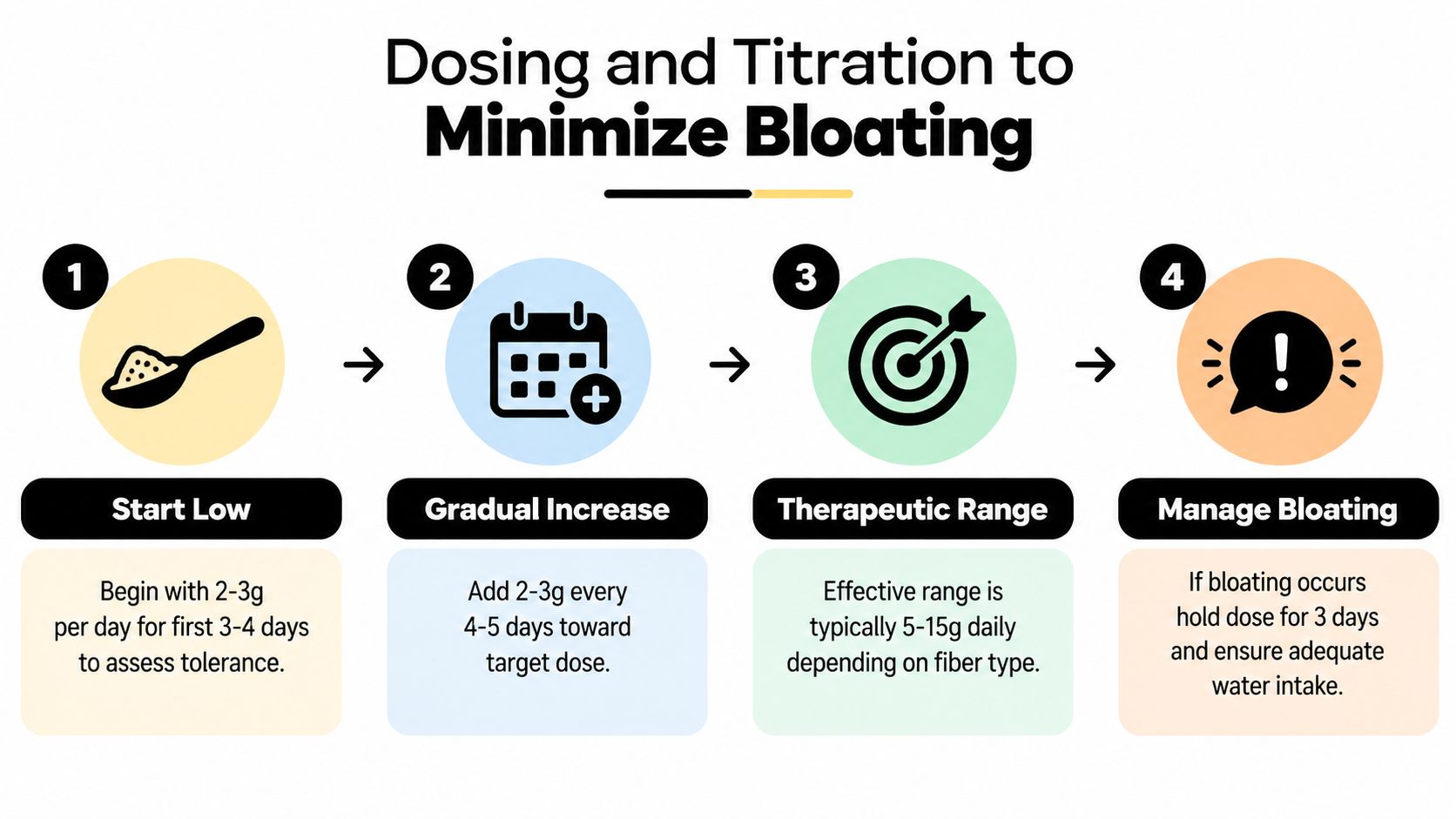
The safest practical approach is to start below the label's full serving and increase only when your current dose feels stable. A common starting point is 2 to 3 grams per day for the first 3 to 4 days, followed by gradual increases of 2 to 3 grams every 4 to 5 days if bowel comfort remains acceptable.
The research supports taking dose seriously. A 2022 review identified a medium range of 0.6 to 0.85 g/kg and a high-dose range of 1.70 to 2.49 g/kg as the most promising dose ranges for improving gastrointestinal transit, although the authors also emphasized variation among products and studies (the chronic constipation review). Those ranges aren't a reason to jump immediately to a high amount. They show why a tiny dose may do nothing and why a sudden large dose may cause avoidable symptoms.
A practical titration sequence
-
Start low. Use 2 to 3 g daily and track stool frequency, stool form, urgency, pain, and bloating. Don't change several supplements at once, or you won't know what caused the response.
-
Hold steady before increasing. If mild gas appears but settles, keep the same dose for several days. If bloating is persistent or painful, don't push through it.
-
Build gradually. Increase by 2 to 3 g every 4 to 5 days, working toward a product-appropriate range. Many people can find benefit within 5 to 15 g daily, but the effective amount depends on the prebiotic type and individual tolerance.
-
Split the dose if needed. Taking half with one meal and half with another can feel easier than taking the full amount at once. Mix the powder thoroughly and maintain adequate fluid intake.
Stop-and-adjust signal: Mild, temporary gas can occur during adaptation. Worsening pain, persistent distension, escalating constipation, vomiting, or severe discomfort calls for a dose reduction, discontinuation, and clinical advice.
Track the trial for several weeks rather than judging it after one serving. If your stools aren't becoming easier to pass, or bloating is steadily worsening despite a conservative dose, switching prebiotic types makes more sense than continuing to increase.
Combining Prebiotics with Probiotics and Synbiotics
A synbiotic combines a probiotic microorganism with a substrate that can support microbial activity. The logic is straightforward: the prebiotic provides fuel, while the probiotic supplies a selected organism. In theory, the pairing can improve survival or metabolic activity, but the result depends on whether the components work well together.
Clinical evidence gives synbiotics a meaningful signal, but not a blank check. A 2024 network meta-analysis found that prebiotics and synbiotics increased stool frequency, with the strongest signal for lactulose and synbiotics, while certainty ranged from moderate to very low (the evidence summary). That range tells you to look beyond the word “synbiotic” and inspect the actual formulation.
When a combination makes sense
A combined product may be practical if you want one routine and the formula discloses:
- Named probiotic strains, rather than only genus and species.
- The specific prebiotic ingredient and amount, so you can assess fermentation risk.
- Clear storage and delivery information, especially if the product claims delayed-release or shelf-stable protection.
- Independent quality documentation, such as third-party testing or downloadable Certificates of Analysis.
- A target use case, such as daily regularity, rather than a long list of unrelated promises.
Separate products can be easier for sensitive users because you can introduce one component at a time. If a combination causes bloating, you may otherwise struggle to identify whether the probiotic, prebiotic, dose, or another ingredient is responsible.
A probiotic doesn't automatically need prebiotic fuel to work, and evidence from one strain can't be transferred to every other strain. The most useful combination is the one whose ingredients, doses, and intended outcome match your symptoms.
For a buyer comparing a prebiotic probiotic postbiotic supplement, don't assume that more categories equal better constipation support. A simpler product with a tolerable prebiotic dose may be more useful than a complex formula you stop taking after a few days.
Deciding Whether Prebiotics Are Right for Your Constipation
Prebiotics are most reasonable when constipation occurs alongside low fiber intake, bloating, irregularity, or selected IBS-C symptoms, and when you're willing to titrate rather than chase an immediate effect. They're less compelling as a first choice when the main problem is difficult evacuation, severe pain, medication-related slowing, or a symptom pattern that hasn't been evaluated.
Other dietary approaches may have stronger evidence for straightforward constipation. A 2025 review of chronic constipation identified psyllium, kiwifruit, prunes, and some other dietary options as better-supported choices than many prebiotic products (the chronic constipation review). That doesn't make prebiotics irrelevant. It places them in the right role, often as an adjunct for people who want microbiome-directed support or who don't tolerate conventional fiber strategies.
The gut-brain connection may also matter. A 2025 randomized trial of inulin in constipation-predominant IBS reported improvement in constipation status and psychological state in the prebiotic group (the IBS-C trial). This suggests that some people may notice changes beyond stool frequency, but it shouldn't be interpreted as proof that prebiotics treat anxiety, depression, or every stress-related digestive symptom.
Use a short, monitored trial
Before starting, record your baseline pattern. Note stool frequency, consistency, straining, pain, bloating, and incomplete evacuation. After gradually introducing the product, assess whether stools are easier and whether abdominal symptoms are stable.
Contact a healthcare professional before experimenting if constipation is new, severe, persistent, or associated with warning symptoms such as rectal bleeding, unexplained weight loss, persistent vomiting, marked abdominal swelling, or inability to pass gas. Those patterns need evaluation rather than a self-directed increase in fermentable fiber.
Choose a product with a clearly named prebiotic, transparent dosing, and third-party testing where possible. If you develop worsening bloating or no meaningful improvement after a careful trial lasting 3 to 4 weeks, stop escalating and reassess the ingredient, dose, diagnosis, and whether psyllium, dietary foods, or medical treatment would be a better fit.
GutRx offers targeted digestive formulas, including GutRx Daily, which pairs selected probiotic strains with prebiotics intended to support regularity over time. Visit GutRx to review the available options and compare the formula details, testing information, and intended use before choosing a routine.


