

Probiotics for respiratory health can help in a narrow, evidence-based way, but they're not a cure-all for colds, asthma, or chronic airway disease. The strongest adult evidence suggests they may reduce the chance of having at least one acute upper respiratory tract infection by 24% and may shorten each episode by 1.22 days on average, according to a 2022 Cochrane review of 16 studies with 4,798 participants (PubMed).
That's the right starting point for anyone comparing probiotics for respiratory support. The key question isn't whether they “boost immunity” in a vague sense, it's which strains help, which outcomes improve, and where the evidence stops.
Table of Contents
- What the Evidence Actually Shows About Probiotics for Respiratory Health
- How the Gut-Lung Axis Connects Digestion to Breathing
- Three Distinct Evidence Buckets for Respiratory Outcomes
- Strains With Real Respiratory Evidence and Why Specificity Matters
- Where Probiotics Fall Short for Asthma and Chronic Airway Disease
- How to Choose a Probiotic for Respiratory Support
- Practical Use, Safety, and When to Talk to a Clinician
- Frequently Asked Questions on Probiotics and Respiratory Health
What the Evidence Actually Shows About Probiotics for Respiratory Health
The clearest answer is this, probiotics may modestly help prevent acute upper respiratory tract infections and may shorten them, but they do not replace standard respiratory care. The best adult summary I'd trust for that claim is the 2022 Cochrane review, which found a 24% lower chance of having at least one acute URTI, a 1.22-day shorter average episode, and a 42% reduction in prescribed antibiotic use for acute URTIs (PubMed). That last point matters because fewer antibiotics for routine viral respiratory illness is exactly the kind of downstream effect clinicians care about.
Respiratory health in probiotic research is broader than “catching fewer colds.” It includes acute URTI prevention, symptom duration, symptom burden, antibiotic use, and in some studies immune markers that suggest a stronger mucosal defense response. It also includes a much weaker and more complicated set of claims around asthma, COPD, and allergic airway disease, where the data don't line up as cleanly.
What counts as a meaningful benefit
A probiotic doesn't need to eliminate every infection to be useful. A realistic benefit can look like fewer infections over a season, a shorter bout when illness does happen, or less antibiotic prescribing when symptoms are mild and self-limited.
Practical rule: if a product only promises “better immunity” without naming a strain, a use case, or a study population, it's probably leaning on marketing more than evidence.
The best way to read the rest of the literature is to separate prevention, symptom relief, and immune-marker change. Those are not the same outcome, and they don't carry the same clinical weight. Keep that distinction in mind, because a supplement can move one bucket without meaningfully moving the others.
How the Gut-Lung Axis Connects Digestion to Breathing
The gut-lung axis is easiest to understand as a shared security system. The gut is the command center, the lungs are one of the protected sites, and immune cells carry messages between them. That's why an oral probiotic can influence respiratory defense without ever living in the airways themselves.
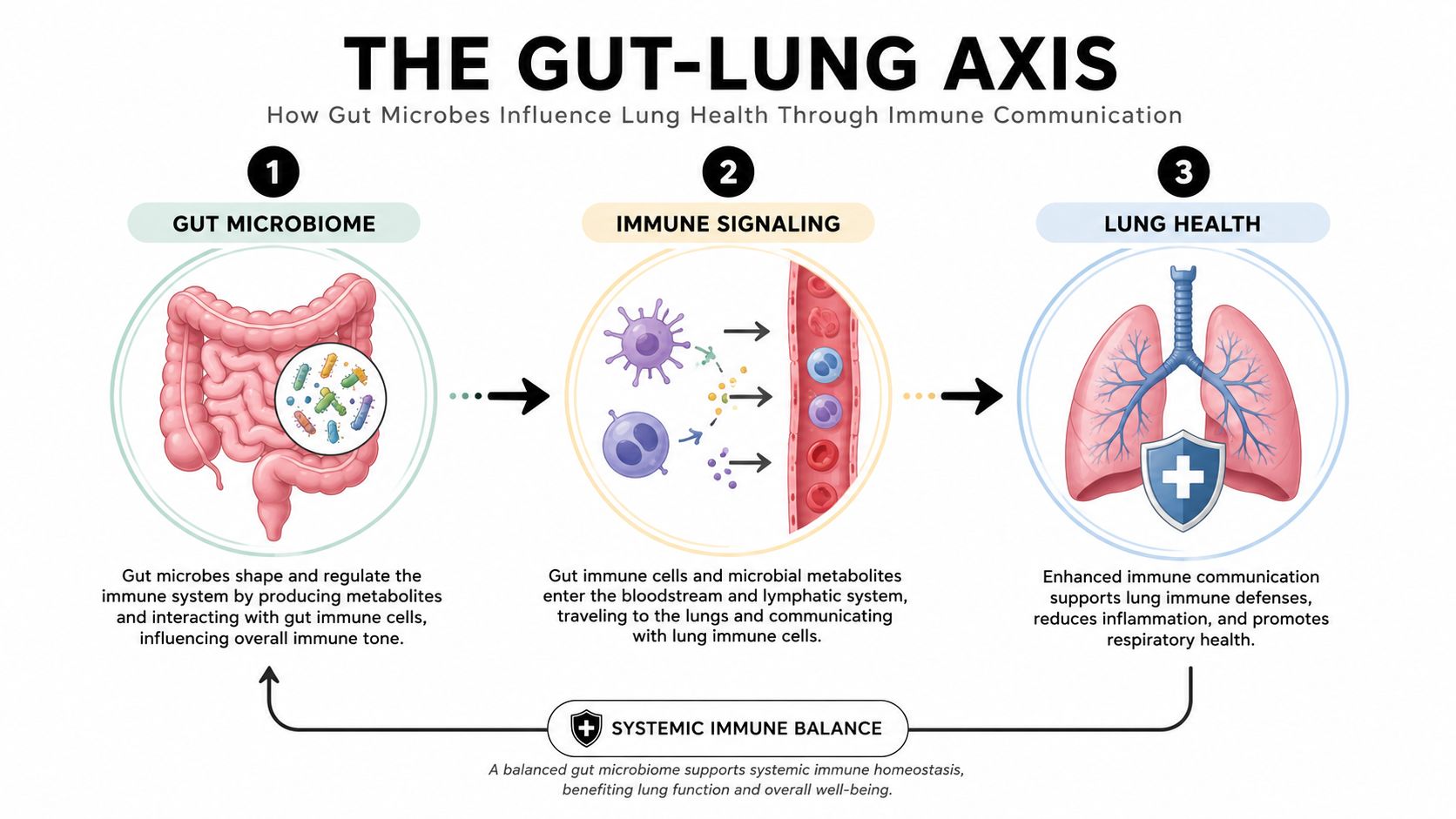
The mechanism isn't direct airway colonization. Instead, clinical and review data point to changes in mucosal and systemic immune markers, including secretory IgA (sIgA), interferon-gamma (IFN-γ), and cytokines, alongside lower viral titers and reduced symptom burden in some settings (PMC). In plain language, probiotics may help the body respond more efficiently when a respiratory pathogen shows up.
A useful mental model is this, gut microbes train immune tone. They help determine whether the immune system is under-reactive, over-reactive, or balanced enough to respond without excessive inflammation. That matters for respiratory infections, because much of the misery of a cold comes from the immune response, not just the virus itself.
Why oral products can affect the lungs
The gut lining is packed with immune tissue. When probiotics influence that environment, the effect can travel through systemic immunity and mucosal signaling to the respiratory tract. That's why oral products are the main focus in the evidence base, even though they never need to “seed” the lungs.
The same logic also explains why different formulations behave differently. A strain that supports gut immune signaling may help respiratory outcomes, while a broadly labeled “probiotic blend” may not do much at all if the strain identity is unclear.
A product label should tell you what you're buying. If it doesn't identify the strain, it's hard to connect the capsule in your hand to the trial data on paper.
For people who want a deeper mechanistic bridge, a butyrate-focused discussion belongs in gut-immune research, not in a simplistic “probiotics cure colds” story. The physiology is real, but the claims need to stay anchored to the outcome being studied, not the marketing angle.
Three Distinct Evidence Buckets for Respiratory Outcomes
The cleanest way to read the trial data is to separate the outcomes into three buckets. Once you do that, the mixed literature stops looking contradictory and starts looking more precise.
Bucket one, prevention of acute URTIs
The strongest signal comes from the 2022 Cochrane review, which found that probiotics may reduce the chance of having at least one acute URTI by 24%, and may lower the chance of having at least three infections by about 41% (PMC). The same review also reported a lower incidence rate of acute URTIs by about 18%.
Bucket two, symptom duration and burden
This bucket is about how long a cold lasts and how intense it feels. The same Cochrane review found an average reduction of 1.22 days per episode (PubMed). A 2021 review in older adults also concluded that probiotics were better than placebo for reducing incidence or risk and duration of acute URTIs, while noting that results varied by strain and study design (PMC).
Bucket three, immune-marker shifts
This is the least patient-facing bucket, but it still matters. Reviews have found increases in immune markers like sIgA, IFN-γ, and cytokines after probiotic use, alongside respiratory symptom changes in some trials (PMC). These changes are encouraging, but they're still proxy outcomes.
| Outcome Bucket | Typical Effect Size | Evidence Strength | Best Studied Population |
|---|---|---|---|
| Prevention of acute URTIs | 24% lower risk of at least one URTI, 41% lower risk of at least three infections, 18% lower incidence rate | Strongest and most clinically relevant | Adults and children in randomized trials |
| Symptom duration and burden | 1.22 days shorter per episode, with symptom reduction in some studies | Moderate, but strain-dependent | Adults, older adults, mixed populations |
| Immune-marker shifts | Increased sIgA, IFN-γ, and cytokine changes | Supportive, not a direct clinical endpoint | Mixed populations across mechanistic studies |
The takeaway is simple. Prevention has the best evidence, symptom improvement is plausible, and immune markers are supportive but not enough on their own.
Strains With Real Respiratory Evidence and Why Specificity Matters
A probiotic label that says only “proprietary blend” is not enough for respiratory decision-making. The evidence is strain-specific, which means the organism name matters as much as the word probiotic itself.
The single-strain example clinicians should know
Lacticaseibacillus rhamnosus GG is one of the best-studied single strains in this area. A review found that 13 randomized controlled trials showed fewer respiratory disease episodes in people receiving LGG than in control groups, with a mean difference of −0.14 (PMC). That doesn't make LGG a universal respiratory fix, but it does make it a useful reference point for how strain-level evidence should look.
Blends can work, but the strain mix still matters
The adult and pediatric URTI literature often includes multi-strain Bifidobacterium and Lactobacillus formulations, and that's part of why broad conclusions are messy. Some blends appear to help prevention or symptom burden, but not every blend does, and the label has to tell you exactly what's inside for the evidence to mean anything.
The practical implication is straightforward. If a formula only lists genus names, you can't tell whether it resembles the strains used in the trials. If it names the strain, you can at least compare the product to the published data.
A related point is often missed in consumer content. Saccharomyces boulardii is not a classic respiratory probiotic, but it sits in the same immune-support conversation because it has a clearer role in antibiotic-associated contexts than in airway-specific claims. That makes it adjacent, not interchangeable, with the respiratory strains above.
For readers comparing product pages, one internal resource on LGG benefits is useful context for why strain identity matters in practice, not just in theory: Lactobacillus rhamnosus GG benefits.
Where Probiotics Fall Short for Asthma and Chronic Airway Disease
The story gets more careful. Probiotics may support immune balance, but that doesn't mean they reliably improve asthma, COPD, or other chronic airway conditions in a way that patients can feel day to day.
A review of oral and nasal probiotic administration for allergic disease, asthma, and COPD notes that the evidence is much weaker and more contradictory for chronic respiratory disease than for acute URTIs. One review found probiotics could lower inflammatory cytokines in asthma, yet clinical symptom improvements were limited, and COPD data were too sparse for a firm conclusion (Cambridge Core).
Biomarkers are not the same as outcomes
That distinction matters more in chronic disease than in colds. A supplement can move a cytokine marker and still leave wheeze, cough, rescue inhaler use, or exercise tolerance unchanged.
A 2026 meta-analysis in adults with asthma found that multi-strain Bifidobacterium/Lactobacillus probiotics or synbiotics produced mild improvements in lung function, but the authors judged the effect insufficient for routine clinical use (PMC). That is the right level of caution. It suggests possible adjunct value, not a stand-alone therapy.
If a product claims to treat asthma or COPD with probiotics, it's overselling the evidence.
The more defensible position is narrower. Probiotics may have a place as an immune-modulating adjunct in people who want seasonal respiratory support, but chronic airway disease still belongs in standard medical management. That means inhaled therapies, trigger control, vaccines, and clinician-guided care stay first-line.
How to Choose a Probiotic for Respiratory Support
Selection starts with the label, not the marketing headline. A respiratory-focused probiotic should identify the exact strain, the intended use case, and some way to verify quality. Without that, you're buying a category, not a studied intervention.
Read the label like a trial comparison
Look for strain specificity first. “Lactobacillus” alone isn't enough, and neither is “immune support.” You want the full organism name, ideally the strain code, so you can match the product to the evidence.
Then check the delivery system. Delayed-release capsules can help protect bacteria through stomach acid, while shelf-stable formulas are easier to use consistently. Neither feature guarantees benefit, but both can matter if the organisms need to survive transit before they reach the gut.
The evidence on formulation also extends beyond probiotics alone. A 2023 review in Frontiers in Nutrition reported that orally ingested probiotics reduced the risk of experiencing one or more respiratory tract infections by 9% overall (PMC). The same review summarized broader findings that synbiotics reduced RTI incidence by 16% and prebiotics by 27%. That suggests some people may do better with a synbiotic than with a plain probiotic, especially if the product is built around a clearly described strain-fiber pairing.
What quality proof should look like
Third-party testing is not a cosmetic extra. A downloadable Certificate of Analysis helps confirm identity, purity, and potency, which is especially important when you're comparing expensive supplements that look similar on Amazon or a brand site. If a company can't verify what's in the capsule, it's harder to trust the respiratory claim.
For practical buying behavior, this is the short version:
- Match the use case: pick a formula positioned for seasonal respiratory support, not a generic wellness blend.
- Verify the strain: look for a named organism, not just genus-level labeling.
- Check the delivery format: delayed-release and shelf-stable formats are easier to use reliably.
- Ask for proof: third-party testing and a COA should be visible, not buried.
The strongest fit tends to be adults who want prevention during cold season, frequent travelers, people with high occupational exposure, and clinicians choosing an adjunctive option for patients who understand the limitations. For a closer look at testing standards, see third-party tested probiotics.
Practical Use, Safety, and When to Talk to a Clinician
Most respiratory probiotic trials run for 3 to 6 months, so this is not a same-day intervention. If a product is going to help with seasonal prevention, it usually needs enough time to influence immune tone before exposure ramps up.
Timing is simpler than most shoppers think. Oral probiotics are commonly taken with or around meals because that's a practical way to maintain routine and support passage through gastric acid. The exact timing matters less than consistency unless the product label says otherwise.
Antibiotics, intranasal use, and the safety boundary
Saccharomyces boulardii is the clearest probiotic name in the antibiotic conversation, especially when someone is already on respiratory antibiotics and wants to preserve gut resilience. That said, it's an adjunct, not a reason to use antibiotics casually.
Intranasal probiotic products are part of the broader literature, but oral formulations dominate the evidence base. For everyday consumers, the oral route is the more defensible default because that's where most of the respiratory trial data exist.
Safety matters most in vulnerable populations. Probiotics are not a good fit for many immunocompromised patients, and clinicians are appropriately cautious in people with central lines, severe acute illness, or post-surgical ICU status because rare bloodstream infections can occur. Pregnancy is another area where respiratory-specific evidence is not strong enough to treat casual use as risk-free.
If someone has chronic lung disease, they should not self-prescribe based on a supplement label alone. Probiotics are not a substitute for vaccines, antivirals, inhaled therapies, or standard respiratory care.
Frequently Asked Questions on Probiotics and Respiratory Health
How long until a respiratory probiotic starts working
Usually not overnight. The strongest trials run for months, so the seasonal prevention window, not immediate symptom relief, is a more accurate expectation. If a person is already sick, the better question is whether the product has any evidence for shortening duration, and that's much more limited than prevention.
Can I take probiotics with antibiotics during a respiratory infection
Often yes, but the reason matters. If antibiotics are prescribed, a probiotic may help protect the gut from disruption, and S. boulardii is the most familiar strain in that context. The probiotic is still an adjunct, not a substitute for the antibiotic decision itself.
Are probiotics better studied in children or adults
The pediatric literature is surprisingly strong, and the ISAPP summary reported that probiotics reduced the risk of at least one URTI event by 28%, lowered acute URTI incidence by 21%, and cut antibiotic use for URTIs by 41% in pooled pediatric trials (ISAPP). Adult data are still useful, but they're more heterogeneous, which is why strain-by-strain interpretation matters so much.
Who should avoid probiotics for respiratory reasons
People who are immunocompromised, have central venous lines, are critically ill, or are recovering from major surgery should talk to a clinician before using them. The risk is uncommon, but the downside is serious enough that “natural” is not a sufficient safety argument.
If you're comparing respiratory probiotic options, GutRx can help you evaluate the quality signals that matter, like strain specificity, third-party testing, and formula design. Visit GutRx to review the brand's approach to clinically studied ingredients and transparent product verification before you choose a supplement.


