

Probiotics may help prevent recurrent UTIs in some women, but the strongest evidence points to specific strains like Lactobacillus rhamnosus GR-1, L. reuteri RC-14, and L. crispatus, and vaginal delivery may outperform oral-only approaches. The best probiotic for UTI prevention isn't a generic capsule, it's a strain-specific formula chosen for the vaginal and urinary pathway it's meant to support.
If you've had one UTI after another, that distinction matters. Some products look similar on the shelf, but the research separates broad “probiotic” marketing from the strains and delivery methods that showed clinical signal in recurrent UTI prevention.
Table of Contents
- Can Probiotics Help Prevent Recurrent UTIs
- The Gut Vaginal and Urinary Connection
- What the Clinical Evidence Shows
- The Best Studied Strains for Urinary Support
- Oral Versus Vaginal Probiotic Delivery
- How to Choose a Probiotic for UTI Support
- Evidence Based Recommendations and Next Steps
Can Probiotics Help Prevent Recurrent UTIs
Yes, they can help some women reduce recurrence, but they're not a universal fix. The clearest pattern in the literature is that probiotics appear more useful for prevention than for treatment, and the benefit depends heavily on the strain and the delivery route.
A patient who keeps getting UTIs after antibiotics often wants a simple answer, and that's understandable. The clinical reality is more conditional. In the early phase 2 2011 randomized, double-blind, placebo-controlled trial of Lactobacillus crispatus CTV-05 given intravaginally, recurrent UTI occurred in 7 of 48 women, 15%, versus 13 of 48 women, 27% on placebo, with a relative risk of 0.5. That was one of the first strong signals that a targeted vaginal Lactobacillus strategy could matter for UTI-prone women. Lactin-V trial details
That said, broader reviews have not been uniformly positive. A Cochrane review found no significant overall reduction in recurrent symptomatic bacterial UTI with probiotics versus placebo, which is why I don't present probiotics as a guaranteed solution. The right takeaway is narrower and more useful, some Lactobacillus strategies may help prevent recurrence, especially in women with repeated infections, but the product has to be built around the right strain and the right route. Cochrane evidence summary
Practical rule: if a product only says “probiotic” or “Lactobacillus blend,” I treat that as too vague for recurrent UTI prevention.
That's why I'm cautious with generic oral probiotics sold for all-purpose “women's health.” Some may support digestive balance, but recurrent UTI prevention is a more specific use case. A formulation meant for this problem has to engage the vaginal microbiome, not just the gut. Related women's microbiome context
The Gut Vaginal and Urinary Connection
The biology behind probiotic support for UTIs becomes clearer once you follow the microbial pathway rather than the product label. Uropathogens, especially E. coli, often start in the gut, move to the vaginal area, and then ascend into the urinary tract. A lactobacillus-dominant vaginal environment can interrupt that sequence by lowering pH, competing for adhesion sites, and making it harder for pathogens to establish themselves.

Why vaginal dominance matters
When Lactobacillus species dominate the vagina, they create a local environment that is less hospitable to organisms linked to recurrence. The prevention target extends beyond the bladder to the full chain of colonization that allows bacteria to reach it. For practical guidance on how gut and vaginal support overlap, I point patients to this overview of gut and vaginal microbiome support. In practice, this is why vaginal Lactobacillus strategies make more mechanistic sense than generic oral “gut health” formulas for recurrent UTI support.
The landmark 2011 Lactin-V trial made that point concrete. In the study, women receiving Lactobacillus crispatus CTV-05 intravaginally had recurrent UTI in 15% of cases compared with 27% on placebo, with a relative risk of 0.5. The sample was modest and the confidence interval was wide, so it wasn't the final word. It still provided a biologically plausible clinical signal that restoring vaginal Lactobacillus could reduce recurrence in UTI-prone women. Clinical trial source
Why the strain has to fit the route
Not every probiotic strain can colonize the vagina in a way that matters for urinary health. That detail is easy to miss, yet it shapes whether a product can do anything useful for recurrent infections. The field moved toward strain-specific vaginal Lactobacillus because the effect depends on local microbiome activity, not just on swallowing more bacteria.
Route matters as much as strain because the target tissue differs. Oral products may influence the gut, while vaginal products are designed to act where colonization can directly alter recurrence risk. That difference helps explain why recurrent UTI prevention often overlaps with women's vaginal health content, and why I focus on full strain names rather than species labels alone.
The more useful question is not “Do probiotics work?” It is “Which strain reaches the vaginal niche, and by which route?”
What the Clinical Evidence Shows
The evidence base is mixed, and I'd rather say that plainly than oversell it. A meta-analysis of six randomized controlled trials involving 620 patients found a pooled risk ratio of 0.684 for recurrent UTI with Lactobacillus supplementation, which corresponds to about a 31.6% relative risk reduction. That sounds encouraging, but a Cochrane review of six studies and 352 participants found no statistically significant overall reduction versus placebo, with RR 0.82 and a confidence interval crossing 1. Clinical Infectious Diseases review summary
Why the reviews do not line up perfectly
These findings make more sense once you look at the trial design. The studies differed in strain selection, delivery route, and the populations enrolled. In this category, those differences matter a lot. A probiotic that appears weak in one pooled analysis may still be relevant when the signal concentrates in vaginal formulations or in certain adult women with recurrent disease.
A 2017 meta-analysis adds to that nuance. Across all included studies, the pooled risk ratio was 0.85, which was not statistically significant, but the subgroup analysis in adult women showed a statistically significant reduction with a pooled risk ratio of 0.51 and I2 = 0%. That points to a narrower phenotype, adult women with recurrent UTI, responding differently from broader mixed populations included in some reviews. 2017 meta-analysis
What later clinical commentary emphasizes
More recent clinical commentary continues to favor vaginal probiotics over oral-only products. A 2025 American Family Physician evidence summary reported that probiotics containing Lactobacillus, taken orally or vaginally, reduce recurrent UTIs in premenopausal women with frequent infections and prolong time between episodes, while vaginal probiotics with or without oral products outperform oral probiotics alone. AAFP evidence summary
Delivery method changes the interpretation. The same Lactobacillus label can produce very different results depending on whether the product is meant to reach the gut or the vaginal niche. In practice, that is why a strain such as Lactobacillus rhamnosus GG may be useful for one question while a vaginally directed product answers a different one, as discussed in this GutRx overview of Lactobacillus rhamnosus GG benefits.
| Key Clinical Evidence for Probiotics and UTI Prevention | |||
|---|---|---|---|
| Study | Participants | Delivery Method | Relative Risk |
| 2011 Lactin-V phase 2 trial | 96 women | Intravaginal | 0.5 |
| Meta-analysis of 6 RCTs | 620 patients | Lactobacillus supplementation | 0.684 |
| Cochrane review | 352 women and children | Probiotics versus placebo | 0.82 |
| 2017 meta-analysis, adult women subgroup | Adult women | Mixed probiotic studies | 0.51 |
The Best Studied Strains for Urinary Support
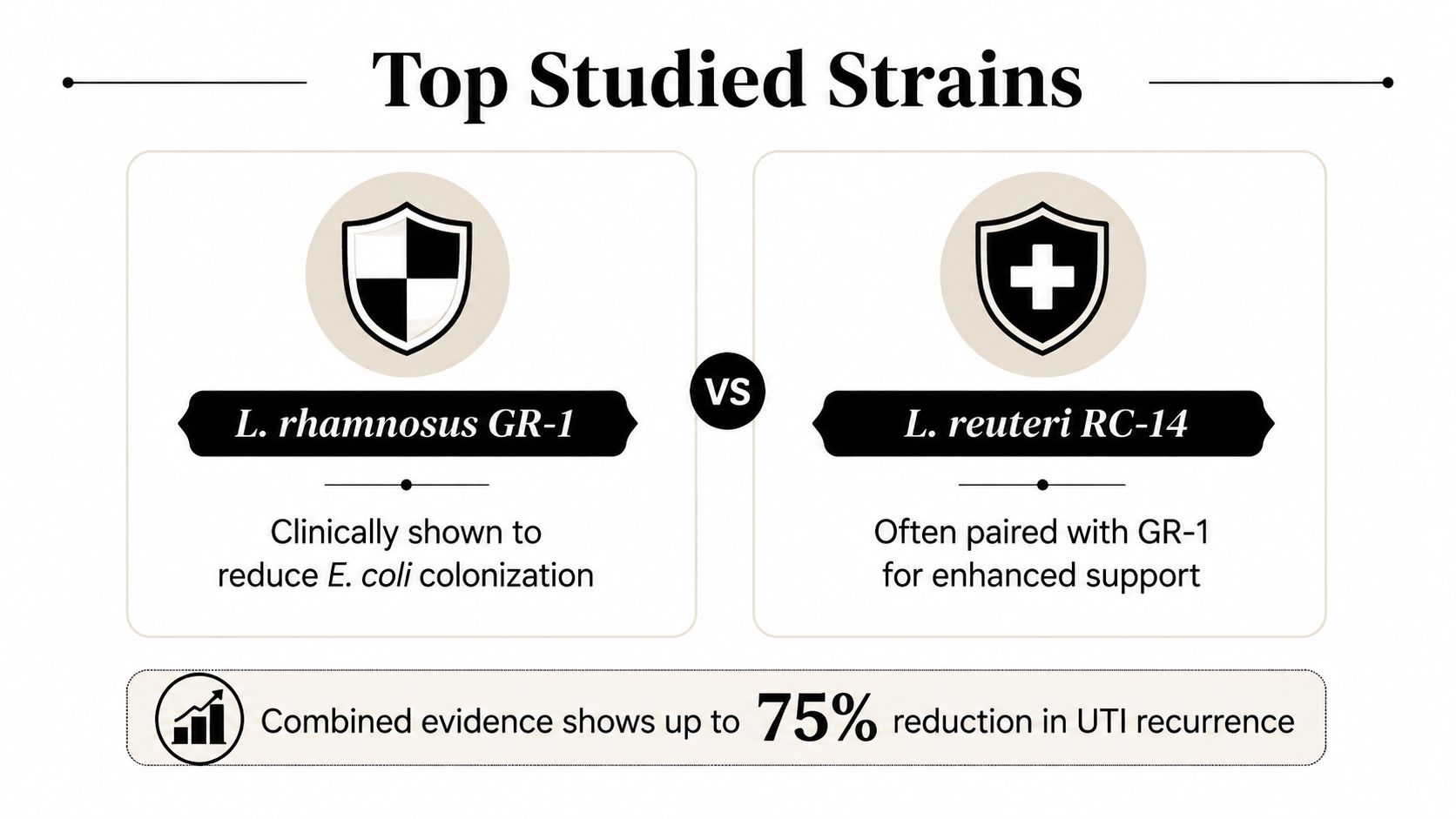
If you're shopping for the best probiotic for UTI prevention, the strain list matters more than the brand front panel. The two names that come up repeatedly are Lactobacillus rhamnosus GR-1 and Lactobacillus reuteri RC-14. A PubMed review identified them as the most effective lactobacilli among those studied for recurrent UTI prevention. PubMed review
The strains that deserve attention
L. crispatus CTV-05 also deserves a place on the shortlist because it was used in the intravaginal trial and is tied to the strongest early clinical signal. In later adult and women-focused reviews, vaginally administered Lactobacillus preparations, especially those containing L. crispatus CTV-05 or combinations like L. rhamnosus GR-1 plus L. fermentum B-54, were among the most effective studied options. The common thread is not “more Lactobacillus,” it's the right strain in the right place.
Why generic labels aren't enough
A bottle that says only Lactobacillus doesn't tell you much. Clinical evidence belongs to specific strains, not to the genus as a whole. That matters because two products can look similar, yet only one contains the strain with supportive data for vaginal colonization and urinary protection.
Decision rule: if the label doesn't name the exact strain, I don't consider it evidence-aligned for recurrent UTI prevention.
The difference is practical, not academic. A shopper looking for a daily probiotic for gut health might tolerate broad strain variety, but someone with repeated UTIs needs a tighter match between product design and biology. That's why I prefer products that clearly identify GR-1, RC-14, or L. crispatus rather than hiding behind a proprietary blend.
Later adult reviews also favor vaginally administered Lactobacillus preparations over oral-only formulas, which fits the mechanistic story already covered. The more the product supports the vaginal microbiome directly, the more sense it makes for urinary support.
Oral Versus Vaginal Probiotic Delivery
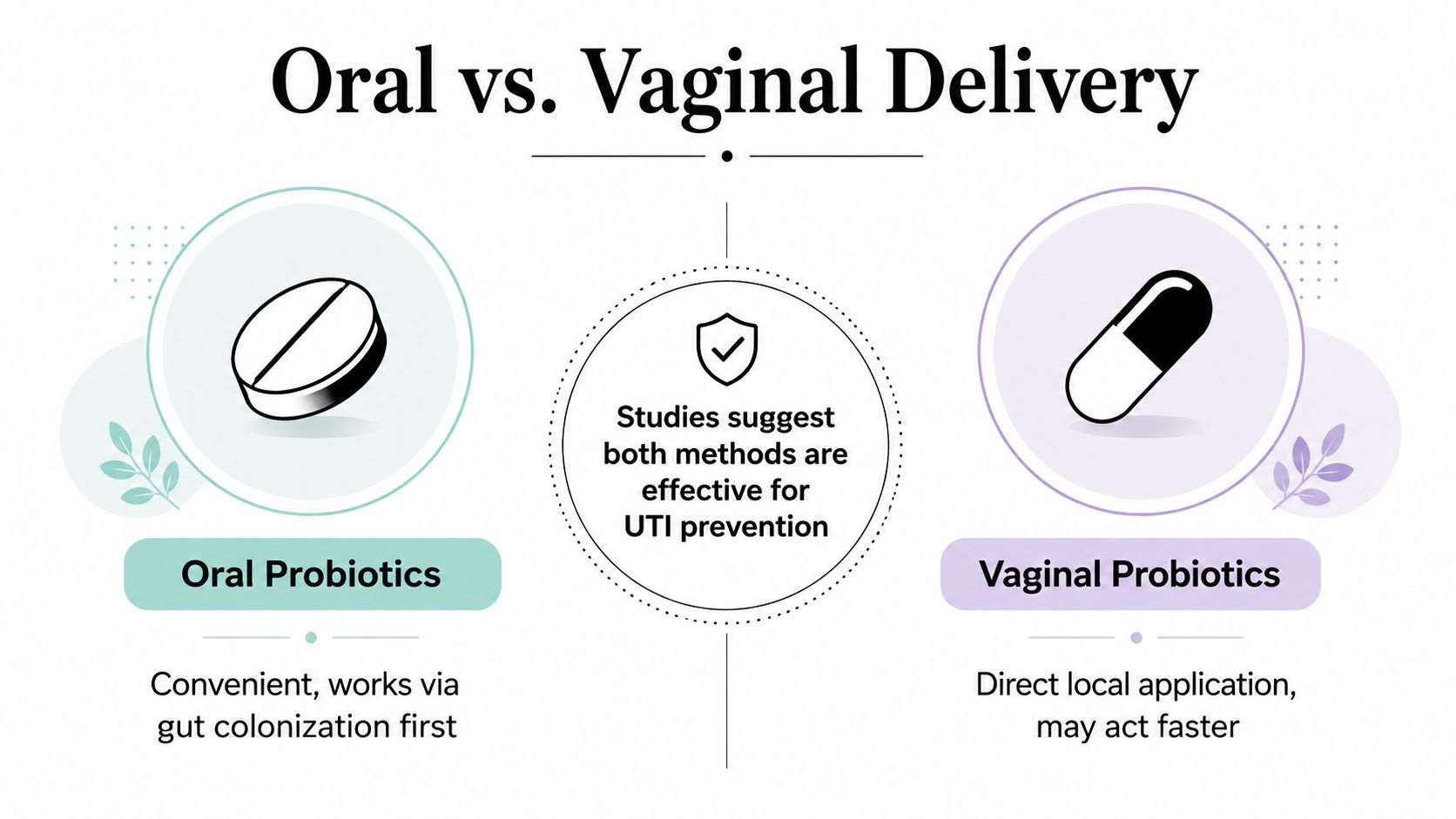
Delivery route is the detail most “best probiotic” articles skip, and it is the one I would focus on first after strain selection. For recurrent UTI prevention, vaginal probiotics tend to outperform oral probiotics alone. Oral products still have a role, but they are a less direct fit when the target is the vaginal and urinary interface.
What oral products can and can't do
Oral probiotics have to pass through digestion, survive gastrointestinal transit, and then influence the downstream microbiome. That path is longer, and the response is more variable from product to product. The broader evidence base has been mixed, which is one reason oral-only approaches have not shown consistent benefit across studies.
Why vaginal products look more direct
Vaginal delivery places Lactobacillus where prevention needs to happen. More recent clinical evidence, including the Oxford Clinical Infectious Diseases analysis cited in later reviews, reported lower recurrence incidence and longer time to first symptomatic recurrence with vaginal probiotic alone or combined oral plus vaginal prophylaxis in premenopausal women. The practical takeaway is straightforward, if the goal is recurrent UTI prevention, vaginal delivery deserves serious consideration. Clinical Infectious Diseases evidence summary
The 2025 American Family Physician summary reached the same general conclusion and noted that vaginal probiotics, with or without oral probiotics, outperform oral probiotics alone, while vaginal products appear to be the least invasive and least costly option. That fits the day-to-day reality for many patients, a local approach that does not require a complicated routine. AAFP evidence summary
Practical rule: if the goal is recurrent UTI prevention, I rank vaginally delivered, strain-specific Lactobacillus above oral-only probiotics.
Preference, adherence, and comfort still matter. A vaginal product is not the right fit for every woman, and some patients will reasonably choose an oral option for convenience or acceptability. Still, when recurrent infections are the problem, route of administration should be treated as a core selection criterion, not an afterthought.
How to Choose a Probiotic for UTI Support
Start with the strain, then check how it is delivered. If the label does not clearly name L. rhamnosus GR-1, L. reuteri RC-14, or L. crispatus CTV-05, I would be cautious about using it specifically for UTI prevention. The best-supported options are those named strains, not generic Lactobacillus products.

What to check on the label
- Exact strain names: Look for the full designation, not just the species name.
- Route of delivery: Vaginal formulas make more sense for recurrent UTI support than oral-only capsules.
- Quality verification: Third-party testing and downloadable Certificates of Analysis are meaningful quality markers.
- Formulation details: Shelf stability and, where relevant, delayed-release features can help preserve viability.
- Clinical fit: A product can be high quality while still being the wrong match if it is not built for urinary support.
CFU count matters less than many shoppers assume. The studies often used products delivering billions of CFUs, but a larger number does not compensate for the wrong strains. What matters is whether the product delivers the studied strain at a viable dose and through the route that fits the target problem. Clinical Infectious Diseases review summary
Safety deserves a real mention
Most healthy adults tolerate probiotics well, but medical supervision is appropriate for people who are immunocompromised or who have a central line. In those settings, probiotic safety deserves a clinician's input before anyone starts a new supplement. That caution is standard practice, not alarm.
For shoppers who want a broader women's formula, one option is GutRx Women, which combines Lactobacillus and Bifidobacterium strains with cranberry, postbiotics, and third-party testing with downloadable Certificates of Analysis. I would still judge it the same way I judge any product, by whether the strains, delivery method, and quality controls match the goal.
Evidence Based Recommendations and Next Steps
For recurrent UTI prevention, I'd prioritize strain-specific Lactobacillus, especially L. rhamnosus GR-1, L. reuteri RC-14, and L. crispatus CTV-05, with a strong preference for vaginal delivery when the goal is urinary support. That recommendation is based on the best available pattern in the evidence, not on the idea that every probiotic will help everyone.
Probiotics also work best as part of a broader prevention plan. Hydration, post-sex urination, avoiding douching and scented products, and talking with a clinician about recurrent infections all still matter. In some women, cranberry or D-mannose can fit into the same prevention toolbox, but those choices should be matched to the pattern of recurrence and the person's tolerance.
The main thing I want readers to avoid is buying a generic capsule and expecting it to behave like a targeted urinary product. That's where disappointment comes from. The evidence points toward specific strains, local vaginal support, and transparent quality control, not a one-size-fits-all probiotic aisle strategy.
If you're comparing options now, use the same standard every time. Check the exact strain name, confirm the delivery method, and look for third-party testing before you buy.
If you want a supplement that aligns with the strain-specific and quality-focused approach discussed here, visit GutRx to review its women's formula, testing standards, and related gut support products. It's a practical place to compare ingredients, see how the formulas are built, and decide whether a product fits your prevention goals.


