

The popular advice gets this wrong: organic doesn't automatically mean gentle. A meal replacement shake organic label can tell you how ingredients were grown, but it can't tell you whether the shake will sit well with IBS, bloating, or a sensitive gut. In practice, digestive tolerance comes down to the fiber type, protein source, sweeteners, emulsifiers, and whether the formula uses enzymes or probiotics, not the seal on the front.
Table of Contents
- Why Organic Does Not Always Mean Gut-Friendly
- The Nutritional Architecture of Organic Meal Replacement Shakes
- How to Read Organic Shake Labels for Digestive Red Flags
- Organic Shakes and Digestive Conditions Like IBS and Bloating
- Choosing the Right Organic Shake for Your Digestive Needs
- Meal Replacement Plans and Digestive Supplement Pairing
- Real-World Use Cases for Organic Meal Replacement Shakes
Why Organic Does Not Always Mean Gut-Friendly
An organic label and a gut-friendly formula are not the same thing. Organic certification speaks to farming and ingredient standards, but it doesn't guarantee that a shake will be easy to digest, low in FODMAPs, or suitable for someone who bloats after fiber-heavy drinks. That's the gap shoppers often miss when they assume premium positioning equals better tolerance.
A true meal replacement shake is built to replace breakfast, lunch, or dinner, not just to deliver protein in liquid form WebMD. That means the formula has to do more than look clean on a label. It needs the right balance of protein, fiber, calories, and micronutrients, while also avoiding ingredients that can aggravate sensitive digestion.
Practical rule: If a shake makes you gassy, crampy, or sluggish, the organic seal doesn't matter. The ingredient list does.
Many organic shakes lean on plant ingredients that sound benign but can be rough in real life. Inulin, chicory-derived fibers, gums, chia, flax, and sugar alcohols are common trouble spots for people with IBS-like symptoms, especially if the product is concentrated or taken too fast. I've seen plenty of clients tolerate a simpler shake better than a more “natural” one because fewer fermentable ingredients meant less gas pressure and less distension.
The market context matters here too. Meal replacement products are already a large, mainstream category, with the global market estimated at USD 25.51 billion in 2025 and projected to reach USD 55.74 billion by 2035 in one industry forecast Precedence Research. Organic options are growing, but they're still positioned as a quality signal inside a broader market that remains heavily conventional. That's exactly why label-reading matters, because shoppers are often paying for an identity cue when what they need is a formula that their gut can handle.
The Nutritional Architecture of Organic Meal Replacement Shakes
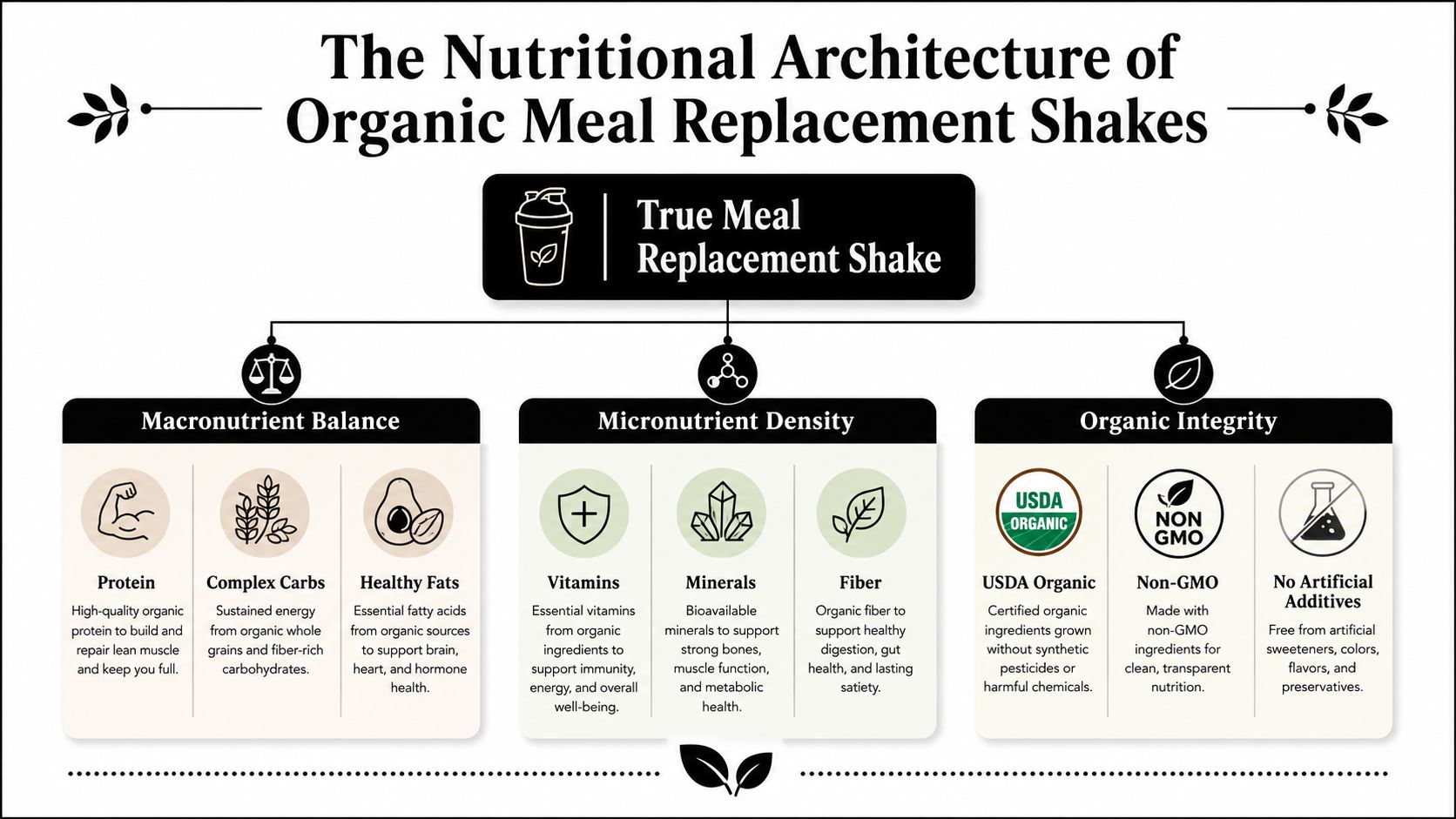
A shake only works as a meal when it behaves like one nutritionally. Consumer guidance commonly points to targets such as at least 15 g protein, at least 3 g fiber, less than 10 g sugar, and at least 33% of the Daily Value for vitamins and minerals per serving Healthline. If a product falls short of those marks, it may still function as a smoothie base, but it is not doing the work of a replacement meal.
What the base formula is trying to do
Organic meal replacement shakes usually begin with plant proteins, often from pea, rice, quinoa, or hemp, then add fats, fiber, and fortification. That structure is meant to slow digestion, improve fullness, and keep energy release steadier than a simple protein drink. For sensitive guts, the question is not whether the formula sounds healthy. The question is whether it fills you up without creating pressure, gas, or a heavy post-shake slump.
The fiber system carries a lot of weight here. Some products use organic inulin, guar gum, acacia gum, tapioca fiber, chia, or flax-derived fiber to create a thicker texture and a slower release pattern. A 2023 in vitro digestion study of commercial meal replacement shakes found products ranging up to 23.2 wt% dietary fiber, 42.8 wt% carbohydrate, and 20.5 wt% protein, showing how widely these formulas can differ in structure and delivery NCBI. Those differences matter because a shake with that much fiber can feel completely different from one that is mostly sweetened liquid. For practical formulation ideas, see how to build a smoothie base with organic powders.
Why the organic version isn't automatically easier
Organic shakes often follow the same formulation logic as conventional ones, just with different ingredient sourcing. The key issue is whether the product builds satiety with ingredients your gut can tolerate. A shake can be organically sourced and still be too dense, too fibrous, or too fermentable for someone who is prone to bloating.
Packaging language can blur that distinction. “Plant-based,” “clean label,” and “organic” all sound reassuring, but none of them tell you whether the formula provides the right macronutrient mix for a real meal or whether it will leave you uncomfortable an hour later. A more useful check is straightforward. Ask whether the shake gives enough protein, enough fiber to keep you full, and enough micronutrients to function as a meal, without overloading digestion.
A lot of the better organic options work because they are built like food, not like flavored powder. A lot of the weaker ones fail because they treat “healthy” ingredients as a substitute for actual nutritional engineering.
How to Read Organic Shake Labels for Digestive Red Flags
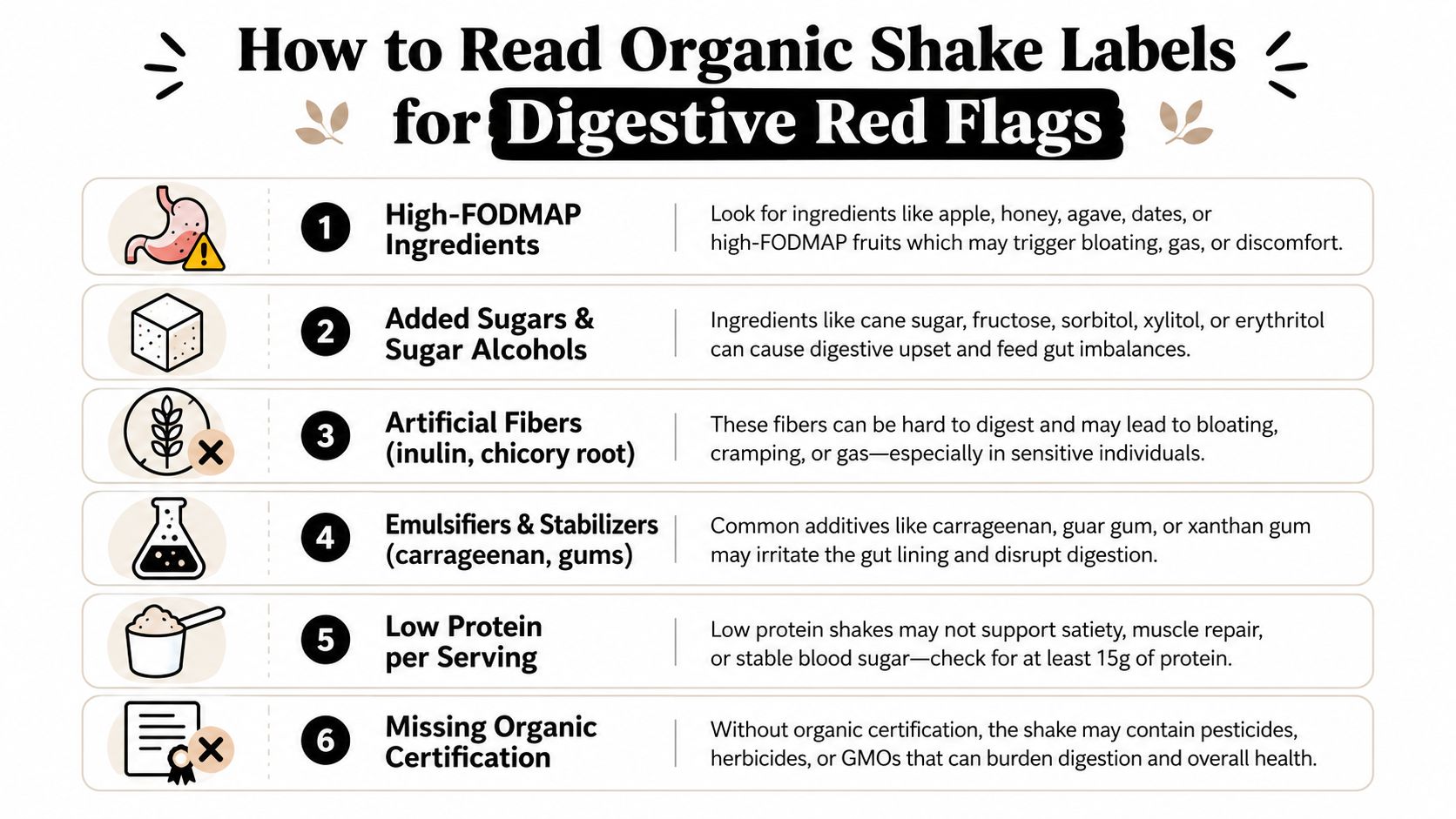
The front of the package is marketing. The ingredient panel is where your gut gets the answer. If a meal replacement shake organic product is meant for sensitive digestion, I want to see a short, readable ingredient list and a formula that doesn't rely on gut-irritating shortcuts.
Red flags that deserve a slower look
Start with the fibers. Inulin and chicory root fiber are common in organic shakes, but they can be rough for people who bloat easily because they're highly fermentable. That doesn't make them bad ingredients. It just means they're not universally gentle.
Then check the sweeteners. Sugar alcohols can be a big issue for people who already deal with gas or loose stools, especially when they're paired with a high-fiber formula. If you've had trouble with “healthy” bars or low-sugar snacks before, the same pattern can show up in shakes.
Practical rule: A clean-looking label isn't the same as a low-irritation label. The shorter the ingredient list, the easier it is to spot what's likely to bother you.
Protein source matters too. Some plant blends are more digestible when they're sprouted or fermented, and that's one reason some shoppers do better with formulas that include digestive support. In the marketplace, examples include blends paired with protease, amylase, cellulase, lactase, lipase, and Bacillus coagulans, often alongside MCT oil, inulin, and gum stabilizers to improve texture and mixability. Those additions can help, but they can also complicate tolerance if the overall formula gets too busy.
What a good label usually tells you
A solid label should make it easy to answer three questions fast.
-
Is the protein high enough to count as a meal?
The product should move beyond snack territory. Labeled organic shakes in the category commonly supply around 20 to 23 g protein per serving, which is a more realistic meal-replacement range than basic protein drink territory. -
Does the fiber help or hurt?
Look for the type, not just the total. Some fibers support fullness and stool quality, while others create gas in sensitive people. -
Is there any digestive support built in?
If you know you struggle with dairy, fat digestion, or plant-protein heaviness, enzyme support can matter more than another gram of protein.
That's why a shake that looks “pure” can still be a poor match for a sensitive gut. What you want is not just organic sourcing. You want a formula that's organized around digestibility.
Organic Shakes and Digestive Conditions Like IBS and Bloating
People with IBS often do worse with formulas that are marketed as extra wholesome. That's not because they're fragile. It's because several “healthy” organic ingredients are the same ingredients that ferment, swell, or slow emptying in ways that make symptoms more obvious.
Meal replacement products are often framed as suitable for busy people, weight management, or recovery, but the more relevant question for many readers is whether the shake will trigger bloating, urgency, or a heavy post-meal feeling. That's where symptom-specific formulation matters more than generic macro targets.
What usually helps and what usually backfires
If someone bloats easily, I look first at fiber load, then at protein source, then at sweetener choice. A shake with a lot of chicory-derived fiber, gums, or sugar alcohols can feel very different from a simpler formula with a more modest fiber profile. The problem isn't that these ingredients are always wrong, it's that they're often stacked together in the same product.
Plant proteins can be another issue. They're fine for many people, but they can feel heavy if the formula is dense, underprocessed, or paired with enough fiber to slow gastric emptying too much. That's why some users tolerate smaller servings, slower sipping, or diluted shakes better than drinking the full portion quickly.
The symptom fit is the real decision point
The question isn't whether an organic shake is healthy in the abstract. The question is whether it matches the digestive pattern in front of you.
- For IBS with bloating, simpler formulas and lower-fermentation profiles usually make more sense.
- For people who feel too full too fast, a thinner shake with less fiber may be easier to finish.
- For people who need meal replacement but react to dairy, plant-based or low-lactose options matter more than broad “clean label” claims.
Recent consumer guidance still tends to focus on protein, fiber, and sugar instead of symptom-specific fit Fit and Well. That's useful, but it's incomplete. A formula can meet the macro checklist and still be wrong for someone with bloating, diarrhea, or inconsistent stool patterns.
If you already know your gut is reactive, treat organic shakes like a tolerance experiment, not a moral choice. Start with the ingredient types most likely to behave well, then add complexity only if your digestion proves it can handle more.
Choosing the Right Organic Shake for Your Digestive Needs
The best shake for a sensitive gut is the one that fits your actual symptom pattern. A person trying to manage bloating needs a different formula than someone using a shake for general convenience or weight management. That's why a comparison framework is more useful than a generic “best organic shakes” list.
| Decision Factor | For Sensitive Guts and IBS | For General Digestive Health | For Weight Management |
|---|---|---|---|
| Protein source | Easier-to-digest plant blends, shorter ingredient list, less protein crowding | Plant or dairy-based, depending on tolerance | Higher protein if satiety is a priority |
| Fiber type | Lower-fermentation fibers, avoid heavy inulin loads if they bother you | Moderate fiber that supports fullness | Enough fiber to blunt hunger between meals |
| Digestive enzymes | Helpful when plant proteins, dairy, or fat digestion are issues | Optional, but useful if meals feel heavy | Useful if larger servings cause discomfort |
| Probiotic strain specificity | More relevant when the formula is built for gut support, not just marketing | Can be a plus if the product is designed well | Secondary to calories and satiety |
| Sugar and sugar alcohols | Keep them as low as your tolerance allows | Moderate if you know you handle them well | Lower is still preferable, but goal matters |
| Third-party testing | Important if you want purity and label trust | Helpful for confidence and quality | Useful if you use shakes frequently |
How I'd rank the buying questions
First, decide whether the product needs to be gentle. If your gut is easily irritated, gentleness wins over maximal protein density every time. If you're just trying to skip a meal during a busy day, a more feature-rich shake may be fine.
Second, decide whether the shake is meant to be a true meal or a partial bridge. A lot of people buy a formula that's too light, then get hungry and add snacks within an hour. That defeats the purpose and can create more digestive noise because you're stacking intake too quickly.
Third, ask whether you need a formula that's complete enough on its own. If the shake is low in protein, fiber, or micronutrients, it may work better as a base than as a replacement. That distinction matters more than the word organic printed on the front.
Short answer: For sensitive guts, the right shake is usually simpler, not more fashionable.
If you're deciding between two organic products, choose the one with fewer fermentable extras, a protein level that counts as meal support, and a label you can understand without decoding half the aisle.
Meal Replacement Plans and Digestive Supplement Pairing
The cleanest way to use an organic shake is to match it with the body's digestion, not to force it into a rigid routine. Timing matters. So does what else you take around it. A shake that goes down well alone can still feel heavy if you pair it with other dense foods or take it too quickly.
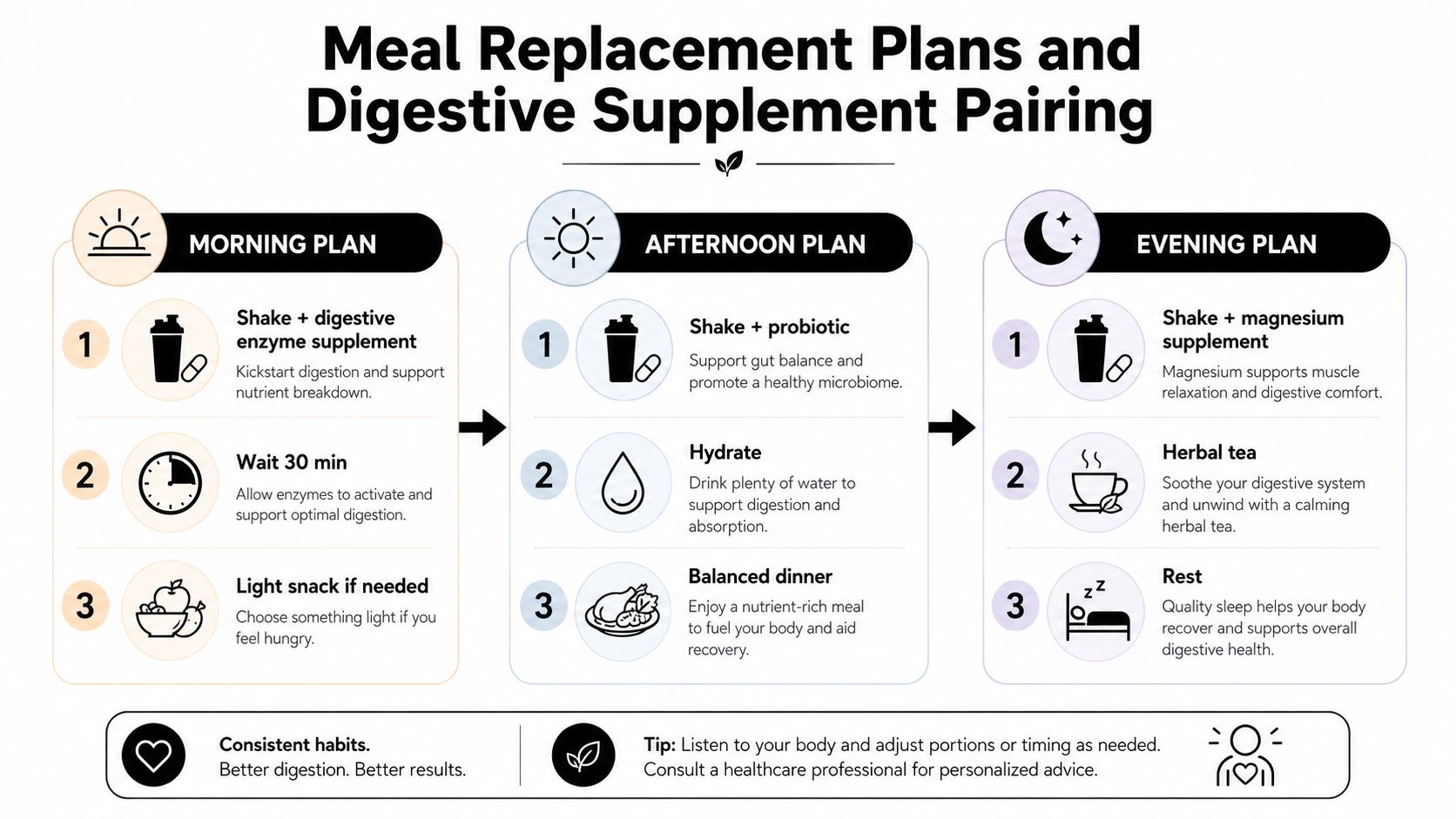
Morning, afternoon, and evening usage
A morning shake works best when you want a fast, controlled start and know breakfast is a problem meal. If the formula is heavier than expected, taking it slowly can reduce the sense of pressure afterward. I often find that people tolerate shakes better when they don't treat them like something to chug on the way out the door.
Afternoon use is often the easiest for busy adults. Hunger is real, but the digestive system is already awake, and the shake can function as a bridge without replacing the rest of the day's food. If someone is using a shake as a meal stopgap, that's the moment to keep the rest of the meal pattern simple, not stacked with more fermentable snacks.
Where supplements fit
Digestive supplements should solve a problem, not decorate the label. If a shake leaves you with bloating after protein, fat, or dairy-heavy ingredients, then enzyme support can be useful. If your symptoms are more about irregularity or microbiome resilience, a targeted probiotic may make more sense than more fiber.
A practical pairing approach is straightforward.
- For heavy or protein-dense shakes: take digestive enzymes with the shake when the label includes ingredients you know are hard on you.
- For gut balance goals: use a probiotic separately from the shake if you're already prone to fullness.
- For recovery days: keep the meal structure simple and avoid mixing too many new products at once.
The article on digestive enzymes for bloating is the right reference point if your main issue is discomfort after meals rather than simple hunger. That's the distinction that gets missed most often. Shakes and enzymes are not interchangeable. They do different jobs.
If you've already identified a shake that sits well, keep the routine boring and repeatable. If you're still trialing options, change one variable at a time so you can tell whether the issue is the formula, the serving size, or the timing.
Real-World Use Cases for Organic Meal Replacement Shakes
A busy professional with IBS usually doesn't need a more complicated product. They need a breakfast that won't backfire. A simple organic shake with a modest fiber load, tolerable sweetener profile, and enough protein to replace the meal often beats a more elaborate formula that promises superfoods but leaves the person distracted by bloating before noon.
A woman dealing with bloating and irregularity often needs a different strategy. She may do better with a shake that's easy on the stomach in the morning, then a separate gut-support routine later in the day. That keeps the shake focused on meal replacement while the other support addresses the broader digestive pattern.
A person recovering from digestive upset needs the gentlest entry point of all. In those cases, I'd rather see a simpler shake used consistently for a few days than a maximal formula with every possible add-in. Smaller portions, slower sipping, and careful attention to tolerance usually work better than trying to get everything right on day one.
The article on how probiotic supplements support digestion and reduce bloating fits well for readers whose main problem is digestive balance rather than just meal convenience. That's the key distinction in practice. Some people need a shake. Some people need support around the shake. Some people need both, but not at the same moment.
The common mistakes are predictable. People replace too many meals too quickly. They ignore early bloating signals. They assume the most expensive organic option will behave best. None of those choices are necessary.
What works is slower and less glamorous. Pick one formula, use it consistently, and pay attention to whether your gut feels calm, not just whether the nutrition panel looks impressive.
If you want a more practical way to choose digestive support alongside an organic shake, GutRx focuses on lab-grade synbiotics and enzymes built for bloating, regularity, and meal-related discomfort. Visit GutRx to compare options and choose a routine that fits how your gut responds, not just how the label reads.


