

Most advice on probiotic vs postbiotic gets the first step wrong. It treats this like a winner-take-all supplement matchup, when decision is simpler and more useful: which one fits your symptom pattern, your tolerance, and the way you'll use it.
That matters if you're shopping for a daily probiotic, a shelf-stable gut formula, a probiotic for bloating, or a prebiotic probiotic postbiotic supplement and trying to sort signal from marketing. Some people need a live microbe with strain-specific evidence. Others may do better with an inactivated preparation that's easier to store, easier to standardize, and less dependent on survival through the stomach.
Table of Contents
- Why the Probiotic vs Postbiotic Question Is the Wrong Starting Point
- How Probiotics and Postbiotics Actually Work in the Gut
- Comparing the Evidence, Stability, and Safety Profiles
- Best Use Cases for Each Category in Real Symptoms
- Dosing, Quality, and Formulation Factors That Change the Outcome
- How to Choose Between Probiotic, Postbiotic, or Both
- Practical Buying Guidance and Common Questions
Why the Probiotic vs Postbiotic Question Is the Wrong Starting Point
The cleanest way to frame this starts with definitions, not hype.
A probiotic is the older category: live microorganisms that, when administered in adequate amounts, confer a health benefit on the host. A postbiotic was formally defined in 2021 by the International Scientific Association for Probiotics and Prebiotics as “a preparation of inanimate microorganisms and/or their components that confers a health benefit on the host”, which clarified that postbiotics are not live organisms and that the preparation must retain microbial cells or cellular structures rather than being only isolated metabolites, as described in the ISAPP consensus published in Nature Reviews Gastroenterology & Hepatology on May 4, 2021.
That definition did two important things. It separated live-microbe products from inactivated microbial preparations, and it gave clinicians and formulators a shared language for comparing them. It also stopped a common labeling mistake. A purified metabolite by itself isn't automatically a postbiotic.
The better question to ask
Most buyers ask, “Which is better?” That's usually the wrong question.
A more useful set of questions looks like this:
- What outcome are you targeting? Bloating after meals, irregularity, diarrhea support, microbiome balance, or a broader daily gut support goal all point to different product types.
- Do you need live activity? Some use cases lean toward strains that need to arrive alive and in adequate amounts.
- Do you need convenience and stability? Travel, warm-climate shipping, and long shelf life can shift the balance toward postbiotic formats.
- Are there reasons to be cautious with live organisms? In some higher-risk situations, the fact that postbiotics are inanimate changes the safety conversation.
Practical rule: Don't buy by category alone. Buy by intended outcome, tolerance, and whether the product's format matches real life.
Recent review literature makes this nuance explicit. Probiotics and postbiotics shouldn't be treated as simple substitutes in every case. Selection depends on the target population, the microorganism, and the use case, as discussed in this recent PubMed-indexed review.
How Probiotics and Postbiotics Actually Work in the Gut
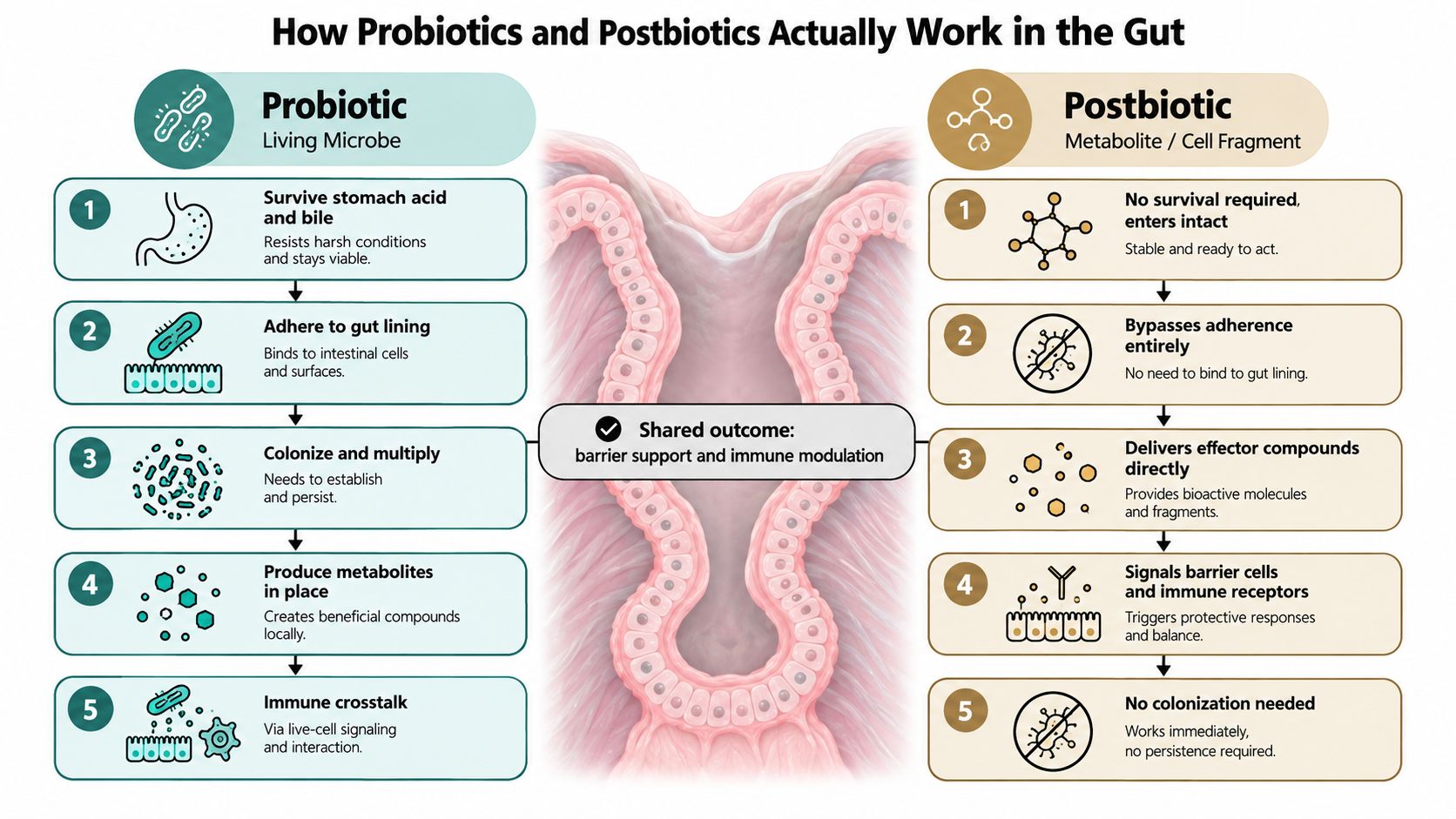
A live probiotic and a postbiotic can lead to some of the same downstream effects, but they get there in different ways.
| Feature | Probiotic | Postbiotic |
|---|---|---|
| What it is | Live microorganism | Inanimate microbial preparation with components that retain health activity |
| Main requirement | Must survive handling and reach the gut alive in adequate amounts | Doesn't need to survive as a live organism |
| Typical strength | Direct live microbe interaction with the gut ecosystem | Stability, standardization, and process tolerance |
| Common buying fit | Daily probiotic, targeted strain support, enteric-coated probiotic | Shelf-stable probiotic alternative, postbiotic support, warm-climate practicality |
| Best framing | Match strain to symptom | Match preparation to use case |
What probiotics do while alive
Probiotics work through more than one pathway. Some effects depend on the organism arriving alive and interacting with the gut environment. Others depend on compounds it produces or immune signaling it triggers during transit.
A live strain may help by:
- Competing in the gut environment: It can occupy space, interact with resident microbes, and help limit less desirable organisms.
- Producing useful compounds locally: These can include short-chain fatty acids and antimicrobial peptides.
- Modulating immune activity: Gut immune cells respond to microbial signals, which can influence barrier function and mucosal defense.
- Affecting digestion-related chemistry: Some strains interact with bile-rich conditions and may influence metabolism in the small intestine.
For a probiotic product, survival isn't a detail. It's the job. Scientific literature treats acid resistance and bile salt tolerance as fundamental properties because a microorganism has to survive the acidic stomach and bile-rich small intestine before it can exert probiotic effects, as outlined in this review on probiotic properties.
What postbiotics do without being alive
Postbiotics skip the viability problem. They don't need to colonize, multiply, or remain alive during storage to have biological activity.
That's because the active material can include microbial cell fragments, cell-wall structures, peptides, vitamins, bacteriocins, short-chain fatty acids, and other bioactive compounds within an inanimate preparation. Reviews and consensus documents also note that heat-killed or otherwise inactivated organisms can still present microbial patterns that interact with the gut lining and immune system. If you want a plain-language overview of that concept, GutRx has a short explainer on postbiotic benefits.
Some of the overlap is why people get confused. Both categories may support barrier function and immune signaling. The difference is whether those effects depend on a live organism getting there intact.
Where this matters in real products
Formulation starts to matter more than label trends. A probiotic aimed at small intestinal support, for example, lives or dies on whether the organisms stay viable long enough to do their work. GutRx OVERGROWTH is a probiotic formula that includes Saccharomyces boulardii, Bifidobacteria, and Lactobacillus for SIBO, candida, bloating, and leaky gut support, which makes it the kind of product where live-organism delivery is central to the intended use.
Comparing the Evidence, Stability, and Safety Profiles
If you're choosing between categories, the evidence question and the product-quality question need to be separated. A category can be biologically plausible but still uneven in human data. Another can have stronger historical data but be harder to formulate well.
Probiotic vs Postbiotic Evidence, Stability, and Safety
| Dimension | Probiotic | Postbiotic |
|---|---|---|
| Evidence base | Broader historical human literature, but still strain-specific and outcome-specific | Newer and growing, with promising mechanistic and applied literature, but less standardized |
| What the evidence usually asks | Whether a defined live strain helps a defined symptom or use case | Whether an inactivated preparation with retained structure and bioactivity confers a benefit |
| Storage burden | Often more sensitive to heat, moisture, and transit conditions | Generally easier to stabilize because viability isn't required |
| Processing tolerance | Can be vulnerable to harsh manufacturing conditions | Better suited to harsh processing and long shelf-life use cases |
| Higher-risk populations | Requires more caution where live organisms may be less desirable | Often discussed as advantageous when live microbes raise practical or safety concerns |
| Real-world formulation challenge | Keeping the right strains alive through shelf life and digestion | Standardizing the active preparation and linking it to meaningful human outcomes |
Where postbiotics currently stand out
Postbiotics have a practical advantage that isn't theoretical. They are often easier to formulate for heat resistance, storage, and shipping. Comparative experimental work reviewed in npj Biofilms and Microbiomes reported stronger microbiome-modulatory performance for postbiotics than probiotics in a mouse colitis model, and the same review summarized stability findings where antibacterial activity remained stable after 121°C for 30 minutes, while another report found more than 95% antimicrobial activity after 40 to 100°C for 30 minutes, with activity still persisting after 121°C for 15 minutes, according to this postbiotics review.
That doesn't mean postbiotics are automatically the better clinical choice. It means they can be a better delivery format when heat resistance, long shelf life, or reduced cold-chain dependence matters.
Where probiotics still hold an advantage
Probiotics still have the deeper clinical tradition. That doesn't make every probiotic product strong, but it does mean there's a larger body of condition-specific work to guide strain selection than there is for most postbiotic products.
A good probiotic also has ways to compensate for the survival problem. Enteric coating is one example. The coating is designed to protect organisms from stomach acid and release them later in the gut. One comparative study reported that enteric-coated capsules left 97.0% of the initial probiotic load viable after 60 minutes in simulated gastric fluid, and another found coated spheres completely protected L. casei from acid over 2 hours with no detectable loss of viability, as summarized in this viability review PDF.
Safety is practical, not abstract
For many healthy adults, either category may be reasonable depending on the target. The gap shows up more clearly when the person, not the ingredient, becomes the priority.
Recent reviews note that postbiotics can offer safety and stability advantages because they don't require live cells and avoid concerns around colonization variability and some food-safety issues tied to live microbes. At the same time, the clinical literature remains heterogeneous, with differences in strains, inactivation methods, doses, and intervention length limiting direct comparisons, as discussed in this open-access review on postbiotic safety and context.
If someone needs convenience, warm-weather storage, or a lower-viability-risk format, postbiotics deserve a serious look. If someone needs a strain with a long history of live-organism use, probiotics still make sense.
Best Use Cases for Each Category in Real Symptoms
The probiotic vs postbiotic debate becomes useful. Not every buyer is asking the same question. Someone looking for a probiotic for diarrhea support is in a different decision lane than someone looking for a shelf-stable daily gut formula or all-in-one microbiome support.
Use Case to Category Fit
| Use Case | Better-Supported Option | Evidence Level | Typical Active |
|---|---|---|---|
| Daily digestive balance | Probiotic or both | Broader for probiotics, emerging for combinations | Multi-strain probiotic blend, with or without prebiotic or postbiotic support |
| Functional bloating | Usually probiotic first | Strain-specific and variable | Lactobacillus and Bifidobacterium-focused formulas |
| Irregularity and constipation-leaning symptoms | Usually probiotic first | Category support is stronger than postbiotics alone | Daily probiotic blends, sometimes with prebiotic support |
| Diarrhea-prone patterns or post-antibiotic support | Probiotic first in many buying situations | More established historical use | Targeted live strains such as yeast-based or bacterial blends |
| Travel, warm-climate storage, or simplified shelf stability | Postbiotic often fits better | Strong practical rationale | Inactivated microbial preparation |
| Sensitive users who don't want a live-organism format | Postbiotic often fits better | Context-dependent | Heat-treated or otherwise inactivated microbial preparation |
| Layered goals such as digestive support plus broader microbiome support | Both can make sense | Depends on formula quality and intended use | Synbiotic or mixed-category approach |
Symptom-by-symptom guidance
For bloating, I usually treat the product category as secondary to the pattern. Meal-related bloating can point away from a microbiome-first supplement and toward digestive enzymes. The evidence-based part is specific: lactase is used to help digest lactose in dairy, and enzyme products for FODMAP foods need to match the offending carbohydrate rather than act as a general gut remedy, as explained in this digestive enzyme review.
For daily gut support, a probiotic often makes more sense when the goal is regular use for digestive balance and the person wants a familiar, live-strain format. GutRx BALANCE offers 30 billion CFUs per capsule with next-generation probiotics for gut health, digestive balance, and immune support, which places it in the daily-support side of the category rather than the postbiotic side.
What tends to fit best
- IBS-like symptom patterns: Usually start with a targeted probiotic approach if the formula is strain-specific and the symptom profile is clear.
- Shelf-stable convenience: Postbiotics often fit better if storage conditions are unpredictable.
- Recovery after gut disruption: A probiotic or synbiotic approach often has the more familiar buying logic.
- Metabolic or broader barrier-support interest: Postbiotics are increasingly relevant here, but the evidence still needs product-by-product reading.
- People who react poorly to many supplements: Postbiotics may be worth considering because they remove the live-colonization variable.
Buy for the symptom pattern first. Buy for the ingredient category second.
Dosing, Quality, and Formulation Factors That Change the Outcome
A good formula can still underperform if the dose is vague, the delivery system is weak, or the label hides what's inside. That's true for both probiotics and postbiotics, but the weak spots differ.
What to check on a probiotic label
Probiotics are usually dosed in CFUs, and postbiotics are commonly framed by the amount of a defined preparation or active fraction. The exact right dose is product-specific, so a larger number isn't automatically better. What matters more is whether the product names the organisms clearly and is built to get them where they need to go.
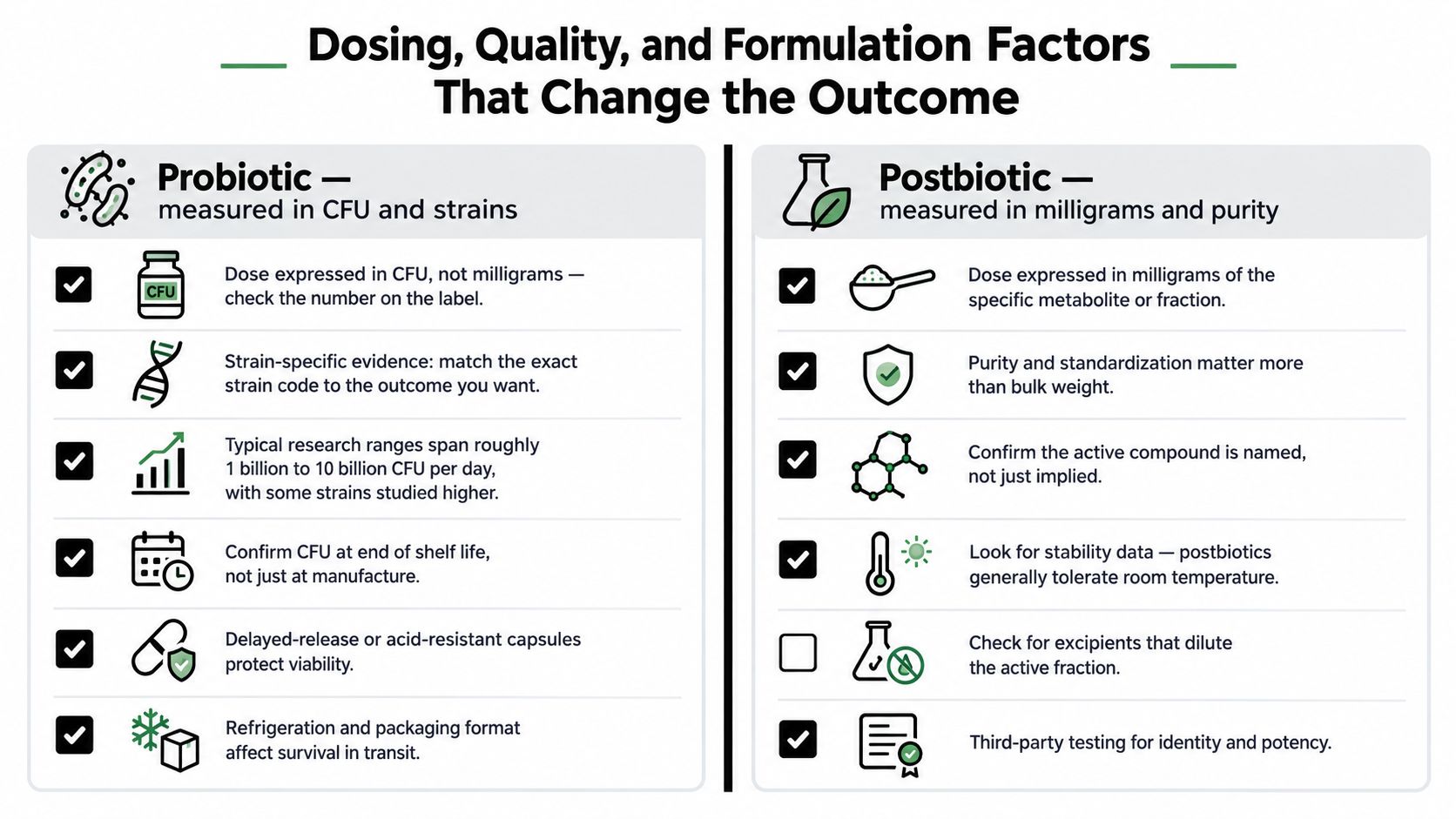
For probiotics, I'd prioritize:
- Full strain naming: Genus and species alone aren't enough if the evidence is strain-specific.
- Survival support: Delayed-release or acid-resistant delivery matters when viability matters.
- Shelf-life honesty: Labels should make it clear whether potency is intended through expiration.
- Moisture and heat protection: Packaging quality affects whether the live count means anything by the time you take it.
Why delivery format changes the result
A common mistake is comparing two products only by category and count. That misses the issue. If a probiotic doesn't survive the stomach and small intestine, the formula can look good on paper and disappoint in use.
Enteric-coated delivery is one of the better practical signals when you're shopping for a live-organism formula. If you want a buyer-oriented overview of what independent verification adds on top of label claims, this GutRx guide on third-party tested probiotics is worth reading.
Label shortcut: For probiotics, ask “Will it survive?” For postbiotics, ask “What exactly is standardized?”
A simple equal-price checklist
If two options cost about the same, use this order of importance:
- Match to goal first. Daily probiotic, women's probiotic, digestive enzymes for bloating after eating, and postbiotic support are not interchangeable.
- Check format second. Delayed-release for live strains. Clear preparation naming for postbiotics.
- Look for testing proof. Third-party testing and accessible quality documentation reduce guesswork.
- Then compare extras. Prebiotics, digestive enzymes, or added support ingredients only matter after the core fit is solid.
How to Choose Between Probiotic, Postbiotic, or Both
The fastest way to make this decision is to sort yourself into the right profile.
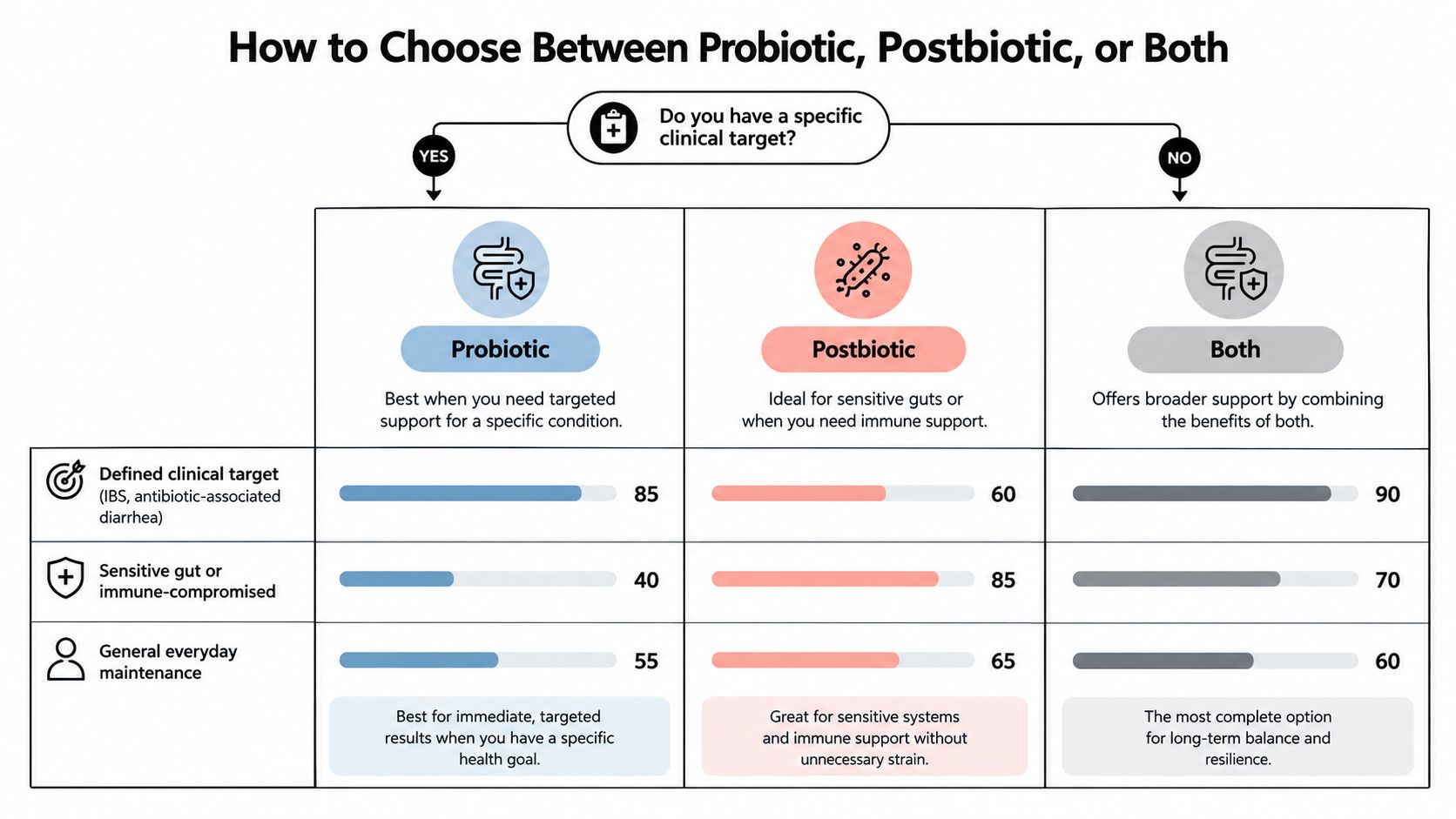
If you have a defined target
If your goal is specific, such as a post-antibiotic routine, diarrhea-prone travel, or a daily probiotic for irregularity, a probiotic usually makes the most sense when you can identify a formula built around live delivery and clear strain labeling. This is also where a combined approach can be reasonable if the product is intentionally designed that way rather than stuffed with buzzwords.
For readers comparing category stacks, this explainer on prebiotic probiotic capsules helps clarify how combination products are meant to work.
If tolerance and practicality lead the decision
If you're more concerned about storage, travel, long shelf life, or you're in a situation where live organisms deserve extra caution, postbiotics can move to the front of the line. They remove the viability problem and may be easier to use consistently.
That doesn't mean they're automatically more effective for every symptom. It means the format may fit your constraints better.
A quick visual summary can help here:
If your goals are layered
Some people aren't choosing for one symptom. They want broad digestive support, steadier tolerance, and a product they can keep using without storage headaches. That's where “both” can make sense, especially in synbiotic-style formulations or a stepwise plan where one format is used first and another later.
Match the category to the symptom, the strain or preparation to the evidence, and the format to your stomach and routine.
If you're severely immunocompromised, recently had major surgery, or have a more complex medical picture, live-microbe products deserve extra caution and clinician input.
Practical Buying Guidance and Common Questions
When you're comparing products on Amazon or a brand site, start with the label, not the headline claim.
What to check before you buy
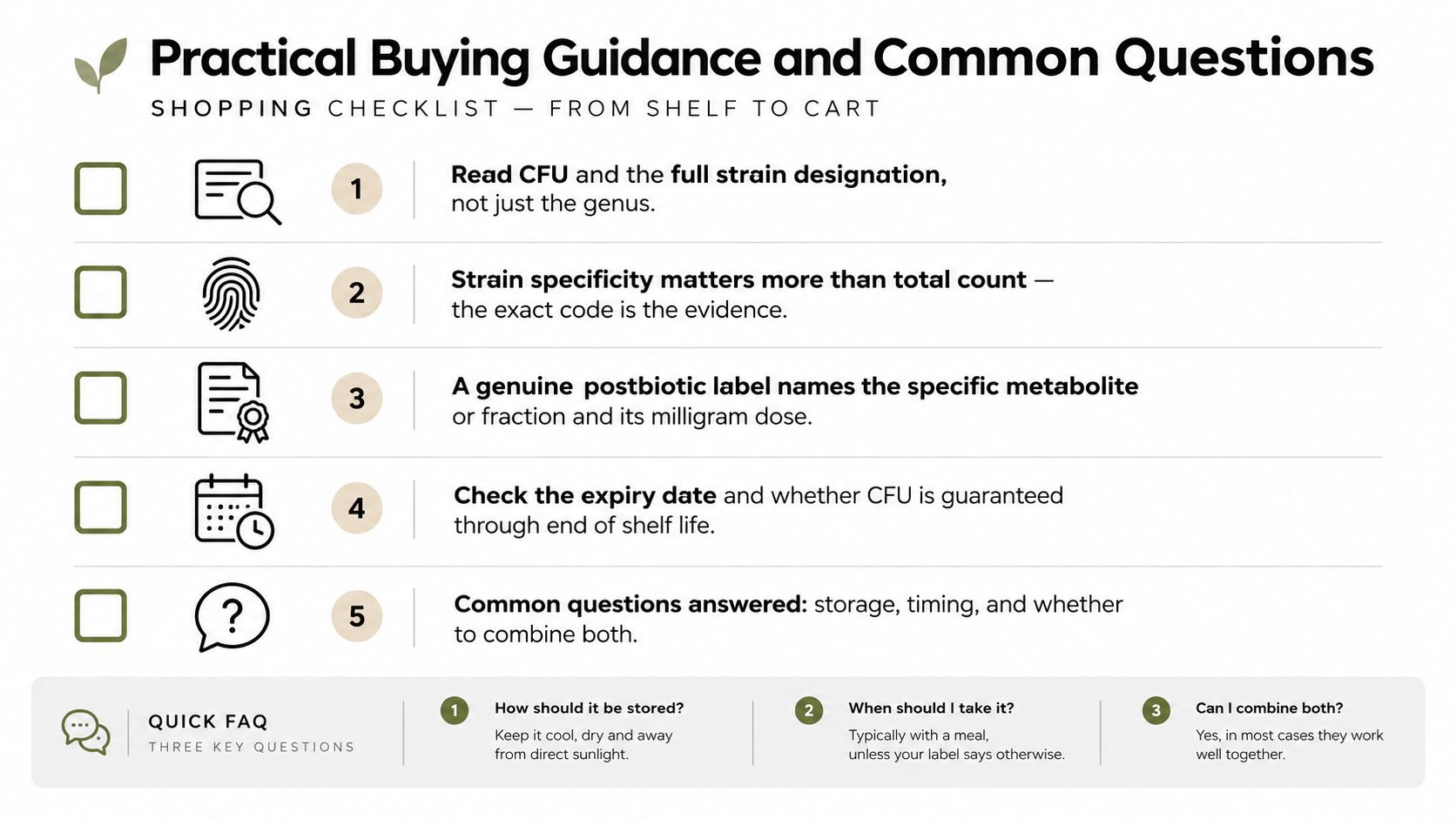
- Read the organism name fully: A useful probiotic label should go beyond “Lactobacillus blend” or “Bifido complex.”
- Don't chase count alone: A higher total CFU doesn't beat a better-matched strain.
- Look for real postbiotic language: The label should identify the inactivated preparation, not just imply “fermented support.”
- Check expiration logic: For probiotics, viability at the time you take it matters more than a big number at manufacture.
- Use the product category accurately: Digestive enzymes for dairy and FODMAP foods solve a different problem than a daily probiotic.
Common buyer questions
Do postbiotics work for SIBO?
They may fit some people better from a tolerance or stability angle, but that doesn't make them a universal first choice for every overgrowth-style complaint.
Can you take probiotics during antibiotics?
Some people do, but the right approach depends on timing, the formula, and why you're using it.
How long does either one take to show results?
That varies by symptom, product design, and baseline gut status. Fast claims are usually a red flag.
Are kids or immunocompromised users different?
Yes. The live-versus-inanimate distinction matters more in higher-risk groups, and product selection should be more conservative.
What if bloating mostly happens after meals?
Check whether the issue looks more like food digestion than microbiome imbalance. In that case, digestive enzymes may be the more direct tool.
GutRx offers targeted digestive support across probiotics, synbiotics, postbiotic-inclusive formulas, and digestive enzymes, with third-party testing and downloadable COAs that make label comparison easier. If you're deciding between a daily probiotic, a broader microbiome formula, or a mealtime digestive support option, visit GutRx and compare the format to the symptom you're trying to solve.


