

You wake up after a restless night, feel bloated before breakfast, and spend the morning moving through tasks without much energy. By afternoon, your mood is flat, your concentration is unreliable, and another coffee seems easier than asking why you feel this way. That pattern is common, but it doesn't mean you lack discipline or need a stronger stimulant.
A practical way to improve mood and energy is to look upstream. Sleep, movement, digestive comfort, stress regulation, nutrition, and gut-brain-immune signaling can reinforce one another. The plan below combines those areas into a 4 to 8 week reset, with realistic tracking and a cause-matched approach to probiotic or synbiotic support.
Table of Contents
- Why Low Mood and Low Energy Often Travel Together
- How the Gut Brain and Immune System Influence Mood and Energy
- Common Contributors That Drain Mood and Energy
- Your 4 to 8 Week Plan to Improve Mood and Energy
- Choosing Synbiotic and Probiotic Support Wisely
- Tracking Progress and Knowing When to Seek Help
Why Low Mood and Low Energy Often Travel Together
Low mood and low energy frequently appear on the same days because they share several inputs. Poor sleep can leave you physically depleted and less emotionally steady. Gut discomfort can make meals stressful, disrupt routines, and keep your attention focused on bloating, urgency, constipation, or abdominal pain. Stress can then affect both digestion and sleep, creating a loop that feels personal even when the drivers are physiological and modifiable.
Sleep and daily activity are strongly linked to perceived energy. In a smartphone-based cohort study of adults, daily physical activity was positively correlated with mood (P=.004) and perceived energy (P<.001), while sleep duration was positively correlated with mood (P=.02), as reported in the Journal of Medical Internet Research study on sleep, activity, mood, and energy. That doesn't prove one simple cause for every person, but it supports a useful starting point: your daily routine can influence how emotionally and physically capable you feel.

A realistic reset is not a promise of instant relief
This approach isn't designed to promise that a probiotic, walk, or earlier bedtime will eliminate depression, fatigue, or digestive symptoms. It also isn't a replacement for medical assessment when fatigue is persistent, severe, or accompanied by warning signs. The purpose is narrower and more useful: identify likely contributors, apply a structured routine, and observe whether mood, energy, sleep, and digestion move in a better direction together.
Use the first two weeks to establish a baseline and remove obvious friction. The middle weeks add more deliberate movement and gut-supportive choices. The final phase focuses on deciding which habits are worth keeping and whether a supplement trial is helping a defined symptom pattern.
Practical rule: Track patterns, not perfect days. A difficult morning doesn't invalidate a routine that is becoming more consistent overall.
The most valuable result may not feel dramatic. You might notice less negative mood, fewer interruptions from digestive discomfort, more predictable energy after meals, or a greater willingness to move. Those changes can provide better guidance than chasing a generic “energy boost.”
How the Gut Brain and Immune System Influence Mood and Energy
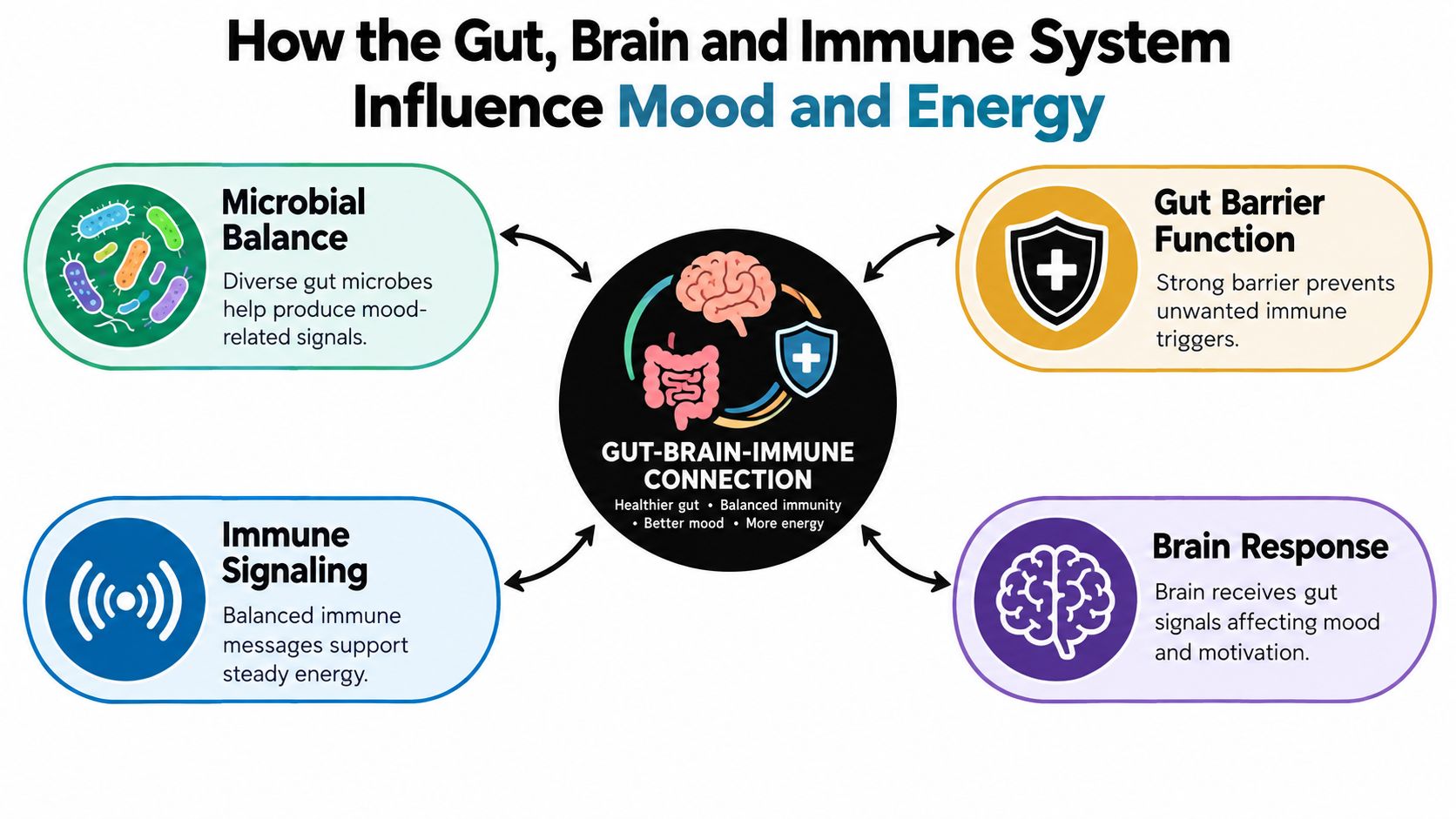
The gut-brain axis is a two-way communication network. The brain affects digestion through stress signals and nervous-system activity, while the gut sends information back through microbial metabolites, immune messengers, hormones, and nerve pathways. The immune system sits between these systems, helping translate changes in the intestinal environment into signals that may influence how rested, motivated, or emotionally steady you feel.
A simple model has four connected parts:
- Microbial balance: Different microorganisms interact with dietary fibers and produce compounds that participate in gut signaling.
- Gut barrier function: The intestinal barrier helps regulate what moves from the digestive tract into surrounding tissues.
- Immune signaling: The immune system responds to the gut environment and communicates with the rest of the body.
- Brain response: The brain interprets these signals alongside sleep, stress, activity, and other inputs.
Why the same supplement can feel different for different people
A probiotic provides live microorganisms. A prebiotic provides a substrate that selected gut microbes can use. A synbiotic combines both approaches, while a postbiotic contains non-living microbial components or metabolites intended to provide a biological effect. These categories describe what a product is designed to deliver, not a guarantee that it will improve mood or energy.
Baseline microbiome composition, diet quality, inflammation, digestive symptoms, and sleep may all affect response. Someone whose main problem is constipation may evaluate a product by stool regularity and abdominal comfort. Someone with stress-related mood dips may notice changes in negative mood or resilience first. A person with meal-related bloating may need to consider digestive enzymes rather than assuming a probiotic is the right tool.
A large review of clinical trials found that probiotics can measurably affect mood-related outcomes, but the strongest signal was reduced negative mood, not a broad improvement in overall well-being. In one daily-monitoring study summarized in the clinical review of gut-brain-axis trials, healthy volunteers showed a clear reduction in negative mood after about two weeks of probiotic use, while standard psychological questionnaires didn't detect the same effect.
That difference matters. A person may feel less irritable or less emotionally weighed down without reporting a sweeping improvement in happiness. It also shows why a short, defined trial with symptom tracking is more informative than relying on a label's general promise.
For a plain-language explanation of how supplements may fit into this pathway, see gut-brain axis supplements. The evidence supports cautious experimentation, not the idea that one formula can correct every cause of low mood and fatigue.
Common Contributors That Drain Mood and Energy
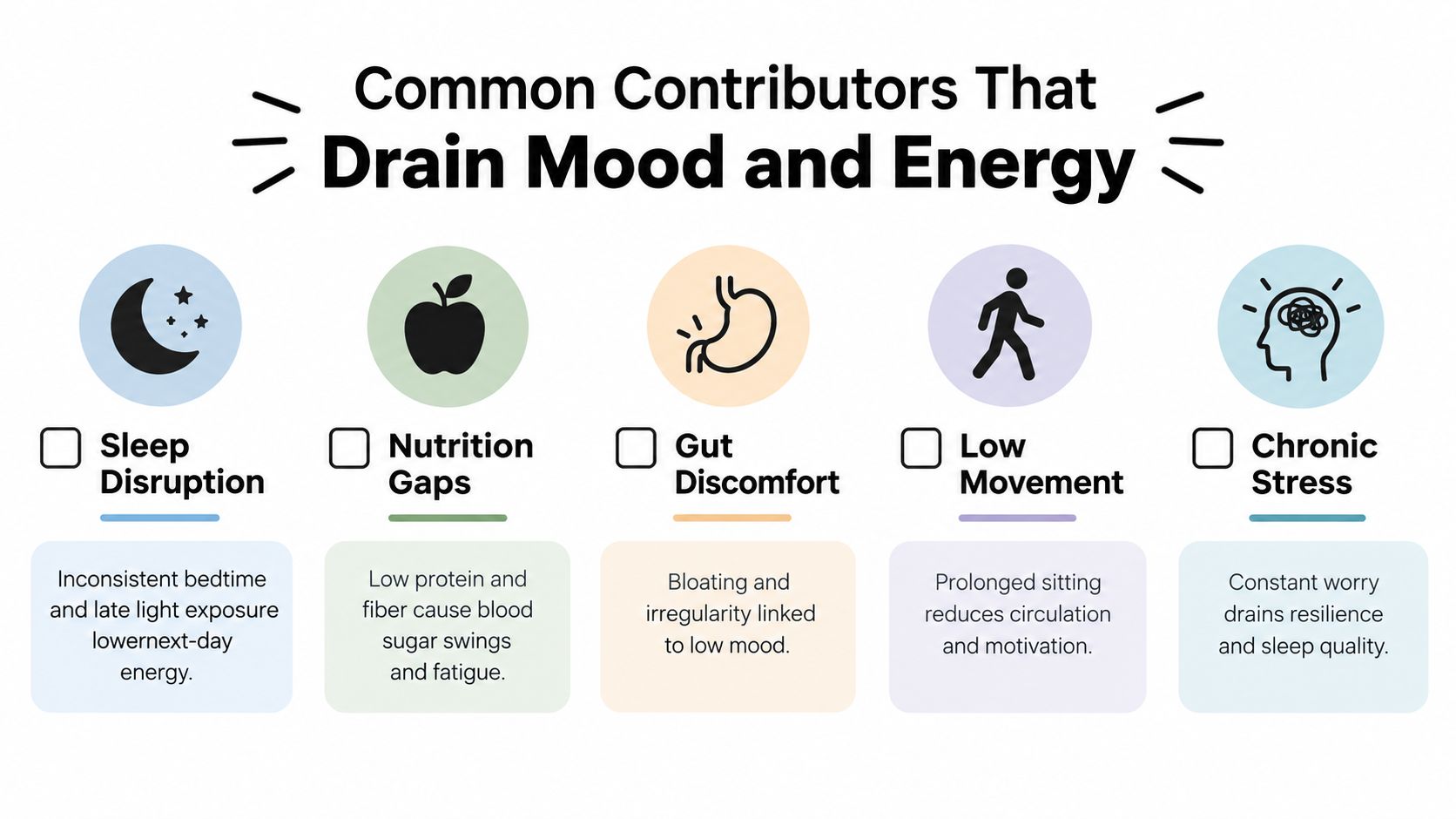
Fatigue is a symptom, not a diagnosis. Before buying a supplement, ask what changed, when the problem began, and whether low energy appears alongside a specific digestive, sleep, emotional, or physical pattern.
Start with the most visible daily drivers
Sleep disruption often shows up as inconsistent wake times, late-night light exposure, frequent awakenings, or enough time in bed without feeling restored. Ask whether your energy is predictably worse after a short or fragmented night. If insomnia persists, loud snoring, breathing interruptions, or severe daytime sleepiness deserve clinical attention rather than more sleep-hygiene tips.
Nutrition gaps and unstable meals can make energy feel unreliable. Look for long stretches without food, meals built mostly around refined carbohydrates, or a pattern of feeling depleted soon after eating. Digestive restrictions can also reduce dietary variety, especially when bloating or diarrhea makes foods feel unsafe.
Gut discomfort becomes a likely contributor when low mood tracks with abdominal pain, visible bloating, irregular bowel movements, or urgent bathroom trips. Keep a short record of meals, symptoms, stool pattern, and energy. That can reveal whether the main opportunity is microbiome support, meal-specific enzyme support, or evaluation for another gastrointestinal problem.
Don't overlook medical and emotional contributors
Low movement can reinforce fatigue. Long periods of sitting may make activity feel harder, which reduces the chance of getting the mood and energy benefits associated with movement. Start by noticing how you feel after ordinary walking, not by judging your fitness.
Chronic stress can keep the body in a state of high alert. Worry may alter appetite, digestion, sleep timing, and muscle tension, while digestive symptoms can create more worry. If your energy drops during stressful periods and improves during calmer periods, stress regulation belongs in the plan rather than being treated as an optional extra.
Independent reviews note that the most reliable energy gains often come from correcting iron or vitamin B12 deficiency, while generic energy blends, megadoses of B vitamins, and many adaptogens have weak or inconsistent evidence in already well-nourished adults, as discussed in this review of supplements for energy. Thyroid problems, medication effects, mood disorders, anemia, sleep disorders, and other medical contributors can also cause fatigue.
Clinical checkpoint: If low energy is persistent or worsening, ask a clinician whether iron status, vitamin B12, thyroid function, medication effects, and other relevant causes should be assessed.
Your 4 to 8 Week Plan to Improve Mood and Energy
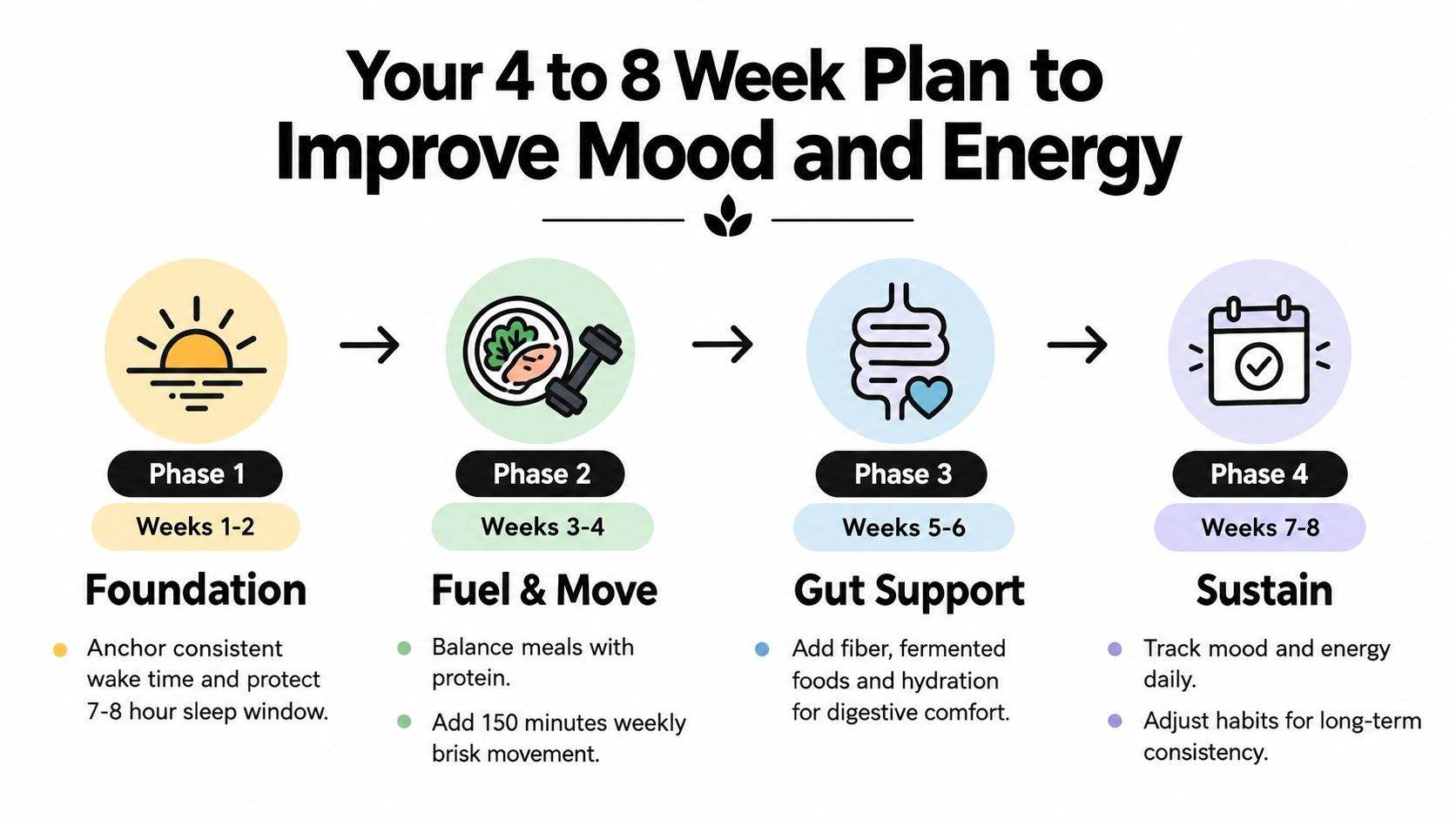
A reset works better when each phase has a small number of actions. Trying to change sleep, diet, exercise, supplements, and stress management at the same time makes it difficult to know what helped and easy to abandon everything after one difficult day.
Weeks 1 and 2 build the foundation
Choose a consistent wake time that fits your obligations. Protect a sufficient sleep opportunity, dim evening light, and review caffeine and alcohol timing if either appears to worsen sleep. The first target isn't a perfect bedtime. It's giving your body a dependable morning anchor and enough protected time for recovery.
Record a simple daily snapshot:
- Mood: Rate it descriptively, such as low, even, or positive.
- Energy: Note morning, afternoon, and evening energy.
- Sleep: Record bedtime, wake time, and whether sleep felt restorative.
- Digestion: Note bloating, abdominal discomfort, stool pattern, or urgency.
- Movement: Write down what activity you completed and how it felt.
Keep meals predictable enough to observe. Include a source of protein and fiber when tolerated, drink fluids regularly, and avoid making several restrictive diet changes at once. If a food repeatedly causes discomfort, record the pattern instead of eliminating broad food groups without guidance.
Weeks 3 and 4 add a measurable movement dose
Use brisk walking as an accessible starting point. A dose-response meta-analysis identified a minimum effective threshold of about 320 MET-min/week and an estimated optimal response around 860 MET-min/week. Aerobic exercise produced one of the strongest symptom reductions, with an SMD of -0.93 and a 95% CI of -1.25 to -0.62, according to the exercise dose-response meta-analysis.
For implementation, begin with approximately 20 to 30 minutes of brisk walking 4 to 5 times weekly if that level is appropriate for you. Progress gradually toward moderate aerobic activity, then add optional resistance or mind-body sessions. The response curve was U-shaped, so more isn't automatically better. Excessive volume, poor recovery, or an ambitious routine that you can't repeat may undermine energy even if movement supports mood.
Weeks 5 through 8 refine gut support
If bloating, irregularity, or diarrhea remains prominent, choose one digestive strategy that matches the symptom pattern. Increase fiber only as tolerated, use food variety gradually, and pay attention to hydration and meal timing. A synbiotic may be reasonable when you want combined probiotic and prebiotic support, but judge it by defined outcomes rather than by broad claims about total wellness.
If progress stalls, change one variable at a time. Review whether movement is being underdosed, whether sleep opportunity is protected, and whether a supplement is causing more bloating. For a practical framework on digestive timelines and expectations, read how long it takes to support gut health.
The embedded video offers another way to reinforce the routine:
Don't use the calendar as a test of willpower. Use it as feedback. A plan that produces modest improvement and remains sustainable is more valuable than a demanding routine that repeatedly leads to exhaustion.
Choosing Synbiotic and Probiotic Support Wisely
The right supplement depends on the problem you're trying to solve. A daily probiotic may suit general digestive maintenance, while a targeted formula may make more sense when bloating, irregularity, or barrier-support goals dominate. A synbiotic adds a prebiotic component, but that can also increase gas for some people if the dose or ingredient doesn't suit their current tolerance.
A 2023 systematic review and meta-analysis found that probiotics improved global IBS symptoms, with an SMD of −0.55 and a 95% CI of −0.76 to −0.34, and abdominal pain, with an SMD of −0.89 and a 95% CI of −1.29 to −0.5. The analysis also found that benefits were strain-dependent rather than universal, as reported in the systematic review of probiotics for IBS.
Compare the label, not just the CFU count
A useful product review asks whether the strains are identified, whether the formula explains its intended use, and whether the delivery system protects the ingredients through storage and digestion. Delayed-release or enteric-coated capsules may be relevant when protection from stomach conditions is part of the product design. Third-party testing and downloadable Certificates of Analysis can help buyers verify purity, potency, and strain identity when those documents are available.
| Feature to Check | What Good Looks Like | When It Matters Most |
|---|---|---|
| Strain specificity | Clearly identified strains with a stated purpose | When symptoms are specific or previous products failed |
| Formula design | Probiotic, prebiotic, postbiotic, or enzyme ingredients matched to the goal | When deciding between daily maintenance and targeted support |
| Delivery system | Storage and release information that explains how the capsule is protected | When shelf stability or delayed release matters |
| Testing | Independent testing with accessible documentation | When product verification is a buying priority |
| Tolerance | A formula and serving approach that doesn't worsen digestive discomfort | When bloating, diarrhea, or sensitivity is already present |
Next-generation organisms such as Akkermansia muciniphila and Christensenella are often discussed in relation to microbiome balance, barrier function, and metabolic or immune pathways. Their presence on a label shouldn't be treated as proof that a product will improve your mood or energy. Match the formula to your symptoms, introduce it cautiously, and track the response.
When meal-related discomfort is the main complaint, especially after dairy or difficult-to-digest foods, a digestive enzyme may be more relevant than a probiotic. For combined microbiome support, compare the formulation details in prebiotic and probiotic capsules. GutRx Balance is one option that provides a synbiotic-style digestive support approach with next-generation probiotics and a focus on digestive balance and barrier support.
Tracking Progress and Knowing When to Seek Help
Keep your tracking simple enough to continue. Each day, record mood, energy, sleep quality, movement, and the digestive symptom that matters most to you. Review the notes weekly and look for direction rather than a perfect upward line.
Exercise can support mood and anxiety, but the response varies by modality, dose, adherence, and recovery. A broad 2026 synthesis found that exercise reduced depression symptoms by SMD -0.61 and anxiety by SMD -0.47 across 63 studies and 79,551 participants, while also emphasizing that overtraining, inconsistent adherence, and inadequate sleep recovery can blunt energy gains, as reported in the exercise synthesis.
Seek prompt professional care for severe or rapidly worsening symptoms, thoughts of self-harm, fainting, chest pain, unexplained weight change, blood in the stool, persistent vomiting, severe abdominal pain, or signs of dehydration. Discuss supplements with a clinician if you're pregnant, managing a medical condition, taking medication, or experiencing ongoing fatigue that doesn't improve with routine changes.
Progress marker: Keep an intervention when it improves a defined symptom without creating a new problem, and stop treating it as useful when the evidence from your own tracking doesn't support it.
GutRx offers targeted digestive support, including Balance for microbiome and barrier-focused support and Mealtime enzymes for food-related digestive discomfort. If your low mood and energy appear alongside bloating, irregularity, or stress-related gut symptoms, visit GutRx to compare options and choose a formula that matches your primary pattern.


