

Prebiotics are fuel, probiotics are live microbes, and the better choice depends on the goal. For daily regularity and short-chain fatty acid production, prebiotics usually make more sense. For specific symptoms or after antibiotics, probiotics are the sharper tool.
If you want the blunt version, here it is. Healthy adults are the group least likely to benefit from either one, while people with a real digestive target, like constipation, antibiotic-associated diarrhea, or IBS-style bloating, need a more specific pick. That's the mistake most supplement-aisle advice makes, it treats all gut support like one category when the evidence doesn't work that way.
| Category | Best for | Less useful for | Main job |
|---|---|---|---|
| Prebiotic | Regularity, stool consistency, SCFA production | Fast symptom relief, acute diarrhea support | Feeds resident microbes |
| Probiotic | Antibiotic recovery, some diarrhea patterns, strain-specific support | General wellness in healthy adults | Adds live organisms |
| Postbiotic | Predictable mechanistic support, emerging gut-focused formulas | Quick consumer-friendly fixes | Uses microbial compounds |
| Synbiotic | People who want both fuel and live microbes together | One-size-fits-all buying | Combines both roles |
Table of Contents
- Why the Prebiotics or Probiotics Question Matters More Than You Think
- What Prebiotics and Probiotics Are
- How They Work in the Gut and Why the Difference Is Real
- Evidence by Condition and Symptom
- Safety, Side Effects, and Who Should Be Cautious
- How to Choose a Quality Prebiotic or Probiotic Product
- Matching the Right Category to Your Specific Goal
- Dosing, Timing, and the Questions Most Readers Still Have
Why the Prebiotics or Probiotics Question Matters More Than You Think
A lot of supplement advice turns this into a lazy swap, buy both and hope one helps. That is a poor strategy. Prebiotics and probiotics do different jobs, and the right choice depends on the symptom you want to change, not on a generic idea of “gut health.”
The history matters because the category itself had to be defined before it could be used well. The modern prebiotic definition was formalized in 1995 and refined in 2004 to emphasize selective fermentation and microbiota changes that support health and wellbeing, which moved prebiotics from a vague wellness label into a measurable scientific category (PMC review on the evolution of the prebiotic definition). That shift is why fiber-based ingredients like inulin and fructo-oligosaccharides became part of clinical and commercial product development, and why a product with the word “fiber” on the front is not automatically a prebiotic.
Why the generic advice fails
The evidence is uneven, and that should change how you spend money. Harvard's nutrition source says probiotic supplements have mostly low-quality evidence, that relatively healthy people are unlikely to benefit, and that people with weakened immune systems should avoid them (Harvard Nutrition Source on probiotics). A random capsule with “gut health” on the label is not a serious first move for many individuals.
Food should usually come first. If you do not have a specific symptom, you usually do not need a supplement at all. Food-based fiber, fermented foods, and a targeted product with a clear use case are better starting points than buying a broad probiotic and hoping it covers everything. For a practical guide to fiber-centered options, see this overview of prebiotic fiber supplements.
The ranking that matters is simple. Prebiotics usually make more sense for regularity and stool quality. Probiotics make more sense for post-antibiotic recovery and some diarrhea patterns. Both are only modestly helpful for general wellness in healthy adults, and that is the honest answer. If bloating is the main issue, the wrong prebiotic can make it worse before it helps, so the category matters even more than the brand.
What Prebiotics and Probiotics Are
Prebiotics are non-digestible, fermentable food ingredients that selectively feed beneficial microbes. In gut-disorder reviews, they're described as ingredients that change gut bacteria in ways that benefit the host, and the modern definition ties them to selective fermentation and specific microbiota changes (gastrointestinal disorders review, prebiotic definition review). That is why not every fiber qualifies as a prebiotic.
Probiotics are live, non-pathogenic microorganisms that can confer a health benefit when taken in adequate amounts (gastrointestinal disorders review). That definition matters because “good bacteria” is too vague to help you buy the right product. If a label does not tell you the genus, species, and strain, it is giving you marketing, not a real probiotic choice.
The four-category map buyers need
Use a simple mental model:
- Prebiotic, non-digestible fuel that feeds resident microbes.
- Probiotic, live microbes that add or rebalance organisms.
- Postbiotic, microbial-derived compounds that can support host health without the live organism.
- Synbiotic, a deliberate pairing of a probiotic with the substrate it prefers.
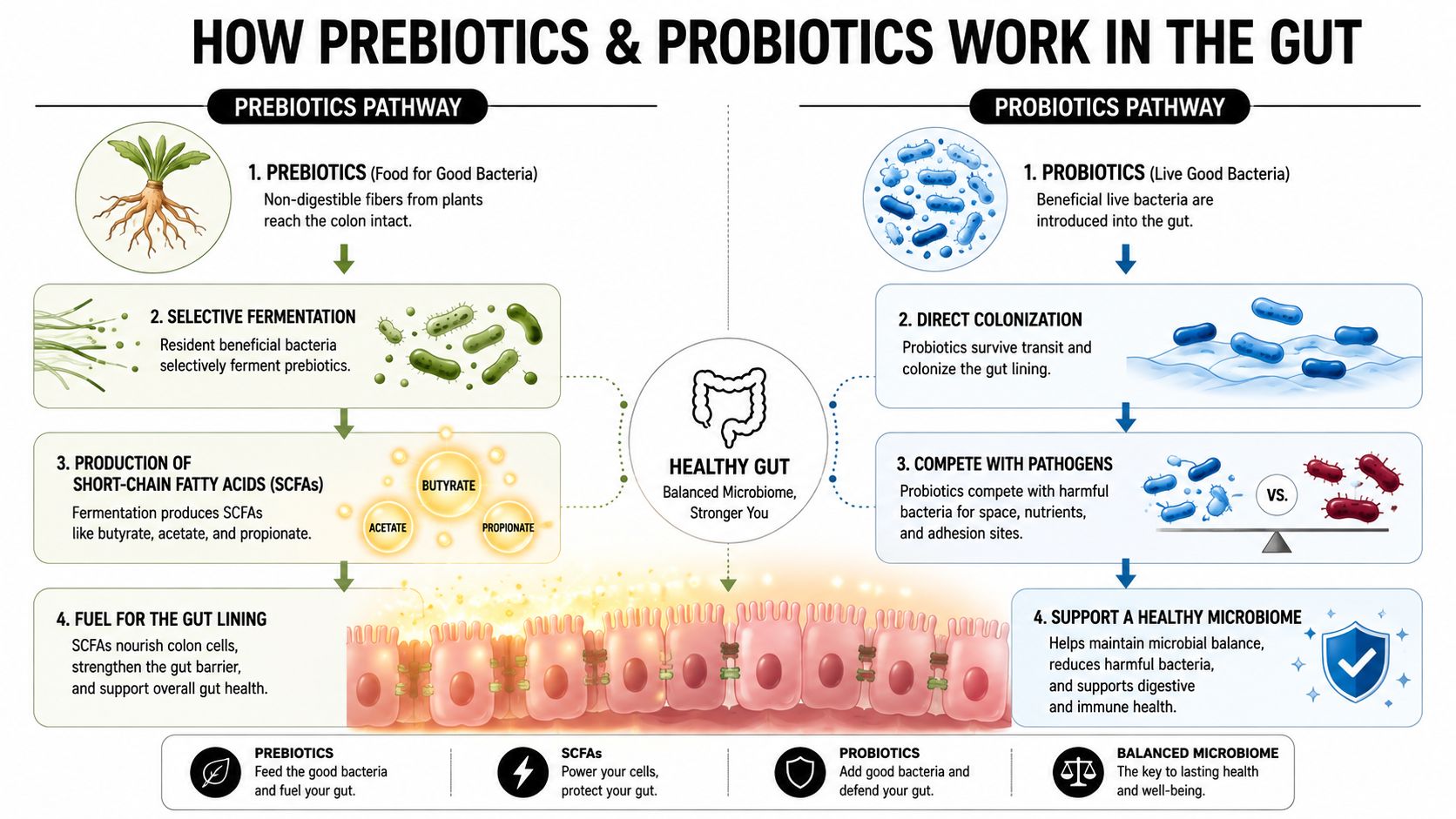
A review of gut-focused biotics makes the same point in plain language, prebiotics feed probiotics, and probiotics produce postbiotic compounds like short-chain fatty acids (BodyBio's overview of prebiotics, probiotics, and postbiotics). The point is not to collect every category. The point is to match the tool to the job.
| Quick reference: prebiotic, probiotic, postbiotic, synbiotic | |||
|---|---|---|---|
| Category | What it is | Example | How it works in one phrase |
| Prebiotic | Non-digestible substrate | Inulin, FOS | Feeds beneficial microbes |
| Probiotic | Live microorganism | Lactobacillus, Bifidobacterium, Saccharomyces | Adds helpful live organisms |
| Postbiotic | Inanimate microbial product | Butyrate | Delivers microbial output directly |
| Synbiotic | Combined formula | Probiotic plus matched fiber | Feeds the microbe you just added |
If you are shopping for a product, the category on the label should match the problem in your body. A broad “gut health” blend is usually a poor bet unless the strain and use case are clear. For a practical look at fiber-centered options, see this guide to prebiotic fiber supplements.
How They Work in the Gut and Why the Difference Is Real
Prebiotics work as selective fuel. The gut bacteria you already have ferment them into short-chain fatty acids, including butyrate, propionate, and acetate. Those compounds support colonocyte energy, barrier integrity, mineral absorption, immune modulation, and satiety signaling. That is why the useful prebiotic question is not whether fiber is good. It is which fiber is most likely to produce the result you want.
Prebiotics shape the ecosystem
Prebiotics are about ecosystem management. They help resident microbes do better work, and that work can show up as better stool form, better microbial balance, and more production of compounds that support the gut lining.
Prebiotics shape the existing ecosystem, probiotics add or rebalance organisms.
That is the distinction people keep missing. If your gut is underfed, prebiotics are often the better tool. If you need a strain-specific intervention, a probiotic is the more direct choice.
Probiotics act like a temporary workforce
Probiotics do not behave like permanent residents. Specific strains can colonize transiently, compete with pathogens, produce bacteriocins, influence motility, and affect immune and neural signaling through the gut-brain axis. That is why strain identity matters so much. A generic “blend” is not automatically better than a single strain with an actual evidence trail.
Named examples make that clear. Saccharomyces boulardii is used in the context of antibiotic-associated diarrhea, and Lactobacillus rhamnosus GG has human evidence tied to rotavirus-related diarrhea support (Nature review on prebiotics and probiotics). Those are symptom-specific tools, not general wellness ornaments.
The other difference is what happens after the microbe is gone. Probiotics may still leave behind useful metabolic output, which is why interest has shifted toward postbiotic benefits. That does not make every probiotic worth buying. It does mean the live organism is only part of the story.
Evidence by Condition and Symptom
The answer depends on the symptom. Prebiotics and probiotics do different jobs, and the better choice changes with the problem you're trying to fix, not with whatever label looks cleaner on the bottle.
Where probiotics are the sharper bet
The clearest probiotic use cases are antibiotic-associated diarrhea, some cases of infectious or traveler's diarrhea, and several IBS symptom patterns. Human evidence also supports lactose intolerance relief and suggests a possible role in reducing rotavirus-related diarrhea risk, as noted in the Nature review. If the main problem is diarrhea after antibiotics, probiotics belong in that lane.
Where prebiotics usually win
Prebiotics have the stronger case for stool frequency and stool consistency in mild constipation, along with calcium and magnesium absorption and the downstream SCFA effects tied to barrier and metabolic health. If bowel movements are sluggish, prebiotic fiber is usually the first thing I would try.
The same logic applies to daily maintenance. If the goal is to make the gut work better over time, food-based fiber usually beats a random capsule.
Where the evidence is weaker or mixed
Bloating is the hard one. Both categories can help, and both can aggravate the wrong gut. The cleaner read is that probiotics often outperform prebiotics for functional bloating, while some prebiotics can make bloating worse early on, especially if the dose climbs too fast.
A practical example is a product meant for bloating, not generic “gut support.” A review on how probiotic supplements support digestion and reduce bloating makes the point well, the formula has to match the symptom or the money is wasted.
For healthy adults, buying supplements just to “support the microbiome” is a weak use case. For constipation, prebiotics lead. For post-antibiotic diarrhea, probiotics lead. For bloating, the product has to be chosen carefully or it can backfire.
Newer microbiome names like Akkermansia and Christensenella sound exciting, but they are not a shortcut to proven outcomes. If you are buying for a real symptom, do not pay extra for futuristic branding unless the formula has a clear target and transparent strain or substrate data. When fiber-rich foods or fermented foods can do the job, they are usually the better buy.
Safety, Side Effects, and Who Should Be Cautious
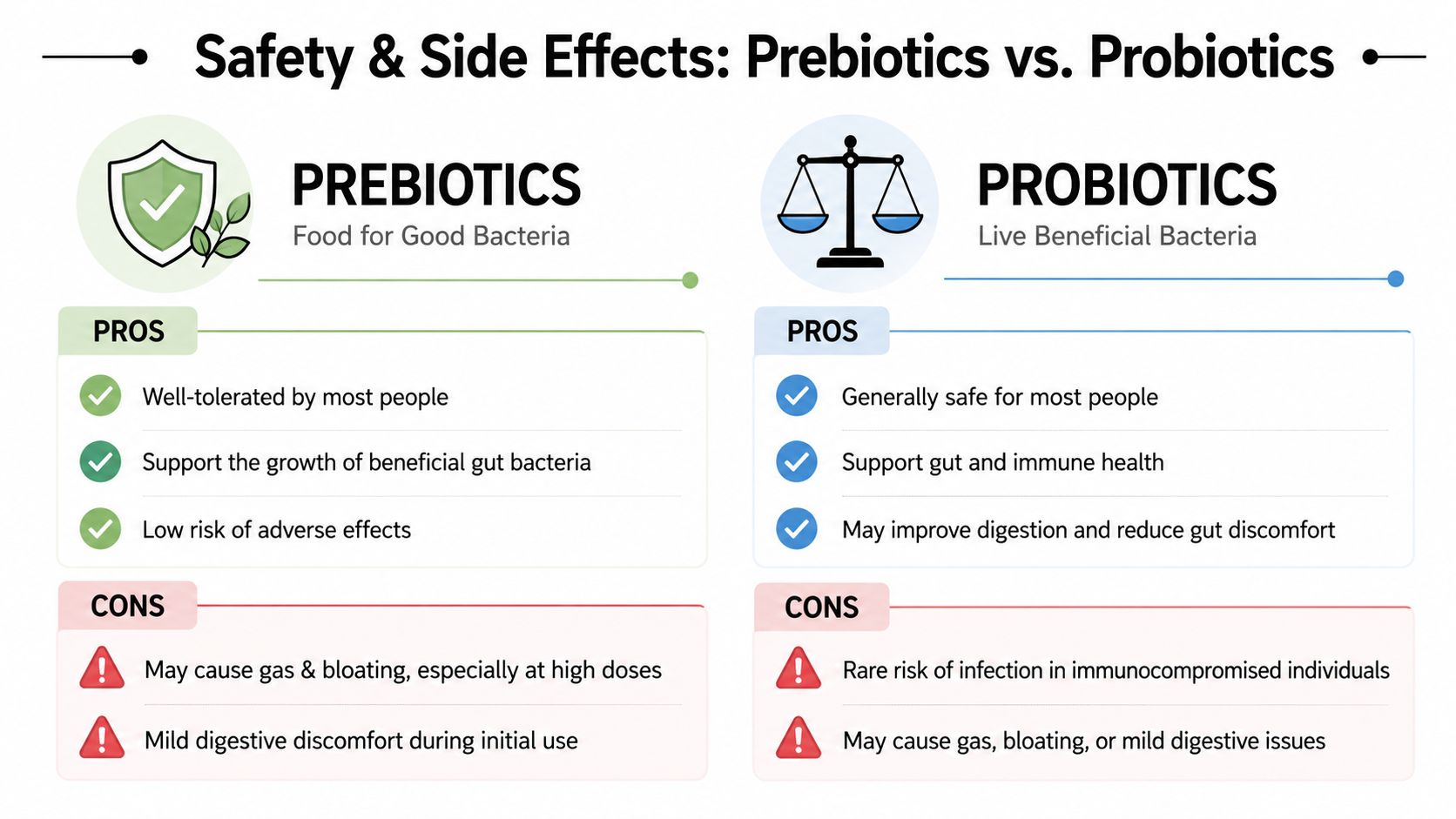
Both categories are generally tolerated, but neither one deserves blind trust. Prebiotics often cause gas, bloating, and cramping in the first one to two weeks, especially with higher inulin or FOS exposure while the microbiota adjusts. That is not a product failure. It usually means the dose is too aggressive or the fiber type is wrong for that person.
Who should be careful with probiotics
Probiotics deserve more caution than their marketing suggests. The Harvard Nutrition Source notes that probiotic supplements have mostly low-quality evidence, that healthy people are unlikely to benefit, and that people with weakened immune systems should avoid them. In higher-risk settings, the World Gastroenterology Organisation also says there is insufficient evidence for probiotics or synbiotics in critically ill adults in intensive care units. That is enough to keep probiotics out of the casual supplement pile.
People on immunosuppressants, people with central lines, and anyone recovering from major surgery should treat probiotics as a clinical decision, not a wellness purchase. The rare infection risk is not the issue for healthy adults. It is the issue for vulnerable patients.
The food-first answer is often the right one
For many adults, fiber-rich foods and fermented foods do most of the work a mediocre supplement never will. That does not make supplements useless. It does mean that someone with mild symptoms and a limited budget should fix food quality before buying a complicated capsule stack.
How to Choose a Quality Prebiotic or Probiotic Product
Buying well matters more than buying trendy. If you want a probiotic that might do something, you need strain specificity, CFU at expiration, third-party testing, and a delivery system that can survive stomach acid. If you want a prebiotic that won't wreck your gut, you need the right fiber type, a tolerable dose, and minimal filler.
What to look for on a probiotic label
The label should name the genus, species, and strain, not just a generic blend. It should list CFU at expiration, not just at manufacture, because that's what tells you whether the product still meets potency by the time you use it. And if the formula claims gut survival, look for delayed-release or enteric-coated delivery, plus third-party testing and a downloadable Certificate of Analysis.
What matters in a prebiotic product
Prebiotics are simpler, but not easy. The useful question is whether the product uses a fiber you can tolerate, such as inulin, FOS, GOS, PHGG, or acacia, and whether the dose is realistic for your gut. I'd rather see a modest, tolerable formula than a giant scoop that causes bloating and then gets abandoned.
A synbiotic can make sense if the probiotic and prebiotic are matched. A random combo with no logic is just marketing with a longer ingredient list.
Use this checklist before you buy:
- Verify the strain name: genus, species, and strain ID should be printed clearly.
- Check the potency claim: CFU at expiration is more meaningful than a vague high number.
- Look for proof: third-party testing and a downloadable COA beat hype.
- Match the fiber: the prebiotic should be the right substrate, not just any fiber.
- Watch the extras: sugar, fillers, and unnecessary additives should be low.
Product-level proof beats branding. A real strain name, real testing, and a real guarantee matter more than a flashy CFU count on the front of the jar.
Matching the Right Category to Your Specific Goal
If your goal is daily regularity or stool consistency, start with prebiotics. Partially hydrolyzed guar gum and acacia fiber are the gentler calls, and a synbiotic upgrade makes sense only if you've already tolerated fiber well and still want more support.
If your problem is post-antibiotic recovery, antibiotic-associated diarrhea, or traveler's diarrhea, I'd reach for a probiotic first, especially a formula built around Saccharomyces boulardii or Lactobacillus rhamnosus GG. That is a much better fit than a generic daily capsule.
Goal to formula match
| Goal | Best first choice | Add a | Synbiotic upgrade |
|---|---|---|---|
| Daily regularity | Prebiotic | PHGG or acacia | Yes, if tolerated |
| Antibiotic recovery | Probiotic | S. boulardii or LGG | Sometimes |
| IBS-style bloating | Targeted probiotic | Low-FODMAP fiber | Only if well tolerated |
| Women's gut, vaginal, urinary support | Targeted probiotic | Cranberry and D-mannose | A Lactobacillus-led synbiotic |
| Meal-related discomfort | Digestive enzymes | Lactase or broader enzyme support | No |
For bloating and gas, I'd avoid high-FOS inulin at the start. A low-FODMAP approach is often smarter than forcing a fiber that makes the symptom worse. For meal-related discomfort with dairy, FODMAP foods, or heavy meals, neither prebiotics nor probiotics is the main answer, digestive enzymes are.
One GutRx option in this lane is GutRx Daily, a probiotic and prebiotic supplement for gut health and digestion. That kind of product fits the daily-maintenance category, but the broader rule still stands, the formula has to match the symptom, not the marketing label.
Dosing, Timing, and the Questions Most Readers Still Have
Dose matters, but more is not automatically better. For probiotics, 1 to 50 billion CFU is the range most often supported in practice, and taking them with or just before a meal helps them survive stomach acid better. For prebiotics, a smart start is usually 2 to 5 grams per day of FOS or inulin, then slowly increasing over 1 to 2 weeks if your gut tolerates it.
The practical timing rules
Take synbiotics together so the live microbe arrives with its preferred fuel. That's the whole point of the pairing. If you split them wildly apart, you lose some of the logic of the formula.
If symptoms get worse, don't keep pushing through. Lower the dose, switch the fiber type, or stop and reassess.
Both prebiotics and probiotics can be taken long term if they're helping and you tolerate them. If bloating, pain, or irregularity gets worse instead of better, the product may be wrong for your body, not “detoxing” you.
The questions people ask most
Can you take them together? Yes, and that's the definition of a synbiotic.
How long until you notice something? It depends on the goal, but if you're not getting any meaningful change after a fair trial, the formula may not be worth continuing.
When should you stop self-treating? If you're immunocompromised, recovering from surgery, or dealing with serious GI symptoms, talk to a clinician instead of guessing.
The right answer is the one that matches the symptom, has strain- or substrate-specific evidence, and comes with real product proof.
GutRx builds digestive-support formulas around that same logic, with category-specific products for daily use, women's support, and meal-related discomfort. If you want to compare a practical synbiotic or enzyme option against your own symptom pattern, visit GutRx and look at the formulas with the strongest match for your goal.


