

Intestinal transit time is the total time it takes food to travel from your mouth through the digestive tract and leave the body. In healthy adults, stomach emptying commonly takes about 2.5 to 5 hours, small-bowel transit about 2.5 to 6 hours, colonic transit around 30 to 40 hours, and whole-gut transit can range from 10 to 73 hours.
You may be asking because your digestion feels unusually slow after meals, your bowel movements have become infrequent, or food seems to pass through you almost immediately. The important point is that transit isn't one stopwatch reading for everyone. It depends on which digestive segment is moving slowly or quickly, what you ate, your physiology, medications, stress, and your usual bowel pattern.
Table of Contents
- What Is Intestinal Transit Time
- Understanding Normal Transit Time Ranges
- Key Factors That Influence Gut Motility
- Connecting Transit Time to Your Symptoms and Health
- Evidence-Based Strategies to Regulate Transit Time
- When to See a Doctor About Your Gut Motility
What Is Intestinal Transit Time
Intestinal transit time describes the movement of food, liquid, and waste through the gastrointestinal tract. It starts when you swallow and continues through the stomach, small intestine, and colon until waste is eliminated. Clinicians may measure the entire journey, called whole-gut transit, or examine individual regions to identify where movement changes.
That distinction matters in everyday life. If material moves too slowly through the colon, the colon has more time to remove water, which can contribute to harder stools and constipation. If contents move too quickly through the intestine, the body may have less time to absorb water and nutrients, contributing to loose stools or diarrhea. Bloating and discomfort can occur with either pattern because transit speed affects fermentation, gas movement, and the time intestinal contents remain in a particular region.
Practical rule: Stool frequency is useful information, but it doesn't show the speed of every part of your digestive tract.
A person can have a bowel movement regularly and still experience delayed movement in one segment. Another person may have frequent stools without unusually rapid whole-gut transit. That's why a single “normal” number can't explain every digestive complaint.
The purpose of understanding transit time isn't to make your digestion as fast as possible. A better goal is comfortable, consistent movement that matches your body and doesn't produce persistent constipation, diarrhea, pain, or disruptive bloating. The sections below separate the stomach, small intestine, and colon so you can understand what the ranges mean and why symptom-focused solutions should match the likely region involved.
Understanding Normal Transit Time Ranges
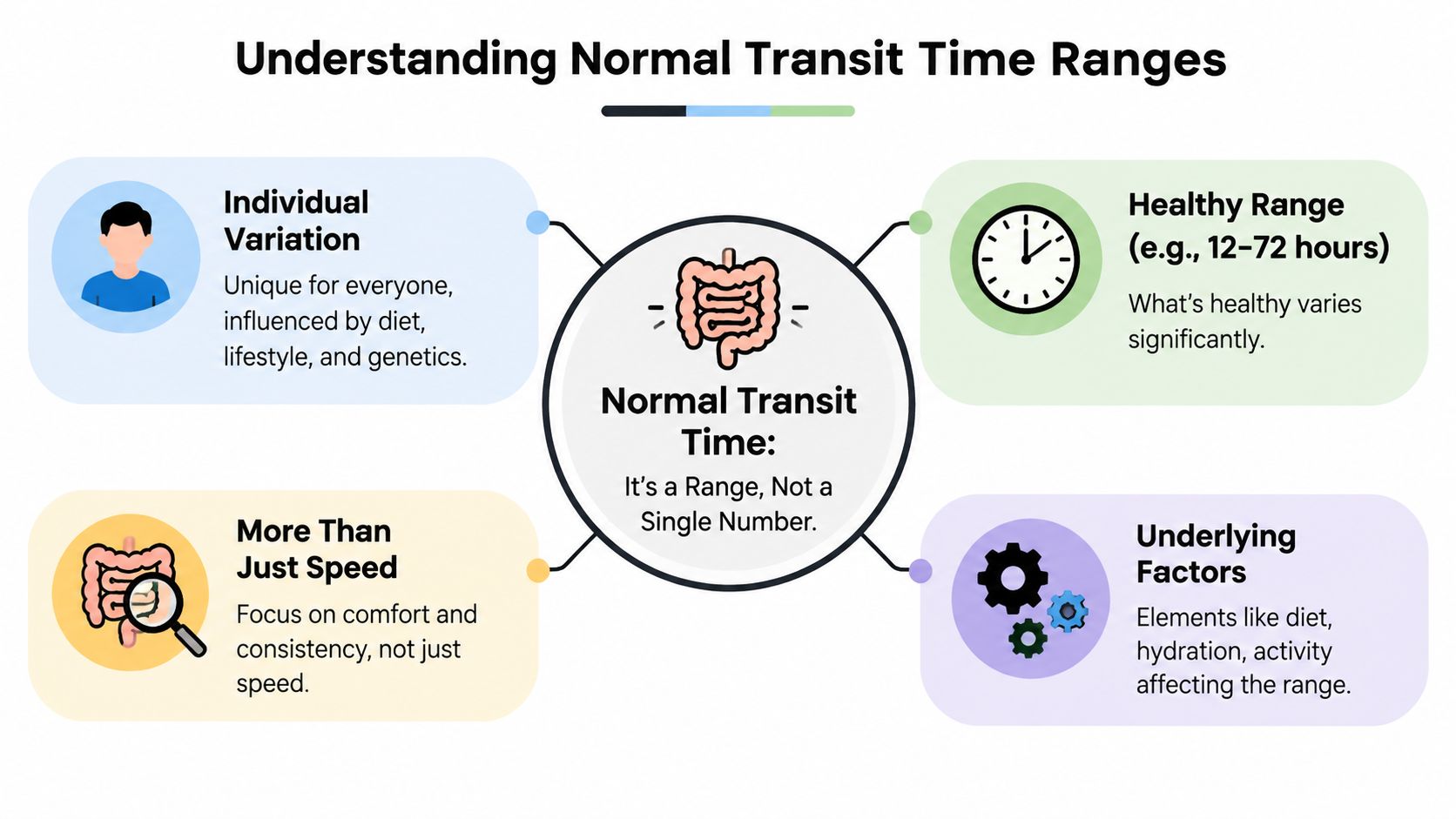
Healthy gastrointestinal transit is best understood as a distribution rather than a fixed target. One clinical review lists typical ranges of 2 to 5 hours for gastric emptying, 2 to 6 hours for small-bowel transit, 10 to 59 hours for colonic transit, and 10 to 73 hours for whole-gut transit (clinical review of gastrointestinal transit ranges).
The stomach sets the first timing window
The stomach stores and mixes food before gradually releasing it into the small intestine. A meal's size and composition can change how long that process takes. A higher-calorie meal has been found to significantly delay gastric transit and increase variability, while calorie content didn't significantly change mean small-intestinal transit or colonic transit in a quantitative review of oral dosage-form movement (meal composition and gastrointestinal transit).
This is one reason you may feel full or heavy for longer after a large meal, even if your colon is functioning normally. Upper digestive timing can also affect when nutrients, enzymes, and supplements encounter the digestive tract.
The small intestine handles most absorption
The small intestine receives partially digested food from the stomach and moves it through a long absorptive region. A 2023 systematic review reported small-intestinal transit ranges of 3.3 to 7 hours, with substantial variation caused partly by testing protocols (2023 systematic review of regional transit).
A delay here may be relevant when symptoms center on prolonged fullness, bloating, or discomfort after eating. However, symptoms alone can't identify the exact segment. Testing and clinical history are needed when the distinction affects treatment.
The colon often determines stool timing
The colon absorbs water and stores stool before elimination. Many adult colon-transit studies place the average around 30 to 40 hours, and an upper range near 72 hours can still be considered normal in people without constipation (UCSF Health bowel transit reference).
Whole-gut transit offers a broad overview, but it can hide regional differences. For example, someone might have a relatively acceptable total result while one segment moves more slowly than expected. That's why a product chosen for “gut health” should be evaluated by its intended use, strain or ingredient profile, delivery system, and quality documentation rather than by a promise to speed the entire digestive tract.
GutRx BALANCE offers 30 billion CFUs per capsule with next-generation probiotics for gut health, digestive balance, and immune support. That description may be relevant to someone comparing a probiotic for digestive balance, but it doesn't establish a personal transit diagnosis or guarantee symptom relief.
Key Factors That Influence Gut Motility
Transit speed changes because the digestive tract responds to food, movement, nervous-system signals, hormones, and medicines. Two people can eat similar meals and experience different timing, so the useful question is often, “What changed in my routine or symptoms?” rather than “What single number should I reach?”
Diet and fluid intake
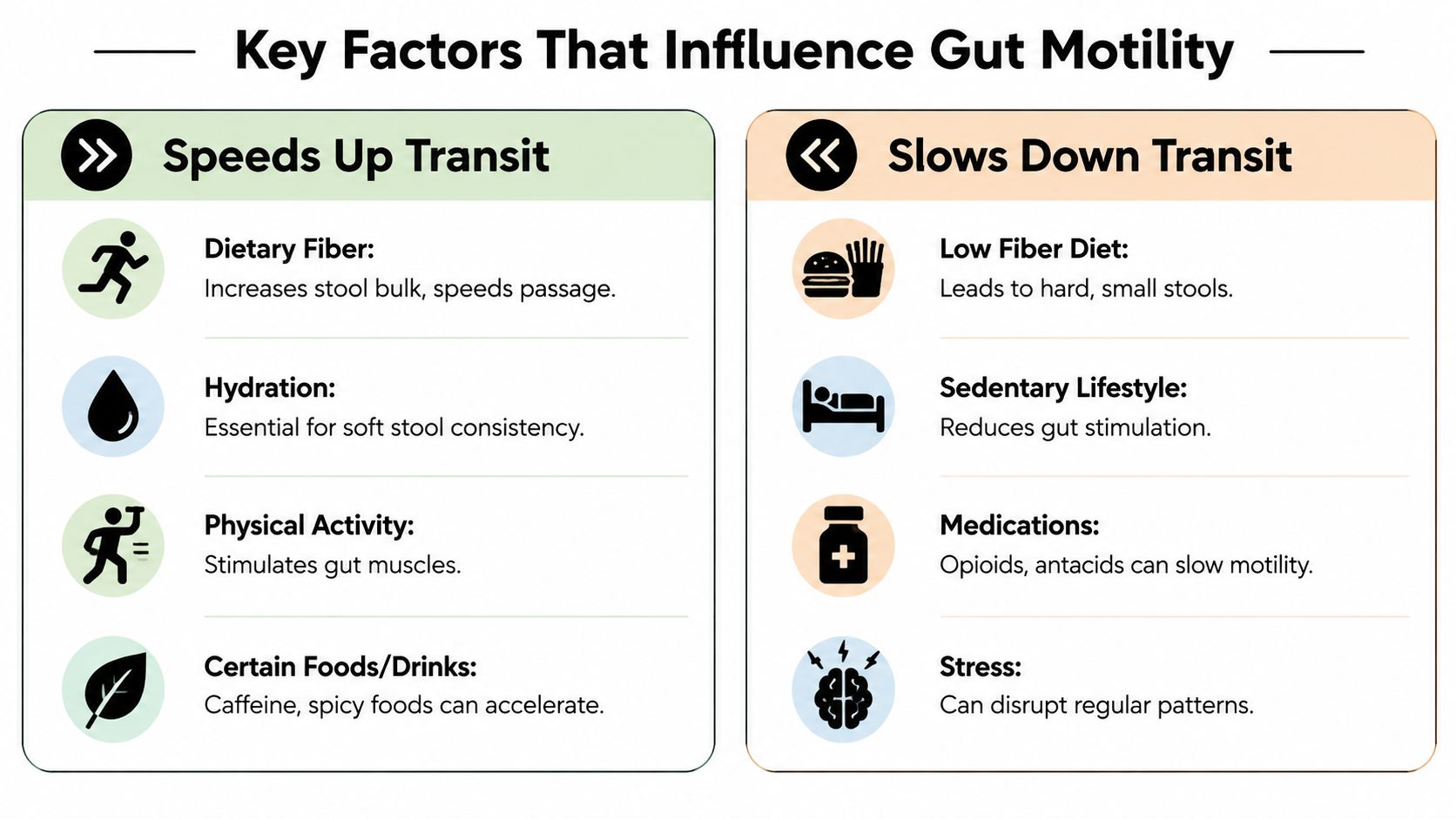
Fiber adds structure to stool and can influence how contents move. Soluble fiber absorbs water and forms a softer, gel-like material, while insoluble fiber adds bulk. Increasing fiber suddenly may worsen gas or bloating, so gradual changes and adequate fluid intake are usually easier to tolerate. If you're comparing a fiber supplement with whole foods, this fiber supplement and whole-food guide can help you think through the practical differences.
Hydration supports softer stool consistency, but drinking more water won't correct every cause of constipation. A low-fiber diet, limited movement, medication effects, or an underlying motility problem may still need attention.
Meal composition matters most clearly in the upper tract. Higher-calorie meals can delay gastric transit, while the same review found no significant effect of calorie content on average small-intestinal or colonic transit. That distinction helps explain why a meal may sit heavily without necessarily changing the time stool spends in the colon.
Movement and the gut-brain connection
Physical activity can encourage regular bowel habits by adding movement to a generally sedentary routine. Stress can also change digestive patterns. Some people notice looser stools during acute stress, while others experience slowed bowel movements, abdominal tension, or increased awareness of normal sensations.
Sleep disruption may make routines less consistent, especially when it changes meal timing, activity, hydration, or stress management. The response isn't purely mechanical. The intestine communicates with the nervous system, so emotional strain can influence contractions and symptom perception even when no structural problem is present.
Biology and medication effects
Hormonal changes, individual anatomy, illness, and microbiome composition can all influence motility. These factors are difficult to identify from symptoms alone, and a supplement shouldn't be used as a substitute for evaluation when symptoms are persistent or worsening.
Medication review is especially important. Opioids can slow intestinal movement, while other medicines may alter stool consistency or digestive symptoms. Antacids and other products can also affect bowel habits depending on their ingredients and how your body responds. Don't stop a prescribed medicine without discussing the change with your clinician.
A useful experiment: Track meals, bowel movements, stool form, stress, activity, and supplements for several days. Patterns are more informative than one unusually fast or slow day.
Connecting Transit Time to Your Symptoms and Health
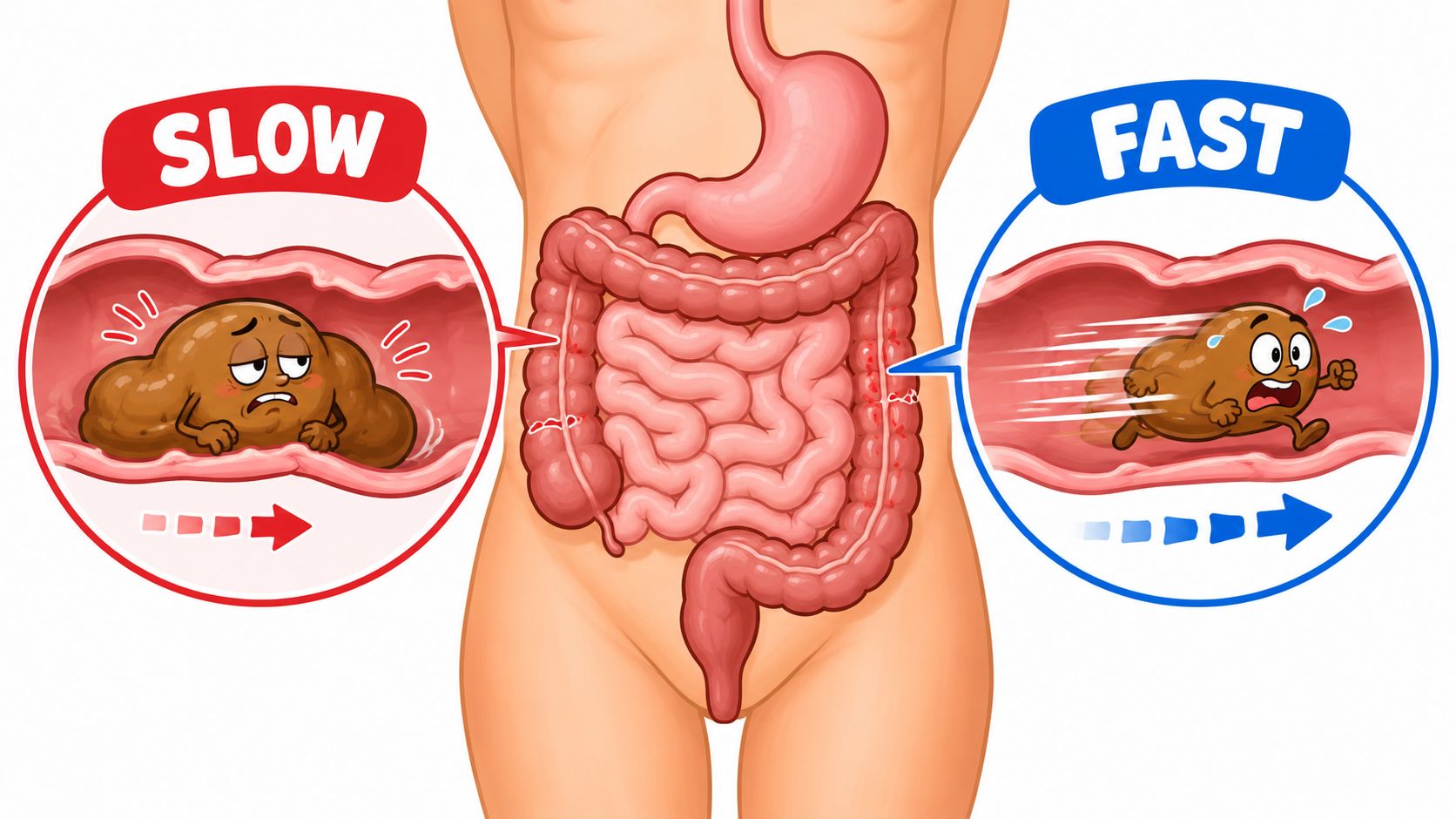
Symptoms often reflect the interaction between transit speed and the region involved. Constipation commonly relates to slower colonic movement, which gives the colon more opportunity to remove water from stool. Diarrhea can occur when intestinal contents move too quickly, leaving less time for water absorption. These descriptions are useful mechanisms, but they aren't diagnoses by themselves.
Bloating may develop when gas and intestinal contents accumulate, when fermentation becomes more noticeable, or when movement is poorly coordinated. A slow pattern can make fullness and gas feel prolonged. A fast pattern can produce urgency and loose stools, but bloating may still occur if fermentation, food intolerance, or sensitivity contributes to symptoms.
Regional timing explains more than stool count
A 2023 systematic review reported healthy ranges of 3.3 to 7 hours for small-intestinal transit, 15.9 to 28.9 hours for colonic transit, and 23.0 to 37.4 hours for whole-gut transit (systematic review of segment-specific transit). The wide ranges show why a person can have symptoms even when a broad whole-gut estimate appears acceptable.
This regional view is especially relevant to people with IBS-type symptoms. Diarrhea-predominant IBS tends to be associated with shorter small-bowel and whole-gut transit, while constipation-predominant IBS tends to be associated with longer transit. Transit abnormalities don't explain every IBS symptom, and they aren't present uniformly in every person with the same subtype (research on intestinal transit and bowel habits).
For constipation-focused reading, see this guide to probiotic strains for constipation support. It's more useful to match a supplement's intended purpose to your pattern than to assume every probiotic works by accelerating digestion.
What transit can and can't tell you
Transit influences the time available for digestion, absorption, fermentation, and stool formation. It may therefore affect how you experience meals and bowel changes. But transit time alone doesn't measure your complete microbiome, explain every abdominal sensation, or prove that one ingredient will resolve a complex symptom pattern.
Use your symptoms as signals, not as a self-diagnosis. Persistent constipation, recurrent diarrhea, unexplained changes in bowel habits, or significant pain deserves a more complete assessment.
Evidence-Based Strategies to Regulate Transit Time
The most reliable approach starts with the basics and changes one variable at a time. Trying fiber, several supplements, major dietary restrictions, and new exercise all at once makes it difficult to know what helped or what caused more gas.
Start with a steady routine
Build meals around foods you tolerate, add fiber gradually, and drink fluids consistently across the day. Regular movement can support a predictable bowel routine, while a calm, unhurried bathroom schedule may help you respond to natural urges instead of repeatedly delaying them.
If constipation is the main concern, don't assume that more fiber is always better. A sudden increase can intensify bloating, particularly when your current diet is low in fiber or your gut is sensitive. Start with a manageable amount, observe stool consistency and comfort, and adjust with professional guidance if symptoms persist.
Stress management deserves a place beside food changes. Walking, slow breathing, and consistent sleep won't diagnose a motility disorder, but they can reduce the routine disruptions that make symptoms harder to interpret.
Choose supplements by the problem you want to address
A probiotic contains live microorganisms. A prebiotic is a substrate that selected microorganisms can use. A synbiotic combines a probiotic and a prebiotic, while a postbiotic refers to preparations of inanimate microorganisms and their components or products. These categories aren't interchangeable, so read the label for the actual formulation rather than relying on a broad “gut health” claim.
For a slow, irregular pattern, a daily formula designed around regularity may be more relevant than an enzyme product. For bloating or digestive imbalance, someone may instead compare a targeted probiotic blend, a synbiotic, or a formula with delayed-release protection. A supplement's strain identification, storage instructions, third-party testing, and certificate of analysis can matter as much as the front-label category.
For practical constipation habits, use this guide to natural constipation relief alongside any supplement decision. GutRx Daily is positioned within that regularity-focused category, while GutRx Balance is described as a probiotic option for digestive balance.
Use enzymes for meal-related problems
Digestive enzymes work upstream, during digestion of food components. They aren't the same as probiotics, which are selected microorganisms, and they shouldn't be chosen only because a person has slow colonic transit.
An enzyme product may be worth considering when discomfort is closely tied to particular meals, such as dairy or foods that are difficult for you to digest. The practical question is whether symptoms consistently follow a food and whether the formula contains enzymes relevant to that food. If symptoms occur regardless of meals, or include persistent diarrhea, bleeding, severe pain, or weight loss, seek medical advice rather than masking the pattern with enzymes.
This video provides a general visual explanation of how a daily digestive routine may fit into broader gut-support choices:
Compare products with a buyer's checklist
Amazon listings and search results often emphasize a single feature, such as potency or a named strain. A more careful comparison looks at the full formula and its intended use.
- Target use: Is it designed for daily maintenance, regularity, digestive balance, or meal-related support?
- Formula type: Does it contain a probiotic alone, a prebiotic and probiotic combination, a postbiotic, enzymes, or a blend?
- Strain detail: Are the microorganisms identified clearly enough to distinguish one strain from another?
- Delivery system: Does the product explain delayed-release or enteric protection, storage, and shelf stability?
- Quality evidence: Does the manufacturer provide third-party testing or a downloadable Certificate of Analysis?
- Tolerance: Could added prebiotics or other ingredients increase gas for someone with a sensitive gut?
Don't treat a higher CFU number as proof that a product matches your symptoms. Potency, delivery, strain selection, tolerability, and transparent testing all contribute to a sensible decision.
When to See a Doctor About Your Gut Motility
Contact a healthcare professional if constipation, diarrhea, bloating, or abdominal discomfort persists, keeps returning, or interferes with daily life. Seek prompt medical attention for blood in the stool, severe or worsening abdominal pain, unexplained weight loss, repeated vomiting, marked weakness, or a sudden persistent change in bowel habits.
A clinician may begin with your bowel history, stool form, meal pattern, medications, and symptom timing. A landmark population study published in the mid-1990s showed that transit time could be estimated from self-reported bowel habits and stool form, helping establish the connection between everyday observations and measured movement (review of transit assessment methods).
When more detail is needed, testing may examine separate regions rather than relying on one whole-gut estimate. Radiopaque markers can track passage through the colon, scintigraphy can assess selected transit landmarks, and wireless motility capsules can provide objective information about movement through multiple gastrointestinal segments. The appropriate test depends on your symptoms and the clinical question.
Don't use a “normal” range to dismiss symptoms that are significant for you. Your baseline, symptom pattern, medications, and examination all matter more than chasing a universal transit target.
GutRx offers probiotic, synbiotic, and digestive enzyme options organized around needs such as regularity, digestive balance, broader microbiome support, and meal-related discomfort. Visit GutRx to compare formulas, review product details, and choose a digestive-support approach that fits your symptoms and routine.


