

You're comparing probiotic bottles because one problem has turned into several. Maybe meals leave you bloated, bowel movements have become unpredictable, and a recent antibiotic course has made your digestion feel unfamiliar. A broad-spectrum probiotic may fit that pattern better than a single-strain product, but only if its strains, delivery system, and intended use match your symptoms.
The important question isn't “Which bottle has the most strains?” It's “Which formula has evidence relevant to the symptoms I want to support?” Broad-spectrum probiotics are blends, not automatic upgrades, and more microbial names on a label don't guarantee better results. A clinician-focused review of 65 randomized controlled trials across eight indications found that single strains were equivalent to mixtures in most cases, reinforcing the need to evaluate strain-level evidence rather than count strains alone.
Table of Contents
- When One Symptom Turns Into Several and You Need Broader Support
- What Broad Spectrum Probiotics Actually Mean
- What the Evidence Says for Bloating, IBS, Regularity, and Mood
- Key Strains to Know Including Akkermansia and Christensenella
- How to Read a Broad Spectrum Probiotic Label
- Dosing, Timing, and What to Expect Week by Week
- Choosing the Right Formula for IBS, Women, and Clinicians
- Practical Questions Buyers Ask Before They Commit
When One Symptom Turns Into Several and You Need Broader Support
Maria first noticed bloating after meals. She began avoiding foods she liked because her abdomen felt tight and uncomfortable by the afternoon. Then her bowel pattern changed. Some days brought sluggishness and incomplete relief, while other days were less predictable.
After a course of antibiotics, she also started describing afternoon fatigue and difficulty concentrating. The problem no longer looked like one isolated digestive complaint. A product chosen only for occasional bloating might not address a pattern involving discomfort, irregularity, and recovery after medication.
Why a single-target fix can feel incomplete
The gut works as a community. Microbes interact with food, intestinal contents, mucus, bile acids, and one another. Antibiotics can disrupt that ecosystem, and the extent of the change differs from person to person. A reduction in microbial diversity can affect how the system handles fermentation and movement through the digestive tract, although a supplement can't be assumed to rebuild every missing organism.
That's where the logic of broad spectrum probiotics comes in. A multi-strain formula attempts to provide several defined organisms with different potential roles, rather than placing the entire product around one strain and one outcome. It's similar to choosing a small team with complementary skills instead of hiring one specialist for every problem.

Match breadth to the symptom pattern
Broad support may be worth considering when symptoms overlap or shift, such as:
- Bloating plus irregularity, especially when neither symptom stays consistent.
- Digestive changes after antibiotics, where the goal is support during a period of disruption.
- Mixed IBS features, when constipation and diarrhea-type symptoms alternate.
- Gut support alongside broader wellness goals, such as digestive balance and immune support.
That doesn't make a broad formula the right answer for everyone. If one well-defined symptom dominates, a targeted product with a clinically studied strain may be a more rational starting point. The decision should follow the symptom pattern, not the largest CFU number or longest ingredient list on the shelf.
Practical rule: Choose breadth because your needs are broad, not because “more strains” sounds automatically stronger.
What Broad Spectrum Probiotics Actually Mean
Broad-spectrum probiotics are blends containing multiple probiotic genera, species, and strains, selected to provide complementary functions. The phrase should describe the formula's design, not serve as a guarantee of broader health benefits.
Think of a sports team. A striker may be excellent at scoring, but a complete squad also needs players who defend, build attacks, and adapt when the game changes. A broad-spectrum formula follows a similar idea. Different strains may be studied for different digestive, immune, or metabolic roles, but each strain still needs its own evidence.
A single-strain probiotic is more like a specialist. It may be designed around a specific use, such as Saccharomyces boulardii for diarrhea-related support or Lactobacillus rhamnosus GG in selected acute or antibiotic-associated contexts. A targeted approach can make sense when one symptom is clearly dominant and the strain has relevant clinical data.

The label terms that determine what you're buying
- Genus is the larger biological group, such as Lactobacillus or Bifidobacterium.
- Species narrows the identity, such as Bifidobacterium lactis.
- Strain identifies the specific version used in research, such as Bifidobacterium lactis DN-173010.
- CFU, or colony-forming units, estimates the number of viable organisms under the product's stated conditions.
Two products can list the same species but contain different strains, and those strains may not have the same clinical evidence. That's why a label showing only “proprietary probiotic blend” gives you less decision-making information than a label naming the full strain designations and their amounts.
A product such as GutRx BALANCE provides 30 billion CFUs per capsule and is described as containing next-generation probiotics for gut health, digestive balance, and immune support. That description explains the product's category and intended positioning, but it doesn't remove the need to match the formula to your symptoms.
The core takeaway is simple: broad-spectrum is a functional category, not a marketing badge. A useful blend is one where the named organisms, doses, and delivery format make sense for the person taking it.
What the Evidence Says for Bloating, IBS, Regularity, and Mood
A person with bloating, irregular stools, abdominal pain, and brain fog may look for one broad-spectrum product to cover everything. The evidence supports a more careful approach. Match the formula to the dominant symptom cluster, then judge the result by the outcome that matters to you. Probiotic effects can vary with the strain, combination, dose, diagnosis, and outcome measured.
For IBS, a 2024 meta-analysis of 20 studies involving 3,011 participants reported improvements in overall symptoms and quality of life compared with placebo. Multiple-strain products and daily doses of at least 10^10 were associated with improvement in abdominal pain. A separate network meta-analysis found benefits from combinations dominated by Lactobacillus and Bifidobacterium for IBS symptoms, abdominal pain, and IBS-related quality of life. Prebiotics and synbiotics did not significantly improve IBS symptoms in that analysis.
Read the evidence by symptom cluster
Bloating and abdominal discomfort may improve with selected Lactobacillus and Bifidobacterium combinations. The response is uneven. One person may notice less pressure or pain, while another sees little change in gas or distension.
IBS with mixed or diarrhea-type features calls for closer matching. Evidence supports some named strains and combinations, but results do not apply equally to urgency, gas, incomplete evacuation, and bloating. A recent evidence review describes probiotic effects as disease-specific and strain-specific, with low or very low certainty for many IBS outcomes.
Constipation and regularity may fit a strain with transit evidence better than a formula chosen for its long ingredient list. The World Gastroenterology Organisation identifies Bifidobacterium lactis DN-173010 as a strain shown to accelerate gastrointestinal transit and increase stool frequency in people with constipation-focused IBS.
Mood and brain fog remain adjunctive targets. A broad formula may suit someone whose digestive symptoms and perceived mental fatigue occur together, but current evidence does not support promising that a probiotic will resolve mood symptoms.
| Symptom Cluster | Best-Supported Strains | Evidence Strength | Minimum Trial Window |
|---|---|---|---|
| IBS symptoms and abdominal pain | Defined combinations, including Lactobacillus and Bifidobacterium blends | Heterogeneous | Up to 12 weeks |
| Constipation-focused IBS | Bifidobacterium lactis DN-173010 | Strain-specific support | Use the product's studied protocol |
| Diarrhea-related support | Selected strains or combinations, including yeast-based options | Context-dependent | Clinician-guided when illness is significant |
| Bloating and gas | Some multi-strain combinations | Variable | Up to 12 weeks |
| Mood-related concerns | Selected microbiome formulations as adjunct support | Limited and indirect | Evaluate alongside standard care |
For a symptom-focused overview, see probiotics for IBS. Clinical IBS guidance recommends trying a probiotic for up to 12 weeks and stopping if there is no improvement. The clinical guidance frames potential benefits around global symptoms, abdominal pain, and bloating, rather than every digestive complaint.
Key Strains to Know Including Akkermansia and Christensenella
A broad-spectrum formula is easiest to evaluate when you understand what each named organism is supposed to contribute. The names aren't interchangeable. A strain studied for transit isn't automatically the best choice for diarrhea, and a next-generation microbe with metabolic research isn't automatically a treatment for bloating.
The familiar workhorses
Lactobacillus and Bifidobacterium include many of the most familiar probiotic strains. Examples include Lactobacillus rhamnosus GG, Lactobacillus plantarum 299v, Bifidobacterium lactis HN019, and Bifidobacterium infantis 35624. Their potential roles differ, and the evidence should be attached to the exact strain rather than the genus name alone.
Saccharomyces boulardii is a yeast, not a bacterium. That distinction matters because antibiotics that affect bacteria don't act on it in the same way. It's often considered when diarrhea support or antibiotic-associated digestive disruption is the main concern, although significant or persistent diarrhea needs medical evaluation.
Next-generation organisms
Akkermansia muciniphila has drawn attention for its relationship with the intestinal mucus layer and metabolic markers. In a human proof-of-concept trial, adults received 10^10 bacteria daily for three months. Pasteurized A. muciniphila improved insulin sensitivity by 28.62% and reduced insulinemia by 34.08% versus placebo, and the intervention was reported as safe and well tolerated. Those findings are promising but don't mean every Akkermansia product will produce the same outcome.
Christensenella minuta is associated with research on microbial patterns and metabolic health, while Faecalibacterium prausnitzii is known for its role in producing butyrate. These organisms are part of the next-generation conversation, but consumer formulas and clinical evidence remain uneven. A species name alone isn't proof that an oral supplement will establish the organism or reproduce a study result.
| Strain or organism | Primary Function | Best-Supported Symptom Link |
|---|---|---|
| Lactobacillus rhamnosus GG | Defined probiotic support | Selected acute or antibiotic-associated digestive concerns |
| Lactobacillus plantarum 299v | Digestive comfort research | Bloating and abdominal discomfort |
| Bifidobacterium lactis HN019 | Regularity and digestive support research | Irregularity and transit-related concerns |
| Bifidobacterium infantis 35624 | IBS symptom research | Abdominal pain and IBS symptoms |
| Saccharomyces boulardii | Yeast-based digestive defense | Diarrhea-related support |
| Akkermansia muciniphila | Mucus-layer and metabolic research | Metabolic support, not a universal IBS solution |
| Christensenella minuta | Next-generation microbiome research | Emerging metabolic and ecosystem-focused interest |
| Faecalibacterium prausnitzii | Butyrate production | Emerging gut barrier and inflammation research |
For a closer look at the evidence and limitations around Akkermansia, see Akkermansia probiotic benefits. Use the list to ask a better question: Which organisms are relevant to my symptoms, and does the label identify them precisely enough to judge?
How to Read a Broad Spectrum Probiotic Label
A label should help you answer three questions: what organisms are included, how much remains viable, and whether the formula suits your target symptom. A long ingredient list cannot make up for missing strain identities or unclear potency. “Broad spectrum” describes a decision based on symptom fit, not solely a high strain count.
Five label signals deserve attention
CFU at expiry gives a more useful picture than a count guaranteed only at manufacture. Live organisms may decline during storage, so look for potency tied to the expiration date. Storage instructions matter too.
Full strain specificity lets you compare a product with clinical research. “Bifidobacterium lactis” provides less information than the species name followed by a defined strain designation. Without that detail, the label cannot show whether its organism matches the one studied.
Genera and species diversity should be separated from total strain count. Several organisms from one narrow group may offer less functional range than a shorter blend with complementary evidence. Match the blend to the problem you are trying to address, such as bloating, irregularity, or abdominal discomfort.
Delivery technology supports survival during storage and passage through the stomach. Delayed-release or enteric-coated capsules, acid-resistant strains, moisture control, and refrigeration instructions are relevant design choices. They do not prove that a product is right for you, and shelf-stable formulas are not automatically superior.
Independent testing may provide information about identity, purity, and manufacturing controls. USP, NSF, ConsumerLab, and Informed-Sport seals can cover different testing areas. Check what each certification evaluates instead of treating every logo as equivalent.

Review allergens, inactive ingredients, capsule materials, and any available contamination or heavy-metal testing. A certificate of analysis is more useful when it identifies the lot and confirms the relevant tests. A general quality statement does not provide the same detail.
Label check: If a company places every individual dose inside a proprietary blend, you cannot judge whether the formula is meaningfully designed for your symptoms.
Clinical IBS guidance recommends a trial of up to 12 weeks, followed by discontinuation if there is no improvement. A product that produces no measurable change by then may be a poor symptom match, although that result does not automatically indicate poor manufacturing.
For verification details, review these third-party tested probiotics. A sound buying decision brings together transparent labeling, suitable delivery protection, and a realistic time frame for judging results.
Dosing, Timing, and What to Expect Week by Week
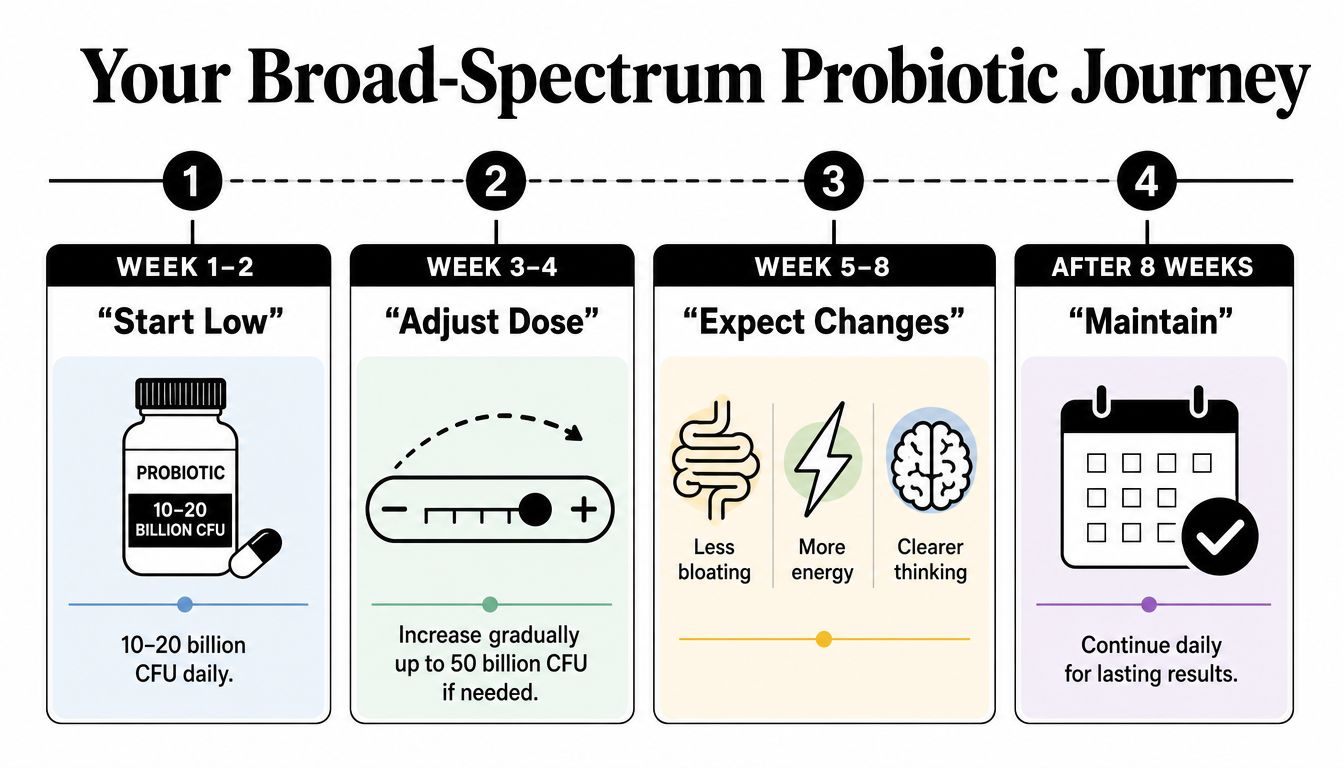
Begin with the product directions and change only one gut-health variable at a time. A broad-spectrum routine is sometimes offered across a range of 10 to 50 billion CFUs, but the suitable amount depends on the formula, strain viability, personal sensitivity, and reason for use. A larger CFU count does not automatically mean better results.
If IBS symptoms are easily triggered, start cautiously. Take the capsule consistently, record the symptom you want to change, and note any new reaction. Morning use with food may feel comfortable for some people. Other formulas specify bedtime or an empty stomach, so follow the label because delivery and survival conditions vary.
A practical observation schedule
- Early days: Mild gas or bloating may occur. Clear or sustained worsening deserves attention.
- The first few weeks: Track bowel rhythm, stool consistency, abdominal comfort, and symptoms after meals.
- Later in the trial: Compare your notes with the original goal. Continuing makes more sense when the target symptom is changing without troublesome effects.
- At the 12-week point: Stop or reassess when there is no meaningful improvement, consistent with clinical IBS guidance.
Pause the product and seek advice if symptoms keep worsening or you develop a new reaction, such as a skin eruption or severe digestive distress. Blood in the stool, fever, dehydration, severe pain, or ongoing diarrhea requires medical evaluation rather than prolonged self-treatment.
People who are immunocompromised, seriously ill, hospitalized, or using a central venous catheter should consult a clinician before taking probiotics. A 2025 review found a concerning association between over-the-counter mixed probiotics and poorer outcomes during immune checkpoint inhibitor therapy. The finding does not apply to every person or product, but it shows why treatment context matters. Anyone receiving cancer immunotherapy should ask the oncology team before starting a supplement.
A probiotic should support a plan, not replace assessment of the underlying problem. Keep the trial specific, measurable, and easy to stop. That approach treats broad spectrum as a symptom-matching decision, not a contest to collect the most strains.
Choosing the Right Formula for IBS, Women, and Clinicians
A person with constipation one week, loose stools the next, and persistent bloating needs a different discussion from someone with one stable symptom. The right meaning of broad spectrum is therefore symptom matching, not a matter of counting strains alone.
For mixed IBS, shifting constipation, diarrhea, bloating, and pain can make a broader formula reasonable because it may address several relevant categories at once. A constipation-dominant pattern may call for a more focused product, such as one containing Bifidobacterium lactis DN-173010, a strain associated by the World Gastroenterology Organisation with faster gastrointestinal transit and more frequent stools. In this case, a targeted formula may fit better than a large blend.
For diarrhea-predominant symptoms, Saccharomyces boulardii may be a more logical targeted option, depending on the cause and clinical context. Ongoing diarrhea, possible infection, or symptoms after antibiotics need assessment rather than indefinite self-treatment.
A women's probiotic often aims to support digestion alongside vaginal or urinary health. Lactobacilli-focused products may suit that goal, but pregnancy, breastfeeding, recurring urinary symptoms, vaginal symptoms, and medication use call for clinician guidance.
Clinicians should review immune status, antibiotics, age, diagnosis, and whether the patient can track changes reliably. Safety depends on the strain, formulation, and treatment setting, as noted in the 2025 cancer-immunotherapy review and later safety guidance.
Choose broad-spectrum when symptoms are multiple or shifting, and choose targeted when one symptom dominates.
Practical Questions Buyers Ask Before They Commit
Most modern shelf-stable capsules don't require refrigeration, but storage depends on the organisms and formulation. Spore-based products and Saccharomyces boulardii formulas can have different requirements, so follow the label rather than assuming every probiotic is room-temperature stable.
A bottle should support a consistent trial that matches the product directions and the up to 12-week IBS guidance. Compare CFUs guaranteed at expiry, full genus-species-strain names, delivery technology, allergen information, and testing documentation.
Be cautious with proprietary blends that hide individual amounts, labels without an expiration-date potency guarantee, and products offering no meaningful third-party verification. The final checklist is simple: specific strains, transparent potency, appropriate storage, relevant evidence, and a clear stop rule.
GutRx offers targeted and broad gut-support options, including formulas built around next-generation probiotics, prebiotics, and digestive balance goals. Review the available products and choose the formula that best matches your symptom pattern by visiting GutRx.


