

You finish a meal with wheat, onion, garlic, beans, or dairy, and the discomfort arrives before you've even left the table. Your abdomen feels stretched, gas builds, and you start wondering whether the low FODMAP diet has failed. Low FODMAP digestive enzymes may help, but only when the enzyme matches the FODMAP that triggered your symptoms. A broad “digestive support” label isn't enough.
The practical approach is simple: use your structured reintroduction results to identify the problem substrate, then consider a targeted enzyme for that food. Enzymes are an adjunct to dietary personalization, not a replacement for the low FODMAP process or professional care.
Table of Contents
- Why Bloating After FODMAP Meals Needs a Targeted Enzyme
- What FODMAPs Are and Why They Cause Bloating
- The Main FODMAP Digestive Enzymes and What Each One Does
- How Enzymes Fit Into the Low FODMAP Diet
- What the Evidence Actually Shows
- How to Choose a Low FODMAP Digestive Enzyme Product
- Common Misconceptions About Enzyme Supplements
- Putting It Together for Your Trigger Foods
Why Bloating After FODMAP Meals Needs a Targeted Enzyme
Bloating after a meal that seemed acceptable can be especially frustrating during FODMAP reintroduction. You may have tolerated a food in one setting, then reacted after eating a larger portion, combining it with other ingredients, or ordering it at a restaurant. The reaction doesn't necessarily mean the entire food category is permanently off limits.
Two explanations are common. You may still be sensitive to a particular FODMAP group, such as fructans or galacto-oligosaccharides, also called GOS, and the reintroduction has revealed that sensitivity. Or a packaged or restaurant meal may contain ingredients that are difficult to identify from a menu or label, including onion, garlic, wheat-based components, dairy, or sweeteners containing polyols.
Start with the trigger, not the supplement
Enzymes work on particular carbohydrate structures. Alpha-galactosidase targets GOS, while lactase targets lactose. Fructan-targeting preparations are designed for fructans found in foods such as wheat, onion, garlic, and inulin-containing ingredients. None of these enzymes is a universal solution for every FODMAP group.
That's why choosing a product first and trying to make your diet fit it can create confusion. If a capsule contains lactase but your reaction came from garlic fructans, the product isn't addressing the relevant substrate. Similarly, alpha-galactosidase won't correct symptoms caused by lactose or polyols.
Practical rule: Identify the food group that caused symptoms during reintroduction before selecting an enzyme.
Monash recommends considering digestive enzymes after the relevant stages of the low FODMAP protocol, when you've identified specific sensitivities rather than avoiding all FODMAPs indefinitely. You can also review common digestive concerns in this guide to enzyme deficiency symptoms, while remembering that post-meal bloating alone doesn't establish an enzyme deficiency.
A FODMAP-trained dietitian can help separate dose-related reactions from genuine intolerance and check whether another factor is contributing. Persistent, severe, or changing symptoms deserve clinical evaluation rather than progressively larger supplement doses.
What FODMAPs Are and Why They Cause Bloating
FODMAP stands for Fermentable Oligosaccharides, Disaccharides, Monosaccharides, And Polyols. These are short-chain carbohydrates that may be poorly absorbed in the small intestine. When they remain in the intestinal contents, they can draw water into the gut through osmosis and later become available for bacterial fermentation in the colon.
That fermentation produces gases including hydrogen, methane, and carbon dioxide. In people with IBS or heightened gut sensitivity, the combination of fluid, gas, intestinal movement, and altered sensation can contribute to distension, cramping, rumbling, and flatulence.
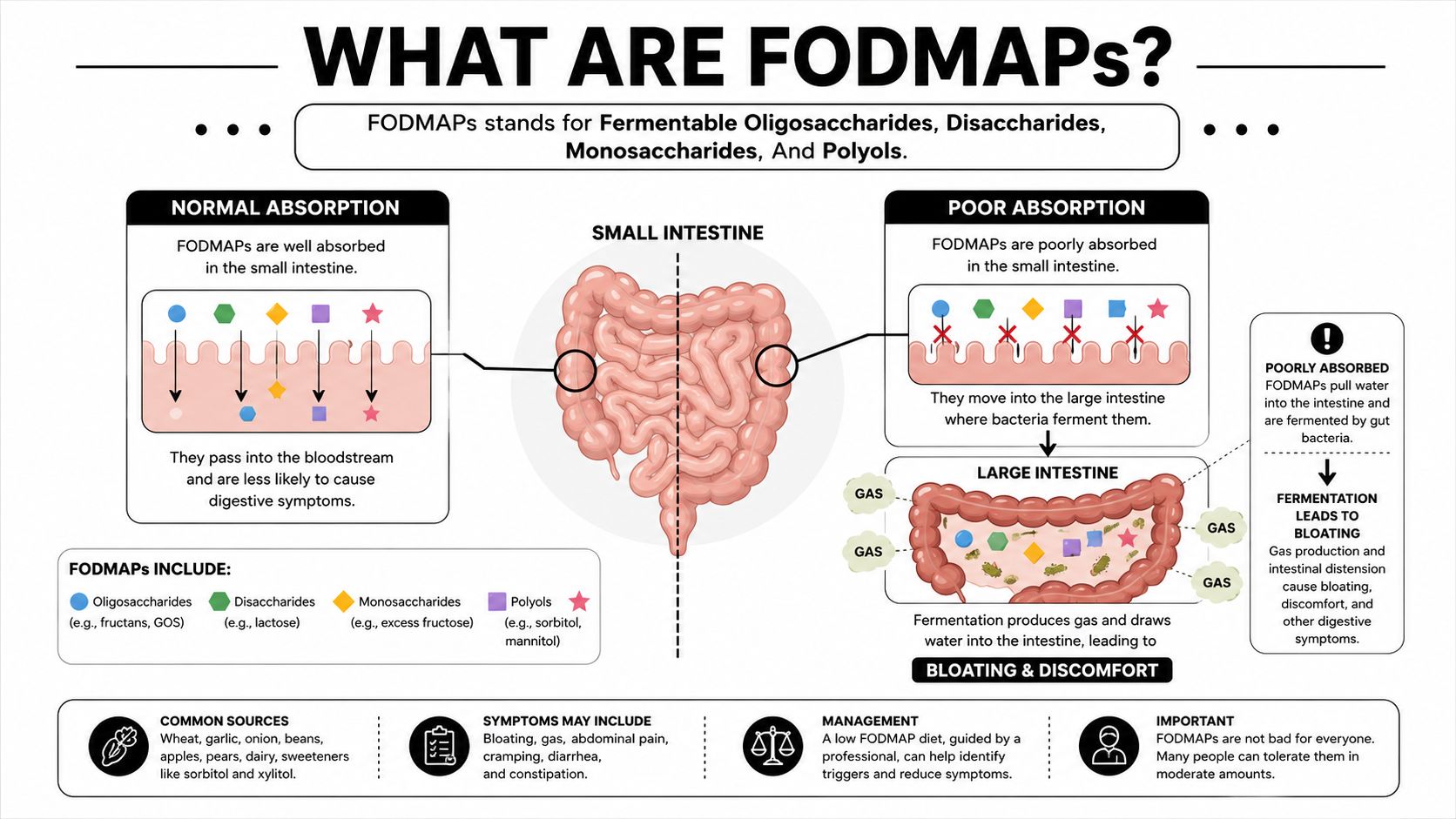
The four groups relevant to enzyme selection
- GOS: These galacto-oligosaccharides occur especially in beans, lentils, chickpeas, soy products, and some nuts. They're the main substrate for alpha-galactosidase.
- Fructans: Wheat, onion, garlic, leek, artichoke, and inulin-type ingredients can supply fructans. Fructan-targeting blends are designed around this group.
- Lactose: Milk, ice cream, soft cheeses, and some yogurts contain lactose. Lactase breaks lactose into smaller sugars that are easier to absorb.
- Polyols: Sorbitol and mannitol occur in some fruits, vegetables, and sugar-free products. They're absorbed through transport processes that aren't reliably addressed by standard over-the-counter enzymes.
Excess fructose is another FODMAP category, but it's largely a transport and absorption issue rather than a clear target for an established over-the-counter enzyme. That distinction matters because a supplement marketed as “complete” may still not address every FODMAP in a mixed meal.
The important question isn't whether a product contains many enzymes. It's whether it contains an active enzyme capable of acting on the carbohydrate you personally react to.
The Main FODMAP Digestive Enzymes and What Each One Does
A useful enzyme label should tell you what the formula targets. The active ingredient matters more than the phrase “broad spectrum.” Alpha-galactosidase, lactase, and fructan-targeting enzymes have different jobs, and their food applications shouldn't be treated as interchangeable.
Alpha-galactosidase for GOS
Alpha-galactosidase hydrolyzes the α(1→6) bonds in GOS. That makes it the logical match for gas and bloating linked to beans, lentils, chickpeas, soy milk, and similar foods. Evidence synthesized in a recent review supports its use when symptoms are triggered by high-GOS foods, but not as a general treatment for IBS on an unrestricted diet or for unrelated FODMAP groups. This review of digestive enzymes and IBS explains why substrate matching matters.
Lactase for lactose
Lactase, also called beta-galactosidase, acts on lactose in dairy. It may be useful for someone who has confirmed or strongly suspected lactose maldigestion and wants to eat a lactose-containing food. It won't address reactions to milk proteins such as casein, dairy fat, or non-dairy ingredients in a dessert.
Monash describes lactase as an adjunct for lactose intolerance, not a standalone treatment for IBS symptoms. Its guidance on digestive enzyme supplements places lactase alongside broader IBS strategies rather than presenting it as a replacement for them.
Fructan-targeting enzymes
Inulinase or other fructan-targeting enzymes are marketed for foods such as wheat, onion, garlic, leek, and inulin-containing products. Laboratory findings are encouraging, but human evidence is less established than the evidence for matching alpha-galactosidase to GOS or lactase to lactose. A promising activity result in a test system doesn't automatically prove relief from garlic- or onion-related symptoms at a real meal.
Polyol options deserve the most caution. There isn't a well-validated over-the-counter enzyme that reliably degrades sorbitol or mannitol, and excess fructose also lacks a straightforward enzyme solution.
| Enzyme Class | FODMAP Substrate | Trigger Foods | Evidence Level |
|---|---|---|---|
| Alpha-galactosidase | GOS | Beans, lentils, chickpeas, soy products | Strongest when symptoms are linked to high-GOS foods |
| Lactase | Lactose | Milk, ice cream, soft cheeses, some yogurt | Supported for lactose intolerance, not IBS alone |
| Fructan-targeting enzymes | Fructans and inulin-type fructans | Wheat, onion, garlic, leek, artichoke | Mechanistically promising, with human evidence still developing |
| Polyol-targeting products | Sorbitol and mannitol | Some fruits, vegetables, and sugar-free products | Limited and not well validated for routine OTC use |
For people seeking a product for meal-related digestive support, GutRx MEALTIME is described as a digestive enzyme supplement designed to support digestion, reduce bloating, and enhance nutrient absorption.
How Enzymes Fit Into the Low FODMAP Diet
The low FODMAP diet isn't intended to be a permanent food blacklist. Monash describes a three-step process: Step 1, elimination; Step 2, reintroduction; and Step 3, personalization. The purpose of the first step is to reduce symptoms, while the second tests individual FODMAP groups and the third builds a diet that's as broad and practical as your tolerance allows.
Enzymes fit most logically into personalization. After you've completed elimination and structured challenges, you may know that lactose causes trouble but GOS doesn't, or that garlic is a more reliable trigger than wheat. That information gives you a rational reason to test a matching enzyme.
Use the sequence to preserve useful information
Taking enzymes throughout elimination can blur the picture. If symptoms stay away, you won't know whether the improvement came from avoiding the trigger or from the supplement. During reintroduction, masking symptoms may also make it harder to determine your personal threshold.
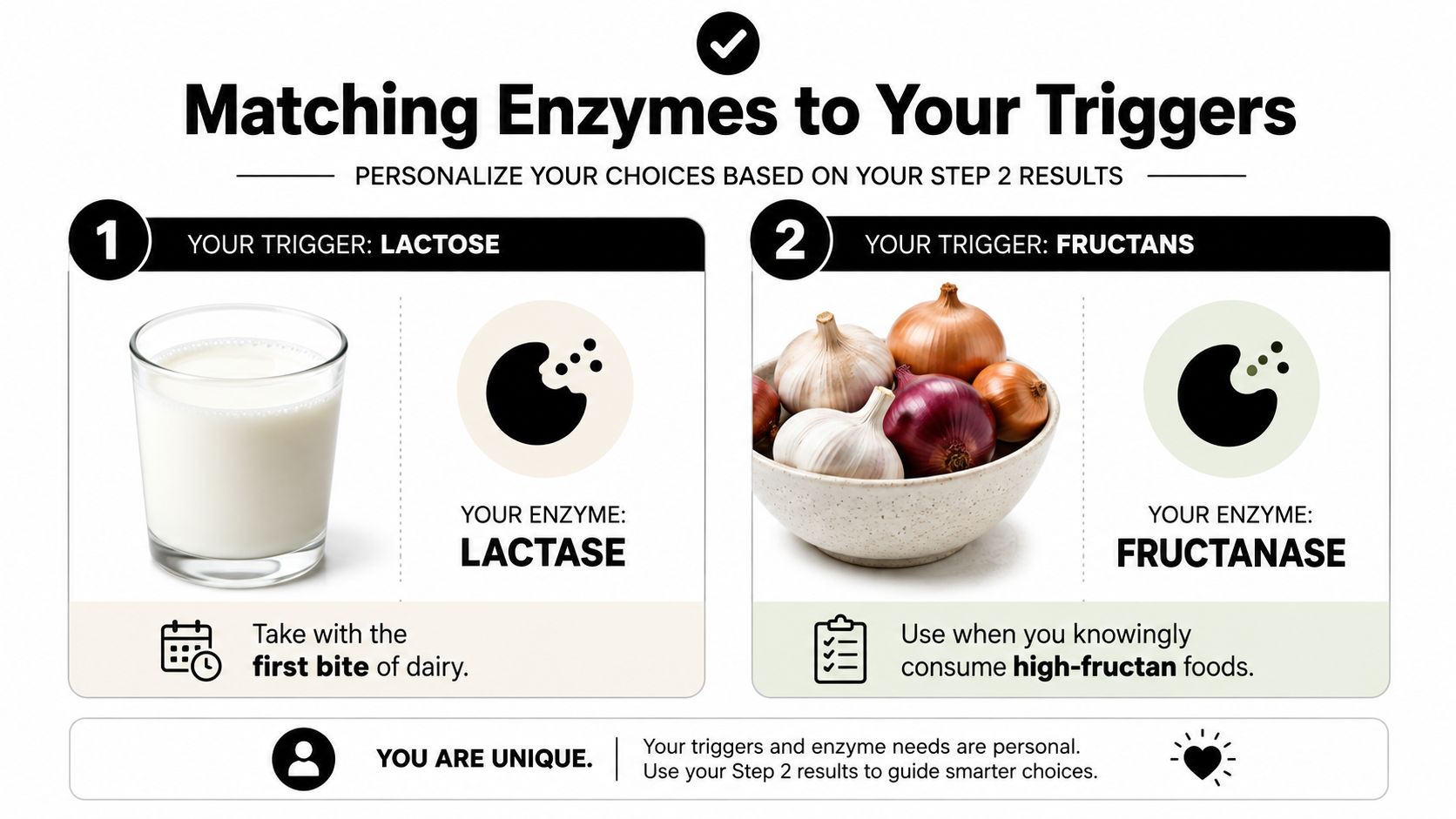
A targeted enzyme can be useful when you knowingly eat a trigger food outside your usual routine. For example, someone who reacts to lactose might take lactase with the first bite of dairy. Someone who reacts to GOS might use alpha-galactosidase with a bean-based meal. A fructan-targeting formula may be considered when a reintroduction has linked symptoms to garlic, onion, wheat, or inulin.
The enzyme generally belongs with the meal, not long after symptoms have begun. It also isn't needed for a baseline meal that contains no known trigger. Follow the product's label directions, and ask a pharmacist or clinician about compatibility if you take medicines or manage a diagnosed gastrointestinal condition.
A short explanation can help make the timing easier to remember.
What the Evidence Actually Shows
The evidence doesn't support treating all low FODMAP digestive enzymes as one category. Results depend on the substrate, the food dose, the person's underlying digestion, and whether the product was tested in a laboratory model or in humans.
A 2022 in vitro study examined a targeted FODMAP enzyme blend. In the model, 1.125 g of the blend converted 90% of inulin to fructose after 30 minutes, and 70% of the released fructose was absorbed during simulated small-intestinal transit. The model also showed lower microbial gas production, while preserving most downstream fermentation byproducts, with only a small decrease in butyrate and other short-chain fatty acids. Read the full in vitro study. These findings are mechanistic, not proof that every person will experience the same response after eating garlic or onion.
More recent human-use data add context. A 2026 prospective real-world cohort followed 118 participants for 4 weeks. In that study, 78.0% reported improvement in bloating and flatulence, while 65.3% reported improvement in abdominal pain. Among the symptom subgroups, 75.0% of IBS-D participants reported improvement in diarrhea, and 72.7% of IBS-C participants reported improvement in constipation. None of the participants reported adverse outcomes. Review the prospective cohort report. Because this was a real-world cohort rather than a blinded randomized trial, it should be viewed as encouraging human-use evidence, not a universal guarantee.
| Enzyme | FODMAP Target | Evidence Type | Symptom Outcome |
|---|---|---|---|
| Alpha-galactosidase | GOS | Evidence synthesized in review, with benefit tied to high-GOS meals | May help when legumes and other GOS foods are the trigger |
| Lactase | Lactose | Established adjunct for lactose intolerance | May support dairy digestion in lactose-sensitive people |
| Fructan-targeting blend | Fructans and inulin | In vitro study plus prospective real-world human data | Encouraging for multiple symptoms, but results don't prove every fructan food will be tolerated |
| Polyol-targeting options | Sorbitol and mannitol | Limited validation | No reliable blanket expectation of benefit |
The central limitation remains substrate specificity. A positive laboratory finding can show that an enzyme acts on a carbohydrate under controlled conditions, but it can't establish that the same capsule will resolve symptoms from a complex restaurant meal.
How to Choose a Low FODMAP Digestive Enzyme Product
Start with your food challenge notes, not the front of the bottle. Write down the food, portion, other ingredients in the meal, timing of symptoms, and the symptom pattern. This makes it easier to distinguish a repeatable trigger from a one-off reaction caused by a large mixed meal, stress, or another variable.
Match the active enzyme
Use the label as a compatibility check:
- GOS reaction: Look for alpha-galactosidase if beans, lentils, chickpeas, or soy products consistently cause gas.
- Lactose reaction: Look for lactase when milk or another lactose-containing dairy food is the clear trigger.
- Fructan reaction: Look for a specifically labeled fructan- or inulin-targeting enzyme when garlic, onion, leek, wheat, or inulin is implicated.
- Polyol reaction: Treat claims cautiously. Sorbitol and mannitol symptoms may not respond to ordinary digestive enzyme blends.
One enzyme, one trigger, one meal at a time is a clearer starting strategy than taking a large mixture and trying to interpret the result.
Read activity units, not only milligrams
The weight of an enzyme ingredient doesn't tell you how active it is. Look for the relevant activity unit on the label, such as GalU for alpha-galactosidase or ALU for lactase, and compare products within the same enzyme category. Follow the serving instructions rather than assuming that more capsules will provide better protection.
Quality documentation matters too. A company that provides current third-party testing and a product-specific Certificate of Analysis gives you more information than a label with only marketing language. This Certificate of Analysis guide explains why a COA can help verify identity, potency, and quality information.
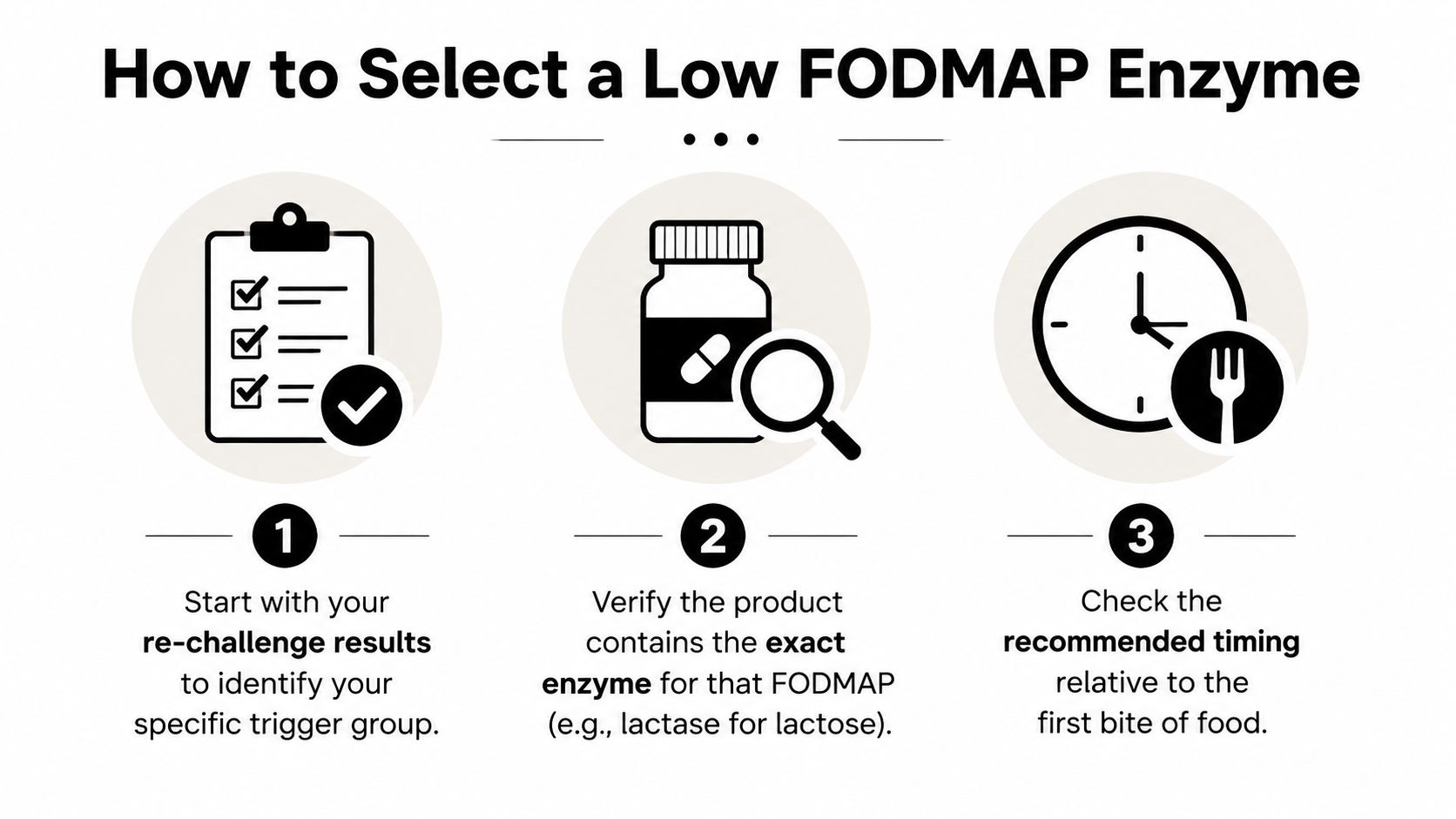
Check allergen statements, excipients, storage instructions, and manufacturing standards that matter to you. If you need vegan, gluten-free, or other dietary criteria, verify the finished product rather than assuming the enzyme source. A targeted formula is often easier to evaluate than a “super enzyme” blend containing several actives you may not need.
Common Misconceptions About Enzyme Supplements
The most common mistake is assuming that more enzymes equal better digestion. Enzymes don't work as a general force field around a meal. Alpha-galactosidase acts on GOS, while lactase acts on lactose, so adding both doesn't make either one more effective against an unrelated fructan or polyol.
Timing also limits what a supplement can do. Enzymes act while food is being digested in the upper gastrointestinal tract. They can't travel backward in time to change a food eaten hours earlier, and they can't reliably undo a mixed-trigger meal after fermentation and symptoms have already developed.
| Common Myth | What the Evidence Shows |
|---|---|
| “A broad blend covers every FODMAP.” | Each enzyme has a defined substrate, and excess fructose and polyols aren't reliably addressed by standard OTC products. |
| “I can use enzymes instead of elimination and reintroduction.” | Monash places enzyme use after Steps 1 and 2, as a targeted adjunct during personalization. |
| “A larger dose guarantees a better result.” | Activity, food dose, timing, and trigger matching matter more than simply increasing capsules. |
| “Enzymes treat the cause of persistent GI symptoms.” | They're food-digestion tools, not treatments for SIBO, celiac disease, inflammatory bowel disease, or every cause of bloating. |
| “The label proves the product contains its stated potency.” | Third-party verification and a current COA provide stronger quality documentation than label claims alone. |
Digestive enzyme supplements also aren't regulated in the same way as prescription medicines. Potency and testing can vary between products, so it's reasonable to look for transparent documentation and avoid escalating use when the intended enzyme hasn't helped.
Persistent diarrhea, constipation, pain, vomiting, bleeding, weight change, or symptoms that progressively worsen call for medical assessment. A clinician can evaluate the underlying problem instead of allowing supplement experimentation to delay diagnosis.
Putting It Together for Your Trigger Foods
Use your Step 2 results as the decision map. If lactose triggered symptoms, lactase with the first bite of dairy is the logical match. If GOS from legumes caused gas, alpha-galactosidase at the start of that meal fits the substrate. If garlic, leek, onion, wheat, or inulin caused bloating, a labeled fructan-targeting blend is the more relevant trial, though evidence for this category is still developing.
Test one enzyme and one trigger meal at a time. Track the response across two to three exposures, then reassess rather than adding several products at once. Polyol triggers may require dietary portion management and clinical guidance because reliable OTC enzyme options are limited.
Enzymes are generally well tolerated, but mild gastrointestinal upset can occur. Stop use and consult a clinician if symptoms worsen, new symptoms appear, or you're concerned about an underlying disorder.
If you're looking for a quality-verified option for FODMAP meals, compare the product's labeled enzyme targets, activity units, testing documentation, and timing instructions with your own re-challenge results.
GutRx offers digestive enzyme support through its Mealtime formula, along with probiotic options for broader digestive balance. Visit GutRx to review the available products and choose support that matches your specific food and gut-health goals.


