

Lactobacillus acidophilus and Bifidobacterium longum are distinct probiotic species, and the research applies to the specific strain, not automatically to every product carrying either name. The most useful buying checks are the strain designation, viable CFU for each organism at expiry, and the formulation that protects those cells during storage and digestion.
You're standing in front of a probiotic label that lists both names, wondering whether a larger CFU number means a better product. It doesn't necessarily. L. acidophilus and B. longum are different organisms with different habitats and research histories, so the species names are only the beginning of a responsible comparison.
Table of Contents
- Two Familiar Names, Two Very Different Bacteria
- Where Each Strain Name Comes From
- How Each Organism Works Inside the Gut
- Clinical Evidence for Bloating, IBS, and Diarrhea
- L. Acidophilus Versus B. Longum in Practical Terms
- Dosing, Timing, and Storage That Matter
- Synbiotics, Prebiotics, and Delivery Systems
- Safety, Side Effects, and Who Should Be Cautious
- How to Read a Label Like a Practitioner
- Putting It Together: Choosing the Right Product
- Quick Answers Buyers Ask Before They Buy
Two Familiar Names, Two Very Different Bacteria
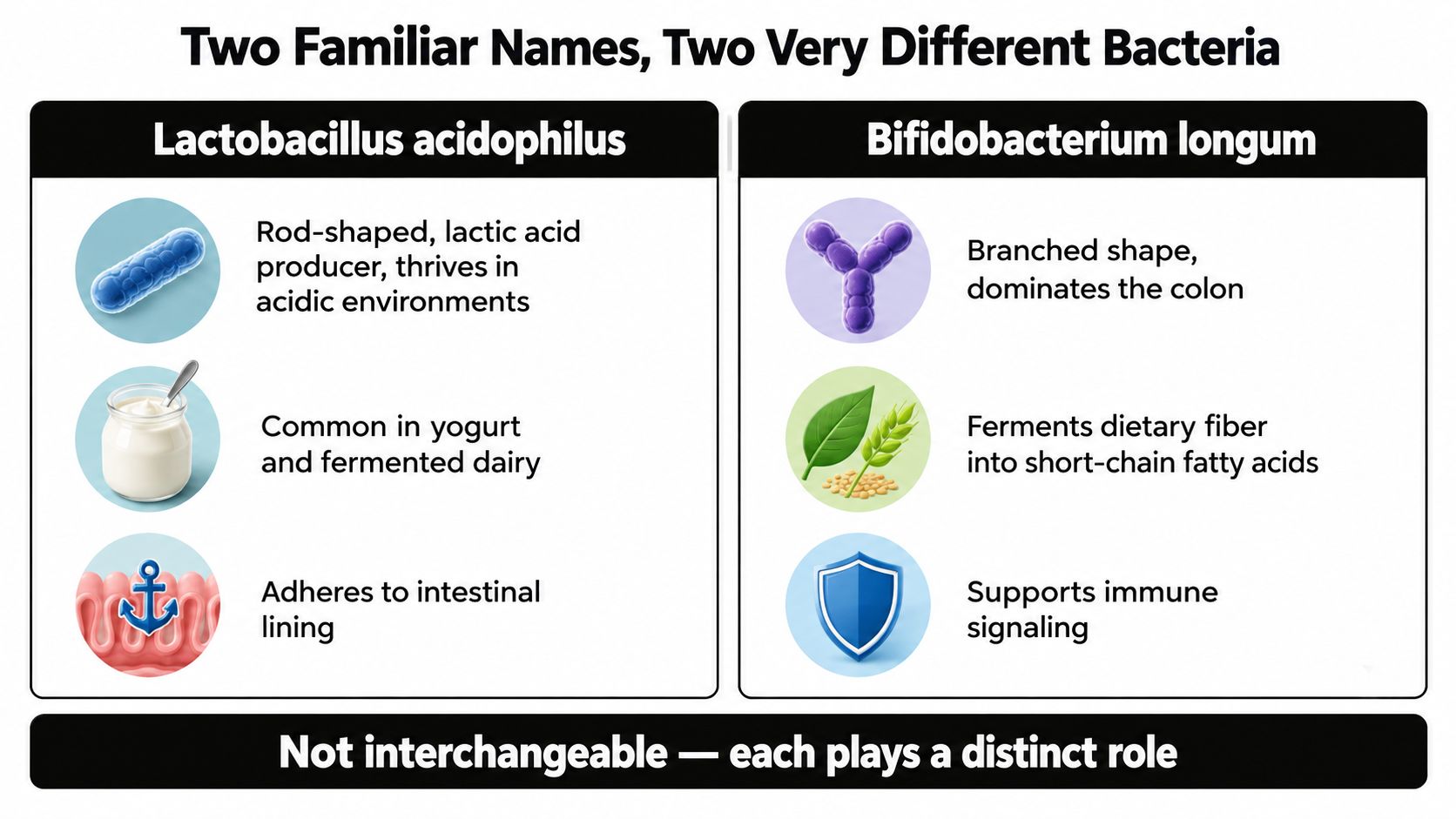
Lactobacillus acidophilus is a lactic-acid-producing bacterium associated with acidic environments and the upper parts of the digestive tract. Bifidobacterium longum belongs to a separate bacterial genus and is strongly associated with the colon and early infant intestinal microbiota. Their biology overlaps enough to make a combination plausible, but not enough to treat them as interchangeable digestive aids.
That distinction matters if your goal is support for bloating, irregularity, IBS-related discomfort, or digestive balance. A label that says only “acidophilus and bifidobacterium” tells you the species category, not whether the exact organisms were used in a clinical study, remain viable through expiry, or are present in meaningful amounts.
Why a combination can make sense
A well-designed blend can provide different functional coverage rather than stacking duplicate ingredients:
- L. acidophilus produces lactic acid and has been studied in relation to digestive comfort, lactose-related symptoms, and bloating.
- B. longum ferments selected carbohydrates and has been investigated in IBS symptom support and intestinal comfort.
- The formulation determines whether both organisms survive manufacturing, storage, stomach passage, and the period before expiry.
The practical conclusion is simple. A product combining Lactobacillus acidophilus and Bifidobacterium longum may be reasonable for broad digestive support, but you should still ask for the complete strain codes, the amount of each strain, and evidence that matches your specific goal.
Practical rule: A familiar species name is a screening clue, not proof that the product will work for your symptom.
Where Each Strain Name Comes From
Species names have a long history, but they do not identify a specific product strain. In 1900, Austrian pediatrician Ernst Moro isolated an organism from infant feces and named it Bacillus acidophilus. Later taxonomic work moved it into the Lactobacillus genus, creating the familiar name Lactobacillus acidophilus.
Bifidobacteria followed a similar path. In 1899, Henri Tissier of the Pasteur Institute isolated an organism from breast-fed infants' feces and called it Bacillus bifidus. Older publications may use Lactobacillus bifidus, while later classification placed these organisms in the separate Bifidobacterium genus based on morphology, biochemical traits, cell-wall components, and DNA base composition. Researchers clarified the species distinction between B. longum subspecies and B. animalis in 1974.

The code after the species is the useful part
A strain code gives a species a reproducible research and manufacturing identity. Examples include NCFM for L. acidophilus, BB536 for B. longum, and 35624 for a clinically studied B. longum strain. NCFM has been produced commercially since 1972. Researchers later published its complete genome sequence in 2005, reporting 1,993,564 nucleotides and no plasmids (FEMS Microbiology Letters research).
FAO/WHO guidance recommends phenotypic characterization followed by validated genetic identification, with strain-discriminating methods and culture-collection information where feasible. A guide to compare probiotic strain benefits shows how these identifiers can affect product selection. The GutRx BALANCE catalog lists 30 billion CFUs per capsule and describes the product as containing next-generation probiotics for gut health, digestive balance, and immune support.
How Each Organism Works Inside the Gut
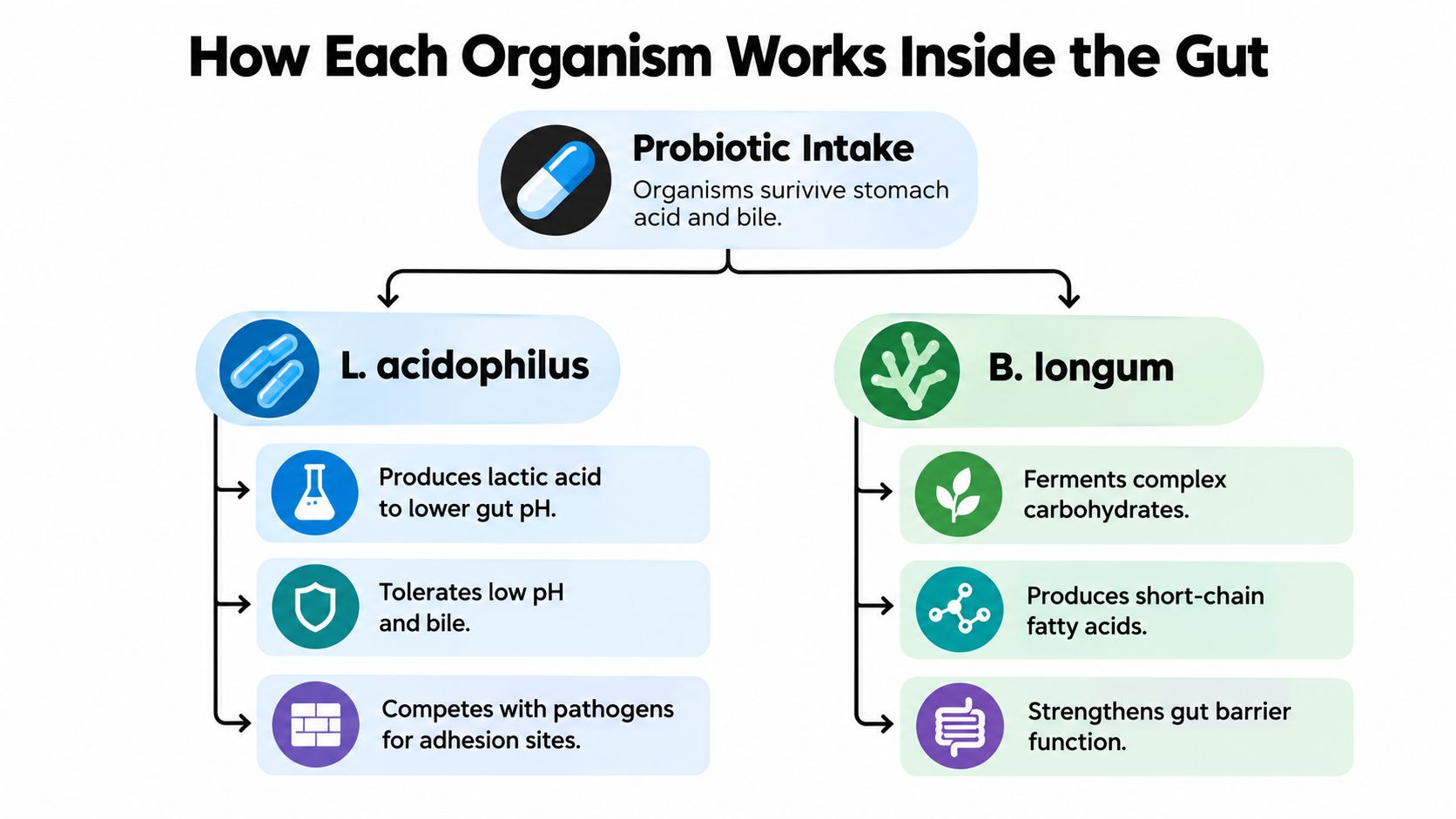
The appeal of pairing these species comes from their different metabolic tendencies. L. acidophilus is a lactic-acid bacterium that can tolerate acidic conditions and, depending on the strain, bile exposure. It may also compete with other organisms for adhesion sites, which is one reason researchers investigate it for digestive comfort and microbial balance.
B. longum occupies a different ecological niche. It ferments selected complex carbohydrates and produces metabolites such as acetate and lactate. Those products can contribute to a lower colonic pH and provide a metabolic environment associated with intestinal function, although the precise effect depends on the strain, available substrate, dose, and host context.
Translating mechanisms into symptoms
Mechanisms can suggest a use case, but they don't establish a guaranteed outcome:
- Bloating after meals: A preparation containing L. acidophilus may be relevant, particularly when the evidence comes from the same strain and formulation.
- Irregularity and IBS-type symptoms: B. longum has a stronger reason to be considered when the product identifies a studied strain.
- Broad digestive balance: A combination can make sense when each strain is individually verified and separately quantified.
- Barrier and mucin interactions: These are strain-variable properties. You can't assume that every organism labeled B. longum behaves like a research strain.
For background on the role of acidophilus in digestive formulations, see this explanation of Lactobacillus and why you need it. The key buying lesson is that a mechanism supports a hypothesis. It doesn't replace a strain-matched human trial or a verified finished-product specification.
Clinical Evidence for Bloating, IBS, and Diarrhea
The human evidence supports cautious optimism, not species-wide promises. An NIH-reviewed meta-analysis of 10 randomized trials involving 877 adults found lower pain scores in probiotic groups containing B. longum, L. acidophilus, or related species, but the products and strains were not identical (NIH Office of Dietary Supplements review).
A 2024 network meta-analysis examined 54 double-blind randomized controlled trials involving 6,732 participants and reported a standardized mean difference of −0.41, with a 95% confidence interval from −0.59 to −0.23, for overall IBS symptoms compared with placebo (Nutrients systematic review and network meta-analysis). The analysis found that combinations dominated by Bifidobacterium and Lactobacillus strains were associated with improvements in overall symptoms, abdominal pain, and IBS-related quality of life. That pooled result doesn't prove that every acidophilus and longum blend performs identically.
Study-specific evidence matters
| Study Reference | Population | Strains or Species | Duration | Reported Outcome |
|---|---|---|---|---|
| NIH-reviewed meta-analysis | 877 adults across 10 randomized trials | Products containing B. longum, L. acidophilus, or related species | 4 weeks to 6 months | Lower pain scores than placebo |
| 2024 network meta-analysis | 6,732 participants across 54 double-blind trials | Probiotic combinations, including Bifidobacterium and Lactobacillus strains | Study-dependent | Improvement in overall IBS symptoms, pain, and quality of life |
| B. longum 35624 study | Adults with IBS | B. longum 35624 | 8 weeks | 38.71% achieved a clinically meaningful reduction of more than 30% in total IBS symptom severity after 1 week (study report) |
| L. acidophilus bloating trial | Adults with abdominal bloating | A preparation containing L. acidophilus | 4 to 8 weeks | At 4 weeks, mean bloating scores were 4.10 versus 6.17 for placebo, with p=0.009; at 8 weeks, scores were 4.26 versus 5.84, with between-group p=0.06 and change in severity p<0.01 (clinical trial) |
These findings can help you shortlist a product, but they can't justify treating a species name as a clinical guarantee. If constipation-predominant IBS is your concern, diet and symptom triggers still matter, so a practical resource on foods to avoid with IBS constipation may complement, rather than replace, strain-focused product selection. For more on longum-specific evidence, review the benefits of Bifidobacterium longum.
L. Acidophilus Versus B. Longum in Practical Terms
The two organisms differ in ways that affect both expectations and product design. L. acidophilus is generally more comfortable in acidic, oxygen-tolerant manufacturing environments than bifidobacteria, while B. longum is more vulnerable to oxygen and moisture. That difference makes packaging, capsule technology, and expiry potency especially important for a combination product.
| Practical question | L. acidophilus | B. longum |
|---|---|---|
| Primary ecological association | Upper digestive tract and small-intestinal environment | Colon and infant intestinal microbiota |
| Main metabolic theme | Lactic-acid production | Fermentation of selected carbohydrates and production of acetate and lactate |
| Common research interests | Bloating, lactose-related discomfort, digestive balance | IBS symptoms, abdominal discomfort, regularity, lactose-related combinations |
| Formulation concern | Acid and bile survival varies by strain | Oxygen, moisture, and gastric-acid protection can be especially important |
| What the label must show | Complete strain code and viable amount | Complete strain code and viable amount |
Match the evidence to the problem
For bloating after meals, an acidophilus-containing product may be a sensible candidate when its strain and study duration match the intended use. For irregularity or IBS-type discomfort, a product naming a studied B. longum strain offers more useful information than one listing only “bifidobacteria.”
A blend isn't automatically superior to a single strain. It becomes more defensible when the manufacturer identifies every strain, quantifies each one, and explains how the delivery system preserves viability through expiry.
Dosing, Timing, and Storage That Matter
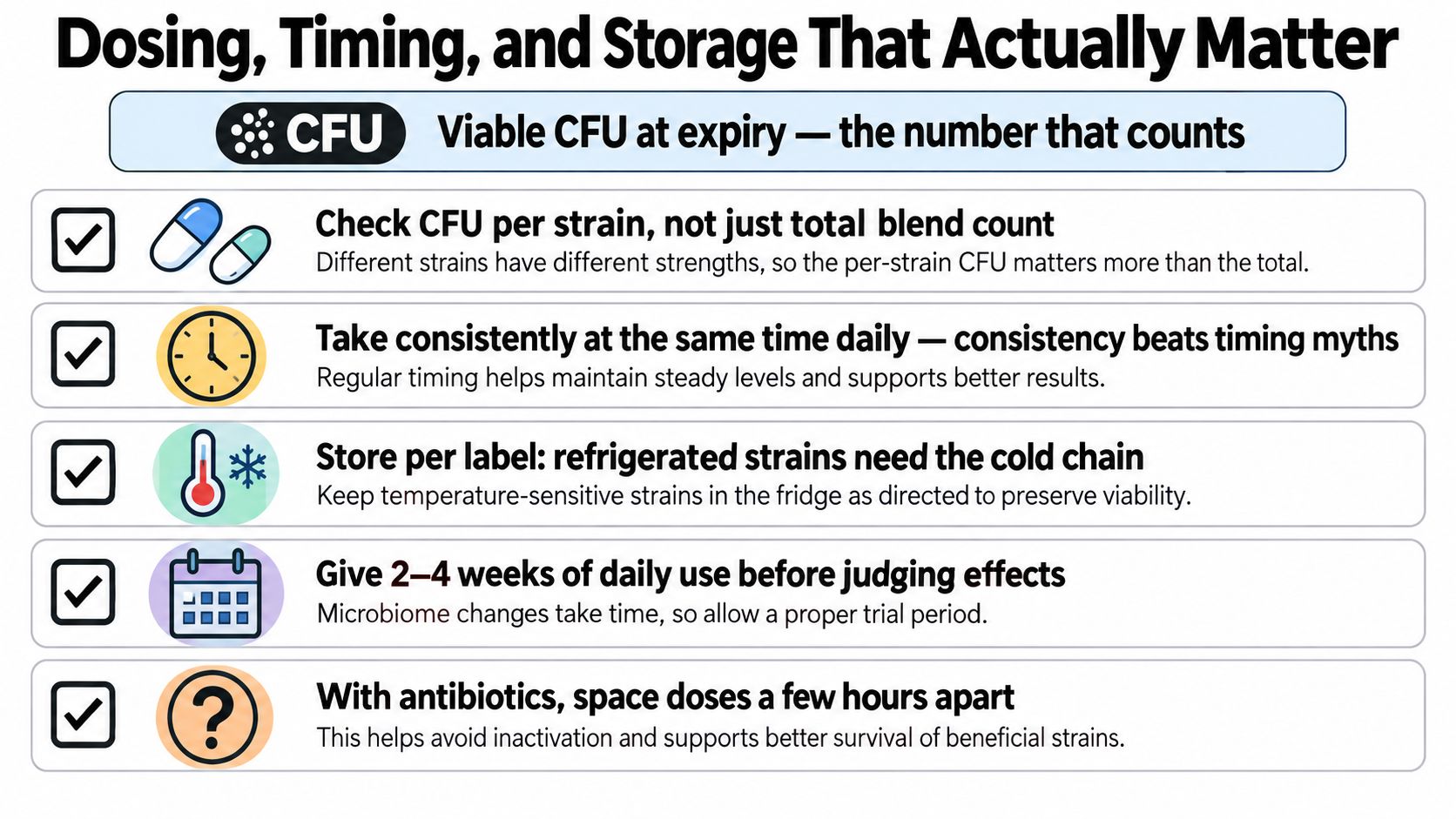
A label claiming “50 billion CFU at time of manufacture” does not show how much may remain when you take the final dose. Prefer products that state the viable amount for each strain at expiry, with storage conditions that support that claim. FAO/WHO and Codex materials emphasize maintaining viability through shelf life and consumption, and stating each strain's count where applicable.
A practical routine
- Read the label first. Follow the listed dose, storage instructions, and expiry date. A larger headline CFU does not guarantee a stronger clinical effect.
- Use a repeatable schedule. Consistency supports adherence. Food instructions differ by formulation, so follow the manufacturer's directions rather than timing rules found online.
- Protect the package. Heat, moisture, and oxygen can reduce viability. This matters particularly for B. longum, which can be sensitive to oxygen exposure.
- Separate antibiotics when advised. Ask a pharmacist or clinician how much time to leave between a bacterial probiotic and an antibiotic. The appropriate interval depends on the medicines and product.
- Assess the response gradually. Digestive effects vary. If symptoms worsen or do not improve, review the strain, dose, formulation, and possible underlying cause before increasing CFUs.
For a powder or capsule, useful quality documentation includes strain-specific counts, acceptance limits at release and expiry, stability under labeled conditions, and moisture or water-activity controls. A total for a “probiotic blend” cannot show whether L. acidophilus and B. longum are each present in meaningful amounts.
Synbiotics, Prebiotics, and Delivery Systems
A probiotic is a live microorganism intended to provide a health benefit when administered in adequate amounts. A prebiotic is a substrate selectively used by host microorganisms, while a postbiotic contains non-viable microbial cells, components, or metabolites. A synbiotic combines a live microorganism with a substrate intended to work together, although the exact formula still needs product-specific evaluation.
For L. acidophilus and B. longum, the prebiotic choice can influence tolerability. Fermentable fibers may support microbial activity, but they can also aggravate gas or bloating in sensitive individuals. More ingredients aren't automatically better, especially when the product doesn't disclose the strain ratio or the amount of each active component.
Delivery is part of the dose
Delayed-release or acid-resistant capsules can reduce exposure to stomach acid before the contents reach the intestine. Moisture-controlled blister packs, oxygen-limited packaging, and validated shelf-stability claims are especially relevant to B. longum. These features don't prove efficacy, but they help protect the organisms the label promises to deliver.
A product that adds Saccharomyces boulardii, Akkermansia muciniphila, or other organisms should explain the role and identity of each one. Before comparing formulas, shoppers can review resources that help them buy pro and pre biotics online, then return to the same core checks: strain identity, expiry potency, testing, and symptom match.
Safety, Side Effects, and Who Should Be Cautious
A healthy adult may notice gas, abdominal fullness, or altered bowel movements after starting L. acidophilus, B. longum, or a multi-strain formula. Fermentable ingredients can contribute, and the response may reflect the full formulation rather than either named species. Mild, short-lived changes can settle. Persistent, severe, or rapidly worsening symptoms call for reassessment and stopping the product until advice is available.
Risk assessment is different for someone who is immunocompromised, critically ill, has serious underlying disease, a central venous catheter, short-bowel syndrome, or has recently undergone major surgery. The World Gastroenterology Organisation guidance describes pathogenic potential as low in generally healthy people, while recommending caution and clinician oversight for higher-risk groups.
A pharmacist or clinician should review use before starting if the person is hospitalized, seriously ill, pregnant, treating a child, or taking complex medicines. Antibiotic timing also needs product-specific advice. Probiotics are not interchangeable, and instructions for separating them from an antibiotic may differ.
Stop the product and seek medical guidance for fever, severe abdominal pain, persistent vomiting, blood in the stool, marked weakness, or quickly worsening symptoms.
Label quality remains part of safety. Look for strain identification, contamination controls, antimicrobial-resistance assessment, and monitoring after release. Laboratory or animal findings, including no detected resistance, mutagenicity, or toxicity at tested doses for selected strains, cannot establish equivalent safety for every commercial strain or medically complex user. Third-party testing is more meaningful when it covers the finished batch and verifies the stated identity and potency, rather than displaying an unsupported quality logo.
How to Read a Label Like a Practitioner
A product page may show impressive species names while hiding the details that determine whether the formula can be judged. Before recommending L. acidophilus and B. longum, I check identity, potency, testing, storage, and formulation rather than relying on the front label.
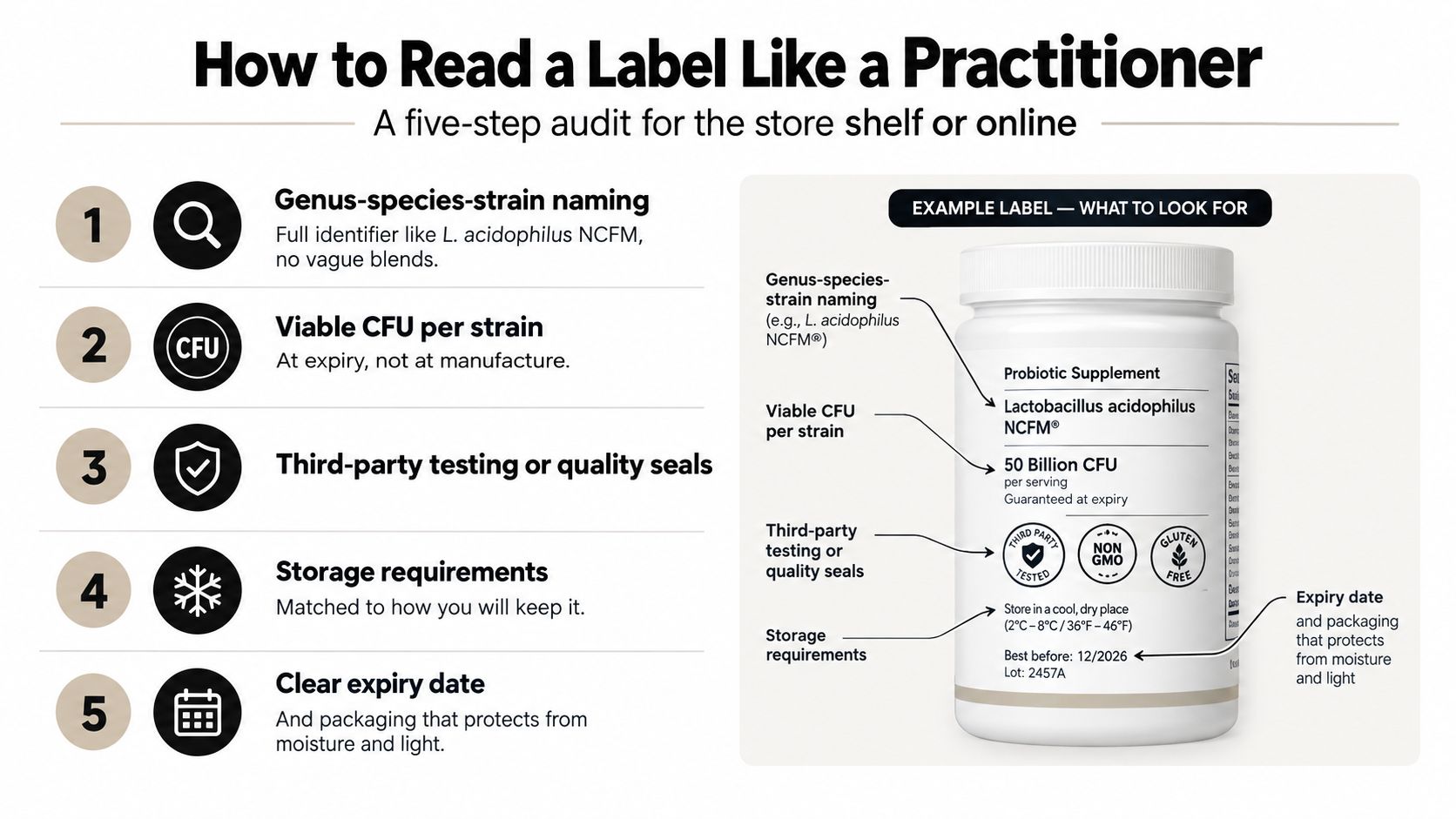
Start with the strain code. L. acidophilus NCFM and B. longum BB536 identify more specific organisms than species names alone. A “proprietary blend” that omits strain codes prevents a meaningful comparison.
Then check viable CFU for each strain at expiry, not only at manufacture. A combined count can conceal how little of one organism is included. For a plain-language explanation of what CFU stands for, review the label's definition and measurement point.
Testing should be traceable to the finished batch. A downloadable Certificate of Analysis, identity and potency results, and contamination testing provide more information than a quality logo without supporting records.
Storage instructions also need to fit your routine. Refrigeration, room-temperature stability, moisture protection, and delayed-release technology matter only if the product's directions match how you will store and use it.
Finally, inspect inactive ingredients and date clarity. Check allergens, capsule materials, sweeteners, fillers, vegan or non-GMO statements, and a readable expiry date.
| Label cue | What it can verify | What it can't prove |
|---|---|---|
| Full strain code | More specific product identity | Guaranteed symptom relief |
| CFU at expiry | Expected viable potency through shelf life | That the dose fits your condition |
| Downloadable COA | Batch-level testing transparency | Clinical efficacy |
| Delayed-release claim | Intended protection from gastric exposure | Survival unless validated |
| Vegan or non-GMO claim | Certain formulation attributes | Strain quality or effectiveness |
A label earns confidence by showing verifiable details, not by presenting the largest combined number. If strain contributions, expiry potency, or storage conditions remain undisclosed, choose a product with clearer documentation.
Putting It Together: Choosing the Right Product
Begin with the reason for taking a probiotic, then check whether the product's strain and formulation fit that goal. For bloating, look for strain-specific human evidence and a formulation you can tolerate. For IBS-type pain or irregularity, a named B. longum strain with research relevant to that symptom pattern is more informative than the species name alone. Lactose-related discomfort requires careful interpretation: a study involving B. longum BB536 also used L. rhamnosus HN001, vitamin B6, and a lactose-free diet, so it did not isolate B. longum’s effect (lactose-related probiotic review).
Product choice also affects how clearly you can judge the result. A single-strain formula can make a trial easier to interpret. Saccharomyces boulardii may suit a different antibiotic-related use case, while a synbiotic may appeal to someone seeking broader daily support.
Use these questions to narrow the options:
- Symptom match: Does the research address your specific concern?
- Strain match: Are complete strain codes listed?
- Dose match: Is the viable CFU amount stated through expiry?
- Tolerance match: Could added fermentable fibers worsen symptoms?
- Safety match: Do your medical circumstances require professional advice?
For readers comparing a broader formula with standard acidophilus and longum products, GutRx COMPLETE is described in its catalog as a high-potency probiotic and prebiotic blend with 62 billion CFUs, Akkermansia muciniphila, and SIBO support. Apply the same scrutiny to its strain details, expiry potency, storage directions, and safety considerations as you would to any other product.
Quick Answers Buyers Ask Before They Buy
Is the species name enough?
No. The complete strain designation is the meaningful unit for comparing research, safety information, manufacturing behavior, and product claims. A bottle listing only L. acidophilus and B. longum doesn't show whether its organisms match a studied preparation.
How long should I try it?
Human studies use different durations, so there isn't one universal schedule. Follow the product label, track the symptom you want to change, and reassess if the product causes persistent discomfort or shows no useful response.
Can I take these strains with antibiotics?
Sometimes, but don't improvise the timing. Ask a pharmacist or clinician whether the product should be separated from the antibiotic and whether a different strain or yeast preparation is more appropriate for your situation.
When should I seek medical advice?
Get professional guidance before use if you're immunocompromised, critically ill, hospitalized, pregnant, treating a child, or managing serious disease. Seek prompt advice for severe pain, blood in stool, fever, persistent vomiting, or rapidly worsening symptoms.
The best Lactobacillus acidophilus Bifidobacterium longum product isn't the one with the most impressive species list. It's the one with verified strains, viable CFUs at expiry, protective packaging, transparent testing, and evidence that fits your reason for taking it.
GutRx offers targeted digestive formulas built around strain-identified probiotics, prebiotics, postbiotics, and digestive-support ingredients, with third-party testing and downloadable Certificates of Analysis described in its product information. Review the available options and visit GutRx to compare a formula with the label, delivery, and symptom criteria discussed here.


