

A bottle labeled women's probiotic with Lactobacillus may contain a carefully studied strain, or it may just be a general digestive blend marketed toward women. How can you tell the difference before you buy? Start with the strain designation, delivery route, and outcome studied, because Lactobacillus is a genus, not a single intervention.
The evidence is encouraging but narrower than many product pages suggest. Controlled human research has examined selected Lactobacillus strains for vaginal microbial-balance markers, bacterial vaginosis, urinary symptoms, and other outcomes, yet studies remain small, varied, and dependent on the exact strain and formulation. The practical question isn't whether Lactobacillus is “good” in general. It's whether the product in front of you resembles the product tested for the problem you want to address.
Table of Contents
- What a Women's Probiotic with Lactobacillus Actually Does
- How Lactobacillus Works in the Gut and Vagina Together
- Key Lactobacillus Strains Studied for Women's Health
- Selection Criteria That Separate Strong Products from Weak Ones
- Oral Capsules Versus Vaginal Delivery and What the Evidence Shows
- Matching Formulas to Symptoms and Life Stages
- How to Use a Women's Probiotic for the Best Results
- Choosing the Right Product for Your Situation
What a Women's Probiotic with Lactobacillus Actually Does
What can a label tell you about whether a women's probiotic with Lactobacillus matches the research behind its claims?
A product may be an oral or vaginal supplement designed to deliver selected Lactobacillus organisms and support microbial balance. Some formulas focus on digestion, while others are developed around vaginal or urinary research. The label is a map of the intervention, not proof that the product treats bacterial vaginosis, yeast infection, urinary tract infection, or another diagnosed condition.
The useful details include the species, strain designation, delivery route, and how potency is measured through expiration. A bottle that lists only Lactobacillus offers far less information than one that names a species and strain, identifies oral or vaginal use, and explains its potency standard. The number of organisms in a capsule cannot make up for missing strain information.
Genus, species, and strain are different levels of information
“Lactobacillus” is the genus. Lactobacillus rhamnosus identifies the species, while GR-1 identifies a particular strain. These labels work like an address that becomes more precise at each level. Two strains from the same species may differ in survival, colonization, metabolites, and clinical evidence, so a study of one strain does not automatically validate every product in the genus.
A 2019 systematic review and meta-analysis examined four controlled trials involving different populations and four Lactobacillus strains. Probiotic supplementation was associated with a statistically significant improvement in Nugent score, a laboratory measure of vaginal dysbiosis, compared with placebo or control treatment. The analysis reported a standardized mean difference of −0.561, a 95% confidence interval from −0.935 to −0.186, and P=0.004. Participants receiving probiotics were also more likely to show an improved Nugent score, with an odds ratio of 3.902, a 95% confidence interval from 1.681 to 9.059, and P=0.001. The authors noted small sample sizes and clinically diverse populations (systematic review and meta-analysis).
Label-reading rule: If a product does not identify the species and strain, you cannot confidently connect it to a strain-specific study.
A basic explanation of how microbes and antimicrobial products interact appears in this BacteriaFAQ.com guide for facility managers. Choosing a supplement still requires attention to human clinical evidence, exact strain identity, and the outcome researchers measured.
How Lactobacillus Works in the Gut and Vagina Together
Could an oral women's probiotic with Lactobacillus affect both digestive health and the vaginal microbiome? Possibly, but the gut and vagina remain two adjacent gardens sharing some of the same soil, rather than one combined ecosystem. They have different conditions and microbial communities, although organisms, metabolites, mucosal barriers, and immune signals can connect them. This helps explain why an oral product may be studied for a vaginal outcome, while its results cannot automatically be applied to a vaginally delivered product.
Lactobacillus can support a lower-pH environment by producing lactic acid and may make it harder for less desirable organisms to attach or multiply. Some strains also produce substances that affect surrounding microbes. These mechanisms give researchers a plausible explanation for possible benefits, but they do not show that every product labeled Lactobacillus will prevent or resolve a particular infection. The strain, formulation, route, and measured outcome still matter.

Three mechanisms matter
First, competitive exclusion. Lactobacillus may occupy attachment sites, use available resources, or create conditions that restrict pathogen growth. That effect depends on whether the specific strain survives and reaches the site where it must act.
Second, immune interaction. Microbes communicate with mucosal tissues and immune cells. A strain that alters local signaling in one person or body site may produce a different response elsewhere. Genus-level marketing therefore cannot substitute for evidence on the exact strain in the product.
Third, metabolite production. Lactobacillus and other gut organisms produce compounds that can influence the intestinal environment and immune signaling. Those compounds may support the wider gut ecosystem, yet they do not prove that an oral supplement will establish itself in the vagina or treat a diagnosed infection.
The 2021 Cochrane review found that available research did not establish probiotics as superior to antibiotics for bacterial vaginosis, or as a reliable addition before, during, or after antibiotic treatment. Some comparisons produced statistical signals, but the trials differed substantially, and the review did not recommend routine probiotics as a replacement for antibiotic care (Cochrane review of probiotics for bacterial vaginosis).
An oral product may support the gut and contribute to vaginal microbial balance in some circumstances, but transfer is not guaranteed. Vaginal delivery places organisms closer to the intended site, while raising separate questions about adherence, tolerability, and study design.
Key Lactobacillus Strains Studied for Women's Health
A Lactobacillus label is only the beginning. The clinically useful question is which organism was studied for which outcome? A systematic review of randomized controlled trials on urogenital infections found possible benefits in bacterial vaginosis, recurrent candidiasis, urinary tract infections, and an HPV-related outcome. It also showed why genus-level marketing is insufficient: results depend on the strain, dose, formulation, and delivery route. The included studies reported no significant probiotic-related adverse events, but the authors cautioned against applying those findings to every Lactobacillus product (systematic review of Lactobacillus in women).
A genus is like a vehicle category. Knowing that a product contains a “car” does not tell you its model, engine, or performance. In the same way, Lactobacillus rhamnosus and Lactobacillus crispatus should not be treated as interchangeable, and evidence for one strain does not automatically support another.
The available evidence does not establish a universal CFU range for each strain. The comparison therefore leaves that column open rather than assigning a standard dose that the studies did not establish.
| Strain designation | Primary outcomes studied | Typical CFU range | Delivery route |
|---|---|---|---|
| Lactobacillus rhamnosus | Vaginal microbiota and bacterial-vaginosis-related outcomes in selected studies | Not established consistently across the provided evidence | Oral in the reviewed trials |
| Lactobacillus reuteri | Vaginal microbiota and bacterial-vaginosis-related outcomes in selected studies | Not established consistently across the provided evidence | Oral in the reviewed trials |
| Lactobacillus crispatus | Vaginal colonization, bacterial vaginosis recurrence, and urinary-tract-infection prevention research | Not established consistently across the provided evidence | Vaginal in the cited clinical examples |
| Lactobacillus acidophilus | Included in urogenital probiotic research and vaginal microbial-balance investigations | Not established consistently across the provided evidence | Depends on the study and formulation |
| Lactobacillus plantarum | Included in broader probiotic research, with strain-specific evidence required for women's outcomes | Not established consistently across the provided evidence | Depends on the study and formulation |
What the trial details really tell you
One multicenter, randomized, double-blind, placebo-controlled vaginal Lactobacillus trial used one capsule vaginally for seven consecutive days. It reported significant reductions in vaginal pH and Nugent scores, along with increased Lactobacillus abundance at later follow-up visits. No serious adverse event was attributed to the product (vaginal Lactobacillus trial). Those results belong to that preparation, route, schedule, and study population.
A registered trial of Lactobacillus crispatus CTV-O5 for urinary-tract-infection prevention used five vaginal applicators during the first week, followed by one applicator weekly for 10 weeks, for 15 applicators total (registered CTV-O5 trial). The schedule makes the evidence boundary clear. Findings from a vaginal regimen cannot automatically be transferred to an oral daily capsule.
For broader label-reading context, a probiotic supplement clinical review may help with general product evaluation. It cannot replace checking whether the exact strain, route, and outcome match the study being considered.
A plain-language Lactobacillus benefits guide explains potential roles of the genus. GutRx BALANCE is one product positioned for digestive balance, providing 30 billion CFUs per capsule with next-generation probiotics for gut health, digestive balance, and immune support. Its description does not establish a vaginal-health indication, so the product's stated purpose should match the reader's goal.
Selection Criteria That Separate Strong Products from Weak Ones
What separates a well-supported women's probiotic from a persuasive label? The useful questions resemble those asked in a clinical study: which strain is present, how much remains viable, how is it delivered, and what quality checks support the claims?
Start with viability, not a CFU contest
A CFU count reports viable organisms under stated testing conditions. It does not show whether the strain has evidence for vaginal balance, remains stable during storage, or provides that amount through expiration. A large number can therefore be less informative than a clearly identified strain with relevant research and dependable stability.
Check where potency is measured, whether it is guaranteed at expiration, how the product should be stored, and whether lot information is available. A label that displays only a high count, without explaining how viability is maintained, leaves an important part of the quality picture unclear.
Require strain-level identification
A useful label names the genus, species, and strain. “Lactobacillus blend” gives less information than an identification matching the organisms studied in a relevant trial. The 2019 meta-analysis and the 2021 Cochrane review illustrate why findings belong to defined interventions rather than to every product carrying the Lactobacillus name (2019 evidence, Cochrane evidence).
Strain names function like an address. The genus identifies the broad neighborhood, while the species and strain point to the specific organism whose behavior and evidence can be examined.
Check independent quality controls
Third-party testing can assess identity, potency, contaminants, and stability. A testing seal alone does not demonstrate clinical effectiveness. Look for accessible documentation, a clearly identified manufacturer, and a certificate of analysis that corresponds to the product or its lot. This distinction matters because manufacturing control and clinical benefit answer different questions.
A practical third-party-tested probiotic guide explains how to distinguish manufacturer statements from independent verification.
Match the format to the evidence
Enteric or delayed-release protection may matter for an oral product moving through the gastrointestinal tract. Refrigerated and shelf-stable formulas also require different handling. Neither format proves that a strain reaches, persists in, or changes the vaginal environment.
Assess prebiotic and postbiotic additions
A prebiotic provides a substrate that selected microbes may use. A postbiotic contains inanimate microorganisms or their components, and its intended effect depends on the specific material. These additions may suit a gut-focused formula, but they do not substitute for strain-specific evidence about vaginal outcomes.
Use this shelf-side checklist:
- Identity: Are the species and strain designations printed?
- Potency: Is viability stated through expiration?
- Testing: Are identity, purity, and potency results available?
- Route: Does the evidence match oral or vaginal use?
- Storage: Are handling and stability instructions clear?
- Purpose: Does the product fit your goal without claiming to diagnose or cure?
Oral Capsules Versus Vaginal Delivery and What the Evidence Shows
Oral and vaginal probiotics should be compared as different interventions, not as two versions of the same product. An oral capsule passes through the gastrointestinal tract and may influence gut microbial activity, immune signaling, or downstream microbial balance. A vaginal insert places the organisms closer to the intended environment, but it doesn't eliminate questions about persistence, adherence, and clinical relevance.
The available research supports cautious distinctions. Controlled oral trials have examined selected Lactobacillus strains and vaginal microbial-balance markers. Vaginal studies have directly measured outcomes such as pH, Nugent score, and Lactobacillus abundance. A 2024 systematic review of 11 higher-quality randomized controlled trials found improvements in clinical outcomes and vaginal microbiota restoration across studies, but results varied, so the authors positioned Lactobacillus probiotics as possible adjuncts rather than guaranteed treatments (2024 systematic review).
| Outcome | Oral capsules | Vaginal suppositories or inserts | Evidence strength |
|---|---|---|---|
| Gut microbial support | Directly relevant to the route | Not designed primarily for gut delivery | Depends on strain and formulation |
| Vaginal microbial-balance markers | Studied with selected strains | Directly studied in selected preparations | Promising but variable |
| Bacterial vaginosis recurrence | Not reliably established as a replacement for treatment | Studied in selected products and schedules | Mixed and uncertain |
| Recurrent urinary-tract-infection prevention | Evidence remains mixed | Defined vaginal strains have been studied | Requires larger confirmation |
| Active infection treatment | Not a substitute for diagnosis or indicated therapy | Not a substitute for diagnosis or indicated therapy | Insufficient for self-treatment |
The practical conclusion is simple. A well-designed oral product may be reasonable adjunctive support for some people, but it isn't a guaranteed shield against bacterial vaginosis or recurrent urinary tract infection. Frequent recurrence, abnormal discharge, pelvic pain, fever, dysuria, or symptoms after treatment deserve clinical evaluation and appropriate testing.
Matching Formulas to Symptoms and Life Stages
The right product depends first on the problem you're trying to solve. A person seeking general digestive support needs a different evidence standard from someone with repeated, clinically diagnosed bacterial vaginosis.
For bloating or irregularity, a gut-focused multi-strain formula may be more logical than a product chosen only for its “feminine” label. Review the strains, tolerability, storage, and testing documentation. Avoid assuming that digestive improvement proves vaginal colonization.
For recurrent bacterial vaginosis, look for evidence tied to the exact strain and route. The oral studies and vaginal trials discussed above don't establish one universal protocol. Antibiotic treatment, when clinically indicated, remains separate from supplement selection.
For recovery after antibiotics, a person may want gut support, but vaginal symptoms should not be automatically interpreted as antibiotic-related dysbiosis. New odor, itching, discharge, or pain can have several causes and may require examination.
Perimenopause and postmenopause deserve extra care because life stage can change the vaginal environment and symptom pattern. The available evidence doesn't justify a universal dose or strain recommendation for every postmenopausal consumer. Pregnancy, immune compromise, significant illness, and complex medication use also warrant clinician input before starting a new supplement.
Persistent urinary frequency isn't automatically a urinary tract infection, and burning can have causes other than infection. Unexplained pelvic pain, bleeding after sex, fever, or symptoms that keep returning should move the next step from supplementation to medical assessment.
How to Use a Women's Probiotic for the Best Results
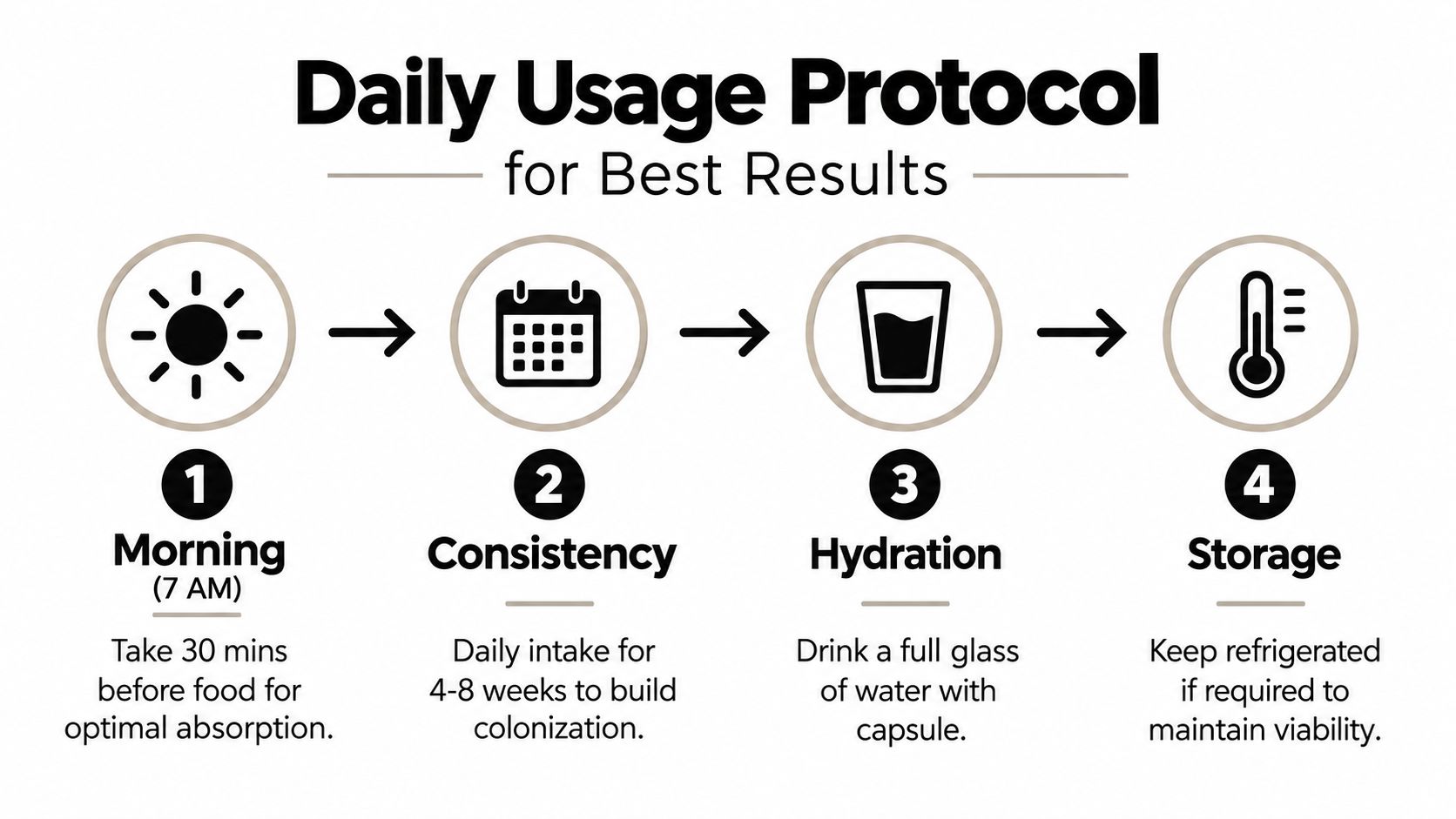
Could a probiotic work well only because you take it every day? Consistency helps, but the schedule must match the product and the evidence behind it. A tested routine is like a recipe: changing the strain, route, or timing can change what the results mean. One vaginal trial used one capsule daily for seven consecutive days, while a registered CTV-O5 study used a staged schedule. These examples show why a universal "one capsule daily" rule is unreliable (vaginal trial details, CTV-O5 dosing design).
Follow the label for dosing and storage. Ask a pharmacist or clinician how to separate a probiotic from antibiotics and whether supplementation suits your situation. Oral and vaginal products are not interchangeable: do not insert an oral capsule vaginally or take a vaginal product by mouth. Refrigerate only when the label requires it, and keep shelf-stable products away from heat and moisture.
Track outcomes that you can actually evaluate
Keep a short record of:
- Digestive symptoms: Bloating, stool consistency, urgency, and meal-related discomfort.
- Vaginal symptoms: New odor, discharge, irritation, or diagnosed recurrence.
- Urinary symptoms: Dysuria, frequency, confirmed infections, and treatment dates.
- Tolerability: Gas, abdominal discomfort, rash, or symptoms that began after use.
A change in a stool or vaginal test does not, by itself, prove that the product helped. The useful test is whether a defined symptom or clinical outcome improves without new problems.
Evidence for probiotics in bacterial vaginosis remains uncertain, so they should not replace established care, as the Cochrane review explains. Reassess at the end of the product's stated evaluation period. Contact a clinician sooner if symptoms persist, worsen, or recur.

Choosing the Right Product for Your Situation
A first-time buyer focused on digestion should prioritize transparent strain labeling, tolerability, storage, and testing. Someone with recurrent bacterial vaginosis should prioritize evidence for the specific strain and route, while treating diagnosis and prescribed therapy as separate matters. A person recovering after antibiotics may need to focus on gut support without assuming that every new vaginal symptom has the same cause.
A perimenopausal or postmenopausal buyer should ask whether the product has evidence relevant to her life stage, rather than relying on the word “women's.” A budget-conscious buyer can downgrade decorative claims and compare the information that matters most: strain identity, potency through expiration, quality documentation, and route.
Use three questions before buying:
- What is my primary goal, digestive, vaginal, urinary, or general support?
- Are my symptoms mild and occasional, or persistent and clinically concerning?
- Which evidence and quality features justify the cost?
The best choice isn't automatically the product with the highest CFU count. It's the formula whose strain, route, quality controls, and intended outcome most closely match your situation. For broader guidance on products positioned for both digestive and vaginal goals, review this guide to choosing a probiotic for gut and vaginal health.
GutRx offers probiotic and digestive-support formulas with an emphasis on strain verification and third-party testing, including products designed for broader gut balance. Visit GutRx to compare the available options against your primary goal, storage needs, and the evidence you want to see before buying.


