

In 2016, the United States created a federal disclosure framework for certain bioengineered foods, while 77% of U.S. adults consumed dietary supplements in 2019. Non-GMO supplements are products whose ingredients are sourced from organisms that weren't produced through genetic engineering, but the claim is voluntary and doesn't guarantee safety, potency, or digestive efficacy.
You may be comparing a daily probiotic, a synbiotic, or digestive enzymes for bloating after meals. The bottle says “non-GMO,” but you still need to know what that statement covers, who verified it, and whether the product has evidence for the qualities that matter to you. A non-GMO label addresses ingredient origin. It doesn't automatically confirm viable probiotic cultures, accurate strain identity, contaminant control, or stability through the expiration date.
Table of Contents
- What Non-GMO Actually Means in a Supplement
- The Regulatory Framework Behind Non-GMO Claims
- Non-GMO Certifications and Third-Party Testing
- How to Verify a Non-GMO Claim Step by Step
- What Non-GMO Does Not Prove About a Supplement
- A Buyer's Checklist for Non-GMO Supplements
- How GutRx Approaches Non-GMO Verification
- Questions Buyers Ask After the Non-GMO Check
What Non-GMO Actually Means in a Supplement
In a supplement, non-GMO generally describes a sourcing attribute. It indicates that relevant plants, microorganisms, or other biological inputs weren't produced through genetic engineering covered by the applicable standard. That may include botanical ingredients, corn- or soy-derived excipients, carrier materials, and inputs used in fermentation.
The distinction matters because a supplement formula can contain several different types of ingredients. A probiotic may include live cultures, prebiotic fibers, capsule materials, flavoring systems, and processing aids. Each input can have a different origin and a different level of documentation.
The label answers one narrow question
Non-GMO status describes genetic origin, not the complete quality of the finished product. It doesn't establish that a probiotic contains the labeled strain, that its CFU count remains viable until expiration, or that an enzyme formula will help with a particular meal. It also isn't the same as organic certification, which addresses broader agricultural and handling standards.
For example, a non-GMO botanical may still require separate testing for identity, purity, contaminants, and stability. A non-GMO probiotic may still need documentation showing what organism is present and whether it remains viable during storage.
The FDA's overview of GMO history and biotechnology provides useful background on how genetic engineering and bioengineered-food policy developed in the United States. For a plain-language explanation of how a company can support a non-GMO position through sourcing controls, readers can also review how Rip Van ensures non-GMO.
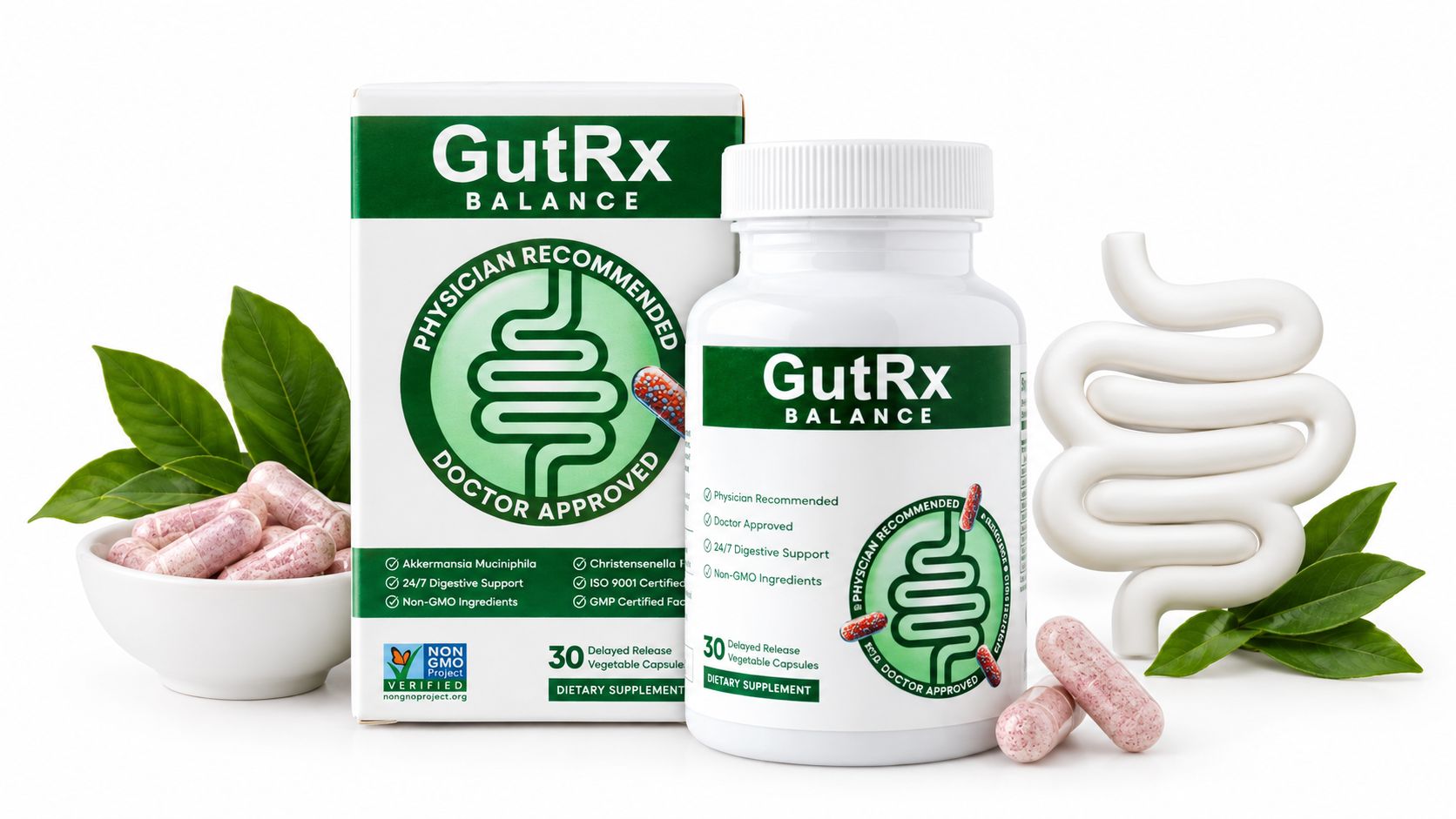
GutRx BALANCE offers 30 billion CFUs per capsule with next-generation probiotics for gut health, digestive balance, and immune support. That product description addresses the formula's stated probiotic content and intended positioning. It doesn't, by itself, replace lot-specific evidence for non-GMO sourcing or broader quality attributes.
Practical rule: Treat “non-GMO” as one documented specification in a supplement quality program, not as a complete verdict on the product.
The Regulatory Framework Behind Non-GMO Claims
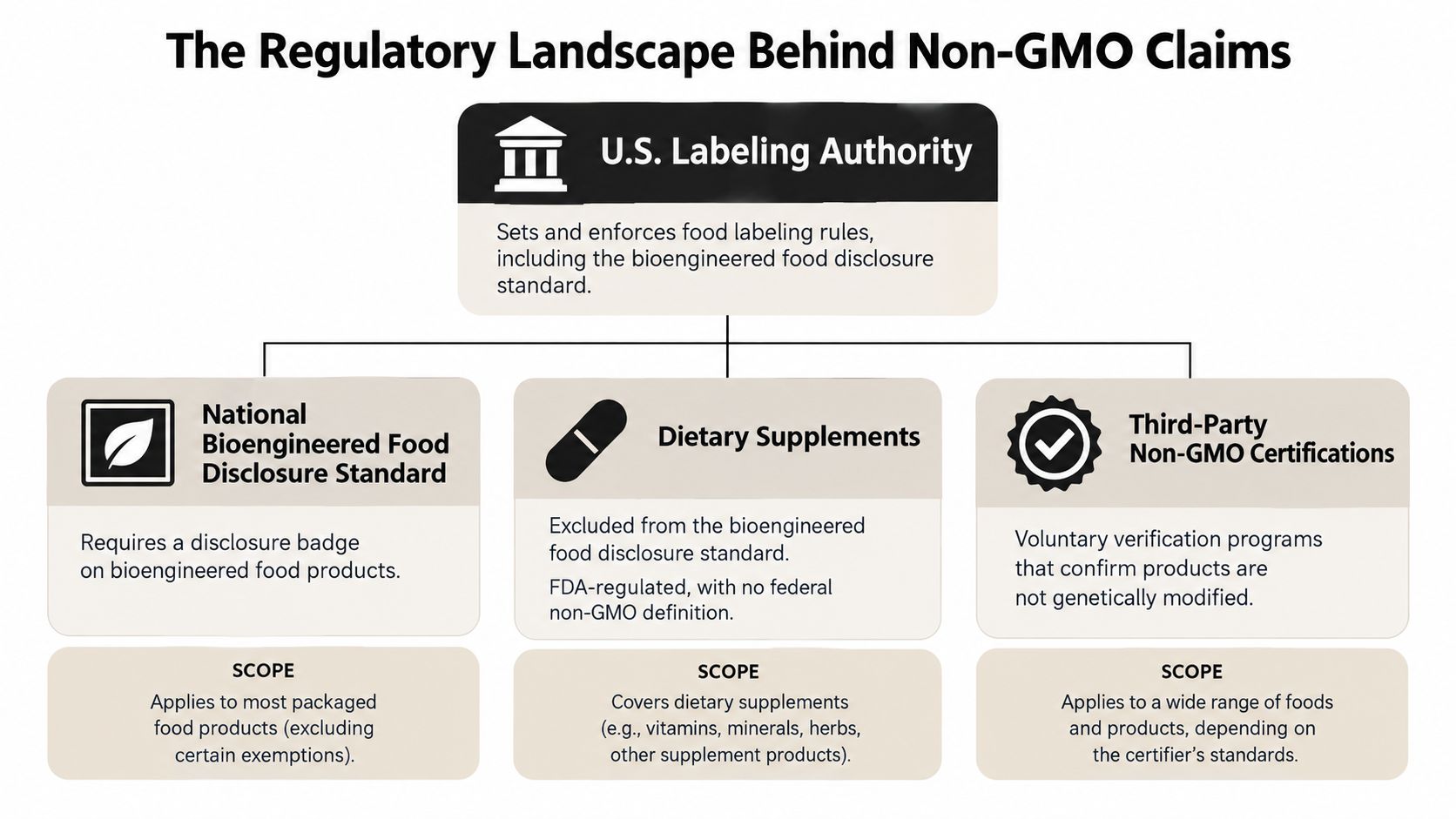
U.S. policy treats mandatory bioengineered-food disclosure and voluntary non-GMO marketing claims as separate matters. The National Bioengineered Food Disclosure Standard, enacted in 2016, established “bioengineered” as a consumer-facing term for qualifying foods. It permits disclosure through text, a symbol, an electronic or digital link, or text messaging.
That framework does not establish a universal federal non-GMO certification category for finished dietary supplements. A manufacturer may make a voluntary claim, but the wording still needs to be truthful and not misleading. The FDA explains that statements about whether plant-derived foods or ingredients were produced with or without bioengineering should be supported by appropriate evidence. Its guidance is not itself a set of legally enforceable duties. FDA guidance on voluntary bioengineering labeling describes that distinction.
Why “bioengineered” and “non-GMO” aren't interchangeable
The federal standard defines a bioengineered food through a technical framework. It covers genetic material modified with in-vitro recombinant-DNA techniques in a way that could not be achieved through conventional breeding or natural processes. A product without a mandatory bioengineered disclosure therefore does not prove that every ingredient is non-GMO.
Highly refined ingredients may fall outside disclosure requirements when modified genetic material is no longer detectable. For supplements containing refined carriers, enzymes, botanicals, or fermentation-derived materials, the relevant evidence may sit in supplier records and processing documentation rather than on the finished label. Verification should follow the ingredient back to its source and review how it was processed.
The FDA's questions and answers on dietary supplements clarify that the agency does not preapprove dietary supplements before marketing. Manufacturers remain responsible for evaluating identity, purity, strength, composition, safety, and truthful labeling. A non-GMO statement forms one part of that responsibility. It does not function as an FDA approval seal.
Non-GMO Certifications and Third-Party Testing
Consumers usually encounter several verification pathways. A brand may hold a product-level certification, use a laboratory report, rely on supplier affidavits, or combine documentary controls with testing. These approaches aren't equivalent, so the label should identify what was reviewed.
The Amazon documentation benchmark for non-GMO products accepts a valid product-level Non-GMO Project Verified or Nutrasource Igen certificate, or PCR laboratory reports from an ISO 17025-accredited laboratory covering high-risk ingredients. The stated threshold is less than 0.9% GMO content for each tested high-risk ingredient. That benchmark is useful because it shows why a printed claim and product-specific evidence aren't the same thing.
| Program | Verification method | What it confirms | What it does not cover |
|---|---|---|---|
| Non-GMO Project Verified | Product-level private verification and supporting supply-chain evidence | Compliance with that program's non-GMO requirements | Probiotic efficacy, CFU viability at expiration, or contaminant safety |
| Nutrasource Igen | Product-level certificate accepted by Amazon as non-GMO evidence | Certification under the program's requirements | Clinical performance, stability, or complete finished-product quality |
| USDA Organic | Federal organic certification covering qualifying agricultural and handling practices | Compliance with organic standards, including GMO avoidance within that system | A guarantee of digestive benefit or probiotic potency |
| Supplier documentation | Affidavits, specifications, origin records, and manufacturer review | A documented supplier-based sourcing position | Independent confirmation unless testing or outside certification is added |
A non-GMO certificate also isn't the same as a contaminant report. The distinction is familiar in other supplement categories, including CBD potency and contaminant testing, where potency and contamination are evaluated as separate quality questions. GutRx's explanation of what third-party testing means can help buyers understand why independent testing should be identified by method, laboratory, and tested attribute.
How to Verify a Non-GMO Claim Step by Step
Start with the bottle, then move to the evidence behind it. A credible review should connect the finished product to specific ingredients, lots, laboratories, and certificates rather than stopping at broad words such as “clean” or “natural.”
Four checks that turn a claim into evidence
-
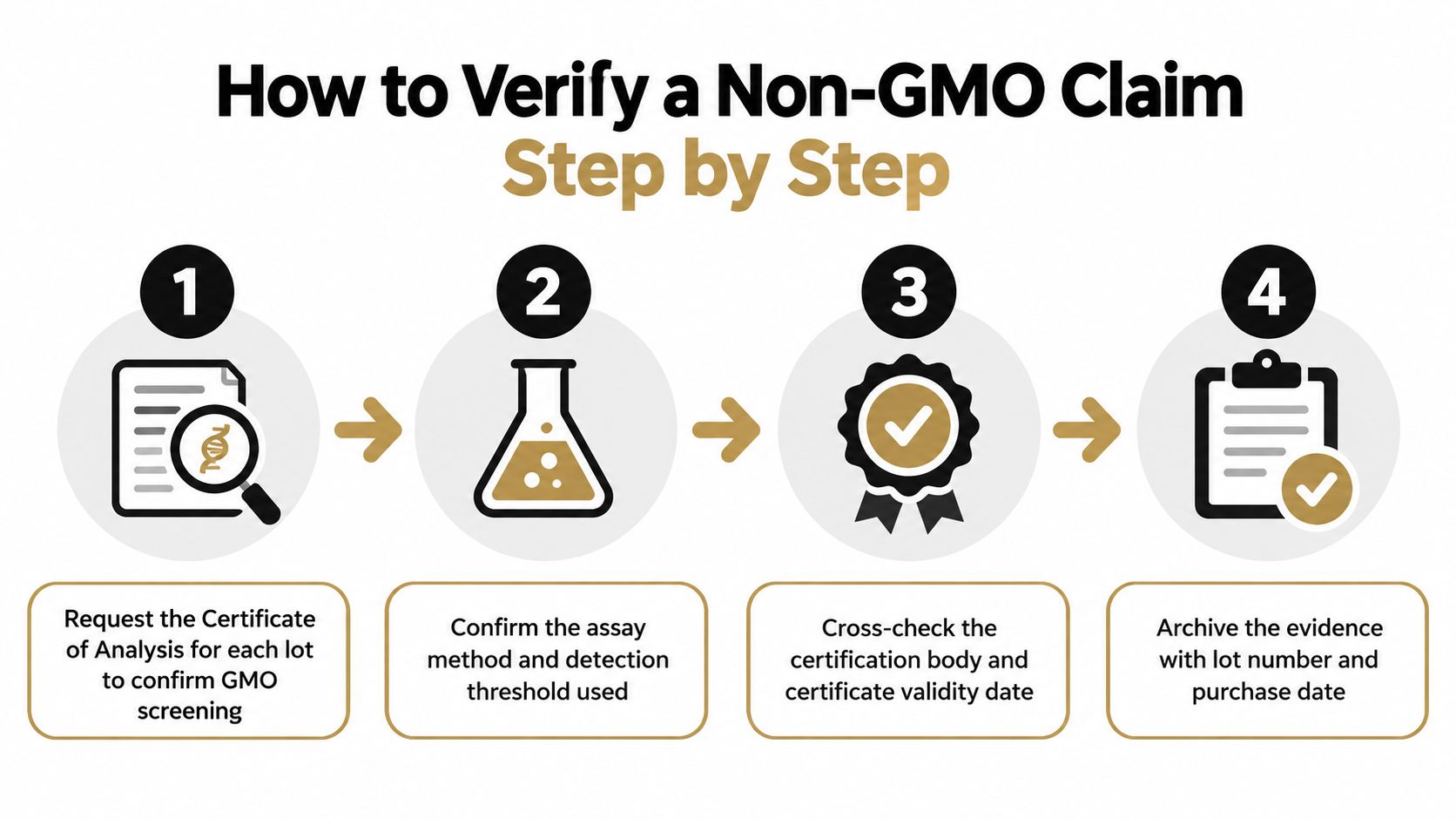
Find the lot number and request the matching COA. A Certificate of Analysis should identify the product or ingredient, lot, date, tested attribute, and result. If the brand publishes only a generic document with no connection to the purchased lot, ask whether a current lot-specific report is available.
-
Identify the testing method and scope. PCR reports can be relevant for some minimally processed inputs, while refined or fermented materials may require stronger documentary controls because processing can remove or degrade detectable DNA. Ask which ingredients were tested and which were supported by supplier records.
-
Review the ingredient trail. Supplier affidavits, country-of-origin records, specifications, and chain-of-custody documents can show how the manufacturer evaluated botanicals, carriers, excipients, and fermentation-derived inputs. Higher-risk agricultural inputs deserve particular attention.
-
Confirm independent oversight. Check whether the laboratory is ISO 17025 accredited and whether a certification belongs to the product you're considering. A certificate should be current and identifiable, not merely represented by an unexplained logo.
The FDA's guidance on dietary-supplement claims reinforces the need for truthful, supportable labeling. For a broader example of how consumer-facing disclosures can be presented, you can see the full disclosure. A practical overview of how to read a Certificate of Analysis can also help you distinguish a real test report from a marketing image.
What Non-GMO Does Not Prove About a Supplement
A non-GMO label can be useful, but it has a narrow job. It addresses whether relevant ingredients were sourced from non-bioengineered organisms under a defined standard. It doesn't answer whether the finished supplement is potent, stable, accurately labeled, or appropriate for a particular digestive concern.
For probiotic products, buyers should separate sourcing evidence from viability evidence. The NIH Office of Dietary Supplements explains that U.S. labeling rules require the total weight of microorganisms on the Supplement Facts label, not a CFU declaration. That weight can include live and dead cells, so it doesn't show how many organisms remain viable. Manufacturers may voluntarily list CFU, and expert guidance recommends listing total CFU, preferably by strain, through the expiration or use-by date. NIH probiotic guidance covers this distinction.
| Quality attribute | Does non-GMO cover it? |
|---|---|
| Genetic origin of specified inputs | Yes, when the claim is properly defined and substantiated |
| Probiotic strain identity | No, it needs separate identity verification |
| Viable CFU through expiration | No, it requires separate potency and stability evidence |
| Heavy-metal and pathogen control | No, these are separate contaminant specifications |
| Allergen control | No, allergen review and labeling follow separate requirements |
| Digestive or clinical efficacy | No, non-GMO status isn't an efficacy study |
| Finished-product stability | No, storage and shelf-life evidence are separate |
U.S. current good manufacturing practice rules provide the wider quality framework. They require scientifically valid testing or examinations and specifications for identity, purity, strength, composition, and contamination limits. The rules require an appropriate identity test for each dietary ingredient, with finished-batch verification using every batch or a statistically sound sampling plan. FDA's small-entity guide to supplement cGMP explains why those controls matter.
Non-GMO can answer “where did this input come from?” It can't answer every question about “what is in this capsule?”
A Buyer's Checklist for Non-GMO Supplements
Use the product page as a starting point, not the final proof. Whether you're comparing probiotic supplements on Amazon, reviewing a digestive enzyme formula, or contacting a brand directly, look for evidence that connects the claim to the actual product and batch.
Five checkpoints before you buy
-
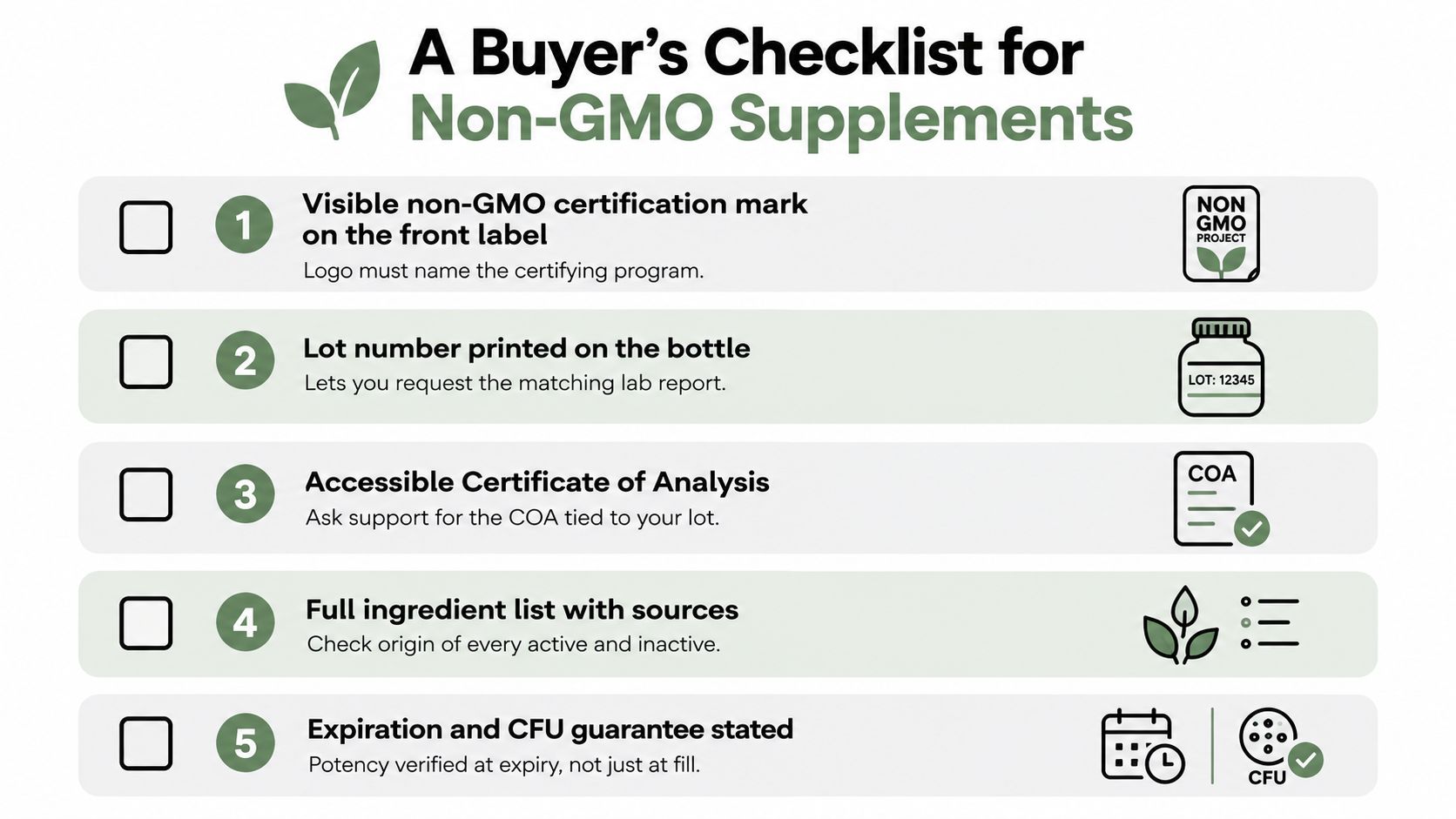
Look for a named certification program. A seal should identify the certifier, such as Non-GMO Project Verified or Nutrasource Igen. A registration or certificate reference gives customer support something specific to verify.
-
Record the lot number. The number printed on the bottle allows you to request the matching COA. Without it, a report may not tell you anything about the product in your hand.
-
Ask for ingredient-level evidence. Find out whether the claim applies to the whole formula, selected high-risk ingredients, or a finished-product assessment. Ask how the brand handled corn-, soy-, sugar-, botanical-, carrier-, and fermentation-derived inputs when relevant.
-
Separate non-GMO testing from quality testing. Request evidence for potency, purity, contaminants, strain identity, and stability as separate documents or results. A non-GMO report shouldn't be presented as proof of all those attributes.
-
Test the manufacturer's transparency. A responsive company should be able to identify the certifying body, laboratory, assay scope, and documentation available for the lot. If support can't answer basic sourcing questions, the claim is difficult to evaluate.
Red flags include vague wording such as “made without GMOs,” no batch number, no accessible COA, and a customer-service team that can't name the certification program or testing laboratory. A product can still be legitimate without a private seal, but the manufacturer should explain the standard and provide enough documentation to support the statement.
If U.S. manufacturing matters to your buying decision, review the brand's information about supplements manufactured in the USA. Treat that attribute as separate from non-GMO verification, just as vegan formulation, gluten-free status, and third-party testing answer different questions.
How GutRx Approaches Non-GMO Verification
GutRx presents non-GMO formulation as one part of a broader supplement quality approach. Its product range includes Daily, Balance, Women's, and Mealtime formulas, each intended for a different digestive-support use case. The relevant question isn't whether a product uses the phrase “non-GMO,” but whether the brand can connect that claim to ingredient records, testing, and the specific batch.
The available publisher information describes GutRx products as using non-GMO, vegan ingredients and third-party testing with downloadable Certificates of Analysis. Those claims should still be assessed at the product and lot level. A downloadable document is most useful when it identifies the batch, date, tested materials, laboratory, and result.
| Product | Plant-derived inputs | Verification method | COA availability |
|---|---|---|---|
| Daily | Review the formula's botanical, fiber, carrier, and capsule inputs individually | Ask for supplier documentation and applicable independent testing | Look for a lot-matched downloadable COA |
| Balance | Review any plant-derived probiotic support ingredients and excipients individually | Confirm the sourcing standard and testing scope for each relevant input | Ask whether the published COA matches the bottle lot |
| Women's | Review cranberry, postbiotic, capsule, and other relevant inputs separately | Check origin records, supplier affidavits, and independent reports where applicable | Confirm current batch documentation before purchase |
| Mealtime | Review enzyme-source materials, carriers, and other agricultural inputs | Ask how each ingredient's origin and identity were verified | Request the COA for the exact finished batch |
This table isn't a substitute for product-specific records. It shows how a buyer should frame the questions: Which ingredients were evaluated? Which were tested? Which relied on documentation? Does the evidence match the lot?
The same approach applies to any probiotic, synbiotic, postbiotic, or digestive enzyme product. Non-GMO verification should sit beside potency, purity, contaminant controls, strain identity, and shelf-life evidence. It shouldn't replace them.
Questions Buyers Ask After the Non-GMO Check
Once a product passes the sourcing review, most buyers still have practical questions. A non-GMO result doesn't establish how many probiotic organisms remain viable at expiration, whether the strain is correctly identified, or whether the product stayed within its storage specifications.
Does non-GMO affect CFU at expiration?
No. Non-GMO status and probiotic viability are separate attributes. Ask whether CFU is stated through the expiration or use-by date and whether the manufacturer has finished-product stability evidence. A large number at the time of manufacture doesn't automatically show what remains available when you take the capsule.
Does non-GMO confirm allergen control?
No. Allergen review, manufacturing segregation, cleaning controls, and label accuracy require separate evaluation. Ask for the company's allergen statement and whether the facility assesses cross-contact risks for the ingredients in the formula.
Is non-GMO the same as organic?
No. Non-GMO focuses on avoiding genetically engineered inputs under a defined claim standard. Organic certification addresses a broader production system. A supplement may carry one claim without carrying the other.
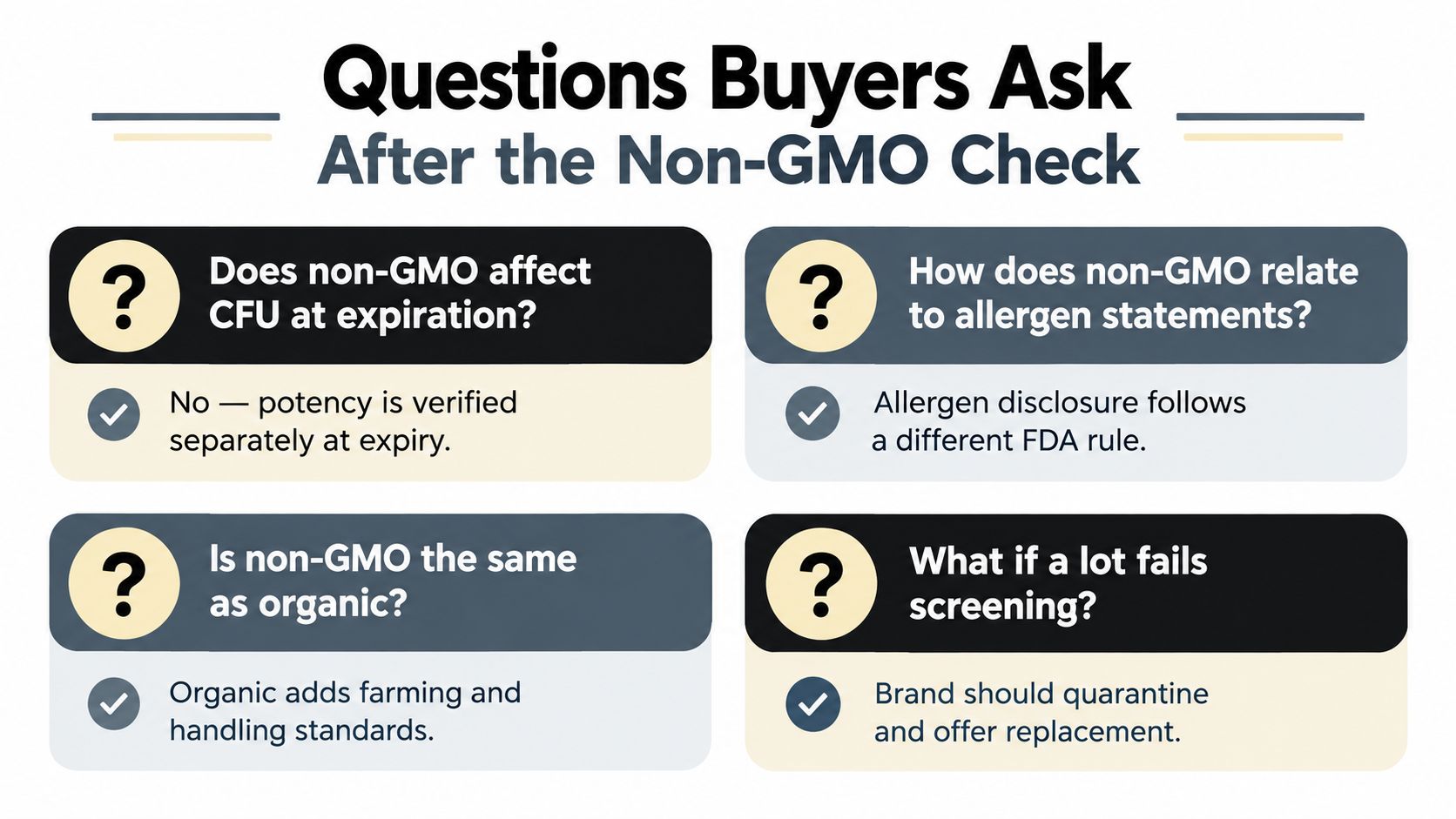
What happens if a lot fails screening?
The manufacturer should have a documented process for investigating the result, controlling the affected lot, and deciding whether the product can be released. Ask how the company handles nonconforming material and whether it can provide a replacement or other resolution when a purchased lot doesn't meet its stated specification.
For probiotic buyers, the strongest documentation package combines non-GMO sourcing records with strain identity, expiration-date potency, contaminant testing, allergen controls, and stability evidence. That broader package helps you compare a daily probiotic, a women's formula, or digestive enzymes without treating one front-label attribute as proof of everything else.
GutRx offers digestive-support formulas built around probiotics, prebiotics, postbiotics, and enzymes, with non-GMO positioning and third-party testing described in its product information. Review the available products and documentation at GutRx, then ask for the lot-specific evidence that matches the qualities most important to you.


