

You're standing in the supplement aisle with bloating, gas, or unpredictable bowel movements, trying to decide whether a bottle marked lactose-free is safe. That label may be enough for lactose intolerance, but it may not answer the more important question for someone with a milk allergy: Did the product contain dairy proteins or use dairy-based culture media during manufacturing?
The right choice depends on your condition, symptom pattern, and the finished formula's documentation. A lactose-free probiotic may support lactose digestion, while someone with a true milk allergy may need a product that's explicitly dairy-free, vegan, and controlled for allergen exposure.
Table of Contents
- Why Lactose Intolerance and Milk Allergy Change Your Probiotic Choice
- How Dairy Derivatives End Up in Probiotic Supplements
- Reading Labels to Identify Truly Dairy-Free Formulations
- Best Probiotic Strains for Lactose Intolerance and IBS Support
- Why Delivery Systems Matter for Sensitive Guts
- Matching Probiotic Formulas to Your Digestive Goals
- How to Use and Track Your Probiotic for Real Results
Why Lactose Intolerance and Milk Allergy Change Your Probiotic Choice
A person with lactose intolerance has difficulty digesting lactose, the sugar in milk, usually because the small intestine produces insufficient lactase. The result can be bloating, abdominal discomfort, gas, or altered bowel movements after consuming lactose. A milk allergy is different. It involves an immune response to milk proteins, such as casein or whey, and can be medically serious.
That distinction changes the supplement decision. Someone with lactose intolerance may tolerate a probiotic containing no measurable lactose, even if a bacterial strain was historically grown on a dairy-derived medium. Someone with a milk allergy may need to avoid the relevant proteins and manufacturing exposures altogether. A front-label claim alone can't establish that difference.

The symptoms can look similar
A patient with IBS may report bloating and loose stools after a dairy-heavy meal, then assume every later reaction confirms lactose intolerance. Another person may develop hives, swelling, wheezing, or a rapid reaction after dairy exposure. Those situations require different levels of caution and clinical assessment.
Probiotics have been studied mainly for lactose intolerance symptoms, including bloating, flatulence, diarrhea, and breath-hydrogen outcomes. That evidence doesn't establish that a probiotic is safe for a person with a severe milk allergy. A neutral discussion from Optibac on dairy-free probiotics specifically highlights that some strains may be cultured on dairy-based media and could leave trace residues, even when the finished product is suitable for lactose intolerance.
Practical rule: “Lactose-free” answers a sugar question. “Dairy-free” and documented allergen controls address a broader protein and processing question.
If you've been diagnosed with lactose intolerance, look for a finished product with clear lactose-free labeling and a complete ingredient statement. If you have a confirmed milk allergy, don't rely on lactose-free wording alone. Ask the manufacturer about dairy-derived media, cross-contact controls, allergen testing, capsule materials, and whether the product is vegan.
For readers who need help distinguishing enzyme support from probiotic support, this guide to enzymes for lactose intolerance offers a useful starting point. Persistent reactions, unexplained weight loss, bleeding, severe pain, or suspected allergy deserve evaluation by a qualified clinician rather than self-treatment with supplements.
How Dairy Derivatives End Up in Probiotic Supplements
Probiotic bacteria need a controlled environment to grow, survive drying, and remain viable during storage. Manufacturers may use fermentation media, protective compounds, or carrier materials that include dairy-derived components. These can include milk proteins, whey, casein, lactose, or other processing ingredients, depending on the organism and production method.
The key point is that the strain itself doesn't determine whether the finished product is lactose-free or dairy-free. Product design and process control do. A development study on fermented goat-milk probiotic formulations used direct lactose measurement with HPLC/ELSD and identified a final formulation as lactose-free while preserving probiotic functionality, demonstrating why the completed matrix must be tested rather than judged by the organism's name alone. The formulation details are described in this study of lactose-free probiotic product design.
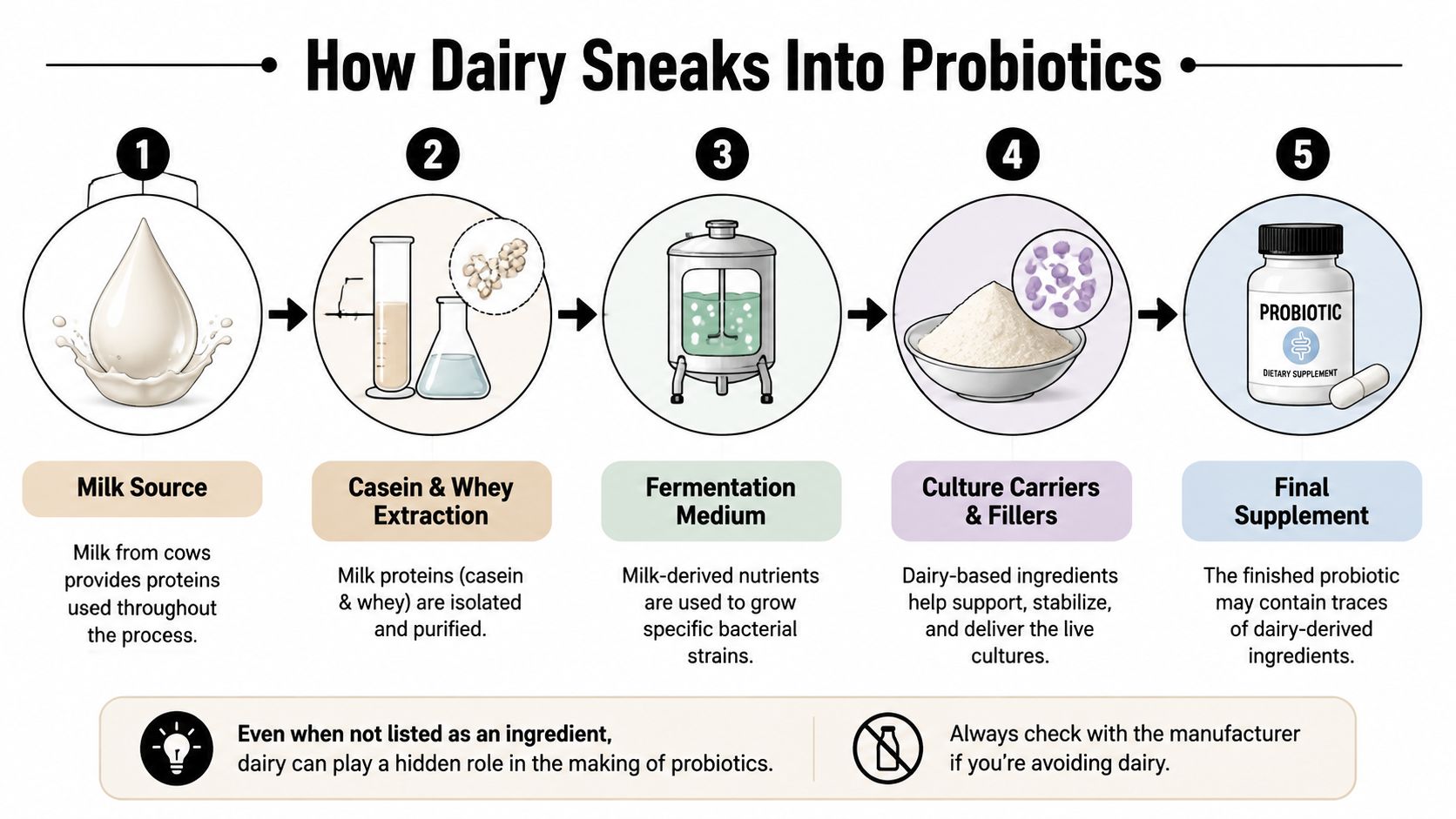
Why processing history matters
During freeze-drying, bacteria can lose viability unless the manufacturer uses protective carriers or cryoprotectants. Some systems may use dairy-derived materials to help cells tolerate drying and storage. Purification can reduce or remove those components, but the amount of residual material depends on the process and verification methods.
That's why “contains no lactose” and “never exposed to dairy” aren't interchangeable claims. A person with lactose intolerance is primarily concerned with lactose reaching the digestive tract. A person with a milk allergy needs a much more complete answer about protein residues and cross-contact.
European labeling rules provide an important baseline. European Regulation (EU) No. 1169/2011 requires milk and its derivatives, including lactose, to be reported on the label or in the ingredients list, as summarized in this review of allergen labeling requirements. Still, a label is only one part of the assessment. Ask whether the manufacturer publishes allergen statements, validates the finished formulation, and controls the facility and filling process.
For example, GutRx BALANCE offers 30 billion CFUs per capsule with next-generation probiotics for gut health, digestive balance, and immune support. If dairy avoidance is central to your decision, review the product's current ingredient and allergen documentation rather than assuming the product category answers the question.
Reading Labels to Identify Truly Dairy-Free Formulations
Start with the Supplement Facts panel and full ingredient list, not the product title. A bottle may emphasize probiotics, digestive balance, or gut support while placing excipients, capsule materials, and flavoring details in smaller print.
Use this sequence when comparing products online or in a store:
-
Scan for direct dairy terms. Look for milk, lactose, whey, whey protein, whey protein concentrate, casein, sodium caseinate, milk powder, milk solids, and cream-derived ingredients.
-
Separate lactose-free from dairy-free. A formula can contain little or no lactose and still raise questions for someone avoiding milk proteins. If you have a milk allergy, look for an explicit dairy-free claim supported by manufacturer details.
-
Check the capsule. Gelatin is animal-derived, although it isn't a milk ingredient. A vegan capsule, often made from plant cellulose or hypromellose, can help narrow the formulation, but it doesn't prove that the fermentation medium was dairy-free.
-
Read the allergen statement. “Manufactured in a facility that processes milk” doesn't prove contamination, but it signals that you should ask about segregation, sanitation, and testing. Severe allergy requires a more cautious standard than ordinary intolerance.
-
Look for strain-level identification. A label that lists only broad categories, such as Lactobacillus blend, gives you less information than one that identifies genus, species, and strain.
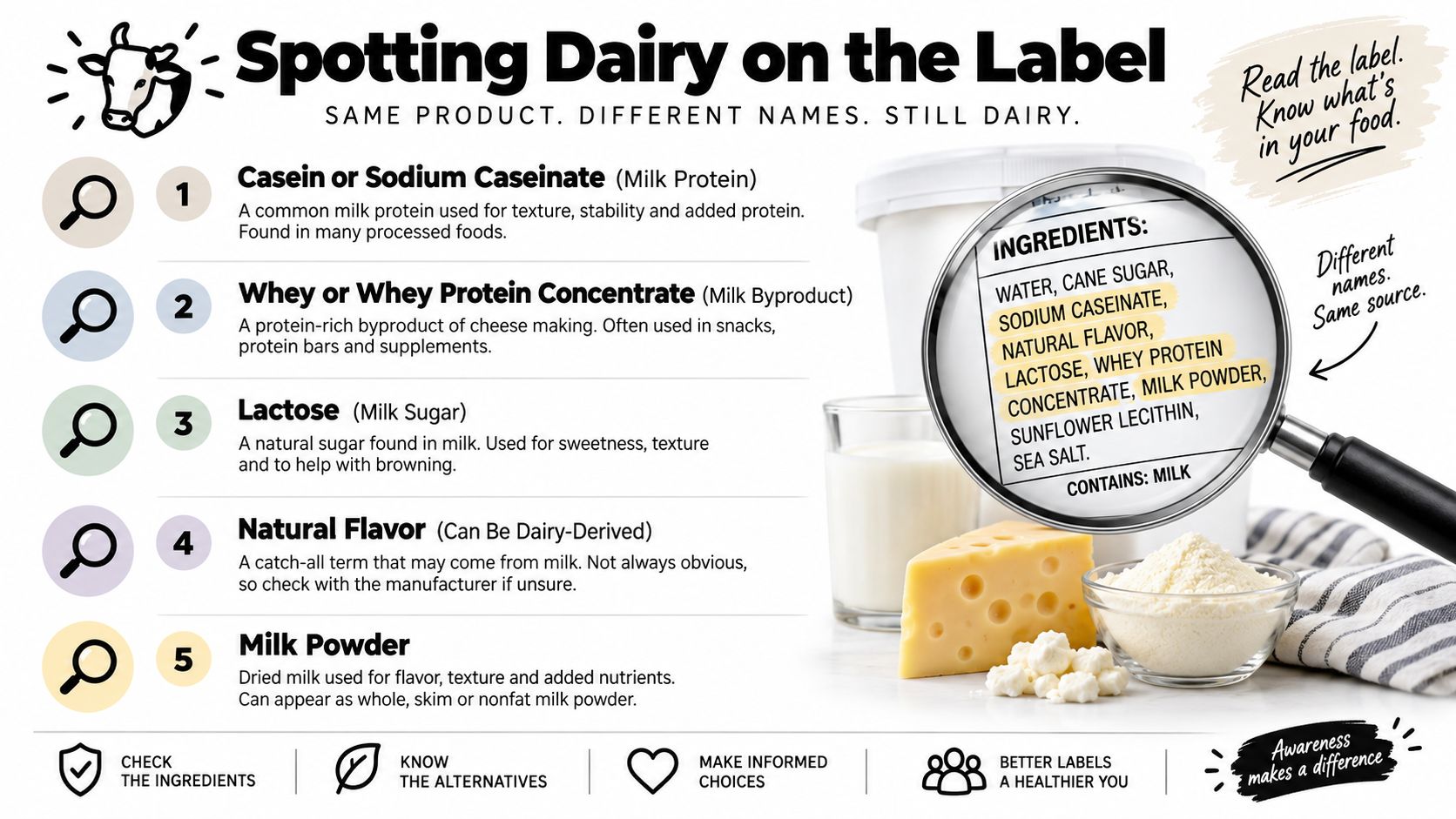
Verification is more useful than marketing language
Third-party testing can help confirm identity, purity, potency, and allergen controls, but the documentation should be specific. A Certificate of Analysis, or COA, may show testing for the finished batch, while vegan or non-GMO certification can clarify other formulation standards. Neither credential automatically answers every milk-allergy question, so check what the certificate covers.
A practical explanation of what batch documentation can and can't establish appears in this guide to Certificates of Analysis. Ask whether the COA identifies the tested product and batch, whether the probiotic organisms are verified, and whether allergen testing or a validated dairy-free manufacturing statement is available.
Label-reading checkpoint: If the company can't explain whether dairy was used in fermentation, stabilization, or filling, the formula isn't sufficiently transparent for a high-risk allergy decision.
Amazon listings often display only selected claims. Open the manufacturer's product page, download available documentation, and compare it with the package label. If the information conflicts, pause the purchase and contact the company.
Best Probiotic Strains for Lactose Intolerance and IBS Support
For lactose intolerance, the most relevant organisms are usually Lactobacillus and Bifidobacterium strains with β-galactosidase activity. This microbial enzyme can help break down lactose during digestion, potentially reducing the amount that reaches the colon and ferments there.
A systematic review of 15 randomized double-blind studies found an overall positive relationship between probiotic use and lactose intolerance outcomes, including self-reported bloating, flatulence, diarrhea, and breath-hydrogen measures. The review identified the most consistent rationale around Bifidobacterium and Lactobacillus strains with known galactosidase activity, as detailed in this systematic review of probiotics for lactose intolerance.
The evidence isn't uniform. A 2023 narrative review summarized 11 human clinical studies involving Bifidobacterium and/or galacto-oligosaccharides. Eight of the 11 studies reported significant improvement, while three were neutral. The same review notes that earlier evidence was mixed, with heterogeneity across trial designs and outcomes, as described in this review of Bifidobacterium and galacto-oligosaccharides.
| Strain or group | Primary mechanism | Evidence strength | Best use case |
|---|---|---|---|
| Lactobacillus strains with β-galactosidase activity | Supports microbial lactose breakdown | Positive but strain-specific | Lactose-related bloating and gas |
| Bifidobacterium strains with galactosidase activity | Adds digestive enzyme activity during lactose exposure | Positive, with variable trial results | Lactose tolerance and digestive comfort |
| Akkermansia muciniphila | Next-generation microbiome support | Not the primary lactose-intolerance evidence base | Broader gut ecosystem and barrier-focused formulas |
| Christensenella | Next-generation microbiome support | Not established as a direct lactose-digestion solution | Broad digestive balance strategies |
| Saccharomyces boulardii | Yeast-based probiotic option | Context-dependent | People seeking a non-bacterial option, especially around antibiotic-related digestive disruption |
Match the strain to the problem
Don't choose solely by total CFUs. A high count doesn't tell you whether the organisms are documented at strain level, tested through shelf life, or relevant to your symptoms. For recurring IBS-type bloating, review the full blend and avoid assuming that a product studied for lactose digestion will address every cause of abdominal discomfort.
Readers who want more detail on organism selection can use this guide to probiotic strains for IBS. If you have a milk allergy, also verify that the strain's production history and finished product controls fit your allergy plan. Strain selection and allergen safety are separate decisions.
Why Delivery Systems Matter for Sensitive Guts
A probiotic can contain a well-researched organism and still perform poorly if too few viable cells survive the journey through the stomach. Delivery technology determines where the organisms are released, while the strain determines what biological activity may be relevant after release.
Enteric-coated and delayed-release capsules are designed to resist gastric conditions and release their contents later in the gastrointestinal tract. In a 2024 peer-reviewed study, capsules coated with Eudragit L100-55 did not disintegrate in simulated gastric fluid and achieved about 95% recovery of viable cells, providing a concrete example of how coating can protect probiotic survival. The findings are reported in this study of Eudragit-coated probiotic capsules.
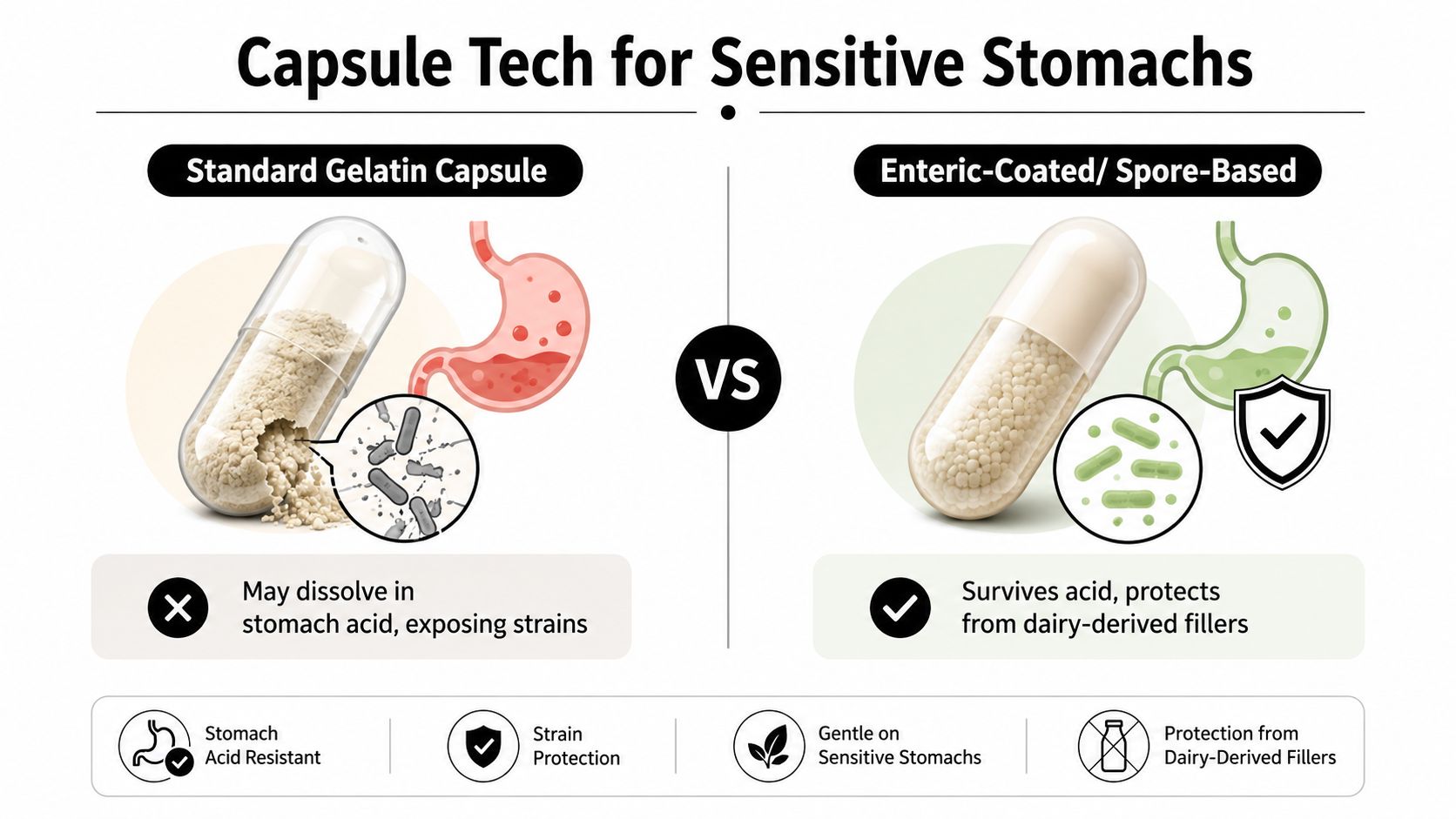
Coating changes the delivery equation
A 2019 formulation study reported 72% gastric survival for bifidobacteria and 53% for Lactobacillus gasseri in enteric-coated tablets. Under similar test conditions, an uncoated powder showed 2% upper-GI survival for bifidobacteria and 0.1% for Lactobacillus, as documented in this study comparing enteric-coated and uncoated probiotic formats.
Those results don't mean every enteric-coated product will produce the same outcome. They show why the delivery format deserves attention alongside the strain list. Ask whether the manufacturer has tested the finished capsule, not just the raw culture, and whether the stated potency applies through the expiration date.
The matrix also matters for dairy-sensitive users. A well-controlled capsule can limit unnecessary fillers and reduce opportunities for cross-contact, but a coating itself doesn't prove the absence of milk proteins. Look for separate evidence about excipients, manufacturing lines, and allergen controls.
A larger CFU number can't compensate for poor viability, an irrelevant strain profile, or unclear allergen handling.
For an IBS-prone gut, I generally prioritize strain relevance, finished-product testing, and delivery protection before comparing potency numbers. That approach is more useful than treating the biggest number on an Amazon label as the deciding factor.
Matching Probiotic Formulas to Your Digestive Goals
Choose the formula around your dominant problem, not around a generic promise of total gut wellness. Someone with constipation and irregularity may need a daily maintenance approach, while someone with meal-triggered bloating may be better served by digestive enzymes or a targeted probiotic strategy.
Use the symptom pattern as your filter
-
Daily maintenance: Look for a straightforward daily probiotic designed for regularity and ongoing digestive balance. Keep the routine simple enough to follow consistently.
-
Bloating and diarrhea-type discomfort: A balance-focused formula may fit better when the main concern is digestive disruption rather than sluggish bowel movements. Review the strain list, prebiotic ingredients, and tolerance of any added fermentable fibers.
-
Women's digestive and urinary goals: A women's formula may combine gut support with vaginal or urinary wellness ingredients. If it includes cranberry, D-mannose, or postbiotics, verify each ingredient separately and don't treat the combination as a substitute for medical care when urinary symptoms are present.
-
Post-antibiotic support: Consider whether a bacterial blend or yeast-based option is more appropriate for the situation. Anyone who is immunocompromised or seriously ill should ask a clinician before using live microorganisms.
-
Meal-related discomfort: Digestive enzymes are a different tool from probiotics. A mealtime formula may be more logical when symptoms appear soon after dairy, high-fat meals, protein-heavy foods, or FODMAP-containing foods.
A synbiotic combines a probiotic with a prebiotic, while a postbiotic contains non-live microbial components or metabolites. An all-in-one product can be convenient, but more ingredients also create more opportunities for intolerance, especially in people with IBS who react to certain fibers.
Use transparent products as a practical benchmark
For dairy-sensitive buyers, a useful product benchmark includes non-dairy positioning, vegan ingredients, third-party testing, strain verification, and accessible batch documentation. These features don't guarantee that a formula will relieve your symptoms, but they make the buying decision more auditable.
GutRx's broader lineup illustrates how formulas can be organized by use case rather than by one universal product. Daily is positioned around regularity, Balance around digestive balance, Women's around combined gut, vaginal, and urinary support, Mealtime around digestive enzymes, and Complete around broader synbiotic support. Compare any brand using the same questions: What problem is the formula designed for? Which strains or enzymes are listed? Is the finished product tested? Are dairy and allergen claims documented?
The best choice is the one that matches your symptoms and risk profile without adding ingredients you don't need.
How to Use and Track Your Probiotic for Real Results
Start with the label's directions and take the product consistently. Many individuals do better with a repeatable routine than with sporadic use only after discomfort begins. Store shelf-stable and refrigerated formulas exactly as directed, keep capsules away from excess heat and moisture, and check the expiration date.
Use this short tracking plan:
-
Record your baseline. Note bloating, stool consistency, urgency, gas, and post-meal discomfort before starting.
-
Keep the rest stable. Avoid changing several supplements or major dietary patterns at the same time, or you won't know what caused a change.
-
Track patterns, not one-off reactions. A single day of gas doesn't establish failure. Look for a sustained pattern in the symptoms you're targeting.
-
Review tolerance. Added prebiotics can cause extra gas in some IBS-prone people. If symptoms worsen, check the ingredient list and discuss adjustments with a clinician.
-
Reassess after roughly one month. The 2023 meta-analysis of probiotic administration for adult lactose intolerance included 263 patients, an average lactose challenge of 24.29 g, and an average intervention period of 26.25 days. Across the pooled studies, measured symptom outcomes decreased, and lactose AUC showed the largest improvement, with an effect size of SMD −4.96, 95% CI −6.92 to −3.00, as reported in the 2023 meta-analysis of probiotics for adult lactose intolerance00271-0/fulltext). That study duration can inform a reasonable review point, but it doesn't guarantee an individual response.
If symptoms plateau, reconsider the strain profile, delivery system, or whether lactose is the trigger. Seek medical guidance for severe reactions, suspected milk allergy, persistent diarrhea, bleeding, fever, nighttime symptoms, or unexplained weight loss. Probiotics may support lactose-intolerance management as an adjunct, but they shouldn't delay assessment of an underlying gastrointestinal condition.
GutRx offers non-dairy, vegan, third-party tested digestive supplements designed around distinct needs, including daily balance, targeted probiotic support, and digestive enzymes for meal-related discomfort. Review the available formulation and documentation at GutRx, then choose the product that matches your symptoms and dairy-safety requirements.


