

Vegetarians typically have lower DHA status than omnivores, but only certain groups have a strong case for routine supplementation. For higher-need groups, 200–300 mg of algal DHA per day is the practical target, while most plant-based adults can make an individualized choice rather than assuming a supplement is mandatory.
The important distinction is between DHA itself and plant foods that merely provide its precursor, ALA. Flax, chia, and walnuts can be valuable foods, but they don't reliably raise blood DHA. If your goal is to correct low DHA status, a vegetarian DHA supplement made from microalgae is the plant-based option with direct human evidence.
Table of Contents
- What Vegetarian DHA Means and Why It Matters
- How DHA Works in the Brain, Eyes, and Pregnancy
- Algal DHA Versus Fish Oil and ALA-Rich Foods
- Who Needs a Vegetarian DHA Supplement
- Dosing Evidence and Practical Daily Targets
- Reading a Vegetarian DHA Label Like a Clinician
- Common Myths Vegetarians Hear About DHA
- A Simple Decision Framework for Choosing Your Algal DHA
What Vegetarian DHA Means and Why It Matters
A vegetarian DHA supplement answers one specific question: should you provide DHA directly, or rely on your body to make it from another omega-3?
DHA, or docosahexaenoic acid, is a long-chain omega-3 fatty acid. ALA, or alpha-linolenic acid, is the shorter-chain omega-3 found in flaxseed, chia, walnuts, and some seed oils. The body can convert ALA into longer-chain omega-3s, but this route does not reliably raise DHA status. A systematic review found no DHA conversion from ALA in seven intervention studies involving nuts and seed oils, while microalgae oil consistently increased erythrocyte and plasma DHA in three studies. The systematic review on ALA, microalgae oil, and DHA status supports a practical distinction: algal DHA bypasses the conversion bottleneck.
ALA-rich foods still have value. They provide plant omega-3 and can fit into a balanced diet, but they are not interchangeable with a capsule containing a declared amount of DHA. A food can be nutritious without being a dependable way to change a specific blood marker.
Microalgae are the original marine source of DHA. Fish acquire DHA through the marine food chain, whereas vegetarian supplements extract the oil directly from microalgae, commonly including Schizochytrium species. Algal oil therefore supplies preformed DHA without using fish.
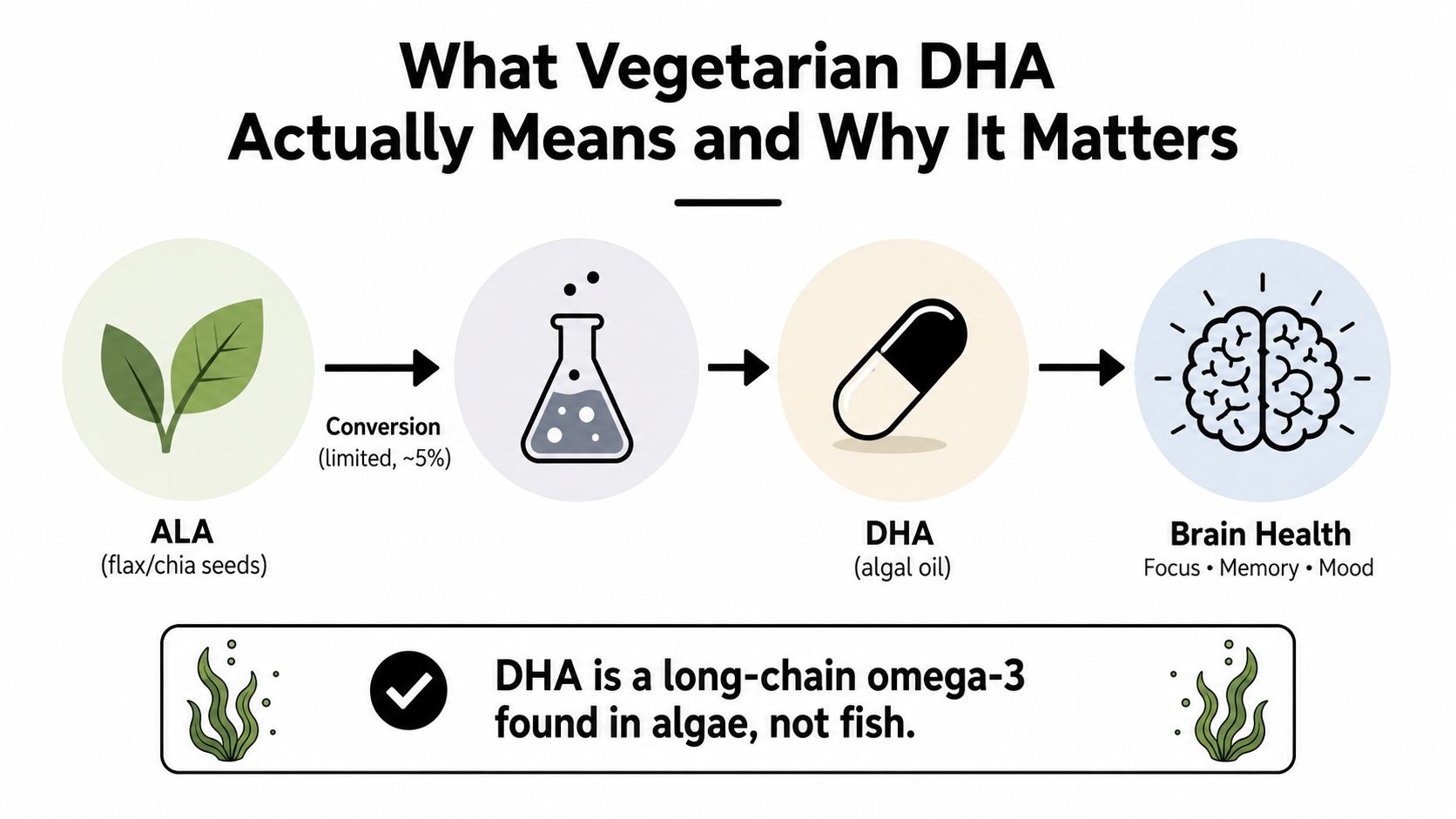
The conversion question
A label that says “omega-3 from algae” does not identify the amount of DHA. Look for DHA listed in milligrams, since some plant oils contain little or no preformed DHA. The key decision is targeted: determine whether supplemental DHA fits your situation, choose an evidence-informed amount, and verify that the product contains real algal DHA rather than vague green marketing.
How DHA Works in the Brain, Eyes, and Pregnancy
DHA is concentrated in the brain and retina, where specialized cell membranes support neural signaling and vision. Those membranes work like responsive surfaces: their fatty-acid composition can influence how receptors, signaling proteins, and visual machinery function. That biological role does not make a DHA capsule a guaranteed cognitive enhancer.
Brain and eyes
The retina contains DHA-rich membranes in the outer segments of photoreceptor cells. Brain tissue also uses DHA in neuronal membranes involved in communication. The clearest rationale concerns maintaining normal tissue composition and supporting life stages when neural and visual structures are developing.
Claims about adult cognition require more caution. A lower DHA status may provide useful context, but one blood measurement cannot predict cognitive performance or future health precisely. Evidence for mood, inflammation, and skin outcomes is less consistent, so labels promising broad benefits extend beyond what the literature can establish.
Clinical perspective: A lower DHA measurement warrants a closer look at intake, life stage, and overall context. It does not prove that every symptom reflects DHA insufficiency.
Pregnancy and infancy
Pregnancy and lactation are particularly relevant because fetal and infant neural and retinal tissues develop rapidly. Vegetarian nutrition guidance commonly discusses a higher-need intake in the 200–300 mg daily range, especially when the diet contains no fish or other direct DHA source. The review of omega-3 needs in vegetarian diets also makes clear that this range is not a universal prescription for every vegetarian adult.
A probiotic does not supply DHA or substitute for omega-3 nutrition. For example, GutRx BALANCE is presented as a probiotic product for gut health, digestive balance, and immune support. It belongs to a separate supplement category and should not be judged as an omega-3 product.

The practical conclusion is targeted. DHA has a clear biological role in brain and retinal tissue, with particular relevance during pregnancy and infancy. Broad adult wellness claims remain less certain. Your decision should reflect life stage, dietary sources, and measured status when testing is available, then focus on a label that declares actual algal DHA rather than merely advertising algae or plant omega-3.
Algal DHA Versus Fish Oil and ALA-Rich Foods
Vegetarians often compare fish oil, algal oil, and ALA-rich foods as though they supply the same omega-3. They do not. Fish oil and algal oil can provide preformed DHA. Flax, chia, and walnuts provide ALA, which the body may convert to DHA inefficiently. ALA remains valuable as a plant food, but it should not be treated as a dependable substitute for a declared DHA dose.
Fish oil has a larger clinical research base because it has been studied more extensively. Algal DHA is not automatically a weaker option. A bioequivalence study found that algal DHA capsules produced equivalent DHA levels in plasma phospholipids and erythrocytes, with a linear response across 200 mg, 600 mg, and 1,000 mg doses. The bioequivalence study of algal DHA supports a practical comparison: check how much DHA the product delivers, rather than judging the source by whether it is fish or algae.
| Source | Contains Preformed DHA | Typical Dose to Reach 250 mg DHA | Sustainability | Best For Vegetarians? |
|---|---|---|---|---|
| Algal DHA | Yes, when DHA is declared on the label | Choose a serving that supplies 250 mg DHA | Avoids direct reliance on fish harvests; sustainability depends on production and testing | Yes |
| Fish oil | Yes | Choose a serving that supplies 250 mg DHA | Depends on fishery practices and purification | No, for strict vegetarian diets |
| ALA-rich foods | No | No dependable food-equivalent dose for reaching 250 mg DHA | Plant-based and useful as whole foods | Yes as an ALA source, but not a direct DHA replacement |
Algal DHA also avoids the dietary conflict that makes fish oil unsuitable for many vegetarians and vegans. Its source does not remove the need to assess quality. Controlled algae cultivation can reduce some contamination concerns, while water quality, processing, oxidation control, and testing still affect the finished oil.
A liquid or capsule format changes how you measure a serving, not the underlying question. This liquid omega-3 supplement guide can help with serving-size and label-transparency questions. Read past the prominent total-oil figure and find the actual DHA amount on the facts panel. That number determines whether the product supplies a meaningful direct DHA dose.
Who Needs a Vegetarian DHA Supplement
A vegetarian DHA supplement is most useful when physiological needs are higher or when DHA status may be low. Vegetarian eating alone does not prove deficiency. Vegetarians may have no obvious clinical signs, even though measured DHA status tends to be lower than in omnivores.
Higher-priority situations
Pregnancy and lactation are the clearest routine-use contexts, especially when the diet provides no direct DHA. Older adults may also discuss DHA with a clinician. Blood DHA can decline with age, and cognitive outcomes have been studied, although supplementation is not a guaranteed way to prevent cognitive decline.
People with diabetes or reduced conversion capacity may have a more individualized reason to test or supplement. Genetic differences in fatty-acid conversion can make dietary ALA a less dependable route to DHA for some people. That does not support self-prescribing high doses, but it does make a direct algal source reasonable to discuss.
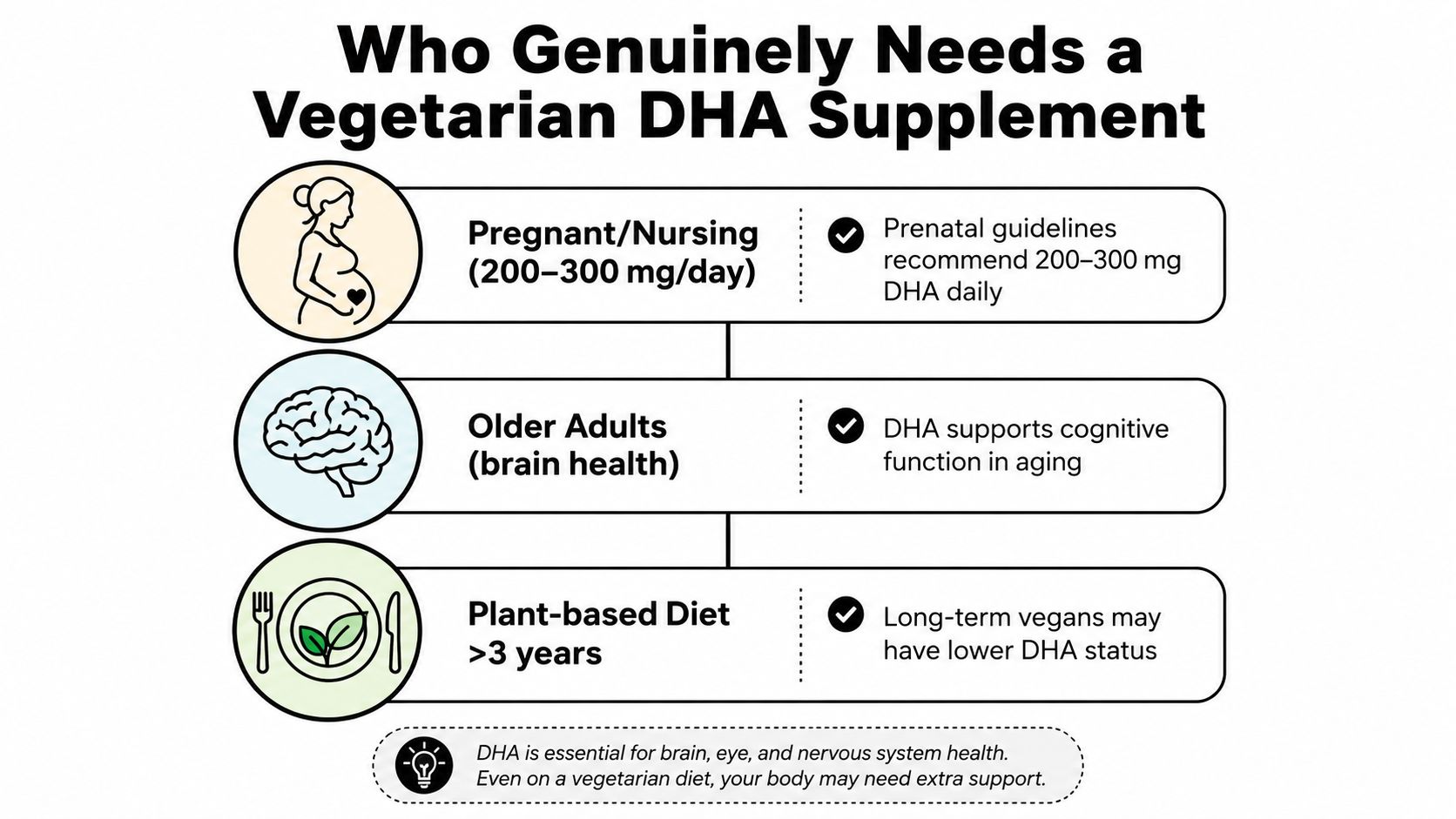
A vegetarian nutrition review suggests 200–300 mg daily for higher-need groups, while 100–300 mg daily can be an optional choice for other vegetarians, not a universal requirement. The vegetarian omega-3 review is useful because it does not treat a lower average DHA level as a blanket diagnosis.
A healthy adult eating varied plant foods, with fortified foods or eggs where appropriate, may reasonably decide against a dedicated DHA supplement. The decision deserves closer attention during pregnancy or lactation, in older age, with diabetes, on a strict vegan diet with little fortified nutrition, or after a documented low omega-3 result. The key question is the person's likely dietary gap, not whether every vegetarian needs the same product.
For broader vegan nutrient planning, see this guide to a vitamin D supplement for vegans. Vitamin D is a separate nutrient, but the decision process is similar: identify the actual dietary gap before buying a supplement.
Dosing Evidence and Practical Daily Targets
Dose selection becomes clearer once the label is read in milligrams of DHA. Total algae oil and total omega-3 blend weight describe the container, not the amount of DHA available per serving.
Human research indicates that algal DHA raises blood DHA in a dose-responsive pattern. One study found comparable DHA changes in plasma phospholipids and red blood cells across 200 mg, 600 mg, and 1,000 mg doses, with a linear response. The algal DHA dose-response research supports using the stated DHA amount for dose calculations.
A usable intake plan
For a vegetarian adult with higher needs, 200–300 mg of DHA daily is the practical range supported by the vegetarian nutrition review. Higher amounts require a specific reason and clinical guidance, because a larger label number does not automatically provide greater benefit.
Take DHA with a meal containing some fat. If the product combines DHA and EPA, count the DHA separately. A front-panel claim such as “500 mg algae oil” could represent 500 mg DHA, considerably less DHA, or a mixture of fatty acids. The Supplement Facts panel resolves that ambiguity.
| Goal or Group | Daily DHA Target | Evidence Strength | Notes |
|---|---|---|---|
| Higher-need vegetarian adults | 200–300 mg | Stronger practical support | Relevant to pregnancy, lactation, and other higher-need contexts described in vegetarian reviews |
| Other vegetarians making an optional choice | 100–300 mg | Optional | Not a universal requirement for every vegetarian |
| Research-supported blood-status increase | Study-dependent | Direct human evidence | A microalgae trial used 250 mg/day for 5 weeks and increased serum DHA across omnivorous, lacto-ovo vegetarian, and vegan participants. The randomized microalgae trial |
| Larger-dose use | Clinician-directed | Context-dependent | A high-dose label is not a routine wellness recommendation |
Blood DHA changes over time rather than immediately. People seeking objective feedback can discuss an omega-3 index or another DHA measure with a clinician, while allowing regular use long enough for the test to reflect the pattern. Testing is most useful when it answers a defined question, such as whether a selected dose is raising blood status.
Finally, distinguish a 1,000 mg fish-oil serving from 1,000 mg DHA. Total oil and individual fatty-acid amounts are separate measurements, just as they are on an algal product label.
Reading a Vegetarian DHA Label Like a Clinician
A label review begins with the Supplement Facts panel, not the product's front-facing claims. Read it like a prescription: identify the source, confirm the active dose, then check whether quality information supports the contents.
Four checks that matter
First, identify the organism. Schizochytrium species are a major commercial source with meaningful human research. A review of algal supplementation found improved DHA concentrations or omega-3 index values across the included studies, using plasma, serum, platelet, and red blood cell measures. The review of algal supplementation in vegetarian diets helps separate researched algal DHA from an undefined “green omega” blend.
Next, find DHA per serving. “Algae oil” names the ingredient category, not the amount of DHA. The panel should list DHA in milligrams and state whether EPA is present. Commercial labels show why this distinction matters. One vegan product supplies 500 mg DHA per two capsules. Another lists 334 mg DHA and 166 mg EPA per a 1,250 mg algal-oil serving. The commercial algal omega-3 label examples demonstrate that total oil and individual fatty-acid amounts are separate measurements.
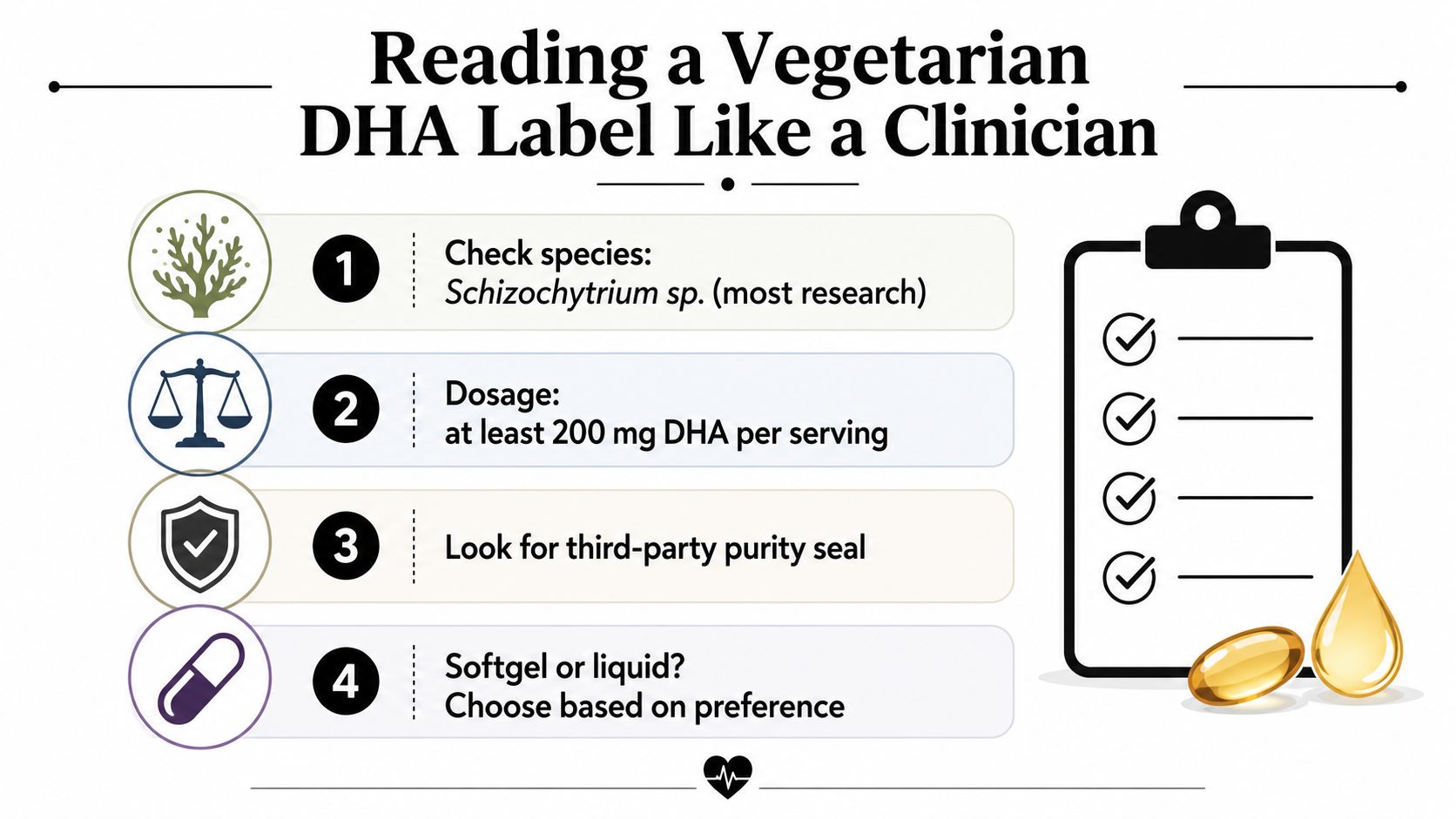
Then assess freshness and verification. Check the expiration date, packaging that limits light exposure, and available testing records. A Certificate of Analysis explanation describes how documentation can address identity, potency, contaminants, and batch-specific results.
Label rule: “Algae oil” identifies the source category. Only the declared DHA milligrams tell you what you're buying.
Oil form can matter, but it comes after these basics. A clear label identifies the source, DHA amount, EPA amount where applicable, serving size, expiry information, and quality documentation. “Ocean-friendly,” “raw algae,” and “pure plant omega” are marketing descriptions, not substitutes for those details.
Common Myths Vegetarians Hear About DHA
Myth one says fish oil is automatically more natural
Fish do not create marine DHA from nothing. They obtain omega-3s through the food chain, while microalgae produce DHA closer to its original marine source. The useful question is whether a supplement provides a documented DHA amount and meets appropriate quality standards.
Earlier bioequivalence findings showed that algal DHA capsules raised DHA in plasma phospholipids and red blood cells similarly across the doses tested. That result does not make the fish-oil research record irrelevant. It does show that vegetarians do not need fish oil to obtain DHA in a form the body can use.
Myth two says flax and chia cover DHA needs
Flax and chia provide ALA, a useful plant omega-3. ALA is not preformed DHA, however, and the body's conversion pathway is limited and inconsistent. In the intervention evidence reviewed earlier, ALA did not produce a measurable DHA increase in the evaluated studies, whereas microalgae oil consistently raised DHA in the studies that tested it. The evidence review on ALA conversion supports treating seeds as ALA foods, not as a measured DHA dose.
Keep flax, chia, and walnuts for their broader nutritional value. Their presence in a diet does not establish that blood DHA has risen.
Myth three says every algae omega-3 product is equivalent
Algae is a source category, not a guarantee of product equivalence. A supplement made with a named, researched DHA-producing microalga differs from an undefined algae blend. Total oil weight also cannot substitute for the declared DHA amount.
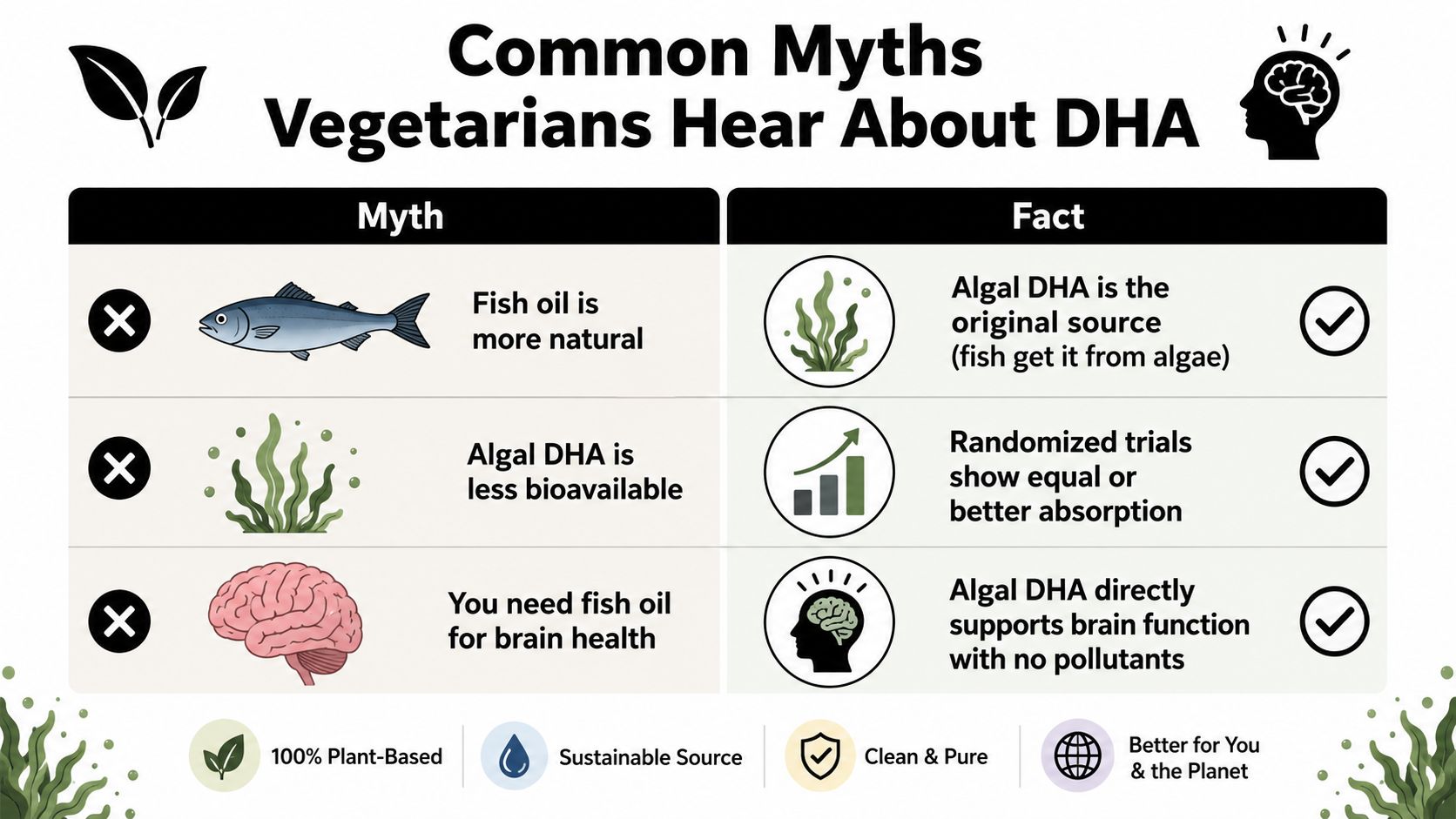
Read the back panel before judging the front label. Species, DHA milligrams, EPA disclosure, serving size, expiry, and testing evidence show what the product provides. A green capsule or broad plant-based slogan cannot answer those questions.
The practical test is simple: identify the algal source, confirm the DHA dose, and check whether the label supplies enough information to compare products.
A Simple Decision Framework for Choosing Your Algal DHA
Start with the question of need, not the brand. Pregnancy or lactation, older age, diabetes management, or a strict vegetarian or vegan diet with little direct DHA intake may justify discussing 200–300 mg of algal DHA daily with a healthcare professional. These categories do not prove deficiency, but they make a targeted supplement decision more reasonable.
A varied plant diet can provide ALA, while fortified foods may provide direct DHA. If none of the higher-priority situations applies, supplementation remains optional. Your intake, health goals, and any available testing should guide the choice. Seeds can support overall nutrition, but they do not confirm that blood DHA has increased.
Product shortlist
Check the back label in this order:
- A named microalgal source: Schizochytrium is a useful marker because it appears in human research.
- A declared DHA amount: Compare DHA milligrams per softgel or serving, not the total algae-oil weight.
- Clear EPA information: EPA may be included, but its amount should be stated.
- Quality documentation: Prefer batch-specific testing or a credible third-party verification pathway.
- Practical packaging: An expiry date and protection from heat and light help you judge freshness.
A green capsule or “plant omega” wording does not establish the DHA dose. Skip products that provide no DHA quantification, no expiry information, or no meaningful quality documentation. A larger capsule can still contain less DHA.
| Reader profile | Daily DHA target | Look for on label | Skip if you see |
|---|---|---|---|
| Pregnant or lactating vegetarian | 200–300 mg | Direct algal DHA, clear serving size, clinician-compatible formula | Unquantified algae oil |
| Older adult considering cognitive-health support | Individualized, often 200–300 mg to discuss | DHA amount and quality testing | Broad cognitive promises without dose details |
| Vegetarian managing diabetes | Discuss with clinician | Declared DHA and transparent testing | A formula that hides fatty-acid amounts |
| Healthy vegetarian with varied intake | Optional 100–300 mg choice | Fortified-food context and modest serving | Treating supplementation as mandatory |
| Strict vegan with little direct DHA intake | 200–300 mg to discuss | Named microalgal source and DHA per serving | Generic “plant omega” language without DHA |
Reassess the plan after regular use rather than judging it from one day. Without objective testing, mood or dry-eye changes are weak signals. Persistent symptoms need clinical assessment, not a supplement trial.
GutRx offers digestive-support products rather than algal DHA, including formulas positioned around probiotics, prebiotics, and digestive balance. Visit GutRx to review its product categories separately from your vegetarian DHA decision and match supplements to the nutritional or digestive goal you are addressing.


