

Yes, a product can be non-GMO without being gluten-free, and it can be gluten-free without being non-GMO. The FDA gluten-free standard allows unavoidable gluten below 20 parts per million, while non-GMO labeling addresses genetic engineering, not gluten contamination.
That distinction matters when you're choosing a probiotic, synbiotic, postbiotic, digestive enzyme, or other supplement. A butterfly-shaped non-GMO seal doesn't tell you whether wheat-derived excipients were used. A gluten-free claim doesn't tell you whether corn, soy, sugar beets, or another ingredient came from genetically modified crops.
Table of Contents
- Is Non-GMO the Same as Gluten Free
- Why the Two Claims Are Regulated Separately
- What Gluten Free Actually Means on a Label
- What Non-GMO Actually Means on a Label
- How Cross-Contact Can Break Both Promises at Once
- How Third-Party Testing and COAs Add Real Proof
- A Shopper's Checklist for Reading Supplement Labels
Is Non-GMO the Same as Gluten Free
Is non-GMO the same as gluten-free? No. These claims answer different questions about a product and require separate checks.
Non-GMO concerns genetic modification or bioengineering. It asks whether an ingredient came from a genetically engineered source and whether its supply chain meets the relevant verification requirements. It does not show that the product is free from wheat, rye, barley, or gluten introduced during processing.
Gluten-free concerns a group of proteins associated with wheat, rye, barley, and related grains. Under the FDA standard, a food labeled gluten-free must contain less than 20 ppm of unavoidable gluten, as explained in the FDA consumer guidance on what gluten-free means.
Consider a corn-derived vitamin C supplement. Its manufacturer might source non-GMO corn, supporting a non-GMO claim. The finished supplement could still be produced on equipment that handles wheat-derived binders. If cleaning, testing, and documentation do not control that shared equipment, the product may not meet gluten-free requirements.
The reverse can also occur. A supplement can contain no wheat, rye, or barley and test below the FDA gluten threshold, while including ingredients from crops that may be genetically engineered. It may therefore qualify as gluten-free without independent non-GMO verification.
Practical rule: If you avoid gluten because of celiac disease or sensitivity, check gluten controls separately. If you avoid genetically engineered ingredients, verify non-GMO status separately.
Read the ingredient list for sources and the allergen statement for declared wheat, while recognizing that neither panel element replaces certification or documented testing.
Why the Two Claims Are Regulated Separately
Why can a supplement carry one claim without the other? Gluten-free and non-GMO address different questions, so they developed through separate regulatory and certification systems.
The FDA established a formal U.S. definition for gluten-free labeling in 2013, with requirements applying to products using the claim from 2014, according to the FDA's gluten-free labeling framework. The focus is gluten exposure, including the possibility that gluten enters through ingredients, equipment, or handling.
Non-GMO labeling followed a different route. Registrar Corp's explanation of non-GMO and gluten-free claims notes that the federal government did not yet require a general GMO or non-GMO label in 2014. In July 2016, legislation directed the USDA to establish mandatory disclosure rules for bioengineered foods.
A passport and a driver's license make the distinction clear. Both are official documents, but a passport verifies identity and citizenship, while a driver's license verifies permission to drive. One does not prove the other.
Two different questions at the supply-chain level
Gluten controls follow the possible presence of proteins from wheat, rye, barley, and related grains. Verification can involve ingredient review, sanitation records, equipment controls, employee practices, and finished-product analysis.
Non-GMO controls follow genetic-engineering status and ingredient origin. The Non-GMO Project Standard describes controls such as traceability, segregation, and testing across the supply chain. In practical terms, an ELISA assay can help detect gluten proteins, while PCR may be used to examine genetic material. Results from one track do not answer the other track's question.
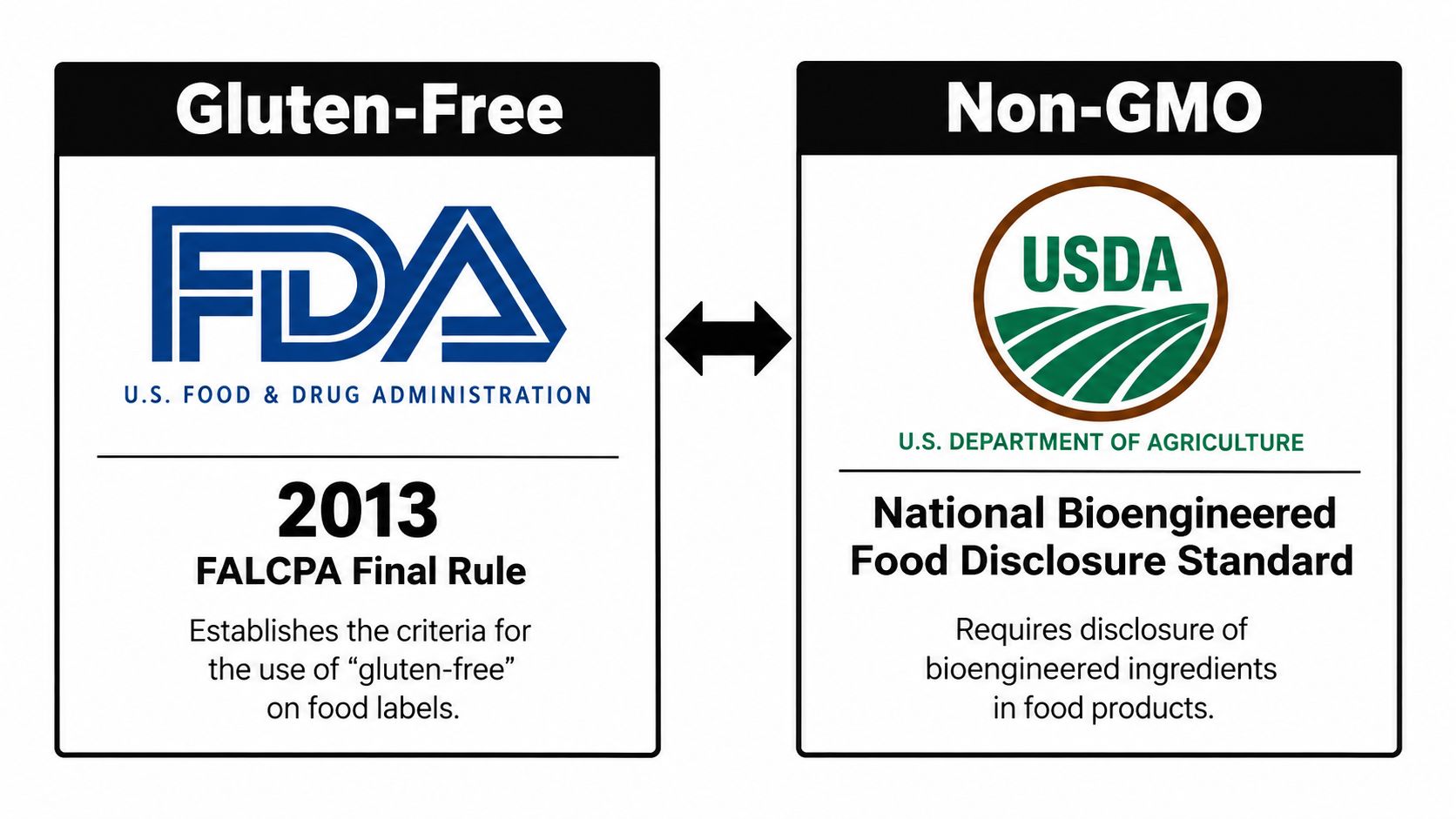
A supplement may therefore have documented non-GMO sourcing yet lack evidence about gluten cross-contact. Another product may meet gluten-free requirements while its agricultural and ingredient records provide no non-GMO verification.
Read the two labels as separate passes through the same supply chain. Strong proof requires evidence for each claim, not one claim treated as a substitute for the other.
What Gluten Free Actually Means on a Label
Could a product labeled “gluten-free” still contain trace gluten? Under the FDA framework, the answer depends on whether the finished food stays below less than 20 ppm, the agency's limit for unavoidable gluten. The claim may appear as “gluten-free,” “no gluten,” “free of gluten,” or “without gluten” when the product meets the applicable conditions. The FDA guidance on gluten and food labeling explains the standard.
A formula can qualify in several ways. It may naturally contain no gluten, exclude wheat, rye, barley, and related grains, or use an ingredient processed to remove gluten. The finished product must still remain below the FDA threshold. This framework applies to the product in the package, much as a water-quality test checks the water coming from the tap rather than only the source ingredients.
Read the phrase, then look for the controls
A gluten-free statement is voluntary. It does not by itself show that an independent organization inspected the facility. Stronger documentation can include a certification seal, supplier records, sanitation and allergen-control procedures, and a lot-specific finished-product test.
| Label Phrase | FDA Definition | Practical Guarantee |
|---|---|---|
| Gluten-free | Meets FDA conditions, including less than 20 ppm unavoidable gluten | The product is expected to remain below the FDA threshold |
| No gluten | Treated as a gluten-free claim on a food label | The same FDA requirements apply |
| Free of gluten | Treated as a gluten-free claim | The same gluten-control standard applies |
| Without gluten | Treated as a gluten-free claim | The same gluten-control standard applies |
The main contamination risk often comes from the route ingredients take through a facility. Wheat-derived binders, malt ingredients, contaminated oats, or dust from a shared mill can introduce gluten even when the active ingredient contains none. Fermented and hydrolyzed ingredients need specific review because their original proteins may be changed during processing. The FDA addresses those categories in its questions and answers on gluten-free food labeling.
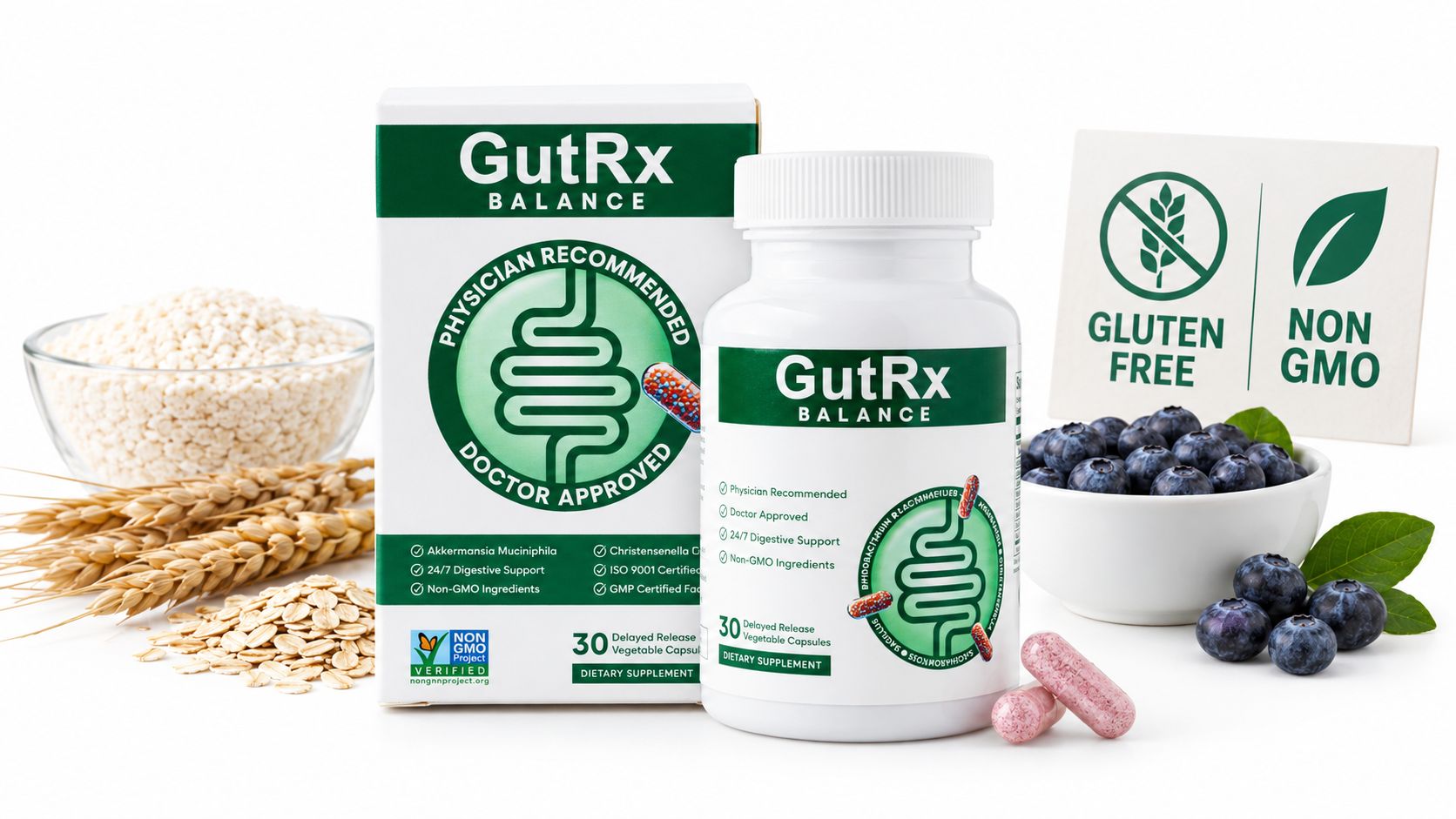
For example, GutRx BALANCE lists 30 billion CFUs per capsule and next-generation probiotics for gut health, digestive balance, and immune support. GutRx publishes batch-level documentation, so you can pull the COA for the lot on your bottle and confirm the gluten result yourself. Its guide to gluten-free probiotics provides further context for comparing ingredient and gluten documentation.
What Non-GMO Actually Means on a Label
Could a product carry a non-GMO claim while still needing separate gluten review? Yes. Non-GMO labeling answers a sourcing question about genetically engineered inputs, not an allergen or gluten question. Verification follows the ingredient's path from seed and supplier to processing and packaging, with attention to traceability, segregation, and testing. The overview of the Non-GMO Project Verified seal helps explain how that mark differs from a simple brand statement.
Shoppers usually see three kinds of signals.
Non-GMO Project Verified
The butterfly mark identifies participation in an independent verification program. Its controls cover records, supply-chain separation, and review of higher-risk ingredients. Consumer Reports describes a threshold below 0.9% genetically modified organisms, along with paperwork checks, facility inspections, and testing for inputs such as corn and soy. That gives the seal more evidence behind it than the words “non-GMO” alone.
USDA bioengineered food disclosure
The USDA bioengineered food disclosure is a federal disclosure system, not the same certification as Non-GMO Project Verified. It focuses on foods with detectable modified genetic material. Highly refined ingredients may fall outside that disclosure when processing removes detectable modified DNA, so the absence of a USDA disclosure is not equivalent to third-party non-GMO verification.
Self-declared non-GMO
A brand can print “non-GMO” without showing an independent certification mark. The statement may reflect a sourcing policy, but the package does not tell you whether an outside party reviewed supplier records, tested high-risk inputs, or checked segregation controls.
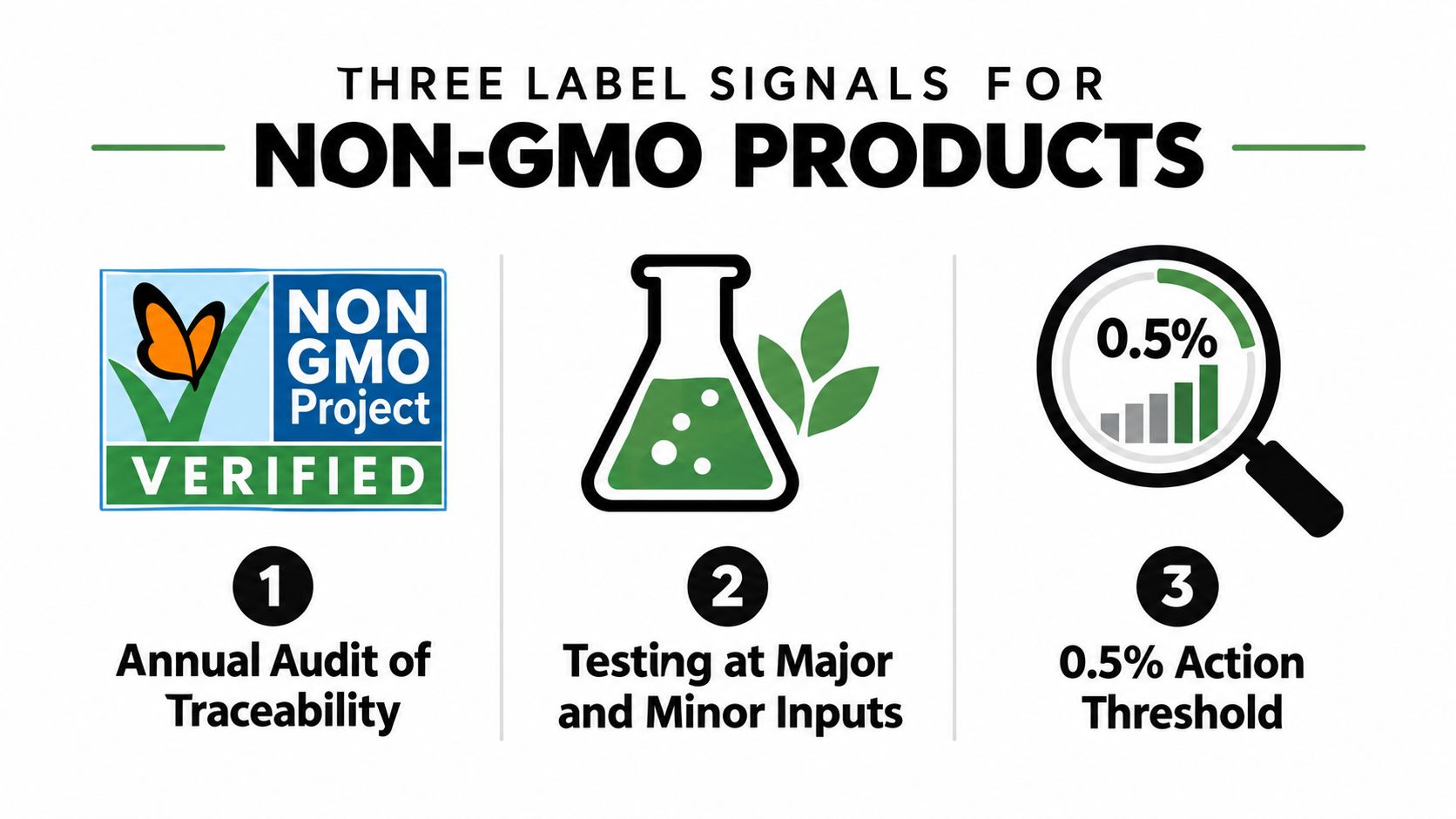
High-risk categories commonly include soy, corn, sugar beet, and canola. A soy lecithin capsule can meet non-GMO requirements while its shell or production line still needs separate gluten review. A beet-based supplement may also require checking wheat-derived flavors, binders, or processing aids. The non-GMO mark strengthens sourcing evidence, but it does not replace a gluten-control statement or lot-specific documentation.
How Cross-Contact Can Break Both Promises at Once
Cross-contact creates two different pathways to a failed claim. Gluten can enter through wheat, barley, rye, shared farm equipment, mills, storage areas, mixing tanks, or tablet presses. Genetically modified material can enter through pollen drift, shared seed stock, mixed harvests, or handling lines that aren't adequately segregated.
The risk doesn't come only from the headline ingredient. A probiotic capsule may contain bacterial strains that are naturally free of gluten, while a separate excipient, flavor, carrier, or processing aid introduces the relevant risk.
A supplement-facility example
Suppose a facility produces an herbal supplement using non-GMO botanical extracts. The same mixing tanks also handle a wheat-derived binder used in another product. If the facility relies on ingredient choice alone and doesn't validate its cleaning process, gluten residues could remain.
The product might still carry a non-GMO claim because the botanical extracts meet the sourcing requirements. But it might fail gluten-free testing if residual gluten reaches or exceeds the FDA threshold. The reverse can happen when a facility prevents gluten cross-contact but doesn't segregate or verify genetically engineered inputs.
Separate controls produce separate confidence. A non-GMO ingredient certificate doesn't replace gluten testing, and a gluten test doesn't verify seed or crop status.
Suppliers manage these risks through dedicated equipment, validated sanitation, controlled storage, production scheduling, supplier declarations, traceability records, and finished-lot testing. A manufacturer should be able to explain which controls apply to the claim being made.
This distinction matters especially for supplements because capsules and powders can include small amounts of inactive ingredients. A shopper who sees “non-GMO” on the front panel still needs to examine the complete Supplement Facts panel, other ingredients, allergen statement, and facility language before deciding that the product meets gluten-avoidance needs.
How Third-Party Testing and COAs Add Real Proof
A Certificate of Analysis, or COA, is a lot-specific document that records test results for a product or ingredient. Depending on the product, it may include identity, potency, purity, microbial results, heavy-metal data, allergen testing, or gluten analysis.
The lot-specific detail matters. A brand-level statement describes a policy. A COA connects evidence to a particular batch, often through a lot number or batch code. The GutRx explanation of Certificates of Analysis describes why this documentation helps buyers assess product quality more concretely.
What common seals do and don't establish
| Seal | Non-GMO Verified | Gluten Tested | Leaves Reviews | Certification |
|---|---|---|---|---|
| Non-GMO Project Verified | Yes, under its standard | Not by default | No | Independent non-GMO verification |
| NSF Gluten Free | No | Yes, within its program | No | Gluten-focused certification |
| GFCO | No | Yes, within its program | No | Gluten-free certification |
| USP | Not necessarily | Not necessarily | No | Quality standards vary by program |
| Informed Sport | Not necessarily | Not necessarily | No | Sports-product testing focus |
| ConsumerLab | Not necessarily | Not necessarily | No | Independent product review and testing |
No seal should be treated as universal proof of every desirable attribute. Ask what the program tests, whether it evaluates the finished product or only ingredients, how often audits occur, and whether gluten testing is included.
What to request from a brand
A useful COA should identify the product and lot, show the laboratory or testing organization, name the analytical method, and report the result clearly. For gluten, look for the assay method, such as ELISA, and the reported limit of detection. For non-GMO status, look for ingredient traceability, supplier declarations, segregation records, or testing appropriate to the input.
A scannable QR code can make retrieval easier, but the code itself isn't proof. The document's lot number should match the container you're buying.
A Shopper's Checklist for Reading Supplement Labels
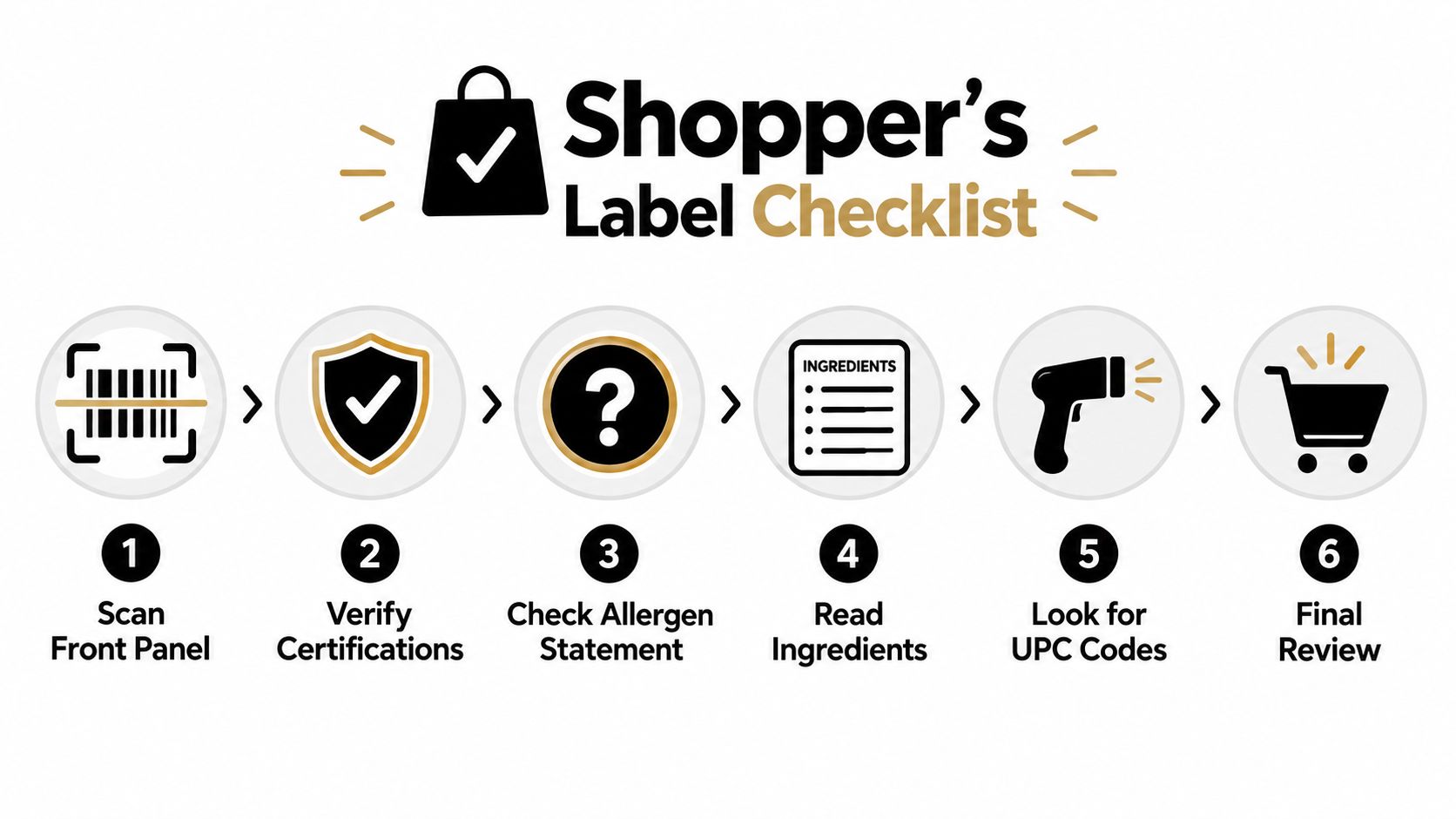
Use this process before checkout, whether you're standing in a store or comparing listings on Amazon. It separates visible marketing language from evidence that addresses your actual concern.
Start with the front panel
-
Scan for gluten language. Look for “gluten-free” and, where relevant, a gluten-focused certification seal such as GFCO or NSF. A general “clean” or “natural” statement doesn't answer the gluten question.
-
Check the non-GMO signal. If genetically engineered ingredients matter to you, look for the Non-GMO Project Verified butterfly or clear documentation supporting a self-declared claim. Don't assume that a gluten-free seal covers this issue.
Inspect the formula and facility information
-
Read every ingredient. Flag wheat, barley, rye, oats, maltodextrin, dextrin, and modified food starch when their source isn't clear. Also check ingredients commonly associated with GMO sourcing questions, including soy lecithin, corn starch, beet sugar, and canola oil.
-
Review allergen and shared-equipment statements. Look for wheat declarations and language about shared equipment or a shared facility. If the label leaves the manufacturing pathway unclear, contact the brand before buying.
-
Find lot-level documentation. A batch number, QR code, or downloadable COA can connect the bottle to actual testing. The GutRx guide to third-party testing explains why independent testing and transparent records matter when you're comparing supplement options.
-
Check regulatory history. Search the manufacturer and product for FDA warning letters or recall notices. This won't establish gluten-free or non-GMO status by itself, but it can reveal quality or labeling issues that deserve attention.
A product can satisfy both concerns only when both claims are supported. For someone with celiac disease, the gluten-free evidence comes first. For someone also avoiding genetically engineered ingredients, non-GMO verification is a separate checkpoint.
The decision rule is simple: if you need both protections, look for both forms of evidence. One seal may be meaningful, but it doesn't complete the other half of the evaluation.
GutRx offers digestive-support formulas made with non-GMO and gluten-free ingredients, including probiotics and targeted digestive support, with third-party testing and downloadable COAs described by the brand. Visit GutRx to review the available formulas and compare the quality documentation with your own gluten-free and non-GMO requirements.


