

An expired probiotic isn't automatically unsafe, but its guaranteed potency almost certainly is compromised. A 2020 analysis found that 22 of 33 expired products still contained viable bacteria, yet only 5 matched or exceeded their original labeled cell-count claims, so whether you should take yours depends on what you're using it for.
If you're staring at an old bottle, don't reduce the decision to “expired equals dangerous” or “expired equals fine.” The practical questions are how far past the date it is, how it was stored, whether the packaging protected it, and whether you need reliable support for a specific problem such as IBS symptoms, irregularity, bloating, vaginal balance, or urinary support.
For general wellness, a recently expired bottle that stayed sealed, cool, and dry may still contain live organisms. For symptom management or a weakened immune system, guessing isn't a sensible strategy. A fresh product with verified potency is the better choice.
Table of Contents
- What an Expired Probiotic Actually Means
- What Expiration Dates Actually Guarantee on the Label
- Storage and Formulation Factors That Drive Viability Loss
- Safety Risks Most Expired-Probiotic Articles Skip
- How to Check Whether Your Probiotic Is Still Viable
- Use It, Discard It, or Replace It
- Choosing a Probiotic That Does Not Put You in This Position
What an Expired Probiotic Actually Means
Yes, you can sometimes take an expired probiotic, but you shouldn't assume it will work as labeled. The expiration date primarily marks the end of the manufacturer's potency guarantee. It isn't automatically a safety emergency, yet the live CFU count, or colony-forming unit count, may have fallen enough that the capsule no longer delivers the intended support.
Probiotics are living microorganisms. They need to remain viable until you consume them, and their numbers can decline during storage. The date on the bottle gives you a useful boundary, but it can't tell you exactly how many organisms remain in a bottle that has spent months in a warm bathroom or inside a hot travel bag.
The three questions that matter
Use this quick framework before you decide:
- Potency: Is the product past the date by a short period or a long period? The farther it is past the labeled shelf life, the less confidence you should have in the stated CFU amount.
- Storage: Did it stay in its original container, protected from heat, humidity, light, and repeated exposure to air? Storage can accelerate viability loss.
- Purpose: Are you taking it casually as a daily probiotic, or are you relying on it for bloating, irregularity, diarrhea support, vaginal health, urinary support, or another active concern?
Practical rule: If you need a predictable result, don't use an expired probiotic as your main intervention.
The risk is different from the usefulness question. A product may still contain live bacteria after its date without delivering enough viable organisms to match the label or support the outcome you want. It may also have developed obvious quality problems if moisture entered the container or the capsules changed appearance.
For a healthy adult seeking general digestive support, a properly stored bottle that's only slightly past its date may be a reasonable discard-or-replace judgment. For anyone with significant symptoms, a weakened immune system, or a clinician-recommended regimen, replace it rather than gambling on an unknown dose.
What Expiration Dates Actually Guarantee on the Label
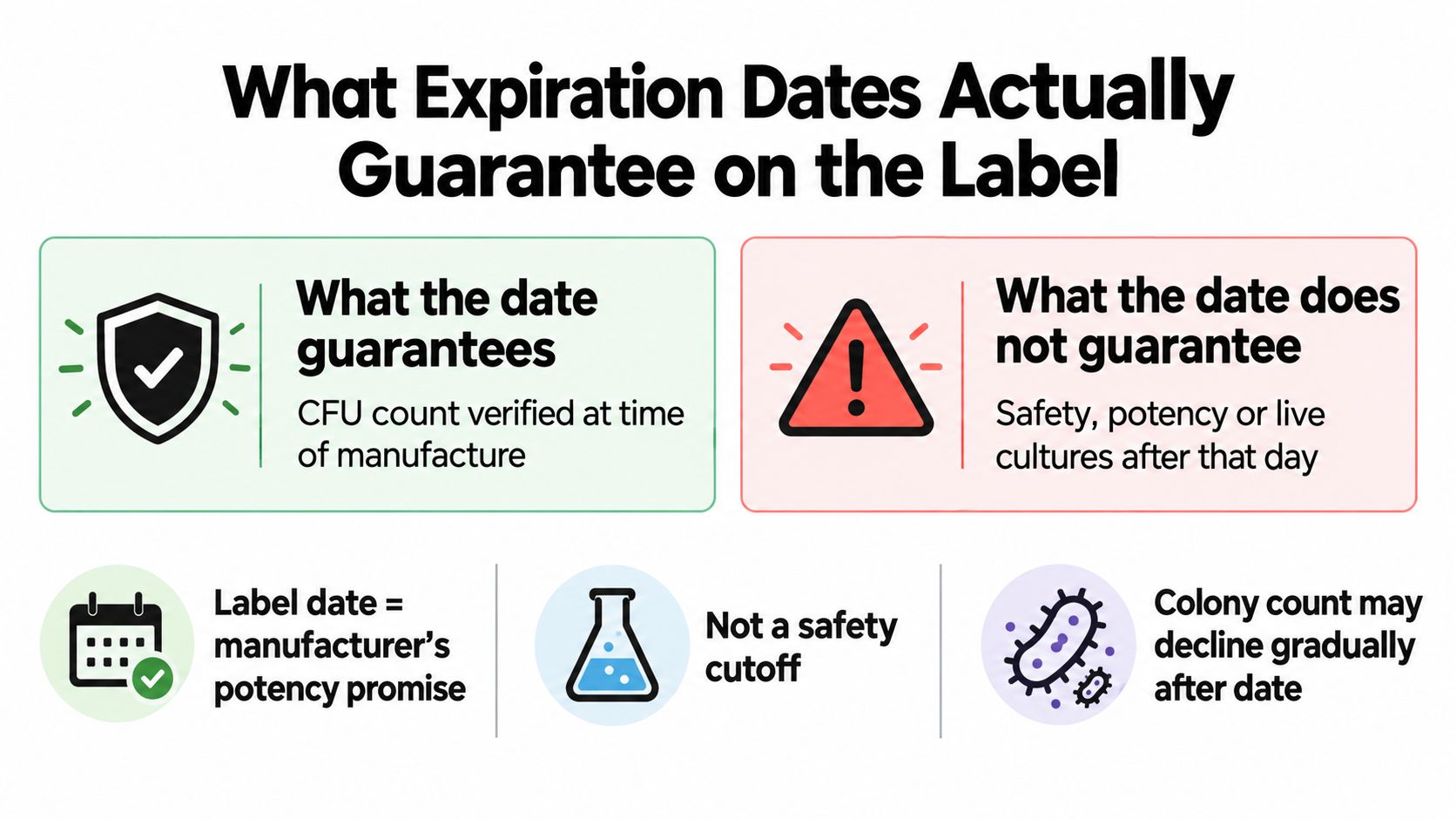
What does a probiotic expiration date promise? It gives you a defined manufacturer's potency promise through a stated point in time, provided you followed the storage instructions. The declared CFU count should still be present at the end of the labeled shelf life. The date does not mean every organism becomes inactive the next day, and it does not support indefinite potency afterward.
The label detail that matters most is the CFU guarantee. Look for wording that confirms the stated count through the expiration date or end of shelf life. A number that describes the amount added during manufacturing gives you less useful information about what remains when you take the product. Probiotics must remain alive to work, and viability can decline throughout storage. See this explanation of probiotic labels and expiration dates for guidance on reading these claims.
What the expired-product evidence shows
The strongest warning comes from a 2020 analysis of 33 expired probiotic products. The products were, on average, 11.32 years past expiration, ranging from 1 to 22 years. Twenty-two products still contained viable bacteria, and 5 met or exceeded their original labeled cell-count claims, according to the 2020 analysis of expired probiotic products.
Those results do not make an expired bottle reliable. Most products contained counts well below the levels manufacturers intended for efficacy. Live organisms can remain present while the product fails to deliver the dose printed on its label or the result you are seeking.
The evidence separates three different questions:
- Do live bacteria remain? Some expired capsules retain viable organisms for a long time.
- Does the label potency remain? Most tested products no longer delivered the manufacturer's intended count.
- Will the expected benefit remain? A reduced count may not support the original purpose of the formula, especially when you are using it for a specific digestive concern rather than general wellness.
A guide to high-CFU probiotic formulas explains why the starting count matters. A high initial count gives viability more room to decline, but it cannot overcome poor storage, moisture, or prolonged time past expiration. GutRx BALANCE lists 30 billion CFUs per capsule and next-generation probiotics for gut health, digestive balance, and immune support. With any product, check whether the declared potency is guaranteed when you take it.
Treat the date as a potency cutoff, not an instant failure point. After it passes, the label no longer gives you the same confidence, so the product's storage history and your need for a dependable dose should decide whether you replace it.
Storage and Formulation Factors That Drive Viability Loss
Two bottles with the same expiration date can have very different viable counts. A sealed capsule stored in a cool, dry place has had a better chance of retaining potency than an opened bottle left beside a steamy shower, even if both look normal.
Temperature is the strongest practical warning sign. One shelf-life study reported that vacuum packaging stored at 4°C could extend shelf life to about 2 years, while storage at 30°C reduced it to about 3 months. Those figures come from the probiotic stability study on temperature and packaging, and they show why “room temperature” isn't a single storage condition. A cool cupboard and a hot cupboard can produce very different outcomes.
Heat, moisture, and air
The 2026 Frontiers analysis reported the greatest bacterial losses under ambient conditions, while refrigeration and freezing best preserved bacterial counts. It also reported that compliance with label-declared counts declined toward the end of minimum durability. That makes a heat-exposed expired bottle a poor candidate for continued use.
Moisture is another major problem. Humidity can enter after repeated opening, especially when you keep a bottle in a bathroom or near a kitchen sink. Clumping, sticky powder, damaged capsules, or a damp desiccant packet suggest that the product's protective environment has failed.
Packaging and delivery systems
Packaging can slow exposure to air and humidity. A tightly closed bottle with a functioning desiccant offers more protection than a container that has been left open. Blister packaging can also limit exposure to the surrounding environment because each capsule remains individually enclosed.
Formulation matters too. Some products are designed as shelf-stable probiotics, while others require refrigeration. Enteric-coated or delayed-release capsules may help protect their contents during passage through the upper digestive tract, but that delivery feature doesn't restore bacteria that died from age, heat, or moisture.
Don't refrigerate a product against its label instructions and assume that cold storage fixes everything. Follow the manufacturer's storage directions from the beginning. If the product was repeatedly warmed, exposed to humidity, or stored outside its recommended conditions, treat the printed expiration date as an optimistic boundary rather than a reliable potency marker.
Safety Risks Most Expired-Probiotic Articles Skip
For a healthy adult, an expired probiotic is usually more concerning for reduced potency than for immediate toxicity. That common answer becomes inadequate when someone is using the product to manage active symptoms or has a higher medical risk profile.
People with IBS may be trying to influence bloating, irregularity, diarrhea-type discomfort, or digestive balance. Someone with recurrent UTIs may be choosing a probiotic for urinary support. A person with a weakened immune system may be considering probiotics while dealing with a much narrower margin for experimentation. In these cases, an expired product creates uncertainty about both what remains in the capsule and whether the product is appropriate for the individual.
When the intended use changes the decision
The question isn't only “can you take expired probiotics?” It's also “what happens if this dose is weaker than expected?”
For general wellness, an underpowered capsule may fail to make a noticeable difference. For symptom support, that same uncertainty can delay a more appropriate evaluation or replacement product. If you're using a probiotic for IBS symptoms, recurrent UTIs, vaginal support, or diarrhea support, a fresh formula with documented potency is the more responsible option.
A review in FEMS Microbes on probiotics and safety considerations emphasizes the gap that many consumer explanations ignore. Expired probiotics may still contain live organisms, but strong safety studies haven't established that they remain safe past expiration. “Probably harmless” is not the same as evidence-based reassurance.
Who should avoid the gamble
- Immunocompromised users: Don't make an expired supplement your first choice. Discuss probiotic use with a healthcare professional, particularly if you have a serious condition or are receiving immune-suppressing treatment.
- People with ongoing or worsening GI symptoms: Replace the bottle or seek clinical guidance instead of using uncertain potency to manage symptoms.
- People seeking vaginal or urinary support: The intended benefit may depend on an appropriate live formulation, so an old bottle with an unknown CFU count is a weak choice.
- Anyone who feels unwell after taking it: Stop using the product and contact a qualified healthcare professional if symptoms concern you.
An expired probiotic with damaged packaging, moisture, unusual odor, or visible deterioration belongs in the trash regardless of your health status. Don't use smell or appearance to clear a product that you're taking for a serious or persistent concern.
How to Check Whether Your Probiotic Is Still Viable
You can't confirm a probiotic's CFU count from the outside of the bottle. You can, however, gather enough information to make a sensible discard-or-replace decision.
Start with the date, then work through the product's history. Don't skip storage just because the capsule looks normal.
A practical inspection
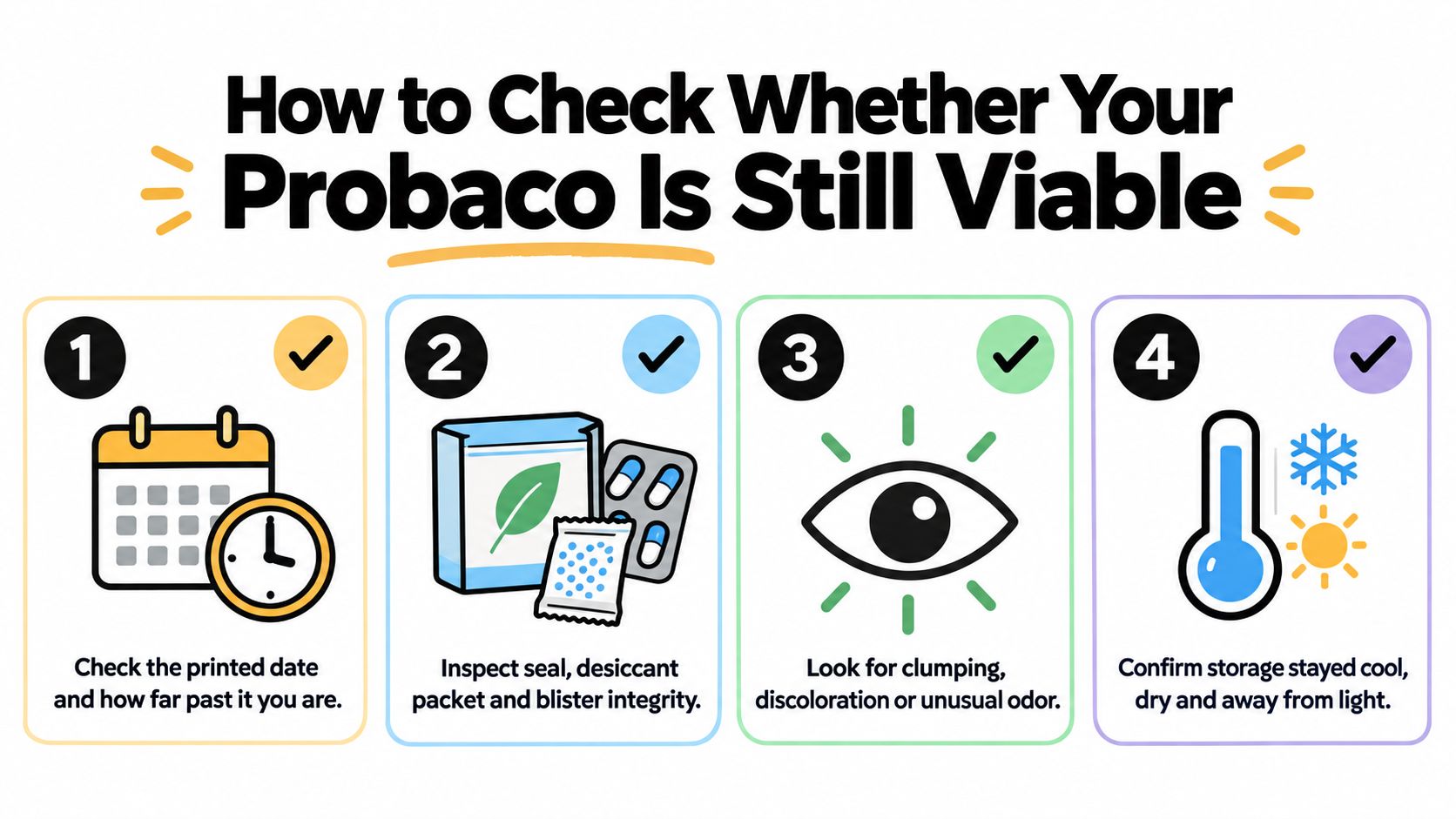
- Read the printed date. Note whether it's a best-by, use-by, or expiration date, and how far past it the product is. A bottle that's barely beyond its date deserves a different assessment from one that has been forgotten for years.
- Inspect the seal and container. Check the cap, inner seal, desiccant packet, bottle walls, and any blister pockets. Bulging, broken seals, damaged blisters, or moisture inside the package are clear reasons to discard it.
- Look at the capsules or powder. Clumping, discoloration, stickiness, cracks, or an unusual odor indicate deterioration. A normal appearance doesn't prove viability, but an abnormal appearance is enough to reject the product.
- Reconstruct its storage history. A cool, dry cupboard is preferable to a bathroom cabinet, windowsill, car, or travel bag exposed to heat. Consider whether the bottle was opened often and whether the cap was replaced promptly.
What home checks can't tell you
A smell test can identify obvious spoilage, but it can't tell you whether the product contains the labeled CFU count. The same applies to color, texture, and capsule condition. A pristine-looking capsule may have lost substantial viability, while an expired capsule that still looks ordinary may retain some live organisms.
The strongest verification comes from a manufacturer's Certificate of Analysis, or COA, showing testing for identity, potency, and quality. Learn how these documents work in this guide to probiotic Certificates of Analysis. If the manufacturer can't provide useful batch-level documentation, you're still making a probability judgment, not confirming the dose.
My advice is simple. Use the inspection to identify obvious reasons to discard the bottle. Don't use it to convince yourself that an expired product is fully equivalent to a fresh one.
Use It, Discard It, or Replace It
You have three practical choices, and the right one depends on purpose, time past expiry, and storage history. Don't treat every expired bottle alike.
| Factor | Use It | Discard It | Replace It |
|---|---|---|---|
| Intended use | General daily maintenance, with modest expectations | Any use where the product has visible deterioration | Bloating, irregularity, diarrhea support, vaginal or urinary support, or another specific goal |
| Time past date | Only when recently expired and the bottle was well protected | Years past expiry or date is unclear | Whenever reliable potency matters |
| Storage | Sealed, cool, dry, and away from light | Heat-exposed, humid, repeatedly opened, or improperly stored | Storage history is uncertain or the product was transported under poor conditions |
| Packaging | Fully intact, dry, and clean | Broken seal, moisture, clumping, damaged capsules, or unusual odor | Fresh packaging gives you a clearer starting point |
| Evidence of potency | No confirmation, so accept uncertainty | No need to investigate an obviously compromised product | Look for shelf-life potency testing and accessible batch documentation |
When using it is reasonable
For a healthy adult taking a recently expired bottle for broad daily support, using it may be reasonable if the container stayed sealed, dry, and cool and shows no signs of deterioration. Set expectations correctly. You may be taking a product with reduced potency, not the dose printed on the label.
I wouldn't choose this route for a targeted symptom plan. If you're trying to address persistent bloating, irregularity, diarrhea-type discomfort, or women's gut and urinary support, inconsistent potency makes it harder to judge whether the formula is helping.
When discarding is the right answer
Discard the bottle if it's years past the date, has been stored in heat or humidity, or has any visible packaging or capsule problem. The cost of keeping an old supplement isn't the only consideration. An unusable product can also distract you from finding the actual cause of ongoing digestive symptoms.
When replacing is smarter
Replace the product when you want dependable support. Choose a fresh probiotic with a stated CFU guarantee through shelf life, storage instructions you can follow, and third-party testing that includes accessible documentation. That gives you a more defensible starting point than guessing what survived in an old bottle.
Choosing a Probiotic That Does Not Put You in This Position
The best way to avoid an expired probiotic is to buy for verifiability, not a large CFU number on the front label. Choose a product that states its CFU guarantee through the expiration date, identifies the strains, and explains how potency is measured. Shelf life varies by formulation and packaging, so storage instructions still matter after purchase.
What to look for before buying
Strain-specific information should match your goal. A label that says only “gut health” gives you little basis for comparison. Look for named strains and a formula designed for the symptom or type of support you want. A product intended for everyday regularity is not automatically appropriate for bloating after meals or diarrhea-type discomfort.
Third-party testing provides another check on the manufacturer's claims. Look for records that address strain identity and potency, rather than a badge or vague statement on the bottle. This guide to third-party-tested probiotics explains why accessible testing records help when you compare products.
Shelf-stable or delayed-release delivery can be practical if refrigeration is inconvenient. It does not make the product immune to heat or moisture. Choose packaging that protects the contents, follow the storage directions, and keep the bottle away from a hot car or humid bathroom.
Clinically studied strains and transparent manufacturing standards should carry more weight than lifestyle claims. Vegan, non-GMO, or gluten-free features may matter for your needs, but they do not prove potency or suitability. If you have IBS, inconsistent potency can make symptom tracking harder. If you are immunocompromised, use a fresh product and ask your clinician before starting or continuing a probiotic, rather than taking chances with an old bottle.
Buy with a clear purpose, documented potency, protective packaging, and storage directions you can follow. That standard gives you a reliable baseline and reduces guesswork about how many live organisms remain.
GutRx offers probiotic and digestive-support formulas with third-party testing and downloadable Certificates of Analysis. Visit GutRx to review the available options and compare products against your digestive-support needs.


