

Many men with IBS don't recognize it because the symptom pattern often looks different from the version commonly read about online. A major global meta-analysis found IBS prevalence of 12.0% in women versus 8.6% in men, and it also found that men with IBS are more likely to present with diarrhea-predominant disease, while women more often report constipation-predominant symptoms (global meta-analysis on sex differences in IBS). That one shift changes how IBS shows up, how quickly it's identified, and why many men dismiss it as stress, bad food, or “just a sensitive stomach.”
Table of Contents
- Why IBS in Men Often Goes Unrecognized
- What IBS Actually Is and the Subtypes That Matter for Men
- The Core Symptom Pattern in Men with IBS
- IBS Versus Other Gut Conditions That Mimic Male Symptoms
- Red Flags That Mean You Should See a Doctor Now
- How IBS Gets Diagnosed in Practice
- Evidence-Based Self-Care, Diet, and Microbiome Support
- Your 30-Day Next Steps and When to Reassess
Why IBS in Men Often Goes Unrecognized
A common pattern goes like this. A man cancels dinner because he can't trust his gut, has to know where the bathroom is, or gets cramping and loose stools after meals. He shrugs it off, blames stress, and moves on until the disruption becomes impossible to ignore.
Part of the problem is simple visibility. IBS is diagnosed more often in women, but that doesn't mean it's uncommon in men. A 2014 NIH review estimated overall international IBS prevalence at 11.2%, with 14.0% in women versus 8.9% in men (NIH review on global IBS prevalence). That gap is real, but it's not so large that IBS in men should be treated as unusual.
Why the male pattern gets missed
Older symptom research helps explain the blind spot. In a 1997 study, men with IBS reported several classic symptom features less often than women: mucus 38% vs 66.2%, incomplete evacuation 26.9% vs 60%, distension 36.9% vs 55.4%, and scybala 7.7% vs 29.2%. The authors concluded that pain-related symptoms were similar by sex, but other hallmark features were less common in men, which may help explain why symptom-based tools could miss male cases (sex differences in IBS symptom reporting).
That matters in practice. If a man has cramping, urgency, and repeated loose stools, but not much visible bloating or constipation, he may not see himself in the standard “IBS symptoms” list.
| Factor | How It Affects Men | Impact on Recognition |
|---|---|---|
| Diarrhea-skewed symptom pattern | Men may notice urgency and loose stools more than constipation | IBS can be mistaken for stress, food intolerance, or a short-term stomach issue |
| Less reporting of classic symptom features | Men may describe less mucus, distension, or incomplete evacuation | Symptom checklists may fit less neatly |
| Stoicism and embarrassment | Many men wait longer before discussing bowel symptoms | Evaluation starts later |
| Generic consumer content | Articles often lead with bloating and constipation | Men may assume they don't fit the IBS picture |
Men can have a very real IBS pattern even when they don't match the stereotype most online articles present.
A male-specific lens matters because recognition is the first step. If the symptom pattern is misunderstood, men often delay care, self-treat randomly, or look only for “food sensitivity” solutions instead of assessing for IBS itself.
What IBS Actually Is and the Subtypes That Matter for Men
IBS is best understood as a disorder of gut-brain interaction, similar to a home alarm system that has become too sensitive. The wiring still works, but the sensor reacts too strongly to normal input. In IBS, the gut, nervous system, and bowel habits can become miscalibrated, so normal digestion produces pain, urgency, or abnormal stool patterns.
In plain language, IBS is defined by recurrent abdominal pain associated with bowel changes. The formal Rome IV framework describes pain that happens at least one day per week for three months, linked to defecation, a change in stool frequency, or a change in stool form. That's why IBS isn't just “having diarrhea sometimes” or “being bloated after pizza.” Pain plus a bowel pattern change is the core concept.
The four subtypes
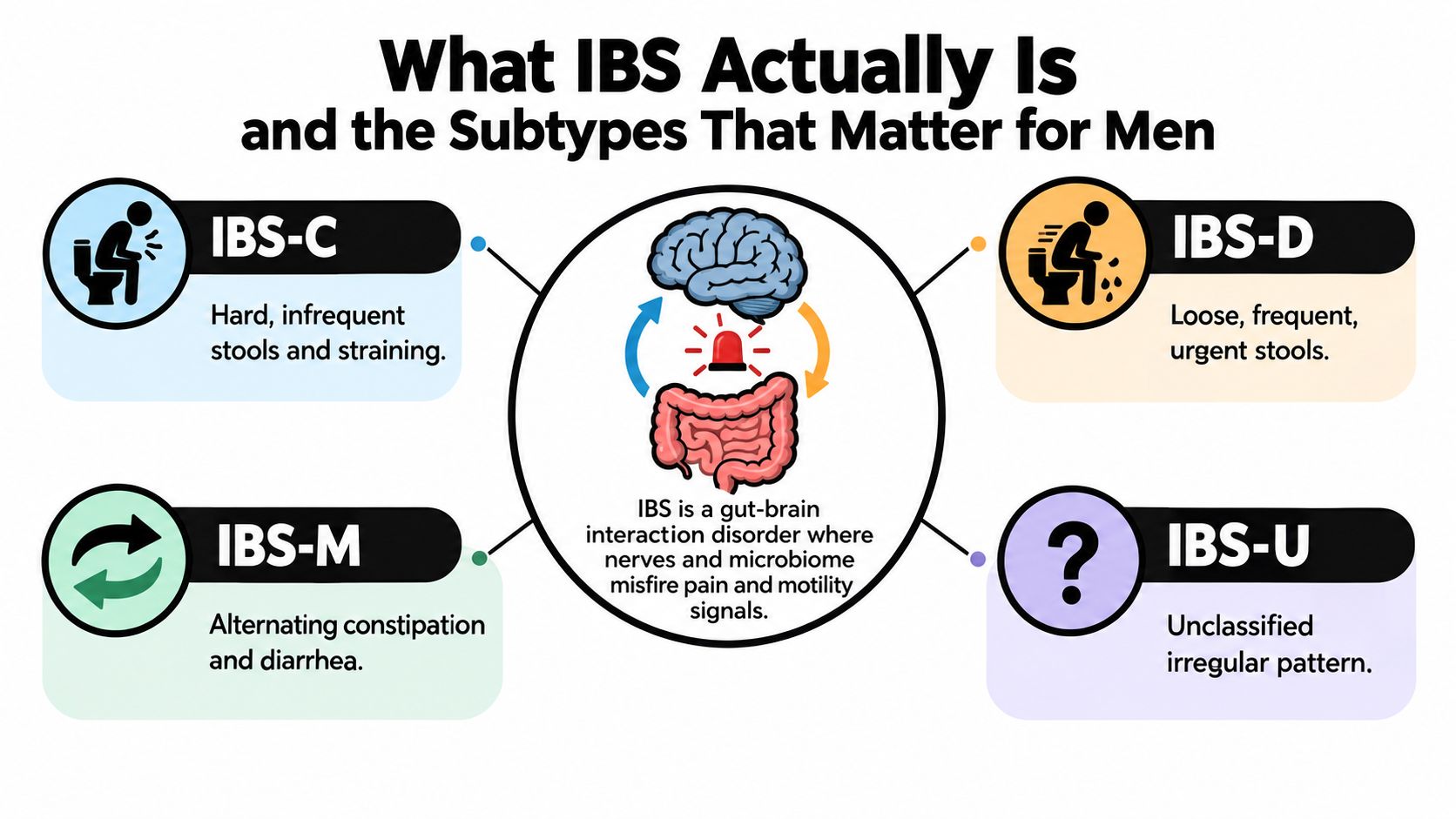
Doctors divide IBS into four subtypes based on stool form, usually using the Bristol Stool Scale.
- IBS-C means constipation-predominant IBS.
- IBS-D means diarrhea-predominant IBS.
- IBS-M means mixed IBS, with both constipation and diarrhea.
- IBS-U means unclassified IBS, when the pattern doesn't fit neatly.
For men, subtype matters early because the male distribution leans toward looser and more frequent stools. A clinic-based meta-analysis found IBS-C was more common in women than men, 40% vs 21%, while IBS-D was more common in men, 50% vs 31% (clinic-based meta-analysis of IBS subtypes by sex). A recent review reported a similar split, with IBS-M at 25.8% in women and 25.0% in men (gender-specific IBS pathophysiology review00105-5/fulltext)).
Why subtype changes the plan
A man with IBS-D often needs a different starting strategy than a man with IBS-C. Trigger foods, fiber choices, timing of meals, and supplement selection all depend on whether the dominant problem is hard stools, loose stools, or an alternating pattern.
Practical rule: If your main issue is urgency, frequent loose stools, and cramping that improves after a bowel movement, start by thinking in terms of subtype, not just the generic IBS label.
The Core Symptom Pattern in Men with IBS
Most articles on IBS symptoms in men give a universal list. That's where many readers get lost. The better way to think about male IBS is as a symptom cluster with some features that stand out and others that are often less prominent.
The symptoms men tend to notice first
For many men, the core complaint is lower abdominal cramping plus a stool pattern that has become unpredictable. That may mean loose stools, more frequent trips, urgency, or a strong need to use the bathroom shortly after eating. Some men also notice partial relief after a bowel movement, even if the gut still feels unsettled.
More recent symptom profiling supports that pattern. Men with IBS often show higher stool frequency and more loose or watery stools, while women more often report nausea and constipation-heavy symptoms. One observational study in that review found nausea was 49% in females versus 18.2% in males (review of sex-related symptom profiling in IBS).
What men may under-report
Some men have symptoms they don't describe unless someone asks directly. They may say “my stomach is off” instead of naming urgency, incomplete emptying, or a repeated need to return to the bathroom. Others assume IBS must involve major bloating, even though some male patients don't have that as the main feature.
If bloating is a major issue for you, this guide on bloating and IBS treatment options can help you think through whether it fits your broader pattern.
| Symptom Cluster | Reported in Men | Often Under-Reported | Most Common Subtype |
|---|---|---|---|
| Cramping with stool change | Common | Whether pain improves after bowel movements | IBS-D or IBS-M |
| Frequent loose stools | Common | How often urgency shapes daily planning | IBS-D |
| Bathroom urgency | Common | Fear of travel, meetings, or eating out | IBS-D |
| Incomplete evacuation feeling | Can occur | Men may mention it less directly | IBS-M |
| Visible distension and nausea | Less emphasized | Some men assume these must be present for IBS | Less defining in many male presentations |
The timing pattern also matters
A useful clue is rhythm. Men with IBS often describe symptoms that spike after meals, during stressful workdays, or in the early morning when the colon is naturally more active. Some notice a strong weekday pattern and then feel better on weekends, which can make them conclude it's “just stress.” Sometimes that's partly true, but stress-sensitive symptoms can still be IBS.
If you keep labeling it as a stress stomach, but the same stool pattern repeats for months, it's worth looking at IBS more seriously.
IBS Versus Other Gut Conditions That Mimic Male Symptoms
Loose stools, cramping, and urgency aren't unique to IBS. That's why self-diagnosis gets messy. In men, the most common confusion points are upper gut problems that overlap with bowel symptoms, food intolerance, and medication effects.
A practical way to sort this out is to compare the pattern, not just the symptom name. “Diarrhea” by itself doesn't tell you much. Timing, triggers, stool form, nighttime symptoms, and associated features tell you much more.
The overlap problems that confuse people
IBS can coexist with dyspepsia or reflux, so some men have both lower gut and upper gut symptoms. The NICE guidance also notes that dyspepsia occurs in 42–87% of IBS patients (NICE guideline on IBS diagnosis and management). That overlap is one reason a man may focus on burping, upper abdominal discomfort, or nausea and miss the bowel pattern underneath.
You might also be dealing with food breakdown issues instead of IBS, or in addition to it. If that sounds familiar, this overview of enzyme deficiency symptoms is a useful cross-check.
| Condition | Main Symptoms | Key Differences From IBS in Men | Typical Triggers |
|---|---|---|---|
| IBS | Abdominal pain with altered bowel habits, urgency, stool form change | Pattern often fluctuates and links to bowel movements | Meals, stress, routine disruption |
| Functional dyspepsia or reflux | Upper abdominal discomfort, early fullness, heartburn, nausea | Symptoms sit higher in the abdomen and may not track clearly with bowel changes | Larger meals, fatty foods, lying down |
| Lactose or carbohydrate malabsorption | Gas, bloating, loose stools after certain foods | Often tied tightly to specific foods rather than a broad recurring pattern | Dairy or other poorly tolerated carbs |
| SIBO-type symptom pattern | Bloating, gas, discomfort, loose stools | Can look similar, often with meal-related fermentation symptoms | Certain fermentable foods |
| Medication-related bowel changes | Diarrhea, cramping, altered stool consistency | Starts after a medication change or dose shift | Metformin, NSAIDs, statins, others |
| Microscopic colitis or inflammatory conditions | Persistent watery diarrhea, sometimes nighttime symptoms | Night waking, progressive course, or other warning signs point away from routine IBS | Not usually just meal timing |
When the pattern doesn't fit routine IBS
Blood in stool, black stools, ongoing nighttime diarrhea, fever, and trouble keeping weight on deserve medical evaluation. Those aren't things to explain away with a probiotic, enzyme, or elimination diet.
Red Flags That Mean You Should See a Doctor Now
Most IBS symptoms can be assessed in a routine clinic visit. Some symptoms shouldn't wait. If you have red flags, the priority is testing and medical evaluation, not tweaking your diet on your own.
Here's the checklist to keep in mind.
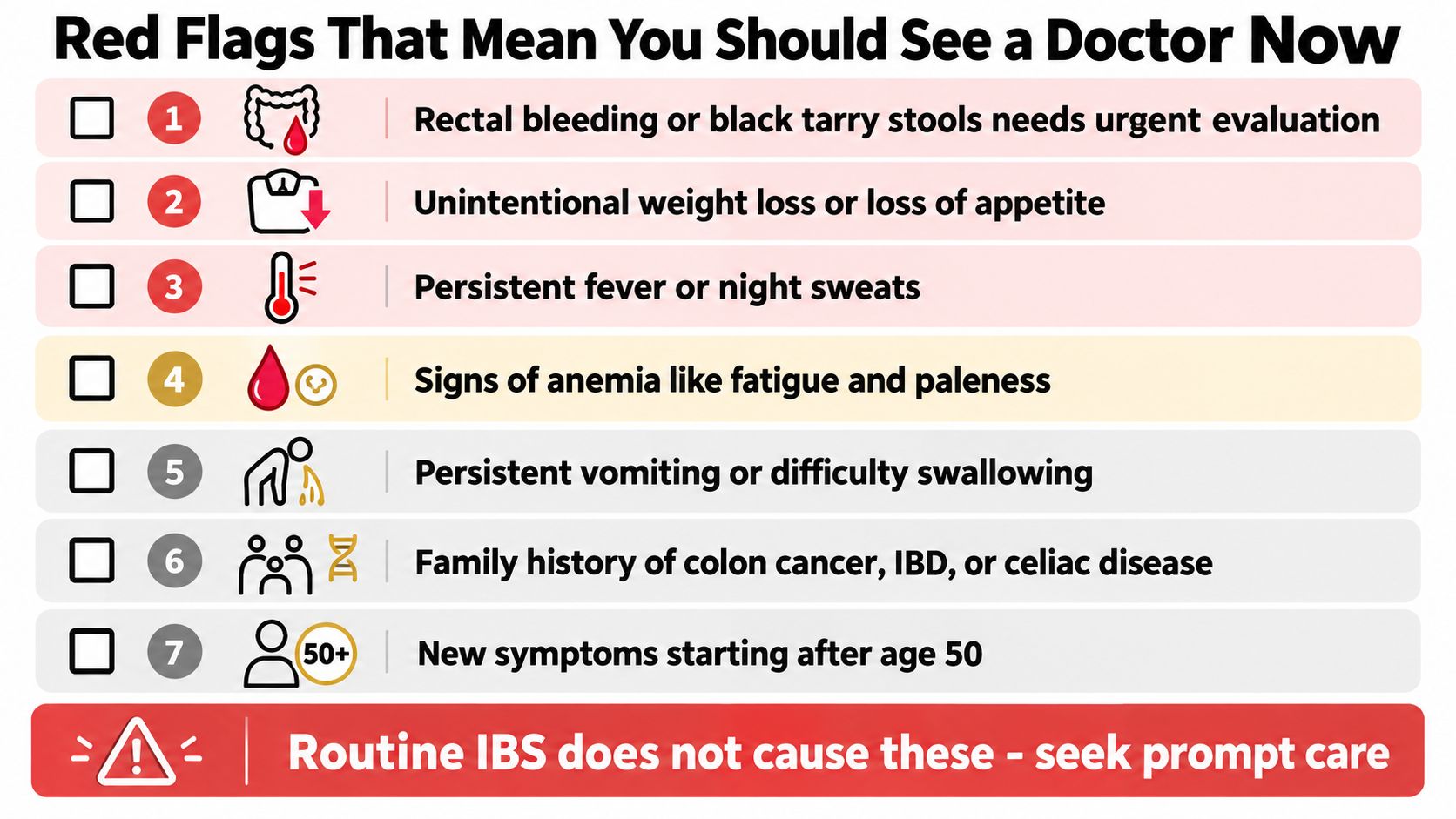
Symptoms that override self-care
- Rectal bleeding or black stools means bleeding has to be considered.
- Unintentional weight loss suggests something more than routine IBS may be going on.
- Anemia symptoms such as unusual fatigue or looking pale can point to blood loss or another underlying condition.
- Nocturnal diarrhea that wakes you from sleep is not a classic IBS pattern.
- New symptoms after age 50 need a careful workup.
- Persistent vomiting or trouble swallowing points away from routine IBS.
- Fever or escalating abdominal pain raises concern for infection, inflammation, or obstruction.
- Family history of colorectal cancer, inflammatory bowel disease, or celiac disease lowers the threshold for testing.
For a quick visual checklist, use this summary while you read your own symptom pattern.
Routine IBS does not explain red-flag features. Those symptoms need a clinician's evaluation.
How IBS Gets Diagnosed in Practice
The diagnosis of IBS usually starts with a careful history, not a dramatic scan or a single definitive test. A clinician listens for the pattern: abdominal pain, how often it happens, whether it relates to bowel movements, and what the stool pattern looks like over time.
For men, that history should be very specific. “I have stomach issues” is too broad. “I get lower abdominal cramps three mornings a week, then loose urgent stools after coffee or breakfast, and I feel better afterward” is much more useful.
What a typical workup includes
Most clinicians screen for red flags first, then decide whether limited testing is enough or whether more evaluation is needed. Common steps may include:
- Basic bloodwork to look for anemia or other general abnormalities
- Inflammation checks when symptoms raise concern for inflammatory bowel disease
- Celiac testing when the symptom pattern overlaps
- Thyroid or metabolic testing if the bowel pattern seems atypical
- Targeted stool testing when infection or inflammation is part of the differential
A stool and symptom diary often helps more than people expect. Over a couple of weeks, it can show whether symptoms are linked to stress, meal timing, caffeine, dairy, poor sleep, or skipped meals. It also helps classify whether the pattern is mostly constipation, diarrhea, or mixed.
When more testing makes sense
Breath testing may be considered when lactose intolerance or SIBO-like symptoms are strongly suspected. Colonoscopy becomes more likely when someone has red flags, persistent unexplained diarrhea, new symptoms later in life, or a pattern that doesn't respond as expected.
Bring useful data to the visit:
- A simple symptom log with pain, urgency, and stool pattern
- A food and drink record for common triggers
- Medication and supplement list including over-the-counter products
- Family history details for colorectal cancer, celiac disease, or inflammatory bowel disease
That preparation often shortens the path to a clearer answer.
Evidence-Based Self-Care, Diet, and Microbiome Support
Once red flags have been excluded, self-care works best when it follows a sequence. Don't change ten variables at once. Men with IBS, especially IBS-D or IBS-M patterns, usually do better with a short list of deliberate adjustments they can maintain.
Start with food structure, not food panic
The strongest early move is often a structured diet review. For some people, a low-FODMAP approach helps reveal whether certain fermentable carbohydrates are driving symptoms. The key is structure. Remove likely triggers for a defined period, then reintroduce systematically so you learn something useful instead of ending up on an overly restricted diet.
Meal timing matters too. Large late meals, heavy alcohol intake, very high caffeine intake, and rushed eating can all aggravate urgency and post-meal cramping. Men often notice that workday habits, not just specific foods, are part of the problem.
| Option | Evidence Strength | Best Fit For | Key Caveat |
|---|---|---|---|
| Structured low-FODMAP trial | Strong clinical use | Men with meal-linked bloating, cramping, or loose stools | Don't over-restrict long term without reintroduction |
| Fiber adjustment | Common first-line tool | Mixed patterns or constipation features | Type of fiber matters, and some forms can worsen bloating |
| Caffeine and alcohol reduction | Practical and often useful | Morning urgency, loose stools, post-weekend flares | Change one variable at a time |
| Regular meals and slower eating | Low-risk, pattern-based support | Men whose symptoms spike with rushed routines | Requires consistency to judge effect |
Use lifestyle tools that match the subtype
Sleep loss and stress often hit diarrhea-predominant IBS hard. That doesn't mean the symptoms are imaginary. It means the gut-brain signaling becomes more reactive when recovery is poor. Regular movement, better sleep timing, and a steadier meal schedule can lower the number of “false alarms” the gut sends.
Microbiome support can fit here too, but quality matters more than marketing. This review of probiotic strains for IBS is a better place to start than guessing based on the biggest CFU number on a label.

If you're comparing options, GutRx BALANCE offers 30 billion CFUs per capsule with next-gen probiotics for gut health, digestive balance, and immune support. That kind of product belongs in the “consider carefully, monitor response” category, not the “take anything probiotic and hope” category.
Where medications fit
Medication can help, but it usually works best as an adjunct. Depending on the dominant pattern, clinicians may use antispasmodics for cramping, loperamide for diarrhea support, osmotic laxatives for constipation patterns, or neuromodulator strategies when pain and gut sensitivity are central.
A useful sequence is diet first, routine second, targeted microbiome support third, and medication based on subtype and symptom burden.
Your 30-Day Next Steps and When to Reassess
A month is long enough to learn a lot if you keep the process simple. The goal isn't to fix everything in four weeks. The goal is to identify your pattern, remove obvious aggravators, and see whether symptoms are moving in the right direction.
Weeks 1 and 2
Start with observation. Track abdominal pain, stool form, urgency, meal timing, stress, sleep, and caffeine or alcohol intake for 14 days. A short note on your phone is enough if you keep it.
Also do a hydration and routine audit.
- Check your mornings if that's when symptoms hit hardest.
- Cut obvious irritants such as excess caffeine, large greasy meals, and heavy weekend alcohol.
- Watch for repeat triggers instead of assuming every bad day has a different cause.
Weeks 3 and 4
Add one structured intervention. For many men, that means a planned low-FODMAP trial or another clinician-guided elimination approach, followed by reintroduction planning rather than permanent restriction. Pair that with a steadier sleep schedule and regular movement.
If you want to trial microbiome support, choose carefully. Look for clearly identified strains, CFU information that's stated meaningfully, and quality signals such as third-party testing and transparent manufacturing standards.
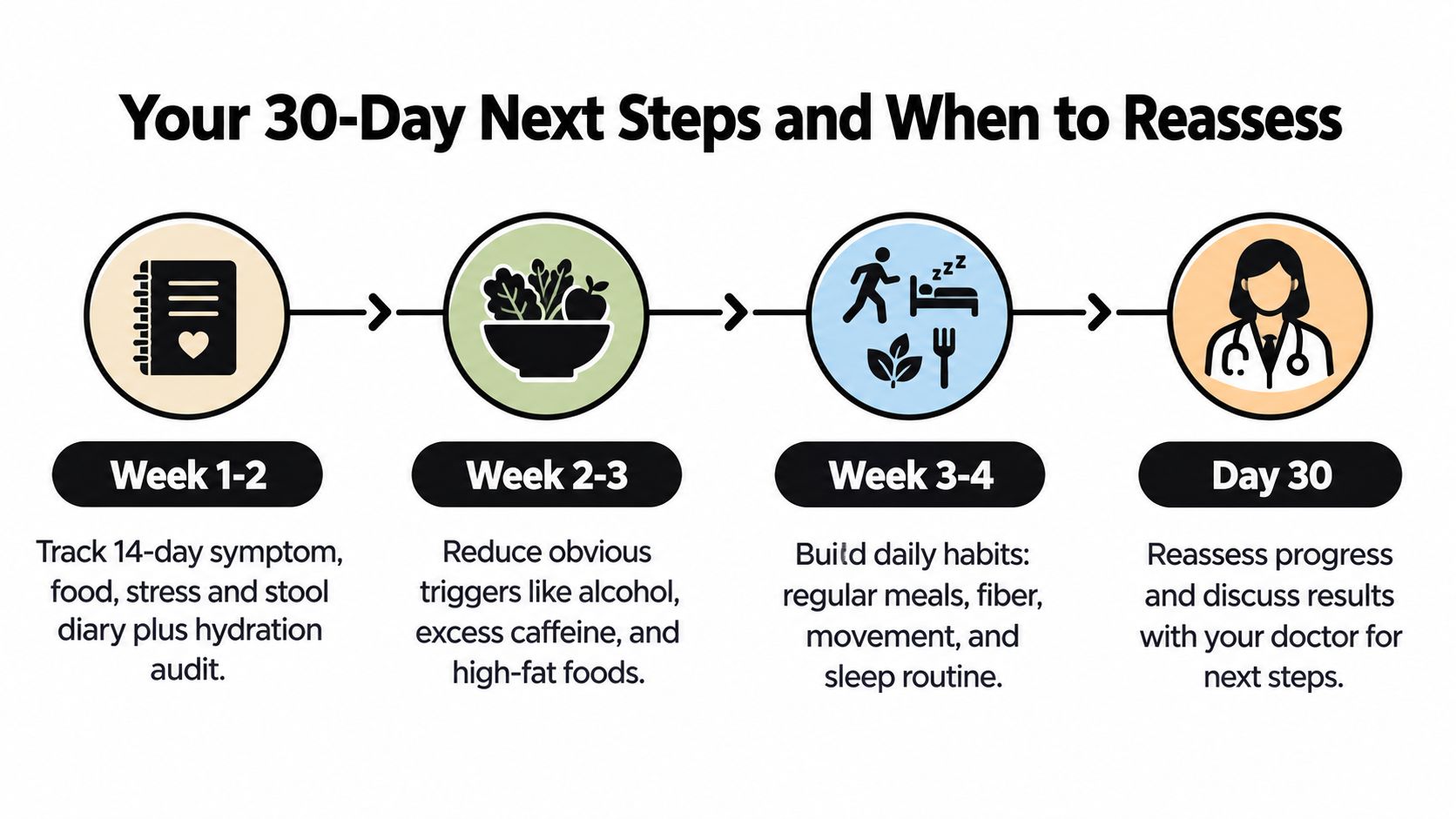
What day 30 should tell you
By day 30, your next step should be clearer.
- If symptoms are meaningfully better, keep the helpful changes and avoid adding too many new variables.
- If nothing changed, bring your diary to a clinician and ask for a more structured IBS evaluation.
- If symptoms worsened or red flags appeared, stop self-managing and seek prompt medical care.
Men often wait too long because the pattern doesn't look like the IBS stereotype. If your symptom log shows repeated pain plus bowel habit change, that's enough reason to take it seriously.
Gut symptoms that don't fit the usual IBS script can still be IBS, especially when urgency, loose stools, and meal-linked flares are driving the picture. GutRx offers digestive support options designed for people comparing probiotics, synbiotics, and enzyme-based approaches with a closer eye on quality and formulation. If you want to explore those options in context, visit GutRx.


