

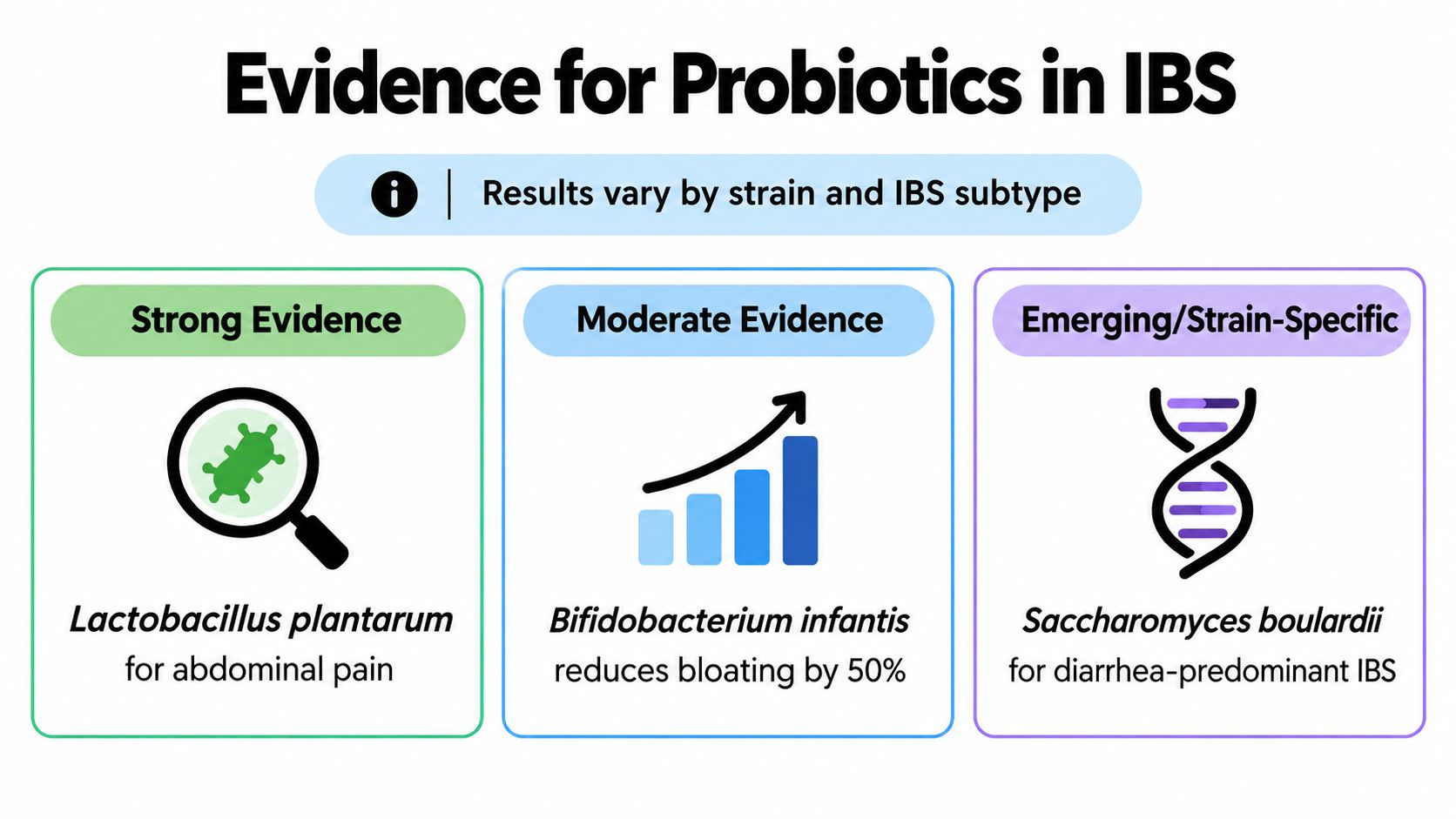
Probiotics can help IBS, but benefits are modest and highly strain-specific. A 2023 meta-analysis of 72 randomized controlled trials found significant improvement in global IBS symptoms versus placebo, with an overall standardized mean difference of -0.55.
Are probiotics good for IBS if the bottle only lists a high CFU count or broad species names? That's the gap in conventional supplement marketing. The most useful answer isn't a simple yes or no. Some formulas and strains have supportive evidence for particular symptoms, while others haven't demonstrated efficacy, and clinical guidelines still disagree about whether probiotics should be routinely recommended.
Table of Contents
- What the Evidence Actually Shows About Probiotics and IBS
- How Probiotics Work in the Gut-Brain-Immune Axis
- Symptom-Specific Benefits Across IBS Subtypes
- Which Probiotic Strains Have the Strongest Evidence
- How to Choose and Use Probiotics for IBS
- Common Misconceptions About Probiotics for IBS
- Combining Probiotics with Diet and When to Seek Medical Guidance
What the Evidence Actually Shows About Probiotics and IBS
The strongest broad signal comes from the 2023 meta-analysis of 72 randomized controlled trials, which found that probiotics improved global IBS symptoms compared with placebo, with a standardized mean difference of -0.55, a 95% confidence interval of -0.76 to -0.34, and P < 0.001. The analysis also found improvement in abdominal pain, with an SMD of -0.89, and quality of life, with an SMD of 0.99. These findings support probiotics as a reasonable option to trial, not as a guaranteed treatment. (2023 meta-analysis of probiotics for IBS)
The same analysis found that treatment lasting under 4 weeks was associated with larger effects, and Bacillus probiotics appeared particularly helpful for abdominal pain. That result shouldn't be interpreted as proof that shorter treatment is always better. It may reflect differences between formulas, study designs, and the people enrolled in each trial.
Why guidelines don't give one answer
Medical guidance remains mixed. The British Society of Gastroenterology said probiotics as a group may help global IBS symptoms and abdominal pain, but it couldn't recommend a specific strain and considered a trial of up to 12 weeks reasonable. The 2021 American College of Gastroenterology guideline suggested against probiotics for global IBS symptoms because the evidence quality was very low. The American Gastroenterological Association made no recommendation for IBS because certainty was insufficient. (British Society of Gastroenterology guideline)
More recent evidence adds a modest benefit signal rather than resolving the disagreement. A network meta-analysis of 20 randomized controlled trials involving 3,011 patients found improved overall IBS symptoms, with an odds ratio of 0.53, a 95% confidence interval of 0.48 to 0.59, and no serious adverse events reported. (Network meta-analysis of probiotics for IBS)
GutRx Balance offers 30 billion CFUs per capsule with next-generation probiotics for gut health, digestive balance, and immune support, but the relevant question for IBS is still whether the labeled strains match the symptom being targeted. (GutRx BALANCE)
How Probiotics Work in the Gut-Brain-Immune Axis
IBS involves more than bowel movements. Abdominal pain, bloating, diarrhea, constipation, and altered stool form can reflect interactions among the intestinal microbiota, the gut barrier, immune signaling, and the nervous system. Researchers often describe this network as the gut-brain axis, although immune activity is an important part of the same communication system.
A probiotic doesn't just “replace bad bacteria with good bacteria.” Its effects depend on the organism, its ability to survive in the digestive environment, the compounds it produces, and the existing microbial community. One strain may influence fermentation or stool consistency, while another may interact more directly with intestinal immune signaling.
The main biological pathways
Probiotic effects may involve several overlapping routes:
- Microbial interaction: A strain can compete with other microbes or change the local chemical environment.
- Barrier support: Some strains may influence the intestinal lining and the movement of substances across it.
- Immune modulation: Probiotic organisms can interact with immune cells and inflammatory signaling.
- Nervous-system communication: Signals from the intestine can affect the enteric nervous system and, through it, pain perception and bowel function.
These mechanisms help explain why the term “probiotic” is too broad to predict an IBS outcome. A species label alone doesn't tell you how a particular strain behaves, and a high CFU count doesn't establish that a formula will reduce pain or bloating.
For a visual explanation of how digestive signals connect with the nervous system, see this gut-brain axis diagram. The practical implication is simple: biological plausibility can explain why a product might help, but clinical trials must establish whether that specific strain improves a symptom in people with IBS.
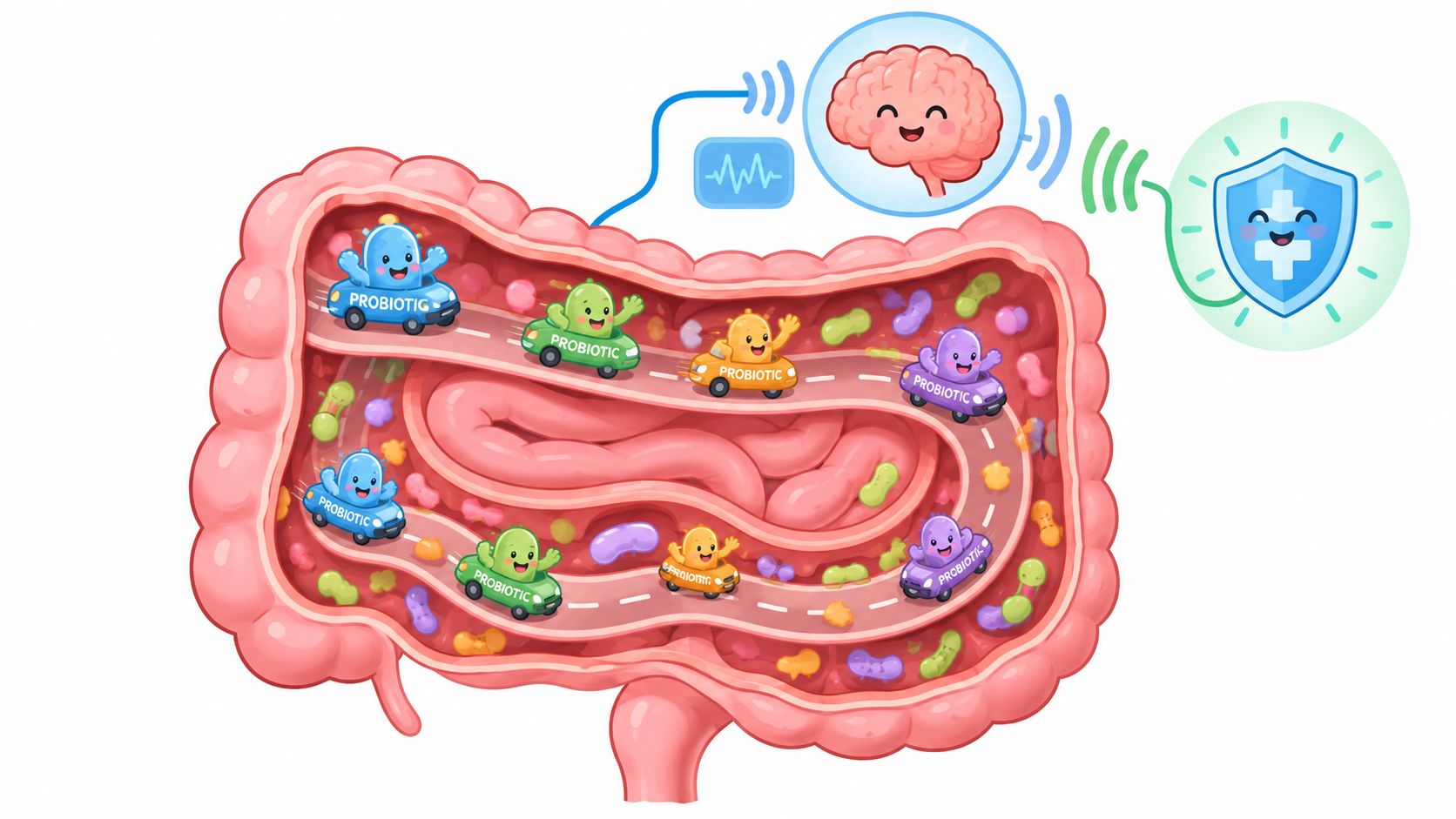
Practical interpretation: A probiotic should be judged by its strain, target symptom, dose, and trial evidence, not by the word “probiotic” on the front of the package.
Symptom-Specific Benefits Across IBS Subtypes
The evidence becomes more useful when the question changes from “Do probiotics work?” to “Which strain appears to help which outcome?” Network-analysis data show that probiotics don't produce one uniform IBS response.
One network meta-analysis found differences across quality of life, abdominal pain, bloating, bowel movement frequency, and stool form. A five-probiotic mixture ranked first for IBS quality of life, while Bacillus coagulans MTCC 5856 and Bacillus coagulans Unique IS2 were among the most effective options for abdominal pain. Several strains or mixtures also improved abdominal bloating. (Outcome-specific probiotic network meta-analysis)
Matching the product to the dominant symptom
| Primary concern | Evidence signal |
|---|---|
| Abdominal pain | Bacillus coagulans MTCC 5856 and Bacillus coagulans Unique IS2 ranked among the more effective options |
| Bloating | Several strains and mixtures showed benefit, but results varied by formula |
| IBS-D bowel frequency | Four strains and one mixture were significantly better than placebo |
| IBS-D stool form | Bacillus coagulans MTCC 5856 and Saccharomyces cerevisiae CNCM I-3856 ranked among the more effective options |
| Quality of life | One five-probiotic mixture ranked first in the network analysis |
For IBS-D, the stool outcome matters because symptom relief isn't limited to pain. The analysis found that four probiotic strains and one mixture significantly reduced bowel movement frequency compared with placebo. That doesn't mean every diarrhea-focused product will work, or that a probiotic should replace medical evaluation for persistent diarrhea.
For IBS with constipation or mixed bowel patterns, the available evidence doesn't justify choosing a formula solely because it claims to support “regularity.” Look for a strain with evidence tied to the symptom you want to change, then assess the result during a defined trial.
See this guide to probiotics for gas and bloating for symptom-focused selection principles.
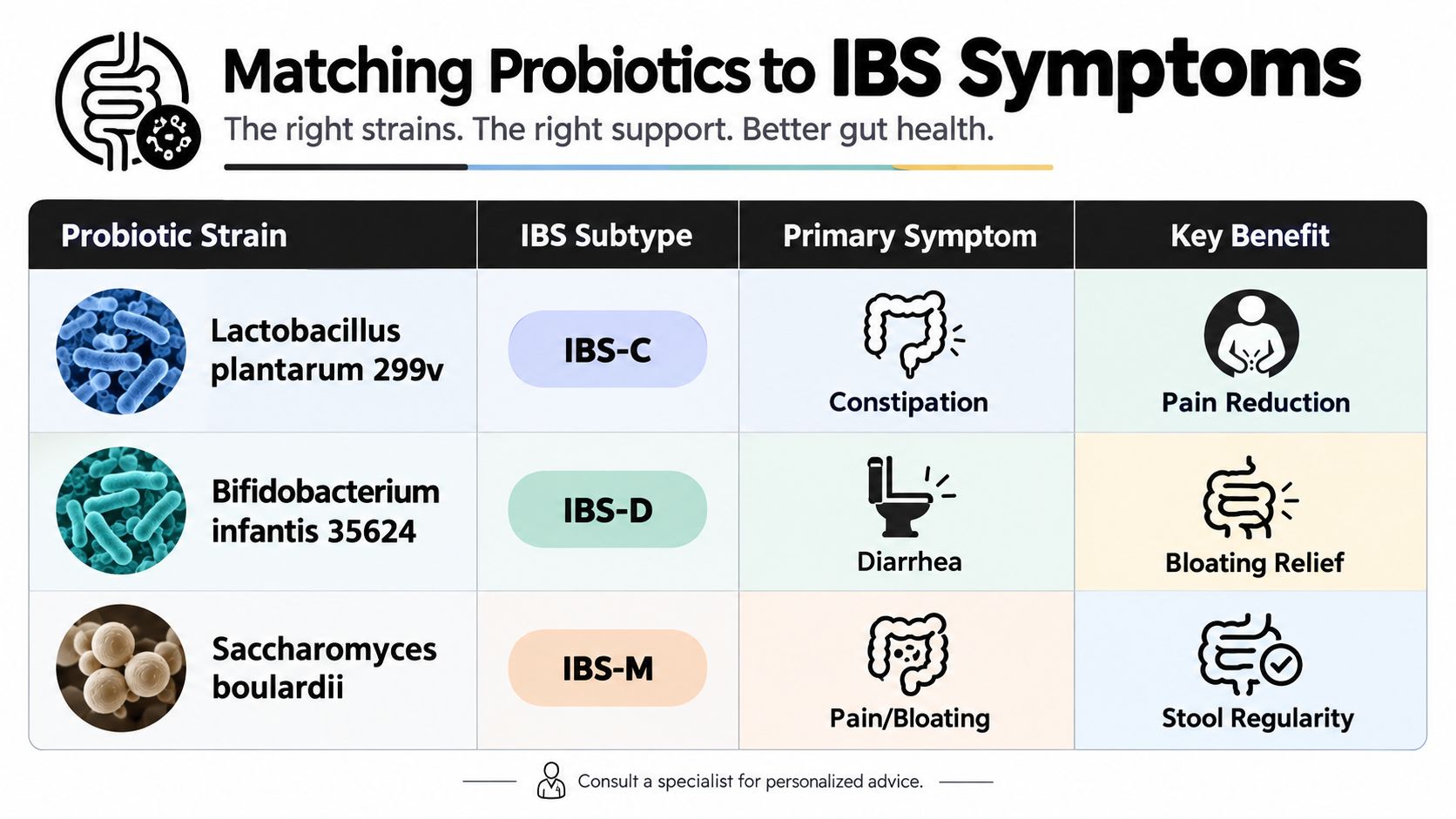
The following video provides additional context on matching probiotic decisions to digestive symptoms.
Which Probiotic Strains Have the Strongest Evidence
A product label can look impressive while revealing very little about IBS relevance. The critical detail is the full strain designation, not merely the genus and species. “Bifidobacterium” or “Lactobacillus” is a category, not a clinical result.
A 2021 strain-specific meta-analysis found that only six single-strain products and three multi-strain mixtures significantly improved at least one IBS outcome. The single strains identified were:
- Bacillus coagulans MTCC 5260
- Bifidobacterium infantis 35624
- Lactobacillus plantarum 299v
- Lactobacillus rhamnosus GG
- Saccharomyces boulardii CNCM I-745
- Saccharomyces cerevisiae CNCM I-3856
The analysis supports a narrower conclusion than “probiotics work for IBS.” It indicates that certain tested products showed benefit for at least one outcome, while many other formulations did not establish the same result. (Strain-specific IBS meta-analysis)
What newer strain reviews add
A newer systematic review found repeatable support for Bifidobacterium longum 35624, Lactobacillus rhamnosus GG, Lactiplantibacillus plantarum 299v DSM 9843, Saccharomyces cerevisiae CNCM I-3856, and Bacillus coagulans Unique IS2 for key IBS symptoms. It reported conflicting results for Saccharomyces boulardii CNCM I-745, while finding no demonstrated efficacy for Escherichia coli Nissle 1917, Lactobacillus gasseri BNR17, or Lactobacillus casei Shirota. (Newer strain-specific systematic review)
This doesn't make the unsupported strains “bad.” It means the available IBS evidence doesn't show a dependable benefit for those specific agents. The distinction matters for buyers comparing a targeted probiotic for bloating, a daily probiotic for digestive balance, or a formula marketed for diarrhea support.
The strongest purchasing signal isn't the longest ingredient panel. It's a clearly identified strain with human IBS evidence connected to your main symptom.
How to Choose and Use Probiotics for IBS
Treat a probiotic trial like a small, structured experiment. Start with the symptom that disrupts your life most, identify the strain or formula studied for that outcome, and avoid changing several major digestive interventions at the same time if you want to know what helped.
A practical selection process
-
Read beyond the species name. Look for the complete strain code, such as 299v, GG, MTCC 5856, or CNCM I-3856. Strain-level evidence is more informative than a generic species claim.
-
Check the dose. One IBS meta-analysis reported that effects may appear by about 4 weeks when the formula is appropriate, with a minimal effective dose around 10^9 CFU per day. Another review found that higher-dose single-strain products, particularly those providing at least 10^10 CFU daily and used for less than 8 weeks, appeared more effective than mixed or longer regimens, although certainty remained limited by heterogeneity and trial bias. (Dose and duration review)
-
Set a trial window. British Society of Gastroenterology guidance says people who choose to try probiotics should use the product for at least 4 weeks, monitor the effect, and follow the manufacturer's dosing recommendation. The guidance places probiotics after dietary advice as an option to trial, not an instant fix. (NICE IBS guidance)
-
Track one or two outcomes. Record pain, bloating, stool form, bowel movement frequency, or another clearly defined symptom. If nothing improves or tolerance worsens, continuing indefinitely doesn't create stronger evidence that the formula suits you.
-
Assess quality controls. Third-party testing, strain verification, storage instructions, and a transparent certificate of analysis can help distinguish a traceable supplement from a vague label. This third-party tested probiotic guide explains what quality documentation should make visible.
Delayed-release or shelf-stable claims may matter for product handling and delivery, but they don't replace clinical evidence for the strain. Similarly, CFU count is a selection detail, not a guarantee of better IBS outcomes.
Common Misconceptions About Probiotics for IBS
The most persistent misconception is that all probiotics work in the same way. They don't. The evidence is better described as strain-specific and outcome-specific, which means a product associated with bloating support may not be the right choice for diarrhea, abdominal pain, or constipation.
A 2026 umbrella review found only small but measurable reductions in global IBS symptoms, pain, and bloating, with safety similar to placebo. A 2025 to 2026 guideline update still rated the evidence as very low and issued only a weak recommendation because it couldn't provide reliable strain-specific guidance. Those findings make “clinically proven for everyone with IBS” an unjustified interpretation. (Recent strain-focused review)
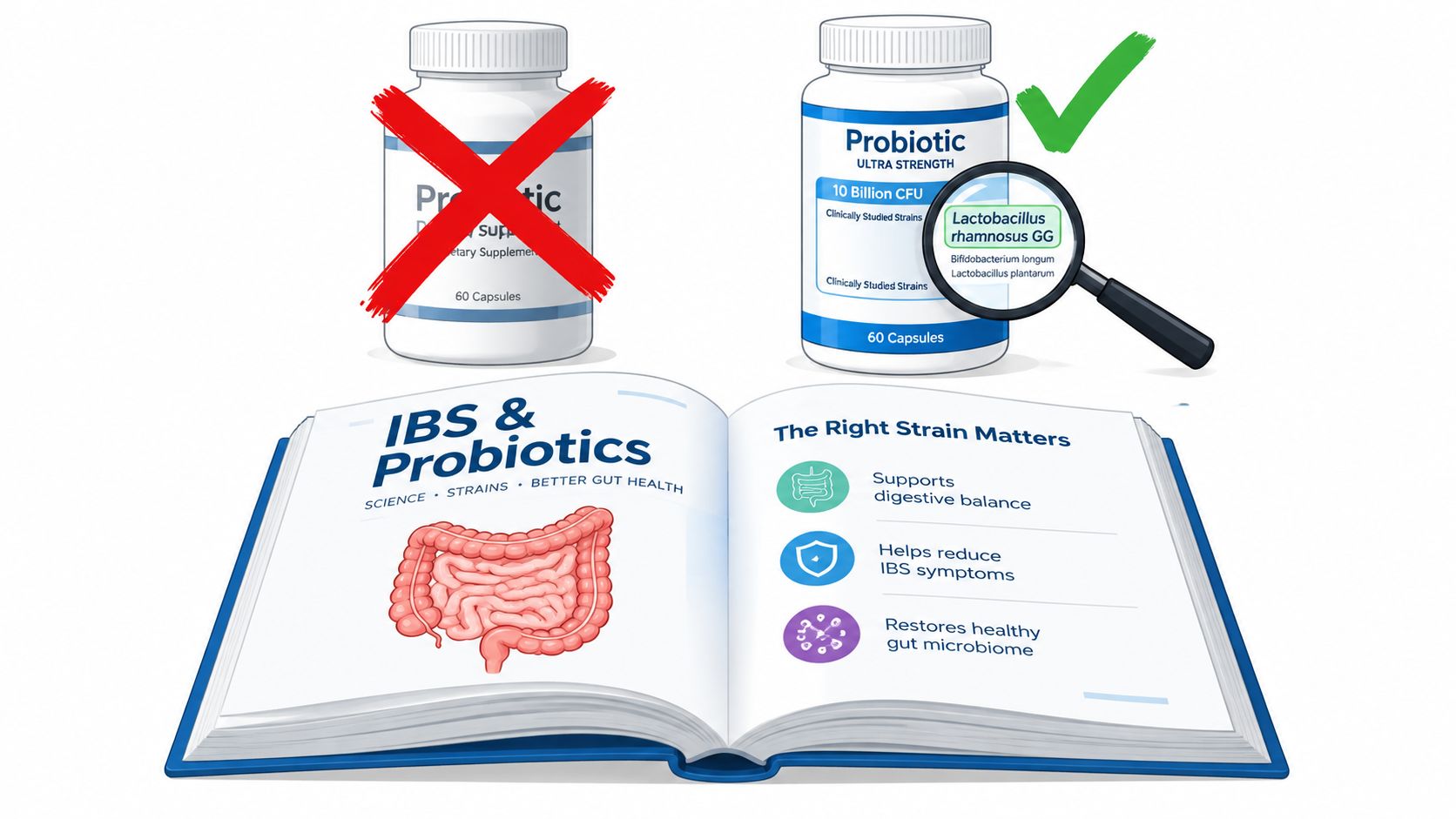
Three assumptions that distort buying decisions
-
“More CFUs must be better.” Dose-response relationships are complex. A larger number doesn't prove that the strain will reach the relevant site, produce the desired effect, or improve your symptom.
-
“A blend covers every IBS problem.” A mixture may have a broader theoretical rationale, but adding organisms doesn't automatically create evidence for each symptom or IBS subtype.
-
“No improvement means probiotics never work.” An unsuccessful trial may reflect the wrong strain, outcome, dose, duration, or an IBS pattern that requires a different treatment approach. It still doesn't prove that every evidence-backed option will fail.
Marketing often compresses these distinctions into “gut health.” Clinical decision-making needs the opposite approach. Ask what the product contains, what outcome was tested, and whether the study population resembles the problem you're trying to address.
Combining Probiotics with Diet and When to Seek Medical Guidance
Probiotics may add value to diet therapy, but they shouldn't be treated as a substitute for it. A 2025 network meta-analysis found that a low-FODMAP diet combined with probiotics was the most effective approach for relieving IBS symptoms. The low-FODMAP diet alone remained the most recommended dietary intervention, while probiotics were mainly associated with quality-of-life improvements and few adverse events. (Diet and probiotic network meta-analysis)
That evidence answers a common practical question: if you're already trying low-FODMAP, a probiotic might add something, but not uniformly. The likely benefit depends on the strain and the symptom, so adding a product should be a monitored trial rather than an automatic next step.
The outcomes also don't always move together. One 2026 meta-analysis found significant improvement in IBS severity scores but not IBS quality of life. A person may notice less pain or bloating without experiencing a broad improvement in daily well-being, especially if sleep, stress, food restriction, or persistent bowel disruption remains unresolved.
When professional guidance matters
Speak with a qualified healthcare professional if symptoms are severe, persistent, changing, or difficult to distinguish from another gastrointestinal condition. A supplement trial shouldn't delay assessment, diagnosis, or treatment, particularly when diarrhea, constipation, pain, or weight-related concerns continue despite reasonable self-care.
If you do try a probiotic, bring the exact product label and strain information to the discussion. That gives a clinician something more useful to evaluate than a general claim such as “high potency” or “supports microbiome balance.” The most defensible conclusion is that probiotics can be complementary tools for some people with IBS, but precision selection and realistic expectations matter more than broad category marketing.
GutRx offers targeted digestive-support products, including probiotic and prebiotic formulas designed around gut balance and digestive needs. Visit GutRx to review the available options and compare each formula's stated ingredients and intended use with your IBS symptoms.


