

You're sitting through a meeting with abdominal pain, planning every meal around the nearest bathroom, or waking up unsure whether constipation, diarrhea, bloating, or all three will control the day. Learning how to manage IBS symptoms effectively starts with a decision process, not a single “best” food or supplement. The most reliable approach matches treatment to your dominant bowel pattern, uses a structured diet trial, addresses gut-brain factors, and tracks results closely enough to know what's helping.
Irritable bowel syndrome is common and persistent. Major clinical guidelines estimate that it affects about 10% of the global population, with prevalence reaching 10%–20% in many populations. It's also reported most often between ages 20 and 30 and occurs about twice as often in women as in men, according to the American College of Gastroenterology guideline. Those patterns matter because IBS management has to be individualized rather than built around one universal diet, one probiotic, or one medication.
Table of Contents
- Understanding Your IBS Triggers and Gut-Brain Connection
- Implementing a Structured Low-FODMAP Elimination Diet
- Optimizing Lifestyle Factors for Gut-Brain Balance
- Evaluating Probiotics and Digestive Enzymes for Relief
- Tracking Your Symptoms and Adjusting the Protocol
- Knowing When to Escalate to Medical Care
Understanding Your IBS Triggers and Gut-Brain Connection
IBS isn't a problem with the structure of the intestine. The British Society of Gastroenterology describes the modern classification of IBS as a disorder of gut-brain interaction, a framework that better accounts for pain sensitivity, bowel-movement changes, bloating, stress responsiveness, and altered gut function. The digestive tract may look normal on routine evaluation while communication between the nervous system and the gut remains disrupted.
That distinction changes how I approach symptom management. A flare doesn't necessarily mean that one food has damaged your intestine. It may reflect the interaction of meal composition, fermentation, bowel motility, sleep, stress, and heightened sensitivity to normal digestive sensations.
Practical rule: Treat the pattern, not just the loudest symptom on one difficult day.
IBS affects daily function, not just digestion. In a large international patient survey, 1,966 respondents reported that IBS restricted activity by an average of 73 days per year, while 35% described their symptoms as severe. More than 90% reported a combination of pain, bowel problems, bloating, and diet-related interference in the survey published through PubMed. These findings help explain why casual advice such as “just avoid dairy” often fails.
Start with the dominant bowel pattern
Before changing your diet or buying a supplement, identify which pattern dominates:
- Constipation-predominant symptoms: Infrequent or difficult bowel movements, hard stool, straining, or a sensation of incomplete evacuation.
- Diarrhea-predominant symptoms: Loose stool, urgency, frequent bowel movements, or difficulty staying away from a bathroom.
- Mixed symptoms: Repeated movement between constipation and diarrhea, often with abdominal pain and bloating.
The pattern can change, but it still provides a useful starting point. Someone with constipation and bloating needs a different first-line strategy from someone whose main problem is urgency after meals. A person with mixed IBS may need smaller, carefully timed interventions rather than aggressive restriction.
Use the GutRx gut-brain axis diagram as a visual reminder that symptoms can involve several connected systems. The practical implication is straightforward: combine trigger management with bowel-pattern support and nervous-system regulation instead of expecting a single intervention to solve every symptom.
Implementing a Structured Low-FODMAP Elimination Diet
A low-FODMAP diet can be useful when bloating, gas, abdominal pain, and bowel changes persist despite basic meal adjustments. It works by temporarily reducing specific fermentable carbohydrates that can draw water into the intestine and undergo fermentation, but it shouldn't become a permanent list of forbidden foods.
Guideline-level evidence supports a structured low-FODMAP trial, ideally supervised by a dietitian. Compared with control interventions, it was associated with a lower risk of remaining symptomatic, with RR 0.71 and a 95% confidence interval of 0.61 to 0.83 in the cited guideline evidence (British Society of Gastroenterology guideline).
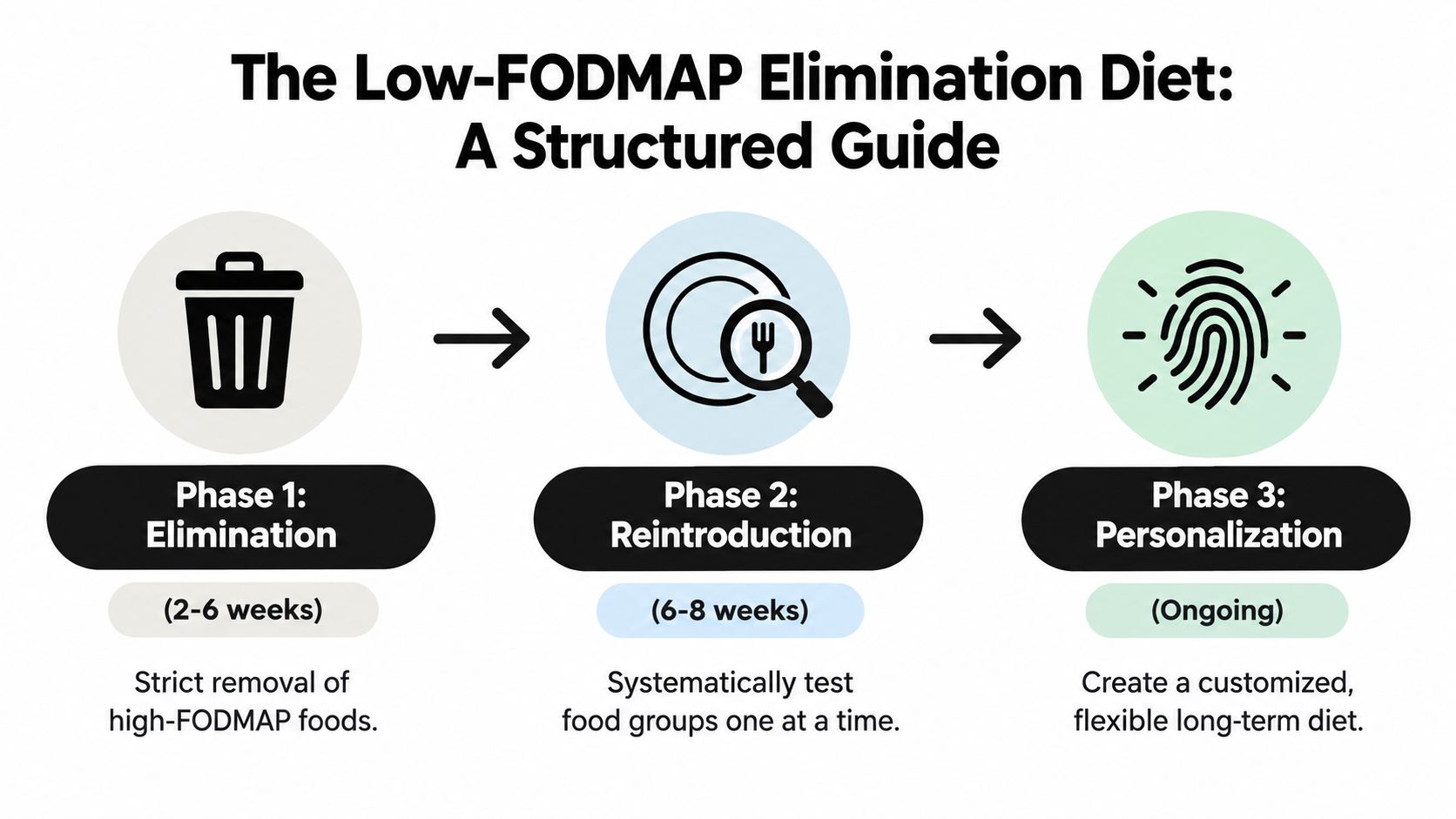
Phase one is short-term elimination
During elimination, you temporarily reduce high-FODMAP foods while keeping meals nutritionally adequate. The purpose isn't to prove that every restricted food causes symptoms. It's to lower the overall fermentable load enough to create a clearer baseline.
Work with a registered dietitian if possible, particularly if you're already eating a narrow range of foods, have a history of disordered eating, or struggle to maintain weight. Over-restriction can reduce fiber and nutrient variety, make eating socially difficult, and leave you unable to identify which foods matter.
Phase two tests one group at a time
Reintroduction is where many self-directed plans break down. Once symptoms are more stable, test one FODMAP group at a time, using a consistent portion and recording what happens. Don't reintroduce several new foods during the same period, because you'll lose the ability to identify the responsible variable.
A reaction also needs context. Portion size, sleep, stress, and the rest of the meal can affect tolerance. A single difficult day doesn't always justify permanent avoidance.
Phase three creates your personal diet
The final diet should be flexible. Some people tolerate small portions of foods that caused problems during elimination, while others identify only one or two FODMAP groups as meaningful triggers. The goal is a broader diet that supports adequate fiber and nutritional variety without returning to uncontrolled symptoms.
For food-specific support, alpha-galactosidase for gas-producing foods may be relevant when beans and legumes are a known trigger. Evidence summaries also describe lactase taken immediately before dairy as helpful for lactose-related diarrhea, bloating, and abdominal pain, while alpha-galactosidase can help reduce gas and bloating from galacto-oligosaccharide-rich foods such as legumes (digestive enzyme evidence guide).
Optimizing Lifestyle Factors for Gut-Brain Balance
Food is only one input into IBS symptoms. The gut and brain continuously exchange signals that influence motility, pain processing, and the sensation of bloating. When the nervous system remains on high alert, ordinary intestinal movement may feel painful, and bowel transit can become less predictable.
That's why generic advice to “reduce stress” is inadequate. The useful question is which intervention can calm your system consistently enough to change your symptom pattern.
Use gut-directed therapy, not vague relaxation advice
For people whose symptoms worsen during stress or emotional strain, gut-directed psychological therapy can be a high-yield treatment component. Meta-analysis data found medium-to-large improvements in gastrointestinal symptom severity after treatment, with an effect size of d = 0.69. Benefits persisted at short-term follow-up, d = 0.76, and long-term follow-up, d = 0.73, in the psychological therapy meta-analysis.
Options include:
- Cognitive behavioral therapy: Useful for identifying fear-driven food avoidance, catastrophic interpretations of symptoms, and behavioral patterns that reinforce urgency or restriction.
- Gut-directed hypnotherapy: Uses structured relaxation and gut-focused imagery rather than general meditation alone.
- Self-administered or minimal-contact CBT: A practical option when access to face-to-face therapy is limited.
The same network meta-analysis found self-administered or minimal-contact CBT, face-to-face CBT, and gut-directed hypnotherapy among the more effective options, with respective relative risks of 0.61, 0.62, and 0.67, each reported with confidence intervals in the cited source. These treatments work best as structured protocols completed over time, not as one-off stress tips.
A calmer nervous system doesn't replace food and bowel-pattern management. It makes those interventions easier to interpret and sustain.
Build repeatable daily signals
Keep meals reasonably consistent, eat slowly, and avoid making every meal an experiment. Gentle movement can support routine and reduce the tendency to monitor every abdominal sensation. Sleep also deserves attention because irregular or inadequate sleep can heighten pain sensitivity and make stress responses harder to control.
Choose one or two practices you'll repeat, such as paced breathing before meals, a regular walking routine, or a fixed wind-down period before bed. Adding five new habits at once makes it impossible to know what helped. The strongest plan is usually the one you can complete during an ordinary workweek, not only during a carefully controlled weekend.
Evaluating Probiotics and Digestive Enzymes for Relief
Probiotics and digestive enzymes solve different problems. A probiotic or synbiotic is a longer-term microbiome intervention that may support digestive balance, while an enzyme is usually a mealtime tool matched to a specific food component.
Guidelines don't fully agree on routine probiotic use for global IBS symptoms. The American College of Gastroenterology doesn't recommend routine probiotics for global IBS symptoms because evidence quality is low and products vary. The British Society of Gastroenterology allows a probiotic trial for up to 12 weeks, but it doesn't identify specific strains that should be preferred (guideline-based probiotic review).

Match the supplement to the problem
A probiotic for bloating, constipation, or diarrhea shouldn't be selected only by a high CFU number. Look for clear strain identification, quality testing, transparent labeling, and a defined trial period. Clinical guidance reports that probiotics may modestly improve global IBS symptoms, abdominal pain, and bloating, and may increase bowel movement frequency or improve stool consistency in functional constipation (clinical probiotic guidance).
Digestive enzymes are more specific. Lactase makes sense immediately before dairy when lactose is the suspected trigger. Alpha-galactosidase is more relevant immediately before beans or legumes. A digestive enzyme won't correct stress-related urgency or replace evaluation for persistent pain.
| Dominant symptom or trigger | Primary supplement category | Key mechanism of action | Expected timeline for results |
|---|---|---|---|
| Bloating linked to dairy | Lactase enzyme | Supports lactose digestion before the meal | During the relevant meal |
| Gas after beans or legumes | Alpha-galactosidase | Helps break down GOS-rich carbohydrates | During the relevant meal |
| Ongoing digestive imbalance | Probiotic or synbiotic | Provides selected microorganisms, with prebiotic support in synbiotic formulas | A structured trial over time |
| Constipation with broader digestive symptoms | Targeted probiotic support, plus clinician-guided bowel management | May support stool consistency and bowel movement frequency | Track over the planned trial |
| Diarrhea-type discomfort | Strain-specific probiotic consideration, with medical guidance when persistent | May support digestive balance and stool patterns | Track symptoms rather than assuming immediate benefit |
Read digestive enzymes versus probiotics before combining categories. For readers comparing a next-generation probiotic option, GutRx BALANCE offers 30 billion CFUs per capsule with next-gen probiotics for gut health, digestive balance, and immune support. Treat that type of product as one candidate in a monitored trial, not as a universal IBS treatment.
Tracking Your Symptoms and Adjusting the Protocol
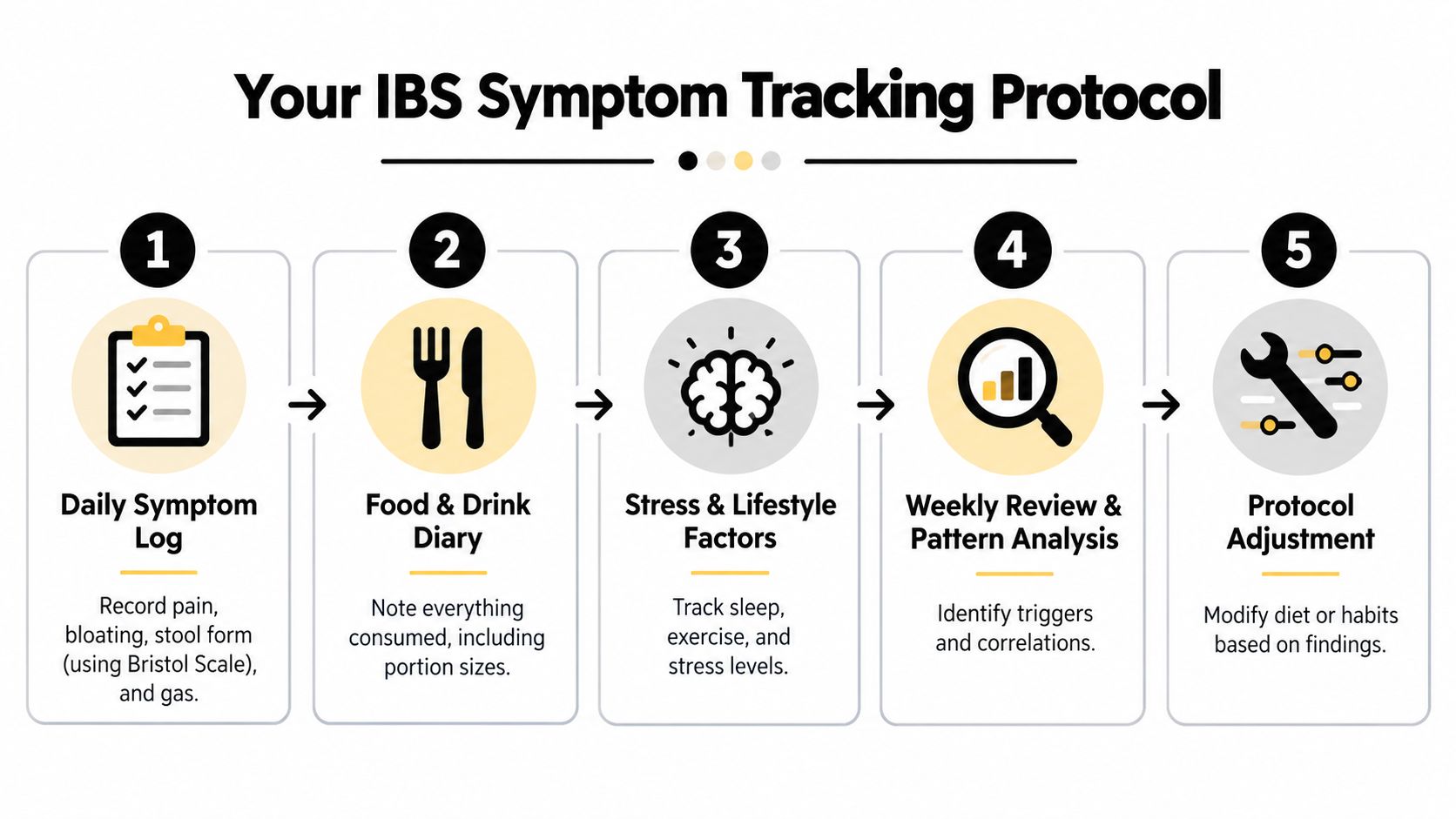
IBS management becomes more reliable when you stop changing several variables at once. A symptom journal turns vague impressions into usable information, especially when a flare follows a stressful day and a meal that also contained a suspected trigger.
Record the basics every day. Note abdominal pain, bloating, gas, urgency, and stool form using the Bristol Stool Chart. Add meal timing, approximate portions, drinks, sleep quality, exercise, stress events, medication timing, and supplements.
Separate the variables
A useful entry might say that bloating appeared two hours after a meal containing a suspected high-FODMAP food, following poor sleep and a difficult work meeting. That record is more informative than writing “food caused bloating,” because it preserves the competing explanations.
Use a simple scale for symptom intensity and apply it consistently. Don't redesign the scale halfway through the process. The purpose isn't laboratory precision. It's repeatability.
Review patterns instead of reacting to single flares
Review your notes every two weeks, then ask:
- Did the dominant bowel pattern remain the same?
- Did symptoms follow a food repeatedly, or only once?
- Did stress or poor sleep precede symptoms even when meals were familiar?
- Did a supplement change one symptom while worsening another?
- Are you restricting foods without a clear benefit?
If the low-FODMAP diet reduced symptoms, use the journal to guide reintroduction rather than extending elimination indefinitely. If a probiotic trial produces no meaningful change, check adherence, timing, and the chosen target before deciding whether to stop or switch.
Your journal should reduce fear, not create another source of surveillance. Record enough to identify patterns, then use the information to make fewer, better changes.
Knowing When to Escalate to Medical Care
Self-management has limits. Repeatedly changing foods, probiotics, enzymes, and supplements can delay the evaluation of another condition, especially when symptoms change character or continue despite a careful plan.
Seek medical assessment for warning signs such as unexplained weight loss, rectal bleeding, severe or persistent pain, symptoms that wake you at night, or a marked change from your established pattern. These features don't prove that another illness is present, but they do make indefinite self-treatment inappropriate.
Use plateau markers as a decision point
Escalation also makes sense when symptoms continue to impair work, sleep, eating, or social activity despite consistent implementation. If a structured dietary trial, trigger review, and gut-directed therapy produce little improvement, ask a gastroenterologist to reassess the diagnosis and treatment sequence.
Guideline-based care may use different treatments for different symptoms, including antispasmodics for pain, laxatives for constipation, loperamide for diarrhea, rifaximin in appropriate diarrhea-predominant cases, and gut-brain therapies such as CBT or hypnotherapy. These choices depend on the bowel pattern, medical history, contraindications, and clinician assessment. They aren't interchangeable over-the-counter substitutes.
Prepare useful information for the appointment
Bring your symptom journal, a current medication and supplement list, details about your bowel pattern, and a record of what happened during elimination and reintroduction. Include the timing of pain, bloating, urgency, constipation, or diarrhea rather than reporting only that your stomach feels “off.”
A specialist can do more with a clear timeline than with a long list of foods you've stopped eating. The objective is to move from improvised restriction toward a safe, subtype-specific plan that protects quality of life and nutritional adequacy.
GutRx offers targeted probiotic and digestive-support categories for different needs, including daily regularity support, digestive balance, women's gut and urinary wellness, and mealtime enzyme support. Visit GutRx to compare options by symptom pattern and choose a product that fits into a monitored IBS management plan rather than replacing medical care.


