

You've removed onions, garlic, milk, and several other foods, yet a simple chicken-and-rice meal still leaves you bloated. That doesn't necessarily mean your entire diet is a problem. A hidden fructan, excess fructose, or another poorly absorbed carbohydrate may be reaching the colon and fermenting before you've identified the actual trigger.
FODMAP digestive enzymes can help when they're matched to the carbohydrate in the meal. They aren't a universal fix for IBS, and they don't replace a structured low-FODMAP process. They're more useful as targeted tools during food testing, travel, restaurant meals, and long-term dietary liberalization.
Table of Contents
- What FODMAP Digestive Enzymes Actually Are
- How FODMAPs Trigger Bloating, Gas, and IBS Symptoms
- Which Enzyme Targets Which FODMAP Group
- What the Evidence Says About Effectiveness
- Practical Dosage, Timing, and Food Pairing
- When to Use Enzymes Versus a Low-FODMAP Diet
- Quality and Safety Considerations Before You Buy
- Putting It Together for Your Next Meal
What FODMAP Digestive Enzymes Actually Are
FODMAP digestive enzymes are oral enzymes matched to specific fermentable carbohydrates. Taken with the relevant food, they can break down part of that carbohydrate before it reaches gut bacteria for fermentation. Products may contain lactase for lactose, alpha-galactosidase for galacto-oligosaccharides, fructan hydrolase for fructans, or xylose isomerase for excess fructose.
The useful question is which substrate is in the meal. A general digestive formula with protease, lipase, and amylase may assist protein, fat, and starch digestion, but it does not automatically address lactose, GOS, fructans, or fructose. A long ingredient list can still be a poor match for your trigger.
Practical rule: Choose the enzyme for the carbohydrate you plan to eat, not for the intensity of your bloating.
Enzymes also differ from probiotics and laxatives. Probiotics provide live microorganisms, whereas an enzyme carries out a chemical breakdown of a particular food component. Laxatives alter stool transit or water content. FODMAP enzymes aim to reduce the amount of one targeted carbohydrate reaching the lower gut intact.
The modern FODMAP framework began with Monash University researchers in 2005, when they published the first paper naming fermentable oligosaccharides, disaccharides, monosaccharides, and polyols as short-chain carbohydrates implicated in IBS symptoms (Monash University's FODMAP history). This identified the types of carbohydrates that targeted enzyme products attempt to address.
Their role changes across the diet process. During elimination, use them sparingly while establishing a clear baseline. During reintroduction, a substrate-specific enzyme may help test a food without abandoning the challenge. During long-term liberalization, it can provide flexibility for a known trigger, but only if the enzyme matches that trigger. A broad blend with every meal can obscure which foods you tolerate.
How FODMAPs Trigger Bloating, Gas, and IBS Symptoms
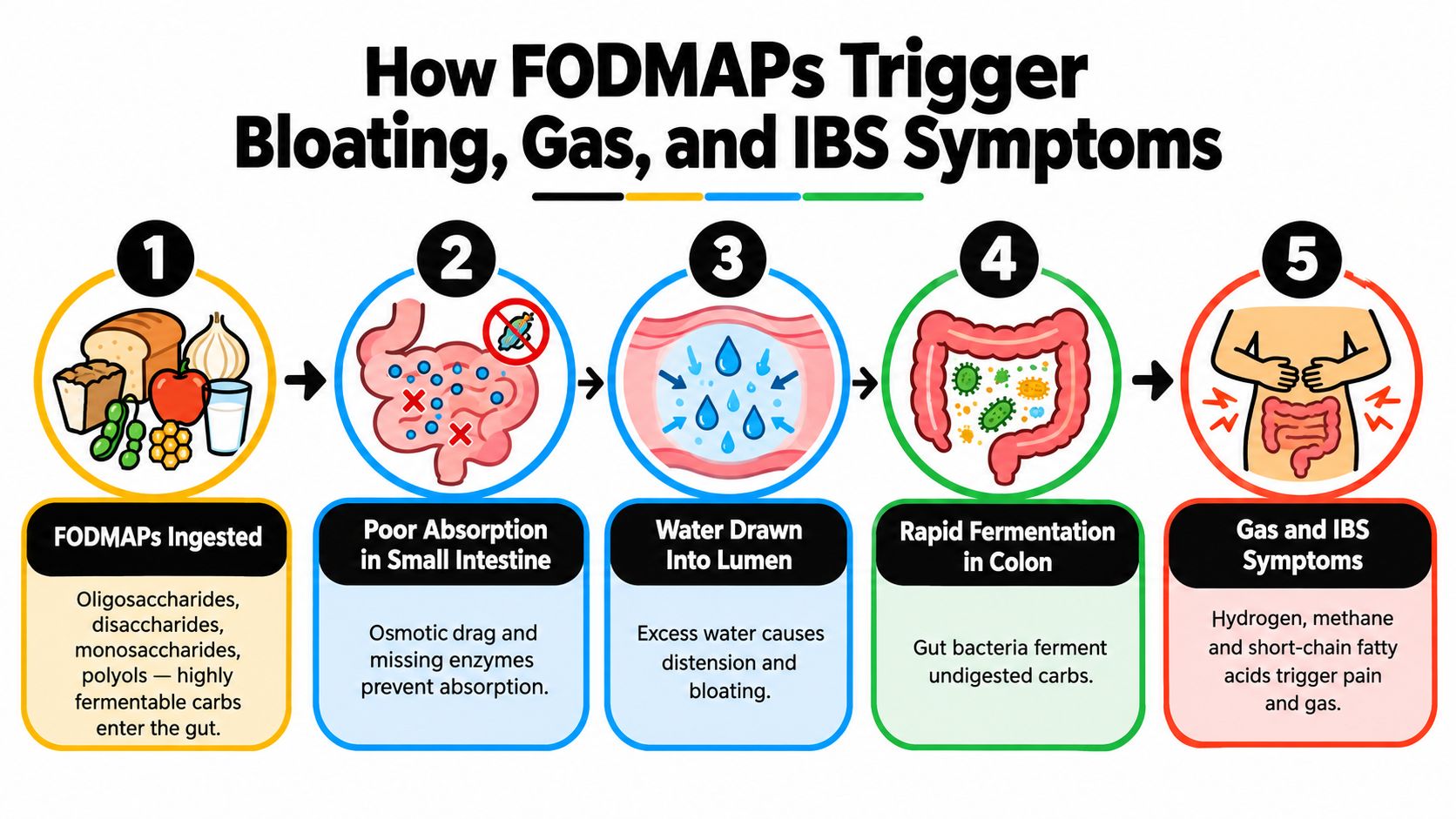
After a meal containing onion, milk, beans, or certain fruit, symptoms can begin through two related mechanisms. Some short-chain carbohydrates are not fully absorbed in the small intestine because transport capacity is limited or human digestive enzymes cannot break them down adequately. The Monash University's explanation of the FODMAP concept describes this process and its relevance to IBS.
The sequence is:
- A FODMAP-containing food is eaten. Its carbohydrate enters the small intestine.
- Absorption remains incomplete. Some of the carbohydrate passes through undigested or only partly absorbed.
- Water enters the bowel. The unabsorbed material has an osmotic effect, increasing water in the intestinal contents and contributing to distension.
- Colonic bacteria ferment the residue. Fermentation produces gases and short-chain fatty acids.
- Symptoms appear in susceptible people. Intestinal stretching and fermentation may contribute to bloating, cramping, flatulence, constipation, or diarrhea.
The symptom pattern depends on the carbohydrate
Lactose, the disaccharide in milk and other dairy foods, can draw water into the intestine when lactase activity is insufficient. Loose stools and urgency may be more noticeable in people who digest lactose poorly.
Excess fructose can have a similar effect when intake exceeds the small intestine's absorption capacity. Honey and some fruits may trigger symptoms, although portion size and individual tolerance matter.
Fructans occur in foods such as wheat, onions, and garlic. GOS is concentrated in beans, legumes, soy, and some nuts. Because bacteria ferment these carbohydrates readily, gas may be prominent.
Polyols, including sorbitol and mannitol, are sugar alcohols found in some fruits, vegetables, and sweeteners. They can increase water in the bowel and provoke symptoms, but no well-established oral enzyme reliably breaks them down during digestion.
IBS symptoms vary because gut sensitivity, transit speed, microbial activity, and the rest of the meal all influence the response. The same food may cause mild fullness in one person and marked bloating or altered bowel movements in another.
Which Enzyme Targets Which FODMAP Group
A useful formula starts with substrate coverage, not ingredient count. Lactase acts on lactose, alpha-galactosidase acts on GOS, fructan hydrolase acts on fructans, and xylose isomerase is intended to convert excess fructose into glucose. These mechanisms aren't interchangeable.
Enzyme-to-FODMAP Substrate Mapping
| Enzyme | Target FODMAP | Common Food Sources | Typical Activity Units |
|---|---|---|---|
| Lactase | Lactose | Milk, yogurt, ice cream, other lactose-containing dairy | 300 to 9,000 ALU |
| Alpha-galactosidase | GOS | Beans, lentils, legumes, soy, some nuts | 300 to 450 GALU |
| Fructan hydrolase, often labeled inulinase | Fructans | Wheat, onion, garlic | 800 to 1,000 U |
| Xylose isomerase | Excess fructose | Honey, apples, mangoes, fructose-heavy foods | Activity varies by product |
| No well-supported oral enzyme | Polyols | Sorbitol- or mannitol-containing foods | No established effective activity range |
Lactase breaks lactose into the absorbable monosaccharides glucose and galactose. Alpha-galactosidase hydrolyzes the α(1→6) bonds in GOS, which is why it's most relevant to beans, legumes, soy, and related foods. The clinical usefulness of alpha-galactosidase is strongest in people who are sensitive to GOS, not in people whose primary problem is fructan-rich onion or garlic (review of enzyme mechanisms in IBS).
Fructan hydrolase is attractive for people who react to wheat, onions, garlic, or inulin. It targets fructan chains rather than gluten, starch, or all carbohydrate. Xylose isomerase has a different job again, converting excess fructose so it can be absorbed more effectively.
GutRx MEALTIME is described as a digestive enzyme supplement that supports digestion, reduces bloating, and enhances nutrient absorption. If you're evaluating it for FODMAP-related discomfort, read the activity units and substrate coverage rather than assuming that a general digestive blend covers every FODMAP class.
For a closer explanation of one of the most relevant ingredients, see this guide to alpha-galactosidase supplements.
What the Evidence Says About Effectiveness
Enzyme evidence is substrate-specific, and the practical question is whether the product matches your personal trigger. Lactase and alpha-galactosidase have the clearest rationale because each targets a defined carbohydrate. Fructan hydrolase and xylose isomerase remain more limited, while no oral enzyme has established activity for polyols.
| Enzyme | Target FODMAP | Evidence Strength | Key Finding |
|---|---|---|---|
| Lactase | Lactose | More established | Supports digestion of lactose-containing dairy when inadequate lactase is the relevant problem |
| Alpha-galactosidase | GOS | Strongest single-ingredient use case | Most useful for GOS-sensitive people eating beans, legumes, or soy |
| Fructan hydrolase | Fructans | Mechanistically promising, human evidence emerging | In vitro studies show fructan breakdown and reduced gas production |
| Xylose isomerase | Excess fructose | Emerging | Fits fructose-specific symptoms, but broad claims aren't justified |
| Polyol-targeted enzymes | Sorbitol and mannitol | Insufficient | No established oral enzyme reliably addresses these triggers |
Laboratory findings support targeted fructan and fructose breakdown, but they do not establish symptom relief for every person. A recent in vitro study found that a targeted enzyme mix absorbed 70% of released fructose during simulated small-intestinal transit and reduced microbial gas production, with only a small reduction in butyrate and short-chain fatty acid output in the model (2026 peer-reviewed enzyme study). That result supports the mechanism, not a guaranteed clinical response.
Earlier research found that 90% of inulin was converted to fructose after 30 minutes by 1.125 g of a FODMAP-digesting enzyme product. Separate in vitro work also supports microbial inulinase for fructan hydrolysis under digestion conditions (inulinase and fructan hydrolysis research). These findings may justify a trial for a person whose symptoms consistently follow inulin, wheat, onion, or garlic, but they do not support taking a broad enzyme blend for every meal.
Human findings are developing. In a 2026 peer-reviewed pre-post cohort, 78.0% of participants reported improved bloating and flatulence after 4 weeks. Reported improvements also included diarrhea in 75.0% of participants with IBS-D, constipation in 72.7% of those with IBS-C, and abdominal pain in 65.3%, with statistically significant changes in several IBS-related outcomes, all with P < .01. A pre-post cohort cannot separate the product effect from expectation, diet changes, or natural symptom variation.
Use enzymes as a targeted experiment across the low-FODMAP process. During elimination, they may help identify whether a suspected substrate is driving symptoms. During reintroduction, they can test a specific food more cleanly. During liberalization, they may support occasional trigger foods, while the goal remains a broader diet, not permanent reliance. A practical overview of the IBS context is available in this guide to digestive enzymes for IBS.
Practical Dosage, Timing, and Food Pairing
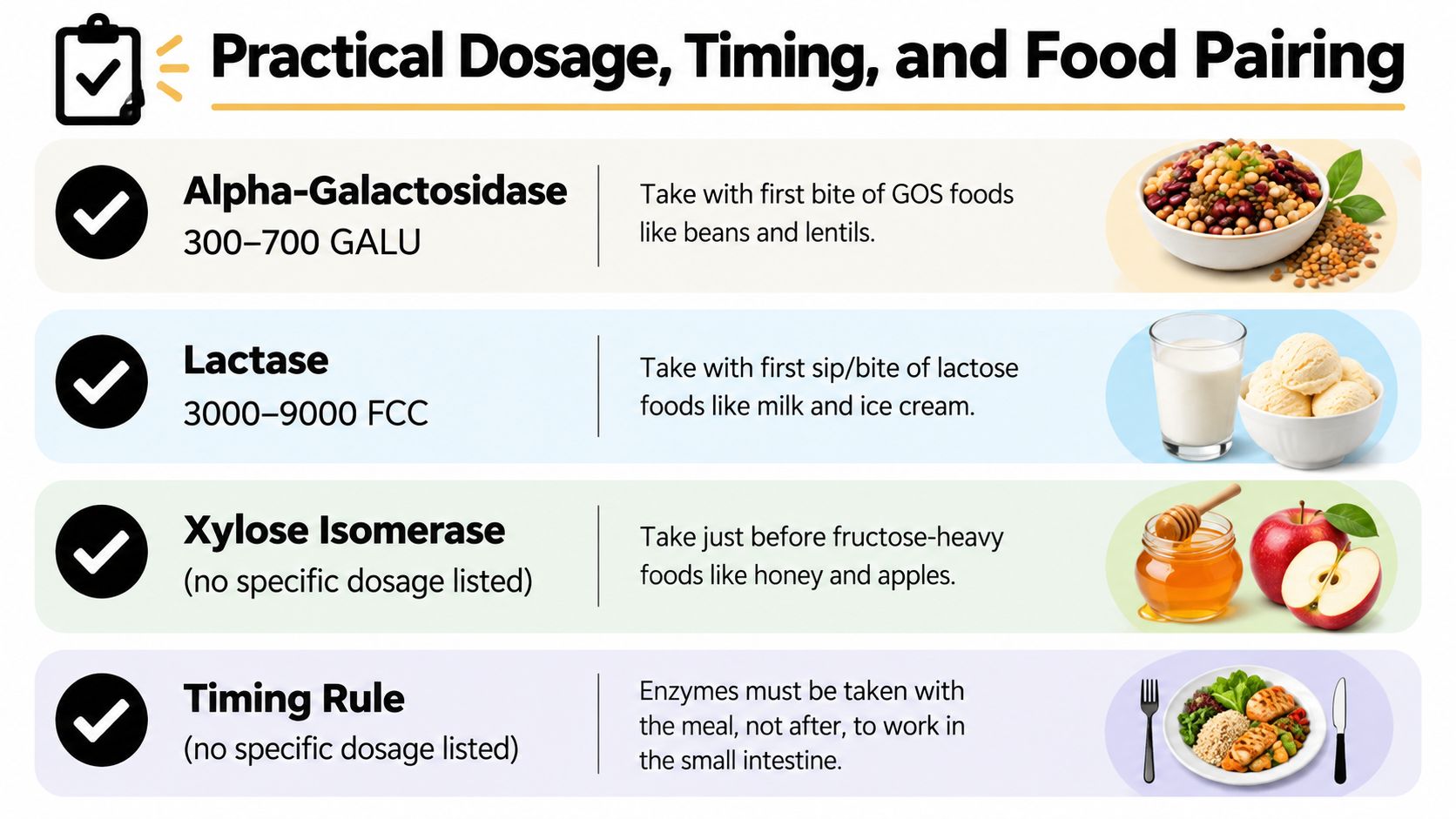
A bean challenge that causes bloating calls for a different enzyme than a dairy challenge. Match the product to the carbohydrate you are testing, rather than treating every meal with a broad blend. The first bite is usually the key timing point, because the enzyme needs to mix with food while the target carbohydrate is being digested. More detailed guidance is available on the best time to take digestive enzymes.
Use activity units, not capsule weight, when comparing formulas:
- Alpha-galactosidase: A practical working range is 300 to 700 GALU with the first bite of a GOS-containing meal such as beans or lentils. A review describes a threshold effect around 300 GALU for these meals (review of enzyme formulation and dosing considerations).
- Lactase: Products commonly provide 3,000 to 9,000 FCC ALU per dairy serving. Use less for a smaller lactose exposure and more activity when the serving contains more lactose.
- Fructan hydrolase: Products may list approximately 500 to 1,500 BGU for garlic-, onion-, or wheat-heavy meals. Activity labels vary, so direct brand comparisons are difficult.
- Xylose isomerase: Take it just before or with fructose-heavy foods such as honey or certain fruit, following the product's stated activity and directions.
Let your reintroduction diary choose the product
If bloating follows a bean challenge but not dairy, alpha-galactosidase fits the pattern better than lactase. Repeated symptoms after garlic and wheat justify examining fructan hydrolase. Several polyol triggers suggest that an enzyme may not address the problem.
During elimination, enzymes can help investigate an occasional suspected exposure, but they should not obscure your baseline. During reintroduction, take the matched enzyme with the first bite and compare the result with a similar meal without it. During liberalization, reserve it for known trigger foods rather than increasing the dose whenever a meal contains more substrate than the formula can handle. Keep other FODMAPs in the test meal relatively low so the comparison remains useful.
When to Use Enzymes Versus a Low-FODMAP Diet
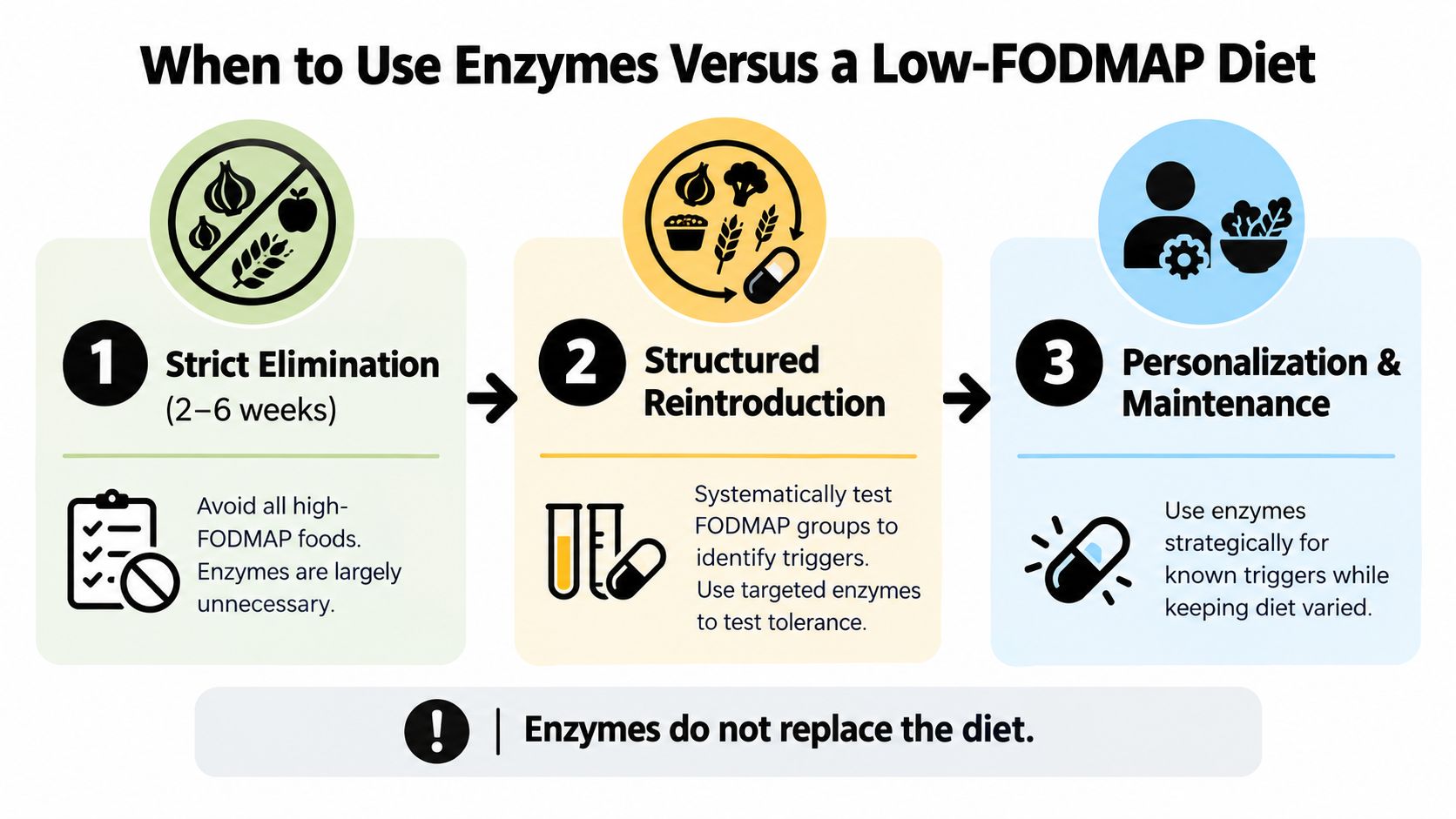
Enzymes don't replace the low-FODMAP diet. Their best role is usually precision support during reintroduction and maintenance, not indefinite use while every possible trigger remains unknown.
The three phases have different goals
Strict elimination is the investigative phase. A low-FODMAP protocol is commonly used for 2 to 6 weeks, with high-FODMAP foods reduced so symptoms can settle and the person can establish a clearer baseline. During this stage, enzymes are often unnecessary because the relevant foods are being limited rather than challenged.
Structured reintroduction is where targeted enzymes can become useful. You test one FODMAP group at a time, such as lactose, GOS, fructans, or excess fructose. Taking the matched enzyme with the challenge food may let you assess whether the carbohydrate is the problem and whether digestion support changes your tolerance.
Personalization and maintenance should restore as much variety as your symptoms allow. You might use lactase with a dairy meal, alpha-galactosidase with beans, or a fructan-focused product with a known onion exposure. That approach is more rational than permanently avoiding broad categories of nutritious foods.
Enzymes should make your food history more informative, not make your diet more restrictive.
Don't use supplements to postpone medical evaluation when symptoms are new, severe, progressive, or otherwise concerning. People with confirmed celiac disease or inflammatory bowel disease need condition-specific medical management, and a low-FODMAP strategy should be individualized rather than used as a substitute for diagnosis or treatment.
The field is also testing whether enzymes can help people who already respond to a low-FODMAP diet broaden their meals. A 2025 clinical trial listing describes an enzyme formulation for IBS patients who previously responded to a low-FODMAP diet, but results weren't available in the source material (clinical trial listing for reintroduction support).
Quality and Safety Considerations Before You Buy
A capsule's milligram weight tells you very little about whether it can digest the food on your plate. Enzyme potency is measured in activity units, such as ALU, GALU, LAU, or other manufacturer-specific units. A label that lists only milligrams or hides activity quantities makes it difficult to compare products.
Look for clear activity per capsule, transparent ingredient sourcing, lot-level testing, and independent verification. Third-party testing from organizations such as USP, NSF, or ConsumerLab can add useful assurance, although you should verify exactly what the testing covers.
| Red Flag | Quality Marker |
|---|---|
| Ingredient list with no activity units | Enzyme-specific activity shown per serving |
| “Proprietary blend” that hides quantities | Full disclosure of each enzyme and amount |
| No batch documentation | Independent testing or downloadable COA |
| Unclear expiration information | Visible expiration date and storage guidance |
| Lactose, inulin, or fructose fillers | Excipients reviewed for personal triggers |
| Broad promise to digest every FODMAP | Clearly stated substrate coverage |
Alpha-galactosidase may come from Aspergillus niger, lactase may come from Kluyveromyces lactis, and fructan hydrolase, often called inulinase, comes from microbial sources. People sensitive to fungal proteins or particular manufacturing inputs should review the source and discuss concerns with a qualified professional.
Be cautious with combinations that include sucrase or xylose isomerase if you don't have a clear reason to use them. More carbohydrate-breaking activity isn't automatically better, and an expanded blend can make it harder to identify what helps or causes an unwanted response.
Enzymes can lose activity during storage, so check the expiration date and follow storage directions. Supplements also don't undergo FDA pre-market approval in the same way medicines do, which makes manufacturing transparency and independent verification especially important.
Putting It Together for Your Next Meal
A reintroduction meal goes better when the enzyme matches the suspected trigger. Start with your history and identify whether symptoms repeatedly follow lactose, excess fructose, fructans, GOS, or polyols.
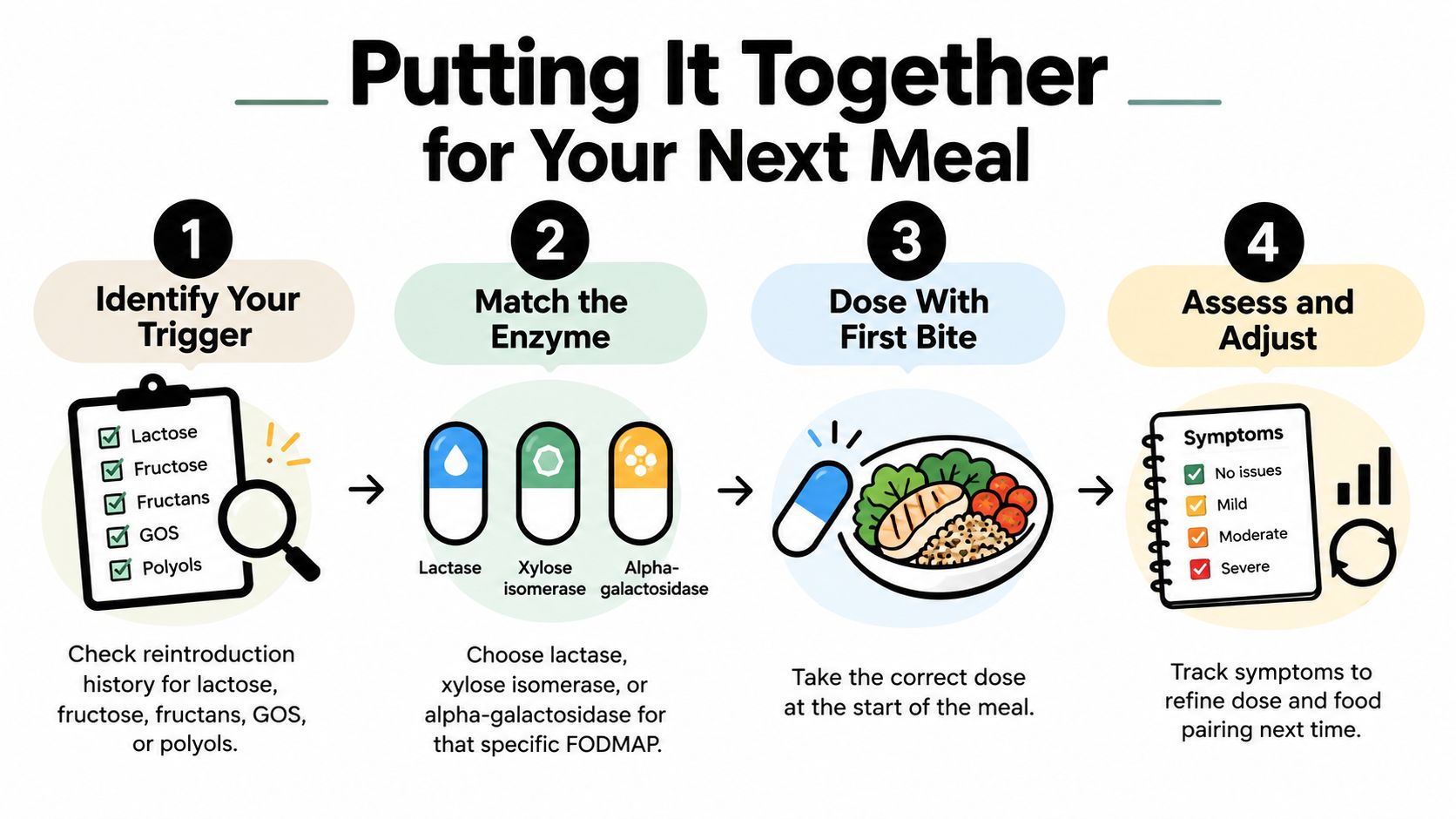
Use this sequence:
- Match the substrate. Choose lactase for lactose, xylose isomerase for excess fructose, fructan hydrolase or inulinase for fructans, and alpha-galactosidase for GOS. Polyols generally lack a dependable enzyme option.
- Take it with the first bite. For a bean-based meal, around 300 GALU of alpha-galactosidase is a reasonable starting point, as noted in the earlier formulation review.
- Keep the meal controlled. Pair the test food with a lower-FODMAP base, so other fermentable ingredients do not blur the result.
- Record the response. Repeat the same food and enzyme pairing across 3 days, then compare it with a similar meal without the enzyme.
During elimination, enzymes should not replace the structured diet. During reintroduction, they can test whether a specific substrate is manageable. During liberalization, a matched product may support dietary variety when the trigger and response are already clear.
If symptoms continue across several FODMAP groups, stop adding products and return to structured elimination and reintroduction with professional guidance. GutRx offers GutRx digestive enzyme support through its Mealtime formula. Review its disclosed activity and ingredients against the foods you are testing.


