

You're standing in front of three collagen bottles, or comparing them on Amazon. One says marine collagen, another says bovine collagen, and a third highlights type II for joints. The labels sound similar, but they're aimed at different tissues.
The useful answer to “collagen 1 2 3” isn't that one type is universally superior. Type I, type II, and type III are distinct proteins with different structures and jobs. Once you match the type to your goal, choosing between a marine peptide, a bovine blend, chicken cartilage, or a multi-collagen formula becomes much easier.
Table of Contents
- Why Collagen I, II, and III Confuses So Many Shoppers
- The Collagen Family at a Glance
- Type I vs Type II vs Type III Compared
- What Each Collagen Type Does for Skin, Joints, and Connective Tissue
- Where to Get Each Type from Food and Supplements
- The Honest Answer on Collagen and Gut Health
- How to Choose and Use a Collagen Supplement Safely
- Matching the Right Collagen Type to Your Goal
Why Collagen I, II, and III Confuses So Many Shoppers
A shopper concerned about skin may choose marine collagen. Someone with joint discomfort may see type II and assume it behaves like every other collagen product. Another buyer may select a multi-collagen blend because it lists more types, without checking whether those proteins match the tissue they want to support.
The source label and the collagen type answer different questions. Marine, bovine, and chicken identify where the collagen comes from. Type I, type II, and type III identify the protein itself. That distinction matters because collagen is a family of proteins, not one interchangeable ingredient. Types I, II, and III are the classical fibril-forming group commonly discussed in nutrition, skincare, orthopedics, and connective-tissue biology.
Why the label doesn't tell the whole story
A bovine product may contain type I, type III, or both. Chicken cartilage is commonly associated with type II. Source and type can overlap, but they are not synonyms, as outlined in source guidance from GNC.
Processing creates another layer of confusion. Hydrolyzed collagen peptides are broken into smaller pieces and are commonly used for general connective-tissue and skin support. Undenatured type II is a different preparation, usually discussed in small-dose joint protocols. Two products can both display “type II” while using different forms and serving purposes.
Practical rule: Start with the tissue connected to your goal. Then check the collagen type, source, processing method, and label transparency.
The tissue map is simple. Type I is associated most closely with skin, bone, tendons, and ligaments. Type II forms the specialized collagen network of cartilage. Type III supports flexible connective tissues, including blood vessels and parts of the gut, and commonly appears alongside type I.
The Collagen Family at a Glance
Collagen gives tissues a structural framework. It's a fibril-forming protein in many important parts of the body, but the body doesn't make one universal collagen molecule and distribute it everywhere. Different genes produce different collagen types, and those proteins assemble into tissue-specific networks.
A useful analogy is a house with several structural materials:
- Type I resembles load-bearing beams. It helps tissues resist pulling and stretching forces.
- Type II resembles a cushioning matrix. It forms the specialized fibrillar network found in cartilage.
- Type III resembles flexible reinforcing mesh. It often works with type I where tissues need both strength and recoil.
All three belong to the fibril-forming collagen group, but their molecular blueprints differ. A clinical review describes type I as [α1(I)]2α2(I), type II as [α1(II)]3, and type III as [α1(III)]3, demonstrating that these are genetically distinct proteins with different assembly patterns, as detailed in the 2021 clinical review of collagen structure and function.
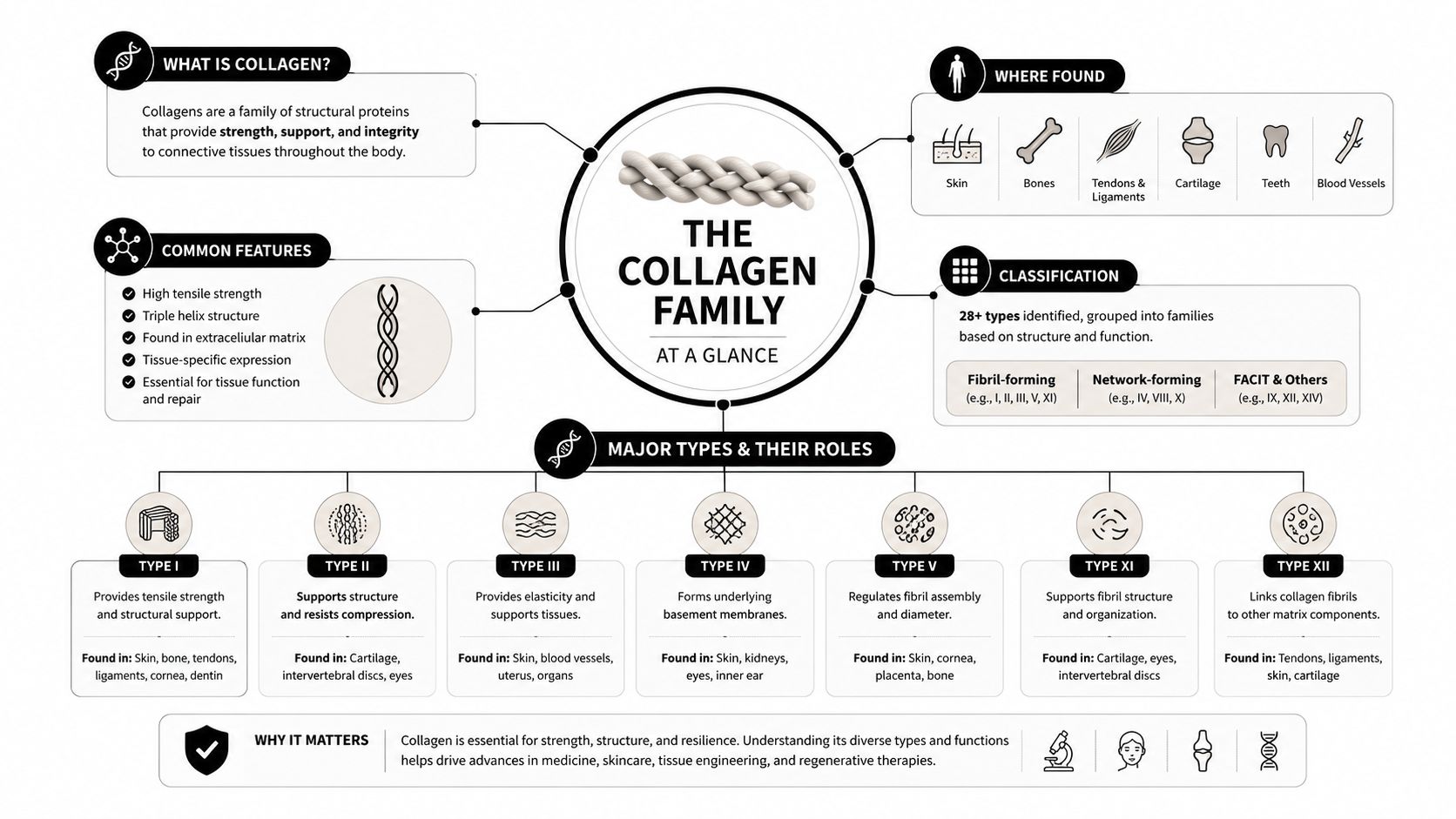
A shared shape with different instructions
Collagen's familiar triple-helix structure helps give the protein its strength. But the triple helix alone doesn't determine the final job. The amino-acid chains, genetic instructions, fibril arrangement, and surrounding tissue environment all influence how collagen behaves.
Type I forms strong fibrils that carry tensile loads. That makes it suited to skin, bone, tendons, ligaments, and parts of vascular tissue. Type II creates a distinct network in cartilage, where the tissue must distribute compressive forces rather than resist pulling.
Type III is commonly found in reticular fibers and frequently co-assembles with type I. The balance between these two affects whether a matrix behaves as relatively stiff or more elastic. This matters in tissues that must stretch and recoil, including skin and blood vessels, according to a review of collagen composition and tissue biomechanics.
The body's collagen family therefore works less like a single supplement ingredient and more like a group of specialized construction materials. Similar chemistry doesn't mean identical performance.
Type I vs Type II vs Type III Compared
A knee that absorbs impact, skin that stretches, and bone that resists bending rely on different collagen arrangements. To compare collagen 1, 2, and 3, ask three practical questions: What is its molecular structure? Where does it live? What mechanical problem does it solve?
| Feature | Type I | Type II | Type III |
|---|---|---|---|
| Molecular signature | [α1(I)]2α2(I) | [α1(II)]3 | [α1(III)]3 |
| Main tissue homes | Skin, bone, tendon, ligament, and vascular tissue | Articular cartilage and cartilage matrix | Reticular fibers, muscle, blood vessels, uterus, and bowel |
| Mechanical job | Tensile strength and structural support | Cushioning and distribution of compressive stress | Elastic recoil, compliance, and flexible support |
| Typical supplement association | Marine, bovine, and porcine collagen peptides | Chicken cartilage or undenatured type II | Bovine connective-tissue collagen, often with type I |
| Best-known consumer goal | Skin and connective-tissue support | Joint and cartilage support | Elasticity, flexible connective tissue, and tissue repair support |
Type I acts like a tensile cable
Type I is the dominant collagen in the human body, concentrated in skin, bone, tendons, and ligaments. These tissues must tolerate pulling, stretching, body weight, or repeated movement. Its molecular arrangement forms strong fibrils, giving tissues a firm structural framework.
Bone shows why collagen is not the same as mineral. Type I forms much of bone's organic framework, while minerals supply hardness. Together, they help bone resist both bending and brittleness.
Type II is built for cartilage mechanics
Type II is the main collagen associated with cartilage. Articular cartilage must manage compression whenever a joint bears weight, changes direction, or absorbs impact. Its fibrillar network helps distribute force through the tissue and supports chondrocytes, the cells that maintain cartilage.
For that reason, type II is a more direct match for cartilage-focused joint support than a generic type I powder. Both are fibrillar collagens, yet they are built for different mechanical demands. A supplement's collagen type therefore matters more when the intended goal is specifically joint or cartilage support.
Type III adds compliance and recoil
Type III commonly develops alongside type I in skin and other connective tissues. It also appears in reticular fibers, muscle, blood vessels, and hollow organs such as the uterus and bowel. These locations need support that can flex, expand, or recoil rather than remain completely rigid.
The type III to type I relationship changes with aging, injury, and pathology, particularly in tendon tissue. Type III may also increase in scar tissue, reflecting its participation in remodeling and repair. That association describes a biological role, not a promise that type III alone produces an anti-aging effect.
What Each Collagen Type Does for Skin, Joints, and Connective Tissue
A person choosing collagen for dry skin, knee discomfort, or digestive concerns is not choosing from one interchangeable protein. Type I and type III generally belong in skin and connective-tissue discussions, while type II belongs in cartilage discussions. The tissue a type builds offers a more useful starting point than the product label alone.
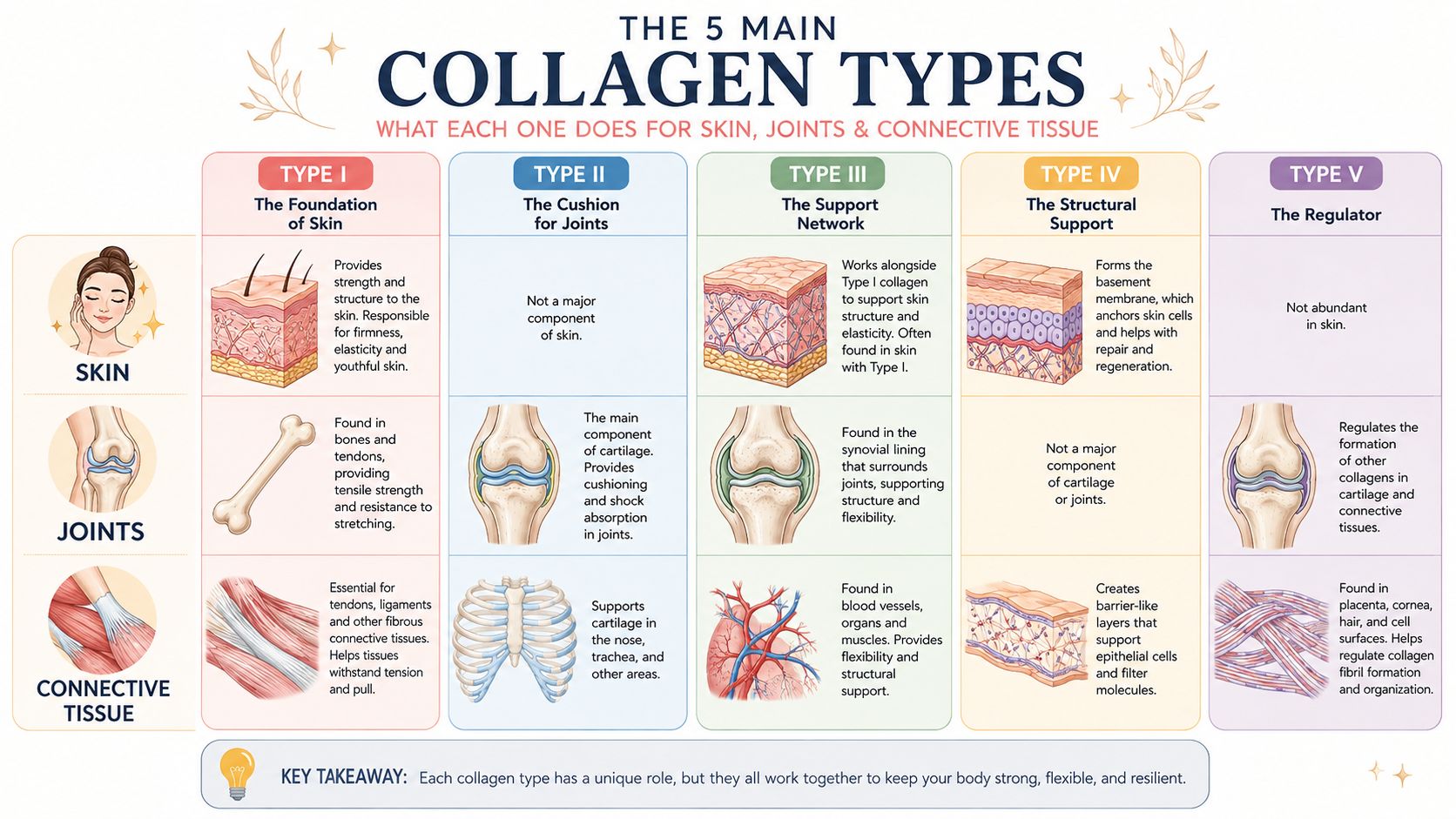
Skin, bone, and tendons
Type I supplies much of the structural framework in skin, bone, tendons, and ligaments. Type III often develops alongside it, influencing fibril arrangement and allowing tissue to remain more flexible. Products aimed at skin elasticity or broad connective-tissue support therefore often combine type I and type III.
For skin, collagen peptides have the clearest human evidence for supporting hydration and the skin barrier. Wrinkle-reduction claims and proposed deeper structural changes are less consistent. A 2025 review in the Journal of Cosmetic Dermatology found that wrinkle-reduction claims lacked consistency, with some findings disappearing during sensitivity analysis.
Type I also participates in bone biology. A supplement does not replace resistance training, adequate nutrition, or medical evaluation for low bone density. Bone strength relies on both its collagen framework and its mineral content.
Cartilage and joint comfort
Type II forms the central fibrillar network in articular cartilage. It helps the tissue transmit force, preserve its matrix, and support the cells embedded within that matrix. This makes type II the more direct biological match for a cartilage-focused goal.
Human outcomes are condition-specific. An eight-week randomized study found significant improvements in osteoarthritis-related pain and quality-of-life scales with type I and type III supplementation. A separate eight-week trial in meniscopathy reported better pain and quality-of-life scores, while objective performance findings were mixed, according to a review of collagen supplementation and joint outcomes.
The practical takeaway is modest. Collagen may support comfort or the cartilage matrix, but it is not an immediate performance enhancer and cannot replace diagnosis or rehabilitation.
A short visual explanation connects each protein type with its main tissue roles:
Blood vessels, muscle, and the gut wall
Type III appears in blood vessels, muscle, and hollow organs, including the gut wall. Its network contributes to tissues that must flex, expand, and recoil while retaining structural support.
That biological location does not prove that a type III supplement repairs a particular organ. It shows why type III belongs in discussions of compliant, interconnected connective tissue. Choose a product according to the tissue and goal it is intended to support, not because a collagen type is present there.
Where to Get Each Type from Food and Supplements
The source map is useful, but it's only a starting point. Marine, bovine, porcine, and chicken labels describe where the collagen came from, while the type tells you which collagen protein the product emphasizes.
- Marine collagen is commonly associated with type I and often comes from fish skin or scales.
- Bovine collagen may provide type I, type III, or a combination, particularly when connective tissue is used.
- Porcine collagen is another common source of type I.
- Chicken cartilage is the source most commonly associated with type II.
A food-first approach can include fish with the skin on, chicken cartilage and skin, slow-cooked cuts containing connective tissue, and broths made from bones or joints. These foods provide protein and other nutrients, but their collagen type and final amount can vary with the cut, preparation, and serving.
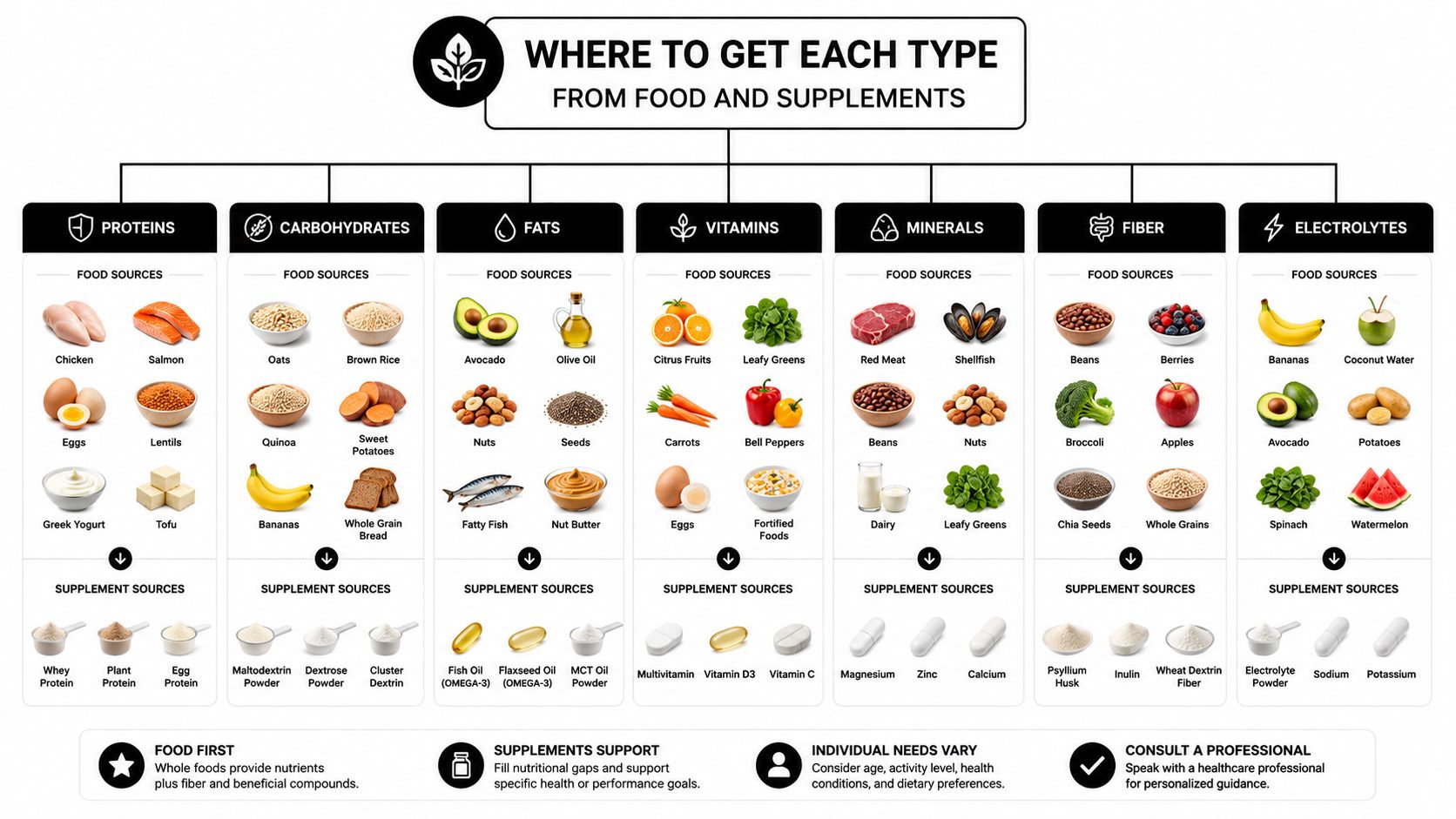
Peptides and undenatured type II aren't the same
Hydrolyzed collagen peptides have been enzymatically broken into smaller pieces. They're commonly used in products for skin and general connective-tissue support. The label may say “collagen peptides,” “hydrolyzed collagen,” or both.
Undenatured type II remains closer to its native structure and is generally used in small-dose joint protocols. It shouldn't be compared directly with a large serving of hydrolyzed type I or type I and III peptides. The preparation, dose, and proposed mechanism differ.
For readers comparing source and type, GutRx Collagen MT-1 is described as a type I marine collagen product. It's one example of why the label should identify both the collagen type and its source rather than relying only on the word “collagen.”
The Honest Answer on Collagen and Gut Health
Collagen is often marketed for the gut lining, bloating, digestion, and intestinal permeability. The honest answer is narrower: some people may notice mild digestive benefits, but collagen hasn't been established as a treatment for IBS, constipation, or “leaky gut.”
A 2022 pilot study reported that 20 grams per day of collagen peptides may reduce bloating and improve bowel frequency in otherwise healthy women, as described in the pilot study on collagen peptides and digestive symptoms. A small pilot can identify a useful signal, but it can't establish that the same result will occur across people with different diagnoses, diets, medications, or causes of bloating.
Why the findings don't settle the question
A 2025 crossover randomized trial in exercised volunteers found no significant difference in gastrointestinal symptoms compared with placebo. A 2026 clinician summary also notes that human trials examining collagen and gut barrier function remain scarce and inconclusive.
Those findings point to a sensible interpretation. Collagen may be worth a cautious trial if you're interested in protein support and want to observe whether symptoms change, but it shouldn't replace evaluation for persistent diarrhea, constipation, pain, bleeding, unexplained weight change, or ongoing bloating.
Readers exploring the “gut lining” conversation can review this plain-language explanation of intestinal permeability, while keeping the distinction between a biological mechanism and a proven clinical treatment clear.
Evidence boundary: A possible symptom signal in a limited population is not the same as proof that collagen repairs the gut barrier.
If bloating or irregularity is your main problem, a supplement designed around the actual symptom may be more directly relevant than choosing collagen solely because it's associated with connective tissue.
How to Choose and Use a Collagen Supplement Safely
A shopper choosing between marine type I peptides, a type II joint formula, and a broad blend is really choosing between different tissue targets. Start with the goal, then read the label.
- For skin or broad connective-tissue support, look for hydrolyzed type I or a type I and III peptide blend. Marine and bovine products are common sources.
- For cartilage-focused joint support, confirm that the label identifies type II and states whether the material is hydrolyzed or undenatured.
- For general support, a multi-type blend may be reasonable, although listing more types does not automatically make a product a better match.
Common collagen plans use 5 to 15 grams of peptides per day for skin and connective-tissue goals, while some joint protocols use around 40 milligrams of undenatured type II. Treat these amounts as reference points, not a personal prescription. Your goal, product form, diet, allergies, and health history still matter.
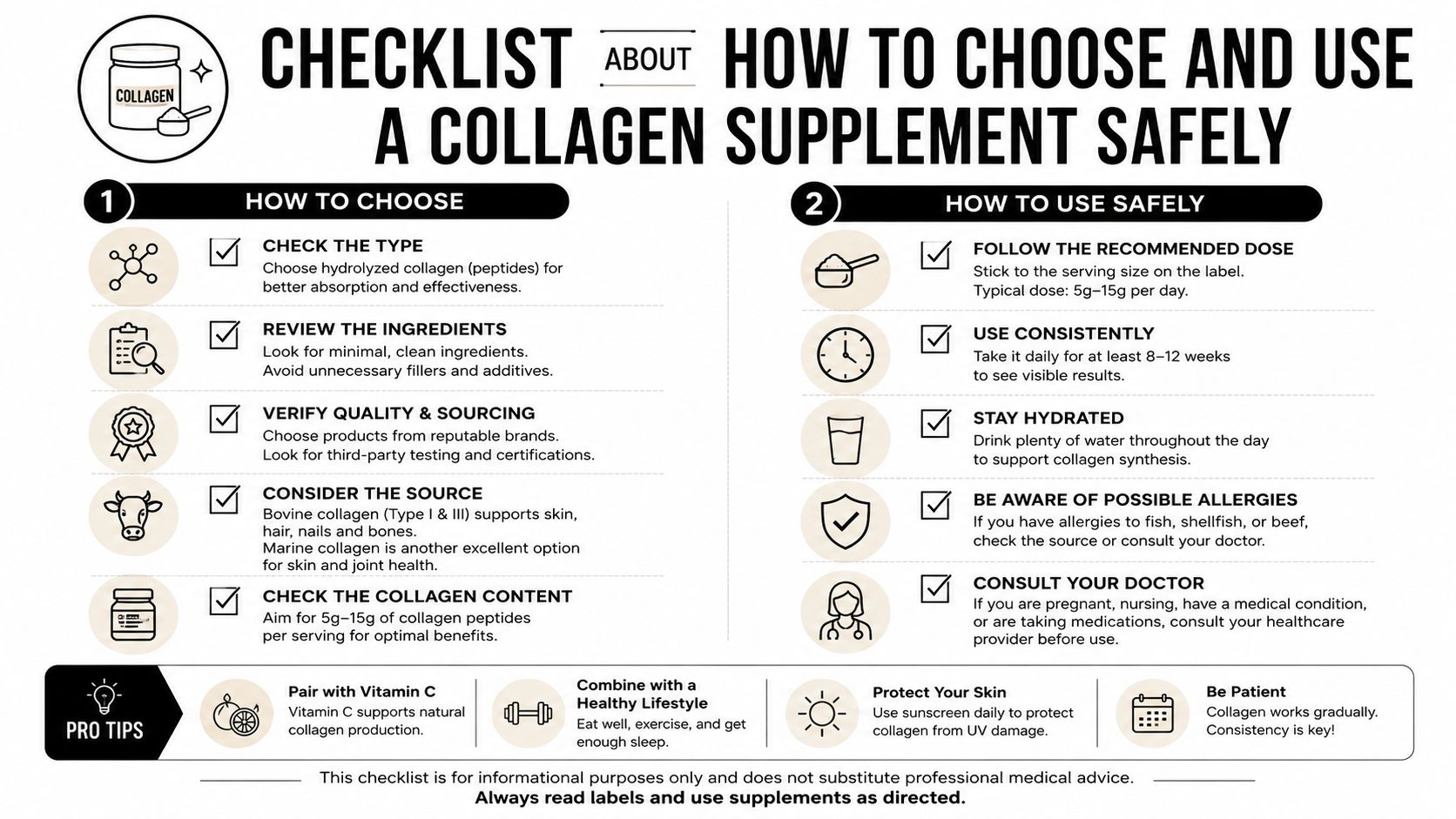
Label checks that matter
Check the collagen type, animal source, serving amount, processing method, allergen information, and independent quality documentation. A batch-testing Certificate of Analysis that explains what potency and composition records can verify can clarify what was tested, but it cannot prove a particular health outcome.
Collagen can be taken with or without food. Taking it consistently matters more than choosing a perfect time of day. Assess any change over a reasonable trial, rather than judging the product after one serving.
Check the source carefully if you have a fish, shellfish, chicken, or egg allergy. People taking blood thinners should discuss collagen products with a clinician. Anyone who is pregnant or nursing should ask a qualified healthcare professional before starting a supplement.
For bone-related goals, consider collagen alongside adequate vitamin D and calcium. A 2025 meta-analysis found bone and muscle benefits were most consistent when collagen was paired with vitamin D and calcium, rather than assuming collagen alone is sufficient, as reported in the review of collagen outcomes.
Matching the Right Collagen Type to Your Goal
For skin elasticity, hydration, or wrinkle support, start with type I or a type I and III blend, often from marine or bovine peptides. For joint comfort or cartilage support, look for type II, especially a clearly identified undenatured type II formula when that protocol fits your needs.
For connective tissue, wound remodeling, or vascular and gut-wall structure, type I and III are the closest biological match. A multi-type blend is reasonable when you want broad connective-tissue support without one dominant goal. Collagen is supportive nutrition, not a replacement for a balanced diet, resistance training, sleep, or medical care for persistent symptoms.
GutRx offers collagen options alongside digestive supplements, including type-specific products such as marine type I collagen, as well as formulas designed for probiotic, synbiotic, and digestive enzyme support. Visit GutRx to compare products by your goal and review the available quality and formulation details before choosing.


