

Refrigeration isn't automatically necessary for probiotics. Some products are tested for refrigerated storage at 2°C to 8°C, while others are tested for controlled room temperature at 20°C to 25°C, so the correct choice depends on the strain, formulation, packaging, and label.
The more useful question isn't “Do probiotics have to be refrigerated?” It's “Can this specific product maintain its stated potency under the storage conditions printed on the label?” Probiotic organisms are generally sensitive to temperature and humidity, but modern manufacturing can protect some strains with freeze-drying, moisture barriers, oxygen control, and other stability measures. The label should match the conditions the finished product has been tested to withstand across warehousing, shipping, retail storage, and everyday use. The CRN and IPA probiotic best-practices guidance specifically distinguishes refrigerated storage from controlled room temperature rather than treating every probiotic as identical.
Table of Contents
- Why Refrigeration Is Not a Universal Probiotic Rule
- How Probiotic Viability Actually Works
- Live, Freeze-Dried, and Spore-Forming Strains Compared
- Reading Probiotic Labels the Right Way
- Why Third-Party Testing and COAs Matter More Than the Fridge Label
- Travel, Shipping, and Real-World Storage Scenarios
- Signs Your Probiotic May Have Lost Potency and a Simple Storage Checklist
- Choosing a Probiotic You Can Trust at Room Temperature or in the Fridge
Why Refrigeration Is Not a Universal Probiotic Rule
Do probiotics have to be refrigerated? The answer depends on the product's specific strain, formulation, and packaging, not on a universal rule. Cold storage may slow viability loss, but it cannot make an untested product dependable.
Many traditional live cultures, including Lactobacillus and Bifidobacterium products, have often been refrigerated because heat, moisture, and oxygen can reduce survival. Other formulations use freeze-dried organisms, low-moisture materials, protective capsules, or spore-forming bacteria that handle ambient storage more effectively. In practice, refrigerated and shelf-stable products can both be legitimate when their storage conditions are supported by testing.
The three questions that matter
Begin with strain resilience. Organisms differ in their response to warmth and humidity, and strains within one species may perform differently. A 2025 review found that some vegetative strains can remain stable at 25°C in selected matrices, while spore-formers such as Bacillus subtilis show especially high thermal resistance. The review's discussion of temperature and strain biology supports evaluating the strain rather than judging the entire category.
Then inspect the moisture and oxygen barriers. A dry powder in a moisture-resistant blister may tolerate room temperature better than a liquid or high-moisture capsule in a standard bottle. Packaging acts like a protective shell while the organisms remain dormant.
Finally, check whether the manufacturer guarantees potency through expiration without refrigeration. The storage statement matters, but a stability-backed CFU claim and accessible testing records provide stronger evidence than a refrigerator symbol alone.
Practical rule: Refrigerate a product when its label requires it. Don't refrigerate a shelf-stable product because you assume colder is always better.
How Probiotic Viability Actually Works
A probiotic's potency is commonly expressed in CFUs, or colony-forming units. This measurement estimates how many organisms remain capable of forming colonies under the test conditions. It's a snapshot of viable organisms at a particular point in time, not a permanent guarantee that the same number will remain in the bottle forever.
Viability usually declines as storage continues. Heat can accelerate reactions that damage cells, moisture can disturb the dormant state created during manufacturing, and oxygen can harm strains that are sensitive to oxidation. A 2022 review of probiotic storage stability identifies temperature, packaging, oxygen, and water activity as important influences. It reports that 4°C can maintain viability for more than one month, while dry products are commonly evaluated at room temperature, around 30°C, for longer shelf-life testing. The same review notes that storage at 37°C can cause a significant loss of cell viability.
What manufacturers do to slow the decline
Freeze-drying, also called lyophilization, removes water under controlled conditions and leaves organisms dormant. Desiccants absorb residual moisture, while blister packs and aluminum-lined materials create stronger barriers against humidity and oxygen than some ordinary containers.
Nitrogen-flushed bottles can reduce oxygen exposure inside the package. Protective encapsulation can also shield free cells from environmental stress, although the benefit depends on the specific design and formulation. Product-stability research on encapsulated probiotics emphasizes that moisture, oxygen exposure, temperature fluctuations, and storage interruptions can accelerate viability losses.
| Threat | Effect on Bacteria | Typical Formulation Defense |
|---|---|---|
| Heat | Speeds viability loss in sensitive organisms | Refrigerated storage, thermal stability testing, protective matrices |
| Moisture | Can disturb dormant cells and accelerate deterioration | Desiccants, blister packs, low-moisture powders |
| Oxygen | Can damage oxygen-sensitive strains | Oxygen-barrier packaging, nitrogen flushing, sealed capsules |
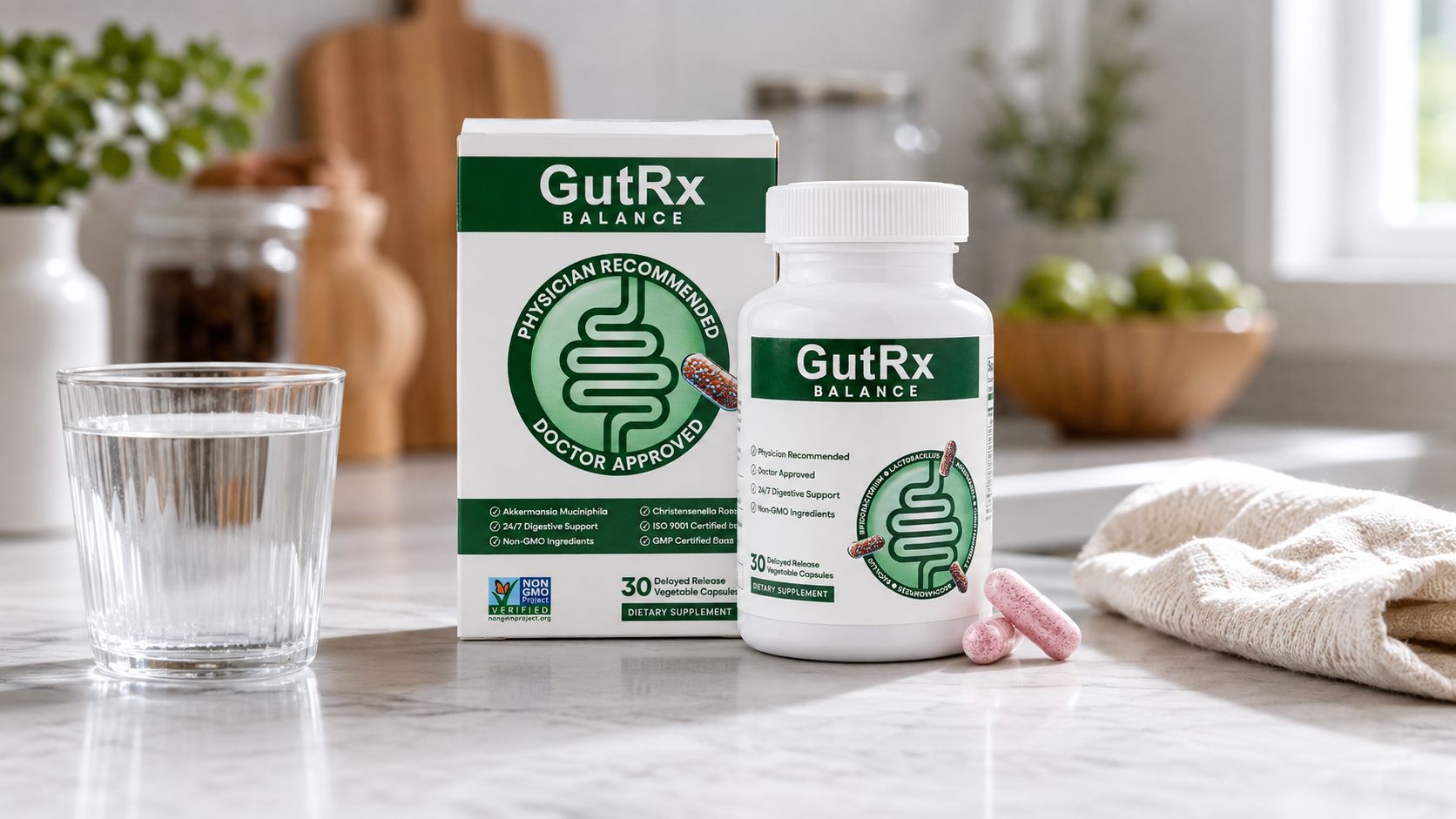
For example, GutRx BALANCE offers 30 billion CFUs per capsule with next-generation probiotics for gut health, digestive balance, and immune support. That CFU figure still needs to be interpreted alongside the product's storage statement, expiration-date guarantee, packaging, and testing documentation.
Live, Freeze-Dried, and Spore-Forming Strains Compared
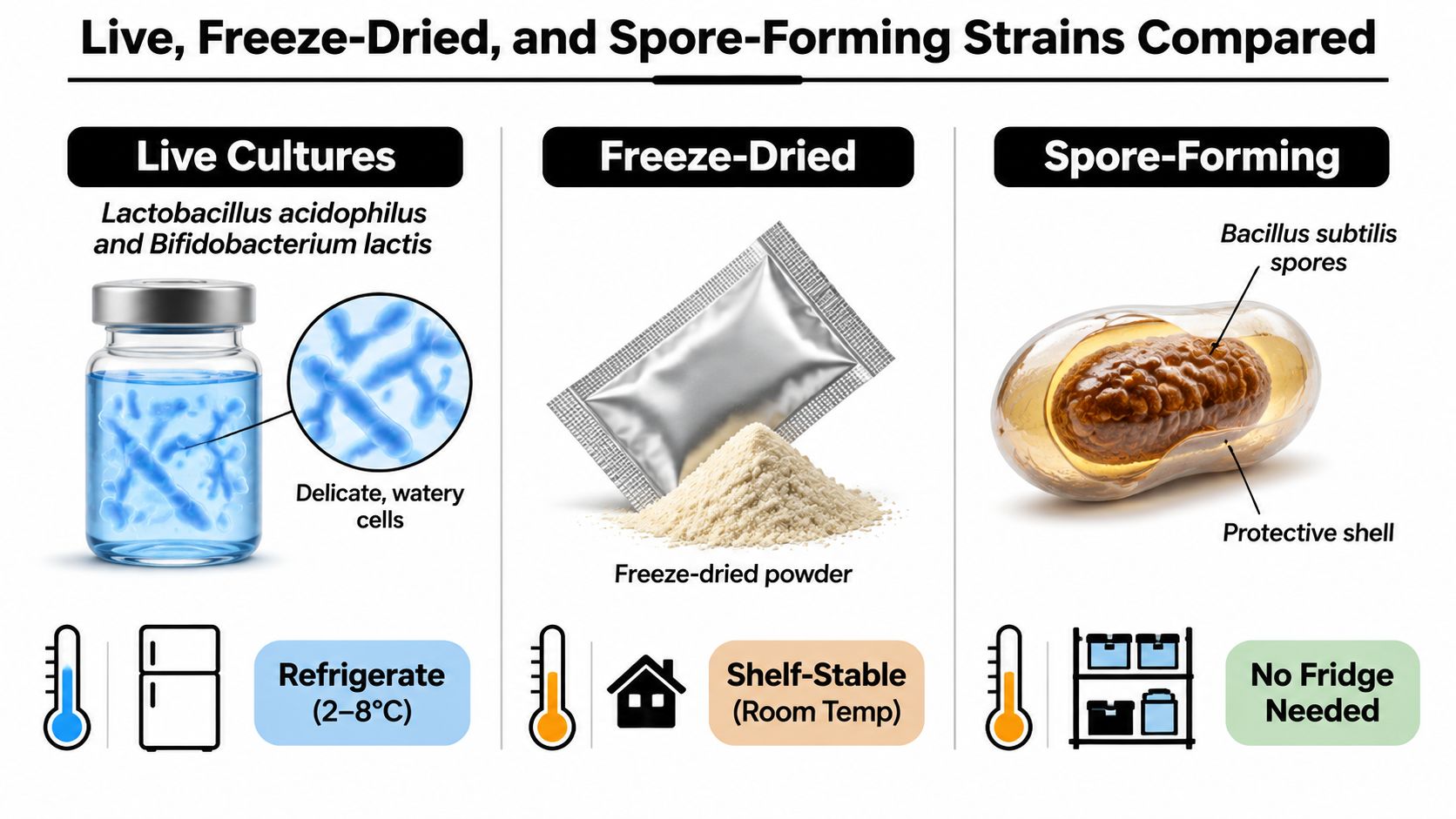
The word “probiotic” covers organisms with very different survival strategies. A refrigerated live-culture capsule, a freeze-dried powder, and a spore-forming formula shouldn't be judged by the same storage assumption.
Live cultures
Many traditional strains, such as Lactobacillus acidophilus and Bifidobacterium lactis, are supplied as live vegetative cells. They can be sensitive to heat, moisture, and oxygen, particularly when the formulation doesn't provide enough protection. A 2014 review found that viability generally has an inverse relationship with storage temperature and described 4°C to 5°C as preferable for probiotic food products, while also reporting product-specific optima such as 2°C for L. acidophilus LA-5 in yogurt and 8°C for Bifidobacterium lactis BB-12. The review of probiotic viability and storage temperature shows why the strain and matrix matter.
Freeze-dried probiotics
Freeze-dried organisms are placed into a dormant state by removing moisture. This can support shelf-stable storage when the finished product uses effective moisture and oxygen protection. The process doesn't make every probiotic invulnerable, though. A damaged seal, humid environment, or unsuitable bottle can still undermine stability.
Spore-forming strains
Spore-formers such as Bacillus coagulans and Bacillus subtilis create a protective endospore. That structure can resist heat, acid, and desiccation more effectively than many vegetative cells, which often makes these products suitable for ambient storage. The exact strain still matters, so “spore-forming” isn't a substitute for reading the finished product's stability claim.
A useful strain-specific resource is this explanation of Bacillus probiotics. The central buying lesson is simple: species names alone don't predict refrigeration needs. Look for the full strain identity, the delivery format, and the storage condition validated for the finished product.
Reading Probiotic Labels the Right Way
A probiotic label can answer most storage questions if you know where to look. Don't start with the CFU number alone. Start with the storage instruction, then verify whether the potency claim lasts through the product's expiration date.
Four label signals to check
-
Storage statement: Look for wording such as “refrigerate,” “refrigerate after opening,” or “store at room temperature.” The CRN and IPA guidance identifies refrigerated storage as 2°C to 8°C and controlled room temperature as 20°C to 25°C. The label should reflect the product's tested stability profile.
-
CFU timing: Check whether the CFU count is guaranteed at the time of manufacture or through expiration. The latter gives you a more useful picture of what the manufacturer intends to deliver at the end of shelf life.
-
Full strain identifier: A complete listing includes genus, species, and a strain code, such as Lactobacillus rhamnosus GG or Bifidobacterium animalis subsp. lactis HN019. Strain identity matters because organisms within one species can have different stability characteristics.
-
Moisture protection: Terms such as “moisture-resistant blister,” “desiccant included,” and “single-serve sachets” point to packaging designed to limit humidity exposure.
| Label Element | What to Look For | Why It Matters for Storage |
|---|---|---|
| Storage instruction | Refrigerate or room-temperature direction | Gives the manufacturer's tested condition |
| CFU claim | Potency through expiration | Indicates whether end-of-shelf-life viability is addressed |
| Strain code | Full genus, species, and alphanumeric identifier | Helps distinguish strain-specific behavior |
| Packaging language | Blister, desiccant, oxygen barrier | Shows how moisture and air are controlled |
| Lot information | Batch or lot number with testing access | Lets you connect the bottle to verification records |
A batch or lot number is especially useful when the brand provides a guide to Certificates of Analysis. A QR code or online lookup portal can connect the package to actual test documentation rather than leaving you with a broad marketing statement.
Why Third-Party Testing and COAs Matter More Than the Fridge Label
“Refrigerate” and “shelf-stable” are storage claims, not complete quality assessments. The stronger question is whether the manufacturer can show that the product contains the listed organisms at the stated potency under the declared conditions.
A Certificate of Analysis, or COA, is a batch-specific document that can report identity, potency, and purity results. Depending on the testing program, it may address the CFU count, strain verification, heavy metals, and unwanted microbes. A COA doesn't replace a product label, but it gives you a way to inspect evidence connected to a particular lot.
How to inspect a COA
Find the lot number on the bottle and enter it into the brand's testing portal, if one exists. Then check the assay method, the CFU result for each strain or blend, and the testing date in relation to the expiration date. A document that identifies the product but doesn't connect to your lot offers less practical reassurance than a batch-specific record.
Independent seals can also help consumers screen products. Familiar programs include USP, NSF, ConsumerLab, and Informed Ingredient, although the exact scope of verification varies by program and product. Read what the seal covers rather than assuming it proves every possible quality attribute.
A shelf-stable product with accessible, independent potency data may be a more verifiable choice than a refrigerated product that publishes no stability evidence. Refrigeration can slow deterioration, but it can't compensate for unclear strain identity, weak packaging, or an unsupported CFU claim. This guide to third-party-tested probiotics offers a practical way to evaluate that evidence.
The key is not to treat a COA as a decorative trust badge. Use it to answer a specific question: does this lot contain the organisms and potency the label promises under the product's stated storage conditions?
Travel, Shipping, and Real-World Storage Scenarios
Does a probiotic need special handling during travel? Storage becomes harder to control in a mailbox, suitcase, car, or humid kitchen, but the answer still comes from the product's declared storage conditions. Refrigeration is a formulation outcome, not a universal probiotic rule.
A two-week road trip through a hot climate shows the difference. A moisture-protected, freeze-dried product may be easier to carry than a refrigerated liquid, yet it should remain out of direct sunlight and never sit on a dashboard. A product that requires a cold chain needs an insulated pouch and phase-change pack. Keep the pack from touching the product directly, because freezing can also create a problem.

Summer mail delivery requires a separate check. For a refrigerated product, arrange expedited shipping when possible, select a climate-controlled pickup location, and open the package promptly. If it arrives warm, contact the manufacturer with the lot number and delivery details. The manufacturer can compare the exposure with the product's tested specifications, while guessing cannot.
Humidity matters even when the room feels comfortable. A steamy bathroom can expose capsules or powder to moisture each time the bottle opens. Keep the original container tightly sealed in a cool, dry cabinet, away from the stove, sink, and sunlit counters.
Travel rule: Follow the manufacturer's storage instruction first. If a refrigerated product leaves its required range, resolve the deviation quickly, measured in hours rather than days.
The CRN and IPA storage guidance recommends considering conditions across warehousing, shipping, retail storage, and consumer use. A tested shelf-stable probiotic may therefore suit travel, while a sensitive liquid or live-culture product may require a maintained cold chain.
Signs Your Probiotic May Have Lost Potency and a Simple Storage Checklist
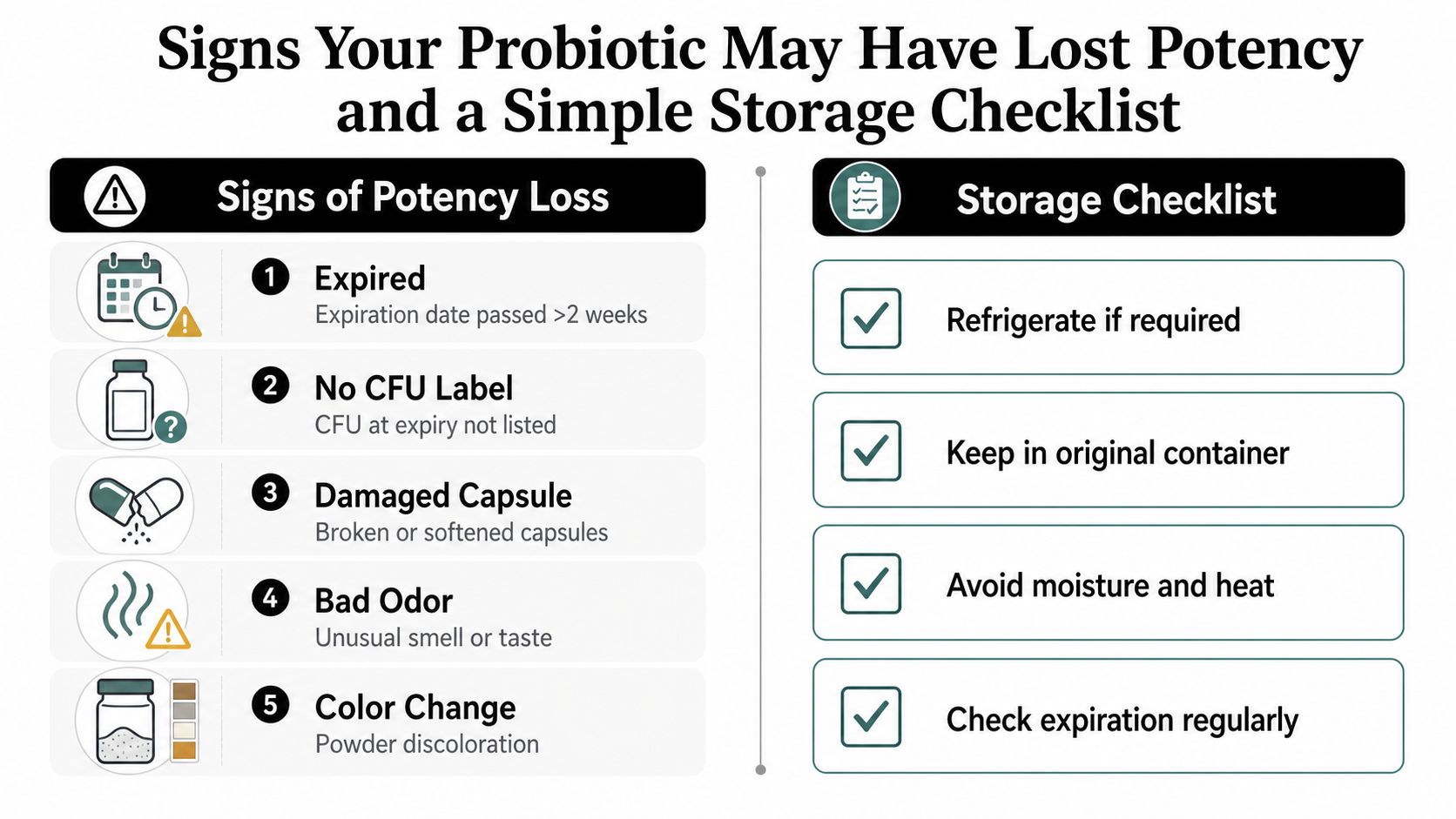
Visible changes can raise a concern, but they can't prove that a probiotic has lost viability. A bottle may look normal while its live count has declined, so the most reliable evidence remains the expiration date, the CFU guarantee, and relevant batch testing.
Watch for these warning signs:
- Expired product: Don't assume an old bottle still delivers its labeled potency after the expiration date.
- Missing end-date potency: If the label lists CFUs only at manufacture, you can't use that number as a guarantee for the end of shelf life.
- Damaged capsules: Broken, softened, leaking, or fused capsules can indicate heat or moisture exposure.
- Clumping or discoloration: Powder that has clumped or changed color deserves closer inspection.
- Unusual odor: A new off or yeasty smell may signal that the product's physical condition has changed.
- Poor storage history: A bottle left in a hot car or sunny window may have experienced conditions outside its intended range.
A simple routine
Keep the bottle sealed in its original packaging. Store it away from bathroom humidity, stovetops, direct sunlight, and heat-producing appliances. Refrigerate only when the label requires refrigeration, and ask the manufacturer for a recent lot-specific COA if the storage history is uncertain.
Before each refill cycle, check the expiration date and the CFU claim. That small habit helps you avoid relying on appearance alone.
Choosing a Probiotic You Can Trust at Room Temperature or in the Fridge
A trustworthy choice follows a short evidence trail. Identify the full strain, confirm whether the CFU claim applies through expiration, read the storage statement, and look for independent testing or a lot-specific COA.
| Criteria | Refrigerated Probiotic | Shelf-Stable Probiotic |
|---|---|---|
| Strain profile | Often includes temperature-sensitive live cultures | May use freeze-dried or spore-forming organisms |
| Packaging | Cold-chain bottle, insulated shipping, or protective container | Moisture-resistant blister, desiccant bottle, or oxygen barrier |
| Storage claim | Usually specifies refrigeration, commonly within a defined temperature range | Specifies room-temperature limits or no-refrigeration storage |
| Potency evidence | Should document viability under refrigerated conditions | Should document viability under ambient conditions |
| Convenience | Requires consistent cold storage | Easier for cupboards, travel, and mail delivery |
| Verification | Look for lot testing and independent confirmation | Look for the same evidence, not just a shelf-stable label |
For a refrigerated multi-strain capsule, verify how the cold chain is maintained during shipping and whether the potency claim extends to expiration. For a shelf-stable spore-former or moisture-protected blend, confirm that ambient stability applies to the finished product, not merely to an ingredient before encapsulation.
A product's format also matters. Compare a blister pack with a repeatedly opened jar, and distinguish independent lab testing from in-house quality checks. A potency guarantee or return policy may add consumer protection, but it doesn't replace clear strain information and stability data.
The best choice isn't automatically the coldest one. It's the product whose storage condition, strain identity, packaging, potency claim, and testing records make sense together.
GutRx offers targeted digestive-support formulas, including probiotic options designed around specific gut-health needs and third-party testing with downloadable Certificates of Analysis. Visit GutRx to review the available formulas and compare their storage, potency, and quality information before choosing.


