

You're standing in the supplement aisle with a probiotic bottle in one hand and a prebiotic powder in the other. One label promises vaginal balance, another mentions gut health, and neither makes clear whether you need live bacteria, the fiber that feeds them, or both. Prebiotics for vaginal health are a plausible support strategy, but the strongest human evidence currently concerns adjunctive use after bacterial vaginosis treatment, especially with intravaginal products. Oral prebiotics may support the gut-to-vagina connection, but they shouldn't be treated as a proven replacement for diagnosis or prescribed therapy.
Table of Contents
- What Prebiotics Are and Why They're Being Studied for Vaginal Health
- The Vaginal Microbiome and the Gut-to-Vagina Connection
- How Substrate Selectivity Defines a Good Vaginal Prebiotic
- What the Human Trials Actually Show
- Choosing Your Route and Evaluating Product Quality
- Practical Use, Timelines, Safety, and When to See a Clinician
- Where Prebiotics Fit and What to Do Next
What Prebiotics Are and Why They're Being Studied for Vaginal Health
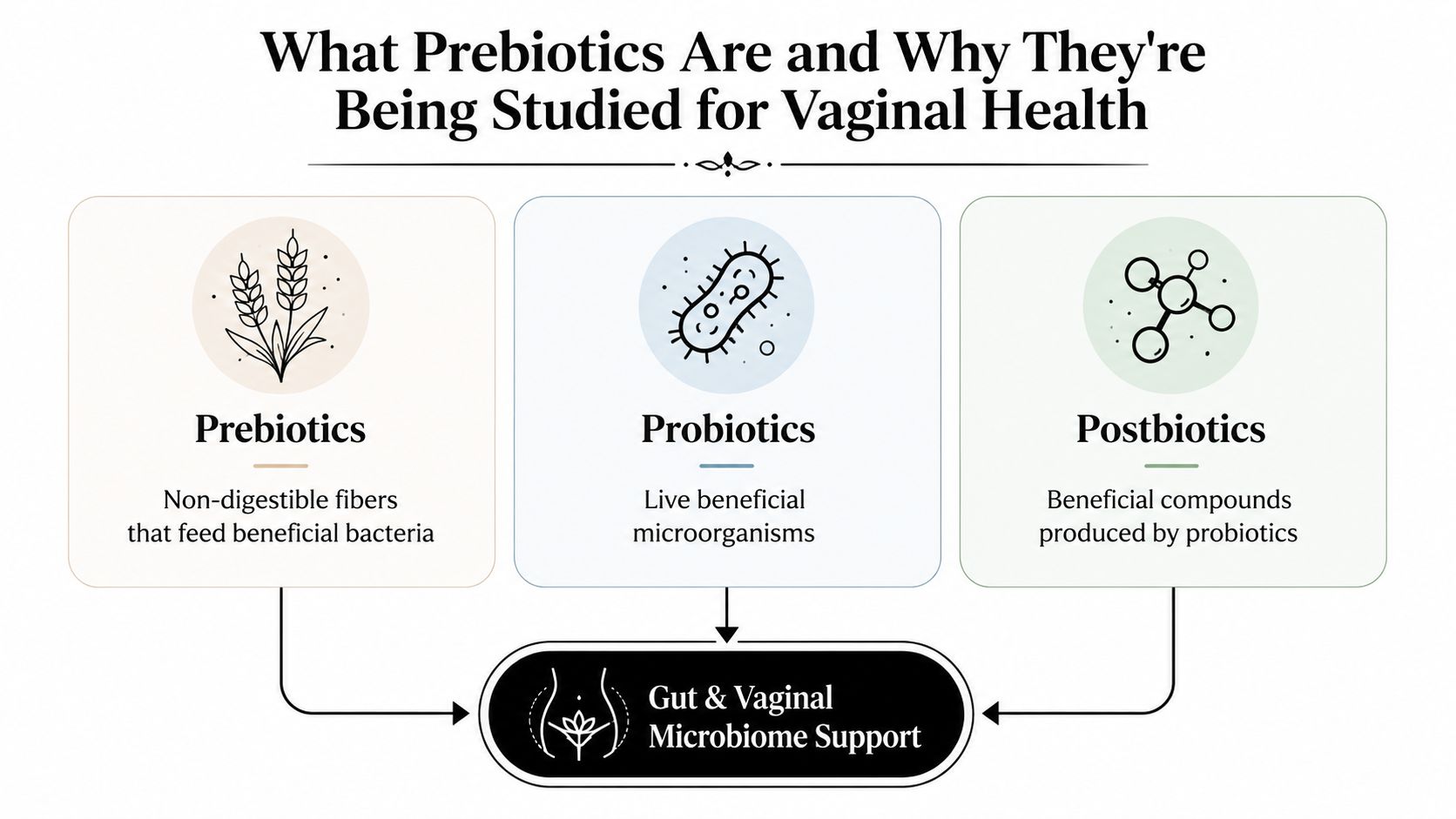
A prebiotic is a non-digestible compound that beneficial microorganisms can use as a food source. Prebiotics may include fibers, oligosaccharides, and other selectively fermented substrates. A probiotic is a live microorganism administered to support health, while a postbiotic is a beneficial preparation or compound produced by microorganisms. The distinction matters because these products work through different routes.
The simplest example is a garden. Probiotics add selected plants, prebiotics provide the soil nutrients those plants can use, and postbiotics provide useful compounds created during growth. In vaginal health, the desired “plants” are usually protective Lactobacillus species. A prebiotic only makes sense if the local microbial community can use it in a way that supports those bacteria rather than unwanted organisms.
Why the idea has a long history
Modern interest didn't appear suddenly. The concept of prebiotics emerged in the 1980s, and one of the first experiments involving vaginal use was reported in 1995, when skim milk was used to stimulate lactobacilli growth in the vaginal ecosystem. A later review proposed that selected carbohydrates might help control vaginal infections by stimulating indigenous lactobacilli while limiting pathogen growth and attachment to vaginal epithelial cells. It also emphasized that evidence for prebiotic carbohydrates in pessaries, creams, or douches remained limited. The historical review of vaginal prebiotics describes this progression from early theory to more formal clinical testing.
That history gives you a useful way to read today's marketing. Prebiotics aren't purely speculative, but neither is every prebiotic product clinically proven. The compound, route, dose, formulation, and health condition all matter. For a broader explanation of how supplemental fibers are used, see this guide to prebiotic fiber supplements.
The Vaginal Microbiome and the Gut-to-Vagina Connection
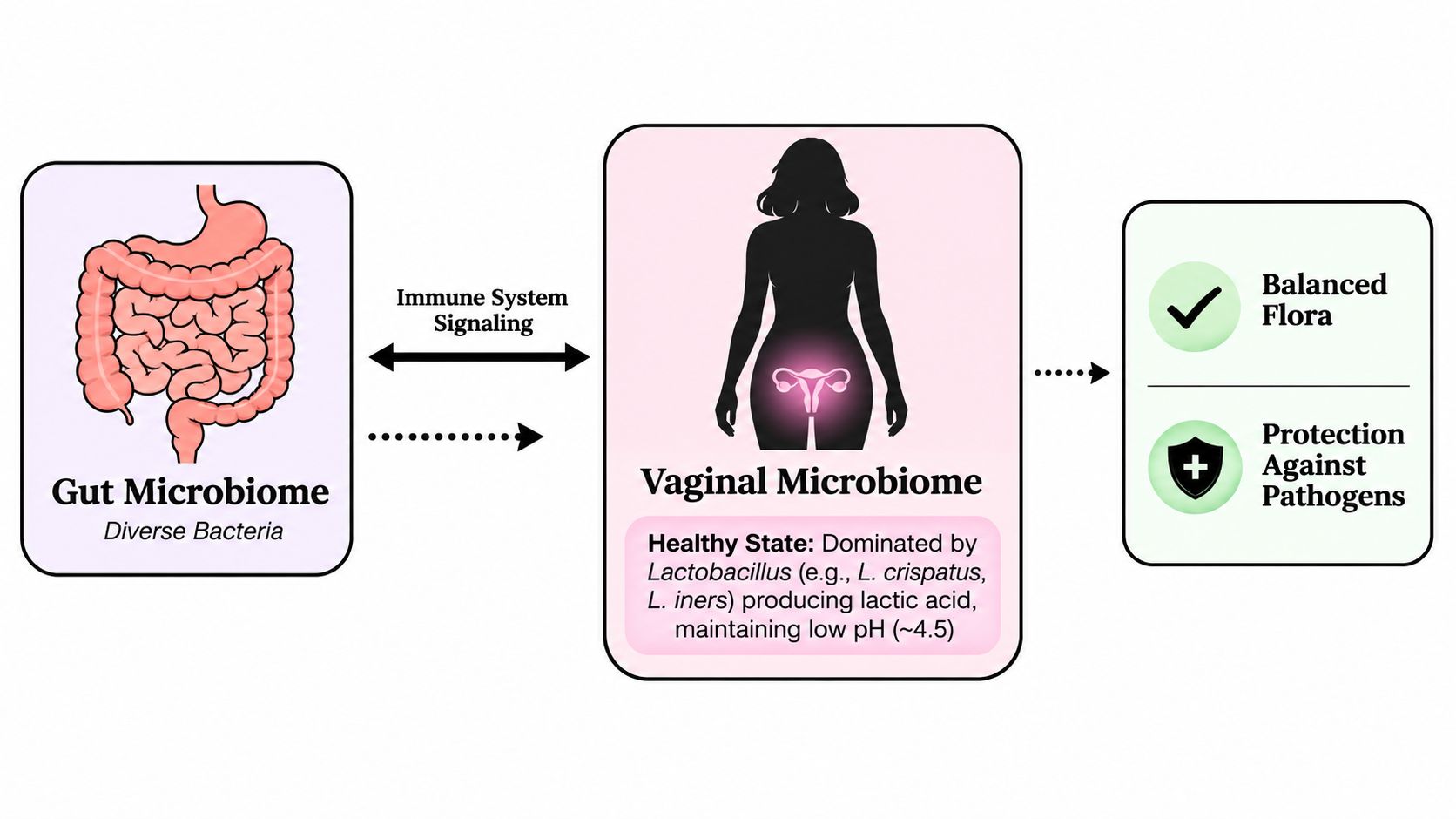
A vaginal microbiome in a more protective state is commonly associated with Lactobacillus dominance. Species such as Lactobacillus crispatus and Lactobacillus iners can produce lactic acid, helping maintain an acidic environment that makes it harder for some disruptive organisms to thrive. The commonly discussed vaginal pH range is about 3.8 to 4.5, but that quantitative range comes from background material rather than the verified evidence supplied for this article, so it shouldn't be treated as a product guarantee.
A useful analogy is slightly acidic, oxygen-poor soil. Lactobacilli are better suited to that environment, while organisms associated with bacterial vaginosis may find it easier to expand when the conditions change. A prebiotic is therefore not "food for all bacteria." The important question is whether it feeds the protective organisms preferentially.
How the two ecosystems may interact
The gut and vaginal microbiomes aren't identical, and a gut supplement doesn't automatically become a vaginal treatment. They are connected through microbial movement, immune signaling, hormone metabolism, and the surrounding anatomy. Early microbial exposure during birth can contribute to vaginal seeding, while movement of organisms between the intestinal and vaginal areas can continue during adulthood. These mechanisms make the gut relevant, but they don't prove that an oral prebiotic will correct a vaginal condition.
Estrogen metabolism is another proposed link. Gut bacteria participate in processing hormones, and hormonal changes can influence the vaginal tissue environment and the resources available to Lactobacillus. Immune signaling and microbial metabolites may also affect both sites. This is why researchers study oral approaches, but the pathway is indirect and patient responses can vary.
Practical rule: A gut-to-vagina mechanism can make an oral product biologically plausible. It doesn't make oral prebiotics interchangeable with a locally tested vaginal gel.
For readers who want a focused explanation of the protective organism itself, this overview of Lactobacillus and why it matters is a useful companion. A short visual explanation can also help connect the microbial and immune concepts:
How Substrate Selectivity Defines a Good Vaginal Prebiotic
The technical test for a vaginal prebiotic is substrate selectivity. A candidate should support health-associated Lactobacillus species more effectively than it supports organisms linked with dysbiosis. If a compound is broadly fermented by many organisms, it may create activity without producing the desired microbial shift.
Laboratory research comparing several carbohydrates identified lactulose as the strongest candidate among the tested substances. It selectively stimulated vaginal lactobacilli across multiple species without promoting dysbiotic or pathogenic organisms in the model system. The same work connected the shift with a more acidic environment, a mechanism that matters because acidification can suppress bacterial-vaginosis-associated overgrowth. The comparative laboratory study of lactulose and other substrates provides the relevant evidence.
What the comparison means
The tested compounds didn't perform equally:
| Candidate | What the evidence indicates |
|---|---|
| Lactulose | Broadly stimulated vaginal Lactobacillus species in the model and didn't promote dysbiotic organisms. |
| Lactitol | Showed less broad or less specific utilization than lactulose. |
| Raffinose | Was less broadly or specifically used in the model system. |
| Oligofructose | Also showed weaker selectivity than lactulose. |
That pattern is more useful than a generic claim that “fiber feeds good bacteria.” The preferred substrate has a narrow target. It should encourage acid production and Lactobacillus growth without supplying an equally useful fuel source to organisms associated with BV.
The evidence here is primarily mechanistic and model-based, not proof that every oral powder or vaginal product will produce the same clinical result. Product labels may mention FOS, GOS, inulin, or other fibers, but the ingredient name alone doesn't tell you whether the exact formulation has been tested in people with recurrent BV. A formula that looks advanced on paper still needs human outcome data.
This is also why “more prebiotic” isn't automatically better. A poorly matched substrate can produce bloating orally or nonspecific microbial activity locally. The clinically relevant benchmark is microbiome stability and recovery, not just fermentation.
What the Human Trials Actually Show
Human evidence is more encouraging for adjunctive recovery after BV treatment than for general prevention. One triple-blind randomized clinical trial included 100 patients and tested a 5 mg prebiotic vaginal gel alongside standard oral metronidazole. At day 10, the healing rate was 76% with the prebiotic gel versus 30% with the placebo gel. At day 90, healing remained higher at 84% versus 62%. These results are reported in the trial record for the randomized clinical study of adjunctive vaginal prebiotic gel.
Those numbers don't mean the gel is a universal BV cure. Participants received standard antibiotic treatment, so the prebiotic was evaluated as an addition to therapy, not as a stand-alone replacement. The result does support a practical hypothesis: after treatment disrupts the local ecosystem, a targeted substrate may help beneficial bacteria regain an advantage.
Local normalization matters
Another intravaginal prebiotic gel containing APP-14 evaluated recovery using Nugent scores, a clinical measure associated with vaginal bacterial patterns. After 16 days, all treated subjects maintained a normal Nugent score, while 24% of placebo users still had high Nugent scores. The APP-14 study is important because it measured normalization after treatment rather than relying only on a broad wellness claim.
A separate randomized trial cited in a microbiome review included 39 participants and tested galacto-oligosaccharides with red clover extract after standard BV treatment. That design again treated prebiotics as an adjunct. It shows researchers are investigating combinations after therapy, but it doesn't establish a universal dose, route, or prevention schedule.
What remains uncertain
The field still has a small and fragmented evidence base. A 2025 bibliometric review identified 71 studies from 1999 through 2024 covering probiotics, prebiotics, synbiotics, and postbiotics for vaginal microbiome modulation, as summarized in recent expert coverage of vaginal microbiome probiotics. Active research is moving toward sequencing and patient-reported symptoms, which signals that important efficacy questions remain open.
The balanced verdict is straightforward. Adjunctive use after BV treatment has the clearest signal. Primary prevention, yeast-specific claims, and broad “vaginal wellness” promises remain less certain.
Choosing Your Route and Evaluating Product Quality
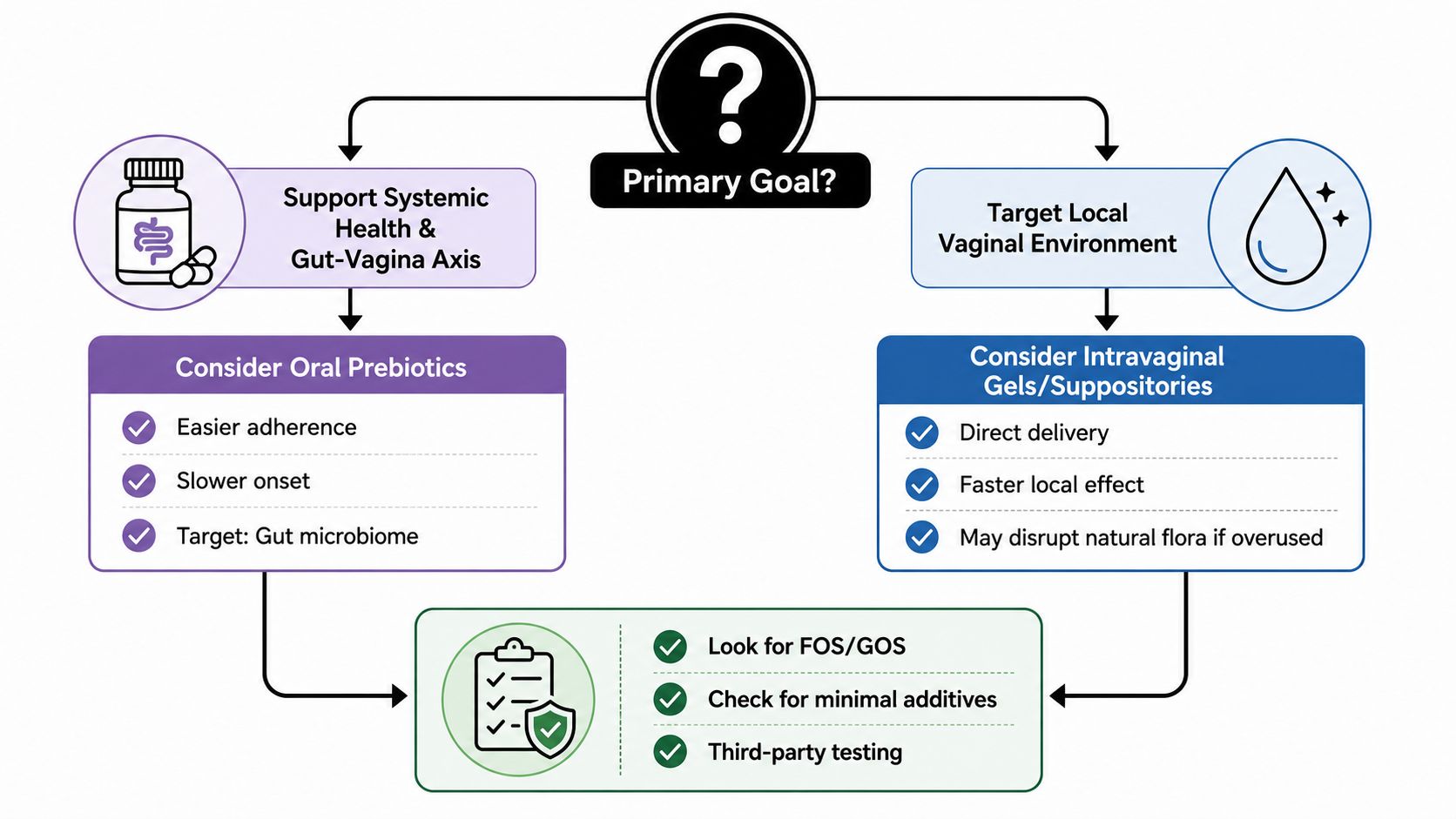
Route changes the question you're asking the product to solve. Oral prebiotics act first in the gut and may support the gut-to-vagina pathway indirectly. Intravaginal gels or suppositories deliver ingredients closer to the vaginal environment. Synbiotic products combine a probiotic organism with a substrate intended to support it.
| Route | Potential role | Main limitation |
|---|---|---|
| Oral prebiotic | Gut support and indirect gut-to-vagina support | The vaginal effect may be slower and less predictable. |
| Intravaginal gel or suppository | Local support after treatment or during clinician-guided maintenance | Application can be inconvenient, and irritation is possible. |
| Synbiotic formula | Pairing live bacteria with a substrate, particularly in adjunctive BV research | Evidence depends on the exact strains, substrate, dose, and delivery system. |
For post-antibiotic recovery, an intravaginal product has the most direct logic because it places the substrate where researchers have measured local outcomes. For general digestive and microbiome support, an oral option may be easier to maintain. For recurrent BV, discuss the route with a clinician rather than selecting a product from a broad “women's wellness” label.
A label checklist for buyers
Before purchasing, look for details that let you evaluate the formula rather than its advertising:
- Named substrate: The label should identify the prebiotic type, such as lactulose, FOS, or GOS, and disclose the amount instead of hiding it in a proprietary blend.
- Strain-level probiotic information: If live organisms are included, the label should provide genus, species, and strain designations. “Lactobacillus blend” isn't enough to evaluate clinical relevance.
- Independent verification: Third-party testing, including recognized programs associated with USP, NSF, or ConsumerLab, can provide more useful quality information than a vague “lab tested” statement.
- Vaginal formulation details: Intravaginal products should be designed for the local environment and should disclose relevant excipients. Avoid fragrance and unnecessary irritants, and ask a clinician about any ingredient that causes sensitivity.
- Evidence matched to the claim: A trial of one gel after BV treatment doesn't validate an unrelated oral powder for yeast prevention.
GutRx Women's is one product option that combines women-focused prebiotic and probiotic ingredients, including cranberry extract, D-mannose, FOS, and GOS, with positioning around digestive, urinary, and vaginal support. Review the actual label, testing documentation, and intended use before deciding whether it fits your needs. A related guide to prebiotic probiotic capsules can help you compare combination products more carefully.
Practical Use, Timelines, Safety, and When to See a Clinician
Use prebiotics as supportive education, not self-treatment for an undiagnosed infection. Research and product protocols vary, so a clinician should confirm whether a specific dose or route is appropriate for you. The following ranges are examples from the requested clinical-use framework, not universal prescriptions: lactulose 5 to 10 grams daily, GOS 2.5 to 5 grams daily, and FOS 3 to 10 grams daily. These quantitative ranges aren't included in the verified source set, so they should be treated as general planning information rather than evidence-backed dosing instructions.
Intravaginal products are often used at bedtime, with courses commonly described as one application daily for 7 to 14 days after antibiotic treatment, followed by weekly maintenance in some protocols. Those schedules also vary and should not replace the instructions for a tested product or a clinician's plan.
Set expectations without overpromising
Microbiome changes take time, and symptoms can have causes unrelated to Lactobacillus levels. The proposed planning windows are about 4 to 6 weeks for pH normalization and 8 to 12 weeks for measurable Nugent-score shifts, with recurrence outcomes assessed at 6 months. Because these figures aren't present in the verified evidence supplied here, don't treat them as established timelines for every prebiotic product.
Oral prebiotics commonly cause gas or bloating, especially when someone increases intake quickly. Intravaginal products can cause irritation or burning in sensitive users. Stop and seek advice if symptoms worsen instead of gradually settling.
Situations that need clinical input
Talk with a clinician before using a vaginal prebiotic if you're pregnant, immunosuppressed, being treated for an active infection, or allergic to the substrate source. Don't use an over-the-counter product to delay evaluation of symptoms that could require antibiotics or antifungal treatment.
Seek prompt clinical evaluation for:
- New or worsening discharge or odor
- Persistent itching, burning, or irritation
- Pelvic pain or fever
- Bleeding after sex
- Symptoms that repeatedly return
- Repeated BV episodes, especially if you've had three or more within 12 months
A product can support recovery, but it can't identify whether symptoms reflect BV, yeast, a sexually transmitted infection, irritation, hormonal changes, or another condition.
Where Prebiotics Fit and What to Do Next
For now, the strongest practical use case is adjunctive support after treatment for bacterial vaginosis. Intravaginal gels have produced measurable recovery outcomes in randomized research, while oral prebiotics remain more indirect because they act through the gut-to-vagina pathway. That distinction should guide your buying decision.
People with documented dysbiosis, recurrent BV, or a need for post-antibiotic recovery have a clearer reason to discuss prebiotic support with a clinician. Someone without symptoms, a diagnosed imbalance, or a treatment-related disruption may not need a vaginal prebiotic at all. Adding more microbiome products isn't automatically beneficial.
Several questions remain unsettled, including the best oral dose, long-term safety, the most useful substrate for different vaginal microbiome states, and whether increasing dietary prebiotic intake can meaningfully shift vaginal flora. The limited research base also makes it difficult to say whether results differ by baseline microbiome, estrogen status, or underrepresented demographic groups. A 2025 pilot phase 1 trial in premenopausal African, Caribbean, and Black women found intravaginal estrogen and/or probiotics feasible, safe, and well tolerated, but it also illustrates how much subgroup-specific prevention evidence is still missing. The trial record provides that context.
A short decision FAQ
Do prebiotics treat BV?
The strongest evidence supports them as an adjunct to standard treatment, not as a replacement for prescribed therapy.
Are oral and vaginal prebiotics equivalent?
No. Oral products act through the gut and an indirect connection, while intravaginal products deliver ingredients locally.
Does a prebiotic help yeast infections?
Human evidence is not strong enough to support a broad yeast-infection treatment claim. Symptoms need proper evaluation.
What should I ask before buying?
Ask for the exact substrate, amount, probiotic strain names, route, clinical evidence, safety testing, and instructions for use.
Track your symptoms, note antibiotic and hormone changes, and bring the product label to your clinician. If you're comparing supplements, request strain-level information and third-party testing rather than relying on phrases such as “microbiome repair” or “feminine balance.”
GutRx offers women-focused synbiotic support with prebiotic ingredients such as FOS and GOS, alongside cranberry and D-mannose for combined digestive, urinary, and vaginal wellness positioning. Review the formula and quality documentation, then visit GutRx to explore whether its women's support option fits your next conversation with a healthcare professional.


