

Nausea is a possible but uncommon, usually mild and temporary side effect of probiotics, and trial data doesn't show that it's expected for most healthy adults. In one placebo-controlled trial, nausea occurred in 7% of probiotic users, but that result isn't a universal risk estimate.
If feeling sick starts after your first capsule, does that prove the capsule caused it? Not necessarily. The useful question is whether the symptoms follow the product consistently, or whether a meal, another supplement, or something unrelated better explains the timing.
Table of Contents
- What the Trials Show About Nausea Rates
- Why Placebo Groups Also Report Nausea
- Common Reasons Nausea Starts After a New Probiotic
- How to Start a Probiotic and Track Any Nausea
- When Nausea Means Stop and Call a Clinician
- Pick One Formula and Give It a Clear Trial
What the Trials Show About Nausea Rates
Probiotics can cause nausea, but it isn't an inevitable adjustment or proof that a supplement is working. Controlled trials give a more balanced picture than a list of possible side effects because they record what happens to people who don't receive the probiotic, too.
Nausea and adverse event rates in published probiotic studies
| Study | Probiotic group | Placebo or control group | Result |
|---|---|---|---|
| Lactobacillus reuteri DSM 17938, placebo-controlled, 40 adults | Nausea in 2 of 30 (7%) | Nausea in 0 of 10 | No significant overall difference, p = 0.46 |
| Double-blind trial, 79 adults | Nausea in 6 of 40 (15%) | Nausea in 7 of 39 (about 18%) | No significant difference, p = 0.77 |
| Cochrane review of 37 studies and 11,911 participants | Any adverse event in 10.9% (669 of 6,148) | Any adverse event in 12.2% (701 of 5,763) | Nausea among the most common events in both groups |
The Lactobacillus reuteri trial recorded nausea only among probiotic recipients, but its small size limits how confidently that finding can be generalized. The double-blind trial recorded nausea in both groups, with no meaningful evidence of a difference. The Cochrane review provides a broader safety comparison, but it combines different adverse events.
The Cochrane percentages count all adverse events, not nausea alone, so they cannot be read as the share of users who feel sick. Likewise, a nonsignificant result doesn't establish that every formulation is equally tolerable or that an individual reaction can't happen.
Read the outcome, not just the percentage
Nausea-specific results answer a narrower question than overall adverse-event results. A pooled safety measure might include gas, cramping, changes in stool, and other complaints, each with a different explanation.
For background on what these supplements contain and how they're used, Pumpernickel Health Foods' probiotics for gut health explained provides a useful starting point. Product education and tolerability evidence serve different purposes, so don't mistake a general benefits overview for a prediction of your own response.
Expect a possibility of mild early nausea, not a near-certainty. There isn't a reliable nausea percentage that applies to every healthy adult, strain, and combination product.
Why Placebo Groups Also Report Nausea
A symptom on a side-effect list isn't proof that the capsule caused it. Investigators record symptoms that occur during a trial, then compare groups to judge whether the supplement plausibly contributed.
The placebo-controlled Lactobacillus reuteri trial found no significant overall difference in adverse events between participants receiving the probiotic and those receiving placebo. That distinction matters: an event can happen during supplementation without happening because of supplementation.
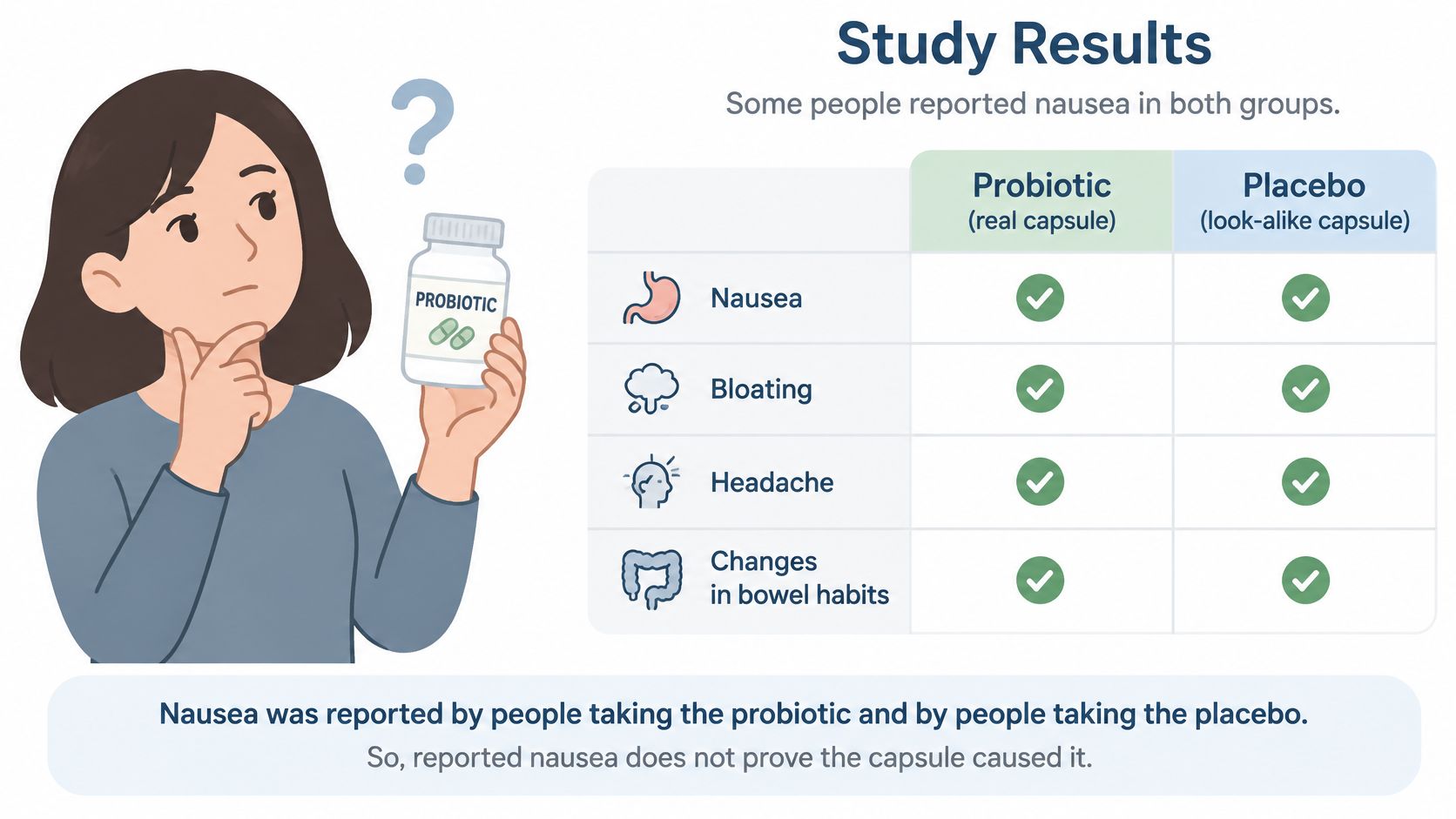
A placebo group helps account for everyday changes participants experience during the same period. People eat unfamiliar meals, sleep poorly, feel stressed, and take other medicines regardless of which study capsule they receive.
Timing creates a clue, not a diagnosis
Say you start a probiotic and a fiber powder together, then feel nauseated after several days. You have a timeline, but you haven't isolated a cause. Either product, the combination, or an unrelated trigger could explain the symptom.
The reading rule is simple: compare the difference between groups, not just the number of people who felt sick. A study without a control group can't reliably separate the product's effect from background symptoms.
A symptom diary can identify a pattern. It can't prove causation or rule out illness.
If nausea repeatedly appears after taking the product and eases when you pause it, the product becomes a more plausible trigger. If nausea continues regardless, consider other causes and contact a clinician when it persists. Don't deliberately restart a product after a severe reaction just to test the connection.
Common Reasons Nausea Starts After a New Probiotic
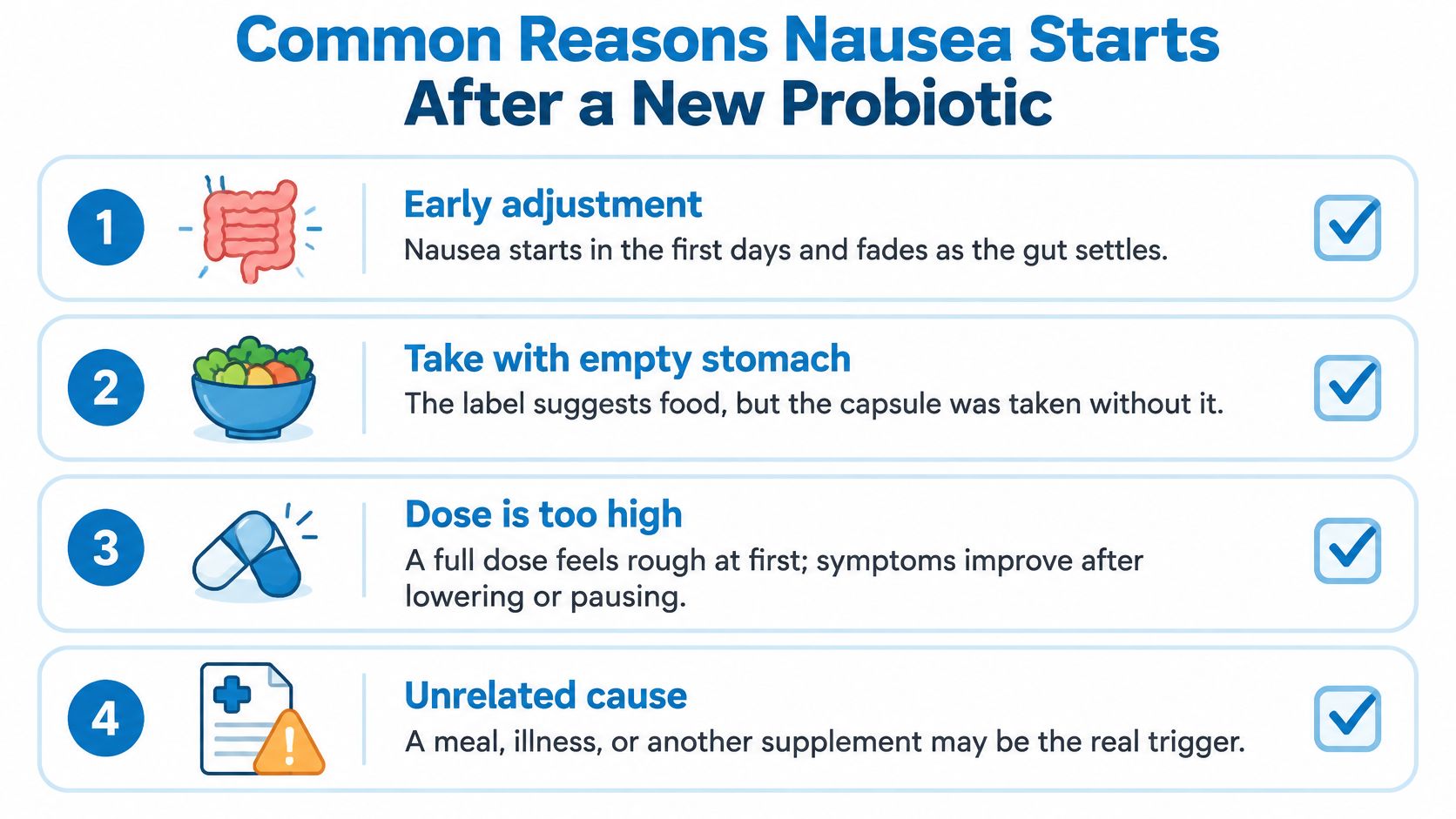
The relevant question isn't only which bacteria are inside the capsule. Dose, added ingredients, and what else changed in your routine can influence how you feel.
A systematic review of probiotic trials describes generally tolerated gastrointestinal adverse events and supports evaluating formulation-specific symptoms rather than assuming all probiotics behave alike. These possibilities are clues to investigate, not diagnoses:
- Early adjustment: Queasiness begins soon after starting and gradually settles. A transient response is possible, but worsening symptoms shouldn't be dismissed as adaptation.
- Prebiotic fermentation: Added fermentable ingredients may accompany gas, fullness, and nausea, especially when you've also introduced a fiber powder.
- Strain and dose: A different strain combination or serving size may feel different. A higher CFU count isn't automatically better for a sensitive stomach.
- Capsule ingredients: Flavors, coatings, and other inactive ingredients are worth reviewing when comparing products. Don't assume the probiotic organisms are the only possible trigger.
- Stacking supplements: Several new products create an unclear pattern. Record every addition, including powders and gummies.
- Empty-stomach timing: Queasiness after a capsule taken without food is worth noting, particularly when its directions specify a meal.
- Unrelated triggers: A heavy meal, stress, a medicine, or an illness can coincide with starting a supplement.
If fullness and wind are the dominant symptoms, our explanation of why probiotics can make you gassy helps distinguish that pattern from nausea alone.
Your medical history and other medicines also matter. Someone else's comfortable experience with a formula doesn't predict your tolerance, and their unpleasant experience doesn't establish that you'll have the same reaction.
How to Start a Probiotic and Track Any Nausea
Make the routine simple enough to interpret. Changing the capsule, meal timing, fiber intake, and serving size together makes it difficult to decide what helped or hurt.
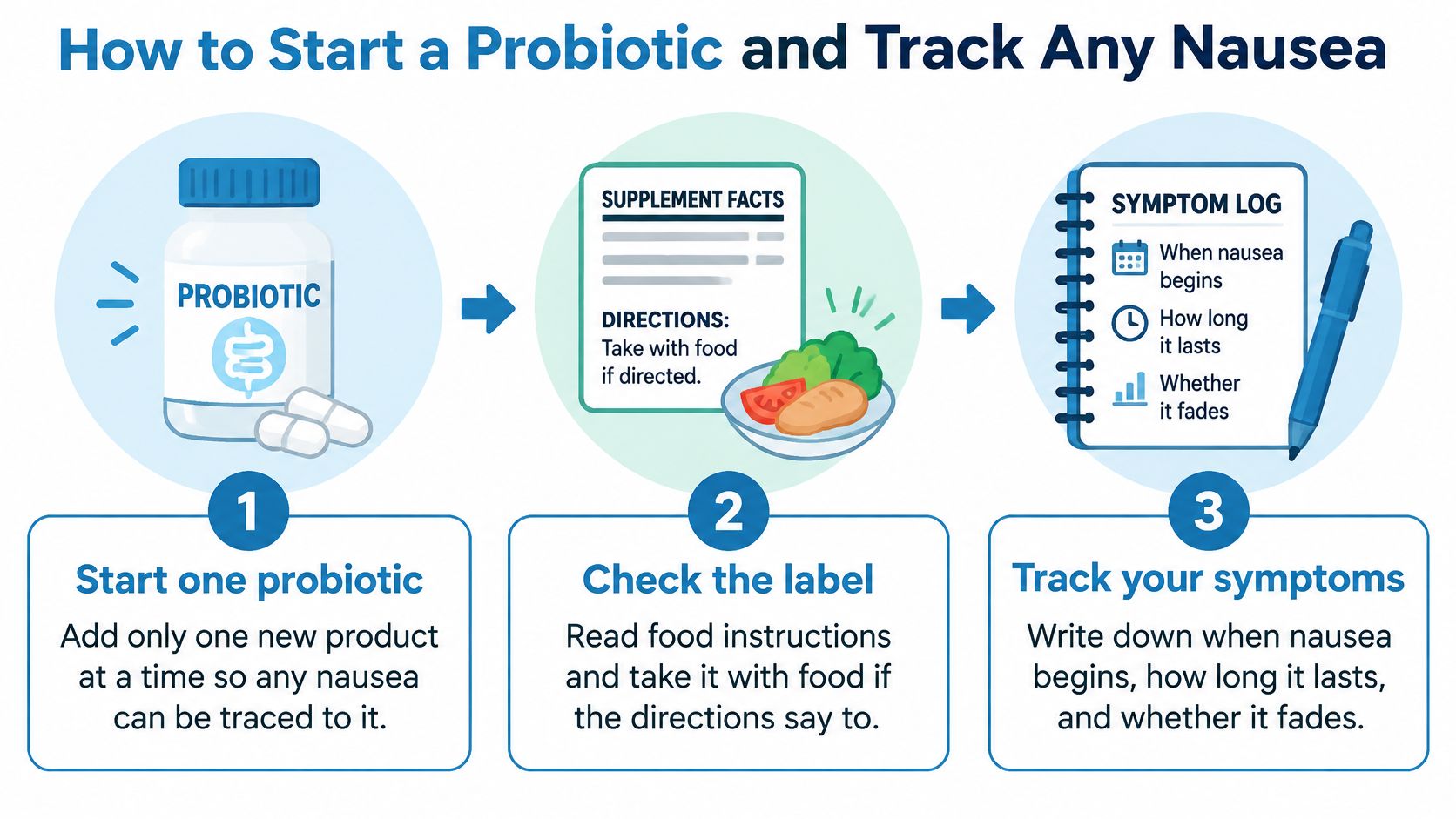
- Introduce one product. Keep other new supplements out of the trial so you can identify a plausible trigger.
- Read the food directions. Take it with food when the label permits, particularly if an empty-stomach dose feels uncomfortable. Don't override product-specific instructions.
- Keep the routine consistent. Use the labeled dose at a repeatable time. Don't alternate between missed servings and extra capsules.
- Keep a short daily log. Record the date and dose time; meals and other supplements; then nausea severity, onset, and duration. Use descriptions such as none, mild, moderate, or severe.
- Hold other habits steady. Avoid adding fiber powder or making a major dietary change during your initial assessment. Maintain your usual fluid intake.
- Reassess mild symptoms rather than pushing through. If queasiness is brief and clearly improving, cautious observation may be reasonable. Continuing is optional, not a requirement for benefit.
- Pause for a recurring or worsening pattern. Don't keep taking a supplement because someone called the reaction normal.
- Store it correctly. Follow refrigeration and handling instructions, including directions that apply after opening.
How long should you observe mild nausea?
A randomized placebo-controlled trial documented nausea during probiotic use, while trial evidence also describes mild initiation symptoms that eased with continued use. That doesn't establish a universal onset window or a fixed deadline for adaptation.
I would review a mild, improving reaction after about a week rather than committing to a prolonged trial. That's a practical checkpoint, not a proven biological adjustment period. Pause earlier if symptoms recur after every dose, interfere with eating, or become more intense.
For scheduling considerations, Feed Mom & Me discusses morning or night for probiotics. Consistency and the label matter more for this assessment than finding a supposedly perfect hour.
Our guide to how to know if probiotics are working can help you track the intended goal separately. Nausea itself isn't evidence of benefit.
When Nausea Means Stop and Call a Clinician
Mild, fading queasiness is different from persistent nausea or nausea with warning signs. You don't need to finish a bottle before deciding a product isn't tolerable.
Nausea patterns and the right response
| Symptom pattern | What it may indicate | What to do |
|---|---|---|
| Mild nausea in the first few days that fades | Possible early gut adjustment | If you choose to continue, keep the log and routine steady |
| Nausea after each dose that doesn't improve within about a week | Product, dose, or stacking mismatch | Pause use and ask a pharmacist or clinician |
| Nausea with vomiting, fever, or dehydration | Possible illness that needs evaluation | Stop use and seek medical care |
| Nausea with blood in the stool or unexplained weight loss | A problem that needs diagnosis | Stop use and see a doctor promptly |
| Nausea while taking prescription medicines or managing a medical condition | Interaction or tolerability question | Ask a clinician before starting or continuing |
The week-long checkpoint is a conservative recommendation, not a trial-established safety threshold. Don't wait for it when symptoms are severe or progressive.
Who should get advice before continuing?
A review of probiotic safety distinguishes minor gastrointestinal complaints from the additional safety considerations relevant to medically vulnerable people. If you're immunocompromised, medically complex, or taking prescription medicines, have a clinician review your situation before continuing.
A pharmacist can review your full supplement and medicine list, including inactive ingredients and duplicate products. Bring the bottles or clear label photographs rather than relying on names alone.
A supplement isn't a diagnostic tool. Persistent nausea deserves an explanation, not another formula.
If you can't keep fluids down, feel faint, or have severe pain, seek urgent medical assessment. Otherwise, stop and contact a clinician when nausea persists beyond your initial reassessment or repeatedly follows dosing.
Pick One Formula and Give It a Clear Trial
Match the formula to your digestive goal rather than shopping for the highest potency number. Fewer ingredients may simplify troubleshooting, but fewer strains or a lower CFU count doesn't guarantee better tolerance. A multi-ingredient formula also makes it harder to identify which component contributed to discomfort.
For occasional digestive concerns, these options differ in their intended use and composition.
GutRx formulas for a one-at-a-time trial
| Formula | Potency and strains | Key ingredients | Best fit |
|---|---|---|---|
| GutRx DAILY | 61 billion CFU, 10 strains | Prebiotic blend of acacia, apple, raspberry, and black currant | Supports regularity and an everyday routine; one capsule daily |
| GutRx BALANCE | 30 billion CFU per capsule, featuring next-generation strains | Akkermansia muciniphila and Christensenella minuta | Supports microbiome balance and occasional bloating |
| GutRx COMPLETE | 78 billion CFU | Prebiotics and postbiotics | All-in-one synbiotic for readers who have established tolerance |
The daily-routine option combines probiotics and prebiotics, while the balance-focused option has the lowest CFU count per capsule among these choices. The all-in-one option adds postbiotic support, which can be useful when you already know the broader formula suits you. During troubleshooting, a simpler starting point makes the symptom log easier to interpret.
None of these formulas is guaranteed to be tolerable, and none is being recommended to prevent nausea. GutRx probiotic, fiber and collagen formulas should be refrigerated after opening, while Mealtime, Bloat+Gas, MAG+ and Hangover are shelf stable.
These statements have not been evaluated by the FDA. These products are not intended to diagnose, treat, cure, or prevent any disease.
Match the purchase to the goal
If your concern is infrequent bowel movements, Vitamin Planet's probiotics for constipation relief offers related educational reading. Persistent bowel changes need clinical assessment rather than repeated supplement switching.
For planning continued use, our guide to how long to take probiotics discusses evaluating a routine over time. Don't use a longer trial as a reason to ignore intolerance. Keep the chosen formula steady, record timing and symptoms, and change one variable at a time.
Frequently asked questions
Does nausea mean the probiotic is working?
No. Judge usefulness by your intended digestive goal and your symptom log, since nausea also appears in placebo groups and can come from timing or another trigger.
Should I buy a stronger formula if the first one feels uncomfortable?
No. Increasing potency or adding formulas makes the cause harder to identify.
Can I open the capsule or split the dose?
Ask a pharmacist and check the product directions first. Don't alter an enteric-coated capsule on your own.
Start with one clearly defined choice and let your symptom log guide the decision. If nausea persists or follows each dose, pause rather than escalating. If you take prescription medicines or manage a medical condition, ask a clinician before starting.
GutRx offers probiotic and synbiotic formulas for different everyday digestive goals, with ingredient and serving information to help you compare options. Visit GutRx to review a formula that matches your routine, and choose one product at a time rather than using greater potency to push through nausea.


