

Gas after starting probiotics is common, usually mild, and often fades within 1 to 2 weeks, but it isn't proof the product is working. You don't need to push through worsening symptoms to get a benefit.
The popular explanation that you're experiencing detox skips the more useful questions: Did you add live microbes, fermentable fiber, or both? Is the discomfort tied to the capsule, constipation, or particular meals? Those distinctions help you decide whether to continue briefly, change the formula, or stop shopping and get medical advice.
Table of Contents
- What Probiotic Gas Usually Means
- Why Probiotics Cause Gas and Which Formulas Raise the Risk
- How Your Symptom Pattern Changes the Plan
- How to Reduce Probiotic Gas This Week
- When to Stop and Call a Clinician
- Pick the Next Formula for a Short Trial
What Probiotic Gas Usually Means
Probiotic gas patterns and what to do
| Pattern | What it often means | What to do |
|---|---|---|
| First 1 to 7 days, mild gas | A possible short fermentation shift as the gut adapts | Keep the dose steady, log symptoms, and watch for improvement rather than escalating |
| Gas rises with inulin, FOS, or a synbiotic | Prebiotic fiber may be fermenting independently of the cultures | Pause separate added fiber and consider a probiotic without a prebiotic |
| Still worsening after 14 days | A poor fit for a simple adjustment explanation | Stop the product and reassess strain, dose, and symptoms |
| Gas with constipation | Slow transit may contribute alongside fermentation | Don't automatically add more fermentable fiber; address fluids and regularity |
| Gas mainly after dairy or high-FODMAP meals | Food breakdown may matter more than the probiotic | Keep the diet stable and consider food-specific digestive support |
| Fever, blood, vomiting, weight loss, or severe pain | Not a side effect to monitor at home | Stop and contact a clinician |
These are practical troubleshooting patterns, not diagnostic cutoffs. Early symptoms alone can't identify which organism or ingredient caused them.
In a 2024 randomized crossover trial, bloating occurred in 27.03% of participants in one supplement group and 53.33% in the comparison group, while gas occurred in 32.43% and 33.33%, respectively; most symptoms resolved without intervention within 1–2 weeks. Those are results from particular study groups, not your personal probability of reacting to any probiotic.
Pay attention to direction, not just timing
Mild gas that's becoming less noticeable is different from discomfort that increases after every dose. A temporary fermentation change is plausible in the first situation; the second deserves reassessment rather than reassurance.
Your baseline matters, too. Someone who already has constipation and abdominal pressure has a different starting point from someone whose digestion was comfortable before adding a supplement. Write down what changed instead of assuming every symptom came from the new bacteria.
Practical rule: A tolerable adjustment should move toward your usual comfort level, not require you to accept steadily worsening symptoms.
Gas and bloating also aren't interchangeable. You might pass more gas without feeling swollen, or feel pressure without much additional flatulence. Track both so you don't overlook an improvement in one symptom while another gets worse.
Pick the table row that most closely matches your experience before choosing another product. For shopping, start with the probiotic for digestive balance category; useful companion reading includes How to Choose a Probiotic and Probiotics for Bloating, with the exact formula label beside you.
Why Probiotics Cause Gas and Which Formulas Raise the Risk
Think of a bakery bench already piled with dough. Adding workers can create more bubbles before the pile gets smaller. Adding more dough at the same time makes it harder to tell whether the workers or the extra ingredients caused the change.
That's a useful analogy for a probiotic combined with fermentable fiber, although your digestive tract is more complex than a bakery. The live organisms and the ingredients that feed microbes are separate variables.
The illustration below separates those contributors.
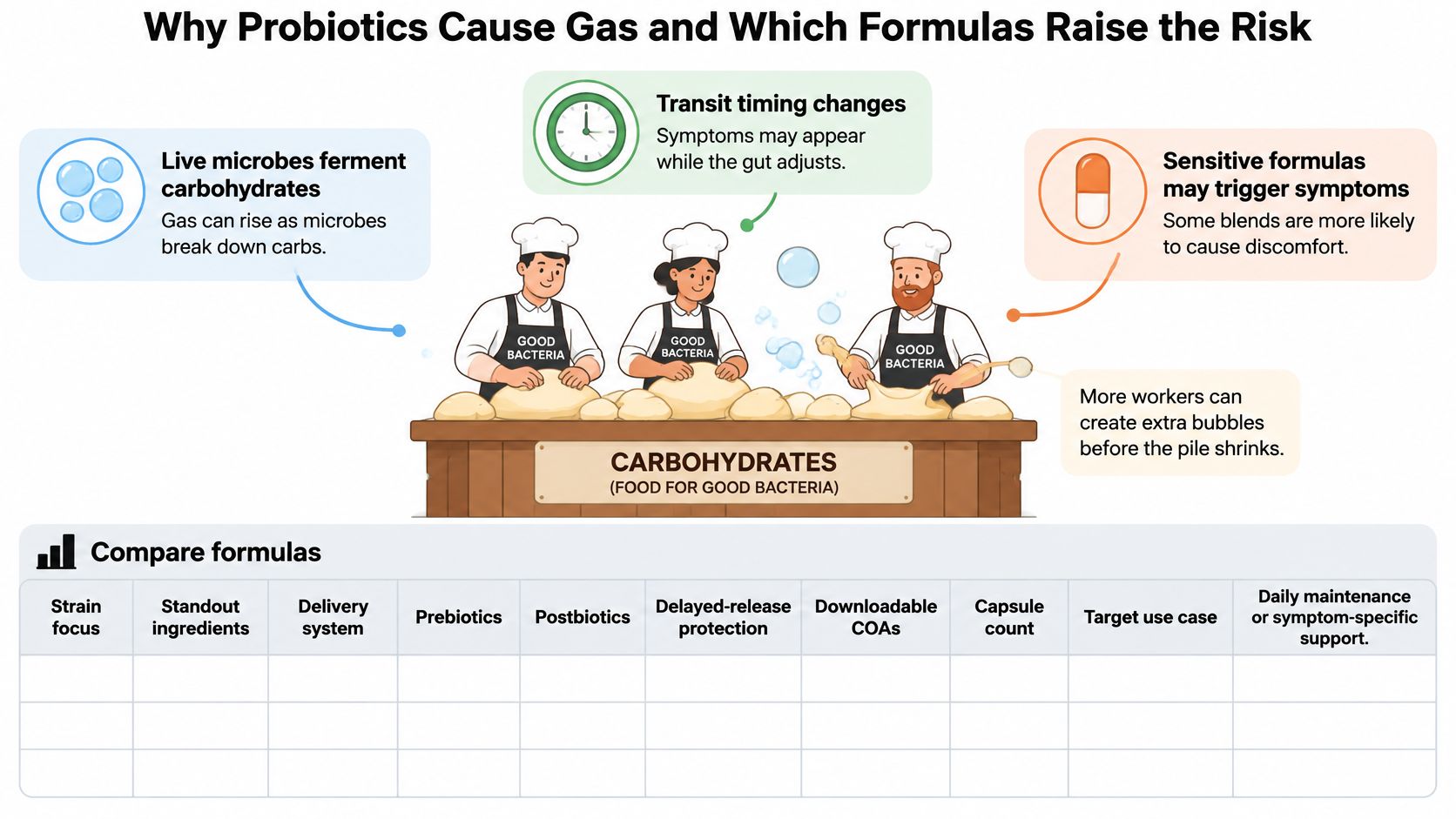
Three reasons a new formula can feel different
Live microbes can change carbohydrate fermentation. Microbial breakdown of carbohydrates produces gases, including hydrogen and carbon dioxide, with methane production involving other members of the gut community. Introducing a probiotic can change that activity, but symptoms don't tell you exactly which microbes are responsible.
Fermentable add-ins create another explanation. Inulin and fructooligosaccharides, often abbreviated FOS, supply material that gut microbes can ferment. Sugar alcohols in other supplements or sugar-free foods may add to digestive discomfort, making a capsule seem responsible for a broader change in intake.
Dose changes make tolerance harder to judge. Starting with a concentrated blend while also increasing fiber changes several things at once. If you develop pressure or flatulence soon afterward, timing establishes an association, not proof that the product is improving your microbiome.
The NIH Office of Dietary Supplements professional fact sheet describes improvements in flatulence or abdominal distension with some products containing Bifidobacterium breve, Bifidobacterium infantis, Lactobacillus casei, or Lactobacillus plantarum, but notes that study quality was low. These species names are useful starting points, not interchangeable guarantees: a specific strain and formulation matter.
Compare ingredients before comparing potency
Formula features and gas tolerance
| Label feature | Typical gas pattern | Better fit |
|---|---|---|
| Inulin or FOS on the label | May increase early gas, especially during dose escalation | Someone who already tolerates the fiber and can introduce it cautiously |
| B. breve, B. infantis, L. casei, or L. plantarum | Some studies report less flatulence or distension; evidence quality is low | A bloating-focused short trial, not a guaranteed result |
| Very high-CFU multi-strain blend | Not proven gentler for IBS or carbohydrate sensitivity | Consider only when the formulation and dose have a clear purpose |
| Probiotic without added prebiotic | Removes added fermentable fiber as a competing explanation | A simpler next trial after a gassy synbiotic |
| Digestive enzymes with meals | No added live microbes; activity is specific to the enzymes included | Meal-linked symptoms when the enzyme matches the problem food |
| Delayed-release capsule | Changes release location but doesn't eliminate fermentation | A delivery preference, not an established treatment for early gas |
CFU means colony-forming units, a measure of viable microorganisms. It doesn't measure how comfortable you'll feel, how well a product matches your symptoms, or whether more organisms will help.
Likewise, delayed-release protection doesn't make a poorly tolerated ingredient disappear. An enteric-coated probiotic may change where organisms are released, but it shouldn't be sold as a reliable solution for gas immediately after a standard capsule.
For the distinction between organisms and their accompanying ingredients, the guide to taking prebiotics and probiotics together can help you read a synbiotic label more deliberately.
Gas isn't a benefit marker
Calling discomfort detox, die-off, or a Herxheimer reaction gives ordinary digestive symptoms a meaning they haven't earned. Gas alone doesn't establish any of those explanations. Nor does it demonstrate microbiome repair.
The NIH overview of probiotic evidence describes strain-specific outcomes and low-quality evidence in pooled IBS studies, which supports a limited trial rather than indefinite dose escalation. Meanwhile, a placebo-controlled meta-analysis of 14 trials found no statistically significant overall difference in flatulence, while four studies involving 253 participants found improvement in bloating.
Those findings explain why both experiences can be real: one person feels gassier after starting a product, while another gets relief. They don't establish that all probiotics cause gas or that any particular bottle will reduce it.
A quality certificate can help establish what's in a capsule. It can't establish how your gut will feel after taking it.
When comparing a third-party tested probiotic, read what the downloadable Certificate of Analysis covers. Identity, potency, and contaminant testing are different from a clinical trial demonstrating symptom relief.
If discomfort is mainly meal-related, The Patients Guide's practical guidance for digestive discomfort offers additional context for thinking beyond the supplement itself. Persistent pain still needs assessment rather than a succession of ingredient experiments.
How Your Symptom Pattern Changes the Plan
Name the pattern before changing the product.
The thought "probiotics make me gassy" may describe a genuine reaction, but it doesn't say whether constipation, food intolerance, or an existing digestive disorder also contributed. Those are different problems with different fixes, and treating them as one reaction is how people end up cycling through bottles without learning anything.
A clinical review in the British Columbia Medical Journal describes possible improvement in global symptoms, pain, and bloating in IBS with diarrhea, less encouraging results in IBS with constipation, and recommends ending a short trial that produces no clinical response. Two lessons follow: match the trial to your bowel pattern, and set a stop point instead of escalating indefinitely.
Match the context to a next move
Symptom context and the next move
| Context | What the evidence shows | Next move |
|---|---|---|
| IBS with diarrhea | Reviews describe this as the more responsive IBS pattern | Consider a short single-formula trial if gas stays mild |
| IBS with constipation | Reviews describe less encouraging results for this pattern | Avoid reflexively adding fermentable fiber; address regularity and hydration |
| Gas after dairy, beans, or heavy meals | Lactose maldigestion or fermentable carbohydrate load is a possible driver | Try a simpler meal or an appropriately matched enzyme before a stronger probiotic |
| Functional bloating | A symptom pattern without a guaranteed strain match; results for individual products vary | Log a baseline and allow for natural symptom fluctuation |
| No diagnosis, new or worsening symptoms | No basis to assume normal probiotic adjustment | Get clinical evaluation before buying a stronger formula |
Functional bloating describes a symptom pattern, and improvement after starting a bottle can reflect a product effect, ordinary symptom variation, changes in eating, or expectations. A flat response to one formula doesn't settle the question for every product either; it settles it for that formula, at that dose, in that context.
Strain findings can mislead in a subtler way. Averages for a product, including results reported for Bacillus subtilis, can look flat overall while a subgroup improves on one measure. That doesn't justify picking a women's formula on the strength of a subgroup result alone.
Food-specific symptoms need food-specific reasoning
Say milk repeatedly causes discomfort, but the same probiotic taken with a dairy-free breakfast doesn't. That pattern makes lactose digestion worth discussing. It doesn't confirm a diagnosis, and it tells you more than capsule potency does.
Lactase targets lactose. It won't address every fermentable carbohydrate, and a product marketed for FODMAP digestion shouldn't be assumed to cover onion, garlic, beans, and dairy equally well. Check the actual enzyme activities and the foods listed for each.
Constipation needs similar precision. The advice to avoid extra fermentable add-ins is not a recommendation to eliminate all dietary fiber indefinitely; a clinician can help identify a tolerable regularity strategy.
Extra digestive activity early on is not proof the product is working, and it isn't a detox signal. It is something to log. Use how to know if probiotics are working to distinguish meaningful changes in your target symptom from noticing more digestive activity.
How to Reduce Probiotic Gas This Week
Run one controlled tolerability trial, not a stack of new supplements. This is a practical observation plan for a generally healthy adult with mild symptoms, not a validated treatment protocol or a reason to delay medical care.
The visual summarizes the setup before the detailed steps.
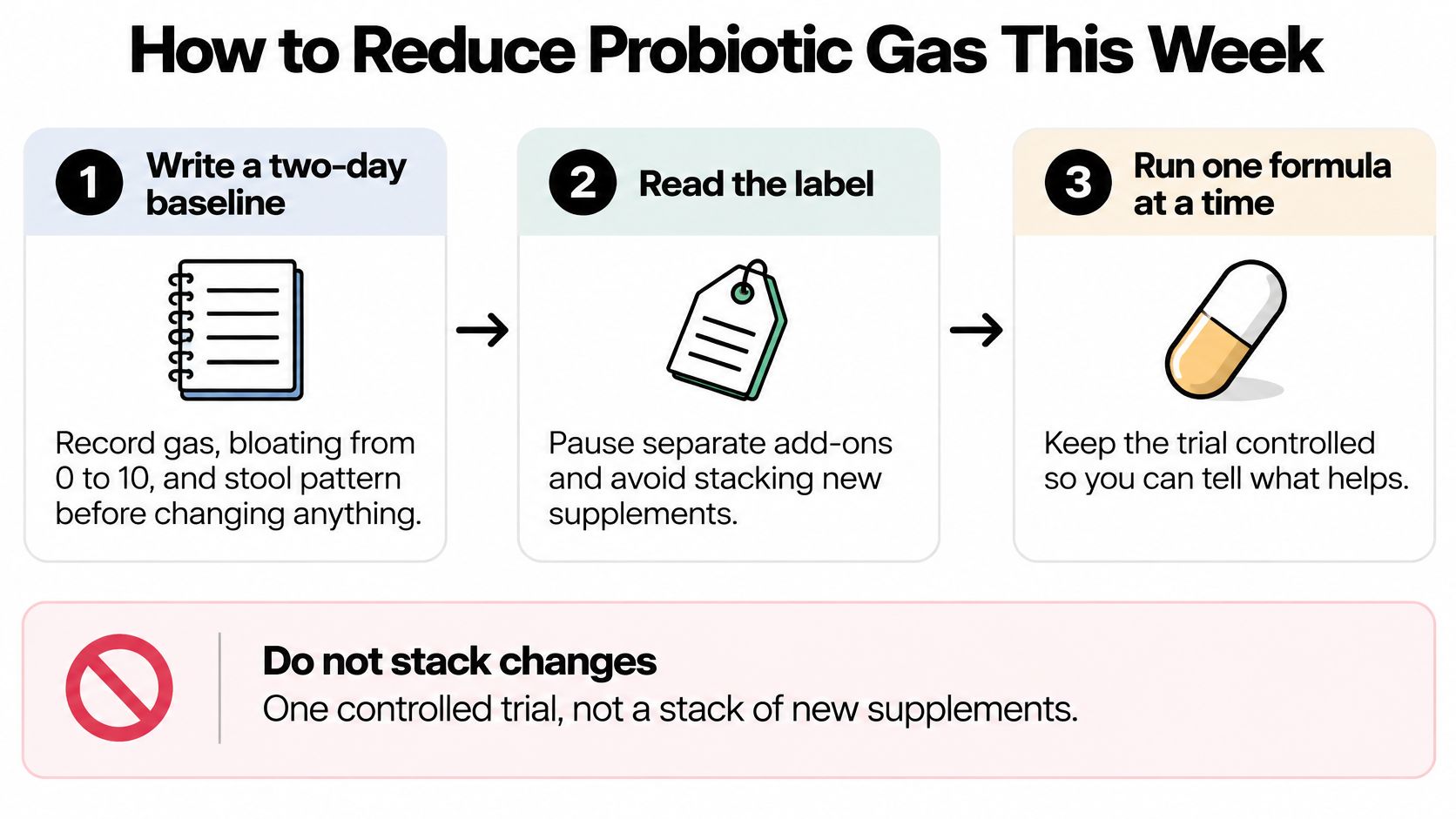
Keep the trial interpretable
-
Write a two-day baseline. Record gas, bloating on a 0-to-10 personal scale, and stool pattern before another change. These are tracking choices, not medical thresholds; the common mistake is comparing today with an unreliable memory of last week.
-
Read the whole label. Identify inulin, FOS, prebiotic blends, and sugar alcohols. Pause nonessential separate fiber add-ons or sugar-free candies rather than changing your entire diet, and don't stop prescribed treatment without advice.
-
Discuss a smaller dose if symptoms are uncomfortable. A pharmacist can help determine whether a lower-strength product or every-other-day schedule is appropriate. Don't assume you can split a capsule, especially an enteric-coated or delayed-release one; if symptoms are worsening, stop rather than trying to dose through them.
-
Choose a consistent meal context. Follow the product's directions about food, and use a small, familiar meal when permitted. Taking the capsule with an unusually large dinner makes it harder to separate the supplement from the meal.
-
Change only one variable. Don't introduce another probiotic, an enzyme, and a restrictive diet together. Otherwise, even improvement won't tell you which change helped.
-
Keep a daily log through day 14. Note the dose, meal timing, gas score, bloating, and stool form. Treat this as a preset review date, not permission to tolerate increasing pain.
-
Classify the result as better, unchanged, or worse. Stop that day if symptoms worsen; stop an unchanged trial instead of raising the CFU count. If you're improving, reassess the target symptom at week four before deciding the formula deserves a continuing place in your routine.
Decide what counts as benefit
Choose an outcome that matters: less abdominal pressure, more comfortable bowel movements, or fewer urgent episodes. More bowel noise isn't an outcome, and a single comfortable afternoon isn't enough to establish a consistent change.
The National Center for Complementary and Integrative Health IBS overview describes a review of 35 studies involving 3,452 people in which four weeks of probiotic use may help pain, bloating, and gas, while emphasizing substantial variation between products. That's context for reassessment, not a promise that everyone should continue.
This video provides another format for reviewing the topic.
People who are immunocompromised or seriously ill shouldn't use this home-trial approach without their clinician's involvement.
When to Stop and Call a Clinician
New gas alone does not show that a probiotic is working or that your body is “detoxing.” Use the symptom pattern to decide what to do: mild, stable gas can be monitored, while severe or worsening symptoms call for medical advice.
Seek same-day medical advice for fever, severe or worsening abdominal pain, vomiting, blood in the stool, black stool, dehydration, or unexplained weight loss. New digestive symptoms alongside known anemia also need assessment.
Severe pain, fainting, substantial bleeding, or inability to keep fluids down can require urgent or emergency care. A different brand cannot address these warning signs.
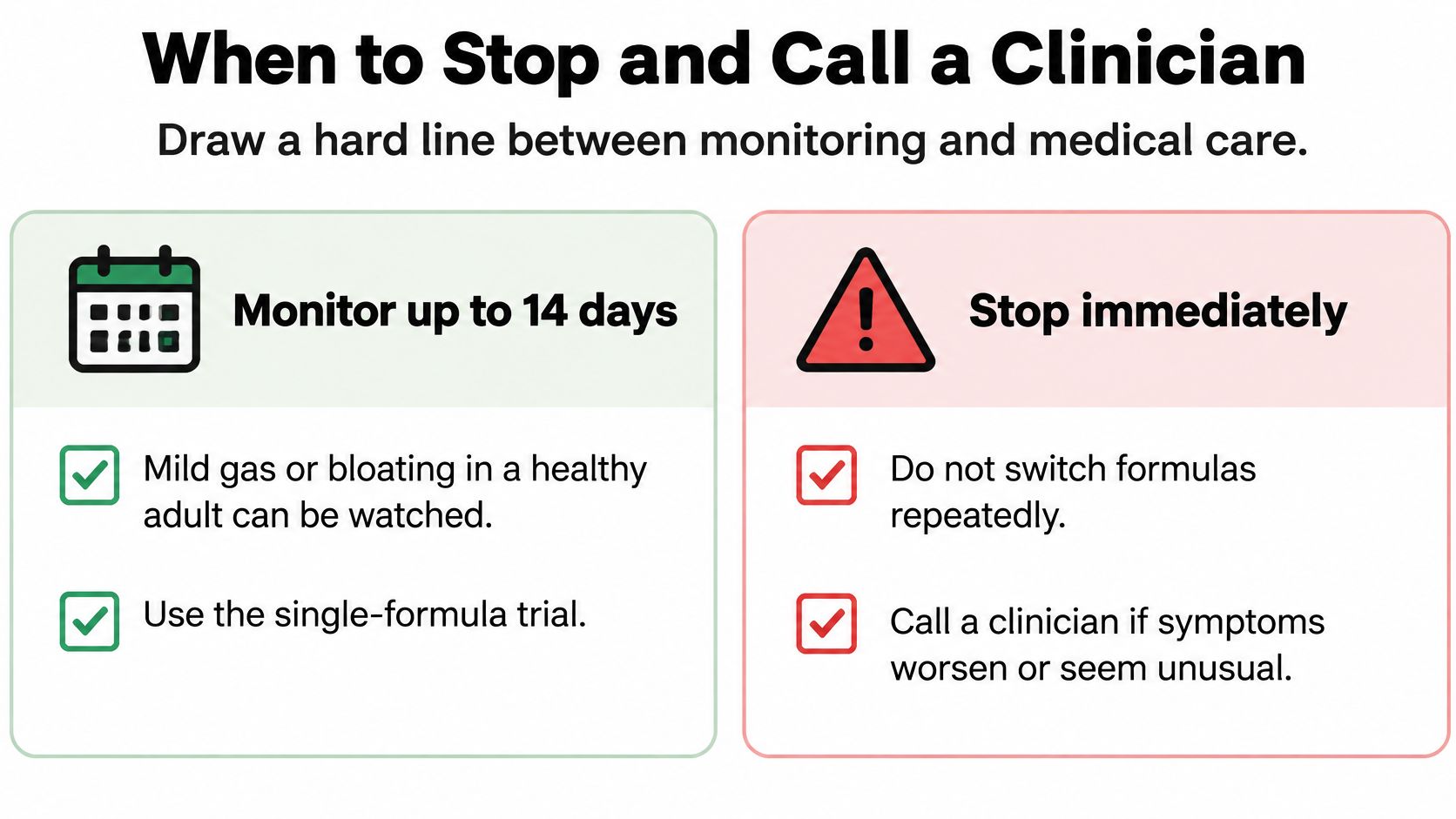
Who shouldn't self-experiment
The NCCIH probiotic safety overview notes that probiotics have a long history of apparently safe use, especially in healthy people, while information about long-term safety and the frequency of side effects remains limited. Reported harms include infections, production of harmful substances, and transfer of antibiotic-resistance genes. People who are seriously ill or immunocompromised may face greater risk.
Ask your treating clinician before starting or restarting a probiotic if you are immunocompromised, seriously ill, hospitalized, have a central line, or are critically ill. A lower dose or different capsule does not replace individualized advice.
Bring information that helps
Take the bottle or a clear photo of its full label to your appointment. Note when you started, any dose changes, other supplements, stool changes, and whether symptoms follow meals or occur independently. This timeline can help your clinician consider causes beyond the supplement.
If symptoms worsen after a dose increase, stop taking the probiotic and contact your clinician or pharmacist. Use a defined review date for mild symptoms rather than continuing indefinitely.
Pick the Next Formula for a Short Trial
Choose the next step by the problem you're trying to solve, not by the most impressive-looking bottle. A supplement that adds more ingredients may be less useful than a simpler formula when you're trying to identify intolerance.
If you're early in a mild, improving reaction, finish your symptom log before switching. If gas rose sharply after introducing inulin, FOS, or a prebiotic blend, look for a probiotic without added fermentable fiber, rather than a higher-potency version of the same combination.
Choose by use case
- Capsule-linked gas with added fiber: Compare simpler ingredient lists and clearly identified strains. Confirm the full label is prebiotic-free before choosing it.
- Meal-linked discomfort: Consider food-specific digestion support rather than another live-microbe blend. An enzyme needs to match the food component you have difficulty digesting.
- Ongoing digestive-balance goals: Choose a formula whose intended use matches your symptoms, while keeping the stop rule from step seven.
- Interest in broader synbiotic support: Consider that route only after you know how you tolerate the simpler components. An all-in-one product makes troubleshooting less precise.
For a digestive-balance option, GutRx BALANCE is a next-generation probiotic formula aimed at calming inflammation and supporting barrier strength, listed at $14.99 and currently in stock. That description doesn't establish that it will relieve your gas or that it's the right choice after a reaction; check the complete ingredient label against your log.
Compare proof with the question it answers
When shopping on Amazon or a brand website, distinguish manufacturing evidence from symptom evidence. A downloadable COA, clear strain identity, and transparent storage instructions help you assess product quality; they don't substitute for evidence that the exact formula may support your specific outcome.
The guide to high-CFU probiotics can help you evaluate potency without treating it as a ranking system. Give your tolerability and observed benefit more weight than the count on the label.
Your next purchase should answer a narrower question than your last one: Can you tolerate this formula, and does your target symptom improve? If you can't answer both, continuing indefinitely isn't a useful experiment.
Before you reorder, pick the single variable you'll test next and compare the full ingredient list on the GutRx product pages against your symptom log.


