

For most healthy adults, there's no established probiotic overdose threshold, and taking extra usually causes temporary gas, bloating or loose stools rather than poisoning. Serious risk is concentrated in medically vulnerable people, so your health and symptoms matter more than the biggest number on the bottle.
That distinction matters when you've accidentally taken an extra capsule. A dose mistake isn't automatically an emergency, but assuming every new symptom is harmless adjustment can also be a mistake.
Table of Contents
- The Short Answer on Probiotic Overdose
- Symptoms After Extra Doses and What to Do
- Safety Studies on Higher Doses
- Why CFU Numbers Do Not Tell the Whole Story
- Who Should Not Self-Dose
- Reading Labels and Dosing Safely
The Short Answer on Probiotic Overdose
You can take more probiotics than you comfortably tolerate without experiencing a classic toxic overdose. Probiotics are live microorganisms, not a single chemical with one predictable toxic dose. The useful question is less about finding a universal capsule limit and more about identifying the product, the person taking it and any symptoms that follow.
For a healthy adult, extra intake most often means digestive discomfort. However, the National Center for Complementary and Integrative Health's safety guidance explains that safety information is incomplete and that serious adverse effects are more likely in people with severe illness or compromised immune systems.
For a healthy adult, the realistic risk of extra probiotics is an uncomfortable gut, not a toxic overdose.
No Threshold Doesn't Mean No Limit
The absence of a defined overdose threshold doesn't prove unlimited quantities are safe. Rare serious complications are documented, particularly in hospitalized or immunocompromised people.
If you're trying to answer “can you overdose probiotics” after a mistake, start with these questions:
- What did you take? Keep the container and identify every supplement involved, including combination products.
- How do you feel? Mild gas requires a different response from fever, breathing difficulty or worsening illness.
- Do you have medical risk factors? A central line, severe immune compromise or recent intestinal surgery changes the advice.
Don't use someone else's comfortable dose as your personal safety limit. Even products with similar counts can contain different organisms and additional ingredients.
Symptoms After Extra Doses and What to Do
| Symptom | What It Usually Means | What to Do |
|---|---|---|
| Mild gas or bloating in the first few days | Common digestive response, usually temporary | Return to the labeled dose and reassess |
| Loose stools for one to two days | Transient gastrointestinal effect | Stop added products and use one product at the label dose |
| Diarrhea beyond a few days | Persistent digestive change | Contact a clinician |
| Signs of dehydration such as dizziness or low urine output | Possible fluid loss from ongoing diarrhea | Contact a clinician promptly |
| Fever or chills | Not an ordinary digestive effect | Seek medical care the same day |
| Confusion, shortness of breath or blood in the stool | Possible serious illness or reaction | Seek urgent medical care now |
These are action guides, not diagnostic rules or guaranteed recovery times. Don't wait for a time window to pass if symptoms are severe, you can't keep fluids down or you're becoming increasingly unwell.
The NIH Office of Dietary Supplements' probiotic fact sheet describes generally minor gastrointestinal effects in healthy people while emphasizing that safety depends on the organism, the person and the circumstances of use. Symptoms after a dose increase don't establish poisoning, and their timing alone doesn't prove the supplement caused them.
What an Accidental Double Dose Can Look Like
Say you take two capsules by mistake and have also introduced a second probiotic brand that week. You notice mild gas that evening and a looser stool the next morning, but you have no fever and otherwise feel well.
That hypothetical pattern calls for simplifying your routine, not adding another supplement to counteract it. Take these steps in order:
- Stop the extra products. Set aside the newly added formula and don't take more capsules to try to improve results faster.
- Return to one product at its labeled dose. If symptoms are worsening or concerning, stop the supplement and ask a pharmacist or clinician before restarting.
- Record what happened. Write down product names, serving sizes, the amount swallowed, timing and symptoms. Track whether discomfort is improving or becoming more disruptive.
Bring the containers or clear photographs of their labels when you seek advice. A blend may contain prebiotic fibers or other ingredients alongside the live organisms, so the complete ingredient list matters.
For gas that remains mild, GutRx's guide to why probiotics can make you gassy offers additional context. Don't interpret persistent discomfort as proof that a product is working or that you need to push through it.
Check What Else Changed
If you started a medication, changed your meals or added several supplements at once, tell the clinician reviewing your symptoms. Otherwise, you may attribute everything to the most recent probiotic dose and miss another explanation.
For readers also dealing with appetite changes while taking stimulant medication, Refresh Psychiatry & Therapy's discussion of gut symptoms and stimulant appetite loss provides context for that conversation. Don't change a prescribed medication on your own.
If a child accidentally swallows probiotics, contact a poison control center immediately rather than waiting for symptoms. Give the child's age, the product name, the amount possibly swallowed and the time of ingestion. Call emergency services immediately for breathing difficulty, collapse, confusion or other severe symptoms.
Mild digestive upset can fit an expected response to extra intake. Fever and whole-body symptoms do not belong in that same category, and shouldn't be dismissed as adjustment.
Safety Studies on Higher Doses
The broad safety evidence is reassuring within its limits. An Agency for Healthcare Research and Quality safety assessment found that across 121 randomized trials, the relative risk of having at least one adverse event was 0.98, with a 95% confidence interval of 0.93 to 1.04. Across 208 trials measuring adverse-event counts, the relative risk was 1.00, with a 95% confidence interval of 0.93 to 1.07.
In plain language, participants receiving probiotics didn't have a statistically significant increase in reported adverse events compared with control groups. A relative risk near one means the measured outcomes were similar between groups.
That supports tolerability at the doses and under the conditions studied. It doesn't establish that every formulation, every person or an amount far beyond the label carries the same risk.
What the Trials Can't Tell You
Think of a bridge with a long record of safe crossings under normal loads. That record is useful, but it doesn't tell you what happens under loads far beyond those tested.
The same boundary applies here:
- Studied doses aren't unlimited doses. A trial testing a particular regimen doesn't validate multiplying that regimen.
- Rare harms can escape detection. Uncommon complications may not appear even when many trials are considered together.
- Short-term tolerability isn't lifetime safety. A reassuring treatment period can't answer every question about prolonged use.
The assessment also identified weaknesses in adverse-event reporting and the ability of existing research to evaluate uncommon harms confidently. That uncertainty matters most when someone has medical vulnerabilities that aren't well represented in ordinary supplement trials.
Don't read these findings as evidence that extra capsules deliver extra benefit. Safety and effectiveness are separate questions, and neither can be settled by looking only at the total live-organism count.
No rise in side effects in trials is not a license to go well above the label.
Why CFU Numbers Do Not Tell the Whole Story
Colony-forming units, or CFUs, estimate viable microorganisms capable of growing into colonies under test conditions. They aren't a toxicity score or a universal measure of how well a supplement will work.
Counting CFUs is a little like counting passengers on a bus without knowing its route. The number tells you something about quantity, but not enough about the journey or whether that bus fits your needs.
The NIH Office of Dietary Supplements' professional guidance emphasizes that higher CFU counts don't necessarily produce greater health benefits and that safety evidence remains incomplete.
This visual separates the label count from the other details that matter.

Read Beyond the Headline Number
Before comparing counts, check:
- Strain identity. Look for the organism's full name and strain designation, not just a broad group name.
- Serving size. Confirm whether the stated count applies to a capsule or a complete serving.
- Count timing. Determine whether the manufacturer states the count at manufacture or guarantees it through expiration.
- Quality and storage. Read handling instructions and check the expiry date rather than assuming the printed count remains unchanged.
For a label-reading example, Daily Powers' explanation of what 30 billion CFU really means provides additional context. GutRx's discussion of high-CFU probiotics also addresses the distinction between potency and suitability.
A high-CFU capsule isn't automatically more dangerous for a healthy adult, but it isn't automatically safer or more effective either. Combining several formulas makes the total dose and organism exposure harder to interpret, especially when their ingredients overlap.
Build the habit of reading strain names, the labeled serving and storage instructions before comparing large numbers across bottles. If the label leaves a critical detail unclear, a pharmacist can help you identify what information is missing.
Who Should Not Self-Dose
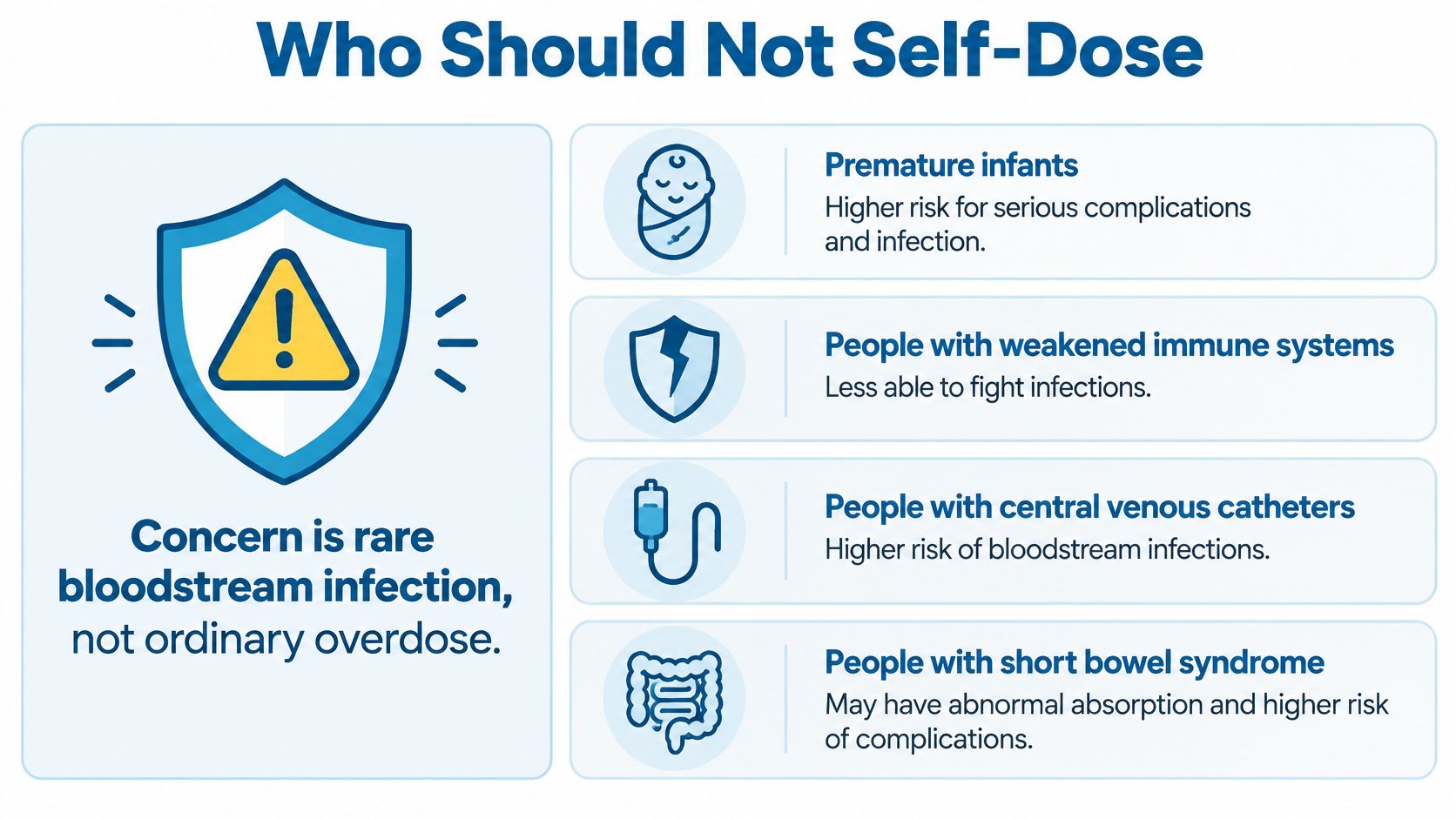
For medically vulnerable people, the concern is rare bloodstream infection, not digestive discomfort from a large count. Live organisms can occasionally reach the bloodstream or other normally sterile sites when normal protective barriers or immune defenses are impaired.
The FDA's safety communication on probiotic use in preterm infants underscores why vulnerable patients need clinician-directed decisions. Groups requiring medical review before starting probiotics or increasing intake include:
- Premature infants, particularly those receiving hospital care.
- People with severely weakened immunity or critical illness.
- Intensive-care patients and people with a central venous catheter.
- People with major intestinal barrier injury or recent gastrointestinal surgery.
Use this visual as a reminder of situations that require medical guidance, not as a self-diagnosis checklist.
What the Serious Reports Actually Describe
In a study of ICU patients with central venous catheters, bloodstream infection occurred in 0.76% of patients receiving powder probiotic formulations versus 0.33% receiving nonpowder formulations, with an odds ratio of 2.03. Infected patients also had higher mortality, with an odds ratio of 2.23 and a 95% confidence interval of 1.30 to 3.71.
Those findings describe a high-risk hospital population. They don't establish the risk from an accidental extra capsule in an otherwise healthy adult, nor do they prove that infection alone caused the difference in mortality.
A systematic review of case reports and case series found that fungemia accounted for 35 cases, or 37.6% of reviewed infectious complications, and that Saccharomyces was the organism most often implicated. These selected reports establish that serious complications can occur, not how often they occur among all probiotic users.
In its October 2023 warning, the FDA reported invasive disease associated with probiotic products in hospitalized premature infants, including one infant death.
For additional discussion of this safety topic, the following video is available.
These serious reports involve medically vulnerable patients, not the typical healthy consumer with mild gas. If you belong to any of these groups, ask your treating clinician before starting a probiotic or changing its dose, even if the intended amount matches the label.
Reading Labels and Dosing Safely
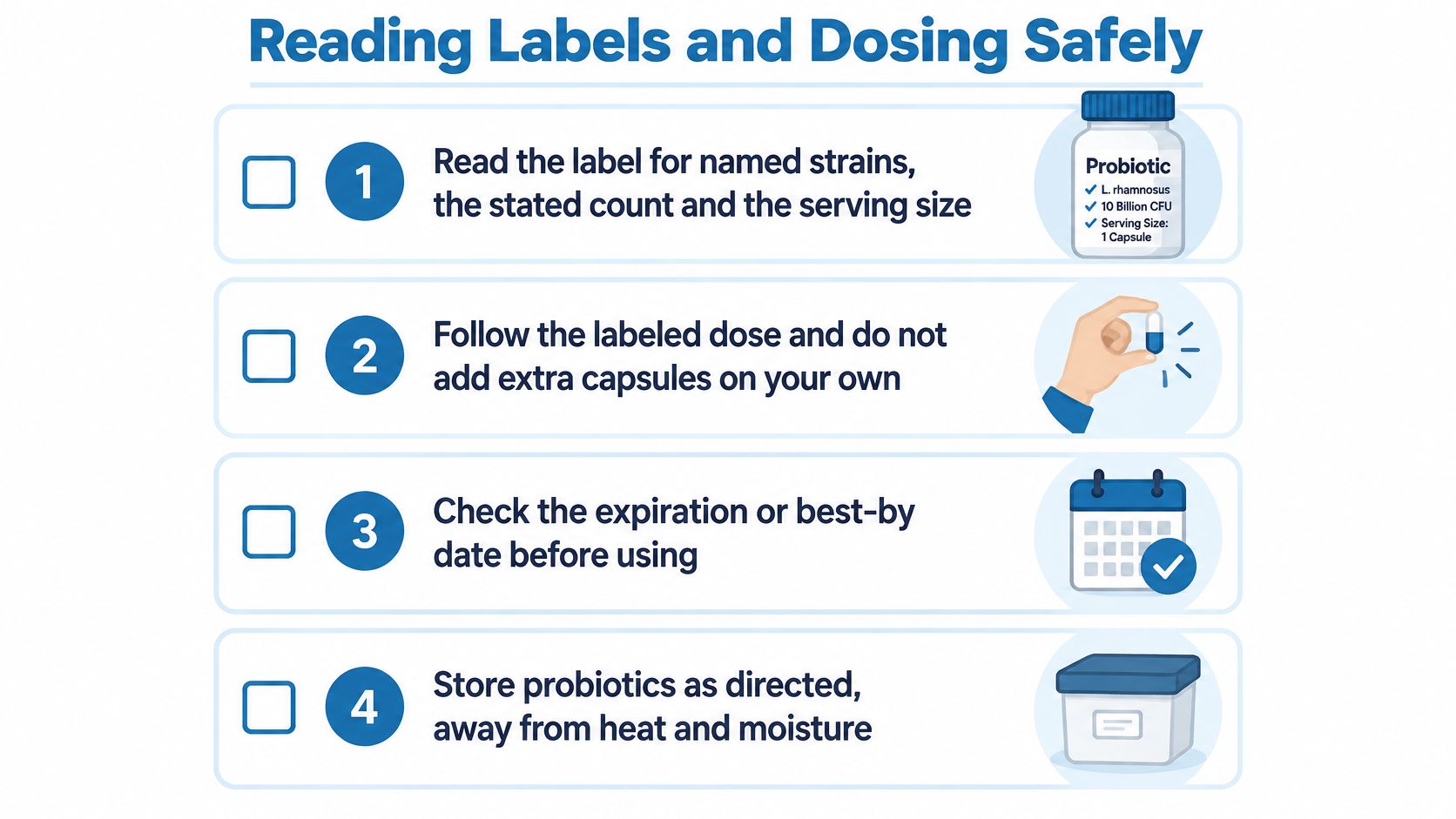
Make your routine easy to understand and easy to review. Keep the original packaging so a pharmacist or clinician can identify exactly what you're taking.
- Read the complete label. Check named strains, the stated count, serving size and additional ingredients. Don't assume the front-panel number applies to each capsule.
- Follow the labeled dose. Don't add capsules or overlapping formulas on your own because symptoms haven't improved.
- Introduce one new probiotic at a time. This makes any change in tolerance easier to trace.
- Follow storage instructions. Check the expiry date and whether refrigeration is required after opening. Avoid heat and moisture.
- Stop and reassess persistent or worsening symptoms. Don't keep increasing intake when gas, bloating or loose stools become more troublesome.
- Act promptly on warning signs. Fever, chills, confusion, shortness of breath or blood in the stool require medical assessment, not another supplement adjustment.
This checklist can help you review a bottle before your next dose.
For additional reading, Healtsy's pharmacist guide to gut probiotics provides general selection context. GutRx's explanation of third-party-tested probiotics can help you understand testing terminology, but testing doesn't establish that a product is appropriate for every person.
Frequently Asked Questions
Should I make myself vomit after an extra dose?
No. Don't induce vomiting. Contact a poison control center or clinician if the amount is uncertain, a child is involved or you develop concerning symptoms.
Should I restart immediately if symptoms settle?
Don't automatically restart the same combination. Review the label and ask a pharmacist if the reaction was substantial or you're unsure which ingredient was responsible.
Can a normal labeled dose still require medical review?
Yes. Severe immune compromise, a central venous catheter or recent intestinal surgery warrants clinician guidance before starting or raising intake, regardless of the count on the bottle.
This information is educational and does not replace a clinician's diagnosis or advice.
GutRx offers educational resources and transparent testing information to help you read supplement labels beyond the CFU count. Visit GutRx to review that information, and bring your current supplement labels to a pharmacist or clinician before making a dose change if you have persistent symptoms or medical risk factors.


