

In a small prospective study, the slowest quarter of travelers had their first bowel movement after a median of 47 hours, compared with 24 hours for the rest of the group, according to the travelers' constipation cohort study. Constipation while traveling often reflects a disrupted bowel routine, not just the wrong meal. The practical response is to protect bathroom access, meal timing, fluids and movement while watching for symptoms that need medical care.
Table of Contents
- What Counts as Constipation on the Road
- Why Travel Slows Your Bowels Down
- How Long a Travel Delay Usually Lasts
- Prevention Steps Before, During and After Travel
- Red Flags That Need a Doctor Visit
- Clinician Review Before Departure and Laxative Safety
- Common Questions About Travel Constipation
What Counts as Constipation on the Road
Constipation while traveling is a bowel pattern that drops below your normal routine, with infrequent movements, hard or lumpy stools, straining, or a sense of incomplete emptying. One slow day after a flight doesn't automatically mean something is wrong. A pattern that runs through much of the trip deserves attention, especially if it continues afterward.
The National Institute of Diabetes and Digestive and Kidney Diseases includes fewer than three bowel movements a week, hard or difficult-to-pass stools, and incomplete emptying among constipation signs, and specifically lists travel and routine changes as possible causes.
NIDDK constipation signs and what to note on a trip
| Sign | Threshold | What to note on a trip |
|---|---|---|
| Bowel movements | Fewer than three a week | Count from departure day through the first week at your destination |
| Stool texture | Hard, dry or lumpy | Note the first day it changes and whether fluid intake was low that day |
| Passing stool | Painful or difficult | Note straining time and whether it happens on most days |
| Completeness | Feeling that not all stool has passed | Note whether the feeling continues after toilet visits |
Read the rows together rather than treating frequency as the only test. You might pass stool regularly but still struggle with hard stool and painful passage. Conversely, skipping your usual morning visit without discomfort isn't enough by itself to establish constipation.
Use a phone note or paper log rather than relying on memory. Record the date, approximate time, texture and ease of each bowel movement, including changes that started before departure. GutRx's guide to irregular bowel movements offers additional context for recognizing a change from your usual pattern.
Practical rule: Don't wait to meet every criterion before adjusting your routine. Persistent difficulty matters even when you're still passing stool.
If several signs continue through the trip, use the routine-protection steps below and arrange a clinician review if they don't improve.
Why Travel Slows Your Bowels Down
Travel constipation usually comes from several interacting pressures. You sleep at an unfamiliar time, eat whenever transport allows, sit longer than usual and postpone a bathroom visit because the next stop seems more convenient.
The interacting causes are summarized below.
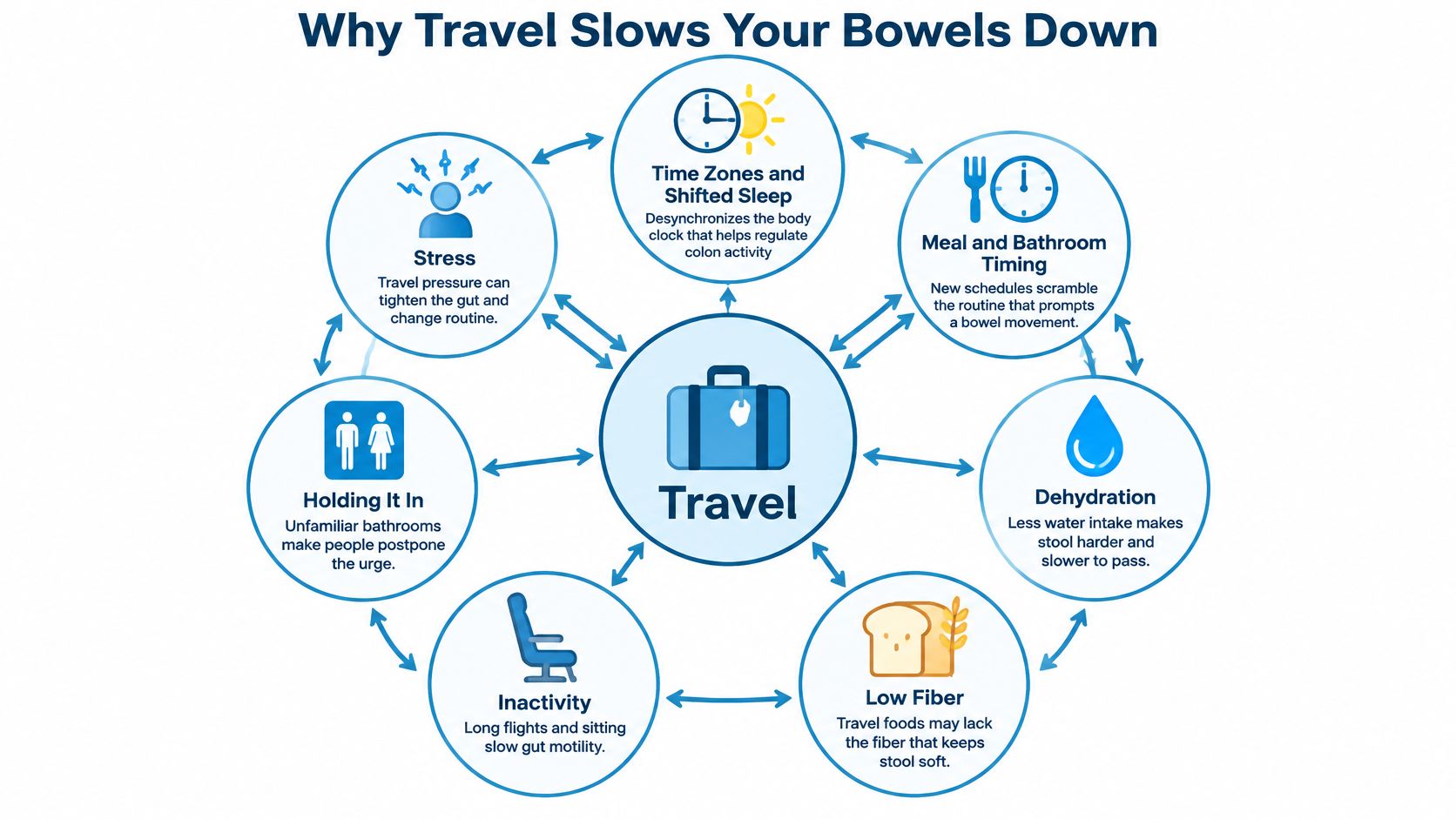
Your bowel routine follows more than the clock
Sleep and meal timing help coordinate colonic activity. Crossing time zones can put your destination schedule out of step with the timing your body expects. For example, you might arrive at bedtime while your body still expects its usual morning bathroom opportunity.
That explanation is clinically plausible, but the precise size and duration of the circadian effect aren't well established. Don't assume every delayed bowel movement is jet lag, especially if the change began before travel.
Prolonged sitting also removes opportunities for normal physical activity. Understanding how to improve gut motility can help you think beyond food alone when planning a journey.
Fluid and toilet access reinforce the delay
When fluid intake falls, the colon removes more water from retained stool, making it harder to pass. Expert guidance in YOLO Journal's interview with gastroenterologist Trisha Pasricha describes airplane cabin humidity of approximately 10–15%, compared with roughly 40–60% in homes, alongside the effects of shifted schedules, inactivity and suppressed urges.
Dry air isn't the whole explanation. Some travelers deliberately drink less to avoid the airplane toilet or a roadside stop. Others repeatedly ignore an urge because they're uncomfortable using shared bathrooms.
A familiar morning beverage can fit into a routine without becoming a treatment strategy. Coffee drinkers considering a caffeine-free option can use Cartograph Coffee's decaf digestion tips for coffee lovers as background, not as a reason to rely on coffee to force a bowel movement.
Finally, CNN's reporting on air travel and digestive discomfort distinguishes pressure-related in-flight bloating from constipation. Feeling swollen during a flight doesn't necessarily mean stool transit has stopped.
You can influence fluids, movement and bathroom opportunities immediately. The time-zone shift itself is largely fixed in the short term, so aim for a workable destination routine rather than instant adjustment.
How Long a Travel Delay Usually Lasts
There's no well-established countdown that separates harmless travel delay from a medical problem. Your usual bowel pattern, stool consistency and accompanying symptoms matter more than the clock alone.
The prospective cohort described above followed a small group before, during and after a week-long international trip involving a medium-haul flight. It found a modest median shift in bowel timing overall, with much longer delays concentrated among the slowest participants. Its small sample makes it a reference point, not a universal normal range.
What the travel-clinic evidence adds
In a 2007 University of Utah travel-clinic study, 68 respondents provided usable bowel information, and 6, or 9%, developed new constipation, compared with 41, or 63%, who developed diarrhea. The sample consisted largely of young returned missionaries attending a specialty clinic, so those percentages shouldn't be applied to tourists generally.
The useful lesson isn't that your trip carries a particular numerical risk. It's that travel can change bowel habits in different directions, and constipation deserves attention even though diarrhea receives more travel-health coverage.
A study's observed delay is not permission to wait through worsening pain, vomiting or an inability to pass gas.
Use arrival day to establish where you stand. Note when you last passed stool, whether it was comfortable and whether you've already been postponing urges during transit. Check the log again as the stay progresses rather than resetting the clock every morning.
A brief delay without discomfort is different from progressively harder stools and repeated unsuccessful toilet visits. Start protecting your routine early instead of waiting until you feel significantly backed up.
If the gap approaches several days, the pattern keeps worsening, or symptoms remain after returning home, contact a clinician. There isn't a travel-specific waiting period that overrides warning signs.
Prevention Steps Before, During and After Travel
The aim is to protect stool water and normal movement without suddenly overloading your gut with fiber. A large fiber increase immediately before departure can trade irregularity for uncomfortable bloating, particularly if you're drinking less.
CNN's travel-constipation guidance emphasizes familiar fiber-rich foods, adequate fluid, movement breaks and responding to morning or post-meal urges. These are planning measures, not a guarantee that every trip will go smoothly.
A travel-ready checklist
-
Before departure, preserve what already works.
Keep oats, fruit, vegetables, beans or whole grains in your usual pattern. Pack a familiar snack rather than counting on airport food to provide everything. If previous trips have caused problems, plan bathroom opportunities before symptoms begin. -
Build a destination morning.
Where practical, start aligning waking, breakfast and a private bathroom opportunity with the destination schedule before leaving. Don't force a bowel movement just because the clock says it's time. The goal is an unhurried opportunity, not prolonged straining. -
During transit, make access practical.
Carry a refillable bottle, identify rest stops and walk when it's safe. On a flight, use permitted opportunities to leave your seat; on a drive, include stops rather than treating them as delays to avoid. -
After arrival, restore familiar meals gradually.
If your fiber intake dropped, bring it back steadily instead of adding a large serving of bran or several new supplements at once. Use the first predictable urge after breakfast or another meal rather than waiting for a more convenient bathroom.
For a fluid benchmark, Allina Health's travel guidance recommends approximately eight 8-ounce glasses of water daily. That isn't a prescription for everyone: climate, activity and any clinician-directed fluid restriction affect what's appropriate. Don't use alcohol or repeated caffeinated drinks as your hydration plan.
Adapt rather than push through
Movement should suit your ability. If an injury limits walking on an outdoor trip, Adventure Medical Kits' guide to ankle sprain recovery on the trail provides relevant injury-care context; don't walk through pain just to pursue a bowel routine.
GutRx's guide to natural constipation measures provides further educational context. These steps don't replace evaluation, and warning signs apply before departure, in transit and after arrival.
Red Flags That Need a Doctor Visit
Don't wait for the trip to end when symptoms suggest more than ordinary delay. Severe pain, vomiting, significant swelling, bleeding or inability to pass gas need medical assessment rather than another dietary experiment.
Use this visual reminder to recognize symptoms that shouldn't be dismissed as travel disruption.
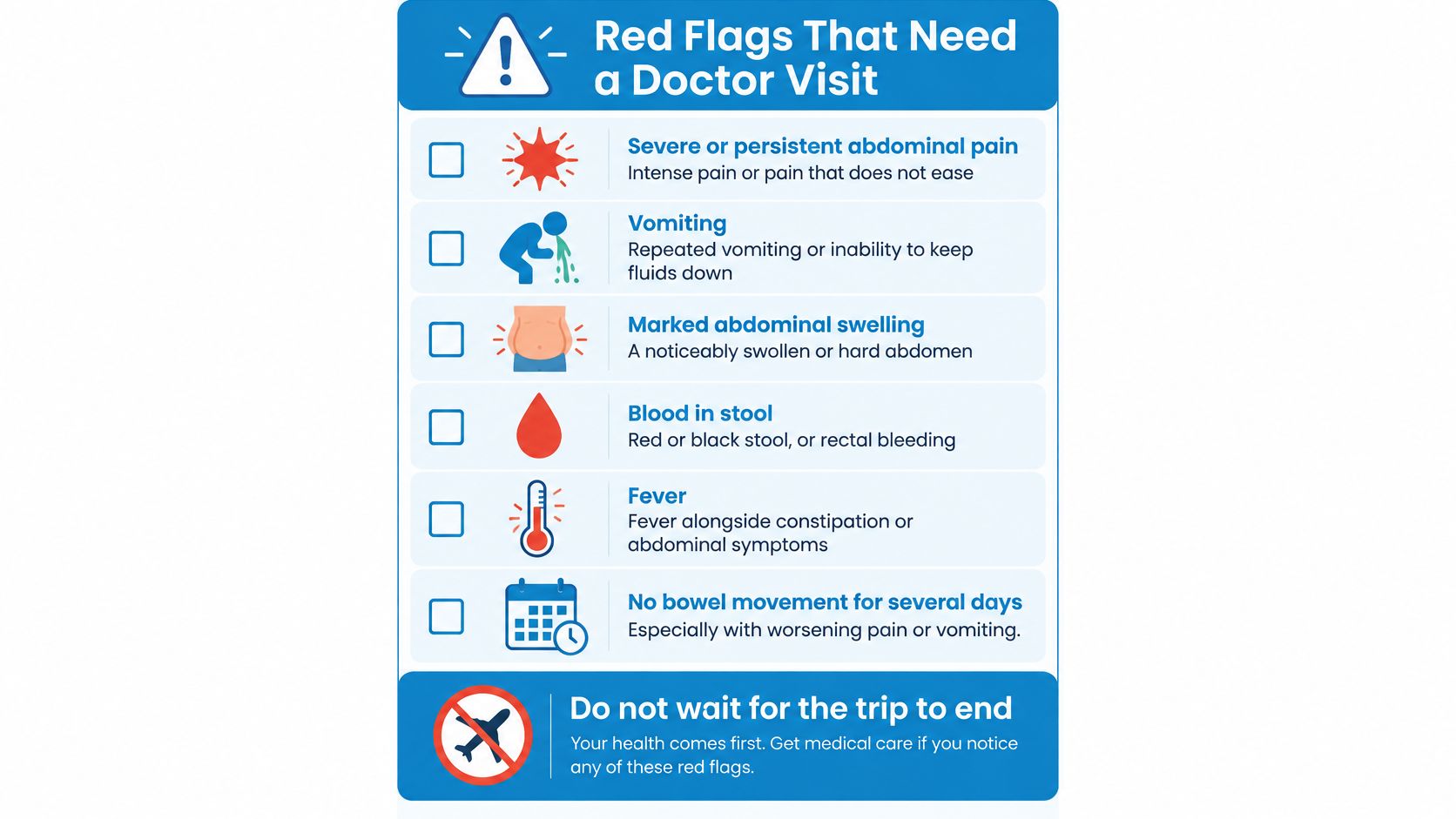
Red flag signs and the action for each
| Sign | Action |
|---|---|
| Severe or persistent abdominal pain | Urgent care |
| Vomiting | Urgent care |
| Blood in the stool | Urgent care |
| Marked belly distension with inability to pass gas | Urgent care |
| Constipation lasting several days despite fluids and movement | Clinician visit within a few days |
| Symptoms persisting after returning home | Clinician visit |
| Dizziness, very little urine or dark urine | Seek care the same day |
Urgent care means acting now, not booking a routine appointment after your return. If symptoms are severe or rapidly worsening, use local emergency services. Fever alongside abdominal symptoms also warrants prompt medical advice.
For persistent symptoms without urgent warning signs, arrange a clinician appointment rather than repeatedly escalating home measures. Dizziness or reduced urination may indicate dehydration, especially if you can't keep fluids down.
Getting help away from home
Ask your accommodation staff or travel insurer to help locate a clinic. Carry a written list of prescriptions, over-the-counter medicines, supplements and health conditions so the clinician can assess possible contributors.
The accompanying video offers another format for reviewing the topic.
This checklist supports triage, not diagnosis. A clinician decides what's causing the symptoms. More water, extra fiber or a laxative isn't an appropriate substitute when warning signs appear.
Clinician Review Before Departure and Laxative Safety
Arrange a pre-departure review if constipation repeatedly disrupts your trips. That's especially useful after long delays on previous journeys, when you have a bowel or kidney condition, when medicines may affect your bowel habits, or when your itinerary offers limited toilet access.
Bring a recent bowel log and a complete medicine list, including supplements and occasional-use products. Ask whether the pattern seems limited to travel or needs evaluation before you leave. Explain the actual itinerary: overnight transport and remote travel create different practical constraints from a hotel stay with predictable meals.
Make a fallback plan before you need it
A useful review should answer practical questions:
- Routine changes: Which food, fluid and bathroom adjustments fit your health needs?
- Medicine contributors: Could a current prescription or supplement be affecting your pattern?
- Fallback choice: If routine measures aren't enough, what option, dose and duration are appropriate?
- Stop rules: Which symptoms mean you should stop self-managing and seek local care?
Cleveland Clinic's travel-constipation guidance supports planning around routine disruption and reviewing medication options rather than assuming a natural product is automatically suitable.
Magnesium deserves particular caution when kidney function is reduced because the kidneys help clear it. Other laxatives can cause cramping, diarrhea, fluid loss or electrolyte changes, depending on the agent and how it's used. Those trade-offs matter on a trip where dehydration or bathroom access is already a concern.
Medication boundary: A laxative should be a reviewed fallback, not an automatic response to missing your usual morning visit.
Before any first dose
Confirm that you're dealing with difficult or infrequent stool rather than bloating alone. Then give the pharmacist or clinician your health conditions and full medicine list, and ask for a specific plan rather than choosing by the strongest promise on the package.
Don't combine products or increase doses because an effect hasn't arrived as quickly as you expected. If a warning sign appears, stop self-managing and seek care rather than trying another option.
Repeatedly needing laxatives without a clear plan is itself a reason for a clinician visit. This article can't diagnose a new or persistent change in bowel habits. Start recording your normal bowel pattern before departure, so you can describe a genuine change instead of guessing when the problem began.
Common Questions About Travel Constipation
Can travel cause diarrhea and constipation on the same trip?
Yes, bowel patterns can change during a journey. Loose stools followed by hard stools don't necessarily have the same cause, and alternating symptoms aren't a reason to keep switching medicines without advice. Record both patterns, including any medicines taken between them, and apply the same warning-sign check.
What if the delay continues after I get home?
Book a clinician visit rather than continuing to add fiber or laxatives. Keep your log after returning and bring it with your medicine list. A persistent change deserves evaluation even if it started during an otherwise uncomplicated trip.
Should I change or cancel a trip because of constipation?
A brief, uncomplicated delay alone doesn't usually require cancellation. The decision changes if you have warning signs, worsening symptoms or an unresolved problem before departure. Get assessed before traveling when symptoms could make it unsafe to be far from care.
For ordinary disruption, focus on a realistic itinerary with bathroom access and a clear plan for obtaining help. Don't let a tightly scheduled excursion become the reason you ignore a persistent urge or postpone medical attention.
GutRx offers educational resources on bowel routines, fiber intake and digestive symptoms to help you prepare more thoughtfully for travel. Visit GutRx to build your pre-trip reading checklist, and bring new or persistent symptoms to a clinician before choosing a laxative or supplement.


