

You're standing in front of three bottles labeled digestive enzymes plus probiotics, and every one promises less bloating, better digestion, and gut balance. The problem is that one may be built for dairy, another for FODMAP-related gas, and a third for longer-term bowel symptoms. They aren't interchangeable.
The best digestive enzymes with probiotics are chosen by primary symptom first, then by enzyme activity, strain identity, delivery system, and proof of quality. This guide will help you narrow the field without pretending there's one universal winner.
Table of Contents
- What This Buyer's Guide Will Actually Help You Decide
- How Digestive Enzymes and Probiotics Do Different Jobs
- The Decision Criteria That Separate Strong Products From Generic Blends
- Comparing Delivery Systems, Third-Party Testing, and Proof
- Matching the Formula to Your Primary Symptom Cluster
- Where GutRx Daily, Balance, Women's, and Mealtime Fit the Framework
- Timelines, Expectations, and a Final Buying Checklist
What This Buyer's Guide Will Actually Help You Decide
The shopping question isn't “Which bottle has the biggest enzyme list?” It's “What problem am I trying to solve, and does this formula match it?” Someone who feels pressure and gas after onions or beans needs a different architecture from someone who feels heavy after a fatty meal. A person with irregular bowel habits may care more about strain-specific probiotic evidence than about a long list of digestive enzymes.
This guide uses a practical sequence:
- Identify the dominant symptom cluster.
- Match the enzyme substrate to the food trigger.
- Match probiotic strains to the outcome being pursued.
- Check delivery, stability, and batch-level testing.
- Set expectations for immediate meal support versus slower microbiome effects.
That order matters. A broad formula can sound impressive while failing to address the ingredient causing your discomfort. A high probiotic count can also be irrelevant if the label hides the strains or doesn't clarify potency through expiration.
Practical rule: Don't buy an enzyme-plus-probiotic product because it claims to support “everything.” Buy it because its ingredients make sense for your most repeatable symptom.
The evidence supports a targeted approach. A major 2025 systematic review and meta-analysis of 16 randomized controlled trials involving 2,823 adults with irritable bowel syndrome found that oral probiotics improved overall symptoms compared with placebo, with an odds ratio of 1.71 and a pooled IBS Symptom Severity Score difference of −93.92 points. The findings are relevant, but they don't prove that every probiotic blend, enzyme blend, or combination product will work for every person. Read the systematic review and meta-analysis.
This guide won't declare one product the best for everyone, review every brand sold online, or replace medical evaluation. It will give you a shortlist logic you can apply to an Amazon listing, a practitioner recommendation, or a brand's product page.
How Digestive Enzymes and Probiotics Do Different Jobs
Digestive enzymes work on the meal in front of you. Amylase helps break down carbohydrates, protease supports protein digestion, lipase acts on fats, and targeted enzymes such as lactase or alpha-galactosidase address particular carbohydrate problems. Their usefulness depends on the food exposure and the enzyme's activity.
Probiotics have a different role. They provide living microbial strains that may influence fermentation, bowel function, barrier activity, and symptom patterns over time. Their value depends on the exact strain, the outcome studied, the amount delivered through expiration, and whether the delivery system protects the organisms during storage and passage through the stomach.
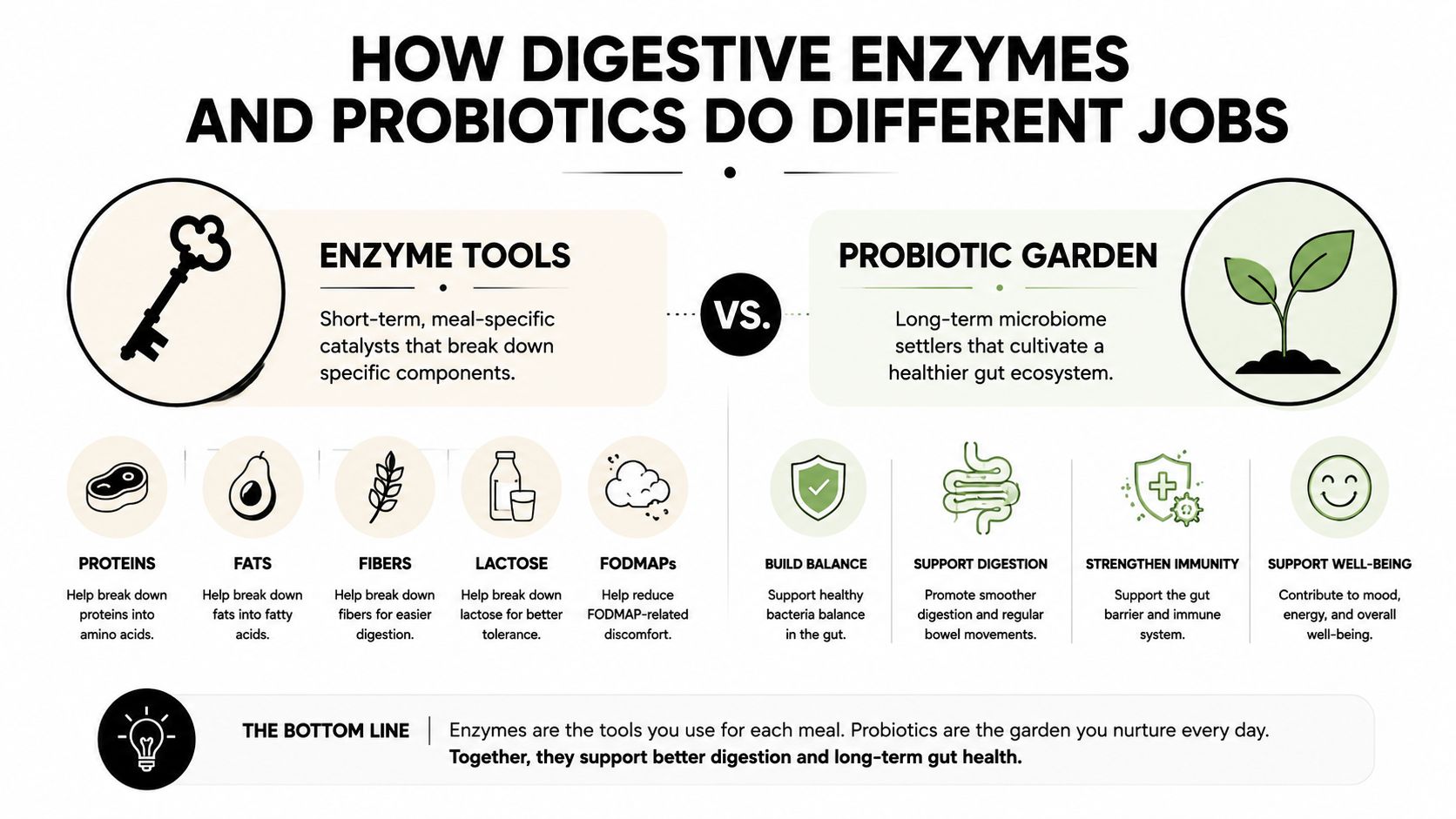
Enzymes are meal tools
A targeted enzyme formula makes the most sense when you can connect symptoms to a food class. Lactase is relevant to lactose, while alpha-galactosidase is relevant to certain fermentable carbohydrates. A targeted in vitro study found that an enzyme mix improved digestibility of lactose, fructans, and galactans and reduced undesirable gas pressure after pre-digestion of FODMAP foods. Review the FODMAP enzyme evidence.
The timing is therefore different from probiotic use. An enzyme should be present with the food it's intended to help process, while a probiotic routine is usually judged by symptom patterns over a longer period.
Probiotics are strain-specific inputs
“Probiotic” isn't one intervention. Earlier reviews found benefits for global IBS symptoms and abdominal pain, while later reviews emphasized that consistent effects were concentrated in only certain single strains. The practical lesson is simple: strain identity matters more than a generic probiotic label. Review the historical probiotic evidence.
Combining both tools isn't automatically redundant. Enzymes can address a meal-specific digestion gap, while probiotics may support broader gut patterns. For example, GutRx BALANCE offers 30 billion CFUs per capsule with next-generation probiotics for gut health, digestive balance, and immune support. That type of product belongs in the probiotic-led part of the decision, not in the same category as a meal-focused enzyme capsule.
The Decision Criteria That Separate Strong Products From Generic Blends
Once you've identified the symptom, judge the formula using criteria that reveal whether the label is useful or merely crowded. A long ingredient panel doesn't compensate for missing activity units, hidden strains, or poor alignment with your trigger foods.
Start with substrate coverage
For food-related bloating, look for an enzyme that corresponds to the suspected substrate:
- Lactase for lactose and dairy-related symptoms.
- Alpha-galactosidase for fermentable carbohydrates found in foods such as beans.
- Amylase for starches and other carbohydrates.
- Protease for proteins.
- Lipase for fats.
- Cellulase for certain plant fibers.
Broad-spectrum coverage can be useful for mixed meals, but it isn't automatically better. If dairy is the clear trigger, a formula with extensive coverage may add complexity without improving the relevant mechanism.
Demand strain-level labeling
A label that says only “Lactobacillus blend” or “Bifidobacterium blend” gives you limited decision-making information. The 2021 evidence synthesis cited in the research data concluded that only six single-strain probiotics showed consistent efficacy for IBS outcomes, reinforcing why genus-only labeling is weak evidence for a buyer.
CFU counts also need context. The meaningful question is whether the stated amount applies at manufacture or through expiration, and whether the product explains storage conditions. More organisms on the label don't guarantee better results.
Use activity units, not just milligrams
Enzyme weight doesn't tell you how much work the enzyme can perform. Look for recognized activity units appropriate to that enzyme and compare products within the same enzyme category. A clinical review also reported that a microbe-derived formulation delivered higher labeled activity than standard pancreatin on a unit basis for amylase, protease, and lipase, though the clinical fit still depends on the indication. Review digestive enzyme supplementation.
Score the label before you buy
| Criterion | Why It Matters | Score 0-3 |
|---|---|---|
| Food-substrate match | Connects lactase, alpha-galactosidase, lipase, protease, or other activity to your trigger | 0 = absent, 3 = clearly matched |
| Named strains | Allows comparison with clinical evidence | 0 = proprietary blend, 3 = full strain names |
| Potency through expiration | Helps distinguish real potency from manufacturing-day marketing | 0 = unclear, 3 = stated clearly |
| Meal-use instructions | Aligns enzyme timing with food exposure | 0 = vague, 3 = specific |
| Symptom alignment | Prevents buying a generalized formula for a narrow problem | 0 = mismatch, 3 = strong fit |
| Formula simplicity | Reduces unnecessary ingredients and makes troubleshooting easier | 0 = crowded and opaque, 3 = purposeful |
For a practical explanation of why probiotic counts alone can mislead, see this guide to high-CFU probiotics. The strongest product isn't the one with the most dramatic headline. It's the one whose label lets you understand what you're taking and why.
Comparing Delivery Systems, Third-Party Testing, and Proof
If a shopper with FODMAP-related gas buys a formula built for post-meal heaviness, even excellent manufacturing will not solve the wrong problem. After choosing enzymes and probiotic strains for the primary symptom cluster, inspect how the product protects those ingredients and how the brand proves the bottle matches its label.
Delivery changes the exposure
Capsules, powders, and tablets create different handling and storage requirements. An enteric-coated capsule is designed to delay disintegration until after exposure to stomach acid. One review found that a non-enteric-coated probiotic capsule disintegrated in simulated gastric fluid within 5 minutes, while an enteric-coated capsule had not disintegrated after 60 minutes. Read the full review of probiotic delivery systems.pdf).
Enteric coating suits products that need protection from stomach acid, but it is not automatically the best choice for every enzyme-plus-probiotic formula. Some strains are selected for resilience, and enzymes may need a different formulation from live cultures. The label should explain what the delivery system protects, when to take the product, and how to store it.
Shelf-stable products also vary by strain. Some manufacturers account for expected cell loss by adding extra organisms at production, while more delicate strains may still need tighter temperature or moisture controls. A shelf-stable claim without storage conditions gives you too little information.
Separate certification from real transparency
Certification logos are useful, but a batch-specific Certificate of Analysis provides stronger proof of what is in your bottle. Look for a lot number or downloadable COA covering identity, potency, and contaminants. Independent testing details also matter, so compare the product with this guide to third-party tested probiotics.
Proprietary blends make comparison difficult because they hide the amount of each strain. A named, strain-specific formula gives you a clearer basis for judging evidence and matching the probiotic to symptoms.
| Attribute | What to Look For | Score (1-5) | Red Flag |
|---|---|---|---|
| Delivery method | Enteric protection, documented acid resistance, or clear handling instructions | 1-5 | No explanation of survival or storage |
| Strain disclosure | Genus, species, and strain designation | 1-5 | “Proprietary probiotic blend” only |
| CFU statement | Potency stated through expiration when possible | 1-5 | Count listed only at manufacture |
| Third-party verification | Recognized testing or clearly described independent testing | 1-5 | Logo with no supporting detail |
| COA access | Batch-specific document through lot number or QR code | 1-5 | No way to verify the actual batch |
| Storage guidance | Clear temperature and moisture instructions | 1-5 | “Shelf-stable” with no conditions |
Before buying, ask: What survives gastric acid, and how do you prove it? A credible answer names the strain, delivery method, storage requirements, and batch documentation. That evidence deserves more weight than a large CFU headline or a polished certification logo.
Matching the Formula to Your Primary Symptom Cluster
The best digestive enzymes with probiotics should be matched to the symptom that keeps recurring, not to a vague desire for “better gut health.” Four patterns are especially useful for sorting products.
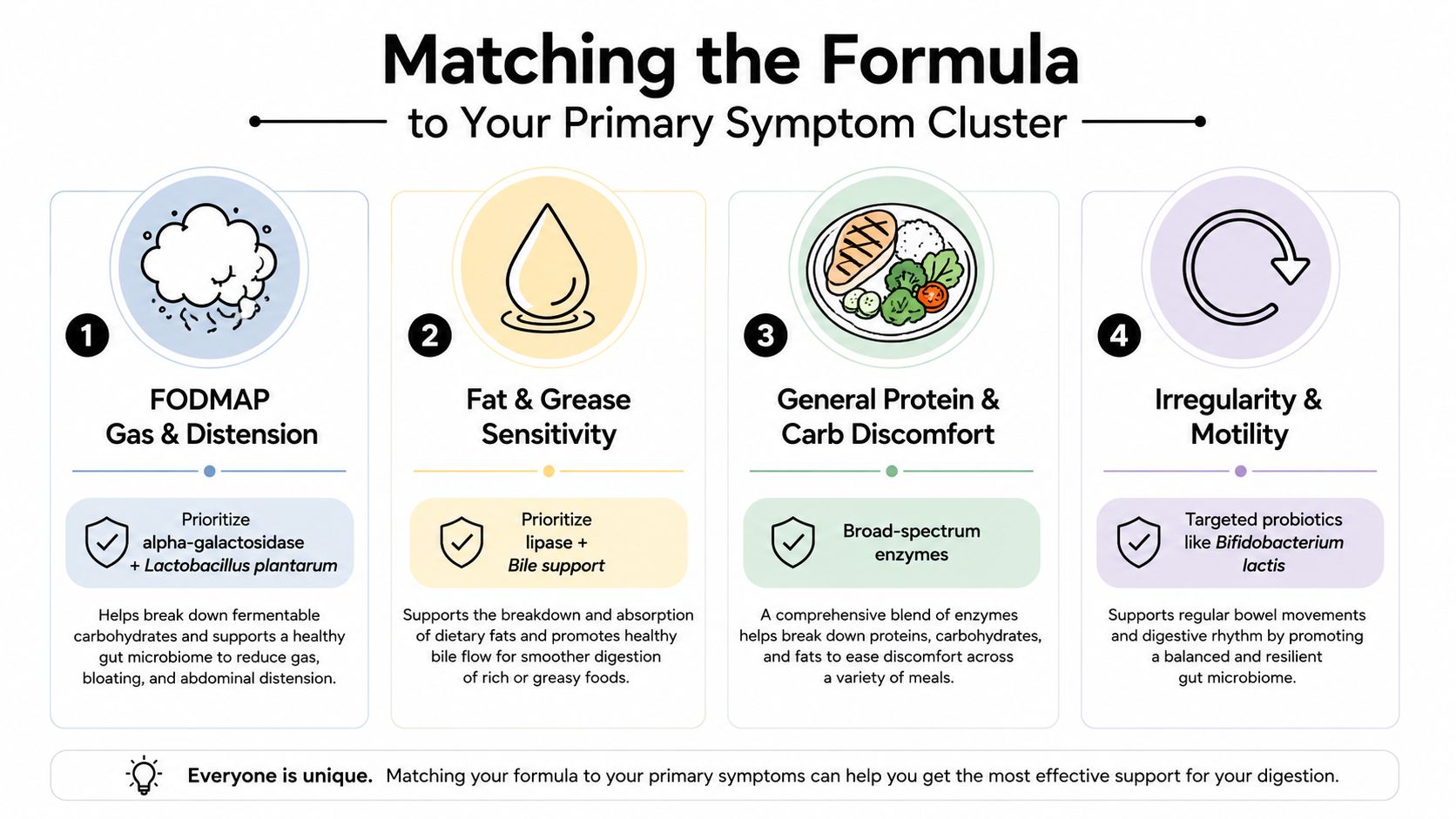
FODMAP-related gas and distension
If onions, garlic, wheat, legumes, or other fermentable foods reliably trigger gas, start with substrate-specific enzymes. Alpha-galactosidase is relevant to galactans, while fructan-targeting activity is more relevant to fructans. Lactase belongs in the formula only when dairy is also part of the pattern.
For the probiotic side, look for named Lactobacillus and Bifidobacterium strains rather than an anonymous blend. Expect the enzyme component to be judged around the meal, while the probiotic component requires a longer trial and consistent symptom tracking.
Post-meal heaviness and fat-related discomfort
A heavy sensation after a mixed or fatty meal points toward a formula that clearly provides lipase, protease, and amylase activity. The question is not how many enzymes appear on the front label. It's whether the activity is expressed clearly and the directions tell you to use the product with food.
Oily stools, persistent weight loss, or a history of pancreatic disease deserve clinical evaluation rather than self-treatment with an over-the-counter blend. Prescription enzyme therapy is a different category from a general digestive supplement.
IBS-D patterns
For diarrhea-predominant symptoms, don't assume a broad enzyme list is enough. Consider whether the formula combines targeted food support with a probiotic strain that has a rationale for bowel symptoms, such as Saccharomyces boulardii or a clinically studied Bifidobacterium strain.
The evidence remains product-specific. A 2025 meta-analysis found positive effects for IBS symptoms but described the certainty as low because results were inconsistent, and quality-of-life effects weren't significant. That's why tracking stool pattern, urgency, pain, and bloating matters more than judging a product by its marketing language.
Constipation and irregularity
Constipation-dominant symptoms call for a different emphasis. Look for a probiotic-led formula with strain documentation and, where relevant, support for fermentation and short-chain fatty acid production. Don't expect a digestive enzyme to function as a universal motility product.
A targeted blend may make sense when irregularity accompanies bloating or meal discomfort, but persistent constipation still needs attention to diet, hydration, medications, pelvic-floor factors, and clinical causes.
Use the digestive enzymes for bloating guide to keep the formula choice tied to the actual trigger rather than to a broad “digestive support” promise.
Where GutRx Daily, Balance, Women's, and Mealtime Fit the Framework
These products fit different positions on the symptom map. The useful question isn't which name sounds most effective. It's which product category matches the dominant problem.
GutRx Daily
A daily formula makes the most sense for adults with generalized bloating, irregularity, or a desire for routine gut support without one sharply defined food trigger. This is a maintenance-oriented choice. It shouldn't be treated as a substitute for a targeted lactase product when dairy is the obvious issue, or for clinical evaluation when symptoms are persistent or severe.
The decision rests on whether you need a baseline probiotic routine rather than meal-specific enzyme coverage.
GutRx Balance
Balance fits a more probiotic-led framework for people focused on digestive balance and IBS-pattern symptoms, particularly when diarrhea-type discomfort or broader bowel instability is part of the picture. Its catalog description identifies next-generation probiotics and 30 billion CFUs per capsule, so it belongs in a strain and delivery review rather than being judged as a simple enzyme product.
It isn't the logical first choice for someone whose only problem is occasional heaviness after a high-fat meal. That person should prioritize meal-timed enzyme activity.
GutRx Women's
A women's formula belongs in the crossover category for people considering gut, vaginal, and urinary wellness together. The relevant evaluation points are strain selection, the intended population, and whether the product's additional ingredients fit the shopper's goal. It shouldn't be selected solely because it carries a women's label if the main concern is FODMAP-related gas after eating.
For women comparing gut and vaginal support products, the formulation should be judged by transparent ingredients and the specific use case, not by a general promise of feminine balance.
GutRx Mealtime
Mealtime is the clearest fit for post-meal heaviness and food-related digestive discomfort. Its product description centers on digestive enzyme support for protein, fat, fiber, dairy, and FODMAP digestion, which places it in the meal-focused category rather than the daily probiotic category.
It's not automatically the right choice for someone whose main issue is constipation or long-standing bowel irregularity. In that situation, the probiotic architecture and broader clinical context deserve more attention than an enzyme-heavy approach.
The framework should return you to your own pattern. Choose Daily for broad routine support, Balance for probiotic-led digestive balance, Women's for combined wellness goals, and Mealtime for food-linked discomfort. Don't choose by product breadth alone.
Timelines, Expectations, and a Final Buying Checklist
Enzymes and probiotics should be judged on different clocks. An enzyme-led benefit should be assessed around the meal it targets. A probiotic-led change may take weeks, especially when the goal involves bowel regularity, bloating patterns, or IBS-related symptoms.
Recent probiotic research has used intervention periods of 8 to 12 weeks, with symptom differences emerging around week 8 in one 2025 double-blind trial. Review the trial information. That doesn't mean every product needs the same duration, but it does mean a probiotic shouldn't be dismissed after one capsule.
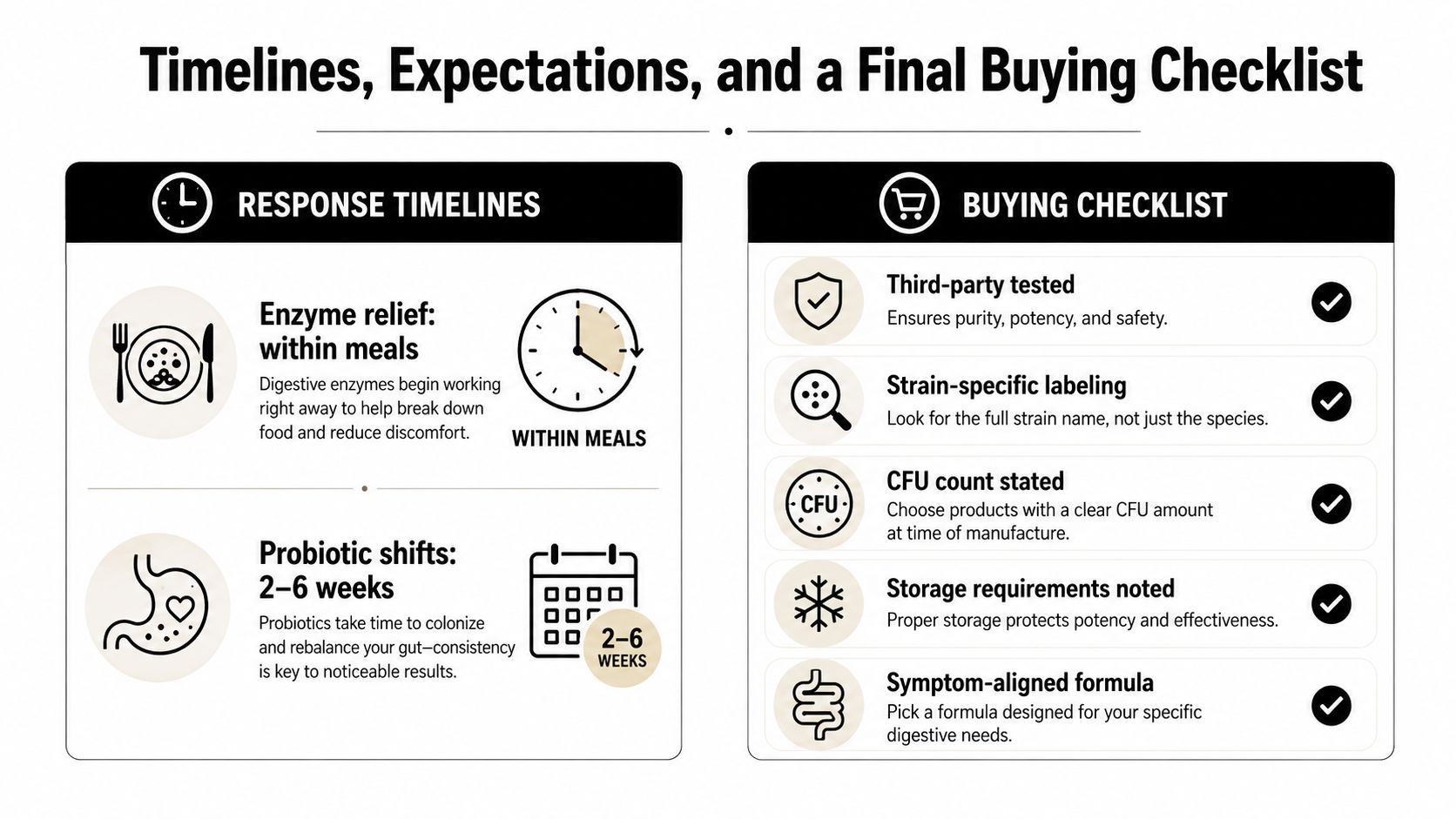
Your final buying checklist
- Name the symptom: Decide whether the main issue is FODMAP gas, post-meal heaviness, IBS-D-type discomfort, constipation, or generalized bloating.
- Match the enzyme: Look for lactase, alpha-galactosidase, fructan activity, lipase, protease, or amylase according to the food pattern.
- Verify the probiotic: Prefer named strains over genus-only or proprietary labels.
- Check potency: Confirm the CFU statement and whether it applies through expiration.
- Inspect proof: Look for independent testing and a batch-specific COA.
- Read storage instructions: Shelf-stable doesn't mean every strain has identical durability.
- Track the response: Judge enzymes around meals and probiotics over a consistent trial period.
Red flags include hidden CFUs, missing strain designations, enzyme amounts expressed only in milligrams, unclear storage directions, and claims that a supplement can cure a diagnosed digestive disease. Supplements can complement dietary changes, but persistent pain, diarrhea, constipation, bleeding, vomiting, or unexplained weight changes require clinical attention.
GutRx offers separate options for daily gut support, probiotic-led digestive balance, women's combined wellness, and meal-focused digestive enzymes, so you can match the product category to your symptom rather than buy a generic blend. Visit GutRx to compare the available formulations and choose a starting point based on your primary digestive goal.


