

You finish a normal lunch, add a sparkling water, and twenty minutes later your waistband is digging in. Within the hour you're unbuttoning your trousers and replaying the meal to work out which food did it. That replay usually sends people straight into an elimination diet, and it's the wrong first move. In many cases, what happens after a meal is decided by how fast they ate, how much air they swallowed and how big the plate was, well before any single ingredient deserves blame. Get those three things right for two weeks and you'll know whether you're dealing with air and pace or with a genuine food trigger.
Table of Contents
- Eating Habits That Trigger Air and Bloating
- Track Meals and Spot When to See a Doctor
- Food Triggers and Lower-Impact Swaps
- Adding Fiber Without Making Bloating Worse
- Build Your Routine and Choose What to Try First
- Frequently Asked Questions
Eating Habits That Trigger Air and Bloating
Start with the mechanics of the meal, not the menu. Gas in the digestive tract comes from two places: air you swallow and bacterial fermentation of carbohydrates that reach the colon undigested. The first of those is entirely within your control at the next meal. The NIDDK guidance on gas in the digestive tract puts slower eating first, then avoiding carbonated drinks and straws, then cutting back on gum, hard candy and talking during meals, and it notes that smaller, more frequent meals help some people.
Here's the lookup many people need, one habit per row:
| Habit | Why it causes bloating | Change to make |
|---|---|---|
| Eating fast and large bites | Swallows air and overfills the stomach before fullness arrives | Put the fork down between bites and stop at satisfied |
| Carbonated drinks | Adds gas directly to the stomach | Switch to still water with meals |
| Drinking through straws | Pulls extra air into the stomach | Drink from a glass |
| Chewing gum or sucking hard candy | Causes repeated swallowing of air | Remove from daily routine |
| Talking while chewing | Adds air with every mouthful | Finish each bite before speaking |
| Very large meals | Stretches the stomach and raises symptom risk | Eat smaller, more frequent meals |
Swallowed air plus fermentation is the whole story for many people, and only the second half responds to food swaps. The honest limit of this approach is that nobody can quote you a success rate for habit changes, because the outcome depends on what's driving your symptoms. That's not a reason to skip it. It's a reason to run it as a timed experiment instead of a vague intention.
The common trap: treating every bloated evening as a food intolerance while still eating in ten minutes with a fizzy drink beside the plate.
The Two-Stage Test
Stage one is the habit audit: work the table for 7 to 14 days while noting meal times, foods, belching, visible distension and pain. Stage two, food swaps, begins only if bloating is still there after that. Skipping stage one is how people end up with a permanently restricted diet and no better symptoms.
Pick one habit to change this week, and pick the one you repeat. If you drink two sodas with dinner, kill the sodas. If you clear a plate in under ten minutes, that's your target. Add the walking test too: a short walk after eating moves gas along and beats lying down, which lets pressure build.
Track Meals and Spot When to See a Doctor
A two-week log does two jobs at once. It separates a food pattern from a timing or posture pattern, and it gives a clinician something concrete to read if you need one. Keep it on paper or in a note on your phone, and keep it simple enough that you'll finish it.
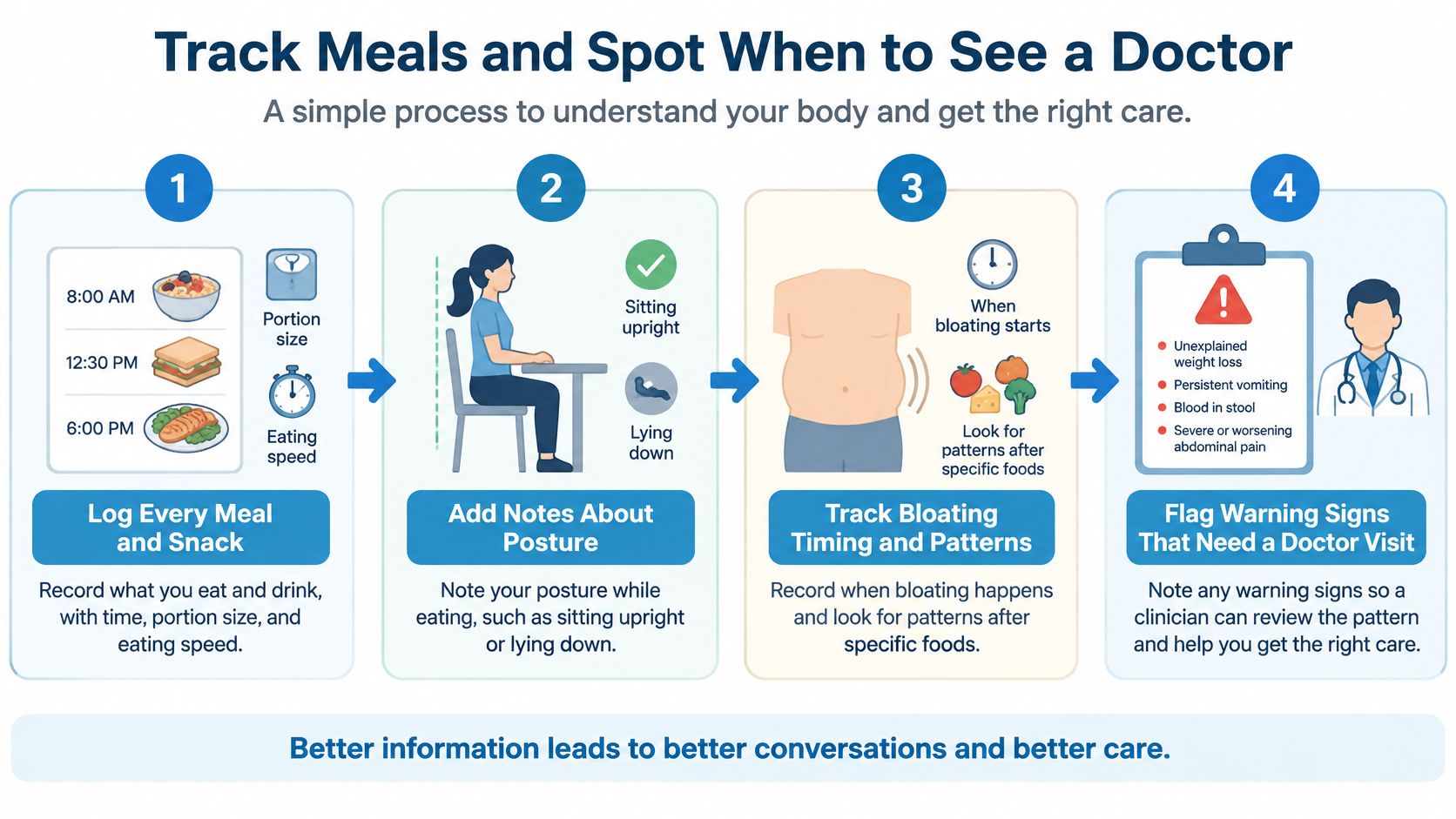
- Time every meal and snack. Note portion size and how fast you ate, in rough terms like "ten minutes" or "twenty minutes sitting at a desk".
- Record posture. Sitting upright, reclined in a chair, standing at the counter, eating while walking.
- Mark the onset. Write down when fullness, pressure or bloating begins. Meal-related symptoms often appear within 30 to 60 minutes.
- Answer the visible question. Did your belly look bigger, not just feel full? Photograph it from the same angle and at the same time of day if you're unsure.
- Log the exits. Belching, passing gas, stool pattern, plus stress level and how much you slept.
- Keep it for the appointment if you end up booking one.
Gas sensation and visible expansion are not the same complaint, and they don't always share a cause. Someone who looks two inches wider after a small meal may be passing very little gas, which points toward muscle coordination and meal-triggered sensitivity rather than fermentation. A trial of biofeedback aimed at correcting abdominophrenic dyssynergia reduced visible distension by 24%, against 8% on placebo, with the benefit still there at three months, as reported in the trial summary. Posture, breathing and pelvic floor work belong in the conversation alongside food.
What Two Weeks of Notes Usually Shows
At the end of the fortnight, look for repeats rather than single events: the same food on three occasions, symptoms only after the largest meal of the day, or bloating only in the evening when you eat at your desk. Repeats are what make a change worth testing.
Targeted assessment beats general advice. A synthesis of dietary interventions across 23 trials evaluating bloating or distension found a low-FODMAP diet superior to a habitual diet, with a relative risk of failing to improve bloating of 0.55 (95% confidence interval 0.37 to 0.80), per Monash University's summary. That same body of work describes symptom improvement in roughly 3 out of 4 people with IBS and notes that about 1 in 4 doesn't improve.
If gas is the dominant complaint rather than fullness, read why you're so gassy all the time before you start cutting foods.
When the Log Says See a Doctor
Ordinary meal-related fullness doesn't need a workup. These signs do, and the order matters.
- Book a routine appointment: bloating that's regular, that persists despite dietary changes, or that comes with unintentional weight loss or blood in the stool, per the NHS guidance on bloating.
- Seek urgent assessment the same day: bloating with vomiting, diarrhea or constipation, stomach pain, fever, a palpable abdominal swelling, or inability to pass urine, stool or gas.
- Go to emergency care: sudden severe abdominal pain with a swollen stomach, vomiting blood, or severe breathing difficulty.
None of this diagnoses anything, and that's the point. Bring the log, mention the timeline, and let a clinician decide what the pattern means.
Food Triggers and Lower-Impact Swaps
When habits and pacing are handled and bloating persists, food becomes the next variable. Fermentable carbohydrates, grouped as FODMAPs, draw water into the intestine and then ferment there, producing gas. Swap first, eliminate later.
| Food group | Common triggers | Lower-trigger swap | Practical note |
|---|---|---|---|
| Alliums | Onion, garlic, leeks | Chive tops, garlic-infused oil | Keeps flavor without most of the fructans |
| Legumes | Beans, lentils, chickpeas | Smaller servings, canned and well rinsed | Test portion size before cutting out completely |
| Wheat-based foods | Bread, pasta, wheat snacks | Rice-based or corn-based pasta | Check labels, since wheat hides in many packaged foods |
| Lactose-containing dairy | Milk, soft cheese, ice cream | Lactose-free milk, aged hard cheese | Lactose-free milk is a direct swap for regular milk |
| High-fructose fruit and polyols | Apple, pear, mango, sugar-free sweets | Berries, oranges, kiwi | Sugar-free gum and candy often contain sorbitol or mannitol |
The numbers behind this list are unusually strong for a dietary intervention. A 2017 review counted at least 10 randomized or randomized-comparative trials in which a low-FODMAP diet produced clinical responses in approximately 50% to 80% of people with IBS. In a randomized comparison of low-FODMAP advice against standard dietary advice, 82% of the low-FODMAP group reported improved bloating versus 49% on standard advice (P=0.002), with abdominal pain improving in 85% versus 61% and flatulence in 87% versus 50%, according to the Monash University comparison.
Read those figures correctly. They're from adults with IBS, not from everyone who gets uncomfortable after a big dinner. If your bloating is occasional and tied to one meal, the swap column is a starting point, not a diagnosis.
Reduce, Then Reintroduce
The evidence-based model is a limited restriction followed by structured reintroduction, ideally with a registered dietitian. Under supervision, you replace high-FODMAP foods with lower-FODMAP alternatives for about 2 to 6 weeks, continuing only if symptoms meaningfully improve, per the Monash FODMAP three-step guide.
Then challenge one subgroup at a time: fructose, lactose, sorbitol, mannitol, fructans or GOS. Use one test food daily for 3 days with increasing portions, record bloating and stool response, and take a 2 to 3 day washout before the next challenge. Full reintroduction commonly runs 6 to 8 weeks. If you want a plain-language walkthrough of the phases before you start, Mise's low-FODMAP guide for SIBO sets them out step by step.
The pitfalls are consistent. Testing three groups in the same week tells you nothing. Staying on restricted eating indefinitely costs you fiber, variety and often enjoyment. Skipping reintroduction means you never learn which foods were innocent. Legumes deserve their own note, since portion size and preparation decide more than the bean itself, which is the detail in why beans cause gas.
Practical rule: keep every food you tolerate, and restrict only what your own challenges confirmed.
Adding Fiber Without Making Bloating Worse
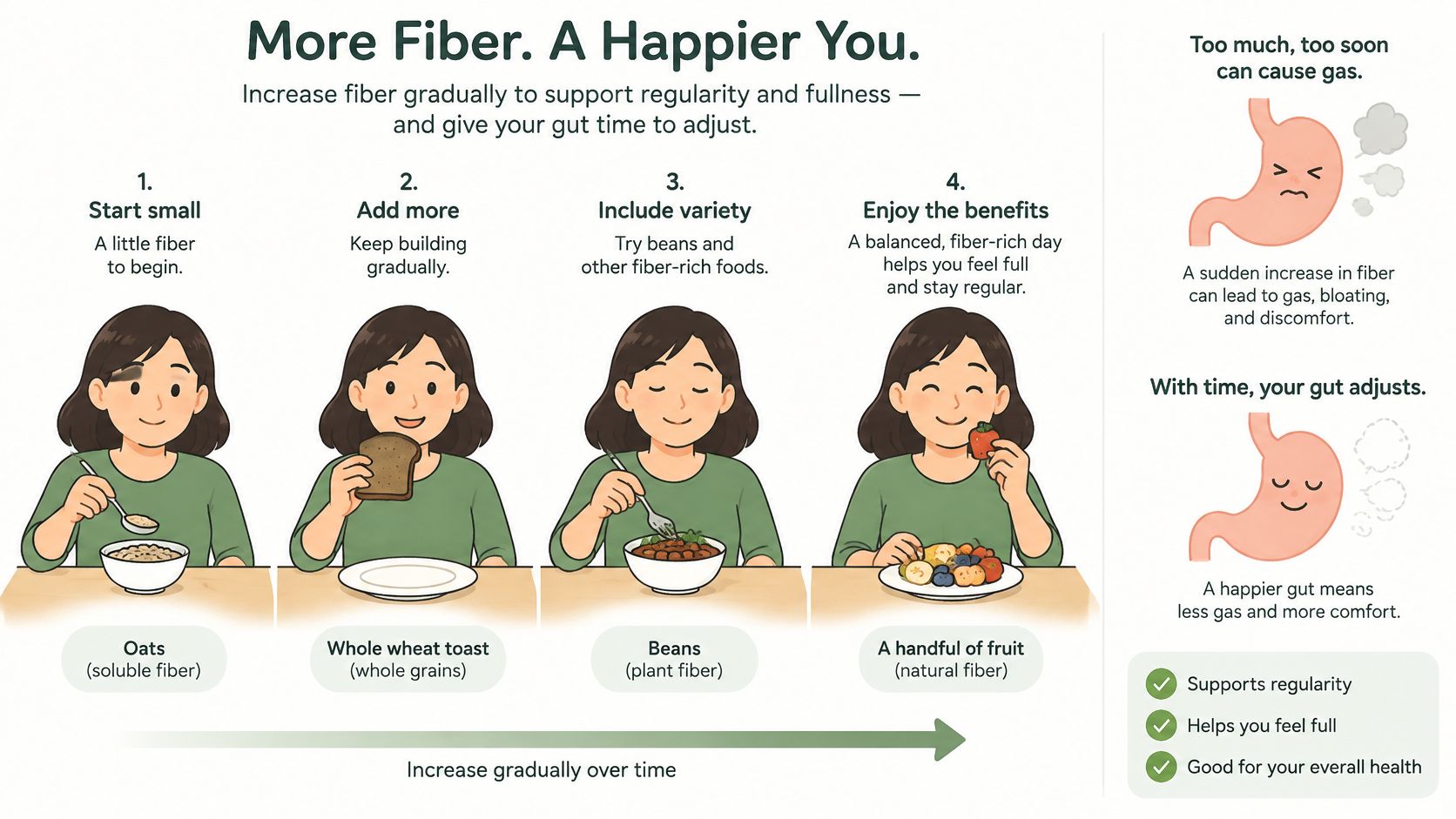
Fiber supports regularity and keeps meals satisfying, but the way you add it decides whether it helps or hurts. Wheat bran, fructo-oligosaccharides (FOS) and galacto-oligosaccharides (GOS) can generate substantial gas in the large intestine, particularly when introduced over a short period, and can worsen symptoms in people with IBS. Oats and oat bran are gentler and may improve constipation, abdominal pain and bloating, though the evidence there still needs more work, as summarized in Monash FODMAP's fiber guidance.
A Gradual Dosing Plan
- Start low. A small daily dose for several days, not a heaped spoon on day one.
- Climb slowly. Increase over several weeks toward 20 to 30 g of fiber per day, the range a Cleveland Clinic Journal of Medicine review recommends.
- Hold instead of quitting. If bloating rises, stay at the last comfortable dose for a week before pushing again.
- Spread it out. Fiber across three meals behaves better than one large dose at breakfast.
- Keep fluids steady. Fiber needs water to move; dry fiber is a recipe for pressure.
If you want the background on which soluble fiber to pick, the case for PHGG covers the type that ferments slowly and tends to suit people who react to everything else.
Here's the short version of that pacing in practice:
Read the Label for Fructans
Powdered supplements that list inulin, chicory root or FOS are concentrated fructan sources. They can trigger symptoms even when you handle onions and garlic in food without trouble, because the dose is far higher than a forkful of vegetables. Check the ingredient panel before you blame the food.
If bloating worsens at every dose you try, stop adjusting the amount and change the type. The fiber isn't the problem, the specific fiber is.
Build Your Routine and Choose What to Try First
Order the steps before you buy anything. My sequence is habits for 7 to 14 days, a two-week log, then targeted food swaps and fiber pacing, with a clinician for anything on the red-flag list. This is the order I'd give anyone asking how to prevent bloating after eating, because each step tells you whether the next one is even necessary.
| Approach | Best fit | What to expect | Limit |
|---|---|---|---|
| Eating pace and air-reducing habits | Gas and fullness from fast eating or soda | Judge after 7 to 14 days | Does not address food triggers |
| Food trigger reduction | Meals with confirmed trigger foods | Judge after 2 to 6 weeks | Needs dietitian guidance and reintroduction |
| GutRx Bloat + Gas, 2 capsules with meals | Gas and bloating after beans, dairy or gas-producing foods | Acts within the meal itself, so judge it meal by meal | Not a substitute for trigger testing |
| GutRx MEALTIME, taken before meals | Heavy meals and protein, fat, dairy or FODMAP foods; supports digestion and nutrient absorption | 1 to 3 capsules right before eating | Works alongside food changes, not in place of them |
Enzymes are a tool for a pattern you already logged, not a first move. The two enzyme formulas are built to work within the meal they're taken with, and both can be used at the same meal when a dinner brings beans and dairy together. What they won't do is tell you which food caused the problem, because they act on the meal in progress. The formula aimed at gas after beans, dairy or heavy food pairs alpha-galactosidase, lactase, fructan hydrolase, xylanase, cellulase and a protease complex with ginger, fennel, peppermint, artichoke and Bacillus coagulans MTCC 5856. The broad one supports digestion of protein, fat, fiber, dairy and FODMAP foods, which is the one I'd reach for on a heavy restaurant meal.
Nothing in that table replaces the habit work or the trigger mapping. Supplements are a convenience layer over a plan, and no capsule is guaranteed to stop bloating for everyone who takes it. These statements have not been evaluated by the FDA. These products are not intended to diagnose, treat, cure or prevent any disease.
Frequently Asked Questions
Does bloating after eating always mean gas? No. Some people feel pressure without passing much gas, and some look visibly bigger without feeling gassy at all. The two-week log separates the two, because it records both the sensation and the visible change.
Is a low-FODMAP diet meant to be permanent? No. It's a limited restriction phase of roughly 2 to 6 weeks, run with a registered dietitian, followed by reintroduction so that tolerated foods come back. Permanent broad restriction costs you nutrition and tells you nothing about your actual triggers.
Can a supplement replace the habit and food steps? No. Enzymes support the digestion of a specific meal and probiotics support the microbiome, but neither is guaranteed to stop bloating. Targeted formulas such as GutRx OVERGROWTH exist for microbiome balance, and they belong after the basics, not before them.
When is a clinician visit needed? When any red-flag sign shows up in your log, or when bloating is regular or persists despite these changes. Weight loss, blood in the stool, vomiting, fever, a palpable swelling or an inability to pass stool or gas all move the conversation from habits to medical assessment.
GutRx makes the supplement side of this simple: strain-level formulas, third-party testing with downloadable certificates of analysis, and enzymes built for the specific meals that give people trouble. If your log keeps circling the same beans, dairy or heavy dinners, match a formula to that pattern rather than to a general promise, and keep it alongside the habit and food work. Start with GutRx and pick the formula that fits what you wrote down.


