

A Christensenella probiotic supplement is designed to deliver a specialized gut bacterium that appears in very small amounts in the human microbiome. Christensenellaceae average about 0.01% of the fecal microbiota in humans, yet their inverse relationship with body mass index is among the more consistent microbiome and metabolic associations reported in research (human-gut review). That combination, low abundance and high scientific interest, makes this a promising but technically demanding next-generation probiotic.
The important question isn't just whether a product lists Christensenella. You need to know which strain it contains, whether the organism can survive manufacturing and storage, how much viable bacteria remains at expiration, and whether an independent laboratory verifies the label. The evidence is still developing, so a careful buyer should treat the supplement as a research-informed option for broader gut support, not as a guaranteed weight-management or disease-treatment product.
Table of Contents
- What a Christensenella Probiotic Supplement Is
- The Biology Behind Christensenella Minuta
- Clinical and Preclinical Evidence on Benefits
- Formulation and Strain Considerations That Matter
- How Christensenella Products Compare With Standard Probiotics
- Safety, Regulation, and Third-Party Testing
- Who Should Consider a Christensenella Probiotic Supplement
What a Christensenella Probiotic Supplement Is
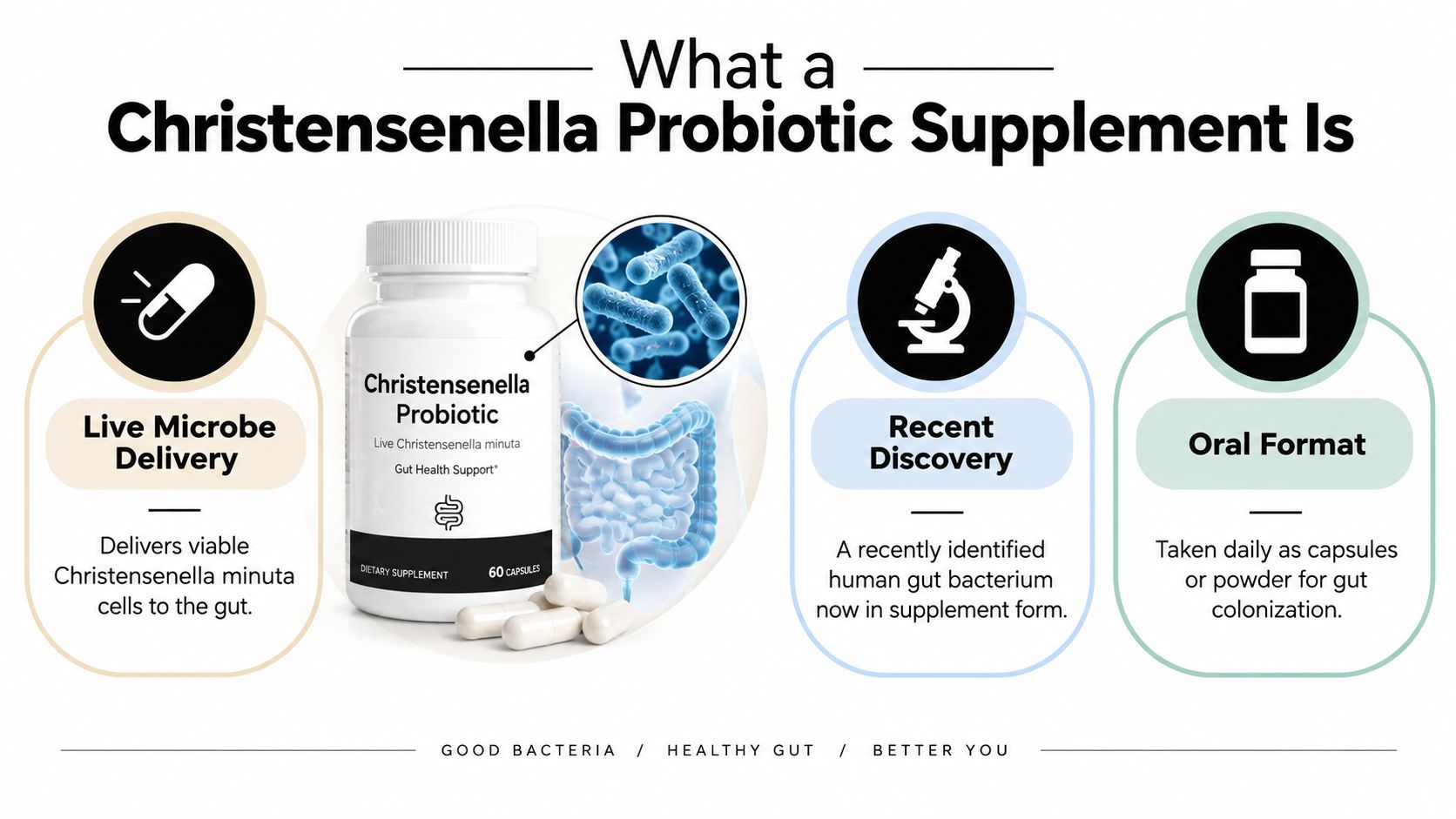
A Christensenella probiotic supplement is an oral product intended to deliver viable cells of Christensenella minuta, a relatively recently characterized human gut bacterium. Some formulas center on Christensenella, while others combine next-generation organisms with familiar groups such as Lactobacillus and Bifidobacterium.
Why it belongs to a different probiotic category
Retail probiotics commonly use established lactic-acid bacteria for broad digestive support. Christensenella belongs to the newer field of next-generation probiotics, which examines organisms naturally found in the human gut and their possible roles in metabolism, intestinal barrier function, and microbial community structure.
The distinction affects how you evaluate the product. Christensenella is an extremely low-abundance, oxygen-sensitive strict anaerobe, reported at about 0.01% of fecal microbiota on average (independent review). Oxygen exposure can reduce viability, and the intended effects may vary with the strain, dose, and delivery system. A label listing the genus therefore provides only part of the information needed to judge the formula.
What a buyer should expect from the label
Check for four details:
- Exact strain identity, rather than only “Christensenella” or “C. minuta.”
- Viable potency information, preferably guaranteed through the stated expiration date.
- Manufacturing and storage guidance addressing oxygen, moisture, and temperature.
- Independent testing, verifying both the claimed organism and its viability.
A Christensenella product is not automatically better than a standard probiotic. It represents a narrower biological strategy, a more demanding production process, and a less mature human evidence base. For that reason, label transparency is part of the product's practical value. A clear strain designation, viability claim, storage instruction, and certificate of analysis give buyers a way to assess what the capsule is designed to deliver and how confidently that claim has been checked.
The Biology Behind Christensenella Minuta
Christensenella minuta is a strictly anaerobic, Gram-negative rod in the Christensenellaceae family. Researchers first isolated it from human fecal samples in 2012. Those traits are not merely classification details. They help explain why a Christensenella probiotic supplement requires different production and quality controls from many familiar probiotic products.

Oxygen sensitivity changes the manufacturing problem
Christensenella is adapted to the oxygen-poor gut, so exposure during fermentation, filling, shipping, or storage can reduce viability. The practical comparison is straightforward: a culture that performs under controlled anaerobic conditions may become vulnerable once oxygen reaches it.
A capsule can therefore list the correct species while delivering fewer viable organisms by the time it is consumed. Reviews of next-generation probiotic development identify oxygen sensitivity, strain-specific effects, and limited long-term safety data as barriers to commercial translation (review of next-generation probiotic development). For shoppers, this makes the manufacturing method and expiration-date potency more informative than the genus name alone.
Christensenella works within a community
The organism does not operate in isolation. Human gut data found global co-occurrence between Christensenellaceae and Methanobrevibacter across 1,821 metagenomes from 10 independent human gut studies, alongside an association with a lean BMI pattern (mBio analysis). This describes a microbial relationship. It does not establish that taking Christensenella changes body weight.
Researchers also examine its relationship with intestinal mucus, microbial cross-feeding, and metabolites made by neighboring organisms. Butyrate-producing bacteria are relevant because their metabolites can contribute to gut ecosystem function. See this explanation of butyrate-producing bacteria for related context.
A product such as GutRx COMPLETE shows how a commercial formula may combine next-generation ingredients with prebiotic support. Its listed snapshot identifies Akkermansia muciniphila rather than a verified Christensenella strain claim. The practical lesson is clear: evaluate a microbiome product by its exact formula, strain information, and viability evidence, not by the category's general reputation.
Clinical and Preclinical Evidence on Benefits
The evidence for Christensenella currently rests on two layers: human microbiome associations and animal intervention studies. Large, definitive human clinical trials have not yet established that a Christensenella probiotic improves bloating, irregularity, metabolic health, or gut-barrier function. That distinction should guide both expectations and product evaluation.
Human research has repeatedly associated Christensenellaceae with a leaner BMI pattern. The relationship may also reflect diet, genetics, physical activity, medications, and the surrounding microbial community. An association shows that two features occur together. It does not show that adding a supplement will cause weight loss or reverse metabolic disease (human-gut review).
The clearest intervention finding comes from a mouse study. Under high-fat-diet conditions, daily administration of 2 × 10^9 CFU of Christensenella minuta DSM33407 prevented weight gain and hyperglycemia, inhibited new fat production, and helped maintain gut epithelial integrity (mouse study). This result gives researchers a mechanism to investigate. It does not confirm the same outcome in humans.
| Outcome area | Study type | Model or population | Key finding | Evidence strength |
|---|---|---|---|---|
| Metabolic and epithelial outcomes | Preclinical intervention | High-fat-diet mice | C. minuta DSM33407 prevented weight gain and hyperglycemia, while supporting epithelial integrity under the study conditions | Promising animal evidence |
| Microbiome and metabolic pattern | Human metagenomic analysis and review | Human gut research | Christensenellaceae showed a recurring association with a leaner BMI pattern and co-occurrence with other gut microbes (mBio analysis) | Association, not causation |
Several factors limit how far these findings can be applied to a supplement label: strain heterogeneity, different formulations and doses, oxygen-related viability concerns, and sparse long-term safety information. A study using DSM33407 does not automatically validate a product that lists only C. minuta, or one that lacks evidence that viable cells survive storage.
If your goal is general digestive balance rather than a narrow research outcome, GutRx BALANCE is described as providing 30 billion CFUs per capsule with next-generation probiotics for gut health, digestive balance, and immune support. That product description is not evidence of a Christensenella-specific clinical effect. Check the label for the organism's identity, viability conditions, and supporting documentation before treating any product claim as equivalent to study evidence.
Evidence rule: A promising organism can justify careful interest, but it cannot justify a guaranteed outcome that human trials have not established.
Formulation and Strain Considerations That Matter
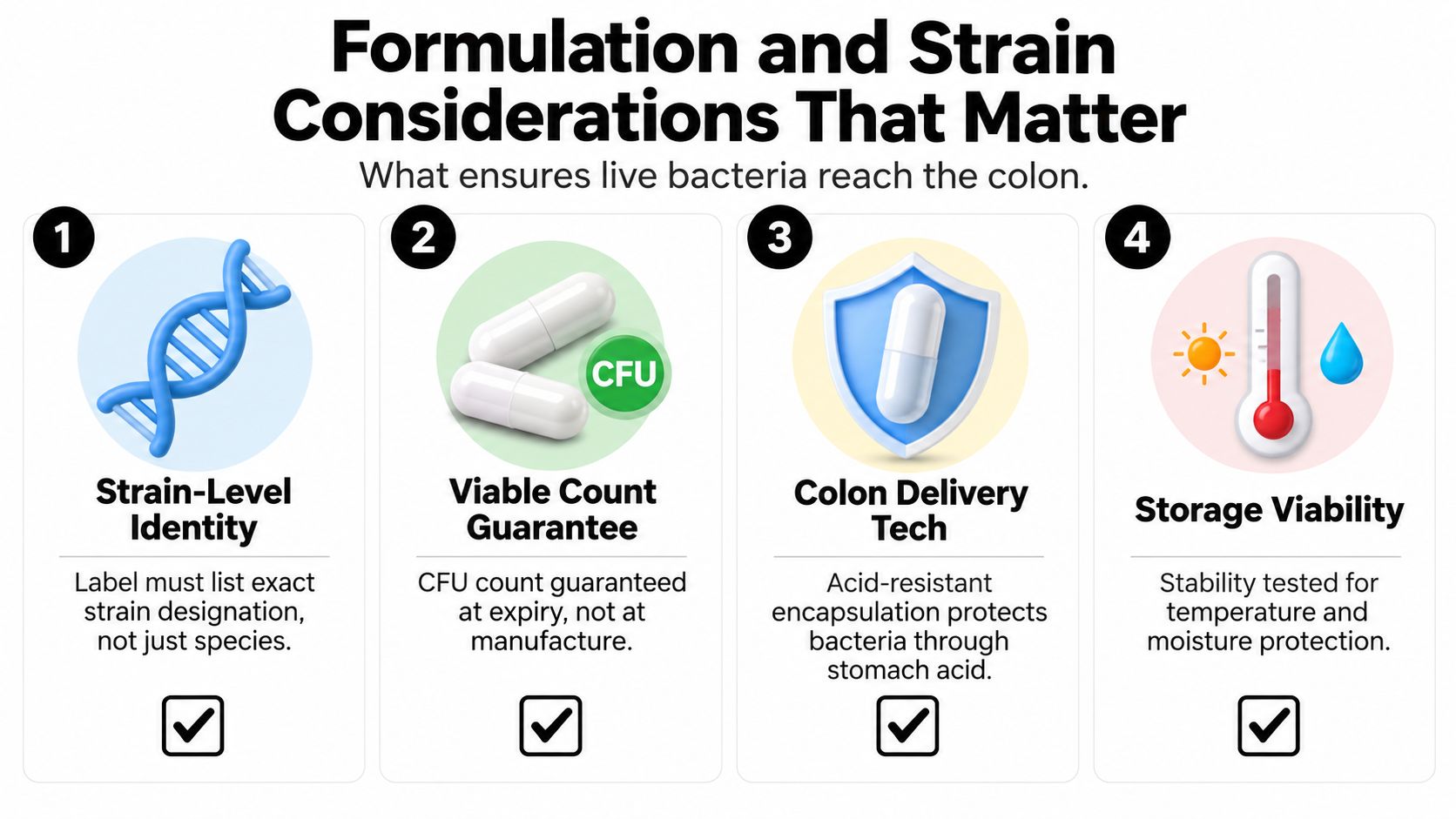
The most useful label question is not “How many probiotic strains are included?” It's “Can I identify the exact Christensenella strain, and can the manufacturer show that it remains viable?” Probiotic effects are strain-specific, so a label that names only the genus gives you limited information.
A product might identify Christensenella minuta with a strain designation such as DSM33407 or another manufacturer-assigned code. Don't assume two products are equivalent just because both use the same species name. The verified preclinical study used DSM33407, and that result shouldn't automatically be transferred to every strain or formulation.
Potency means viable cells at the end of shelf life
CFU means colony-forming units, a laboratory estimate of viable organisms. For an oxygen-sensitive bacterium, the number printed on the label is meaningful only if the manufacturer explains whether it is guaranteed at manufacture or at expiration. A manufacturing-time count can overstate what remains after shipping and storage.
Ask whether the company provides:
- Strain-level identification, not a proprietary blend that conceals the organism.
- Potency verification at expiration, when possible.
- Oxygen-control details, such as anaerobic processing, protective packaging, or validated stability testing.
- A certificate of analysis, with enough information to connect the tested batch to the bottle you receive.
Delivery and storage are part of the formula
Acid-resistant HPMC or delayed-release capsules may help protect live organisms during passage through the stomach. Enteric coating is another delivery approach, while a standard vegetable capsule may offer less specialized protection. The right choice depends on validated performance, not on the marketing label alone.
Storage instructions also deserve attention. Refrigeration, moisture control, oxygen barriers, and cold-chain shipping may matter for a strict anaerobe. Avoid assuming that “shelf-stable” means stable under every household condition. For context on potency claims and high-count formulations, consult high-CFU probiotics, while still checking whether the article or product documentation addresses Christensenella specifically.
How Christensenella Products Compare With Standard Probiotics
A Christensenella-focused supplement and a conventional multi-strain probiotic solve different formulation problems. The first targets a specialized human-gut organism with strict oxygen requirements. The second usually combines established Lactobacillus and Bifidobacterium strains that have longer histories in commercial use and clinical research.
That doesn't make one category universally superior. A person looking for general digestive support may value a familiar multi-strain blend, while someone interested in next-generation microbiome research may accept a narrower evidence base in exchange for a more targeted formulation.
| Attribute | Christensenella supplement | Standard multi-strain probiotic |
|---|---|---|
| Main biological focus | A specialized human-gut anaerobe | Multiple established probiotic species |
| Evidence profile | Early, strain-specific, and heavily preclinical | Broader history across many strains, with results varying by strain |
| Manufacturing demand | High sensitivity to oxygen and viability loss | Often less technically demanding, depending on strains |
| Label priority | Exact strain, anaerobic handling, expiry potency | Exact strains, dose, delivery system, and expiry potency |
| Typical research emphasis | Microbial ecology, metabolism, and epithelial integrity | Digestive balance and symptom-specific support |
| Buyer profile | Research-informed consumer seeking a next-generation option | Consumer seeking an established broad-spectrum approach |
The practical choice may be additive rather than oppositional. A Christensenella product could be considered alongside a broader foundation, but taking multiple supplements increases the need to check overlapping ingredients, storage requirements, and tolerability.
Choose the evidence and formulation that match your goal, not the newest organism name on the label.
Safety, Regulation, and Third-Party Testing
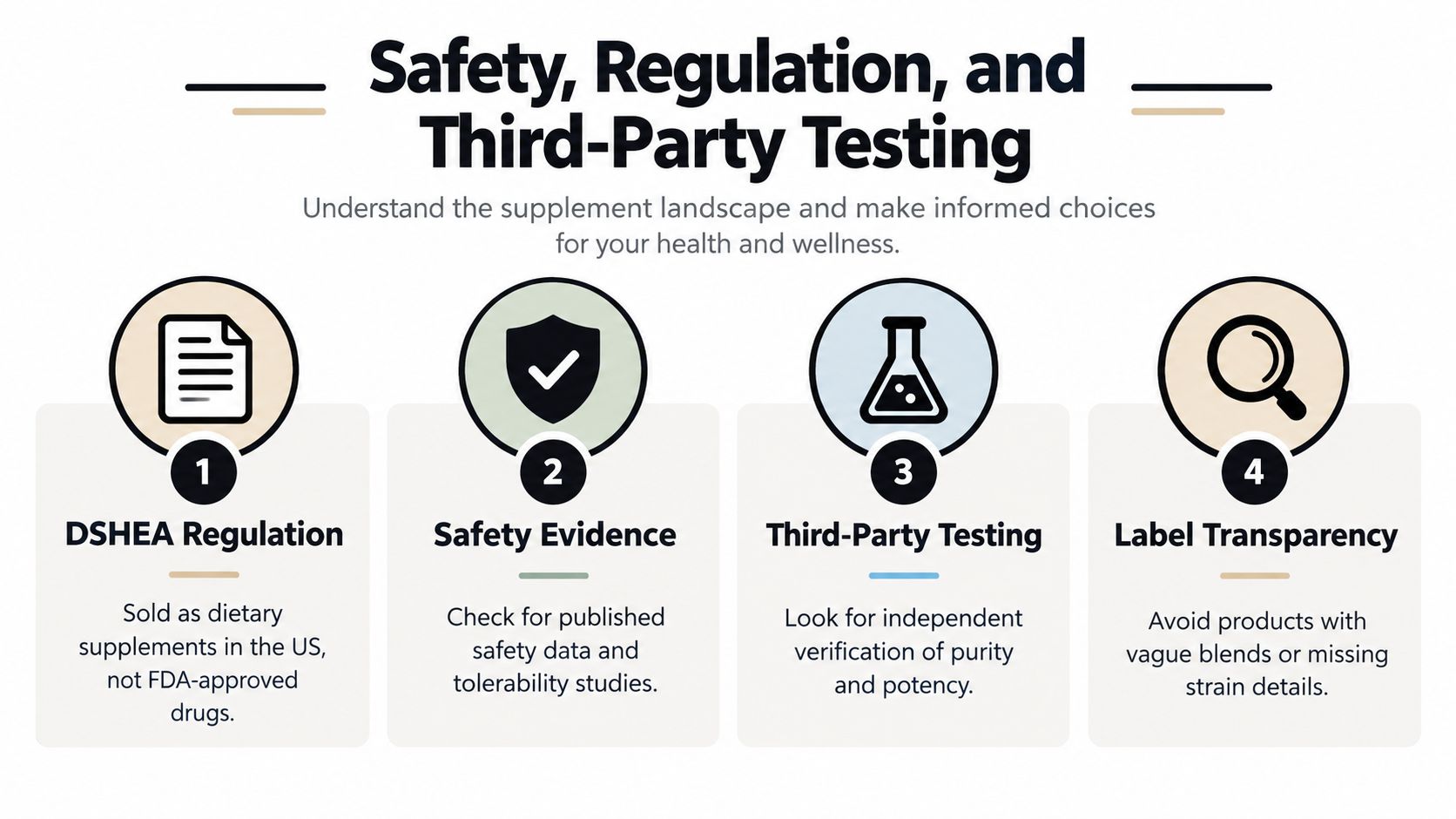
A Christensenella supplement is a dietary supplement, not an FDA-approved drug. In the United States, supplements are marketed under the Dietary Supplement Health and Education Act framework, commonly called DSHEA, so manufacturers don't have to establish drug-style efficacy before marketing a product. No FDA-approved indication exists for Christensenella.
Safety evidence also deserves a measured reading. Formal GRAS status for Christensenella minuta hasn't been established in the information provided here, and independent reviews identify sparse long-term safety data as a commercial translation gap (review of safety and development limitations). Early tolerance findings can't answer every question about long-term use, combination products, or higher-risk medical conditions.
What independent verification should cover
A third-party-tested probiotic should offer evidence that is specific to the batch, not merely a general statement on the product page. Useful documentation may include:
- Identity testing, using methods such as 16S sequencing or whole-genome sequencing where appropriate.
- Viable CFU testing, connected to the labeled strain and batch.
- Contaminant screening, including heavy metals and pathogens.
- Certificate of analysis access, preferably through a downloadable document with clear batch information.
- Manufacturing transparency, including storage and stability conditions.
Certifications from organizations such as USP, NSF, Informed Choice, or ConsumerLab may add useful quality signals, but certification names shouldn't replace reading the actual product documentation. A vague “proprietary blend” makes it harder to assess identity and dose. For a practical quality framework, see third-party-tested probiotics.
People who are immunocompromised, have short-bowel syndrome, or use a central line should discuss probiotic use with a clinician before starting. The same caution applies to anyone with serious gastrointestinal disease or complex medical treatment. Stop and seek medical guidance if a supplement causes concerning or persistent symptoms.
Who Should Consider a Christensenella Probiotic Supplement
A Christensenella probiotic supplement may appeal to an adult who wants a research-informed, next-generation approach to gut health and understands that the human evidence remains limited. It may be especially relevant for someone comparing microbiome products for digestive balance, gut-barrier support, or metabolic wellness rather than searching for a guaranteed treatment.
The lean BMI association makes Christensenella scientifically interesting, but it shouldn't turn the supplement into a weight-loss promise. Likewise, animal findings involving glucose regulation and epithelial integrity can guide research questions without proving that the same outcome will occur in every person.
Use this buyer checklist
Before adding a product to your cart, verify the following:
- Define the reason for buying. Are you seeking broad daily probiotic support, help with digestive balance, or a next-generation formulation? A precise goal makes it easier to judge whether the product fits.
- Read the organism name carefully. Look for Christensenella minuta plus a specific strain designation.
- Check the potency statement. Prefer a count guaranteed through expiration rather than only at manufacture.
- Look for oxygen-control evidence. Anaerobic processing, protective packaging, and stability information are meaningful signals.
- Find the COA. Confirm that identity, viable potency, and contaminant testing are documented for the relevant batch.
- Follow storage instructions. A product that requires refrigeration or protection from heat and moisture needs realistic handling at home.
Pregnant or nursing individuals, people taking immunosuppressants, and anyone with active SIBO or serious gastrointestinal disease should consult a clinician before use. People with complex health conditions shouldn't use a microbiome supplement to replace diagnosis or prescribed treatment.
A sensible trial means tracking your actual reason for purchase, such as bloating patterns, stool regularity, or tolerance, rather than assuming a microbiome change will produce a visible result. If symptoms persist, worsen, or include warning signs, speak with a qualified healthcare professional instead of escalating the dose on your own.
GutRx offers digestive-support formulas built around probiotics, prebiotics, next-generation strains, and targeted enzymes, with product information that includes third-party testing and downloadable Certificates of Analysis. Visit GutRx to compare the available options and choose a formula that matches your specific gut-health goal.


