

The strongest dietary approach combines varied prebiotic and polyphenol-rich foods with resistant starch and gradual fiber increases, rather than relying on one “Akkermansia food.” A 2019 review identified inulin, polydextrose, pomegranate extract, resveratrol, yeast fermentate, sodium butyrate, and caloric restriction as dietary factors associated with increased Akkermansia muciniphila, while a low-FODMAP diet was associated with a decrease (2019 dietary review).
Which foods support Akkermansia? The practical answer is more nuanced than a list of miracle ingredients. Akkermansia muciniphila is a gut bacterium, not a normal ingredient in yogurt, kefir, or other conventional fermented foods (independent microbiome guidance). It lives near the intestinal mucus layer and uses mucin-related carbohydrates, while dietary fibers and polyphenols help shape the surrounding ecosystem (review of Akkermansia biology).
That makes serving size, preparation, tolerance, and consistency important. A food may provide a relevant substrate without producing the same response in every person. The seven choices below are organized by function: feeding the bacterium, supplying fermentable substrates, supporting its mucus-layer habitat, and combining foods in ways that are practical for adults managing bloating, irregularity, or sensitive digestion.
Table of Contents
- 1. Cranberry and Polyphenol-Rich Berries
- 2. Inulin and Chicory Root Fiber
- 3. Cranberry Polyphenols and Proanthocyanidins
- 4. Resistant Starch
- 5. Plant-Based Tannins and Flavonoids
- 6. Dietary Fiber from Legumes and Whole Grains
- 7. Mucin-Supporting Nutrients
- 7-Item Comparison: Akkermansia-Boosting Foods
- Build an Akkermansia-Friendly Eating Pattern
1. Cranberry and Polyphenol-Rich Berries
Could berries support Akkermansia muciniphila without acting as a probiotic themselves? Cranberries, blueberries, and blackberries offer polyphenols with fermentable plant material, making them useful foods for the ecological side of Akkermansia support. Pomegranate, dark grapes, green tea, cocoa, and high-inulin foods are also discussed in food-based Akkermansia guidance. These categories may support a favorable microbial environment, but food-level evidence does not show that one berry reliably raises Akkermansia in every person.
Polyphenols can reach the colon in forms that gut microbes transform into metabolites. Those compounds may affect the mucus-associated habitat where A. muciniphila lives. The cautious interpretation is that berries supply relevant compounds and substrates, rather than delivering the bacterium directly.
Use berries repeatedly as part of a varied eating pattern, not as a short test of whether one ingredient changes the microbiome.
Fresh or frozen blueberries and blackberries pair with oats, chia, or plain yogurt when tolerated. Unsweetened cranberry foods provide another option, while juice and dried cranberries can deliver more concentrated sugars. Check the label and portion. Combining berries with oats or an inulin-containing vegetable supplies a broader mixture of substrates than relying on polyphenols alone.
A women's probiotic with cranberry is generally presented around combined digestive, urinary, and vaginal wellness, so that positioning should not be treated as evidence of an Akkermansia effect. GutRx Balance is positioned as a synbiotic product listed at $14.99 and in stock. Whether it raises Akkermansia in a particular person is not established by the food evidence discussed here.
People with IBS-like symptoms may need smaller portions. Large servings of fruit, concentrated juice, or added fiber can worsen bloating in a sensitive gut. Start with an amount that feels manageable, repeat it consistently, and judge the pattern by digestive comfort rather than pursuing an aggressive intake.
2. Inulin and Chicory Root Fiber
Inulin is a named prebiotic substrate associated with Akkermansia research. A review of dietary modulation reported that inulin-type fructans, fructo-oligosaccharides, polydextrose, soluble corn fiber, and raffinose may increase A. muciniphila and/or F. prausnitzii (dietary modulation review). A separate systematic review found that prebiotics such as FOS consistently promoted Akkermansia abundance in animal studies. These findings support fermentable substrates as one dietary route, but they do not show that a particular food will produce the same response in every person.
Chicory root is a common inulin source. Onions, garlic, leeks, and artichokes also provide related fermentable carbohydrates that microbes can use. Their limitation is practical: rapid increases may cause gas and abdominal discomfort, especially in people with IBS symptoms or known FODMAP sensitivity.
Introduce it slowly
Start with a small portion of a whole food rather than a large serving of chicory fiber or an inulin supplement. Increase gradually only if symptoms remain manageable. Keep water intake adequate and avoid changing several fiber sources at once, which makes it harder to identify the cause of bloating or discomfort.
The prebiotic fiber supplement guide explains the distinction between prebiotics and probiotics. A prebiotic supplies a substrate that resident microbes can ferment, while a probiotic delivers selected microorganisms. They may be used together, but they serve different roles.
A practical combination is oats with berries, or a modest amount of cooked onion alongside protein and vegetables you already tolerate. Garlic, leeks, and chicory can add fermentable material, yet the appropriate amount remains personal. A low-FODMAP pattern may be necessary for symptom control even though dietary research has associated it with lower Akkermansia abundance. Microbiome optimization shouldn't override tolerability.
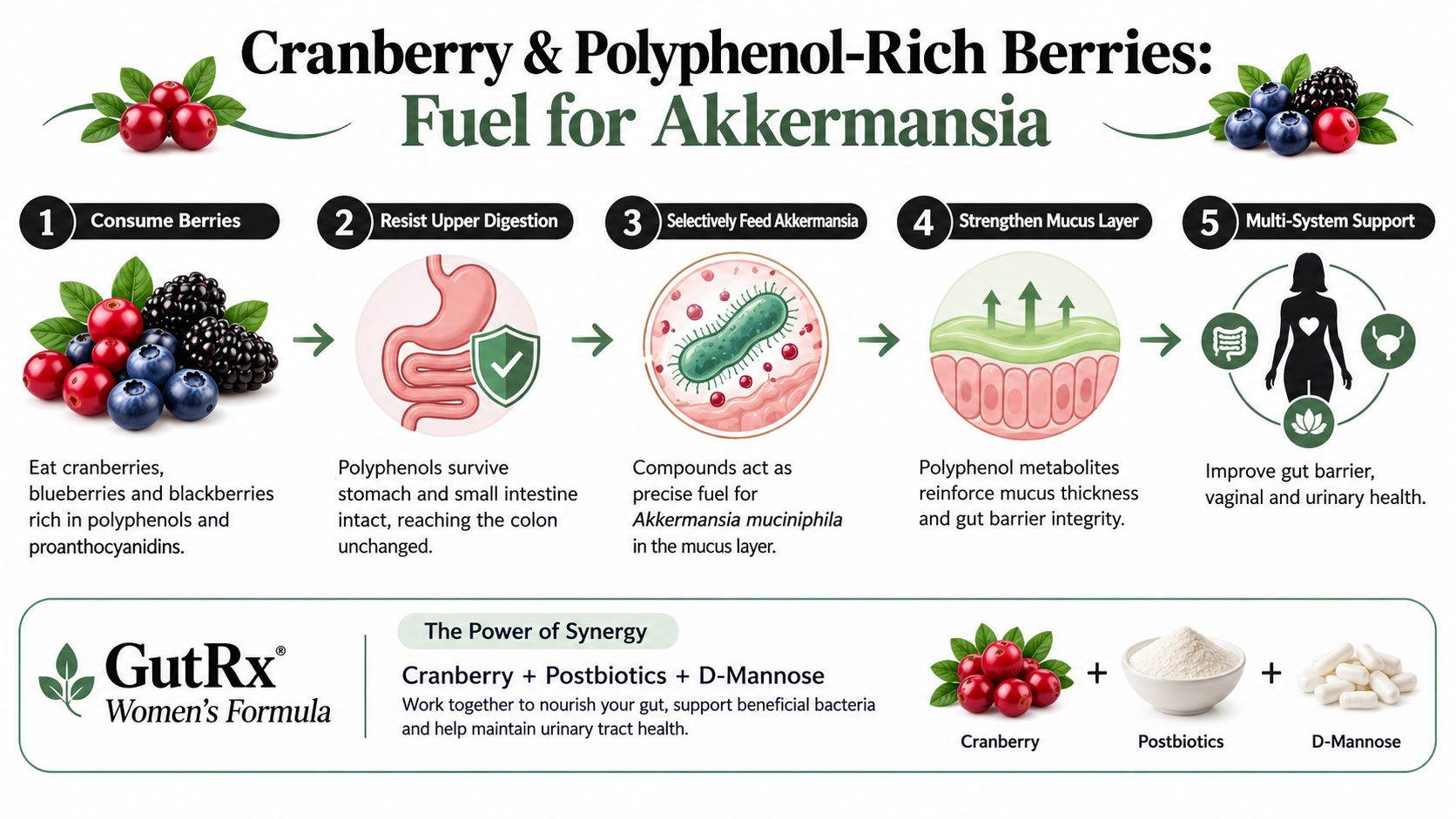
3. Cranberry Polyphenols and Proanthocyanidins
Cranberry has a distinct role in an Akkermansia-friendly eating pattern. Whole berries provide varied polyphenols, while cranberry proanthocyanidins, especially A-type compounds, are a more specific extract category. The two forms should not be treated as interchangeable when comparing foods with supplements.
Polyphenols do not serve as a direct food source for Akkermansia. Gut microbes transform them into metabolites that can influence microbial interactions and the intestinal environment. Since A. muciniphila is associated with the mucus layer, researchers are examining whether polyphenol-rich foods affect the habitat and signaling surrounding the bacterium. Findings from mechanistic and intervention research are mixed, so claims about barrier repair or metabolic improvement still need cautious interpretation.
The practical choice is the least concentrated cranberry form you tolerate. Add fresh or frozen cranberries to meals, choose unsweetened cranberry products when available, or use a standardized extract only when a clinician has a clear reason to recommend it. Sweetened cranberry beverages are not equivalent to whole cranberries because their polyphenol and sugar profiles can differ.
Combine complementary inputs
Cranberry polyphenols are more useful as one part of a broader meal than as a standalone “Akkermansia booster.” Oats with berries combine fermentable carbohydrate and polyphenol-rich plant material. Legumes, vegetables, and a small cranberry-based component provide a wider range of substrates and plant compounds without treating any single ingredient as decisive.
The distinction between food-based support and direct bacterial delivery also matters. Conventional foods do not contain A. muciniphila itself. Pasteurized A. muciniphila is instead being evaluated as a novel food ingredient in regulated markets. In its 2021 novel-food opinion, the European Food Safety Authority concluded that pasteurized A. muciniphila was safe for the target population at an intake of 3.4 × 10^10 cells per day, based on a 90-day rat toxicity study and an uncertainty factor of 200 (regulatory and safety background). That finding concerns a defined, pasteurized ingredient under specified conditions, not cranberry or a general dietary pattern.
The regulatory conclusion does not establish that cranberry extract, a probiotic, or a particular meal pattern will improve symptoms. It does, however, give shoppers a reason to distinguish food-based microbiome support, prebiotic formulas, and direct next-generation probiotic products when evaluating labels and claims.
4. Resistant Starch
Resistant starch reaches the colon because it escapes digestion in the small intestine. Cooled cooked potatoes and rice, along with green banana flour, can supply this fermentable substrate. Colonic microbes process it into metabolites that may influence the surrounding gut environment, but the response is shaped by the wider diet and the person's existing microbiome.
Preparation changes the amount available for fermentation. Cooking and then cooling potatoes or rice promotes starch retrogradation, which increases the resistant fraction. Type 2 resistant starch occurs naturally in foods such as raw or green banana and potato starch, while Type 3 resistant starch forms after cooked starch cools. This distinction explains why the same food can provide different amounts depending on processing.
Use cooled potatoes in a salad or cooled rice with vegetables and a protein source. Oats add another fermentable carbohydrate, while green banana flour can be mixed into food in a small amount if tolerated. These options support a fermentable-substrate strategy, rather than acting as interchangeable Akkermansia treatments.
Resistant starch is a preparation strategy, not a special food category that works independently of the rest of the diet.
Tolerance determines the practical dose. A rapid increase may cause bloating, gas, stool urgency, or abdominal discomfort, particularly when resistant starch comes from concentrated powders. Start with a modest portion, change one variable at a time, and include it with a normal meal and adequate fluids.
Evidence supports resistant starch as one way to broaden fermentable inputs, but it does not justify precise promises about Akkermansia growth, glucose control, satiety, or barrier outcomes from a particular serving. Human responses vary with bowel habits, the rest of the eating pattern, and microbial composition. Persistent constipation or diarrhea warrants medical assessment rather than continued food experimentation.
The preparation sequence is straightforward: cook the potato or rice thoroughly, cool it, refrigerate it, and use it later in a meal. Store cooked foods appropriately and avoid leaving them at room temperature for extended periods.
5. Plant-Based Tannins and Flavonoids
Could a daily tea, coffee, or cocoa habit support polyphenol exposure without adding a large serving of food? Green tea, black tea, coffee, and unsweetened cocoa provide tannins and flavonoids that fit into established routines. Consistency may be easier when the source is a familiar beverage or ingredient rather than an occasional specialty food.
Green tea catechins, coffee compounds, and cocoa flavonoids can reach the colon or be transformed into metabolites that interact with gut microbes. Polyphenol-rich foods are therefore relevant to Akkermansia research because they may influence microbial metabolism and the mucus-associated environment, as described in this mechanistic review. The mechanism is plausible, but it does not show that increasing coffee intake will produce a predictable bacterial response.
Use unsweetened tea or cocoa when practical. Coffee suits some adults, yet it can worsen reflux, anxiety, sleep disruption, or bowel urgency. Decaffeinated tea or coffee may be easier to tolerate for people sensitive to caffeine, although the product and individual response still matter.
Combine polyphenols with fermentable inputs
A polyphenol source works best within a broader food pattern. Stir unsweetened cocoa into oats, add berries to a meal, or serve tea with a fiber-containing breakfast. Pairing tannins or flavonoids with inulin, FOS, resistant starch, legumes, or whole grains supplies different microbial inputs. These foods are complementary, not interchangeable Akkermansia treatments.
Tannins may reduce iron absorption by binding iron in the digestive tract. Anyone taking iron supplements or managing iron deficiency should ask a clinician or pharmacist about timing instead of assuming tea is harmless near every dose. Biological interest does not remove practical dietary limits.
Coffee also requires context. Plain coffee, a sweetened coffee beverage, and unsweetened cocoa added to a high-sugar dessert create different dietary patterns. Choose the preparation that fits digestive tolerance, sleep, medication timing, and the rest of the meal. Persistent symptoms should guide adjustment or medical advice, not justify escalating a beverage for a presumed microbiome effect.
6. Dietary Fiber from Legumes and Whole Grains
Legumes and whole grains provide a long-term foundation that isolated extracts may lack. Lentils, chickpeas, black beans, oats, barley, and whole wheat supply soluble and insoluble fiber, fermentable carbohydrates, and plant compounds. Together, these inputs support a broader fermentation environment rather than targeting Akkermansia through one isolated ingredient.
Legumes contribute raffinose-family carbohydrates and polyphenols. Whole grains help make fiber intake more regular, while their structure can slow digestion and deliver substrates to the colon. The relevance of fermentable fibers such as inulin-type fructans and FOS has been discussed earlier, but beans and grains are not interchangeable with onions, garlic, leeks, or artichokes.
Use combinations that fit tolerance: lentils with barley, chickpeas alongside oats during the day, or beans with a tolerated whole grain and cooked vegetables. Soaking and thorough cooking may reduce discomfort for some people, although they do not remove every fermentable carbohydrate. If beans repeatedly cause gas, urgency, or pain, reduce the portion, try another preparation, or seek individualized guidance instead of abandoning plant fiber.
Build the base before adding concentrates
Change one variable at a time. Add a legume meal, repeat it for several days, and track stool consistency, gas, urgency, and pain. Adjust portion size or frequency before adding another concentrated fiber product. Adequate fluid can also help, since a rapid increase in fiber may worsen constipation for some people.
A clinical study in overweight and obese adults associated Akkermansia with healthier metabolic status and better outcomes after caloric restriction (clinical study in Gut). The finding supports interest in the relationship between Akkermansia, diet, and metabolic health. It does not show that a particular bean or grain treats a metabolic condition.
“More fiber” is incomplete advice. Active digestive symptoms may call for a slower increase, a lower-FODMAP adjustment, or assessment of another cause. The practical goal is a sustainable mix of tolerated legumes, whole grains, vegetables, and other fermentable foods, not the highest possible fiber load.
7. Mucin-Supporting Nutrients
Could nutrients that support the mucus layer help Akkermansia muciniphila indirectly? L-glutamine, zinc, and vitamin A are relevant to intestinal lining maintenance, but they are not direct Akkermansia foods. Because A. muciniphila lives in a mucin-rich environment, adequate nutrition may help maintain the cells and tissues that create that habitat. It does not establish that supplementation will increase the bacterium.
Food sources vary by nutrient. Meat, eggs, dairy if tolerated, and fish can provide relevant nutrients, while leafy greens, carrots, and sweet potatoes contribute vitamin A precursors. A varied diet is a safer starting point than high-dose supplementation. Current evidence does not establish a universal dose of L-glutamine, zinc, or vitamin A for raising Akkermansia, nor does it support promising predictable mucus-layer restoration.
Treat deficiency as a medical question
Zinc and vitamin A can cause harm in excessive amounts, particularly when other nutrients, medicines, or health conditions are not considered. Suspected deficiency should be assessed with a qualified professional, who can determine whether testing and treatment are appropriate. Vitamin A supplements require added caution during pregnancy because excess preformed vitamin A can create risks.
L-glutamine supplements also may not suit people with significant illness or complex medical conditions. Persistent diarrhea, bleeding, unexplained weight change, anemia, fever, or severe pain requires medical assessment. “Gut lining support” should not replace that evaluation.
For a closer explanation of the intestinal barrier, see this guide to intestinal lining repair. The practical distinction is clear: mucin-supporting nutrients help maintain the habitat, while prebiotic fibers and polyphenols affect the microbial inputs within it. These roles complement each other, but neither guarantees an Akkermansia increase.
A practical combination could include a protein-containing meal, cooked vegetables, whole grains, and a tolerated polyphenol source. If a clinician identifies a deficiency, correct it under guidance. Avoid stacking multiple high-dose products because each ingredient appears in microbiome marketing.
7-Item Comparison: Akkermansia-Boosting Foods
| Item | Complexity 🔄 (implementation) | Resources ⚡ (requirements / efficiency) | Expected outcomes 📊 (timeline & impact) | Ideal use cases ⭐ (when to use) | Key advantages & tips 💡 |
|---|---|---|---|---|---|
| Cranberry and Polyphenol-Rich Berries | Low, whole-food approach; consistent intake required 🔄 | Moderate, fresh/frozen or standardized extracts; sugar management needed ⚡ | Moderate Akkermansia rise in 4–8 weeks; improved mucus integrity and urinary/vaginal markers 📊 | Women seeking combined gut + vaginal/urinary support or adjunct to postbiotics ⭐ | Synergizes with prebiotics/postbiotics; prefer unsweetened forms; pair with prebiotic foods to amplify effect 💡 |
| Inulin and Chicory Root Fiber (long‑chain) | Moderate, requires dose escalation to therapeutic range (10–15g) 🔄 | Efficient as a supplement; food sources exist but therapeutic dosing often needs powder ⚡ | Strong Akkermansia increase (30–60%) in 3–6 weeks; boosts butyrate and barrier function 📊 | Targeted Akkermansia expansion and barrier/metabolic support; clinical-style interventions ⭐ | Start low and increase slowly; take with water/meals to limit bloating; evidence-backed for specificity 💡 |
| Cranberry PACs (A‑type proanthocyanidins) | Moderate, best as standardized extract; depends on baseline Akkermansia presence 🔄 | Resource-intense if standardized extracts are used; testing baseline helpful ⚡ | Improved intestinal permeability and barrier markers in 6–12 weeks; potent metabolite-driven effects 📊 | Barrier repair and urinary/vaginal health when combined with Akkermansia probiotic or prebiotics ⭐ | Use labeled PAC extracts or unsweetened cranberry; combine with prebiotics/probiotics for maximal effect; monitor response 💡 |
| Resistant Starch (Type 2 & 3) | Low–moderate, requires specific preparation (cooling) and gradual dosing 🔄 | Highly accessible and cost‑effective from foods; intentional intake needed for therapeutic dose ⚡ | Increases butyrate and Akkermansia (≈20–35%) over 6–8 weeks; improves glycemic control and satiety 📊 | Long‑term maintenance, metabolic health, and appetite control; diet‑first strategy ⭐ | Develop Type‑3 starch by cooling cooked starches; ramp dose to 15–20g/day to avoid bloating; pair with protein/fat 💡 |
| Plant‑Based Tannins & Flavonoids (tea, coffee, cocoa) | Low, simple habitual beverages; caffeine considerations 🔄 | Widely available and efficient; decaf preserves polyphenols if needed ⚡ | Moderate Akkermansia elevation (~15–25%) over 8–12 weeks; reduced pro‑inflammatory bacteria and systemic inflammation 📊 | Broad polyphenol strategy for barrier support and systemic metabolic/inflammatory benefits ⭐ | Choose high‑quality/unsweetened sources; avoid near‑iron supplementation; pair with prebiotics for synergy 💡 |
| Dietary Fiber from Legumes & Whole Grains | Moderate, requires dietary pattern change and gradual fiber escalation 🔄 | Affordable, culturally adaptable; requires cooking/meal planning but low per‑serving cost ⚡ | Stable Akkermansia increases over 8–12 weeks; improved regularity, SCFA production, metabolic markers 📊 | Foundational long‑term microbiota support and sustained Akkermansia maintenance ⭐ | Increase fiber gradually to 25–35g/day; soak/cook legumes; stay hydrated; combine with supplements if intake is low 💡 |
| Mucin‑Supporting Nutrients (L‑glutamine, zinc, vitamin A) | Moderate–high, needs assessment, monitored dosing to avoid toxicity 🔄 | Requires testing and targeted supplementation or nutrient‑dense foods; monitoring recommended ⚡ | Enhanced mucin synthesis and mucus thickness in 6–12 weeks; enables sustained Akkermansia colonization and barrier repair 📊 | Individuals with barrier dysfunction, nutrient deficiencies, or those needing foundational “infrastructure” repair ⭐ | Test levels before supplementing; combine with prebiotics/probiotics for three‑part synergy; reassess after 8–12 weeks 💡 |
Build an Akkermansia-Friendly Eating Pattern
The most practical plan starts with foods you can tolerate repeatedly. Choose berries, legumes, whole grains, tea, coffee, or cocoa in ordinary meals. Add resistant starch through cooled potatoes or rice if that preparation works for you. Only then consider introducing inulin-rich foods or a concentrated prebiotic, and increase slowly enough to distinguish useful fermentation from symptom aggravation.
This sequence follows the biology without pretending that biology is a guarantee. Polyphenols help shape the microbial environment, fermentable carbohydrates provide substrates, resistant starch adds another type of colonic input, and mucin-supporting nutrition helps maintain the habitat where A. muciniphila lives. These functions overlap, but the foods aren't interchangeable. A cup of tea doesn't replace a fiber-rich meal, and a prebiotic powder doesn't replace dietary variety.
Human evidence remains mixed in its strength and design. The 2019 review drew on controlled animal and human intervention studies and identified several dietary factors associated with changes in Akkermansia abundance, but responses can vary substantially by individual microbiome context (dietary evidence review). The commercial interest is growing too. The Akkermansia muciniphila sector was valued at USD 51.23 million in 2024, reached USD 55.44 million in 2025, and is projected to reach USD 98.70 million by 2032, with a projected 8.54% CAGR (market forecast). Market growth reflects interest, not proof that a product will work for a particular person.
If you're considering a supplement, compare whether it delivers a direct microorganism, a prebiotic substrate, or both. GutRx Complete is described as a high-potency probiotic and prebiotic blend with 62B CFUs, Akkermansia muciniphila, and SIBO support. It may be relevant context for someone comparing food-only strategies with a combined formulation, but it isn't a replacement for dietary variety, individualized care, or evaluation of significant symptoms.
People with digestive conditions, nutrient deficiencies, medication interactions, pregnancy, or persistent symptoms should seek professional guidance before using concentrated extracts or high-dose supplements. If a low-FODMAP diet is necessary for symptom control, don't abandon it solely to pursue a microbiome target. Work with a dietitian or clinician to find the broadest pattern you can tolerate.
Start with one change this week, keep the portion moderate, and track comfort rather than assuming that a higher intake is better. That approach gives you a realistic way to build an Akkermansia-supportive pattern while respecting the fact that gut ecosystems respond differently from person to person.
GutRx offers next-generation probiotic and prebiotic options that can complement a food-based Akkermansia strategy, including formulations designed around digestive balance and broader microbiome support. Visit GutRx to compare the available approaches and choose a product that fits your symptoms, dietary pattern, and professional guidance.


